charging NISSAN LEAF 2020 Owner´s Manual
[x] Cancel search | Manufacturer: NISSAN, Model Year: 2020, Model line: LEAF, Model: NISSAN LEAF 2020Pages: 596, PDF Size: 4.33 MB
Page 492 of 596
CAUTION
To prevent damage to the Li-ion bat-
tery: Do not store the vehicle in tem-
peratures below -13°F (-25°C) for over
seven days. If the outside temperature
is -13°F (-25°C) or less, the Li-ion battery
may freeze and it cannot be charged or
provide power to run the vehicle. Move
the vehicle to a warm location.
NOTE:
• Connect the charger to the vehicle and place the power switch in the OFF po-
sition when parking the vehicle if tem-
peratures may go below -4°F (-20°C).
For models with 40 kWh battery
model, this provides external power to
the Li-ion battery warmer (if so
equipped) when it operates and does
not discharge the Li-ion battery. Ve-
hicle driving range is reduced if the Li-
ion battery warmer (if so equipped) op-
erates (Li-ion battery temperature
approximately -4°F (-20°C) or colder)
while driving the vehicle. You may need
to charge the Li-ion battery sooner
than in warmer temperatures.
• The Li-ion battery requires more time to charge when the Li-ion battery
warmer (if so equipped) operates. • The predicted charging time displayed
on the meter and navigation system (if
so equipped) increases when the Li-ion
battery warmer (if so equipped) oper-
ates.
• Vehicle range may be substantially re- duced in extremely cold conditions (for
example under -4°F (-20°C)).
• Using the climate control system to heat the cabin when outside tempera-
ture is below 32°F (0°C) uses more elec-
tricity and affects vehicle range more
than when using the heater when the
temperature is above 32°F (0°C).
• Climate control performance is re- duced when using the Climate Ctrl.
Timer or Remote Climate Control while
the Li-ion battery warmer (if so
equipped) operates (for models with
40 kWh battery model). Set only the
charging timer [End Time] when charg-
ing in cold weather. The vehicle auto-
matically determines when to start
charging to fully charge the Li-ion bat-
tery, even if the Li-ion battery warmer
operates. Charging ends before the set
end time if the Li-ion battery is fully
charged.
FREEING A FROZEN DOOR LOCK
To prevent a door lock from freezing, apply
deicer through the key hole. If the lock be-
comes frozen, heat the key before inserting
it into the key hole or use the remote key-
less entry key fob.
ANTIFREEZE
In the winter when it is possible that the
outside temperature will drop below 32°F
(0°C), check the antifreeze to ensure proper
winter protection. For additional informa-
tion, refer to “Cooling system” in the “Main-
tenance and do-it-yourself ” section of this
manual.
12-VOLT BATTERY
If the 12-volt battery is not fully charged
during extremely cold weather conditions,
the 12-volt battery fluid may freeze and
damage the 12-volt battery. To maintain
maximum efficiency, the 12-volt battery
should be checked regularly. For additional
information, refer to “12-volt battery” in the
“Maintenance and do-it-yourself ” section
of this manual.
COLD WEATHER DRIVING
Starting and driving5-169
Page 505 of 596
•NISSAN recommends using only
Genuine NISSAN Emergency Tire
Sealant provided with your vehicle.
Other tire sealants may damage the
valve stem seal which can cause the
tire to lose air pressure. To start your EV system with a booster bat-
tery, the instructions and precautions be-
low must be followed.
Jump starting provides power to the 12-
volt system to allow the electrical systems
to operate. The electrical systems must be
operating to allow the Li-ion battery to be
charged. Jump starting does not charge
the Li-ion battery. The Li-ion battery must
be charged before the vehicle can be
driven.
WARNING
• If done incorrectly, jump starting can
lead to a 12-volt battery explosion,
resulting in severe injury or death. It
could also damage your vehicle.
• Explosive hydrogen gas is always
present in the vicinity of the 12-volt
battery. Keep all sparks and flames
away from the 12-volt battery.
• Do not allow battery fluid to come
into contact with eyes, skin, clothing
or painted surfaces. Battery fluid is a
corrosive sulfuric acid solution that
can cause severe burns. If the fluid
comes into contact with anything,
immediately flush the contacted
area with water. •
Keep the 12-volt battery out of the
reach of children.
• The booster battery must be rated at
12 volt. Use of an improperly rated
battery can damage your vehicle.
• Whenever working on or near a 12-
volt battery, always wear suitable
eye protectors (for example, goggles
or industrial safety spectacles) and
remove rings, metal bands, or any
other jewelry. Do not lean over the
12-volt battery when jump starting.
• Do not attempt to jump start a frozen
battery. It could explode and cause
serious injury.
• Your vehicle has an automatic cool-
ing fan. It could come on at any time.
Keep hands and other objects away
from it.
• Always follow the instructions below.
Failure to do so could result in dam-
age to the DC/DC converter and
cause personal injury.
• Do not attempt to perform a jump
start on the 12-volt battery at the
same time that the Li-ion battery is
being charged. Doing so may dam-
age the vehicle or charging equip-
ment and could cause an injury.
JUMP STARTING
6-10In case of emergency
Page 507 of 596
CAUTION
• Always connect positive (+) to posi-
tive (+) and negative (−) to body
ground (for example, as illustrated),
not to the 12-volt battery.
• Make sure the jumper cables do not
touch moving parts in the motor
compartment and that the cable
clamps do not contact any other
metal.
8. Start the engine of the booster vehicle
OB.
9. While the booster vehicle
OBengine is
running, place the EV system in the
READY to drive position.
CAUTION
If the system does not start right away,
push the power switch to the OFF posi-
tion and wait 10 seconds before trying
again.
10. Af ter starting your EV system, carefully disconnect the negative cable and
then the positive cable (
O4→O3→O2
→O1) and keep in the READY to drive
position over 20 minutes to charge the
12-volt battery. 11. If necessary, connect the vehicle to a
charging station or EVSE (Electric Ve-
hicle Supply Equipment) to charge the
Li-ion battery. For additional informa-
tion, refer to the “Charging” section. The
vehicle cannot be driven until the Li-ion
battery is charged.
12. Af ter jump starting your vehicle it is rec- ommended you visit a NISSAN certified
LEAF dealer to have the 12V battery
tested.
NOTE:
If it is not possible to turn the system ON
by following this procedure, it is recom-
mended that you visit a NISSAN certified
LEAF dealer immediately. If the power limitation indicator light
illuminates, the traction motor output is
limited resulting in reduced vehicle speed.
Stop the vehicle in a safe location before
the Li-ion battery becomes completely dis-
charged and no power is available to drive
the vehicle. Contact Roadside assistance;
refer to a NISSAN Warranty Information
Booklet.
If possible, place the power switch in the
OFF position while waiting for assistance to
prevent discharging the 12-volt battery.
NOTE:
If the Li-ion battery becomes completely
discharged:
• The vehicle is automatically placed in
the ON position and it will not be pos-
sible to switch to the READY to drive
position.
• The vehicle is automatically switched to the N (Neutral) position and it will not
be possible to drive the vehicle.
IF THE LI-ION BATTERY BECOMES
COMPLETELY DISCHARGED
6-12In case of emergency
Page 525 of 596
–The Climate Ctrl. Timer is not ac-
tive or operating. For additional
information, refer to “Climate Ctrl.
Timer” in the “Monitor, climate, au-
dio, phone and voice recognition
systems” section of this manual.
– The 12-volt battery is not being
charged by the Li-ion battery and
that all charging status indicator
lights are off. For additional infor-
mation, refer to “Charging the 12-
volt battery ” in the “EV overview”
section and “Charging status indi-
cator lights” in the “Charging” sec-
tion of this manual.
• The power switch is in the OFF posi-
tion. Place the power switch in the ON
position and then in the OFF position
to prevent the 12-volt battery auto-
matically being charged by the Li-ion
battery. For additional information,
refer to “Charging the 12-volt bat-
tery ” in the “EV overview” section of
this manual.
The “Maintenance and do-it-yourself ” sec-
tion gives instructions regarding only
those items that are relatively easy for an
owner to perform. A Genuine NISSAN Service Manual is also
available. For additional information, refer
to “Owner’s manual/service manual order
information” in the “Technical and con-
sumer information” section of this manual.
You should be aware that incomplete or
improper servicing may result in operating
difficulties and could affect your warranty
coverage.
If in doubt about any servicing,
it is recommended that you visit a
NISSAN certified LEAF dealer.
8-6Maintenance and do-it yourself
Page 560 of 596
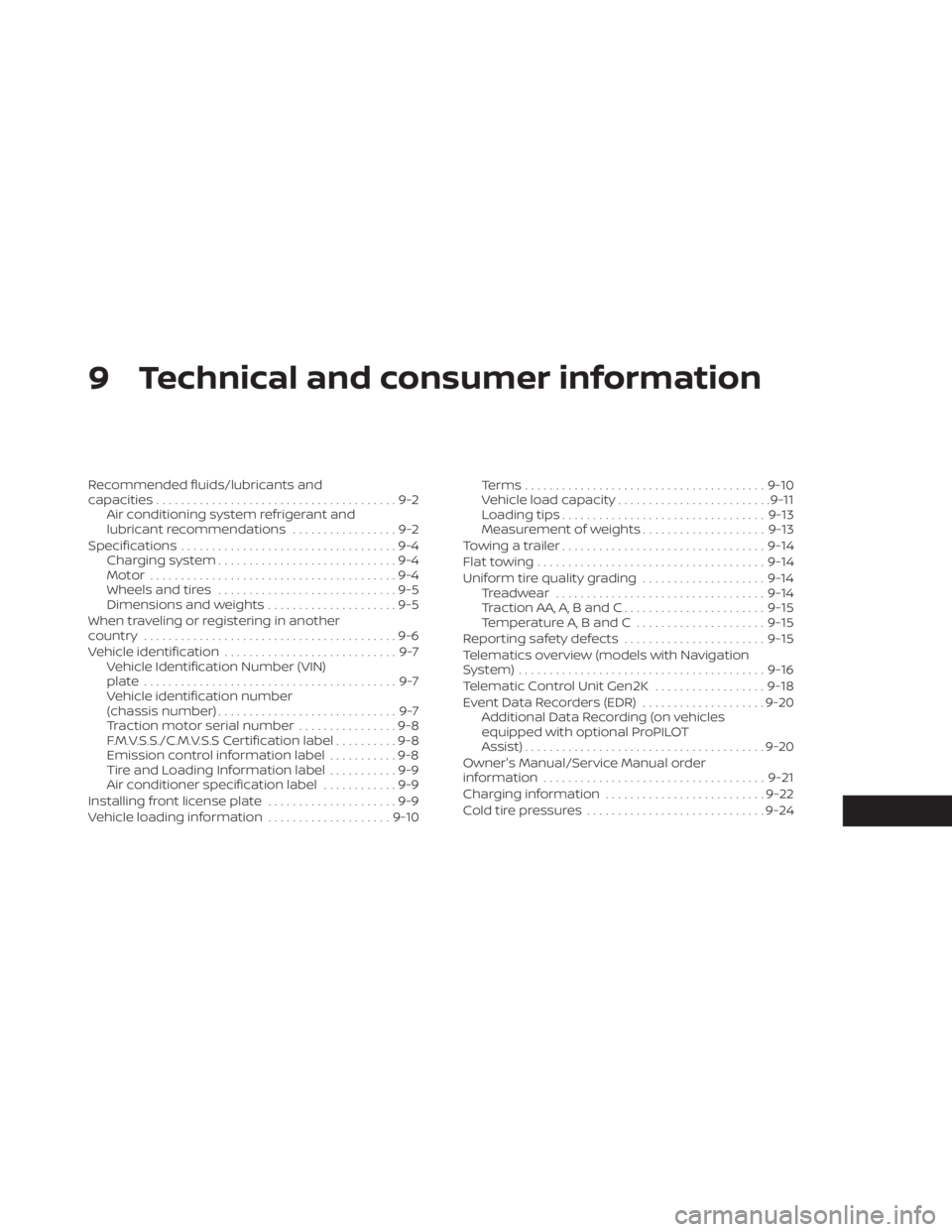
9 Technical and consumer information
Recommended fluids/lubricants and
capacities.......................................9-2
Air conditioning system refrigerant and
lubricant recommendations .................9-2
Specifications ...................................9-4
Charging system .............................9-4
Motor ........................................9-4
Wheels and tires .............................9-5
Dimensions and weights .....................9-5
When traveling or registering in another
country .........................................9-6
Vehicle identification ............................9-7
Vehicle Identification Number (VIN)
plate .........................................9-7
Vehicle identification number
(chassis number) .............................9-7
Traction motor serial number ................9-8
F.M.V.S.S./C.M.V.S.S Certification label ..........9-8
Emission control information label ...........9-8
Tire and Loading Information label ...........9-9
Air conditioner specification label ............9-9
Installing front license plate .....................9-9
Vehicle loading information ....................9-10Terms
....................................... 9-10
Vehicle load capacity ......................... 9-11
Loading tips ................................. 9-13
Measurement of weights ....................9-13
Towing a trailer ................................. 9-14
Flat towing ..................................... 9-14
Uniform tire quality grading ....................9-14
Treadwear .................................. 9-14
Traction AA, A, B and C ....................... 9-15
Temperature A, B and C .....................9-15
Reporting safety defects .......................9-15
Telematics overview (models with Navigation
System) ........................................ 9-16
Telematic Control Unit Gen2K ..................9-18
Event Data Recorders (EDR) ....................9-20
Additional Data Recording (on vehicles
equipped with optional ProPILOT
Assist) ....................................... 9-20
Owner's Manual/Service Manual order
information .................................... 9-21
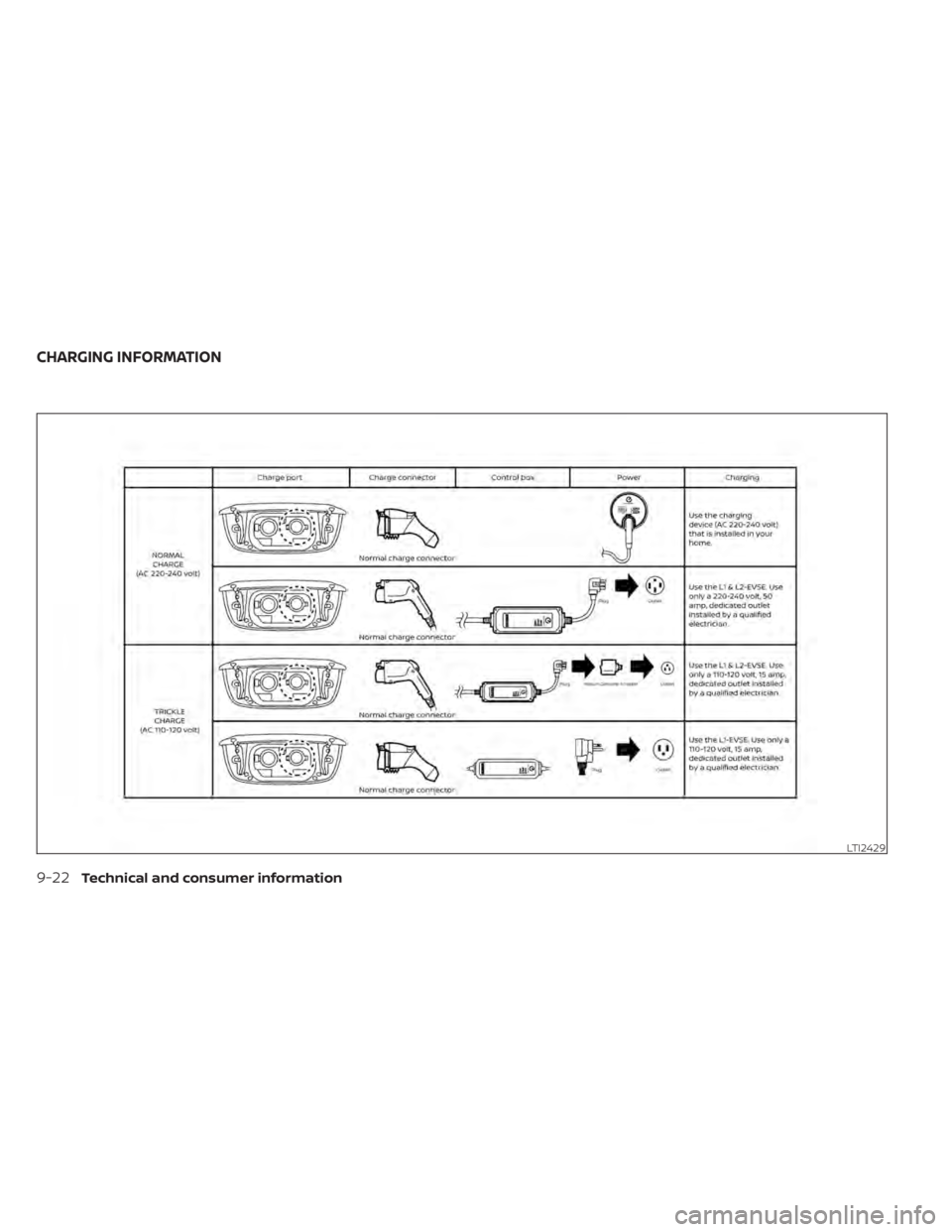
Charging information .......................... 9-22
Cold tire pressures ............................. 9-24
Page 563 of 596
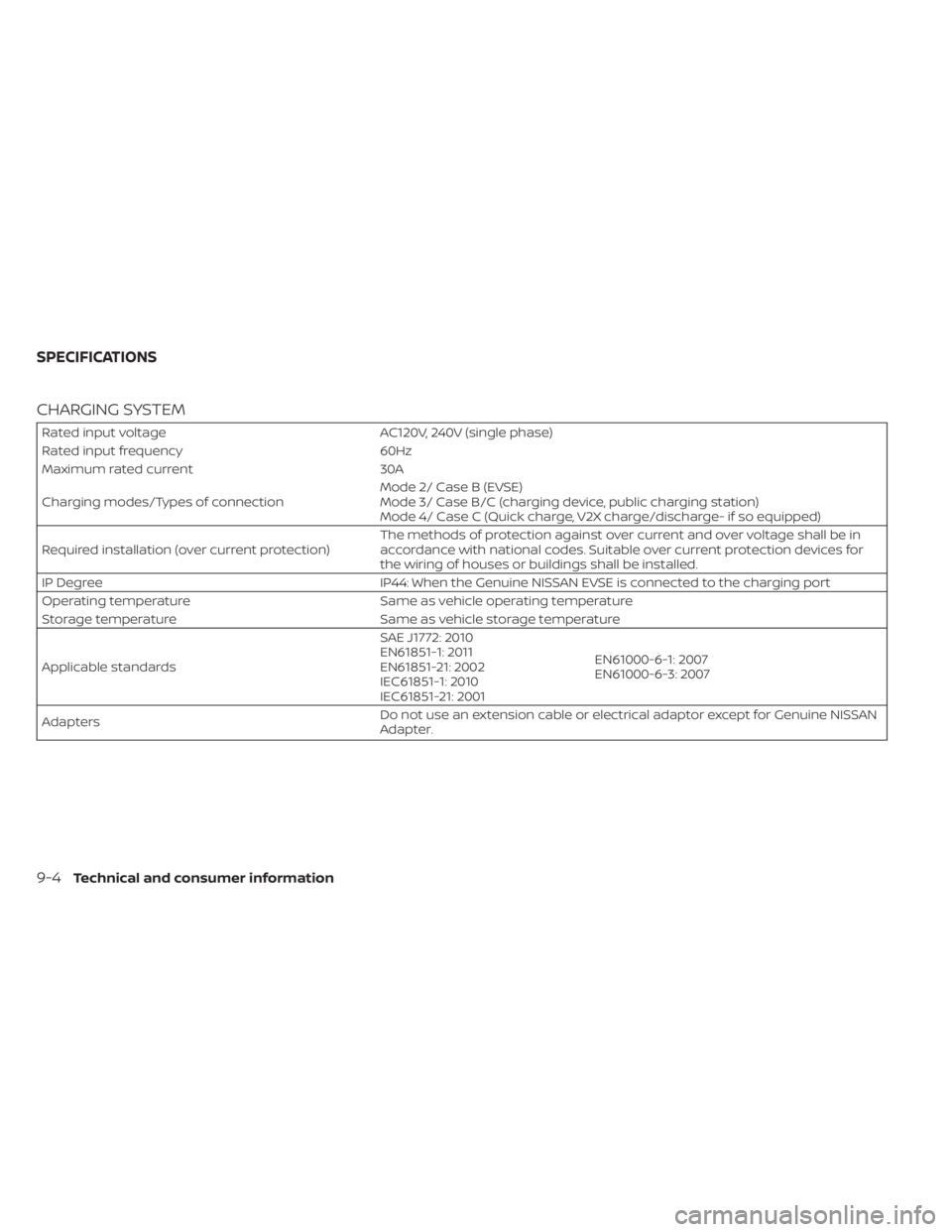
CHARGING SYSTEM
Rated input voltageAC120V, 240V (single phase)
Rated input frequency 60Hz
Maximum rated current 30A
Charging modes/Types of connection Mode 2/ Case B (EVSE)
Mode 3/ Case B/C (charging device, public charging station)
Mode 4/ Case C (Quick charge, V2X charge/discharge- if so equipped)
Required installation (over current protection) The methods of protection against over current and over voltage shall be in
accordance with national codes. Suitable over current protection devices for
the wiring of houses or buildings shall be installed.
IP Degree IP44: When the Genuine NISSAN EVSE is connected to the charging port
Operating temperature Same as vehicle operating temperature
Storage temperature Same as vehicle storage temperature
Applicable standards SAE J1772: 2010
EN61851-1: 2011
EN61851-21: 2002
IEC61851-1: 2010
IEC61851-21: 2001EN61000-6-1: 2007
EN61000-6-3: 2007
Adapters Do not use an extension cable or electrical adaptor except for Genuine NISSAN
Adapter.
SPECIFICATIONS
9-4Technical and consumer information
Page 566 of 596
When planning to travel in another coun-
try,you should first find out if the charging
equipment is compatible with that coun-
try's electrical system.
When transferring the registration of
your vehicle to another country, state,
province or district, it may be necessary
to modif y the vehicle to meet local laws
and regulations.
The laws and regulations for motor vehicle
safety standards vary according to the
country, state, province or district; there-
fore, vehicle specifications may differ.
When any vehicle is to be taken into an-
other country, state, province or district
and registered, its modifications, trans-
portation, and registration are the re-
sponsibility of the user. NISSAN is not re-
sponsible for any inconvenience that
may result.
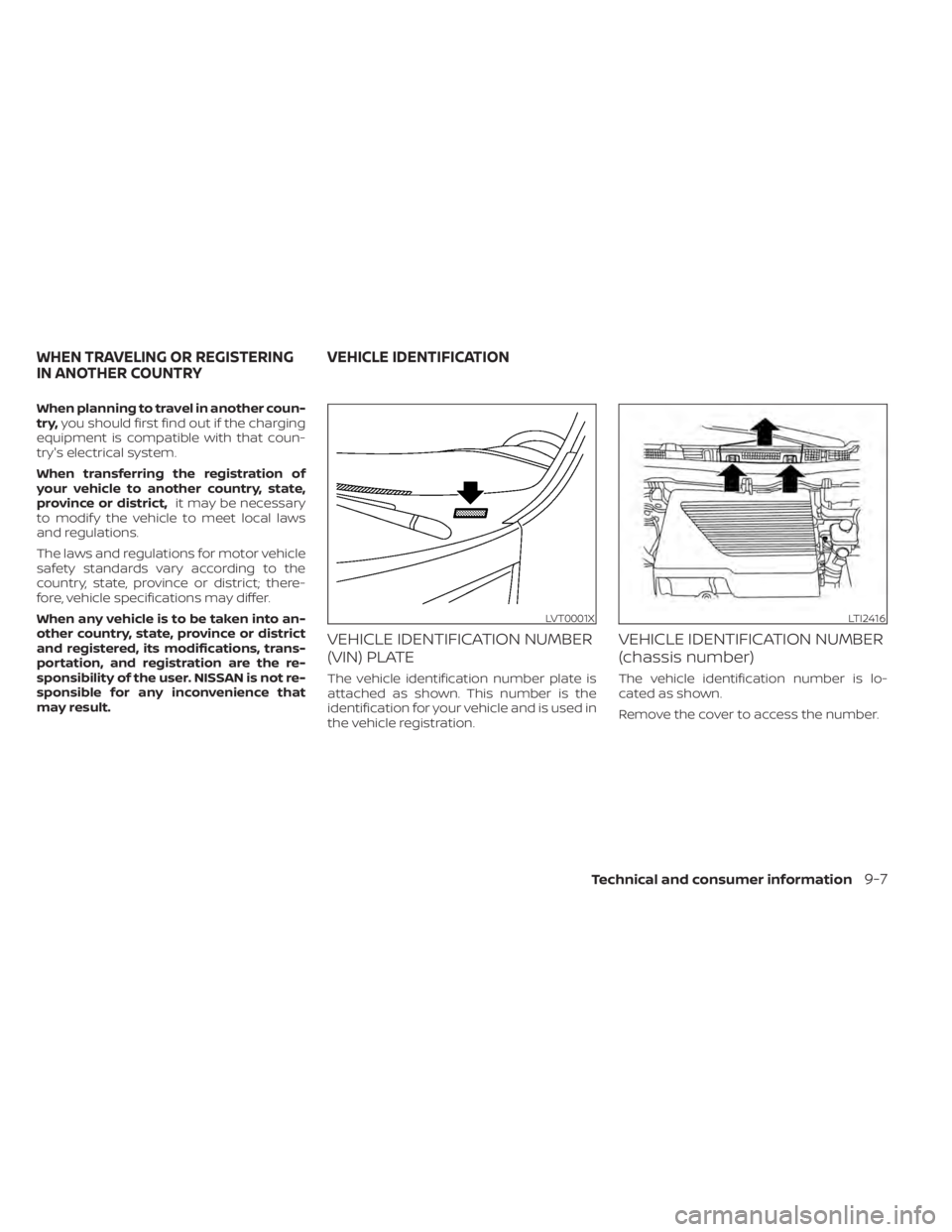
VEHICLE IDENTIFICATION NUMBER
(VIN) PLATE
The vehicle identification number plate is
attached as shown. This number is the
identification for your vehicle and is used in
the vehicle registration.
VEHICLE IDENTIFICATION NUMBER
(chassis number)
The vehicle identification number is lo-
cated as shown.
Remove the cover to access the number.
LVT0001XLTI2416
WHEN TRAVELING OR REGISTERING
IN ANOTHER COUNTRY VEHICLE IDENTIFICATION
Technical and consumer information9-7
Page 575 of 596
20590. You can also obtain other in-
formation about motor vehicle safety
from http://www.safercar.gov.
You may notif y NISSAN by contact-
ing our Consumer Affairs Depart-
ment, toll-free, at 1-800-NISSAN-1.
For Canada
If you believe that your vehicle has a
defect which could cause a crash or
could cause injury or death, you
should immediately inform Trans-
port Canada in addition to notif ying
NISSAN.
If Transport Canada receives com-
plaints, it may open an investigation,
and if it finds that a safety defect
exists in a group of vehicles, it may
request that NISSAN conduct a recall
campaign. However, Transport
Canada cannot become involved in
individual problems between you,
your dealer, or NISSAN.You may contact Transport Cana-
da's Defect Investigations and Re-
calls Division toll free at 1-800-333-
0510. You may also report safety
defects online at: https://
wwwapps.tc.gc.ca/Saf-Sec-Sur/7/
PCDB-BDPP/fc-cp.aspx?lang=eng
(English speakers) or https://
wwwapps.tc.gc.ca/Saf-Sec-Sur/7/
PCDB-BDPP/fc-cp.aspx?lang=fra
(French speakers)
Additional information concerning
motor vehicle safety may be ob-
tained from Transport Canada's
Road Safety Information Centre at
1-800-333-0371 or online at
www.tc.gc.ca/roadsafety (English
speakers) or www.tc.gc.ca/
securiteroutiere (French speakers).
To notif y NISSAN of any safety con-
cerns please contact our Consumer
Information Centre toll free at 1-800-
387-0122.
In addition to Event Data Recorders (EDRs)
mentioned in this Owner's Manual, this ve-
hicle is equipped with electronic modules
that monitor, control and record data con-
cerning various vehicle systems, including
the motor, batteries, braking and electrical
systems. Other electronic modules record
information concerning driving conditions,
including idling, braking, acceleration, trip
and other related data, information about
your use of the car and its features such as
air conditioner or headlight usage, diag-
nostic trouble codes, vehicle charging, ve-
hicle speed, direction and/or location.
Some of this data is stored by the vehicle
for use during vehicle servicing. Other data
concerning your vehicle's operation and
performance is wirelessly transmitted by
cellular connection through the vehicle on-
board telematics system upon vehicle
start-up or at other intervals to NISSAN.
This data may be used by NISSAN for vari-
ous purposes, including: to provide you
with NissanConnect® EV & Services or
NissanConnect® Services (For additional
information, refer to “NissanConnect®
Manual (for Leaf )”.); troubleshooting; evalu-
ation of your vehicle's quality, functionality
and performance; analysis and research
by NISSAN designed to, among other
things, optimize performance of future
TELEMATICS OVERVIEW (models
with Navigation System)
9-16Technical and consumer information
Page 576 of 596
electric vehicles including improvements
in future battery life; to offer you new or
additional products or services; and as
otherwise may be required by law. Such
data may be shared with NISSAN's parents,
subsidiaries, affiliates, successors or as-
signees; authorized NISSAN certified LEAF
dealers; NISSAN's marketing partners; your
fleet company, if your vehicle is a fleet ve-
hicle; your rental company, if your vehicle is
a rental vehicle; and third party service pro-
viders such as cellular, information sys-
tems and data management providers.
State and provincial laws allow access and
use of data recorded by vehicle devices
with the consent of the vehicle owner or
pursuant to subscription agreement. While
you are not required to allow such access
and use, if you do not so agree NISSAN may
be unable under applicable law to activate
the vehicle telematics system in your ve-
hicle, and certain features of your vehicle
which are dependent on vehicle telematics
will not operate as intended or designed.
These may include features such as auto-
matic charging station map updates, re-
mote battery state of charge check, charg-
ing complete notice, remote plug in
reminder, remote charging on, remote cli-
mate control on, drive route planning, driv-
ing tips to improve range, driving history,billing simulation, ECO ranking, ECO forest,
maintenance reminders, etc. Other fea-
tures that may be developed and offered
by NISSAN in the future may also not func-
tion without telematics data transmission.
NissanConnect® EV & Services or
NissanConnect® Services telematics ser-
vices are provided by NISSAN pursuant to a
subscription services agreement covering
your vehicle. This agreement is necessary
for all owners. This agreement, and an ex-
planation of its terms and conditions, can
be found at the NISSAN Owner’s Portal
webpage. Further, the operator of the ve-
hicle must also touch [OK] on the Navi
screen to indicate assent each time he or
she starts the car. If you decide at any time
that you do not want your vehicle to trans-
mit data to NISSAN, you can deactivate the
telematics account associated with this
vehicle by canceling the subscription ser-
vices agreement by visiting the NISSAN
Owner’s Portal Webpage or calling NISSAN
at 1-877-NOGASEV (1-877-664-2738). The
service can be reactivated later upon re-
quest if you choose. Simply visit the same
website or call the number above. Alterna-
tively, you can turn off the transmission of
certain categories of data through the use
of settings found in the navigation system
under Menu, NissanConnect® EV & Servicesor NissanConnect® Services, Vehicle Infor-
mation Sharing with NISSAN. Note, turning
off “Vehicle Information Sharing with
NISSAN” will only disable the automatic
sharing of information at vehicle start-up.
Certain categories of data may still be
transmitted if vehicle telematics features
are accessed either in the vehicle or re-
motely.
Your agreement to the transmission and
use of data by NISSAN can be provided in
various ways. The vehicle is equipped with
a “pop up” screen on the vehicle navigation
system that will ask for your consent to this
data transfer. A version of the following
message will appear: “Pursuant to sub-
scription agreement, your vehicle wire-
lessly transmits recorded vehicle data to
NISSAN for various purposes, including
NissanConnect® EV & Services or
NissanConnect® Services, product evalua-
tion, research and development. By touch-
ing OK, you consent to the transmission
and use of your vehicle data. See Owner's
Manual or NISSAN Owner's portal webpage
for terms and details.” If you touch [OK],
your vehicle will transmit data as designed
in connection with the vehicle telematics
system. If you touch [Decline] your vehicle
Technical and consumer information9-17
Page 581 of 596
LTI2429
CHARGING INFORMATION
9-22Technical and consumer information