horn NISSAN LEAF 2021 Owner´s Manual
[x] Cancel search | Manufacturer: NISSAN, Model Year: 2021, Model line: LEAF, Model: NISSAN LEAF 2021Pages: 602, PDF Size: 4.22 MB
Page 265 of 602
Opening charge port lid
The charge port lid may be opened by
pressing and holding thebutton.
For additional information, see "Opening
charge port lid" (P. 3-20).
Using the panic alarm
If you are near your vehicle and feel threat-
ened, you may activate the panic alarm to
call attention by pressing and holding the
button on the Intelligent Key for lon-
ger than 1 second.
The panic alarm and headlights will stay on
for a period of time.
The panic alarm stops when:
• It has run for a period of time.
• Any button is pressed on the Intelligent Key. (Note: The
button must be
pushed for more than 1 second.)
Setting hazard indicator and horn
mode
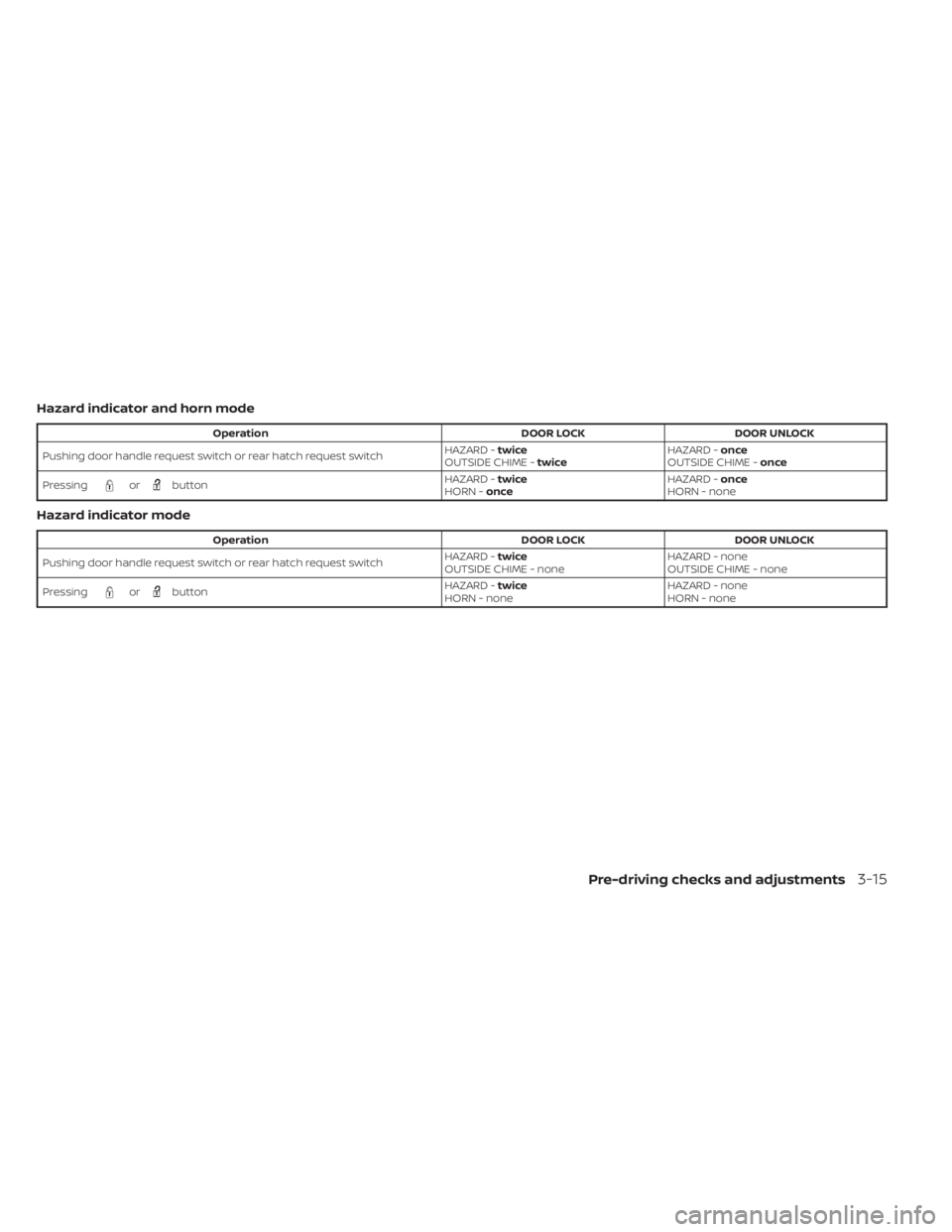
This vehicle is set in hazard indicator and
horn mode when you first receive the
vehicle.
In hazard indicator and horn mode, when
the
button is pressed, the hazard
indicator flashes twice and the horn chirps
once. When the
button is pressed, the
hazard indicator flashes once.
If horns are not necessary, the system can
be switched to the hazard indicator mode.
In hazard indicator mode, when the
button is pressed, the hazard indicator
flashes twice. When thebutton is
pressed, neither the hazard indicator nor
the horn operates.
3-14Pre-driving checks and adjustments
Page 266 of 602
Hazard indicator and horn mode
OperationDOOR LOCKDOOR UNLOCK
Pushing door handle request switch or rear hatch request switch HAZARD -
twice
OUTSIDE CHIME - twice HAZARD -
once
OUTSIDE CHIME - once
Pressing
orbutton HAZARD -
twice
HORN - once HAZARD -
once
HORN - none
Hazard indicator mode
Operation DOOR LOCKDOOR UNLOCK
Pushing door handle request switch or rear hatch request switch HAZARD -
twice
OUTSIDE CHIME - none HAZARD - none
OUTSIDE CHIME - none
Pressing
orbutton HAZARD -
twice
HORN - none HAZARD - none
HORN - none
Pre-driving checks and adjustments3-15
Page 267 of 602
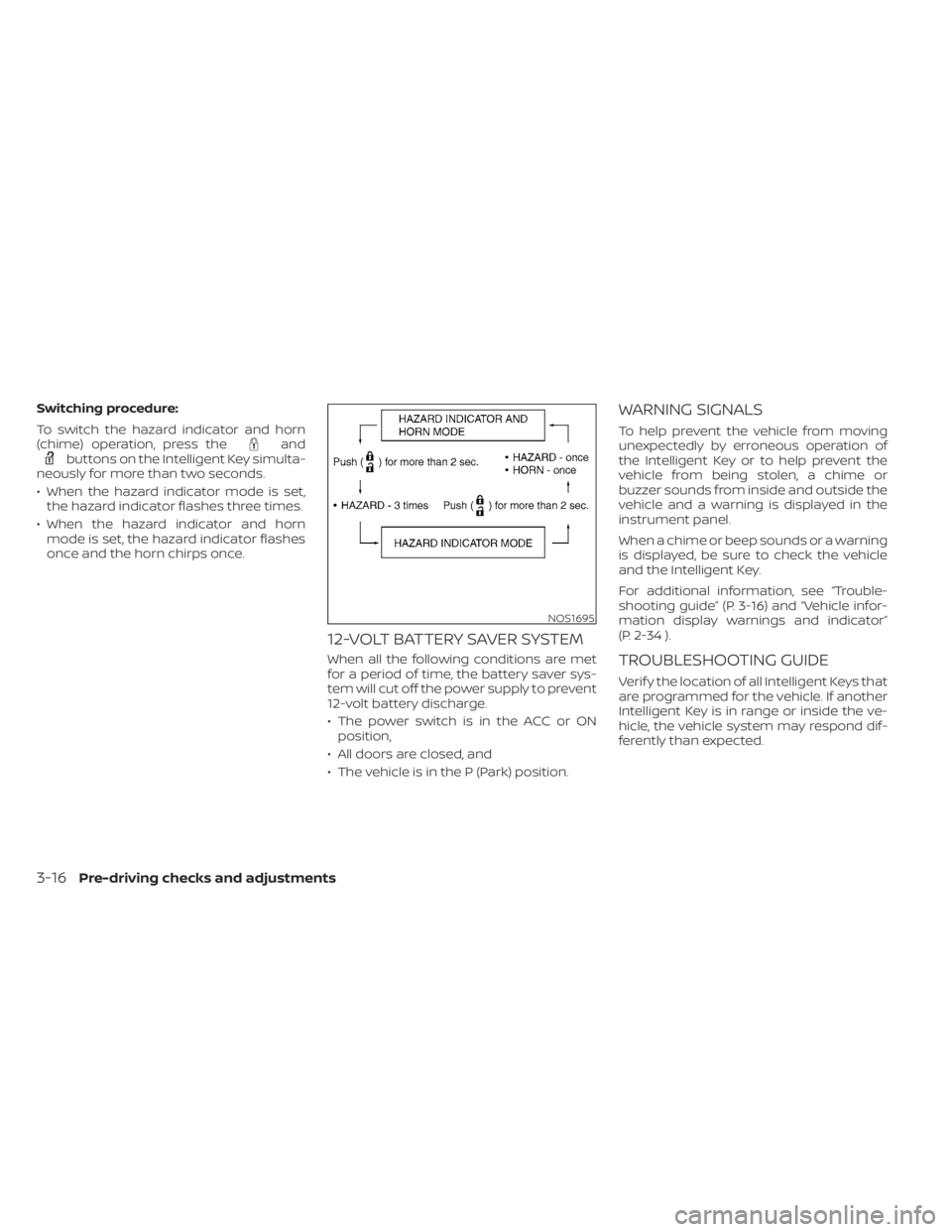
Switching procedure:
To switch the hazard indicator and horn
(chime) operation, press the
andbuttons on the Intelligent Key simulta-
neously for more than two seconds.
• When the hazard indicator mode is set, the hazard indicator flashes three times.
• When the hazard indicator and horn mode is set, the hazard indicator flashes
once and the horn chirps once.
12-VOLT BATTERY SAVER SYSTEM
When all the following conditions are met
for a period of time, the battery saver sys-
tem will cut off the power supply to prevent
12-volt battery discharge.
• The power switch is in the ACC or ONposition,
• All doors are closed, and
• The vehicle is in the P (Park) position.
WARNING SIGNALS
To help prevent the vehicle from moving
unexpectedly by erroneous operation of
the Intelligent Key or to help prevent the
vehicle from being stolen, a chime or
buzzer sounds from inside and outside the
vehicle and a warning is displayed in the
instrument panel.
When a chime or beep sounds or a warning
is displayed, be sure to check the vehicle
and the Intelligent Key.
For additional information, see “Trouble-
shooting guide” (P. 3-16) and “Vehicle infor-
mation display warnings and indicator”
(P. 2-34 ).
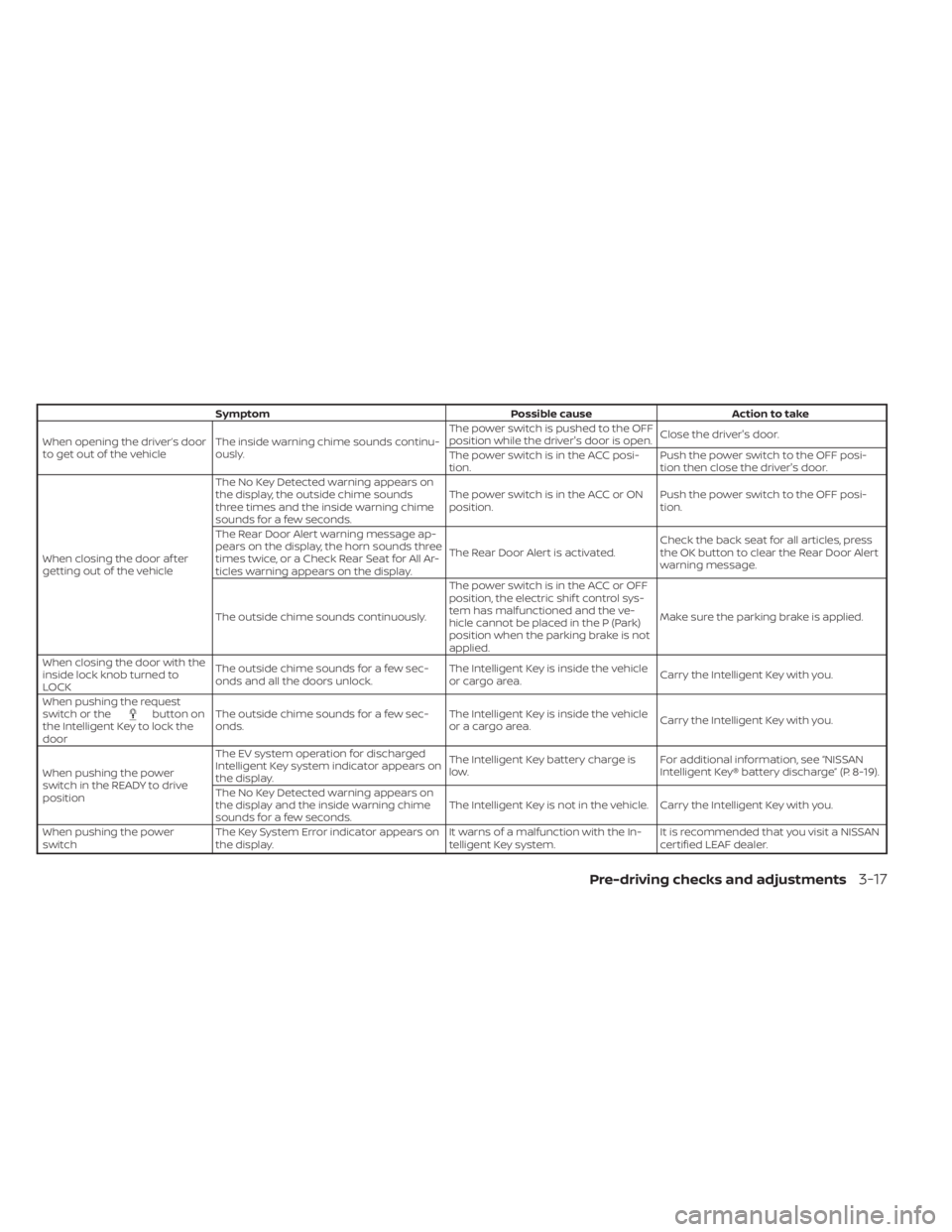
TROUBLESHOOTING GUIDE
Verif y the location of all Intelligent Keys that
are programmed for the vehicle. If another
Intelligent Key is in range or inside the ve-
hicle, the vehicle system may respond dif-
ferently than expected.
NOS1695
3-16Pre-driving checks and adjustments
Page 268 of 602
SymptomPossible causeAction to take
When opening the driver’s door
to get out of the vehicle The inside warning chime sounds continu-
ously. The power switch is pushed to the OFF
position while the driver's door is open.
Close the driver's door.
The power switch is in the ACC posi-
tion. Push the power switch to the OFF posi-
tion then close the driver's door.
When closing the door af ter
getting out of the vehicle The No Key Detected warning appears on
the display, the outside chime sounds
three times and the inside warning chime
sounds for a few seconds.
The power switch is in the ACC or ON
position.
Push the power switch to the OFF posi-
tion.
The Rear Door Alert warning message ap-
pears on the display, the horn sounds three
times twice, or a Check Rear Seat for All Ar-
ticles warning appears on the display. The Rear Door Alert is activated.
Check the back seat for all articles, press
the OK button to clear the Rear Door Alert
warning message.
The outside chime sounds continuously. The power switch is in the ACC or OFF
position, the electric shif t control sys-
tem has malfunctioned and the ve-
hicle cannot be placed in the P (Park)
position when the parking brake is not
applied.Make sure the parking brake is applied.
When closing the door with the
inside lock knob turned to
LOCK The outside chime sounds for a few sec-
onds and all the doors unlock.
The Intelligent Key is inside the vehicle
or cargo area.
Carry the Intelligent Key with you.
When pushing the request
switch or the
button on
the Intelligent Key to lock the
door The outside chime sounds for a few sec-
onds.
The Intelligent Key is inside the vehicle
or a cargo area.
Carry the Intelligent Key with you.
When pushing the power
switch in the READY to drive
position The EV system operation for discharged
Intelligent Key system indicator appears on
the display.
The Intelligent Key battery charge is
low.
For additional information, see “NISSAN
Intelligent Key® battery discharge” (P. 8-19).
The No Key Detected warning appears on
the display and the inside warning chime
sounds for a few seconds. The Intelligent Key is not in the vehicle. Carry the Intelligent Key with you.
When pushing the power
switch The Key System Error indicator appears on
the display. It warns of a malfunction with the In-
telligent Key system.It is recommended that you visit a NISSAN
certified LEAF dealer.
Pre-driving checks and adjustments3-17
Page 326 of 602
TPMS with Easy-Fill Tire Alert
When tire pressure is low, the low tire pres-
sure warning light illuminates.
This vehicle provides visual and audible
signals to help you inflate the tires to the
recommended COLD tire pressure.
Vehicle set-up:
1. Park the vehicle in a safe and level place.
2. Apply the parking brake and push the P(Park) position switch on the shif t lever.
3. Place the power switch in the ON posi- tion. Do not place in the READY to drive
mode.
Operation:
1. Add air to the tire.
2. Af ter a few seconds, the hazard indica- tors will start flashing.
3. When the designated pressure is reached, the horn beeps once and the
hazard indicators stop flashing.
4. Perform the above steps for each tire. • If the tire is over-inflated more thanapproximately 4 psi (30 kPa), the horn
beeps and the hazard indicators flash
three times. To correct the pressure,
push the core of the valve stem on the tire briefly to release pressure. When
the pressure reaches the designated
pressure, the horn beeps once.
• If the hazard indicator does not flash within approximately 15 seconds af ter
starting to inflate the tire, it indicates
that the Easy-Fill Tire Alert is not
operating.
• The TPMS will not activate the Easy-Fill
Tire Alert under the following conditions:– If there is interference from an exter- nal device or transmitter.
– The air pressure from the inflation device is not sufficient to inflate the
tire, such as those using a power
socket.
– If electrical equipment is being used in or near the vehicle.
– There is a malfunction in the TPMS.
– There is a malfunction in the horn or hazard indicators.
– If the Easy-Fill Tire Alert does not op- erate due to TPMS interference,
move the vehicle about 3 f t (1 m)
backward or forward and try again.
If the Easy-Fill Tire Alert is not working, use a
tire pressure gauge.
AVOIDING COLLISION AND
ROLLOVER
WARNING
Failure to operate this vehicle in a safe
and prudent manner may result in loss
of control or an accident.
Be alert and drive defensively at all times.
Obey all traffic regulations. Avoid excessive
speed, high speed cornering, or sudden
steering maneuvers because these driving
practices could cause you to lose control of
your vehicle. As with any vehicle, a loss of
control could result in a collision with
other vehicles or objects or cause the ve-
hicle to rollover, particularly if the loss of
control causes the vehicle to slide side-
ways. Be attentive at all times, and avoid
driving when tired. Never drive when under
the influence of alcohol or drugs (including
prescription or over-the-counter drugs
which may cause drowsiness). Always
wear your seat belt as outlined in “Seat
belts” (P. 7-6), and also instruct your passen-
gerstodoso.
Seat belts help reduce the risk of injury in col-
lisions and rollovers. In a rollover crash, an
unbelted person is significantly more likely
to die than a person wearing a seat belt.
Starting and driving5-7
Page 559 of 602
EV MAINTENANCE SCHEDULES
(EM57 electric motor)
The following shows the maintenance
schedule.
Choose the maintenance schedule
needed based on your vehicle driving
conditions.
Af ter 120,000 miles (192,000 km)/96
months, continue maintenance at the
same mileage/time interval.
7,500 miles/(12,000 km)/6 months
Perform at number of miles, kilometers or
months, whichever comes first.
Standard maintenance:
Inspections:
• Horn, lights, signals, wipers, rear hatch/hood lif t supports
• Battery terminals and cables, battery test
• Tire pressure, treadwear and depth
• Suspension components (shocks, sub- frame, tie rods)
Essential:
• Tire rotation
Severe maintenance:
Inspections:
• Axle & suspension parts
• Brake pads & rotors
• Drive shaf t boots
• Front suspension ball joints
• Steering gear and linkage
• Steering linkage ball joints
15,000 miles/(24,000 km)/
12 months
Perform at number of miles, kilometers or
months, whichever comes first.
Standard maintenance:
Inspections:
• Brake lines & cables
• Brake pads & rotors
• Charging port
• Drive shaf t boots
• EV Battery Usage Report (1) (2)
• Reduction gear oil
• Horn, lights, signals, wipers, rear hatch/ hood lif t supports
• Battery terminals and cables, battery test
• Tire pressure, treadwear and depth
• Suspension components (shocks, sub- frame, tie rods)
Essential:
• Replace in-cabin microfilter
• Tire rotation
9-8Maintenance and schedules
Page 560 of 602
Severe maintenance:
Inspections:
• Axle & suspension parts
• Front suspension ball joints
• Steering gear and linkage
• Steering linkage ball joints
Essential:
• Replace brake fluid
(1) Review of the EV Battery Usage Report is
required as a condition of EV battery war-
ranty. Refer to your 2020 LEAF warranty in-
formation booklet for details. Both the 12
month and 24 month inspections will be
performed by your NISSAN certified LEAF
dealer at no cost to the vehicle owner.
(2) Performed based on the number of ser-
vice months only.22,500 miles/(36,000 km)/
18 months
Perform at number of miles, kilometers or
months, whichever comes first.
Standard maintenance:
Inspections:
• Inspect Intelligent Key battery (1)
• Horn, lights, signals, wipers, rear hatch/hood lif t supports
• Battery terminals and cables, battery test
• Tire pressure, treadwear and depth
• Suspension components (shocks, sub- frame, tie rods)
Essential:
• Tire rotation
Severe maintenance:
Inspections:
• Axle & suspension parts
• Brake pads & rotors
• Drive shaf t boots
• Front suspension ball joints
• Steering gear and linkage
• Steering linkage ball joints
(1) Performed based on the number of ser-
vice months only.
30,000 miles/(48,000 km)/
24 months
Perform at number of miles, kilometers or
months, whichever comes first.
Standard maintenance:
Inspections:
• Axle & suspension parts
• Brake lines & cables
• Brake pads & rotors
• Charging port
• Charging port sealing cap
• Drive shaf t boots
• EV Battery Usage Report (1) (2)
• Front suspension ball joints
• Reduction gear oil
• Steering gear and linkage
• Steering linkage ball joints
• Horn, lights, signals, wipers, rear hatch/ hood lif t supports
• Battery terminals and cables, battery test
• Tire pressure, treadwear and depth
• Suspension components (shocks, sub- frame, tie rods)
Maintenance and schedules9-9
Page 561 of 602
Essential:
• Replace brake fluid
• Replace in-cabin microfilter
• Tire rotation
Severe maintenance:
Not applicable. Proceed to next interval.
(1) Review of the EV Battery Usage Report is
required as a condition of EV battery war-
ranty. Refer to your 2020 LEAF warranty in-
formation booklet for details. Both the 12
month and 24 month inspections will be
performed by your NISSAN certified LEAF
dealer at no cost to the vehicle owner.
(2) Performed based on the number of ser-
vice months only.37,500 miles/(60,000 km)/
30 months
Perform at number of miles, kilometers or
months, whichever comes first.
Standard maintenance:
Inspections:
• Horn, lights, signals, wipers, rear hatch/hood lif t supports
• Battery terminals and cables, battery test
• Tire pressure, treadwear and depth
• Suspension components (shocks, sub- frame, tie rods)
Essential:
• Tire rotation
Severe maintenance:
Inspections:
• Axle & suspension parts
• Brake pads & rotors
• Drive shaf t boots
• Front suspension ball joints
• Steering gear and linkage
• Steering linkage ball joints
45,000 miles/(72,000 km)/
36 months
Perform at number of miles, kilometers or
months, whichever comes first.
Standard maintenance:
Inspections:
• Brake lines & cables
• Brake pads & rotors
• Charging port
• Drive shaf t boots
• EV Battery Usage Report (1) (2)
• Reduction gear oil
• Horn, lights, signals, wipers, rear hatch/ hood lif t supports
• Battery terminals and cables, battery test
• Tire pressure, treadwear and depth
• Suspension components (shocks, sub- frame, tie rods)
Essential:
• Replace intelligent key battery (2)
• Replace in-cabin microfilter
• Tire rotation
9-10Maintenance and schedules
Page 562 of 602
Severe maintenance:
Inspections:
• Axle & suspension parts
• Front suspension ball joints
• Steering gear and linkage
• Steering linkage ball joints
Essential:
• Replace brake fluid
(1) Review of the EV Battery Usage Report is
required as a condition of EV battery war-
ranty. Refer to your 2020 LEAF warranty in-
formation booklet for details. Both the 12
month and 24 month inspections will be
performed by your NISSAN certified LEAF
dealer at no cost to the vehicle owner.
(2) Performed based on the number of ser-
vice months only.52,500 miles/(84,000 km)/
42 months
Perform at number of miles, kilometers or
months, whichever comes first.
Standard maintenance:
Inspections:
• Horn, lights, signals, wipers, rear hatch/hood lif t supports
• Battery terminals and cables, battery test
• Tire pressure, treadwear and depth
• Suspension components (shocks, sub- frame, tie rods)
Essential:
• Tire rotation
Severe maintenance:
Inspections:
• Axle & suspension parts
• Brake pads & rotors
• Drive shaf t boots
• Front suspension ball joints
• Steering gear and linkage
• Steering linkage ball joints
60,000 miles/(96,000 km)/
48 months
Perform at number of miles, kilometers or
months, whichever comes first.
Standard maintenance:
Inspections:
• Axle & suspension parts
• Brake lines & cables
• Brake pads & rotors
• Charging port
• Charging port sealing cap
• Drive shaf t boots
• EV Battery Usage Report (1) (2)
• Front suspension ball joints
• Reduction gear oil
• Steering gear and linkage
• Steering linkage ball joints
• Horn, lights, signals, wipers, rear hatch/ hood lif t supports
• Battery terminals and cables, battery test
• Tire pressure, treadwear and depth
• Suspension components (shocks, sub- frame, tie rods)
Maintenance and schedules9-11
Page 563 of 602
Essential:
• Replace brake fluid
• Replace in-cabin microfilter
• Tire rotation
Severe maintenance:
Not applicable. Proceed to next interval.
(1) Review of the EV Battery Usage Report is
required as a condition of EV battery war-
ranty. Refer to your 2020 LEAF warranty in-
formation booklet for details. Both the 12
month and 24 month inspections will be
performed by your NISSAN certified LEAF
dealer at no cost to the vehicle owner.
(2) Performed based on the number of ser-
vice months only.67,500 miles/(108,000 km)/
54 months
Perform at number of miles, kilometers or
months, whichever comes first.
Standard maintenance:
Inspections:
• Horn, lights, signals, wipers, rear hatch/hood lif t supports
• Battery terminals and cables, battery test
• Tire pressure, treadwear and depth
• Suspension components (shocks, sub- frame, tie rods)
Essential:
• Replace intelligent key battery (1)
• Tire rotation
Severe maintenance:
Inspections:
• Axle & suspension parts
• Brake pads & rotors
• Drive shaf t boots
• Front suspension ball joints
• Steering gear and linkage
• Steering linkage ball joints
(1) Performed based on the number of ser-
vice months only.
75,000 miles/(120,000 km)/
60 months
Perform at number of miles, kilometers or
months, whichever comes first.
Standard maintenance:
Inspections:
• Brake lines & cables
• Brake pads & rotors
• Charging port
• Drive shaf t boots
• EV Battery Usage Report (1) (2)
• Reduction gear oil
• Horn, lights, signals, wipers, rear hatch/ hood lif t supports
• Battery terminals and cables, battery test
• Tire pressure, treadwear and depth
• Suspension components (shocks, sub- frame, tie rods)
Essential:
• Replace in-cabin microfilter
• Tire rotation
9-12Maintenance and schedules