warning NISSAN LEAF 2021 Owner´s Manual
[x] Cancel search | Manufacturer: NISSAN, Model Year: 2021, Model line: LEAF, Model: NISSAN LEAF 2021Pages: 602, PDF Size: 4.22 MB
Page 25 of 602
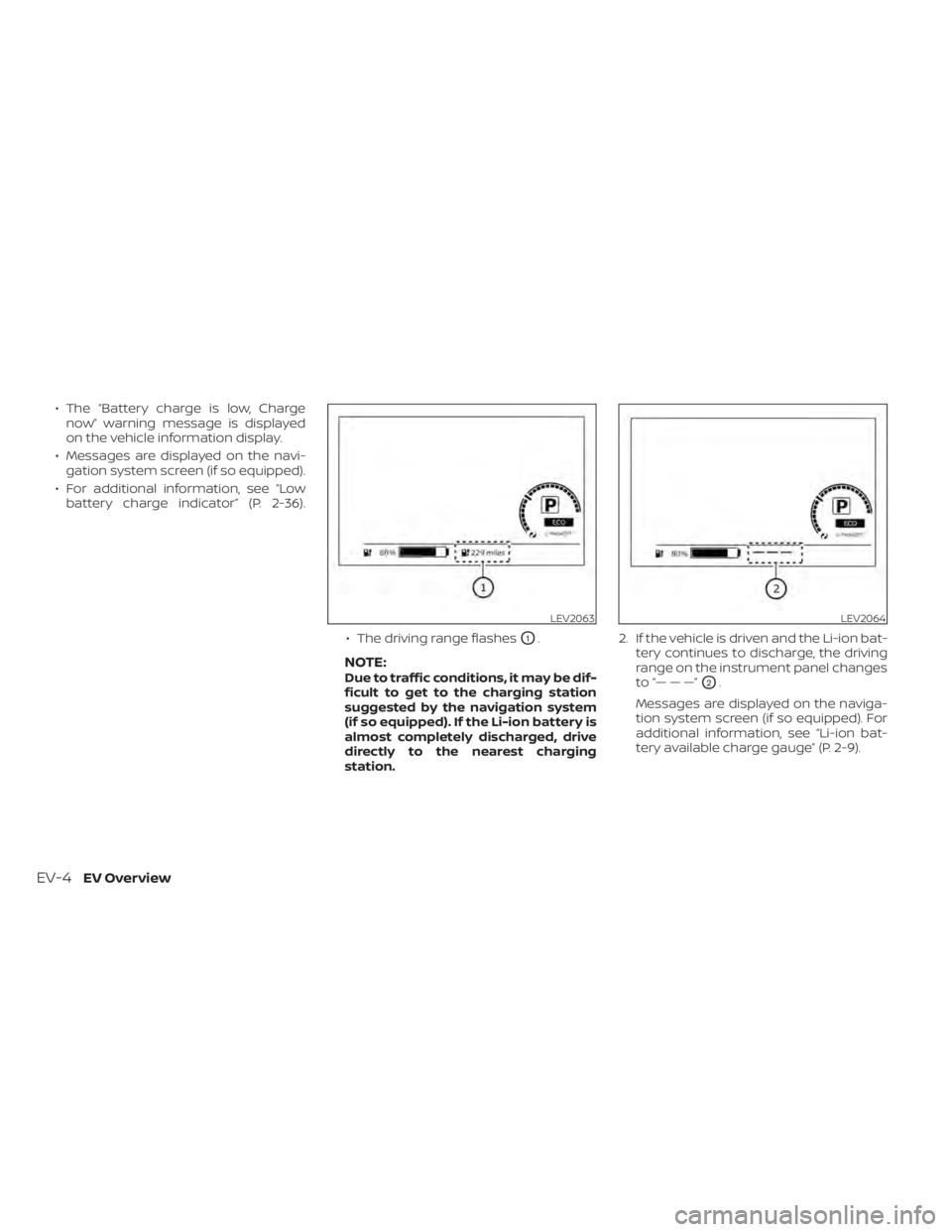
• The “Battery charge is low, Chargenow” warning message is displayed
on the vehicle information display.
• Messages are displayed on the navi- gation system screen (if so equipped).
• For additional information, see “Low battery charge indicator” (P. 2-36).
• The driving range flashes
O1.
NOTE:Due to traffic conditions, it may be dif-
ficult to get to the charging station
suggested by the navigation system
(if so equipped). If the Li-ion battery is
almost completely discharged, drive
directly to the nearest charging
station.2. If the vehicle is driven and the Li-ion bat-
tery continues to discharge, the driving
range on the instrument panel changes
to “— — —”O2.
Messages are displayed on the naviga-
tion system screen (if so equipped). For
additional information, see “Li-ion bat-
tery available charge gauge” (P. 2-9).
LEV2063LEV2064
EV-4EV Overview
Page 29 of 602
• The predicted charging time displayedon the meter increases when the Li-ion
battery warmer uses electrical power
from the Li-ion battery.
• The Climate Ctrl. Timer or Remote Cli- mate Control (models with Navigation
System) does not turn on while the Li-
ion battery warmer operates. This is
not a malfunction.
• The charging timer or remote charge (models with Navigation System) does
not turn on while the Li-ion battery
warmer operates. This is not a
malfunction.
• The Li-ion battery may not be charged to the expected level using the charg-
ing timer while the Li-ion battery
warmer operates.
• If the Li-ion battery warmer automati- cally stops because of the Li-ion bat-
tery temperature or outside tempera-
ture change, charging will continue
until the Li-ion battery is fully charged.HIGH-VOLTAGE COMPONENTS
WARNING
• The EV system uses high voltage up
to approximately DC 400 volt. The
system can be hot during and af ter
starting and when the vehicle is shut
off. Be careful of both the high volt-
age and the high temperature. Fol-
low the warning labels that are at-
tached to the vehicle.
• Never disassemble, remove or re-
place high-voltage parts and cables
as well as their connectors because
they can cause severe burns or elec-
tric shock that may result in serious
injury or death. High-voltage cables
are colored orange. The vehicle high
voltage system has no user service-
able parts. It is recommended that
you take your vehicle to a NISSAN
certified LEAF dealer for any neces-
sary maintenance.
HIGH VOLTAGE PRECAUTIONS
EV-8EV Overview
Page 30 of 602
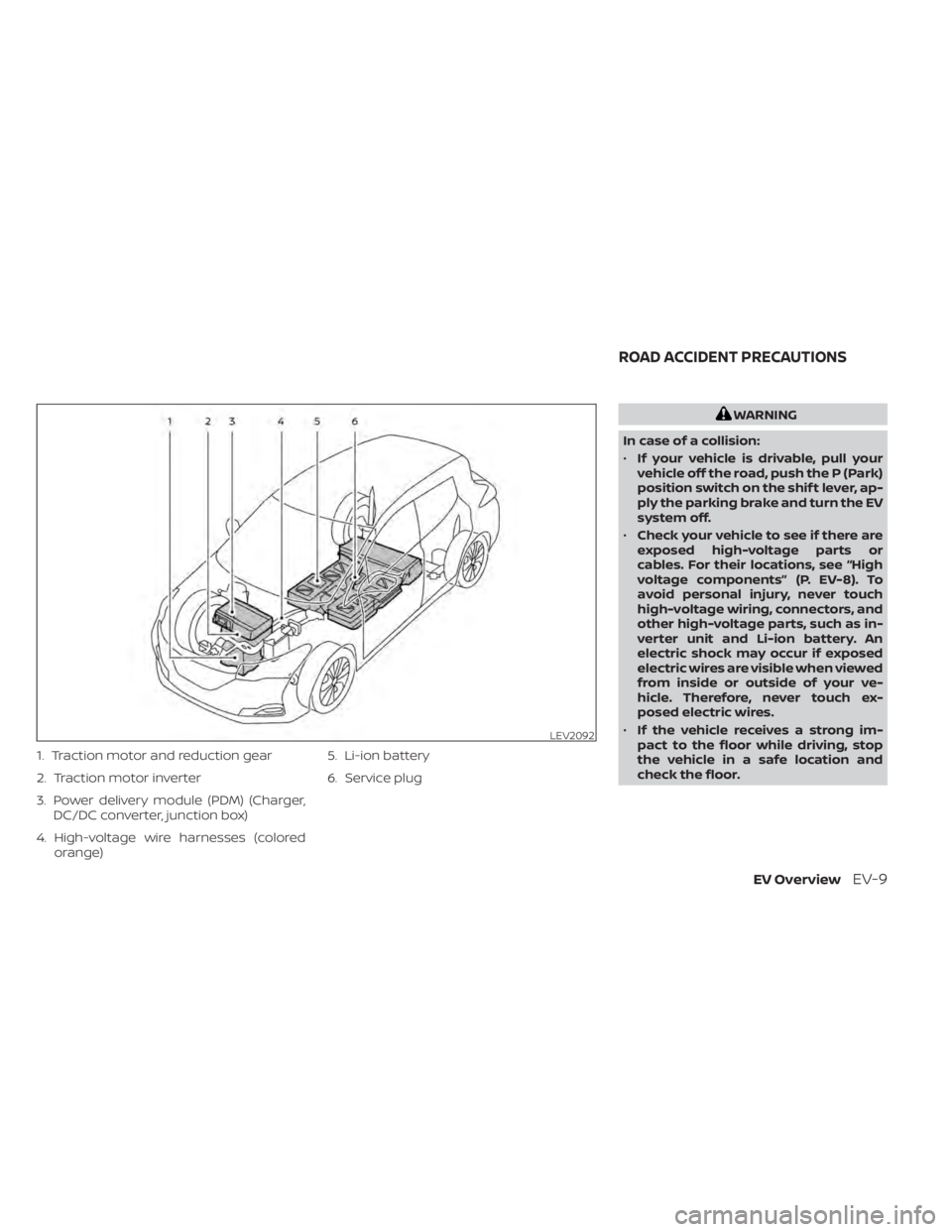
1. Traction motor and reduction gear
2. Traction motor inverter
3. Power delivery module (PDM) (Charger,DC/DC converter, junction box)
4. High-voltage wire harnesses (colored orange) 5. Li-ion battery
6. Service plug
WARNING
In case of a collision:
• If your vehicle is drivable, pull your
vehicle off the road, push the P (Park)
position switch on the shif t lever, ap-
ply the parking brake and turn the EV
system off.
• Check your vehicle to see if there are
exposed high-voltage parts or
cables. For their locations, see “High
voltage components” (P. EV-8). To
avoid personal injury, never touch
high-voltage wiring, connectors, and
other high-voltage parts, such as in-
verter unit and Li-ion battery. An
electric shock may occur if exposed
electric wires are visible when viewed
from inside or outside of your ve-
hicle. Therefore, never touch ex-
posed electric wires.
• If the vehicle receives a strong im-
pact to the floor while driving, stop
the vehicle in a safe location and
check the floor.
LEV2092
ROAD ACCIDENT PRECAUTIONS
EV OverviewEV-9
Page 31 of 602
•Leaks or damage to the Li-ion bat-
tery may result in a fire. If you dis-
cover them, contact emergency ser-
vices immediately. Since the fluid
leak may be lithium manganate from
the Li-ion battery, never touch the
fluid leak inside or outside the ve-
hicle. If the fluid contacts your skin or
eyes, wash it off immediately with a
large amount of water and receive
immediate medical attention to help
avoid serious injury.
• If a fire occurs in the EV, leave the
vehicle as soon as possible. Only use
a type ABC, BC or C fire extinguisher
that is meant for use on electrical
fires. Using a small amount of water
or the incorrect fire extinguisher can
result in serious injury or death from
electrical shock.
• If your vehicle needs to be towed, do
it with the front wheels raised. If the
front wheels are on the ground when
towing, the traction motor may gen-
erate electricity. This may damage
the components of the EV system
and cause a fire. •
If you are not able to safely assess
the vehicle due to vehicle damage, do
not touch the vehicle. Leave the ve-
hicle and contact emergency ser-
vices. Advise first responders that
this is an electric vehicle.
• In the event of an accident that re-
quires body repair and painting, the
Li-ion battery pack and high voltage
parts such as the inverter, including
the wire harness, should be removed
prior to painting. It is recommended
that you visit a NISSAN certified LEAF
dealer for this service. Li-ion battery
packs exposed to heat in the paint
booth will experience capacity loss.
Damaged Li-ion battery packs may
also pose safety risks to untrained
mechanics and repair personnel.
EMERGENCY SHUT-OFF SYSTEM
The emergency shut-off system is acti-
vated and the high-voltage system auto-
matically turns off in the following
conditions:
- Front and side collisions in which the air
bags are deployed.
- Certain rear collisions.
- Certain EV system malfunctions. For the above collisions and certain other
EV system malfunctions, the READY to drive
indicator light will turn off. For additional
information, see “Warning lights, indicator
lights and audible reminders” (P. 2-14).
The emergency shut-off activates for the
above collisions to minimize risk of an
event that could cause injury or an acci-
dent. If the emergency shut-off system ac-
tivates, the EV system may not be switched
to the READY to drive position; it is recom-
mended that you visit a NISSAN certified
LEAF dealer. Even if the power switch is
switched to the READY to drive position, the
system may shut-off suddenly. Therefore,
drive cautiously to the nearest certified re-
pair facility; it is recommended that you
visit a NISSAN certified LEAF dealer for
service.
EV-10EV Overview
Page 32 of 602
WARNING
• Pay special attention to pedestrians.
Because there is no engine noise, pe-
destrians may not know the vehicle
is approaching, moving or about to
move, and may step into the path of
vehicle travel.
• When leaving the vehicle, be sure to
turn off the EV system.
• Be sure to push the P (Park) position
switch on the shif t lever and apply
the parking brake when parking be-
cause the vehicle can move when the
READY to drive indicator light is ON.
When the READY to drive indicator
light is ON, do not leave your vehicle
in a shif t position other than the P
(Park) position.
• Keep the brake pedal depressed until
you are ready to drive. When the ve-
hicle is in the D (Drive) position, B or R
(Reverse) position, if you release the
brake pedal and do not depress the
accelerator, the vehicle will creep and
may start abruptly. This may cause
serious injury or death.NOTE:
• The vehicle cannot run with a dis- charged Li-ion battery. Repeated ac-
celeration consumes more power from
the Li-ion battery than driving at a
steady speed.
• This vehicle is equipped with a regen- erative brake system. The primary pur-
pose of the regenerative brake system
is to provide some power to recharge
the Li-ion battery and extend driving
range. A secondary benefit is “engine
braking” that operates based on Li-ion
battery conditions.
• In the D (Drive) position, when the ac- celerator pedal is released, the regen-
erative brake system provides some
deceleration.
• When you put the shif t lever in the B mode and take your foot off the accel-
erator pedal, more regenerative brake
is applied than in the D (Drive) position. • Less deceleration is provided by the re-
generative brake system when the Li-
ion battery is fully charged. The regen-
erative brake is automatically reduced
when the Li-ion battery is fully charged
to prevent the Li-ion battery from be-
coming overcharged. The regenerative
brake is also automatically reduced
when the battery temperature is high/
low (indicated by the red/blue zones
on the Li-ion battery temperature
gauge) to prevent Li-ion battery
damage.
• The brake pedal should be used to slow or stop the vehicle depending on traffic
or road conditions. The vehicle brakes
are not affected by the regenerative
brake system operation.
EV CHARACTERISTICS
EV OverviewEV-11
Page 33 of 602
NOISE AND VIBRATION
You might experience the following noise
or vibration as a normal characteristic of
this vehicle:
• Traction motor noise from the motorcompartment.
• Water pump and radiator fan noise while charging.
• Compressor and radiator fan noise when the Climate Ctrl. Timer or remote climate
control (models with Navigation System)
is used.
• Relay operation noise and vibration at start-up and shut-down of the EV system
(power switch placed in the ON and OFF
position).
• Approaching Vehicle Sound for Pedestri- ans (VSP). This section provides a brief explanation
for the most important LEAF functions. For
additional information, refer to the specific
sections of this manual for detailed expla-
nations of the vehicle features and
operation.
CHARGING THE LI-ION BATTERY
WARNING
The EV system uses a high voltage cur-
rent. Failure to follow the proper han-
dling instructions may cause serious
injury or death. Be sure to read the
“Charging” section and follow the pro-
cedures and guidelines described.
LIFE WITH AN EV (scene guide)
EV-12EV Overview
Page 45 of 602
METERS AND INDICATORS
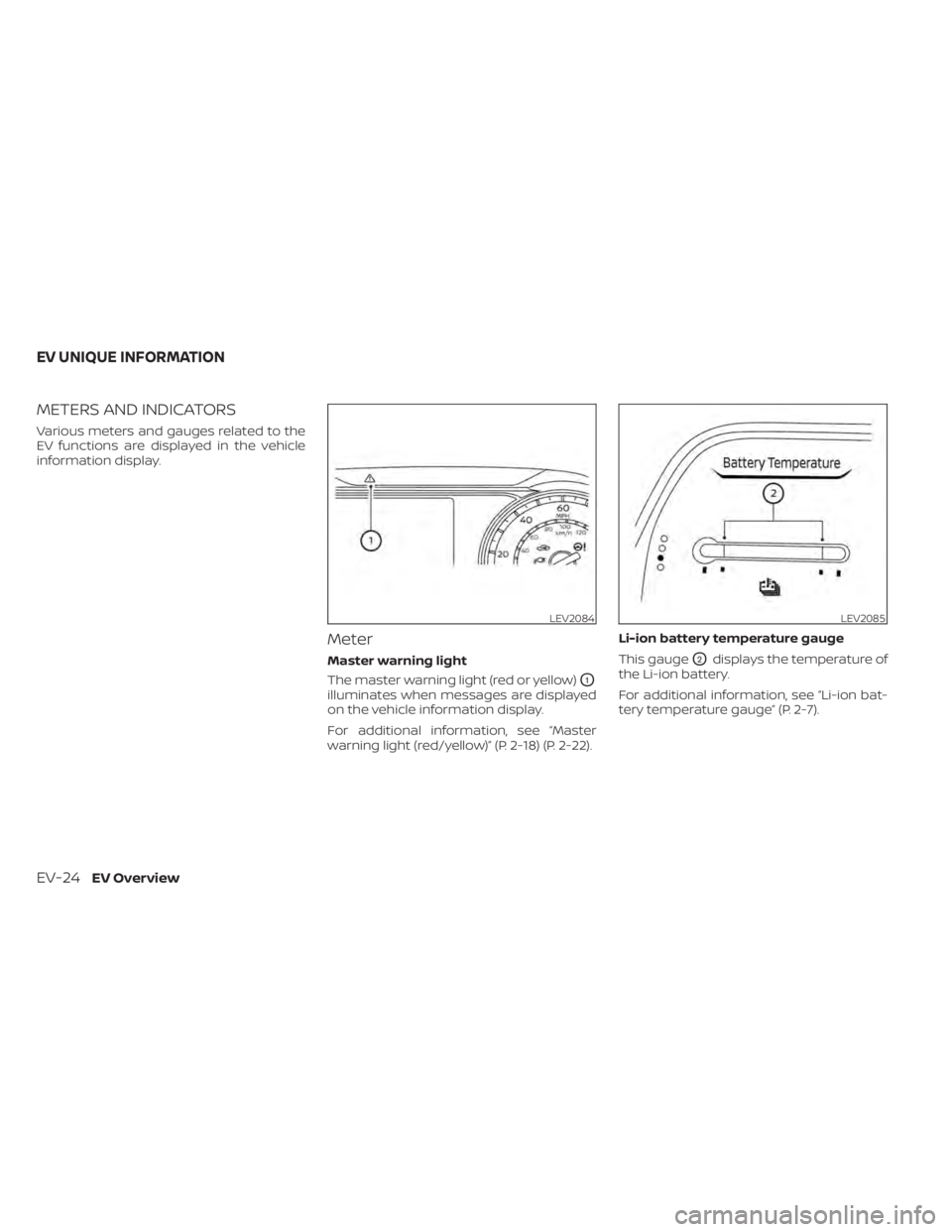
Various meters and gauges related to the
EV functions are displayed in the vehicle
information display.
Meter
Master warning light
The master warning light (red or yellow)
O1
illuminates when messages are displayed
on the vehicle information display.
For additional information, see “Master
warning light (red/yellow)” (P. 2-18) (P. 2-22).Li-ion battery temperature gauge
This gauge
O2displays the temperature of
the Li-ion battery.
For additional information, see “Li-ion bat-
tery temperature gauge” (P. 2-7).
LEV2084LEV2085
EV UNIQUE INFORMATION
EV-24EV Overview
Page 47 of 602
Warning and indicator lights
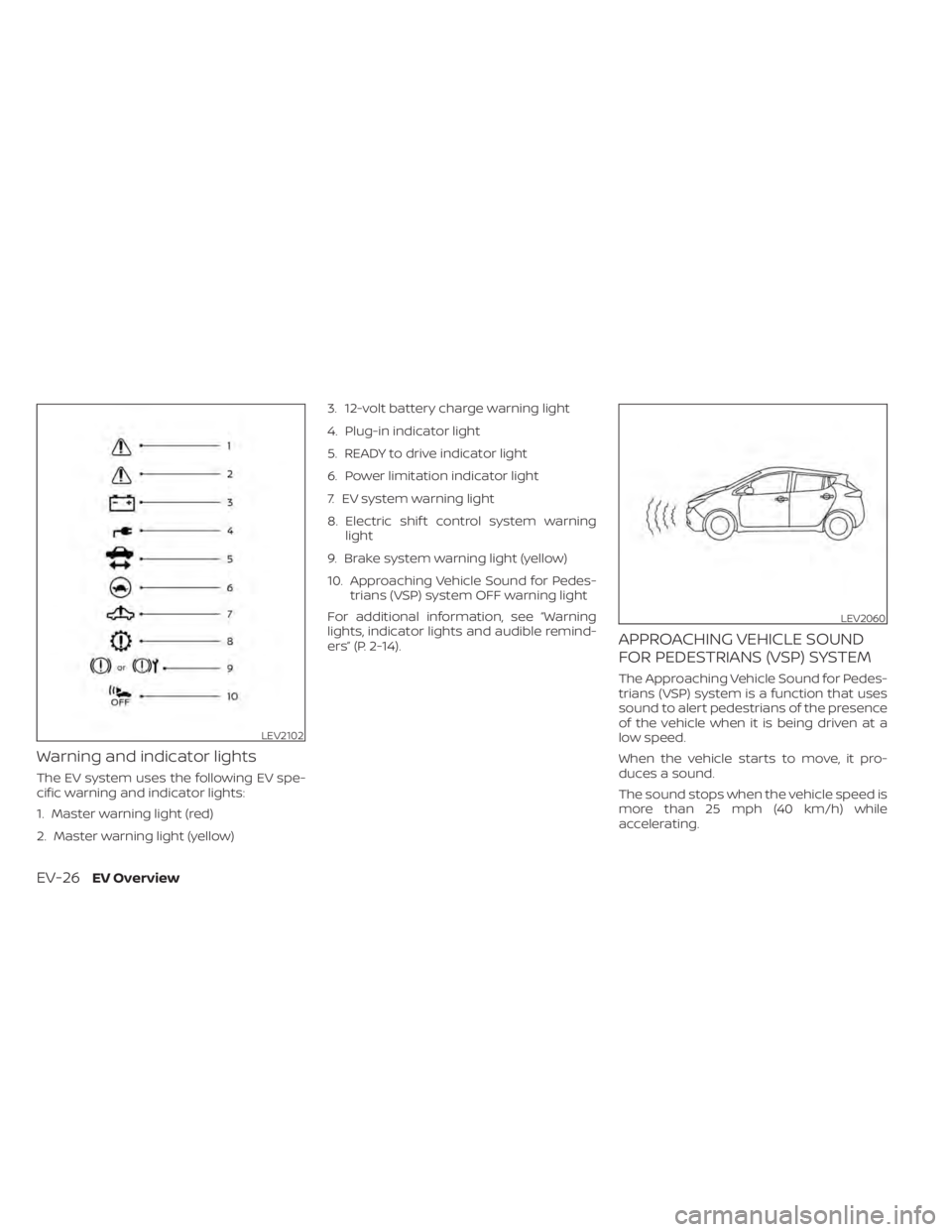
The EV system uses the following EV spe-
cific warning and indicator lights:
1. Master warning light (red)
2. Master warning light (yellow)3. 12-volt battery charge warning light
4. Plug-in indicator light
5. READY to drive indicator light
6. Power limitation indicator light
7. EV system warning light
8. Electric shif t control system warning
light
9. Brake system warning light (yellow)
10. Approaching Vehicle Sound for Pedes- trians (VSP) system OFF warning light
For additional information, see “Warning
lights, indicator lights and audible remind-
ers” (P. 2-14).
APPROACHING VEHICLE SOUND
FOR PEDESTRIANS (VSP) SYSTEM
The Approaching Vehicle Sound for Pedes-
trians (VSP) system is a function that uses
sound to alert pedestrians of the presence
of the vehicle when it is being driven at a
low speed.
When the vehicle starts to move, it pro-
duces a sound.
The sound stops when the vehicle speed is
more than 25 mph (40 km/h) while
accelerating.
LEV2102
LEV2060
EV-26EV Overview
Page 48 of 602
The sound starts when the vehicle speed is
less than 22 mph (35 km/h) while
decelerating.
WARNING
• If the sound cannot be heard, pedes-
trians may not notice the oncoming
vehicle, which may cause an accident
resulting in serious injury or death. It
is recommended that you immedi-
ately visit a NISSAN certified LEAF
dealer for VSP system inspection.
• If the VSP system OFF warning light
illuminates while the power switch is
in the ON position, or in the READY to
drive position, it may indicate the VSP
system is not functioning properly.
Have the VSP system checked. It is
recommended that you visit a
NISSAN certified LEAF dealer for this
service. For additional information,
see “Approaching Vehicle Sound for
Pedestrians (VSP) system OFF warn-
ing light” (P. 2-19).
NOTE:
The volume of the (VSP) sound cannot be
raised or lowered.
ELECTRIC SHIFT CONTROL
SYSTEM
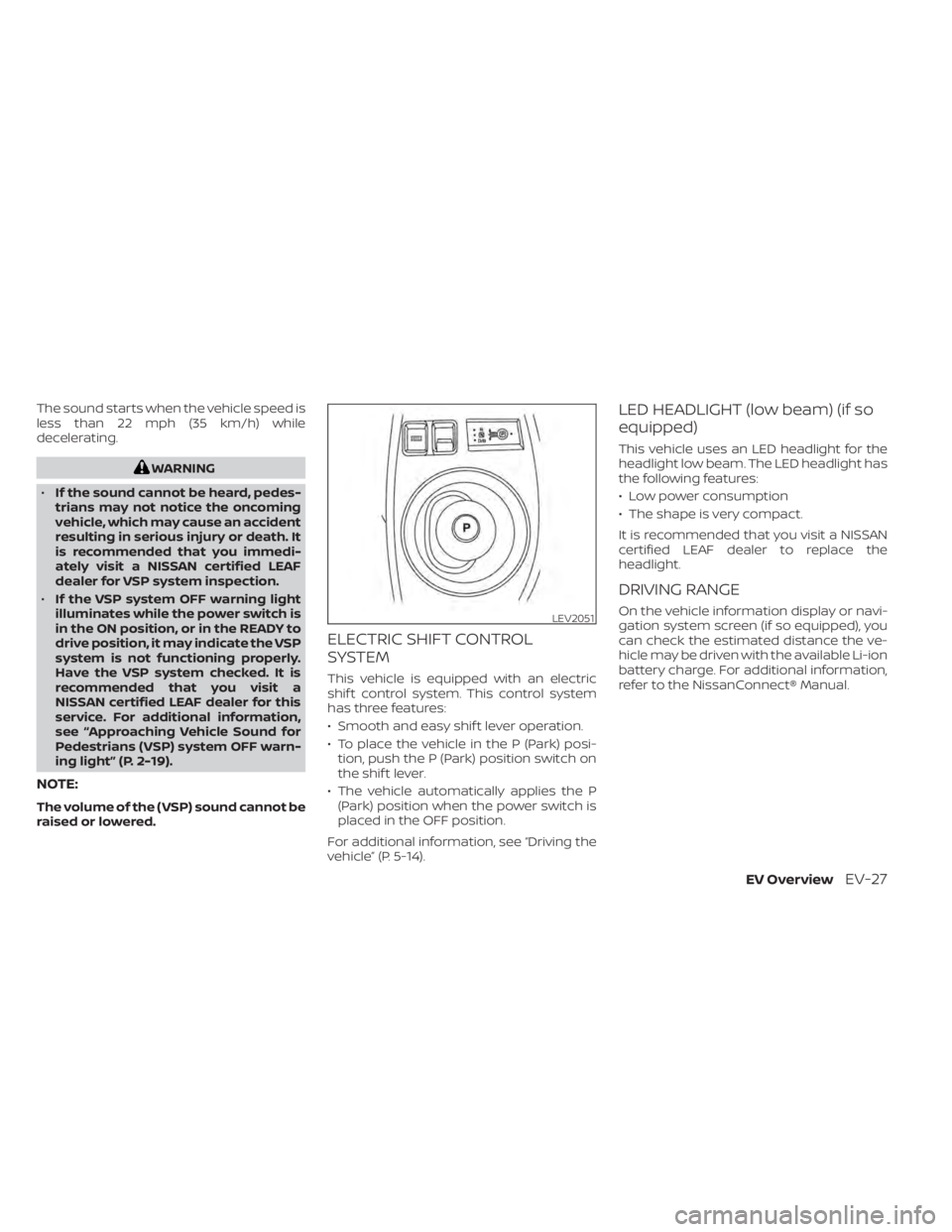
This vehicle is equipped with an electric
shif t control system. This control system
has three features:
• Smooth and easy shif t lever operation.
• To place the vehicle in the P (Park) posi- tion, push the P (Park) position switch on
the shif t lever.
• The vehicle automatically applies the P (Park) position when the power switch is
placed in the OFF position.
For additional information, see “Driving the
vehicle” (P. 5-14).
LED HEADLIGHT (low beam) (if so
equipped)
This vehicle uses an LED headlight for the
headlight low beam. The LED headlight has
the following features:
• Low power consumption
• The shape is very compact.
It is recommended that you visit a NISSAN
certified LEAF dealer to replace the
headlight.
DRIVING RANGE
On the vehicle information display or navi-
gation system screen (if so equipped), you
can check the estimated distance the ve-
hicle may be driven with the available Li-ion
battery charge. For additional information,
refer to the NissanConnect® Manual.LEV2051
EV OverviewEV-27
Page 51 of 602
WARNING
• If you use any medical electric de-
vices, such as an implantable cardiac
pacemaker or an implantable cardio-
vascular defibrillator, check with the
electric medical device manufac-
turer concerning the effects that
charging may have on implanted de-
vices before starting the charge op-
eration. Charging may affect the
operation.
• Make sure there is no water or for-
eign materials in the charge port,
charge connector, or electrical plug,
and that they are not damaged or
affected by rust or corrosion. If any of
these conditions are noticeable, do
not charge the Li-ion battery. This
may result in a short circuit or electric
shock and could cause a fire which
may result in serious personal injury
or death.
• To avoid serious personal injury or
death when the Li-ion battery is
charging, be aware of the following
precautions. –
Do not touch the metal contacts of
the charge port, charge connec-
tor, electrical plug or Genuine
NISSAN Adapter.
– Do not touch the vehicle and EVSE
when there is lightning.
– Do not pull, twist, bend, step on, or
drag the cable.
• Make sure the charge connector is
removed from the charge port before
starting your vehicle. If the charge
connector is only partially engaged
and the connector latch is unlocked,
it is possible to place the EV in the
READY to drive position.
• Do not touch the plug or the Genuine
NISSAN Adapter if they are wet or
with wet hands. Do not put the plug
or the Genuine NISSAN Adapter in
water, liquid or snow. This may cause
an electric shock which may result in
serious personal injury or death.
• Do not disassemble or modif y the
charge port, the EVSE or the Genuine
NISSAN Adapter. This may cause a
fire or an electric shock which may
result in serious personal injury or
death. •
If you notice an unusual odor, smoke
or abnormal noises coming from the
vehicle, stop charging immediately.
• Be careful not to allow your hands,
hair, jewelry or clothing to come into
contact with, or get caught in, the
traction motor cooling fan. The cool-
ing fan can start at any time during
charging.
• Do not use extension cords or adapt-
ers unless they are Genuine NISSAN
parts.
• Do not use the Genuine NISSAN
Adapter with any devices except the
Genuine NISSAN EVSE.
• Do not allow an unattended child to
handle or use this product.
• Use the EVSE with outlet and wiring
installed according to the
regulations/standards.
• Pass the lower side belt of the EVSE
case securely through the fastener
on the bottom of the luggage board.
If the case suddenly becomes loose,
it may cause serious injury or death.
PRECAUTIONS ON CHARGING
CH-2Charging