tire pressure NISSAN LEAF 2021 Owner´s Manual
[x] Cancel search | Manufacturer: NISSAN, Model Year: 2021, Model line: LEAF, Model: NISSAN LEAF 2021Pages: 602, PDF Size: 4.22 MB
Page 498 of 602
If the tire pressure does not increase to26
psi (180 kPa) within 10 minutes, the tire
may be seriously damaged and the tire
cannot be repaired with this tire repair
kit. It is recommended that you visit a
NISSAN certified LEAF dealer.
7. When the tire pressure is at the specified amount, turn the air compressor off. If
the tire cannot be inflated to the speci-
fied amount, the air compressor can be
turned off at the minimum of 26 psi (180
kPa). Remove the power plug from the
power outlet and quickly remove the
hose from the tire valve. Attach the pro-
tective cap and valve cap. Properly stow
the emergency tire puncture repair kit in
the cargo area.
CAUTION
To avoid serious personal injury when
stowing the emergency tire puncture
repair kit:
• Keep the sealant bottle screwed into
the compressor. Failure to do so can
cause the sealant to spray into the air
and get into your eyes or on the skin. 8. Immediately drive the vehicle for 10 min-
utes or 2 miles (3 km) at a speed below
50 mph (80 km/h).
9. Af ter driving, make sure that the air compressor switch is in the OFF posi-
tion, then screw the hose securely onto
the tire valve. Check the tire pressure
with the pressure gauge. Temporary re-
pair is completed if the tire pressure
does not drop.
Make sure the pressure is adjusted to
the pressure that is specified on the Tire
and Loading Information label before
driving.
10. If the tire pressure drops, repeat the steps from 5 to 9. If the pressure drops
again or under 19 psi (130 kPa), the tire
cannot be repaired with this tire re-
pair kit. If the tire cannot be repaired,
the driver should not drive on it any
further. The car should be towed to the
nearest dealership.
The sealant bottle and hose cannot be
reused to repair another punctured tire.
It is recommended that you visit a
NISSAN certified LEAF dealer to pur-
chase replacements. Af ter repairing tire
It is recommended that you visit a NISSAN
certified LEAF dealer for tire repair/
replacement as soon as possible.
WARNING
• Af ter using Genuine NISSAN Emer-
gency Tire Sealant to repair a minor
tire puncture, do not drive the vehicle
at speeds faster than 50 mph (80
km/h).
• Immediately af ter using Genuine
NISSAN Emergency Tire Sealant to
repair a minor tire puncture, it is rec-
ommended that you visit a NISSAN
certified LEAF dealer. The Genuine
NISSAN Emergency Tire Sealant can-
not permanently seal a punctured
tire. Continuing operation of the ve-
hicle without a permanent tire repair
can lead to a crash.
• Do not inject any tire liquid or aerosol
tire sealant into the tires, as this may
cause a malfunction of the tire pres-
sure sensors.
In case of emergency6-9
Page 499 of 602
•If you used the Genuine NISSAN
Emergency Tire Sealant to repair a
minor tire puncture, it is recom-
mended that you visit a NISSAN cer-
tified LEAF dealer to replace the
TPMS sensor in addition to repairing
or replacing the tire.
• NISSAN recommends using only
Genuine NISSAN Emergency Tire
Sealant provided with your vehicle.
Other tire sealants may damage the
valve stem seal which can cause the
tire to lose air pressure. To start your EV system with a booster bat-
tery, the instructions and precautions be-
low must be followed.
Jump starting provides power to the 12-
volt system to allow the electrical systems
to operate. The electrical systems must be
operating to allow the Li-ion battery to be
charged. Jump starting does not charge
the Li-ion battery. The Li-ion battery must
be charged before the vehicle can be
driven.
WARNING
• If done incorrectly, jump starting can
lead to a 12-volt battery explosion,
resulting in severe injury or death. It
could also damage your vehicle.
• Explosive hydrogen gas is always
present in the vicinity of the 12-volt
battery. Keep all sparks and flames
away from the 12-volt battery.
• Do not allow battery fluid to come
into contact with eyes, skin, clothing
or painted surfaces. Battery fluid is a
corrosive sulfuric acid solution that
can cause severe burns. If the fluid
comes into contact with anything,
immediately flush the contacted
area with water. •
Keep the 12-volt battery out of the
reach of children.
• The booster battery must be rated at
12 volt. Use of an improperly rated
battery can damage your vehicle.
• Whenever working on or near a 12-
volt battery, always wear suitable
eye protectors (for example, goggles
or industrial safety spectacles) and
remove rings, metal bands, or any
other jewelry. Do not lean over the
12-volt battery when jump starting.
• Do not attempt to jump start a frozen
battery. It could explode and cause
serious injury.
• Your vehicle has an automatic cool-
ing fan. It could come on at any time.
Keep hands and other objects away
from it.
• Always follow the instructions below.
Failure to do so could result in dam-
age to the DC/DC converter and
cause personal injury.
• Do not attempt to perform a jump
start on the 12-volt battery at the
same time that the Li-ion battery is
being charged. Doing so may dam-
age the vehicle or charging equip-
ment and could cause an injury.
JUMP STARTING
6-10In case of emergency
Page 508 of 602
Inside flanges, seams and folds on the
doors, hatches and hood are particularly
vulnerable to the effects of road salt. There-
fore, these areas must be regularly
cleaned. Make sure that the drain holes in
the lower edge of the door are open. Spray
water under the body and in the wheel
wells to loosen the dirt and wash away
road salt.
Avoid leaving water spots on the paint sur-
face by using a damp chamois to dry the
vehicle.
WAXING
Regular waxing protects the paint surface
and helps retain new vehicle appearance.
Polishing is recommended to remove
built-up wax residue and to avoid a weath-
ered appearance before reapplying wax.
A NISSAN certified LEAF dealer can assist
you in choosing the proper product.
• Wax your vehicle only af ter a thoroughwashing. Follow the instructions supplied
with the wax.
• Do not use a wax containing any abra- sives, cutting compounds or cleaners
that may damage the vehicle finish. Machine compound or aggressive polish-
ing on a base coat/clear coat paint finish
may dull the finish or leave swirl marks.
REMOVING SPOTS
Remove tar and oil spots, industrial dust,
insects, and tree sap as quickly as possible
from the paint surface to avoid lasting
damage or staining. Special cleaning prod-
ucts are available at a NISSAN certified
LEAF dealer or any automotive accessory
stores.
UNDERBODY
In areas where road salt is used in winter,
the underbody must be cleaned regularly.
This will prevent dirt and salt from building
up and causing the acceleration of corro-
sion on the underbody and suspension.
Before the winter period and again in the
spring, the underseal must be checked
and, if necessary, re-treated.
GLASS
Use glass cleaner to remove smoke and
dust film from the glass surfaces. It is nor-
mal for glass to become coated with a film
af ter the vehicle is parked in the hot sun.
Glass cleaner and a sof t cloth will easily
remove this film.
CAUTION
When cleaning the inside of the win-
dows, do not use sharp-edged tools,
abrasive cleaners or chlorine-based
disinfectant cleaners. They could dam-
age the electrical conductors, radio an-
tenna elements or rear window de-
froster elements.
WHEELS
Wash the wheels when washing the vehicle
to maintain their appearance.
• Clean the inner side of the wheels when the wheel is changed or the underside of
the vehicle is washed.
• Inspect wheel rims regularly for dents or corrosion. Such damage may cause loss
of pressure or poor seal at the tire bead.
• NISSAN recommends that the road wheels be waxed to protect against road
salt in areas where it is used during
winter.
CAUTION
Do not use abrasive cleaners when
washing the wheels.
Appearance and care7-3
Page 514 of 602
8 Do-it yourself
Maintenance precautions.......................8-2
Motor compartment check locations ...........8-4
Cooling system .................................8-5
Checking coolant level .......................8-6
Changing coolant ............................8-6
Reduction gear fluid .............................8-7
Brake fluid .......................................8-7
Windshield-washer fluid .........................8-8
12-volt battery ...................................8-9
Jump starting ................................ 8-11
Windshield wiper blades ........................8-12
Cleaning .................................... 8-12
Replacing ................................... 8-12
Rear window wiper blade ...................8-14
Brakes ......................................... 8-14
Brake pad wear warning ....................8-14Fuses
.......................................... 8-15
Motor compartment ........................ 8-15
Passenger compartment ...................8-18
Nissan Intelligent Key® battery replacement ....8-19
Lights .......................................... 8-21
Headlights .................................. 8-22
Fog lights (if so equipped) ...................8-22
Exterior and interior lights ...................8-23
Wheels and tires ............................... 8-25
Tire pressure ................................ 8-25
Tire labeling ................................. 8-30
Types of tires ................................ 8-32
Tire chains .................................. 8-33
Changing wheels and tires ..................8-34
Emergency tire puncture repair kit ..........8-37
Page 538 of 602
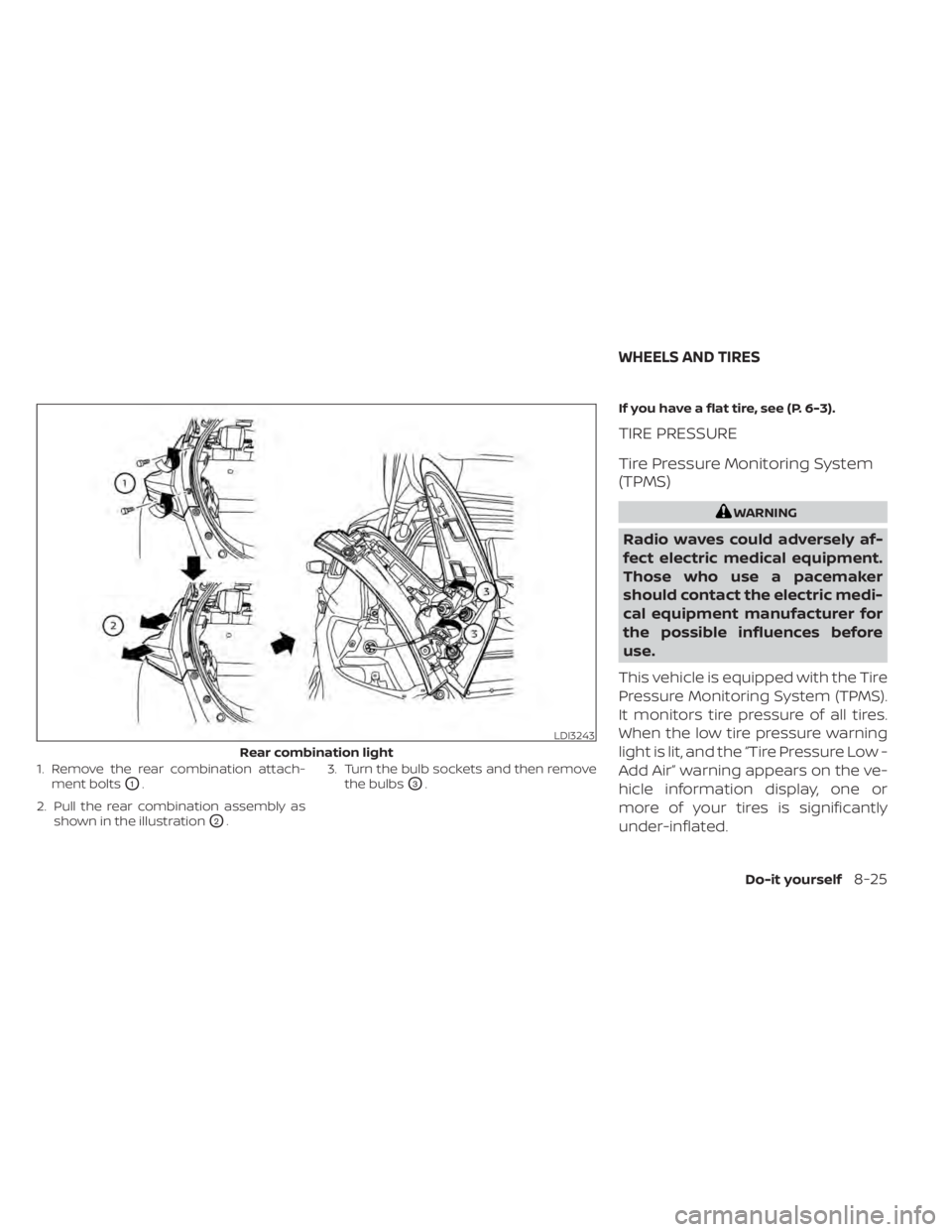
1. Remove the rear combination attach-ment bolts
O1.
2. Pull the rear combination assembly as shown in the illustration
O2. 3. Turn the bulb sockets and then remove
the bulbs
O3. If you have a flat tire, see (P. 6-3).
TIRE PRESSURE
Tire Pressure Monitoring System
(TPMS)
WARNING
Radio waves could adversely af-
fect electric medical equipment.
Those who use a pacemaker
should contact the electric medi-
cal equipment manufacturer for
the possible influences before
use.
This vehicle is equipped with the Tire
Pressure Monitoring System (TPMS).
It monitors tire pressure of all tires.
When the low tire pressure warning
light is lit, and the “Tire Pressure Low -
Add Air” warning appears on the ve-
hicle information display, one or
more of your tires is significantly
under-inflated.
LDI3243
Rear combination light
WHEELS AND TIRES
Do-it yourself8-25
Page 539 of 602
The TPMS will activate only when the
vehicle is driven at speeds above 16
mph (25 km/h). Also, this system
may not detect a sudden drop in tire
pressure (for example a flat tire while
driving).
For additional information, see “Low
tire pressure warning light” (P. 2-20),
“Tire Pressure Monitoring System
(TPMS)” (P. 5-4) and “Tire Pressure
Monitoring System (TPMS)” (P. 6-3).
Tire inflation pressure
Check the pressure of the tires of ten
and always prior to long distance
trips. The recommended tire pres-
sure specifications are shown on the
F.M.V.S.S/C.M.V.S.S certification label
or Tire and Loading Information la-
bel under the “Cold Tire Pressure”
heading. The Tire and Loading Infor-
mation label is affixed to the driverside center pillar. Tire pressures
should be checked regularly
because:
• Most tires naturally lose air over
time.
• Tires can lose air suddenly when driven over potholes or other ob-
jects or if the vehicle strikes a curb
while parking.
The tire pressures should be
checked when the tires are cold. The
tires are considered COLD af ter the
vehicle has been parked for 3 or
more hours, or driven less than 1 mile
(1.6 km) at moderate speeds.
The TPMS with Easy-Fill Tire Alert
also provides visual and audible sig-
nals outside the vehicle for inflating
the tires to the recommended COLD
tire pressure. For additional informa-
tion, see “TPMS with Easy-Fill Tire
Alert” (P. 5-7). Incorrect tire pressure, including
under inflation, may adversely af-
fect tire life and vehicle handling.
WARNING
•
Improperly inflated tires can
fail suddenly and cause an
accident.
8-26
Do-it yourself
Page 540 of 602
•The Gross Vehicle Weight rating
(GVWR) is located on the
F.M.V.S.S./C.M.V.S.S certifica-
tion label. The vehicle weight
capacity is indicated on the Tire
and Loading Information label.
Do not load your vehicle be-
yond this capacity. Overload-
ing your vehicle may result in
reduced tire life, unsafe operat-
ing conditions due to prema-
ture tire failure, or unfavorable
handling characteristics and
could also lead to a serious ac-
cident. Loading beyond the
specified capacity may also re-
sult in failure of other vehicle
components.
• Before taking a long trip, or
whenever you heavily load
your vehicle, use a tire pressure
gauge to ensure that the tire
pressures are at the specified
level. •
For additional information re-
garding tires, refer to “Impor-
tant Tire Safety Information”
(US) or “Tire Safety Informa-
tion” (Canada) in the Warranty
Information Booklet.
Do-it yourself8-27
Page 541 of 602
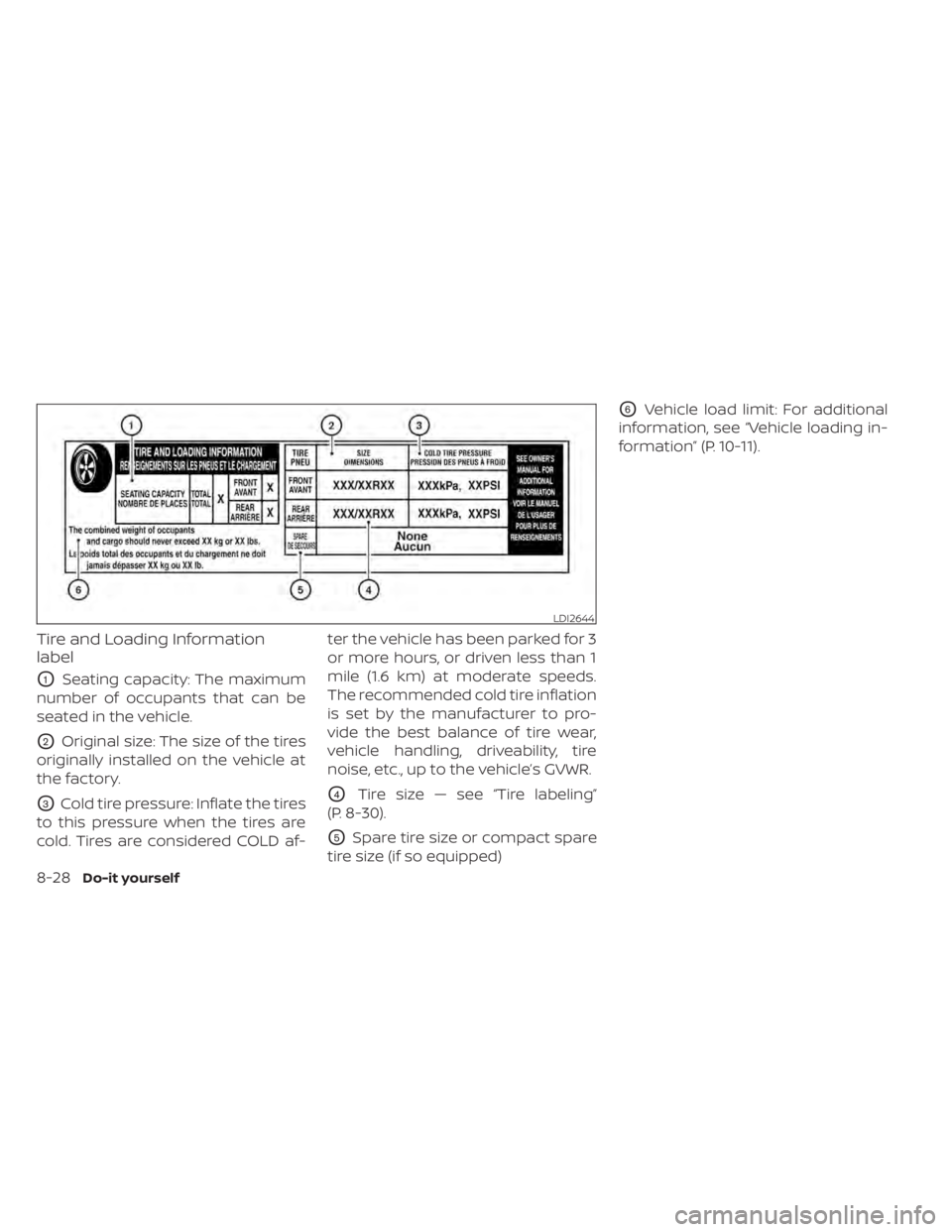
Tire and Loading Information
label
O1Seating capacity: The maximum
number of occupants that can be
seated in the vehicle.
O2Original size: The size of the tires
originally installed on the vehicle at
the factory.
O3Cold tire pressure: Inflate the tires
to this pressure when the tires are
cold. Tires are considered COLD af- ter the vehicle has been parked for 3
or more hours, or driven less than 1
mile (1.6 km) at moderate speeds.
The recommended cold tire inflation
is set by the manufacturer to pro-
vide the best balance of tire wear,
vehicle handling, driveability, tire
noise, etc., up to the vehicle’s GVWR.O4Tire size — see “Tire labeling”
(P. 8-30).
O5Spare tire size or compact spare
tire size (if so equipped)
O6Vehicle load limit: For additional
information, see “Vehicle loading in-
formation” (P. 10-11).
LDI2644
8-28Do-it yourself
Page 542 of 602
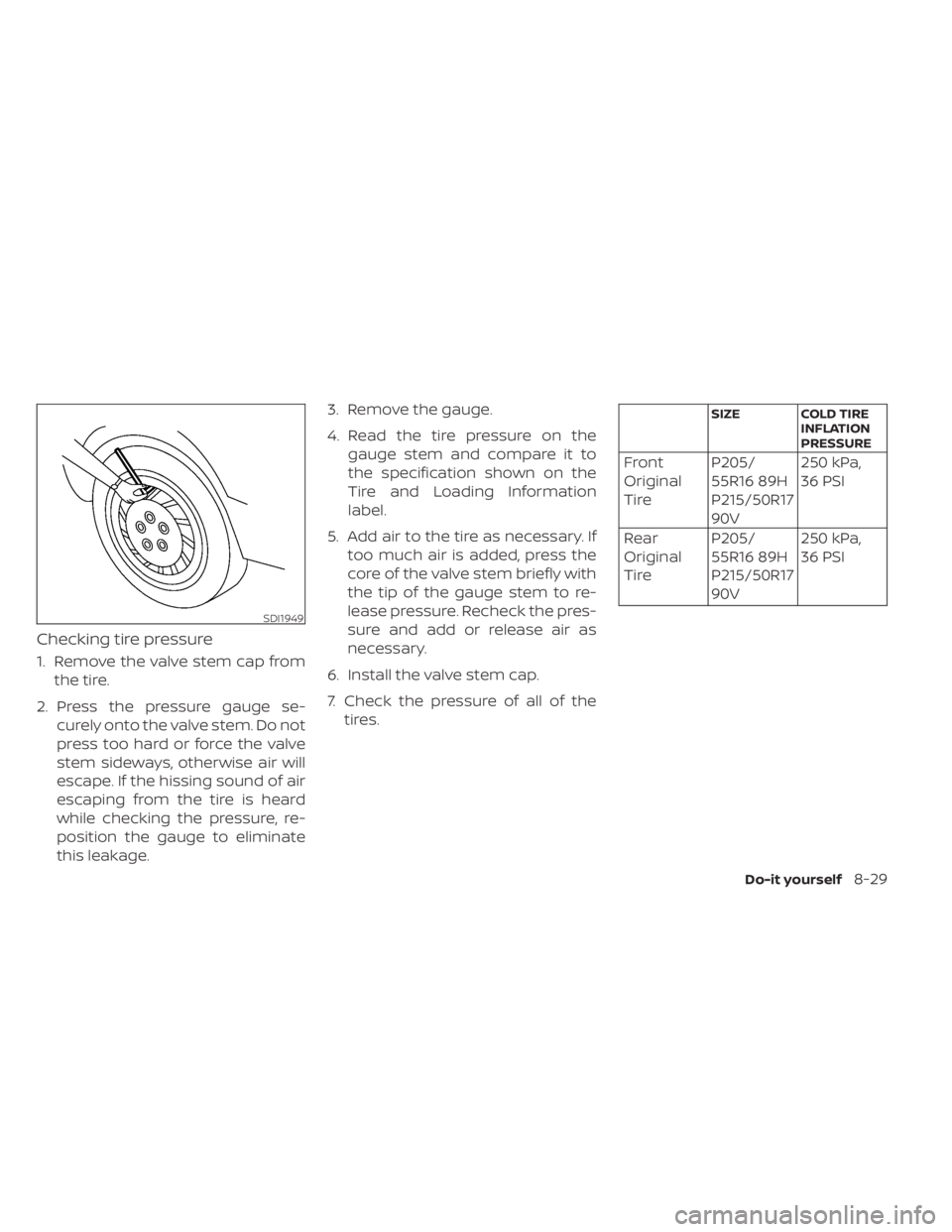
Checking tire pressure
1. Remove the valve stem cap fromthe tire.
2. Press the pressure gauge se- curely onto the valve stem. Do not
press too hard or force the valve
stem sideways, otherwise air will
escape. If the hissing sound of air
escaping from the tire is heard
while checking the pressure, re-
position the gauge to eliminate
this leakage. 3. Remove the gauge.
4. Read the tire pressure on the
gauge stem and compare it to
the specification shown on the
Tire and Loading Information
label.
5. Add air to the tire as necessary. If too much air is added, press the
core of the valve stem briefly with
the tip of the gauge stem to re-
lease pressure. Recheck the pres-
sure and add or release air as
necessary.
6. Install the valve stem cap.
7. Check the pressure of all of the tires.
SIZE COLD TIRE INFLATION
PRESSURE
Front
Original
TireP205/
55R16 89H
P215/50R17
90V 250 kPa,
36 PSI
Rear
Original
Tire P205/
55R16 89H
P215/50R17
90V 250 kPa,
36 PSI
SDI1949
Do-it yourself8-29
Page 544 of 602
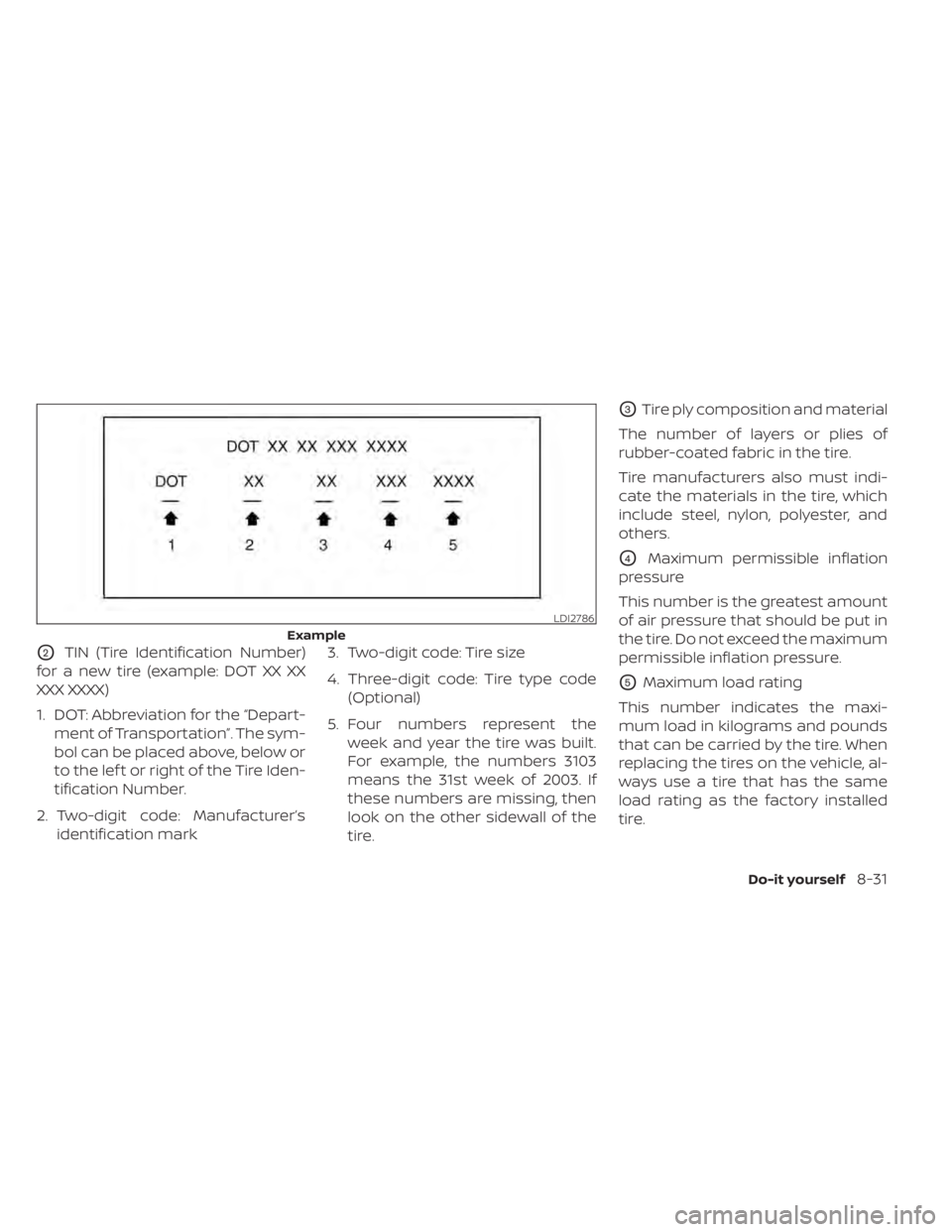
O2TIN (Tire Identification Number)
for a new tire (example: DOT XX XX
XXX XXXX)
1. DOT: Abbreviation for the “Depart- ment of Transportation”. The sym-
bol can be placed above, below or
to the lef t or right of the Tire Iden-
tification Number.
2. Two-digit code: Manufacturer’s identification mark 3. Two-digit code: Tire size
4. Three-digit code: Tire type code
(Optional)
5. Four numbers represent the week and year the tire was built.
For example, the numbers 3103
means the 31st week of 2003. If
these numbers are missing, then
look on the other sidewall of the
tire.
O3Tire ply composition and material
The number of layers or plies of
rubber-coated fabric in the tire.
Tire manufacturers also must indi-
cate the materials in the tire, which
include steel, nylon, polyester, and
others.
O4Maximum permissible inflation
pressure
This number is the greatest amount
of air pressure that should be put in
the tire. Do not exceed the maximum
permissible inflation pressure.
O5Maximum load rating
This number indicates the maxi-
mum load in kilograms and pounds
that can be carried by the tire. When
replacing the tires on the vehicle, al-
ways use a tire that has the same
load rating as the factory installed
tire.
LDI2786
Example
Do-it yourself8-31