ESP NISSAN LEAF 2022 Owner´s Manual
[x] Cancel search | Manufacturer: NISSAN, Model Year: 2022, Model line: LEAF, Model: NISSAN LEAF 2022Pages: 618, PDF Size: 4.3 MB
Page 519 of 618
In order to maintain the appearance of
your vehicle, it is important to take proper
care of it.
To protect the paint surfaces, wash your
vehicle as soon as you can:
• Af ter a rainfall to prevent possible dam-age from acid rain.
• Af ter driving on coastal roads.
• When contaminants such as soot, bird droppings, tree sap, metal particles or
bugs get on the paint surface.
• When dust or mud builds up on the surface.
Whenever possible, store or park your ve-
hicle inside a garage or in a covered area.
When it is necessary to park outside, park in
a shady area or protect the vehicle with a
body cover.
Be careful not to scratch the paint sur-
face when putting on or removing the
body cover.WASHING
Wash dirt off the vehicle with a wet sponge
and plenty of water. Clean the vehicle thor-
oughly using a mild soap, a special vehicle
soap or general purpose dishwashing liq-
uid mixed with clean, lukewarm (never hot)
water.
CAUTION
• Do not concentrate water spray di-
rectly on the sonar sensors (if so
equipped) on the bumper as this will
result in damage to the sensors. Do
not use pressure washers capable of
spraying water over 1,200 psi (8,274
kPa) to wash your vehicle. Use of
high-pressure washers over 1,200 psi
(8,274 kPa) can result in damage to or
removal of paint or graphics. Avoid
using a high-pressure washer closer
than 12 inches (30 cm) to the vehicle.
Always use a wide-angle nozzle only,
keep the nozzle moving and do not
concentrate the water spray on any
one area. •
Do not use car washes that use acid
in the detergent. Some car washes,
especially brushless ones, use some
acid for cleaning. The acid may react
with some plastic vehicle compo-
nents, causing them to crack. This
could affect their appearance, and
also could cause them not to func-
tion properly. Always check with your
car wash to confirm that acid is not
used.
• Do not wash the vehicle with strong
household soap, strong chemical de-
tergents, gasoline or solvents.
• Do not wash the vehicle in direct sun-
light or while the vehicle body is hot,
as the surface may become
water-spotted.
• Avoid using tight-napped or rough
cloths, such as washing mitts. Care
must be taken when removing
caked-on dirt or other foreign sub-
stances so the paint surface is not
scratched or damaged.
Rinse the vehicle thoroughly with plenty of
clean water.
CLEANING EXTERIOR
7-2Appearance and care
Page 521 of 618
ALUMINUM ALLOY WHEELS (if so
equipped)
Wash regularly with a sponge dampened in
a mild soap solution, especially during win-
ter months in areas where road salt is used.
Salt could discolor the wheels if not
removed.
CAUTION
Follow the directions below to avoid
staining or discoloring the wheels:
• Do not use a cleaner that uses strong
acid or alkali contents to clean the
wheels.
• Do not apply wheel cleaners to the
wheels when they are hot. The wheel
temperature should be the same as
ambient temperature.
• Rinse the wheel to completely re-
move the cleaner within 15 minutes
af ter the cleaner is applied.
CHROME PARTS
Clean chrome parts regularly with a non-
abrasive chrome polish to maintain the
finish.
TIRE DRESSING
NISSAN does not recommend the use of
tire dressings. Tire manufacturers apply a
coating to the tires to help reduce discolor-
ation of the rubber. If a tire dressing is ap-
plied to the tires, it may react with the coat-
ing and form a compound. This compound
may come off the tire while driving and
stain the vehicle paint.
If you choose to use a tire dressing, take the
following precautions:
• Use a water-based tire dressing. The coating on the tire dissolves more easily
with an oil-based tire dressing.
• Apply a light coat of tire dressing to help prevent it from entering the tire tread/
grooves (where it would be difficult to
remove).
• Wipe off excess tire dressing using a dry towel. Make sure the tire dressing is
completely removed from the tire
tread/grooves.
•
Allow the tire dressing to dry as recom-
mended by the tire dressing manufacturer.
Occasionally remove loose dust from the
interior trim, plastic parts and seats using a
vacuum cleaner or sof t bristled brush. Wipe
the vinyl and leather surfaces (if so
equipped) with a clean, sof t cloth damp-
ened in mild soap solution, then wipe clean
with a dry sof t cloth.
Regular care and cleaning is required in
order to maintain the appearance of the
leather (if so equipped).
Before using any fabric protector, read the
manufacturer’s recommendations. Some
fabric protectors contain chemicals that
may stain or bleach the seat material.
Use a cloth dampened only with water to
clean the meter and gauge lens.
WARNING
Do not use water or acidic cleaners (hot
steam cleaners) on the seat. This can
damage the seat or occupant classifi-
cation sensor (weight sensor). This can
also affect the operation of the air bag
system and result in serious personal
injury.
CLEANING INTERIOR
7-4Appearance and care
Page 524 of 618
WARNING
Do not allow wet seat belts to roll up in
the retractor. NEVER use bleach, dye, or
chemical solvents to clean the seat
belts, since these materials may se-
verely weaken the seat belt webbing.MOST COMMON FACTORS
CONTRIBUTING TO VEHICLE
CORROSION
• The accumulation of moisture-retaining dirt and debris in body panel sections,
cavities, and other areas.
• Damage to paint and other protective coatings caused by gravel and stone
chips or minor traffic accidents.
ENVIRONMENTAL FACTORS
INFLUENCE THE RATE OF
CORROSION
Moisture
Accumulation of sand, dirt and water on
the vehicle body underside can accelerate
corrosion. Wet floor coverings will not dry
completely inside the vehicle, and should
be removed for drying to avoid floor panel
corrosion.
Relative humidity
Corrosion will be accelerated in areas of
high relative humidity, especially those ar-
eas where the temperatures stay above
freezing, where atmospheric pollution ex-
ists, or where road salt is used.
Temperature
A temperature increase will accelerate the
rate of corrosion to those parts which are
not well ventilated.
Air pollution
Industrial pollution, the presence of salt in
the air in coastal areas, or heavy road salt
use will accelerate the corrosion process.
Road salt will also accelerate the disinte-
gration of paint surfaces.
PROTECT YOUR VEHICLE FROM
CORROSION
• Wash and wax your vehicle of ten to keepthe vehicle clean.
• Always check for minor damage to the paint and repair it as soon as possible.
• Keep drain holes at the bottom of the doors open to avoid water accumulation.
• Check the underbody for accumulation of sand, dirt or salt. If present, wash with
water as soon as possible.
CORROSION PROTECTION
Appearance and care7-7
Page 546 of 618
FCC Notice:
For USA:
This device complies with Part 15 of the
FCC Rules. Operation is subject to the fol-
lowing two conditions: (1) This device
may not cause harmful interference, and
(2) this device must accept any interfer-
ence received, including interference
that may cause undesired operation.
NOTE:
Changes or modifications not expressly
approved by the party responsible for
compliance could void the user’s author-
ity to operate the equipment.
For Canada:
This device contains licence-exempt
transmitter(s)/receiver(s) that comply
with Innovation, Science and Economic
Development Canada’s licence-exempt
RSS(s). Operation is subject to the fol-
lowing two conditions: (1) This device
may not cause interference. (2) This de-
vice must accept any interference, in-
cluding interference that may cause un-
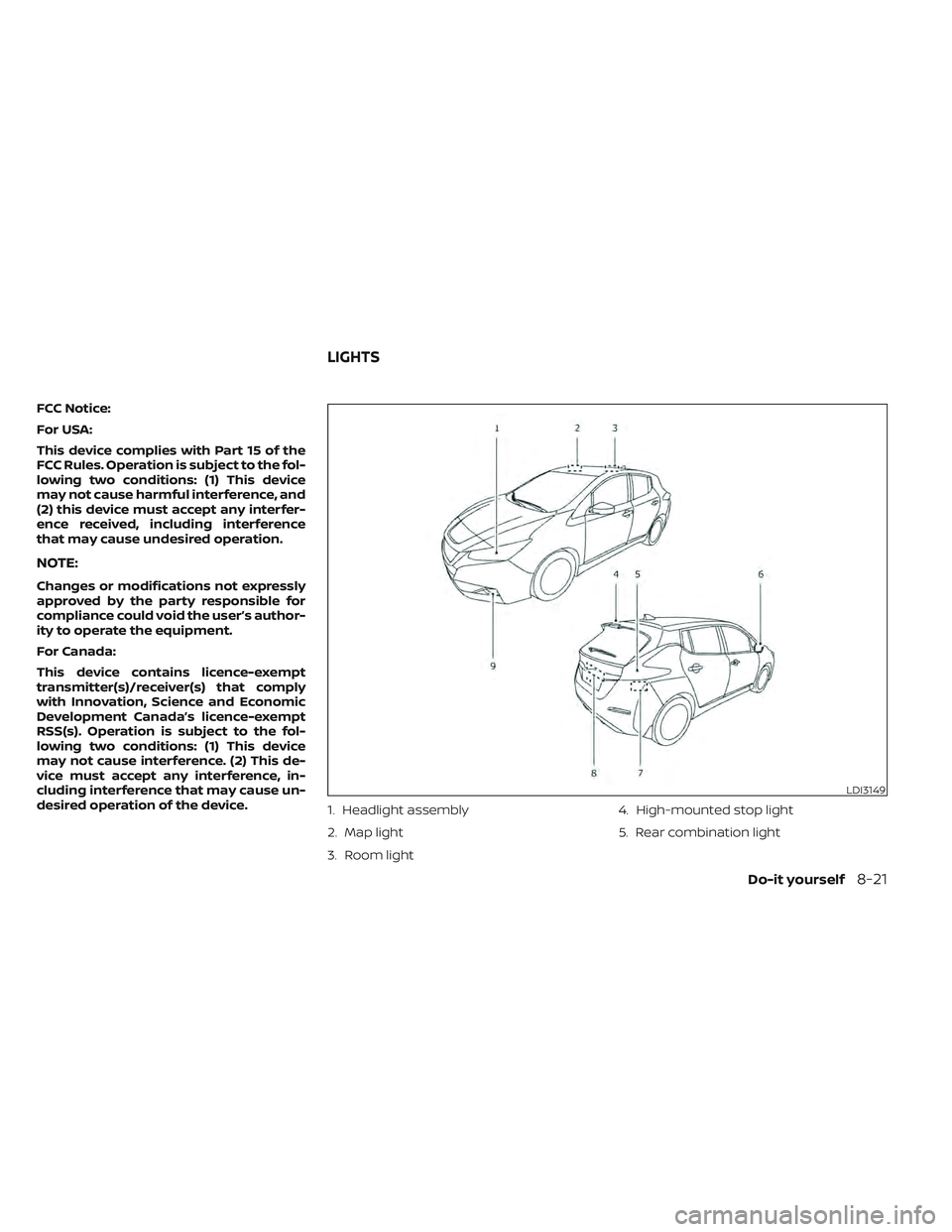
desired operation of the device.1. Headlight assembly
2. Map light
3. Room light4. High-mounted stop light
5. Rear combination light
LDI3149
LIGHTS
Do-it yourself8-21
Page 565 of 618
Some day-to-day and regular mainte-
nance is essential to maintain your vehicle
good mechanical condition, and its Electric
Vehicle (EV) system performance.
It is the owner's responsibility to make sure
that the scheduled maintenance, and gen-
eral maintenance, is performed.
As the vehicle owner, you are the only one
who can ensure that your vehicle receives
proper maintenance. You are a vital link in
the maintenance chain.
GENERAL MAINTENANCE
General maintenance includes those items
which should be checked during normal
day-to-day operation. They are essential
for proper vehicle operation. It is your re-
sponsibility to perform these procedures
regularly as prescribed.
Performing general maintenance checks
requires minimal mechanical skill and only
a few general automotive tools.
These checks or inspections can be done
by yourself, a qualified technician or, if you
prefer, a NISSAN certified LEAF dealer.
SCHEDULED MAINTENANCE
The maintenance items listed in this sec-
tion are required to be serviced at regular
intervals. However under severe driving
conditions, additional or more frequent
maintenance will be required.
WHERE TO GO FOR SERVICE
If maintenance service is required or your
vehicle appears to malfunction, have the
systems checked and serviced. It is recom-
mended that you visit a NISSAN certified
LEAF dealer for this service.
NISSAN technicians are well-trained spe-
cialists and are kept up-to-date with the
latest service information through techni-
cal bulletins, service tips, and training pro-
grams. They are fully qualified to work on
NISSAN vehiclesbeforework begins.
If your vehicle is involved in a collision, it is
recommended that you ask your NISSAN
certified LEAF dealer where the nearest
NISSAN Certified Collision Center is located,
or go to http://collision.nissanusa.com.
You can be confident that a NISSAN certi-
fied LEAF dealer's service department per-
forms the best job to meet the mainte-
nance requirements on your vehicle. During the normal day-to-day operation of
the vehicle, general maintenance should
be performed regularly as prescribed in
this section. If you detect any unusual
sounds, vibrations or smells, be sure to
check for the cause or have a NISSAN cer-
tified LEAF dealer check it promptly. In ad-
dition, it is recommended that you visit a
NISSAN certified LEAF dealer if you think
that repairs are required.
When performing any checks or mainte-
nance work, closely observe the “Mainte-
nance precautions” (P. 8-2).
EXPLANATION OF GENERAL
MAINTENANCE ITEMS
WARNING
Failure to follow the procedures listed
within this section may result in per-
sonal injury.
Additional information on the following
items with“*”isf ound in the “Do-it-
yourself ” section of this manual.
MAINTENANCE REQUIREMENTS GENERAL MAINTENANCE
9-2Maintenance and schedules
Page 569 of 618
NOTE:
Mixing any other type of coolant or the
use of nondistilled water will reduce the
recommended service interval of the
coolant.
CHASSIS AND BODY
MAINTENANCE:
Brake lines and cables:Visually inspect for
proper installation. Check for chafing,
cracks, deterioration, and signs of leaking.
Replace any deteriorated or damaged
parts immediately.
Brake pads and rotors:Check for wear, de-
terioration and fluid leaks. Replace any de-
teriorated or damaged parts immediately.
In-cabin microfilter: Replace at specified
intervals. When driving for prolonged peri-
ods in dusty conditions, replace the filter
more frequently.
Steering gear and linkage, axle and sus-
pension parts, drive shaf t boots: Check
for damage, looseness, and leakage of oil
or grease. Under severe driving conditions,
inspect more frequently. Tire rotation:
Rotate tires at the specified
interval shown in the maintenance sched-
ule. When rotating tires, check for damage
and uneven wear. Replace if necessary.
Reduction Gear Oil: Visually inspect for
signs of leakage at specified intervals. To help ensure smooth, safe and economi-
cal driving, NISSAN provides two mainte-
nance schedules that may be used, de-
pending upon the conditions in which you
usually drive. These schedules contain
both distance and time intervals, up to
120,000 miles (192,000 km)/96 months. For
most people, the odometer reading will in-
dicate when service is needed. However, if
you drive very little, your vehicle should be
serviced at the regular time intervals
shown in the schedule.
Af ter 120,000 miles (192,000 km)/96
months, continue maintenance at the
same mileage/time intervals.
ADDITIONAL MAINTENANCE ITEMS
FOR SEVERE OPERATING
CONDITIONS
Additional maintenance items for severe
operating conditions
should be per-
formed on vehicles that are driven under
especially demanding conditions. Addi-
tional maintenance items should be per-
formed if you primarily operate your vehicle
under the following conditions:
• Repeated short trips of less than 5 miles (8 km).
MAINTENANCE SCHEDULES
9-6Maintenance and schedules
Page 594 of 618
Towing your vehicle with all four wheels on
the ground is sometimes called flat towing.
This method is typically used when towing
a vehicle behind a recreational vehicle,
such as a motor home.
CAUTION
• Failure to follow these guidelines can
result in severe reduction gear
damage.
• DO NOT tow this vehicle with all four
wheels on the ground (flat towing).
• For emergency towing procedures
see “Towing your vehicle” (P. 6-13).
NOTE:
If the Li-ion battery becomes completely
discharged:
• The vehicle is automatically placed in the ON position and it will not be pos-
sible to switch to the READY to drive
position.
• The vehicle is automatically switched to the N (Neutral) position and it will not
be possible to drive the vehicle.
For additional information, see “If the Li-
ion battery becomes completely dis-
charged” (P. 6-12). DOT (Department Of Transportation) Qual-
ity Grades: All passenger car tires must
conform to federal safety requirements in
addition to these grades.
Quality grades can be found where appli-
cable on the tire sidewall between tread
shoulder and maximum section width.
For example:
Treadwear 200 Traction AA Temperature A
TREADWEAR
The treadwear grade is a comparative rat-
ing based on the wear rate of the tire when
tested under controlled conditions on a
specified government test course. For ex-
ample, a tire graded 150 would wear one
and one-half (1 1/2) times as well on the
government course as a tire graded 100.
The relative performance of tires depends
upon actual conditions of their use how-
ever, and may depart significantly from the
norm due to variations in driving habits,
service practices and differences in road
characteristics and climate.
TRACTION AA, A, B AND C
The traction grades, from highest to low-
est, are AA, A, B and C. Those grades repre-
sent the tire’s ability to stop on wet pave-
ment as measured under controlledconditions on specified government test
surfaces of asphalt and concrete. A tire
marked C may have poor traction
performance.
WARNING
The traction grade assigned to this tire
is based on straight-ahead braking
traction tests, and does not include ac-
celeration, cornering, hydroplaning, or
peak traction characteristics.
TEMPERATURE A, B AND C
The temperature grades A (the highest), B,
and C, representing the tire’s resistance to
the generation of heat and its ability to dis-
sipate heat when tested under controlled
conditions on a specified indoor laboratory
test wheel. Sustained high temperature
can cause the material of the tire to degen-
erate and reduce tire life, and excessive
temperature can lead to sudden tire failure.
The grade C corresponds to a level of per-
formance which all passenger car tires
must meet under the Federal Motor Safety
Standard No. 109. Grades B and A represent
higher levels of performance on the labo-
ratory test wheel than the minimum re-
quired by law.
FLAT TOWING UNIFORM TIRE QUALITY GRADING
Technical and consumer information10-15
Page 598 of 618
transmit data. However, the telematics fea-
tures referenced above, and perhaps oth-
ers, will not be available to you. The vehicle’s
static navigation system will remain opera-
tional, and you will be able to access your
radio and climate controls.
Telematics features are dependent on cel-
lular data transmission. Some areas may
have limited or no cellular connectivity, re-
sulting in a loss or interruption of data
transmission and, as a result, certain fea-
tures may be temporarily unavailable. Even
if areas with good signal reception, cellular
connectivity can be adversely affected by
things such as tall buildings, apartments,
tunnels, underground parking, mountain-
ous areas, etc. Even if the signal strength
bar of the in-vehicle data communication
module indicates good reception, connec-
tivity may be disrupted. This does not indi-
cate a malfunction. Operate the system
again af ter a few minutes to restore con-
nectivity. NissanConnect® EV with Services
powered by SiriusXM® features are offered
as a convenience to the vehicle owner.
NISSAN is not responsible for, and owner
assumes all risk of, interruptions in service
or errors based on incomplete or inaccu-
rate data. NissanConnect® EV with Services
powered by SiriusXM® communications
may be received at a verified e-mail ad-dress or by SMS/text messaging-enabled
mobile phone. Standard text rates and/or
data usage may apply depending on your
carrier.
If your vehicle’s telematics account is ac-
tive, and you are not the original owner,
please contact NISSAN at the website or
phone number above as soon as possible
to update the telematics enrollment infor-
mation. Upon sale of the vehicle, please
contact NISSAN at the website or phone
number above so that NISSAN’s records
may be updated. NissanConnect® EV with
Services powered by SiriusXM® subscrip-
tion services will automatically terminate
at the end of the initial free term if you do
not wish to renew your subscription agree-
ment at the prices then in effect.
A. INTRODUCTION
This product Telematic Control Unit Gen2K
incorporates the following sof tware:
1. the sof tware developed by, or developed
for, Ficosa International, S.A. (“Ficosa”),
2. the sof tware owned by third party and licensed to Ficosa,
3. the sof tware licensed under the GNU GENERAL PUBLIC LICENSE, Version 2
(“GPL”),
4. the sof tware licensed under the GNU LI- BRARY GENERAL PUBLIC LICENSE, Ver-
sion 2.0 or the GNU LESSER GENERAL
PUBLIC LICENSE, Version 2.1 (collectively
“LGPL”), the Mozilla Public license v2
(“MPL”), the GPL-2.0 license with-
OpenSSL-exception (“GPLOpenSSL”) and
GNU GENERAL PUBLIC LICENSE, Version
3 with GCC exception (together with the
GPL sof tware, jointly “Copylef t Sof t-
ware”), and/or
5. open sourced sof tware licensed under terms and conditions other than Copyl-
ef t Sof tware.
TELEMATIC CONTROL UNIT GEN2K
Technical and consumer information10-19
Page 599 of 618
For the sof tware classified as (3) or (4)
above, a copy of the license text is included
with the source code in the URL indicated
below, and please also refer to the terms
and conditions of Copylef t Sof tware li-
censes at the websites listed below:
GPL: and
LGPL: and
MPL:
GPL-2.0-with-OpenSSL-exception:
GPLv3 GCC Exception:
The sof tware classified as (3) and (4) above
are copyrighted by multiple people.
Please refer to the websites below regard-
ing the copyright notices of those people.
https://www.ficosa.com/sof tware/
opensource/
The sof tware licensed under the licenses
indicated in (3) and (4) above (“Copylef t
Sof tware”) is distributed in the hope that it
will be useful, but WITHOUT ANY WARRANTY,
without even the implied warranty of MER-
CHANTABILITY or FITNESS FOR A PARTICU-
LAR PURPOSE.For at least three (3) years from delivery of a
device embedding the above product, Fi-
cosa will give to any third party who con-
tacts us at the Contact Information pro-
vided below, for a charge no more than our
cost of physically performing source code
distribution, a complete machine-readable
copy of the source code corresponding to
the Copylef t Sof tware indicated above.
When requesting this source code, please
specif y Product: Telematic Control Unit
Gen2K and version Cx.9.
Furthermore, source code and licenses
corresponding to the Copylef t Sof tware
listed above is freely available to you and
any member of the public at the website
listed below:
https://www.ficosa.com/sof tware/
opensource/
Contact Information
For enquiries about open source sof tware
at FICOSA, please contact Ficosa’s Compli-
ance Officer by email: [email protected]
Please note that we are unable to answer
any queries regarding source code details,
etc.In addition, it is necessary for end users to
provide their own internet connection.
The end user is responsible for any con-
nection or line charges incurred through
browsing websites or downloading.
B. LICENSING ANC COPYRIGHT NOTICE
INFORMATION
The sof tware classified as (5) above con-
tains various open sourced sof tware
(“OSS”) listed in the below website. Please
see the website indicted next for the terms
and conditions of the licenses (OSS Li-
censes) and other information regarding
the OSS contained this Product:
https://www.ficosa.com/sof tware/
opensource/
10-20Technical and consumer information
Page 601 of 618
• In response to an official request from lawenforcement, a court order, governmen-
tal agency, or other legally enforceable
requests
• For use as part of NISSAN's defense of litigation
• For research purposes af ter the data is modified such that it is no longer tied to a
specific vehicle or vehicle owner
If you have any questions regarding the
data NISSAN may collect about you,
please visit our Privacy Policy:
https://www.nissanusa.com. Genuine NISSAN Service Manuals for this
model year and prior can be purchased. A
Genuine NISSAN Service Manual is the best
source of service and repair information for
your vehicle. This manual is the same one
used by the factory trained technicians
working at a NISSAN certified LEAF dealer.
Genuine NISSAN Owner’s Manuals can also
be purchased.
For USA:
For current pricing and availability of Genu-
ine
NISSAN Service Manuals, contact:
www.nissan-techinfo.com
For current pricing and availability of Genu-
ine NISSAN Owner’s Manuals, contact:
1-800-247-5321
For Canada:
To purchase a copy of a Genuine NISSAN
Service Manual or Owner’s Manual for this
model year and prior, please contact a
NISSAN certified LEAF dealer. For the phone
number and location of a NISSAN certified
LEAF dealer in your area, call the NISSAN
Information Center at 1-800-387-0122 and
a bilingual NISSAN representative will assist
you.
OWNER'S MANUAL/SERVICE
MANUAL ORDER INFORMATION
10-22Technical and consumer information