service NISSAN LEAF 2022 Owner´s Manual
[x] Cancel search | Manufacturer: NISSAN, Model Year: 2022, Model line: LEAF, Model: NISSAN LEAF 2022Pages: 618, PDF Size: 4.3 MB
Page 493 of 618
WARNING
The Intelligent Ride Control may not be
effective depending on the driving con-
dition. Always drive carefully and
attentively.
When the Intelligent Ride Control is operat-
ing, you may hear a noise and sense slight
deceleration. This is normal and indicates
that the Intelligent Ride Control is operat-
ing properly.
If the “Chassis Control System Error: See
Owner’s Manual” warning message ap-
pears in the vehicle information display, it
may indicate that the Intelligent Ride Con-
trol is not functioning properly. Have the
system checked as soon as possible. It is
recommended that you visit a NISSAN cer-
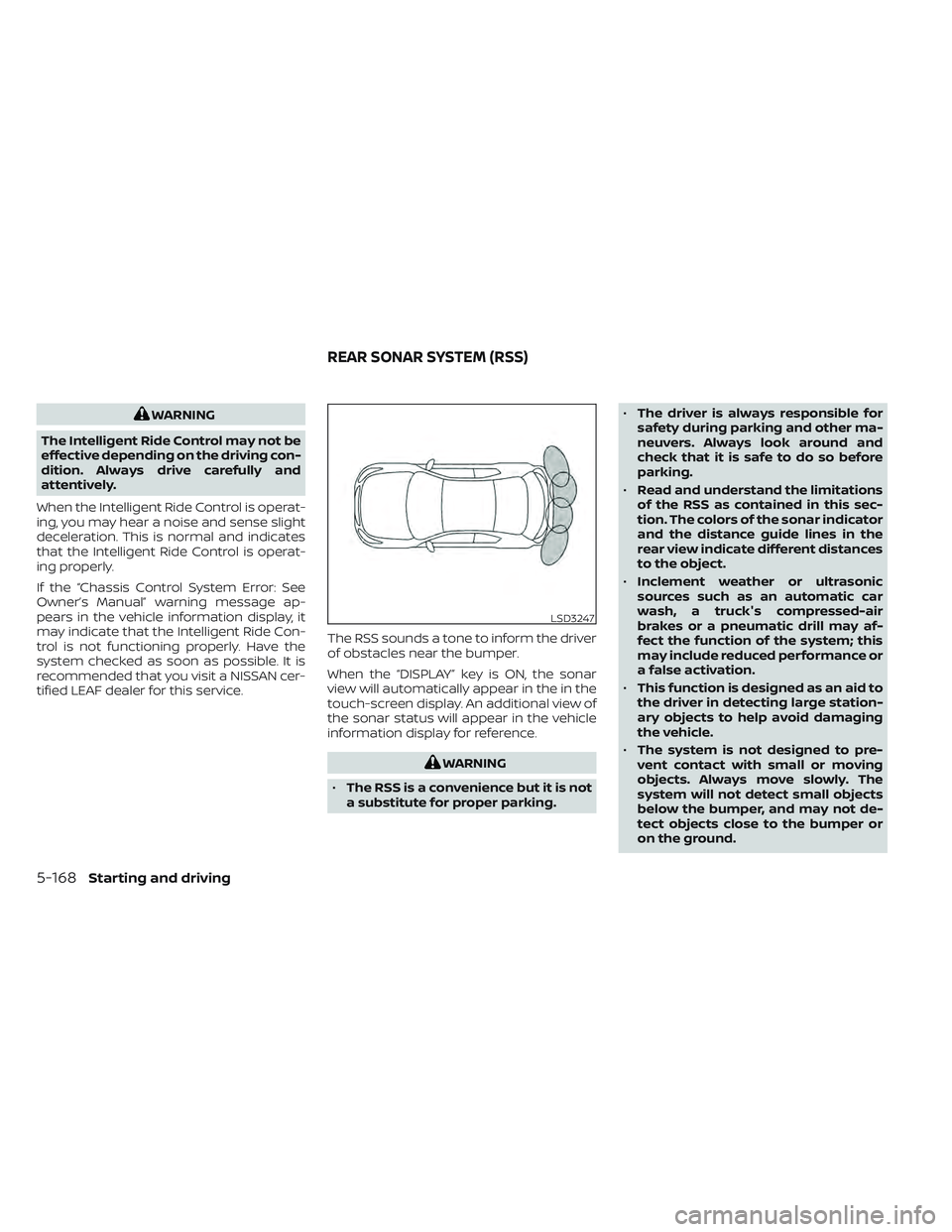
tified LEAF dealer for this service. The RSS sounds a tone to inform the driver
of obstacles near the bumper.
When the “DISPLAY” key is ON, the sonar
view will automatically appear in the in the
touch-screen display. An additional view of
the sonar status will appear in the vehicle
information display for reference.
WARNING
• The RSS is a convenience but it is not
a substitute for proper parking. •
The driver is always responsible for
safety during parking and other ma-
neuvers. Always look around and
check that it is safe to do so before
parking.
• Read and understand the limitations
of the RSS as contained in this sec-
tion. The colors of the sonar indicator
and the distance guide lines in the
rear view indicate different distances
to the object.
• Inclement weather or ultrasonic
sources such as an automatic car
wash, a truck's compressed-air
brakes or a pneumatic drill may af-
fect the function of the system; this
may include reduced performance or
a false activation.
• This function is designed as an aid to
the driver in detecting large station-
ary objects to help avoid damaging
the vehicle.
• The system is not designed to pre-
vent contact with small or moving
objects. Always move slowly. The
system will not detect small objects
below the bumper, and may not de-
tect objects close to the bumper or
on the ground.
LSD3247
REAR SONAR SYSTEM (RSS)
5-168Starting and driving
Page 503 of 618
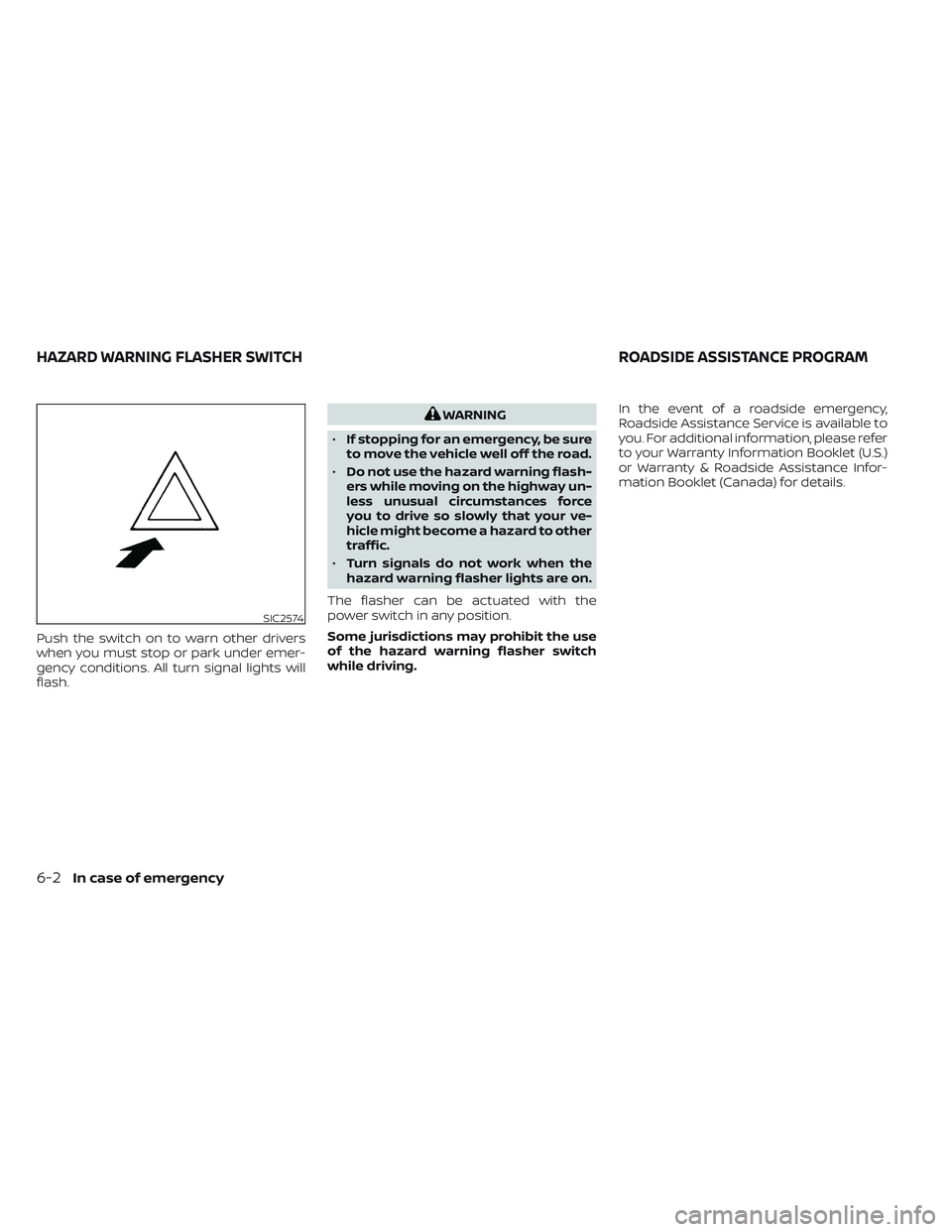
Push the switch on to warn other drivers
when you must stop or park under emer-
gency conditions. All turn signal lights will
flash.
WARNING
• If stopping for an emergency, be sure
to move the vehicle well off the road.
• Do not use the hazard warning flash-
ers while moving on the highway un-
less unusual circumstances force
you to drive so slowly that your ve-
hicle might become a hazard to other
traffic.
• Turn signals do not work when the
hazard warning flasher lights are on.
The flasher can be actuated with the
power switch in any position.
Some jurisdictions may prohibit the use
of the hazard warning flasher switch
while driving. In the event of a roadside emergency,
Roadside Assistance Service is available to
you. For additional information, please refer
to your Warranty Information Booklet (U.S.)
or Warranty & Roadside Assistance Infor-
mation Booklet (Canada) for details.
SIC2574
HAZARD WARNING FLASHER SWITCH
ROADSIDE ASSISTANCE PROGRAM
6-2In case of emergency
Page 504 of 618
To shut off the EV system in an emergency
situation while driving, perform the follow-
ing procedure.
• Rapidly push the power switch three con-secutive times in less than 1.5 seconds, or
• Push and hold the power switch for more than 2 seconds.TIRE PRESSURE MONITORING
SYSTEM (TPMS)
This vehicle is equipped with TPMS. It moni-
tors tire pressure of all tires. When the low
tire pressure warning light is lit, and the “Tire
Pressure Low — Add Air” warning appears
on the vehicle information display, one or
more of your tires is significantly under-
inflated. If the vehicle is being driven with
low tire pressure, the TPMS will activate and
warn you of it by the low tire pressure warn-
ing light. This system will activate only
when the vehicle is driven at speeds above
16 mph (25 km/h). For additional informa-
tion, see “Warning lights, indicator lights
and audible reminders” (P. 2-14) and “Tire
Pressure Monitoring System (TPMS)” (P. 5-4).
WARNING
• Radio waves could adversely affect
electric medical equipment. Those
who use a pacemaker should contact
the electric medical equipment
manufacturer for the possible influ-
ences before use. •
If the low tire pressure warning light
illuminates while driving, avoid sud-
den steering maneuvers or abrupt
braking, reduce vehicle speed, pull
off the road to a safe location and
stop the vehicle as soon as possible.
Driving with underinflated tires may
permanently damage the tires and
increase the likelihood of tire failure.
Serious vehicle damage could occur
and may lead to an accident and
could result in serious personal in-
jury. Check the tire pressure for all
four tires. Adjust the tire pressure to
the recommended COLD tire pres-
sure shown on the Tire and Loading
Information label to turn the low tire
pressure warning light OFF. If the
light still illuminates while driving af-
ter adjusting the tire pressure, a tire
may be flat or the TPMS may be mal-
functioning. If you have a flat tire, re-
pair it as soon as possible. If no tire is
flat and all tires are properly inflated,
have the vehicle checked. It is recom-
mended that you visit a certified
LEAF dealer for this service.
EMERGENCY EV (Electric Vehicle)
SHUT OFF FLAT TIRE
In case of emergency6-3
Page 505 of 618
•When using a wheel without the
TPMS such as the spare tire, the TPMS
will not function and the low tire
pressure warning light will flash for
approximately 1 minute. The light will
remain on af ter 1 minute. Have your
tires replaced and/or TPMS system
reset as soon as possible. It is recom-
mended that you visit a NISSAN cer-
tified LEAF dealer for these services.
• Replacing tires with those not origi-
nally specified by NISSAN could af-
fect the proper operation of the
TPMS.
• The Genuine NISSAN Emergency Tire
Repair Sealant or equivalent can be
used for temporarily repairing a tire.
Do not inject any other tire liquid or
aerosol tire sealant into the tires, as
this may cause a malfunction of tire
pressure sensors. •
NISSAN recommends using only
Genuine NISSAN Emergency Tire
Sealant provided with your vehicle.
Other tire sealants may damage the
valve stem seal which can cause the
tire to lose air pressure. It is recom-
mended that you visit a NISSAN cer-
tified LEAF dealer as soon as possible
af ter using tire repair sealant (for
models equipped with the emer-
gency tire puncture repair kit).
REPAIRING FLAT TIRE
WARNING
• Af ter using Genuine NISSAN Emer-
gency Tire Sealant to repair a minor
tire puncture, do not drive the vehicle
at speeds faster than 50 mph (80
km/h).
• Immediately af ter using the Genuine
NISSAN Emergency Tire Sealant to
repair a minor tire puncture, it is rec-
ommended that you visit a NISSAN
certified LEAF dealer. The Genuine
NISSAN Emergency Tire Sealant can-
not permanently seal a punctured
tire. Continuing operation of the ve-
hicle without a permanent tire repair
can lead to a crash. •
If you used the Genuine NISSAN
Emergency Tire Sealant to repair a
minor tire puncture, it is recom-
mended that you visit a NISSAN cer-
tified LEAF dealer to replace the
TPMS sensor in addition to repairing
or replacing the tire.
• NISSAN recommends using only
Genuine NISSAN Emergency Tire
Sealant provided with your vehicle.
Other tire sealants may damage the
valve stem seal which can cause the
tire to lose air pressure.
This vehicle does not have a spare tire. The
emergency tire puncture repair kit (Genu-
ine NISSAN Emergency Tire Sealant) is sup-
plied with the vehicle instead of a spare tire.
It can be used to temporarily repair minor
tire punctures.
If possible, have the vehicle towed to a fa-
cility that can repair or replace the flat tire.
Using the emergency tire puncture repair
kit may cause a malfunction of the tire
pressure sensor and cause the low tire
pressure warning light to illuminate.
6-4In case of emergency
Page 514 of 618
WARNING
If the vehicle is in the N (Neutral) posi-
tion and the Li-ion battery and the 12-
volt battery become completely dis-
charged, the vehicle cannot be placed
in the P (Park) position. If this occurs,
place suitable blocks at both the front
and back of a wheel to prevent the ve-
hicle from moving. Failure to block a
wheel may allow the vehicle to move
unexpectedly which may result in seri-
ous personal injury or death.
To place the vehicle in the READY to drive
position so the vehicle can be driven,
charge the Li-ion battery until the driving
range on the instrument panel changes
from “---” to a numeric distance.
NOTE:
• Some vibration may occur when the vehicle is stopped in case the Li-ion
battery becomes completely dis-
charged. This is not the malfunction of
the system.
• If the Li-ion battery is completely dis- charged, it is required to charge until
the low battery charge warning light
turns off (white) from on (yellow). Do not attempt to start the system by
pushing the vehicle.
CAUTION
An EV cannot be push-started or tow-
started. Attempting to do so may cause
traction motor damage. When towing your vehicle, all State (Provin-
cial in Canada) and local regulations for
towing must be followed.
Incorrect towing equipment could dam-
age your vehicle. Towing instructions are
available from a NISSAN certified LEAF
dealer. Local service operators are familiar
with the applicable laws and procedures
for towing. To assure proper towing and to
prevent accidental damage to your vehicle,
NISSAN recommends that you have a ser-
vice operator tow your vehicle. It is advis-
able to have the service operator carefully
read the following precautions.
WARNING
• Never ride in a vehicle that is being
towed.
• Never get under your vehicle af ter it
has been lif ted by a tow truck.
PUSH STARTING TOWING YOUR VEHICLE
In case of emergency6-13
Page 527 of 618
When performing any inspection or main-
tenance work on your vehicle, always take
care to prevent serious accidental injury to
yourself or damage to the vehicle. The fol-
lowing are general precautions that should
be closely observed.
WARNING
• The EV system uses high voltage up
to approximately DC 400 volt. The
system can be hot during and af ter
starting and when the vehicle is shut
off. Be careful of both the high volt-
age and the high temperature. Obey
the labels that are attached to the
vehicle.
• Never disassemble, remove or re-
place high-voltage parts and cables
as well as their connectors. High-
voltage cables are colored orange.
• Disassembling, removing or replac-
ing those parts or cables can cause
severe burns or electric shock that
may result in serious injury or death.
The vehicle high-voltage system has
no user serviceable parts. It is recom-
mended that you visit a NISSAN cer-
tified LEAF dealer for any necessary
maintenance. •
Park the vehicle on a level surface,
apply the parking brake securely and
chock the wheels to prevent the ve-
hicle from moving. Push the P (Park)
position switch on the shif t lever or
place the vehicle into the N (Neutral)
position.
• If you must work with the EV (Electric
Vehicle) system is turned on, keep
hands, clothing, hair and tools away
from moving fans and any other
moving parts.
• Make sure that the power switch is in
the OFF or LOCK position when per-
forming any part replacement or
repairs.
• It is advisable to secure or remove
any loose clothing and remove any
jewelry, such as rings, watches, etc.
before working on your vehicle.
• Always wear eye protection when-
ever you work on your vehicle.
• Never get under the vehicle while it is
supported only by a jack. If it is nec-
essary to work under the vehicle,
support it with safety stands.
• Keep smoking materials, flames and
sparks away from the 12-volt battery.
CAUTION
• Do not work under the hood while
the motor compartment is hot. Push
the power switch in the OFF position
and wait until it cools down.
• Avoid direct contact with used cool-
ant. Improperly disposed coolant
and/or other vehicle fluids can dam-
age the environment. Always con-
form to local regulations for the dis-
posal of vehicle fluids.
• Never connect or disconnect the bat-
tery or any transistorized compo-
nent while the power switch is in the
ON position.
• Your vehicle is equipped with an au-
tomatic cooling fan. It may come on
at any time without warning, even if
the power switch is not in the ACC, ON
or READY to drive position. To avoid
injury, always disconnect the nega-
tive 12-volt battery cable before
working near the fan.
• Before performing any electrical
maintenance work on the vehicle
such as the battery, fuses or bulb re-
placement, confirm the following:
– The charge connector is removed
from the vehicle.
MAINTENANCE PRECAUTIONS
8-2Do-it yourself
Page 528 of 618
–The Climate Ctrl. Timer is not ac-
tive or operating. For additional
information, see “Climate Ctrl.
Timer” (P. 4-38).
– The 12-volt battery is not being
charged by the Li-ion battery and
that all charging status indicator
lights are off. For additional infor-
mation, see “Charging the 12-volt
battery ” (P. EV-5) and “Charging
status indicator lights” (P. CH-49).
• The power switch is in the OFF posi-
tion. Place the power switch in the ON
position and then in the OFF position
to prevent the 12-volt battery auto-
matically being charged by the Li-ion
battery. For additional information,
see “Charging the 12-volt battery ”
(P. EV-5).
NOTE:
If the battery is completely drained the
transmission will not manually shif t to
other positions. The “Do-it-yourself ” section gives instruc-
tions regarding only those items that are
relatively easy for an owner to perform.
A Genuine NISSAN Service Manual is also
available. For additional information, see
“Owner’s manual/service manual order in-
formation” (P. 10-22).
You should be aware that incomplete or
improper servicing may result in operating
difficulties and could affect your warranty
coverage.
If in doubt about any servicing,
it is recommended that you visit a
NISSAN certified LEAF dealer.
Do-it yourself8-3
Page 531 of 618
CHECKING COOLANT LEVEL
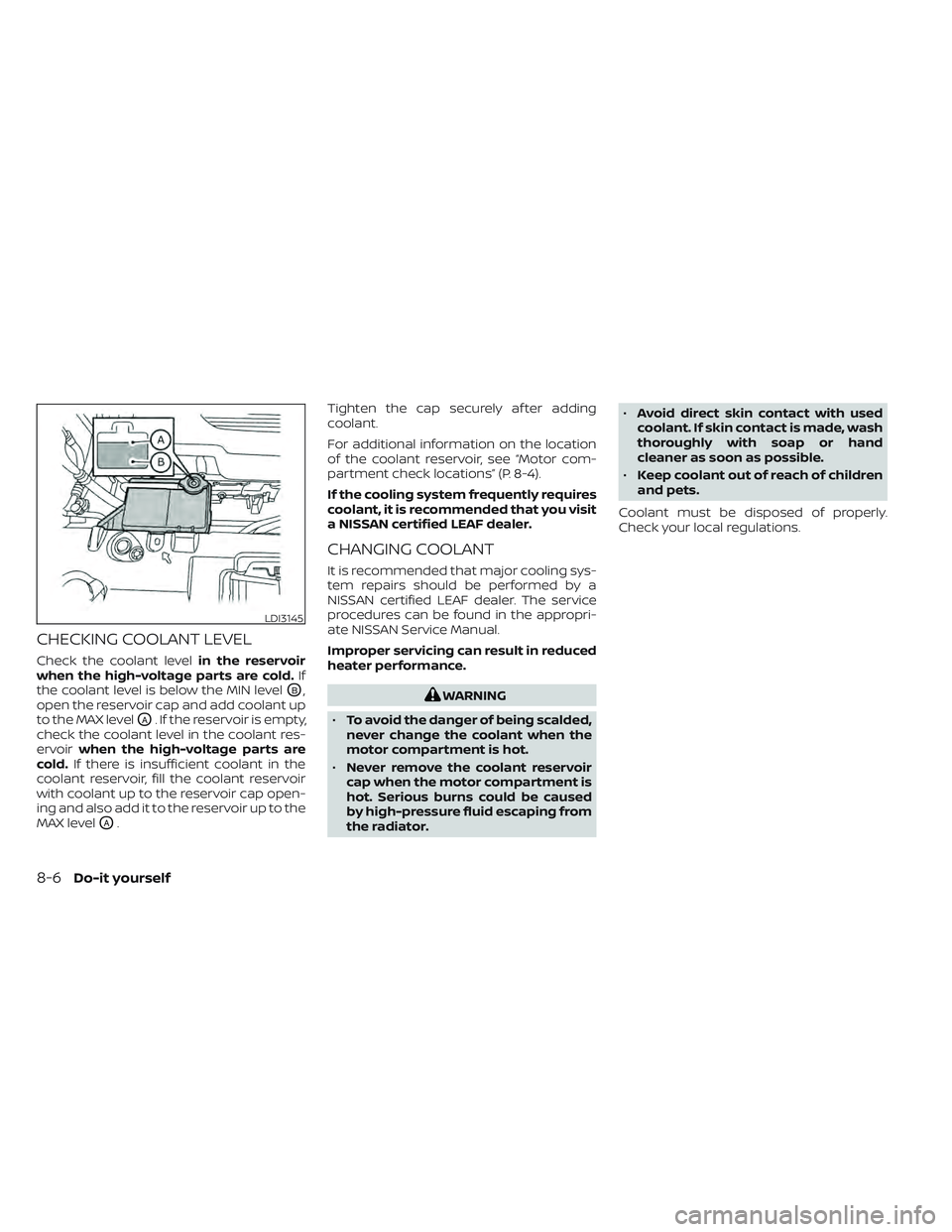
Check the coolant levelin the reservoir
when the high-voltage parts are cold. If
the coolant level is below the MIN level
OB,
open the reservoir cap and add coolant up
to the MAX level
OA. If the reservoir is empty,
check the coolant level in the coolant res-
ervoir when the high-voltage parts are
cold. If there is insufficient coolant in the
coolant reservoir, fill the coolant reservoir
with coolant up to the reservoir cap open-
ing and also add it to the reservoir up to the
MAX level
OA. Tighten the cap securely af ter adding
coolant.
For additional information on the location
of the coolant reservoir, see “Motor com-
partment check locations” (P. 8-4).
If the cooling system frequently requires
coolant, it is recommended that you visit
a NISSAN certified LEAF dealer.
CHANGING COOLANT
It is recommended that major cooling sys-
tem repairs should be performed by a
NISSAN certified LEAF dealer. The service
procedures can be found in the appropri-
ate NISSAN Service Manual.
Improper servicing can result in reduced
heater performance.
WARNING
• To avoid the danger of being scalded,
never change the coolant when the
motor compartment is hot.
• Never remove the coolant reservoir
cap when the motor compartment is
hot. Serious burns could be caused
by high-pressure fluid escaping from
the radiator. •
Avoid direct skin contact with used
coolant. If skin contact is made, wash
thoroughly with soap or hand
cleaner as soon as possible.
• Keep coolant out of reach of children
and pets.
Coolant must be disposed of properly.
Check your local regulations.
LDI3145
8-6Do-it yourself
Page 532 of 618
When checking or replacement is required,
it is recommended that you visit a NISSAN
certified LEAF dealer for this service.
CAUTION
• Use only Genuine NISSAN Matic S ATF.
Do not mix with other fluids.
• Using reduction gear fluid other than
Genuine NISSAN Matic S ATF will
cause deterioration in driveability
and reduction gear durability, and
may damage the reduction gear,
which is not covered by the NISSAN
New Vehicle Limited Warranty. For additional brake fluid information, see
“Recommended fluids/lubricants and ca-
pacities” (P. 10-2).WARNING
• Use only new fluid from a sealed con-
tainer. Old, inferior or contaminated
fluid may damage the brake system.
The use of improper fluids can dam-
age the brake system, and affect the
vehicle’s stopping ability.
• Clean the filler cap before removing.
• Brake fluid is poisonous and should
be stored carefully in marked con-
tainers out of the reach of children.
CAUTION
Do not spill the fluid on any painted sur-
faces. This will damage the paint. If fluid
is spilled, immediately wash the sur-
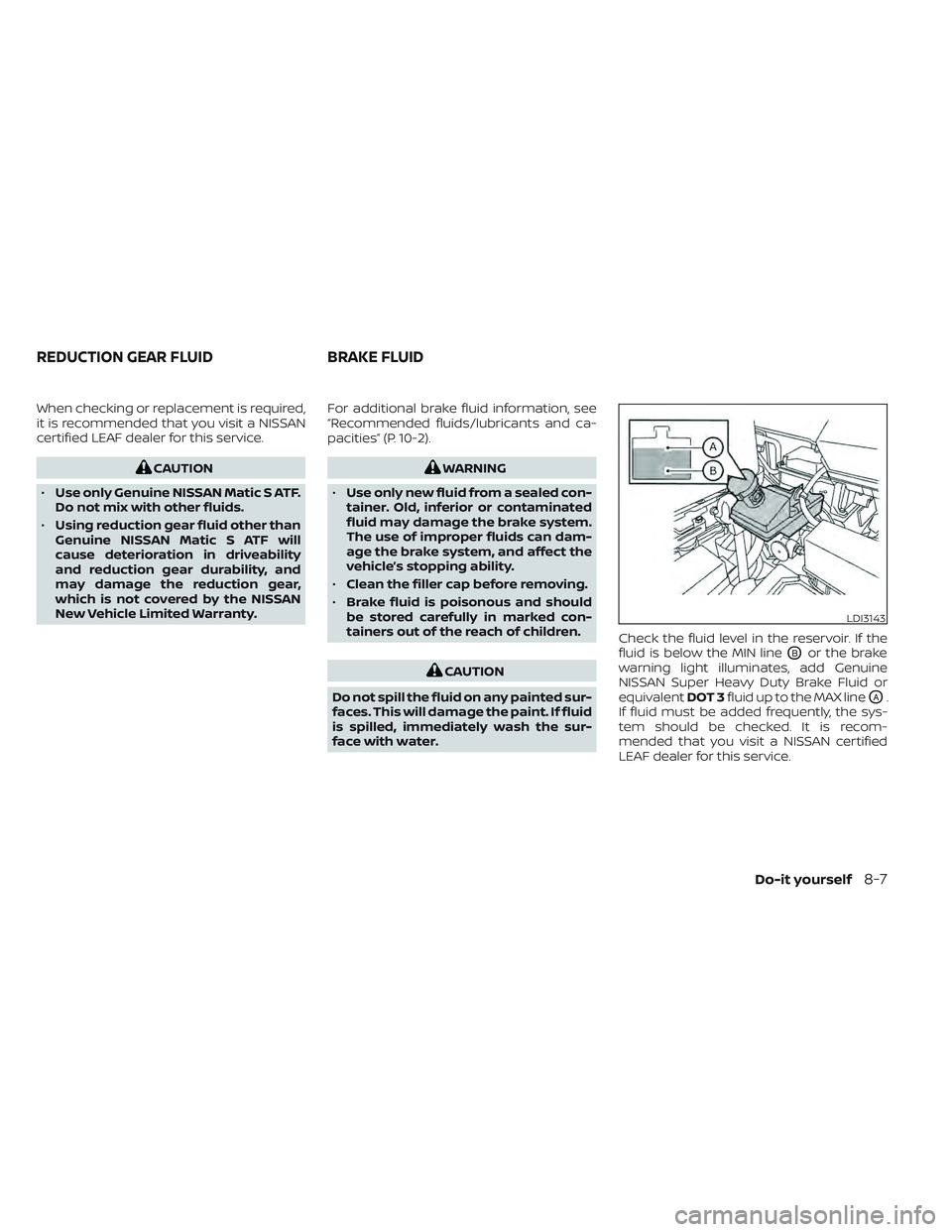
face with water. Check the fluid level in the reservoir. If the
fluid is below the MIN line
OBor the brake
warning light illuminates, add Genuine
NISSAN Super Heavy Duty Brake Fluid or
equivalent DOT 3fluid up to the MAX line
OA.
If fluid must be added frequently, the sys-
tem should be checked. It is recom-
mended that you visit a NISSAN certified
LEAF dealer for this service.
LDI3143
REDUCTION GEAR FLUID BRAKE FLUID
Do-it yourself8-7
Page 536 of 618
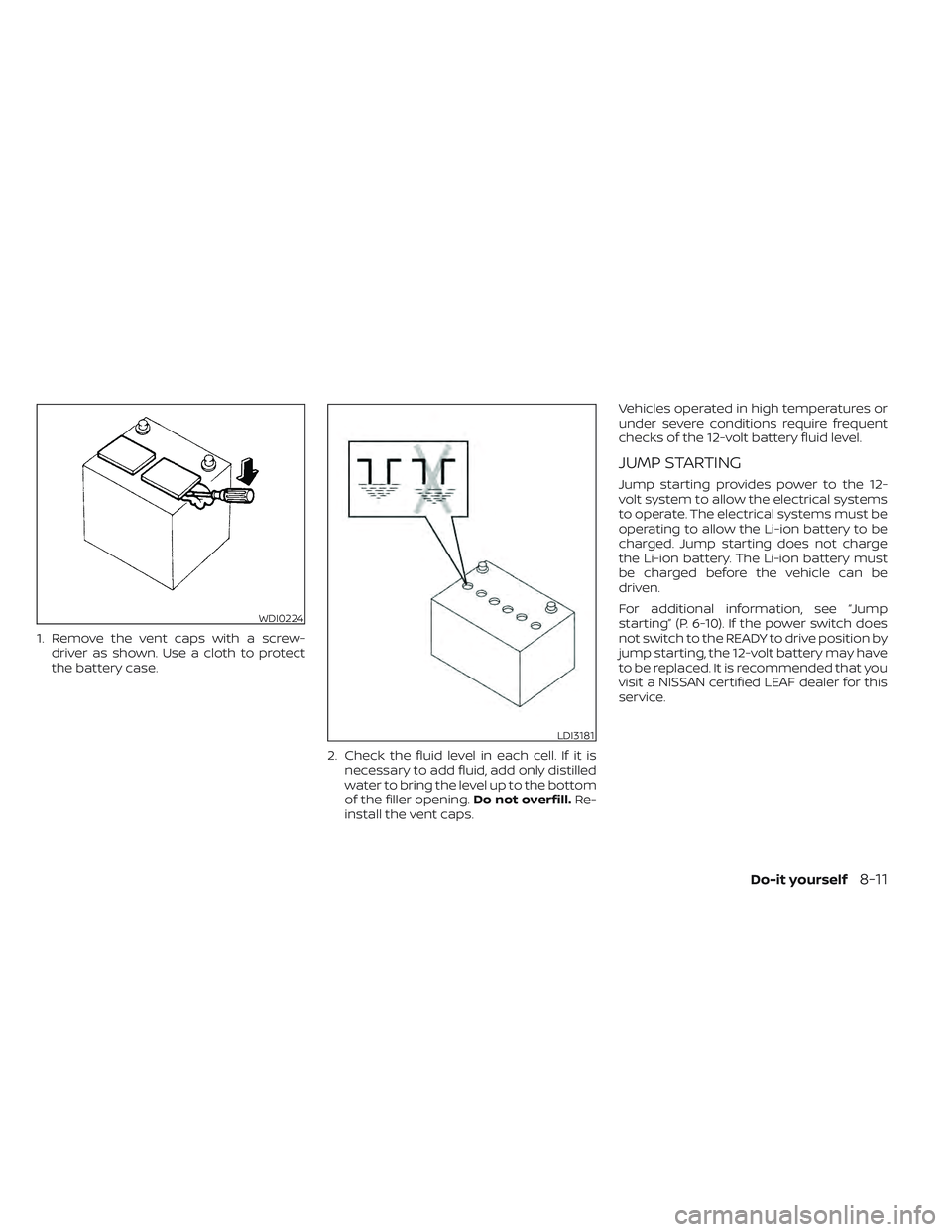
1. Remove the vent caps with a screw-driver as shown. Use a cloth to protect
the battery case.
2. Check the fluid level in each cell. If it isnecessary to add fluid, add only distilled
water to bring the level up to the bottom
of the filler opening. Do not overfill.Re-
install the vent caps. Vehicles operated in high temperatures or
under severe conditions require frequent
checks of the 12-volt battery fluid level.
JUMP STARTING
Jump starting provides power to the 12-
volt system to allow the electrical systems
to operate. The electrical systems must be
operating to allow the Li-ion battery to be
charged. Jump starting does not charge
the Li-ion battery. The Li-ion battery must
be charged before the vehicle can be
driven.
For additional information, see “Jump
starting” (P. 6-10). If the power switch does
not switch to the READY to drive position by
jump starting, the 12-volt battery may have
to be replaced. It is recommended that you
visit a NISSAN certified LEAF dealer for this
service.
WDI0224
LDI3181
Do-it yourself8-11