AKI NISSAN MAXIMA 2000 A33 / 5.G Owner's Manual
[x] Cancel search | Manufacturer: NISSAN, Model Year: 2000, Model line: MAXIMA, Model: NISSAN MAXIMA 2000 A33 / 5.GPages: 239, PDF Size: 1.97 MB
Page 219 of 239

When planning to travel in another country,
you should first find out if the fuel available is
suitable for your vehicle's engine.
Using fuel with too low an octane rating may
cause engine damage. All gasoline vehicles
must be operated with unleaded engine gaso-
line. Therefore, avoid taking your vehicle to
areas where appropriate fuel is not available.
When transferring the registration of your
vehicle to another country, state, province
or district,it may be necessary to modify the
vehicle to meet local laws and regulations.
The laws and regulations for motor vehicle
emission control and safety standards vary
according to the country, state, province or
district; therefore, vehicle specifications may
differ.
When any vehicle is to be taken into an-
other country, state, province or district
and registered, its modifications, transpor-
tation, and registration are the responsibil-
ity of the user. NISSAN is not responsible
for any inconvenience that may result.
VEHICLE IDENTIFICATION
NUMBER (VIN) PLATEThe vehicle identification number plate is at-
tached as shown. This number is the identifi-
cation for your vehicle and is used in the
vehicle registration.
VEHICLE IDENTIFICATION
NUMBER (Chassis number)The number is stamped as shown.
STI0038
STI0187
WHEN TRAVELING OR
REGISTERING YOUR VEHICLE IN
ANOTHER COUNTRYVEHICLE IDENTIFICATION10-10
Technical and consumer information
Z
00.1.17/A33-D/V5.0
X
Page 224 of 239

ceeded. If GVWR is exceeded, remove
cargo as necessary. If either the front or
rear GAWR is exceeded, shift the load or
remove cargo as necessary.
LOADING TIPSIThe GVW must not exceed GVWR or
GAWR as specified on the F.M.V.S.S. cer-
tification label.
IDo not load the front and rear axle to the
GAWR. Doing so will exceed the GVWR.
WARNING
IProperly secure all cargo to help pre-
vent it from sliding or shifting. Do not
place cargo higher than the seat-
backs. In a sudden stop or collision,
unsecured cargo could cause per-
sonal injury.
IDo not load your vehicle any heavier
than the GVWR or the maximum front
and rear GAWRs. If you do, parts on
your vehicle can break, or it can
change the way your vehicle handles.
This could result in loss of controland cause personal injury.
IOverloading can shorten the life of
your vehicle. Failures caused by
overloading are not covered by your
warranty.
Your new vehicle was designed to be used
primarily to carry passengers and cargo. Re-
member that towing a trailer will place addi-
tional loads on your vehicle's engine, drive
train, steering, braking and other systems.
Information on trailer towing ability and the
special equipment required should be ob-
tained from your Nissan dealer. He can obtain
aNissan Trailer Towing Guidefor you.
TI1011M
TOWING A TRAILERTechnical and consumer information
10-15
Z
00.1.17/A33-D/V5.0
X
Page 225 of 239

MAXIMUM LOAD LIMITS
Maximum trailer loadsNever allow the total trailer load to exceed
1,000 lb (454 kg). The total trailer load equals
trailer weight plus its cargo weight. Towing
loads greater than 1,000 lb (454 kg) or using
improper towing equipment could adversely
affect vehicle handling, braking and perfor-
mance.
The ability of your vehicle to tow a trailer is not
only related to the maximum trailer loads, but
also the places you plan to tow. Tow weights
appropriate for level highway driving may have
to be reduced on very steep grades or in low
traction situations (for example, on slippery
boat ramps).
WARNING
Vehicle damage and/or personal injury
resulting from improper towing proce-
dures are not covered by NISSAN war-
ranties. A Nissan Trailer Towing Guide
(U.S. only) containing information on
trailer towing ability and the specialequipment required may be obtained
from an authorized NISSAN dealer.
Tongue loadKeep the tongue load between 9 and 11% of
the total trailer load. If the tongue load be-
comes excessive, rearrange cargo to allow for
proper tongue load.
Maximum gross vehicle weight/
maximum gross axle weightThe gross vehicle weight of the towing vehicle
must not exceed. GVWR shown on the
F.M.V.S.S. certification label. The gross ve-
hicle weight equals the combined weight of the
unloaded vehicle, passengers, luggage, hitch,
trailer tongue load and any other optional
equipment. In addition, front or rear gross axle
weight must not exceed GAWR shown on the
F.M.V.S.S. certification label.
TI1012M
10-16
Technical and consumer information
Z
00.1.17/A33-D/V5.0
X
Page 226 of 239
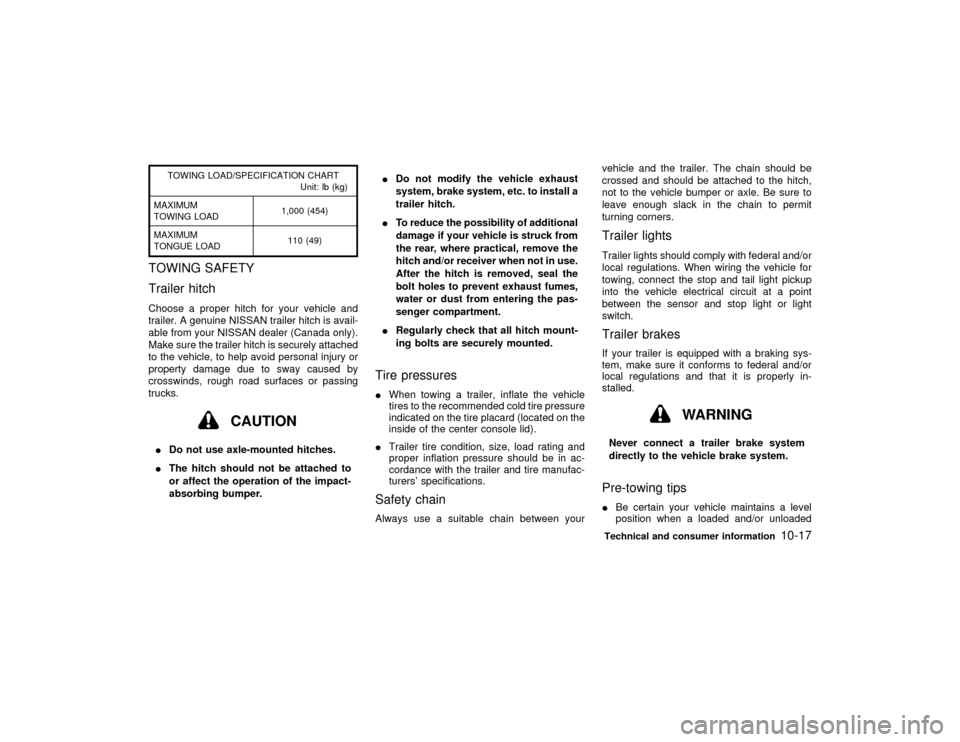
TOWING LOAD/SPECIFICATION CHART
Unit: lb (kg)
MAXIMUM
TOWING LOAD1,000 (454)
MAXIMUM
TONGUE LOAD110 (49)
TOWING SAFETY
Trailer hitchChoose a proper hitch for your vehicle and
trailer. A genuine NISSAN trailer hitch is avail-
able from your NISSAN dealer (Canada only).
Make sure the trailer hitch is securely attached
to the vehicle, to help avoid personal injury or
property damage due to sway caused by
crosswinds, rough road surfaces or passing
trucks.
CAUTION
IDo not use axle-mounted hitches.
IThe hitch should not be attached to
or affect the operation of the impact-
absorbing bumper.IDo not modify the vehicle exhaust
system, brake system, etc. to install a
trailer hitch.
ITo reduce the possibility of additional
damage if your vehicle is struck from
the rear, where practical, remove the
hitch and/or receiver when not in use.
After the hitch is removed, seal the
bolt holes to prevent exhaust fumes,
water or dust from entering the pas-
senger compartment.
IRegularly check that all hitch mount-
ing bolts are securely mounted.
Tire pressuresIWhen towing a trailer, inflate the vehicle
tires to the recommended cold tire pressure
indicated on the tire placard (located on the
inside of the center console lid).
ITrailer tire condition, size, load rating and
proper inflation pressure should be in ac-
cordance with the trailer and tire manufac-
turers' specifications.Safety chainAlways use a suitable chain between yourvehicle and the trailer. The chain should be
crossed and should be attached to the hitch,
not to the vehicle bumper or axle. Be sure to
leave enough slack in the chain to permit
turning corners.
Trailer lightsTrailer lights should comply with federal and/or
local regulations. When wiring the vehicle for
towing, connect the stop and tail light pickup
into the vehicle electrical circuit at a point
between the sensor and stop light or light
switch.Trailer brakesIf your trailer is equipped with a braking sys-
tem, make sure it conforms to federal and/or
local regulations and that it is properly in-
stalled.
WARNING
Never connect a trailer brake system
directly to the vehicle brake system.Pre-towing tipsIBe certain your vehicle maintains a level
position when a loaded and/or unloadedTechnical and consumer information
10-17
Z
00.1.17/A33-D/V5.0
X
Page 227 of 239

trailer is hitched. Do not drive the vehicle if
it has an abnormal nose-up or nose-down
condition; check for improper tongue load,
overload, worn suspension or other pos-
sible causes of either condition.
IAlways secure items in the trailer to prevent
load shifts while driving.
IBe certain your rear view mirrors conform to
all federal, state or local regulations. If not,
install any mirrors required for towing be-
fore driving the vehicle.
Trailer towing tipsIn order to gain skill and an understanding of
the vehicle's behavior, you should practice
turning, stopping and backing up in an area
which is free from traffic. Steering stability, and
braking performance will be somewhat differ-
ent than under normal driving conditions.
IAlways secure items in the trailer to prevent
load shift while driving.
IAvoid abrupt starts, acceleration or stops.
IAvoid sharp turns or lane changes.
IAlways drive your vehicle at a moderate
speed.
IAlways block the wheels on both vehicle
and trailer when parking. Parking on aslope is not recommended; however, if you
must do so, and if your vehicle is equipped
with automatic transmission, first block the
wheels and apply the parking brake, and
then move the transmission selector lever
into the P (Park) position. If you move the
selector lever to the P (Park) position be-
fore blocking the wheels and applying the
parking brake, transmission damage could
occur.
IWhen going down a hill, shift into a lower
gear and use the engine braking effect.
When ascending a long grade, downshift
the transmission to a lower gear and reduce
speed to reduce chances of engine over-
loading and/or overheating.
IIf the engine coolant rises to an extremely
high temperature when the air conditioning
system is on, turn off the air conditioner.
Coolant heat can be additionally vented by
opening the windows, switching the fan
control to high and setting the temperature
control to the HOT position.
ITrailer towing requires more fuel than nor-
mal circumstances.
IAvoid towing a trailer for the first 500 miles
(800 km).
IHave your vehicle serviced more often thanat intervals specified in the recommended
maintenance schedule.
IWhen making a turn, your trailer wheels will
be closer to the inside of the turn than your
vehicle wheels. To compensate for this,
make a larger than normal turning radius
during the turn.
ICrosswinds and rough roads will adversely
affect vehicle/trailer handling, possibly
causing vehicle sway. When being passed
by larger vehicles, be prepared for possible
changes in crosswinds that could affect
vehicle handling. If swaying does occur,
firmly grip the steering wheel, steer straight
ahead, and immediately (but gradually) re-
duce vehicle speed. This combination will
help stabilize the vehicle. Never increase
speed.
IBe careful when passing other vehicles.
Passing while towing a trailer requires con-
siderably more distance than normal pass-
ing. Remember the length of the trailer
must also pass the other vehicle before you
can safely change lanes.
ITo maintain engine braking efficiency and
electrical charging performance, do not use
fifth gear (manual transmission) or over-
drive (automatic transmission).10-18
Technical and consumer information
Z
00.1.17/A33-D/V5.0
X
Page 228 of 239

IAvoid holding the brake pedal down too
long or too frequently. This could cause the
brakes to overheat, resulting in reduced
braking efficiency.
When towing a trailer, change oil in the
transmission more frequently.
See ªPeriodic maintenance schedulesº in
the ª9. Maintenanceº section.DOT (Department Of Transportation) Quality
Grades: All passenger car tires must conform
to federal safety requirements in addition to
these grades.
Quality grades can be found where applicable
on the tire sidewall between tread shoulder
and maximum section width. For example:
Treadwear 200 Traction AA Temperature A
TreadwearTreadwear grade is a comparative rating
based on tire wear rate when tested under
controlled conditions on specified government
test courses. For example, a tire graded 150
would wear one and a half (1-1/2) times as well
on the government course as a tire graded
100. However, relative tire performance de-
pends on actual driving conditions, and may
vary significantly from the norm due to varia-
tions in driving habits, service practices and
differences in road characteristics and climate.Traction AA, A, B and CThe traction grades, from highest to lowest,
are AA, A, B, and C. Those grades represent
the tire's ability to stop on wet pavement as
measured under controlled conditions on
specified government test surfaces of asphaltand concrete. A tire marked C may have poor
traction performance.
WARNING
The traction grade assigned to your ve-
hicle tires is based on straight-ahead
braking traction tests, and does not in-
clude acceleration, cornering, hydro-
planing, or peak traction characteristics.Temperature A, B and CTemperature grades are A (the highest), B,
and C. They represent a tire's resistance to
heat build-up, and its ability to dissipate heat
when tested under controlled conditions on a
specified indoor laboratory test wheel. Sus-
tained high temperature can cause tire mate-
rial to degenerate, reducing tire life. Excessive
temperatures can lead to sudden tire failure.
Grade C corresponds to a performance level
which all passenger car tires must meet under
the Federal Motor Vehicle Safety Standard No.
109. Grades A and B represent higher levels of
performance on laboratory test wheels than
the minimum required by law.
UNIFORM TIRE QUALITY
GRADING
Technical and consumer information
10-19
Z
00.1.17/A33-D/V5.0
X
Page 230 of 239

Due to legal requirements in some states/
areas, your vehicle may be required to be in
what is called the ready condition for an
Inspection/Maintenance (I/M) test of the emis-
sion control system.
The vehicle is set to the ready condition when
it is driven through certain driving patterns.
Usually, the ready condition can be obtained
by ordinary usage of the vehicle.
If a powertrain system component is repaired
or the battery is disconnected, the vehicle may
be reset to a not ready condition. Before taking
the I/M test, drive the vehicle through the
following pattern to set the vehicle to the ready
condition. If you cannot or do not want to
perform the driving pattern, an NISSAN dealer
can conduct it for you.
WARNING
Always drive the vehicle in a safe and
prudent manner according to traffic con-
ditions, and obey all traffic laws.
1. Start the engine when the engine coolant
temperature gauge needle points to C. Al-
low the engine to idle until the gauge needlepoints between the C and H (normal oper-
ating temperature).
2. Accelerate the vehicle to 55 MPH (88
km/h), then quickly release the accelerator
pedal completely and keep it released for at
least 6 seconds.
3. Quickly depress the accelerator pedal for a
moment, then drive the vehicle at a speed
of 53 to 60 MPH (86 to 96 km/h) for at least
5 minutes.
4. Stop the vehicle.
5. Accelerate the vehicle to 35 MPH (55 km/h)
and maintain the speed for 20 seconds.
6. Repeat steps 4 and 5 at least 3 times.
7. Accelerate the vehicle to 55 MPH (88 km/h)
and maintain the speed for at least 3 min-
utes.
8. Stop the vehicle (shift lever in the ªPº or ªNº
position).
9. Rev the engine up between 2,500 and
3,500 rpm and hold it for 3 consecutive
minutes, then release the accelerator pedal
completely.
10.Wait 5 second at idle.
11.Rev the engine up between 2,000 and3,000 rpm and maintain it for 5 consecutive
minutes.
12.Turn the engine off.
13.Repeat steps 1 through 8 at least one more
time.
If step 1 through 7 is interrupted, repeat the
preceding step. Any safe driving mode is ac-
ceptable between steps. Do not stop the en-
gine until step 7 is completed.READINESS FOR INSPECTION/
MAINTENANCE (I/M) TEST (US
only)
Technical and consumer information
10-21
Z
00.1.17/A33-D/V5.0
X
Page 235 of 239

Replacement ............................................. 8-25
Trunk light.................................................. 2-33
Vanity mirror light ...................................... 2-32
Warning/indicator lights and chimes .... 2-7, 2-9
Lights, Exterior and interior light
replacement .................................................... 8-27
Loading information (See vehicle loading
information) ................................................... 10-14
Lock
Door locks ................................................... 3-2
Glove box lock........................................... 2-25
Power door lock .......................................... 3-2
Trunk lid lock opener lever.......................... 3-9
Low fuel warning light ....................................... 2-9
Luggage net .................................................... 2-26
M
Maintenance
Battery ....................................................... 8-13
Explanation of maintenance items..... 9-3, 9-10
General maintenance........................... 9-2, 9-3
Inside the vehicle ................................. 9-2, 9-3
Maintenance precautions ............................ 8-2
Outside the vehicle .............................. 9-2, 9-3
Periodic maintenance schedules ................ 9-5
Seat belt maintenance .............................. 1-27
Under the hood and vehicle ........................ 9-4
Manual front seat adjustment ........................... 1-2
Meters and gauges ........................................... 2-3
Mirror
Inside mirror .............................................. 3-13
Outside mirror............................................ 3-13Outside mirror control................................ 3-13
Outside mirrors .......................................... 3-13
Multi-remote control system.............................. 3-4
N
Net, Luggage net ............................................ 2-26
New vehicle break-in ...................................... 5-15
Nissan vehicle Immobilizer System ................ 2-12
Engine start ................................................. 5-6
O
Odometer .......................................................... 2-4
Oil
Capacities and recommended fuel/
lubricants ................................................... 10-2
Changing engine oil .................................... 8-8
Changing engine oil filter ............................ 8-9
Checking engine oil level ............................ 8-7
Engine oil..................................................... 8-7
Engine oil viscosity .................................... 10-5
Outside mirror ................................................. 3-13
Outside mirror control ..................................... 3-13
Outside mirrors ............................................... 3-13
Overdrive switch ............................................. 5-10
Overheat, If your vehicle overheats................ 6-10P
Parking
Brake check............................................... 8-20
Parking brake check.................................. 5-13
Parking brake operation ............................ 5-13
Parking on hills .......................................... 5-13
Parking/parking on hills .................................. 5-17
Periodic maintenance schedules ...................... 9-5
Personal light .................................................. 2-31
Power
Front seat adjustment ................................. 1-4
Power door lock .......................................... 3-2
Power steering fluid................................... 8-11
Power steering system .............................. 5-18
Power windows ......................................... 2-27
Pre-tensioner seat belt system ....................... 1-17
Precautions
Braking precautions................................... 5-18
Cruise control precautions ........................ 5-13
Maintenance precautions ............................ 8-2
On child restraints ..................................... 1-28
On seat belt usage .................................... 1-20
On supplemental restraint system .............. 1-8
Precautions when starting and driving ........ 5-2
Push starting ..................................................... 6-9
R
Radio, car phone or CB radio......................... 4-25
Readiness for inspection/maintenance (I/M) test
(USA only) .................................................... 10-21
Z
00.1.17/A33-D/V5.0
X
11-4
Page 238 of 239

FUEL RECOMMENDATION:Unleaded premium gasoline with an octane
rating of at least 91 AKI (Anti-Knock Index)
number (Research octane number 96).
If unleaded premium gasoline is not avail-
able, unleaded regular gasoline with an
octane rating of at least 87 AKI (Research
octane number 91) can be used.
However, for maximum vehicle perfor-
mance, the use of unleaded premium gaso-
line is recommended.
CAUTION
Using a fuel other than that specified
could adversely affect the emission con-
trol systems, and may also affect war-
ranty coverage.
Under no circumstances should a
leaded gasoline be used, since this will
damage the three way catalyst.
For additional information, see ªCapacities and
recommended fuel/lubricantsº in the ª10.
Technical and consumer informationº section.
ENGINE OIL RECOMMENDATION:IAPI Certification Mark
IAPI grade SG/SH, Energy Conserving II or
API grade SJ, Energy Conserving
IILSAC grade GF-II
ISAE 5W-30 viscosity oil is preferred for all
ambient temperatures. SAE 10W-30 vis-
cosity oil may be used for ambient tempera-
tures above 0ÉF (þ18ÉC).
See ªCapacities and recommended fuel/
lubricantsº in the ª10. Technical and consumer
informationº section for engine oil and oil filter
recommendation.COLD TIRE PRESSURES:See tire placard affixed to the center console
lid.NEW VEHICLE BREAK-IN
PROCEDURES
RECOMMENDATION:During the first 1,000 miles (1,600 km) of
vehicle use, follow the recommendations out-
lined in the ªBreak-in scheduleº Information
found in the ª5. Starting and drivingº section of
this Owner's Manual. Follow these recommen-
dations for the future reliability and economy of
your new vehicle. Failure to follow these rec-
ommendations may result in vehicle damageor shortened engine life.
GAS STATION INFORMATION
Z
00.1.17/A33-D/V5.0
X