homelink NISSAN MAXIMA 2010 Owner´s Manual
[x] Cancel search | Manufacturer: NISSAN, Model Year: 2010, Model line: MAXIMA, Model: NISSAN MAXIMA 2010Pages: 457, PDF Size: 4.66 MB
Page 11 of 457
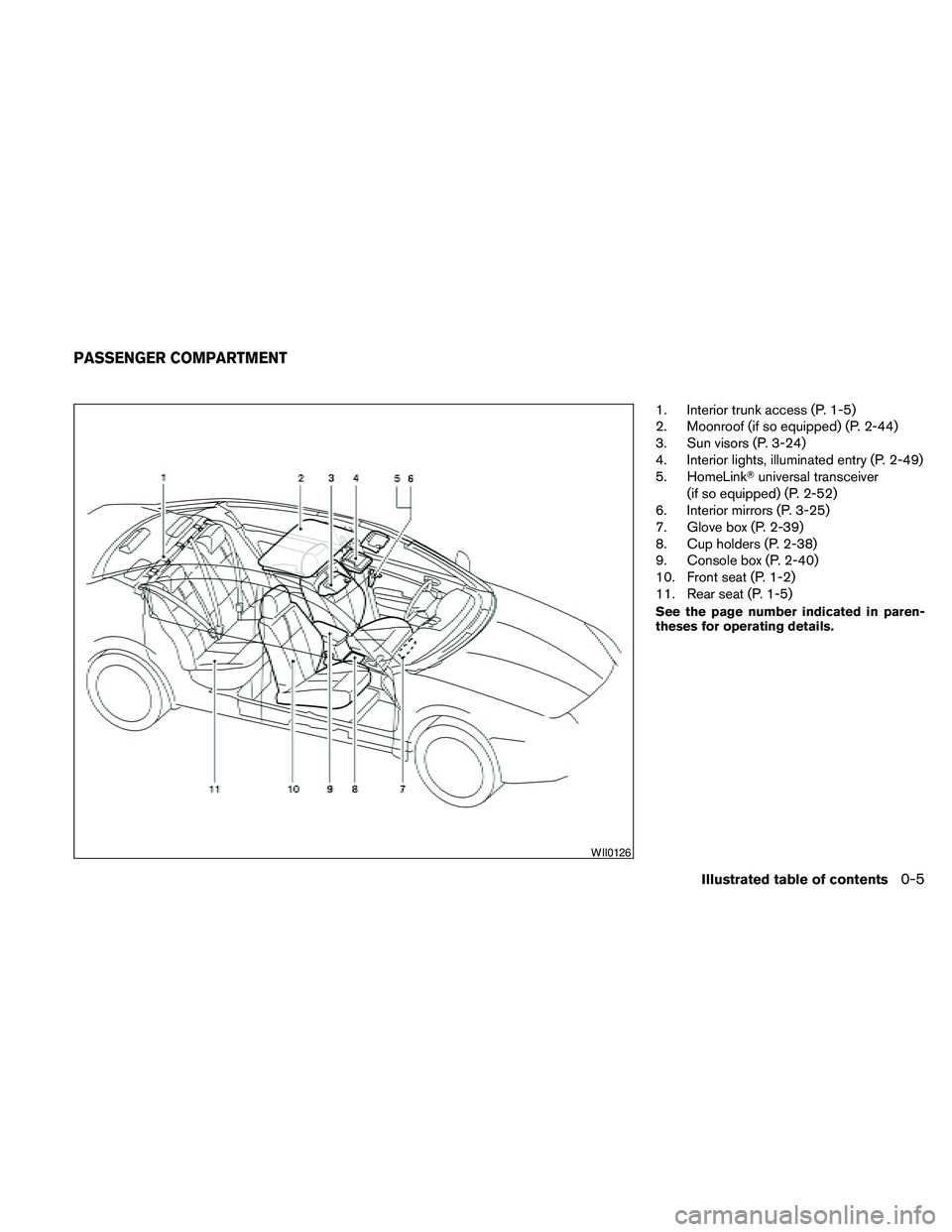
1. Interior trunk access (P. 1-5)
2. Moonroof (if so equipped) (P. 2-44)
3. Sun visors (P. 3-24)
4. Interior lights, illuminated entry (P. 2-49)
5. HomeLinkTuniversal transceiver
(if so equipped) (P. 2-52)
6. Interior mirrors (P. 3-25)
7. Glove box (P. 2-39)
8. Cup holders (P. 2-38)
9. Console box (P. 2-40)
10. Front seat (P. 1-2)
11. Rear seat (P. 1-5)
See the page number indicated in paren-
theses for operating details.
WII0126
PASSENGER COMPARTMENT
Illustrated table of contents0-5
Page 73 of 457
Power windows...............................2-42
Moonroof (if so equipped).........................2-44
Automatic moonroof...........................2-44
Dual Panel Moonroof (if so equipped)...............2-46
Automatic moonroof...........................2-46
Rear Control Cancel Switch (if so equipped)........2-48
Rear power sun shade (if so equipped).............2-48
Interior light......................................2-49
Console light..................................2-50
Personal lights...................................2-50
Front.........................................2-50
Rear.........................................2-51Trunk light.......................................2-52
HomeLinkTuniversal transceiver (if so equipped).....2-52
Programming HomeLinkT.......................2-53
Programming HomeLinkTfor Canadian
customers....................................2-54
Operating the HomeLinkTuniversal
transceiver....................................2-54
Programming trouble-diagnosis.................2-54
Clearing the programmed information............2-54
Reprogramming a single HomeLinkTbutton......2-55
If your vehicle is stolen.........................2-55
Page 124 of 457
The light illuminates when the trunk lid is opened.
When the trunk lid is closed, the light goes off.
The light will go off after about 30 minutes if the
trunk lid is left open, unless the ignition switch is
in the ON position.
For bulb replacement procedures, refer to “Exte-
rior and interior lights” in the “Maintenance and
do-it-yourself” section of this manual.The HomeLinkTUniversal Transceiver provides a
convenient way to consolidate the functions of up
to three individual hand-held transmitters into
one built-in device.
HomeLinkTUniversal Transceiver:
cWill operate most Radio Frequency (RF)
devices such as garage doors, gates, home
and office lighting, entry door locks and se-
curity systems.
cIs powered by your vehicle’s battery. No
separate batteries are required. If the vehi-
cle’s battery is discharged or is discon-
nected, HomeLinkTwill retain all program-
ming.
Once the HomeLinkTUniversal Transceiver
is programmed, retain the original trans-
mitter for future programming procedures
(Example: new vehicle purchases) . Upon
sale of the vehicle, the programmed
HomeLinkTUniversal Transceiver buttons
should be erased for security purposes. For
additional information, refer to “Program-
ming HomeLinkT” later in this section.WARNING
cDo not use the HomeLinkTUniversal
Transceiver with any garage door
opener that lacks safety stop and re-
verse features as required by federal
safety standards. (These standards be-
came effective for opener models
manufactured after April 1, 1982) . A ga-
rage door opener which cannot detect
an object in the path of a closing garage
door and then automatically stop and
reverse, does not meet current federal
safety standards. Using a garage door
opener without these features in-
creases the risk of serious injury or
death.
cDuring the programming procedure
your garage door or security gate will
open and close (if the transmitter is
within range) . Make sure that people or
objects are clear of the garage door,
gate, etc. that you are programming.
cYour vehicle’s engine should be turned
off while programming the HomeLinkT
Universal Transceiver.
TRUNK LIGHT HOMELINKTUNIVERSAL
TRANSCEIVER (if so equipped)
2-52Instruments and controls
Page 125 of 457
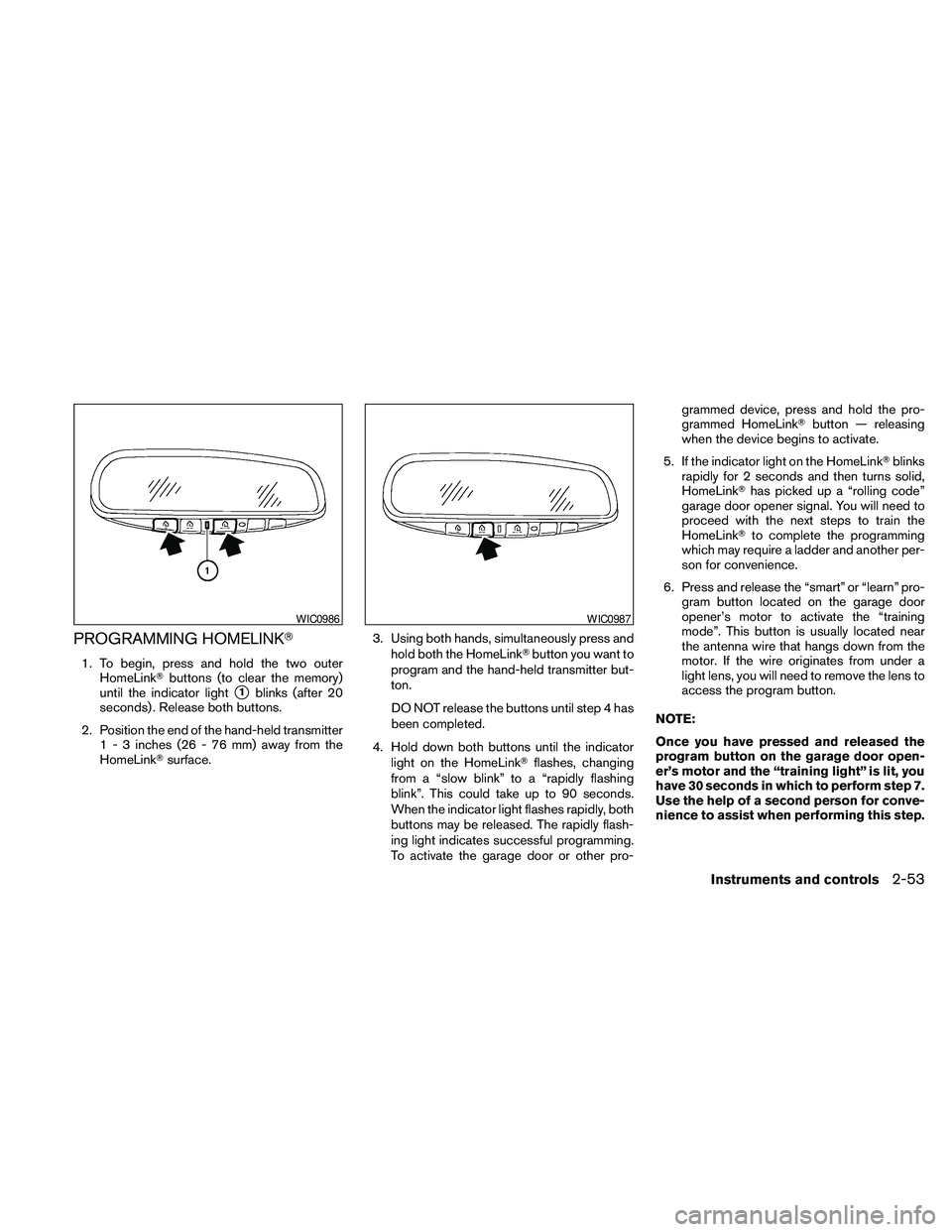
PROGRAMMING HOMELINKT
1. To begin, press and hold the two outer
HomeLinkTbuttons (to clear the memory)
until the indicator light
s1blinks (after 20
seconds) . Release both buttons.
2. Position the end of the hand-held transmitter
1 - 3 inches (26 - 76 mm) away from the
HomeLinkTsurface.3. Using both hands, simultaneously press and
hold both the HomeLinkTbutton you want to
program and the hand-held transmitter but-
ton.
DO NOT release the buttons until step 4 has
been completed.
4. Hold down both buttons until the indicator
light on the HomeLinkTflashes, changing
from a “slow blink” to a “rapidly flashing
blink”. This could take up to 90 seconds.
When the indicator light flashes rapidly, both
buttons may be released. The rapidly flash-
ing light indicates successful programming.
To activate the garage door or other pro-grammed device, press and hold the pro-
grammed HomeLinkTbutton — releasing
when the device begins to activate.
5. If the indicator light on the HomeLinkTblinks
rapidly for 2 seconds and then turns solid,
HomeLinkThas picked up a “rolling code”
garage door opener signal. You will need to
proceed with the next steps to train the
HomeLinkTto complete the programming
which may require a ladder and another per-
son for convenience.
6. Press and release the “smart” or “learn” pro-
gram button located on the garage door
opener’s motor to activate the “training
mode”. This button is usually located near
the antenna wire that hangs down from the
motor. If the wire originates from under a
light lens, you will need to remove the lens to
access the program button.
NOTE:
Once you have pressed and released the
program button on the garage door open-
er’s motor and the “training light” is lit, you
have 30 seconds in which to perform step 7.
Use the help of a second person for conve-
nience to assist when performing this step.
WIC0986WIC0987
Instruments and controls2-53
Page 126 of 457
7. Within 30 seconds of pressing and releas-
ing the garage door opener’s program but-
ton, quickly and firmly press and release the
HomeLinkTbutton you’ve just programmed.
Press and release the HomeLinkTbutton up
to 3 times to complete the training.
8. Your HomeLinkTbutton should now be pro-
grammed. (To program the remaining
HomeLinkTbuttons for additional door or
gate openers, follow steps 2-4 only.)
NOTE:
Do not repeat step 1 unless you want to
“clear” all previously programmed
HomeLinkTbuttons.
If you have any questions or are having difficulty
programming your HomeLinkTbuttons, refer to
the HomeLinkTweb site at: www.homelink.com
or call 1-800-355-3515.
PROGRAMMING HOMELINKTFOR
CANADIAN CUSTOMERS
Prior to 1992, D.O.C. regulations required hand-
held transmitters to stop transmitting after 2 sec-
onds. To program your hand-held transmitter to
HomeLinkT, continue to press and hold the
HomeLinkTbutton (see steps 2 - 4 under “Pro-
gramming HomeLinkT”) while you press and re-
press (“cycle”) your hand-held transmitters every2 seconds until the indicator light flashes rapidly
(indicating successful programming) .
NOTE:
When programming a garage door opener,
etc., it is advised to unplug the device dur-
ing the “cycling” process to prevent pos-
sible damage to the garage door opener
components.
OPERATING THE HOMELINKT
UNIVERSAL TRANSCEIVER
The HomeLinkTUniversal Transceiver (once pro-
grammed) may now be used to activate the ga-
rage door, etc. To operate, simply press the ap-
propriate programmed HomeLinkTUniversal
Transceiver button. The red indicator light will
illuminate while the signal is being transmitted.
PROGRAMMING TROUBLE-
DIAGNOSIS
If the HomeLinkTdoes not quickly learn the hand-
held transmitter information:
creplace the hand-held transmitter batteries
with new batteries.
cposition the hand-held transmitter with its
battery area facing away from the
HomeLinkTsurface.cpress and hold both the HomeLinkTand
hand-held transmitter buttons without inter-
ruption.
cposition the hand-held transmitter1-3
inches (26 - 76 mm) away from the
HomeLinkTsurface. Hold the transmitter in
that position for up to 15 seconds. If
HomeLinkTis not programmed within that
time, try holding the transmitter in another
position – keeping the indicator light in view
at all times.
If you continue to have programming difficulties,
please contact the NISSAN Consumer Affairs
Department. The phone numbers are located in
the Foreword of this manual.
CLEARING THE PROGRAMMED
INFORMATION
Individual buttons cannot be cleared. However,
to clear all programming, press and hold the two
outside buttons and release when the indicator
light begins to flash (approximately 20 seconds) .
2-54Instruments and controls
Page 127 of 457
REPROGRAMMING A SINGLE
HOMELINKTBUTTON
To reprogram a HomeLinkTUniversal Transceiver
button, complete the following.
1. Press and hold the desired HomeLinkTbut-
ton.Do notrelease the button until step 4
has been completed.
2. When the indicator light begins to flash
slowly (after 20 seconds) , position the
hand-held transmitter1-3inches (26 - 76
mm) away from the HomeLinkTsurface.
3. Press and hold the hand-held transmitter
button.
4. The HomeLinkTindicator light will flash, first
slowly and then rapidly. When the indicator
light begins to flash rapidly, release both
buttons.
The HomeLinkTUniversal Transceiver button has
now been reprogrammed. The new device can
be activated by pushing the HomeLinkTbutton
that was just programmed. This procedure will
not affect any other programmed HomeLinkT
buttons.
IF YOUR VEHICLE IS STOLEN
If your vehicle is stolen, you should change the
codes of any non-rolling code device that has
been programmed into HomeLinkT. Consult the
Owner’s Manual of each device or call the manu-
facturer or dealer of those devices for additional
information.
When your vehicle is recovered, you will
need to reprogram the HomeLinkTUniver-
sal Transceiver with your new transmitter
information.
FCC Notice:
This device complies with FCC rules part 15
and RSS-210 of Industry Canada. Opera-
tion is subject to the following two condi-
tions:
(1) This device may not cause harmful in-
terference and (2) This device must accept
any interference that may be received, in-
cluding interference that may cause undes-
ired operation.This transmitter has been tested and com-
plies with FCC and DOC/MDC rules.
Changes or modifications not expressly ap-
proved by the party responsible for compli-
ance could void the user’s authority to op-
erate the equipment.
DOC: ISTC 1763K1313
FCC I.D. CV2V67690
Instruments and controls2-55
Page 155 of 457
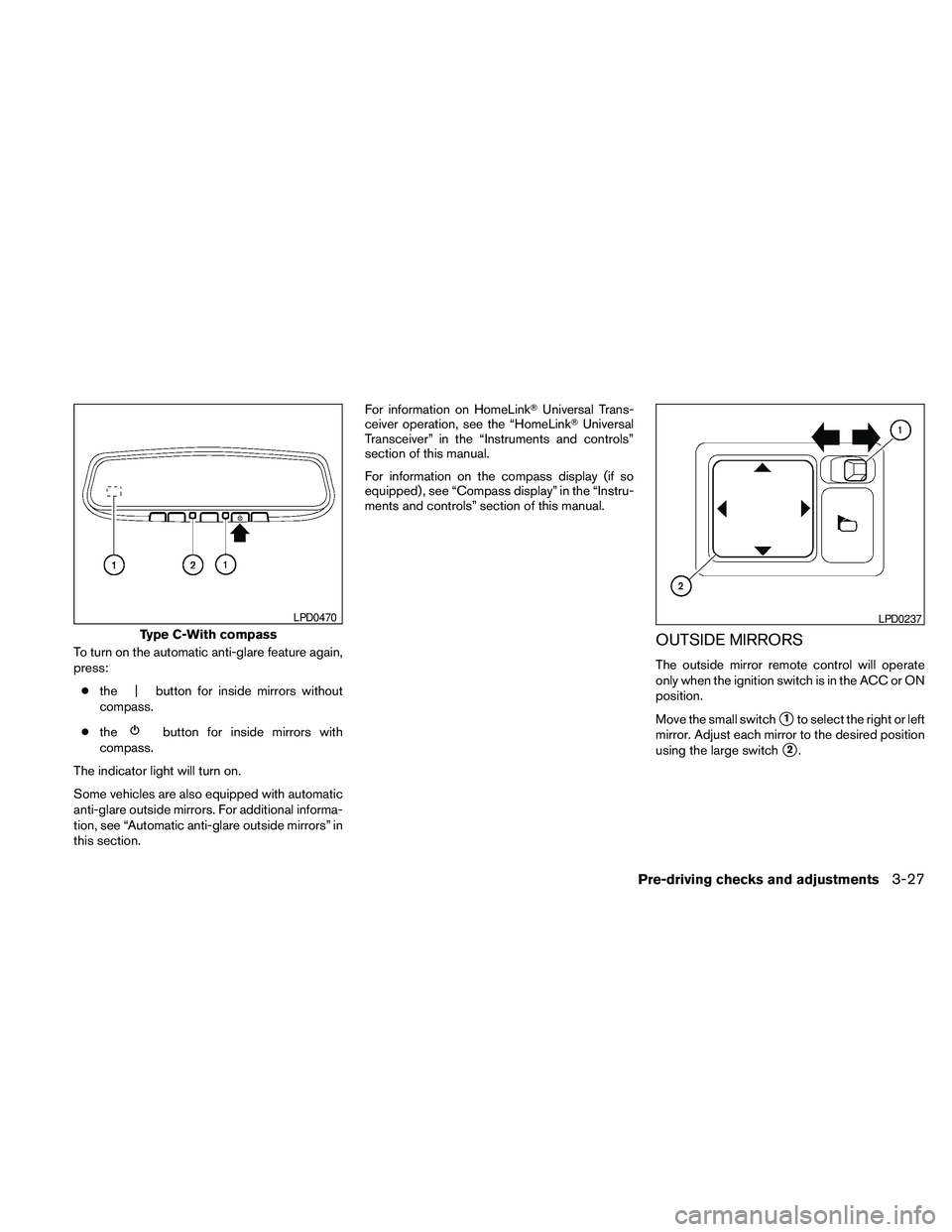
To turn on the automatic anti-glare feature again,
press:
cthe | button for inside mirrors without
compass.
cthe
button for inside mirrors with
compass.
The indicator light will turn on.
Some vehicles are also equipped with automatic
anti-glare outside mirrors. For additional informa-
tion, see “Automatic anti-glare outside mirrors” in
this section.For information on HomeLinkTUniversal Trans-
ceiver operation, see the “HomeLinkTUniversal
Transceiver” in the “Instruments and controls”
section of this manual.
For information on the compass display (if so
equipped) , see “Compass display” in the “Instru-
ments and controls” section of this manual.
OUTSIDE MIRRORS
The outside mirror remote control will operate
only when the ignition switch is in the ACC or ON
position.
Move the small switch
s1to select the right or left
mirror. Adjust each mirror to the desired position
using the large switch
s2.
Type C-With compass
LPD0470LPD0237
Pre-driving checks and adjustments3-27
Page 451 of 457
Capacities and recommended
fuel/lubricants.................9-2
Continuously Variable Transmission
(CVT) fluid..................8-11
Engine coolant.................8-7
Engine oil...................8-8
Power steering fluid.............8-11
Window washer fluid............8-12
F.M.V.S.S. certification label...........9-10
Fog light switch.................2-32
Folding rear seat..................1-5
Front air bag system
(See supplemental restraint system)......1-46
Front seats.....................1-2
Fuel
Capacities and recommended
fuel/lubricants.................9-2
Fuel economy................5-20
Fuel gauge...................2-6
Fuel octane rating...............9-4
Fuel recommendation.............9-3
Fuel-filler door and cap...........3-21
Fuses.......................8-20
Fusible links...................8-21
G
Garage door opener, HomeLinkTUniversal
Transceiver....................2-52
Gascap .....................3-21
Gauge
Engine coolant temperature gauge.....2-5
Fuel gauge...................2-6
Odometer...................2-4
Speedometer.................2-4Tachometer..................2-5
Trip odometer.................2-4
General maintenance...............8-2
Glove box.....................2-39
Glove box lock..................2-39
Grocery hooks..................2-40
H
Hands-free phone system,
BluetoothT...............4-117, 4-132
Hazard warning flasher switch.........2-33
Headlight and turn signal switch........2-28
Headlight control switch............2-29
Headlights....................8-25
Heated seats...................2-35
Heated steering wheel.............2-35
Heater
Heater and air conditioner
controls................4-41, 4-44
Heater operation...........4-42, 4-45
Rear seat air conditioner..........4-47
HomeLinkTUniversal Transceiver........2-52
Hood release...................3-18
Horn.......................2-33
I
Ignition Switch
Push-Button Ignition Switch.........5-7
Image viewer...................4-31
Immobilizer system..........2-25, 3-3, 5-9
Important vehicle information label.......9-10
In-cabin microfilter................8-17Increasing fuel economy.............5-20
Indicator lights and audible reminders
(See warning/indicator lights and audible
reminders)....................2-10
Inside automatic anti-glare mirror........3-25
Instrument brightness control..........2-32
Instrument panel...............0-6, 2-2
Instrument panel dimmer switch........2-32
Intelligent Key system
Key operating range..............3-9
Key operation................3-10
Mechanical key................3-3
Remote keyless entry operation.......3-13
Troubleshooting guide............3-16
Warning signals...............3-16
Interior light....................2-49
Interior trunk lid release.............3-20
iPodTPlayer................4-92, 4-93
ISOFIX child restraints.............1-23
J
Jump starting...................6-8
K
Keyfob battery replacement...........8-23
Keyless entry
With Intelligent Key system
(See Intelligent Key system).........3-13
Keys, For Intelligent Key system.........3-2
10-3
Page 454 of 457
Steering
Heated steering wheel...........2-35
Power steering fluid.............8-11
Power steering system...........5-22
Steering wheel audio control switch.....4-113
Stop light.....................8-26
Storage......................2-37
Sun visors....................3-24
Sunglasses case.................2-38
Sunroof (see Moonroof).............2-44
Supplemental air bag warning light . . .1-53, 2-14
Supplemental front impact air bag system . . .1-46
Supplemental restraint system
Information and warning labels.......1-53
Precautions on supplemental restraint
system....................1-39
Supplemental restraint system
(Supplemental air bag system).........1-39
Switch
Autolight switch...............2-30
Automatic power window switch......2-43
Fog light switch...............2-32
Hazard warning flasher switch.......2-33
Headlight and turn signal switch......2-28
Headlight control switch..........2-29
Power door lock switch............3-5
Rear window and outside mirror defroster
switch.....................2-27
Turn signal switch..............2-32
Vehicle dynamic control (VDC) off
switch.....................2-36
Windshield wiper and washer switch . . .2-26T
Tachometer....................2-5
Temperature gauge
Engine coolant temperature gauge.....2-5
Theft (NISSAN vehicle immobilizer system) ,
engine start..............2-25, 3-3, 5-9
Three-way catalyst................5-2
Tire
Flat tire.....................6-2
Spare tire................6-3, 8-41
Tire and Loading Information label.....9-11
Tire chains..................8-38
Tire placard..................9-11
Tire pressure.................8-30
Tire rotation..................8-38
Types of tires.................8-37
Uniform tire quality grading.........9-24
Wheels and tires...............8-30
Wheel/tire size.................9-8
Tire pressure
Low tire pressure warning light.......2-12
Tire Pressure Monitoring System (TPMS). . . .5-3
Top tether strap child restraint.........1-25
Towing
Flat towing..................9-23
Tow truck towing...............6-11
Towing load/specification..........9-19
Trailer towing.................9-16
Transceiver
HomeLinkTUniversal Transceiver......2-52
Transmission
Continuously Variable Transmission
(CVT) fluid..................8-11Driving with Continuously Variable
Transmission (CVT).............5-11
Selector lever lock release.........5-16
Travel (See registering your vehicle in another
country)......................9-9
Trip odometer...................2-4
Trunk access through the rear seat.....1-5, 1-6
Trunk lid lock opener lever............3-19
Trunk light....................2-52
Turn signal switch................2-32
U
Uniform tire quality grading...........9-24
USB interface
Audio file operation..........4-87, 4-88
Video file operation.............4-90
V
Vanity mirror...................3-25
Variable voltage control system.........8-15
Vehicle dimensions and weights.........9-8
Vehicle dynamic control (VDC) off switch . . .2-36
Vehicle dynamic control (VDC) system.....5-24
Vehicle identification...............9-9
Vehicle identification number (VIN)
(Chassis number).................9-9
Vehicle identification number (VIN) plate. . . .9-9
Vehicle loading information...........9-12
Vehicle recovery.................6-13
Vehicle security system.............2-24
Vehicle security system (NISSAN vehicle immobi-
lizer system) , engine start......2-25, 3-3, 5-9
10-6