seats NISSAN MAXIMA 2017 A36 / 8.G Manual PDF
[x] Cancel search | Manufacturer: NISSAN, Model Year: 2017, Model line: MAXIMA, Model: NISSAN MAXIMA 2017 A36 / 8.GPages: 406, PDF Size: 4.66 MB
Page 319 of 406
●Do not apply wheel cleaners to the
wheels when they are hot. The wheel
temperature should be the same as am-
bient temperature.
● Rinse the wheel to completely remove
the cleaner within 15 minutes after the
cleaner is applied.
CHROME PARTS
Clean all chrome parts regularly with a non-
abrasive chrome polish to maintain the finish.
TIRE DRESSINGS
NISSAN does not recommend the use of tire
dressings. Tire manufacturers apply a coating to
the tires to help reduce discoloration of the rub-
ber. If a tire dressing is applied to the tires, it may
react with the coating and form a compound. This
compound may come off the tire while driving and
stain the vehicle paint.
If you choose to use a tire dressing, take the
following precautions:
● Use a water-based tire dressing. The coat-
ing on the tire dissolves more easily than
with an oil-based tire dressing. ●
Apply a light coat of tire dressing to help
prevent it from entering the tire
tread/grooves (where it would be difficult to
remove) .
● Wipe off excess tire dressing using a dry
towel. Make sure the tire dressing is com-
pletely removed from the tire tread/grooves.
● Allow the tire dressing to dry as recom-
mended by the tire dressing manufacturer. Occasionally remove loose dust from the interior
trim, plastic parts and seats using a vacuum
cleaner or soft bristled brush. Wipe the vinyl and
leather (if so equipped) surfaces with a clean,
soft cloth dampened in mild soap solution, then
wipe clean with a dry, soft cloth.
Regular care and cleaning is required in order to
maintain the appearance of the leather (if so
equipped) .
Before using any fabric protector, read the manu-
facturer’s recommendations. Some fabric pro-
tectors contain chemicals that may stain or
bleach the seat material.
Use a cloth dampened only with water to clean
the meter and gauge lens.
WARNING
Do not use water or acidic cleaners (hot
steam cleaners) on the seat. This can dam-
age the seat or occupant classification
sensor. This can also affect the operation
of the air bag system and result in serious
personal injury.
CLEANING INTERIOR
7-4Appearance and care
Page 322 of 406
When installing Genuine NISSAN floor mats,
follow the installation instructions provided with
the mat and the following:1. Position the floor mat in the floorwell so that the floor mat grommet holes are aligned with
the hook(s) .
2. Secure the grommet holes into the hook(s) and ensure that the floor mat is properly
positioned.
3. Make sure the floor mat does not interfere with pedal operation. With the ignition in the
OFF position, the selector lever in the P
(Park) position (Automatic Transmission
models) or the shift lever in the N (Neutral)
position (Manual Transmission models) fully
apply and release all pedals. The floor mat
must not interfere with pedal operation or
prevent the pedal from returning to its nor-
mal position.
It is recommended that you visit a NISSAN dealer
for details about installing the floor mats in your
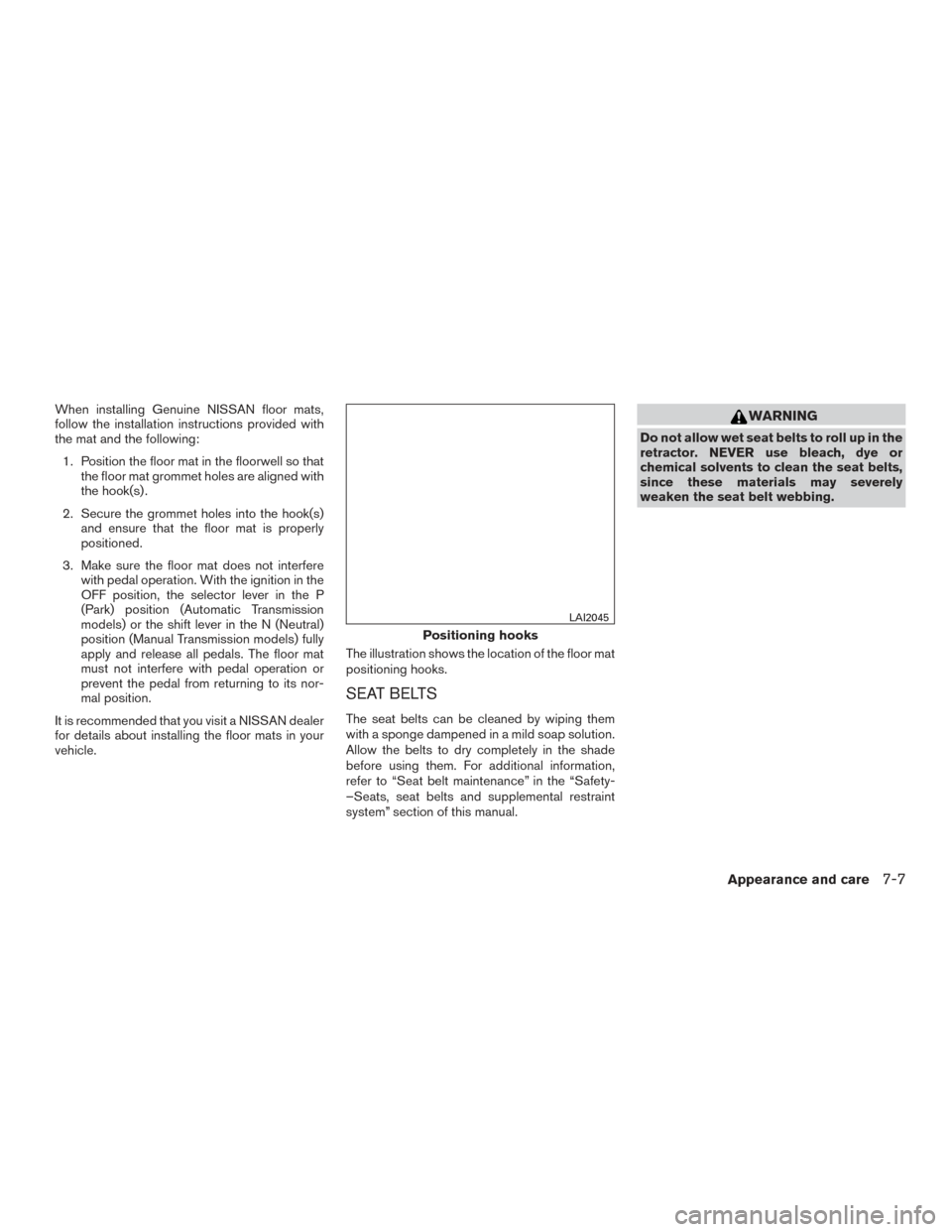
vehicle. The illustration shows the location of the floor mat
positioning hooks.
SEAT BELTS
The seat belts can be cleaned by wiping them
with a sponge dampened in a mild soap solution.
Allow the belts to dry completely in the shade
before using them. For additional information,
refer to “Seat belt maintenance” in the “Safety-
–Seats, seat belts and supplemental restraint
system” section of this manual.
WARNING
Do not allow wet seat belts to roll up in the
retractor. NEVER use bleach, dye or
chemical solvents to clean the seat belts,
since these materials may severely
weaken the seat belt webbing.
Positioning hooks
LAI2045
Appearance and care7-7
Page 364 of 406
Make sure that the secondary latch keeps the
hood from opening when the primary latch is
released.
When driving in areas using road salt or other
corrosive materials, check lubrication frequently.
Lights*:Clean the headlights on a regular basis.
Make sure that the headlights, stop lights, tail
lights, turn signal lights, and other lights are all
operating properly and installed securely. Also
check headlight aim.
Road wheel nuts (lug nuts)*: When checking
the tires, make sure no wheel nuts are missing,
and check for any loose wheel nuts. Tighten if
necessary.
Tire rotation*: Tires should be rotated every
5,000 miles (8,000 km).
Tires*: Check the pressure with a gauge often
and always prior to long distance trips. If neces-
sary, adjust the pressure in all tires, including the
spare, to the pressure specified. Check carefully
for damage, cuts or excessive wear.
Tire Pressure Monitoring System (TPMS)
transmitter components: Replace the TPMS
transmitter grommet seal, valve core and cap
when the tires are replaced due to wear or age. Wheel alignment and balance:
If the vehicle
should pull to either side while driving on a
straight and level road, or if you detect uneven or
abnormal tire wear, there may be a need for wheel
alignment. If the steering wheel or seat vibrates at
normal highway speeds, wheel balancing may be
needed.
For additional information regarding tires, refer to
“Important Tire Safety Information” (US) or “Tire
Safety Information” (Canada) in the Warranty In-
formation Booklet.
Windshield: Clean the windshield on a regular
basis. Check the windshield at least every six
months for cracks or other damage. Have a dam-
aged windshield repaired by a qualified repair
facility.
Windshield wiper blades*: Check for cracks
or wear if they do not wipe properly.
Inside the vehicle
The maintenance items listed here should be
checked on a regular basis, such as when per-
forming scheduled maintenance, cleaning the ve-
hicle, etc.
Accelerator pedal: Check the pedal for smooth
operation and make sure the pedal does not
catch or require uneven effort. Keep the floor mat
away from the pedal. Brake pedal:
Check the pedal for smooth op-
eration. If the brake pedal suddenly goes down
further than normal, the pedal feels spongy or the
vehicle seems to take longer to stop, have your
vehicle checked immediately. It is recommended
that you visit a NISSAN dealer for this service.
Keep the floor mat away from the pedal.
Brakes: Check that the brakes do not pull the
vehicle to one side when applied.
Continuously Variable Transmission (CVT)
P (Park) position mechanism: On a fairly
steep hill check that the vehicle is held securely
with the shift lever in the P (Park) position without
applying any brakes.
Parking brake: Check the parking brake opera-
tion regularly. The vehicle should be securely held
on a fairly steep hill with only the parking brake
applied. If the parking brake needs adjustment, it
is recommended that you visit a NISSAN dealer
for this service.
Seats: Check seat position controls such as
seat adjusters, seatback recliner, etc., to ensure
they operate smoothly and all latches lock se-
curely in every position. Check that the head
restraints/headrests move up and down
smoothly and the locks (if so equipped) hold
securely in all latched positions.
Maintenance and schedules9-3
Page 390 of 406
WARNING
● It is extremely dangerous to ride
in a cargo area inside a vehicle. In
a collision, people riding in these
areas are more likely to be seri-
ously injured or killed.
● Do not allow people to ride in any
area of your vehicle that is not
equipped with seats and seat
belts.
● Be sure everyone in your vehicle
is in a seat and using a seat belt
properly.
TERMS
It is important to familiarize yourself with
the following terms before loading your
vehicle:
● Curb Weight (actual weight of your
vehicle) - vehicle weight including:
standard and optional equipment, flu-
ids, emergency tools, and spare tire
assembly. This weight does notin-
clude passengers and cargo. ●
GVW (Gross Vehicle Weight) - curb
weight plus the combined weight of
passengers and cargo.
● GVWR (Gross Vehicle Weight Rat-
ing) - maximum total combined
weight of the unloaded vehicle, pas-
sengers, luggage, hitch, trailer
tongue load and any other optional
equipment. This information is lo-
cated on the F.M.V.S.S./C.M.V.S.S.
certification label.
● GAWR (Gross Axle Weight Rating) -
maximum weight (load) limit specified
for the front or rear axle. This informa-
tion is located on the
F.M.V.S.S./C.M.V.S.S. certification
label.
● GCWR (Gross Combined Weight
rating) - The maximum total weight
rating of the vehicle, passengers,
cargo, and trailer. ●
Vehicle Capacity Weight, Load limit,
Total load capacity - maximum total
weight limit specified of the load
(passengers and cargo) for the ve-
hicle. This is the maximum combined
weight of occupants and cargo that
can be loaded into the vehicle. If the
vehicle is used to tow a trailer, the
trailer tongue weight must be in-
cluded as part of the cargo load. This
information is located on the Tire and
Loading Information label.
● Cargo capacity - permissible weight
of cargo, the subtracted weight of
occupants from the load limit.
VEHICLE LOADING INFORMATION
Technical and consumer information10-13
Page 398 of 406
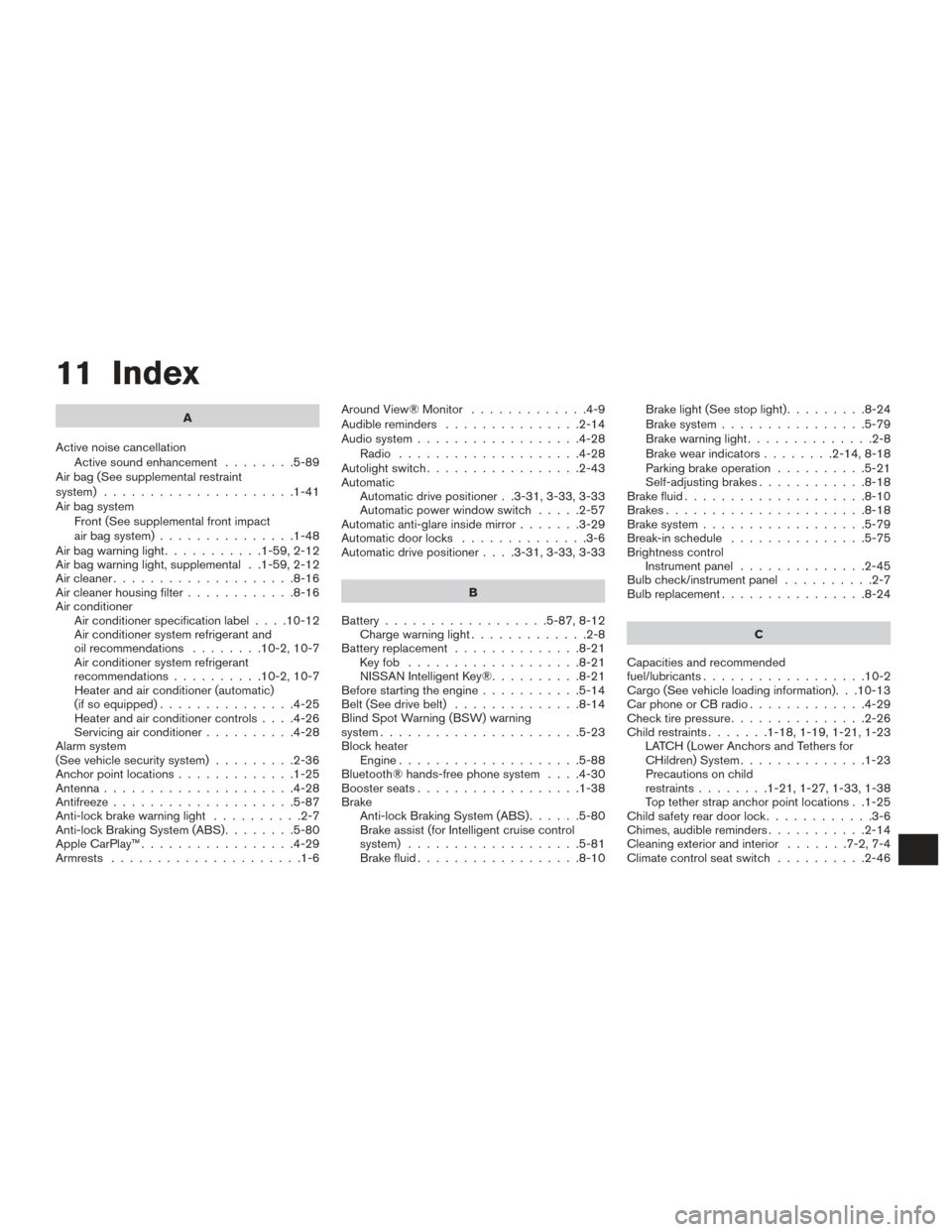
11 Index
A
Active noise cancellation Active sound enhancement ........5-89
Air bag (See supplemental restraint
system) .....................1-41
Air bag system Front (See supplemental front impact
air bag system) ...............1-48
Airbagwarninglight...........1-59,2-12
Air bag warning light, supplemental . .1-59, 2-12
Aircleaner....................8-16
Air cleaner housing filter ............8-16
Air conditioner Air conditioner specification label ....10-12
Air conditioner system refrigerant and
oil recommendations ........10-2,10-7
Air conditioner system refrigerant
recommendations ..........10-2,10-7
Heater and air conditioner (automatic)
(if so equipped) ...............4-25
Heater and air conditioner controls ....4-26
Servicing air conditioner ..........4-28
Alarm system
(See vehicle security system) .........2-36
Anchor point locations .............1-25
Antenna .....................4-28
Antifreeze ....................5-87
Anti-lock brake warning light ..........2-7
Anti-lock Braking System (ABS) ........5-80
Apple CarPlay™ .................4-29
Armrests .....................1-6 AroundView®Monitor .............4-9
Audible reminders
...............2-14
Audio system ..................4-28
Radio ....................4-28
Autolight switch .................2-43
Automatic Automatic drive positioner . .3-31, 3-33, 3-33
Automatic power window switch .....2-57
Automatic anti-glare inside mirror .......3-29
Automatic door locks ..............3-6
Automatic drive positioner ....3-31,3-33,3-33
B
Battery ..................5-87,8-12
Chargewarninglight.............2-8
Battery replacement ..............8-21
Keyfob ...................8-21
NISSAN Intelligent Key® ..........8-21
Before starting the engine ...........5-14
Belt (See drive belt) ..............8-14
Blind Spot Warning (BSW) warning
system ......................5-23
Block heater Engine ....................5-88
Bluetooth® hands-free phone system ....4-30
Boosterseats..................1-38
Brake Anti-lock Braking System (ABS) ......5-80
Brake assist (for Intelligent cruise control
system) ...................5-81
Brake fluid ..................8-10 Brakelight(Seestoplight).........8-24
Brake system
................5-79
Brakewarninglight..............2-8
Brakewearindicators........2-14,8-18
Parking brake operation ..........5-21
Self-adjusting brakes ............8-18
Brake fluid ....................8-10
Brakes ......................8-18
Brake system ..................5-79
Break-inschedule ...............5-75
Brightness control Instrument panel ..............2-45
Bulb check/instrument panel ..........2-7
Bulbreplacement................8-24
C
Capacities and recommended
fuel/lubricants ..................
10-2
Cargo (See vehicle loading information). . .10-13
Car phone or CB radio .............4-29
Check tire pressure ...............2-26
Child restraints .......1-18,1-19,1-21,1-23
LATCH (Lower Anchors and Tethers for
CHildren) System ..............1-23
Precautions on child
restraints ........1-21,1-27,1-33,1-38
Top tether strap anchor point locations . .1-25
Child safety rear door lock ............3-6
Chimes, audible reminders ...........2-14
Cleaning exterior and interior .......7-2,7-4
Climate control seat switch ..........2-46
Page 399 of 406
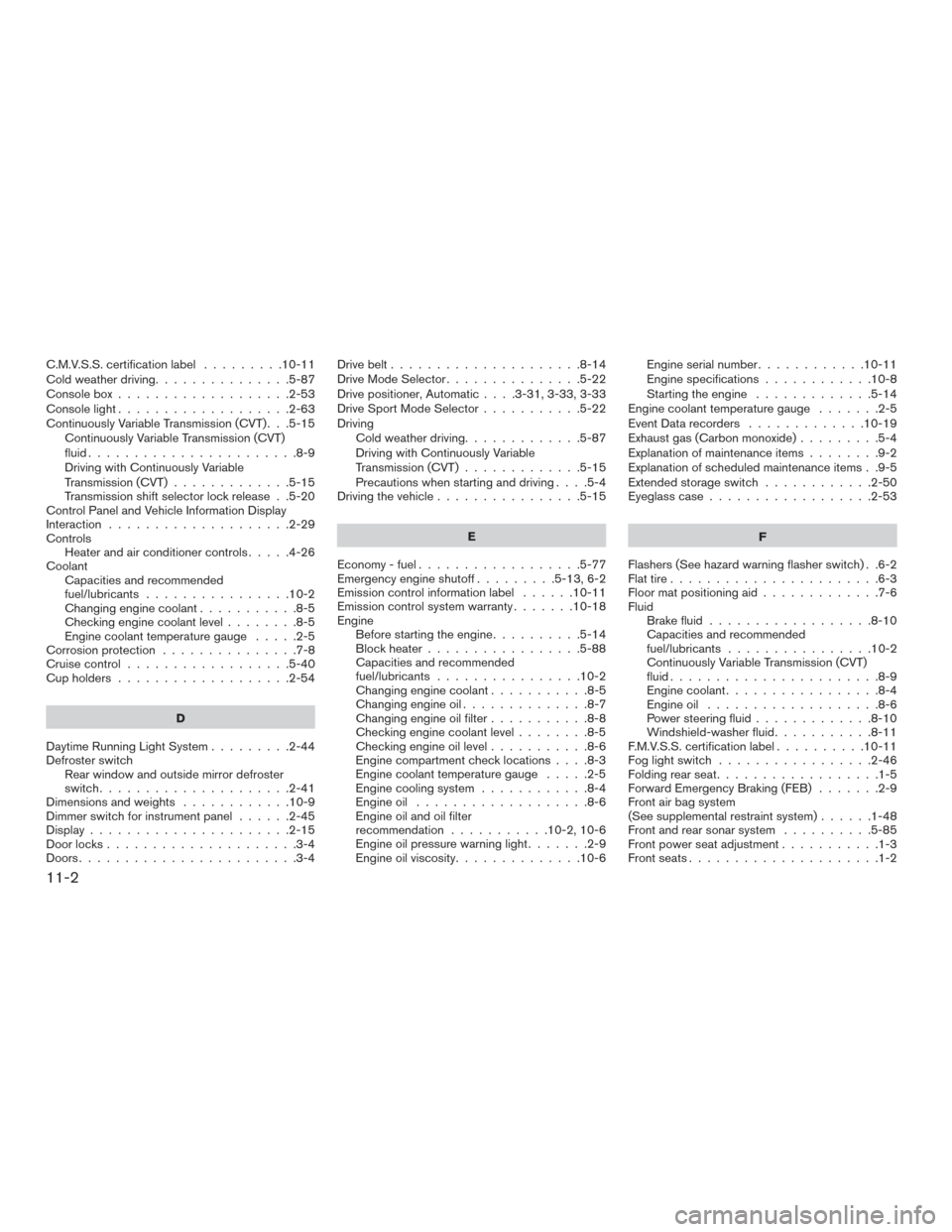
C.M.V.S.S. certification label.........10-11
Cold weather driving ...............5-87
Consolebox...................2-53
Consolelight...................2-63
Continuously Variable Transmission (CVT) . . .5-15 Continuously Variable Transmission (CVT)
fluid .......................8-9
Driving with Continuously Variable
Transmission (CVT) .............5-15
Transmission shift selector lock release . .5-20
Control Panel and Vehicle Information Display
Interaction ....................2-29
Controls Heater and air conditioner controls .....4-26
Coolant Capacities and recommended
fuel/lubricants ................10-2
Changing engine coolant ...........8-5
Checking engine coolant level ........8-5
Engine coolant temperature gauge .....2-5
Corrosionprotection ...............7-8
Cruisecontrol..................5-40
Cupholders...................2-54
D
Daytime Running Light System .........2-44
Defroster switch Rear window and outside mirror defroster
switch.....................2-41
Dimensionsandweights ............10-9
Dimmer switch for instrument panel ......2-45
Display......................2-15
Door locks .....................3-4
Doors ........................3-4 Drive belt
.....................8-14
Drive Mode Selector ...............5-22
Drive positioner, Automatic ....3-31,3-33,3-33
Drive Sport Mode Selector ...........5-22
Driving Cold weather driving .............5-87
Driving with Continuously Variable
Transmission (CVT) .............5-15
Precautions when starting and driving ....5-4
Driving the vehicle ................5-15
E
Economy - fuel ..................5-77
Emergency engine shutoff .........5-13,6-2
Emission control information label ......10-11
Emission control system warranty .......10-18
Engine Before starting the engine ..........5-14
Block heater .................5-88
Capacities and recommended
fuel/lubricants ................10-2
Changingenginecoolant...........8-5
Changingengineoil..............8-7
Changing engine oil filter ...........8-8
Checking engine coolant level ........8-5
Checking engine oil level ...........8-6
Engine compartment check locations ....8-3
Engine coolant temperature gauge .....2-5
Engine cooling system ............8-4
Engineoil ...................8-6
Engine oil and oil filter
recommendation ...........10-2,10-6
Engine oil pressure warning light .......2-9
Engine oil viscosity ..............10-6 Engine serial number
............10-11
Engine specifications ............10-8
Starting the engine .............5-14
Engine coolant temperature gauge .......2-5
Event Data recorders .............10-19
Exhaust gas (Carbon monoxide) .........5-4
Explanation of maintenance items ........9-2
Explanation of scheduled maintenance items . .9-5
Extended storage switch ............
2-50
Eyeglass case ..................2-53
F
Flashers (See hazard warning flasher switch) . .6-2
Flat tire .......................6-3
Floor mat positioning aid .............7-6
Fluid Brake fluid ..................8-10
Capacities and recommended
fuel/lubricants ................10-2
Continuously Variable Transmission (CVT)
fluid.......................8-9
Enginecoolant.................8-4
Engineoil ...................8-6
Power steering fluid .............8-10
Windshield-washer fluid ...........8-11
F.M.V.S.S. certification label ..........10-11
Foglightswitch .................2-46
Foldingrearseat..................1-5
Forward Emergency Braking (FEB) .......2-9
Front air bag system
(See supplemental restraint system) ......1-48
Front and rear sonar system ..........5-85
Front power seat adjustment ...........1-3
Frontseats.....................1-2
11-2
Page 400 of 406
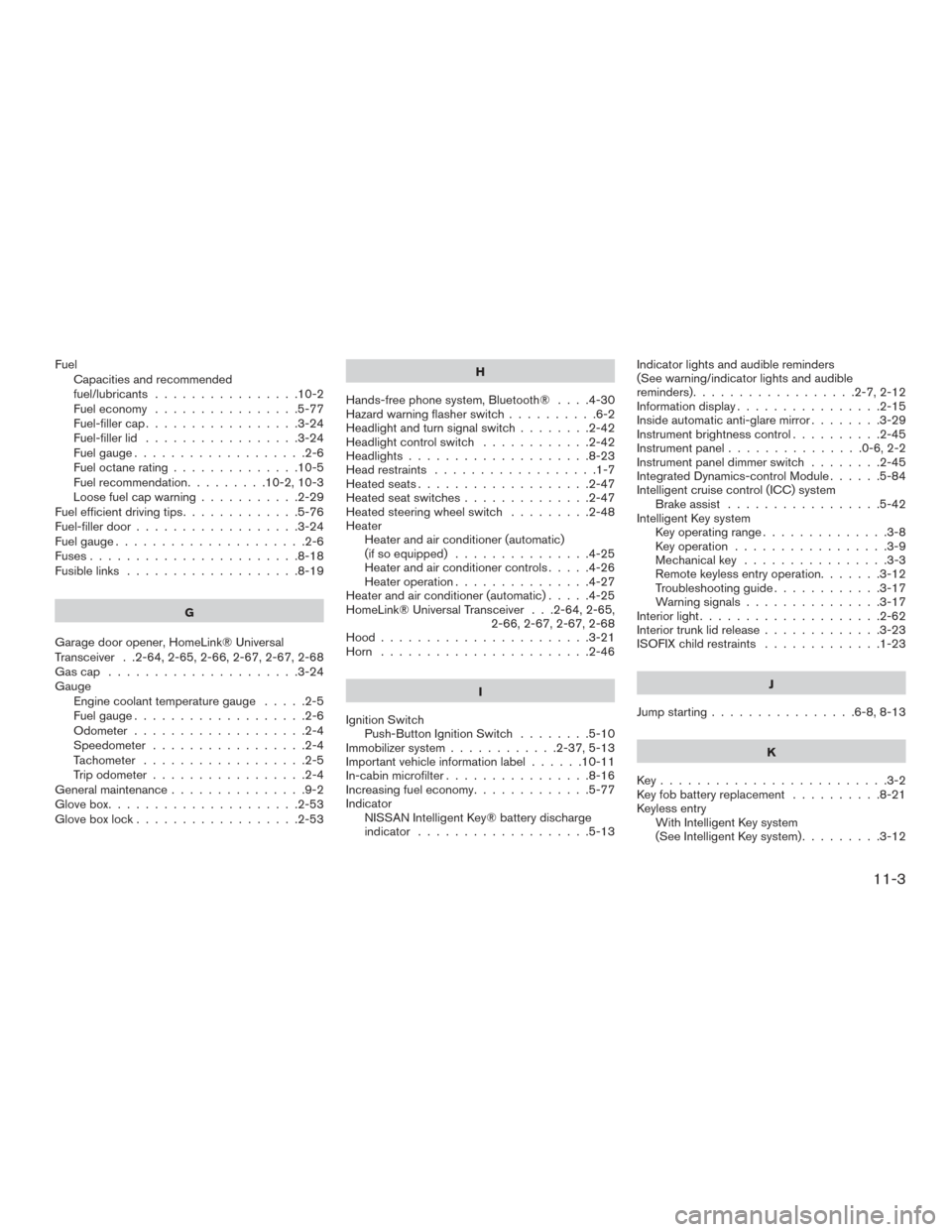
FuelCapacities and recommended
fuel/lubricants ................10-2
Fuel economy ................5-77
Fuel-filler cap .................3-24
Fuel-filler lid .................3-24
Fuel gauge ...................2-6
Fuel octane rating ..............10-5
Fuel recommendation .........10-2,10-3
Loose fuel cap warning ...........2-29
Fuel efficient driving tips .............5-76
Fuel-filler door ..................3-24
Fuel gauge .....................2-6
Fuses.......................8-18
Fusible links ...................8-19
G
Garage door opener, HomeLink® Universal
Transceiver . .2-64, 2-65, 2-66, 2-67, 2-67, 2-68
Gascap .....................3-24
Gauge Engine coolant temperature gauge .....2-5
Fuel gauge ...................2-6
Odometer ...................2-4
Speedometer .................2-4
Tachometer ..................2-5
Trip odometer .................2-4
General maintenance ...............9-2
Glovebox.....................2-53
Gloveboxlock..................2-53 H
Hands-free phone system, Bluetooth® ....4-30
Hazard warning flasher switch ..........6-2
Headlight and turn signal switch ........2-42
Headlight control switch ............2-42
Headlights ....................8-23
Head restraints ..................1-7
Heated seats ...................2-47
Heated seat switches ..............2-47
Heated steering wheel switch .........2-48
Heater Heater and air conditioner (automatic)
(if so equipped) ...............4-25
Heater and air conditioner controls .....4-26
Heater operation ...............4-27
Heater and air conditioner (automatic) .....4-25
HomeLink® Universal Transceiver . . .2-64, 2-65, 2-66, 2-67, 2-67, 2-68
Hood .......................3-21
Horn .......................2-46
I
Ignition Switch Push-Button Ignition Switch ........5-10
Immobilizer system ............2-37,5-13
Important vehicle information label ......10-11
In-cabin microfilter ................8-16
Increasing fuel economy .............5-77
Indicator NISSAN Intelligent Key® battery discharge
indicator ...................5-13 Indicator lights and audible reminders
(See warning/indicator lights and audible
reminders)..................2-7,2-12
Information display
................2-15
Inside automatic anti-glare mirror ........3-29
Instrument brightness control ..........2-45
Instrumentpanel...............0-6,2-2
Instrument panel dimmer switch ........2-45
Integrated Dynamics-control Module ......5-84
Intelligent cruise control (ICC) system Brake
assist.................5-42
Intelligent Key system Key operating range ..............3-8
Key operation .................3-9
Mechanical key ................3-3
Remote keyless entry operation.......3-12
Troubleshooting guide ............3-17
Warning signals ...............3-17
Interior light ....................2-62
Interior trunk lid release .............3-23
ISOFIX child restraints .............1-23
J
Jump starting ................6-8,8-13
K
Key.........................3-2
Key fob battery replacement ..........8-21
Keyless entry With Intelligent Key system
(See Intelligent Key system) .........3-12
11-3
Page 402 of 406
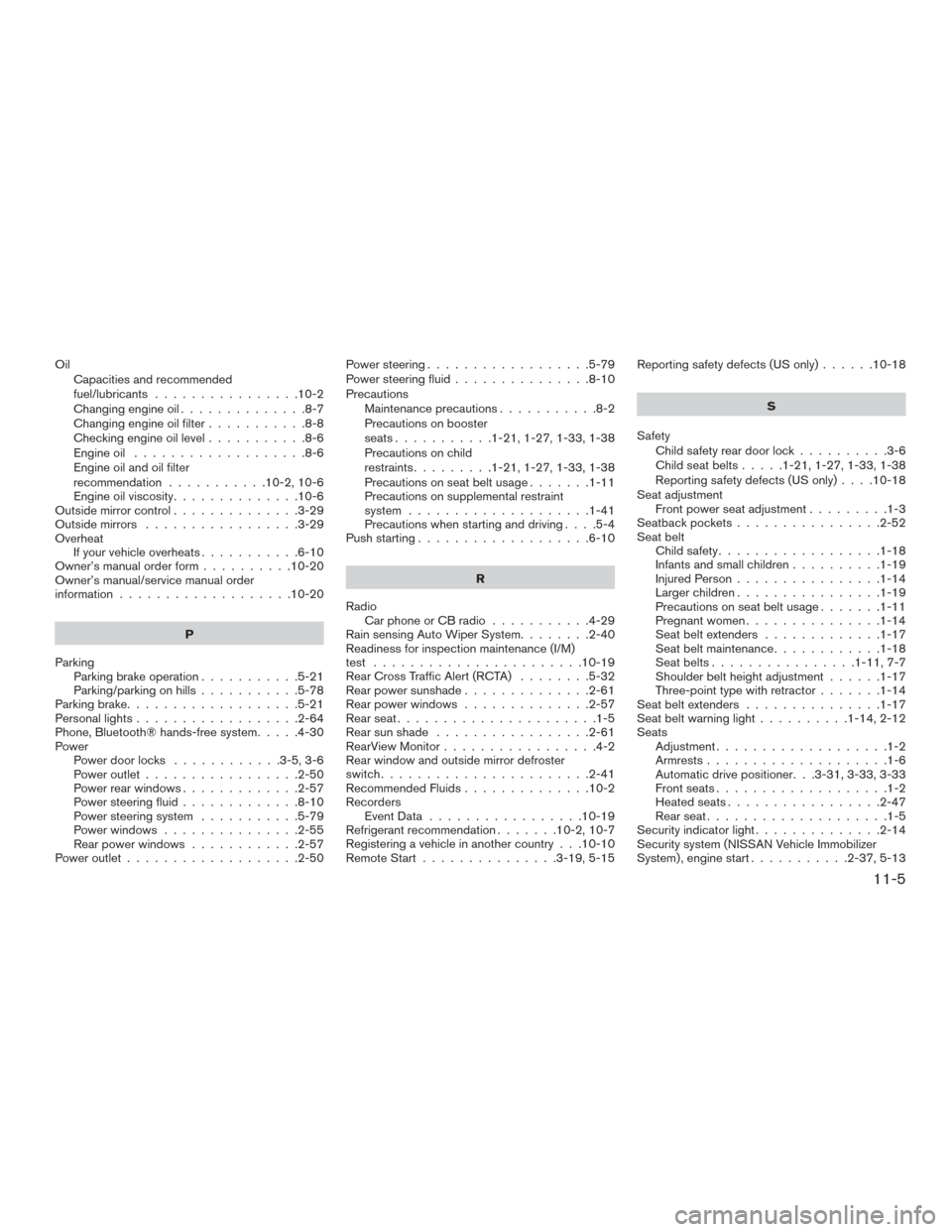
OilCapacities and recommended
fuel/lubricants ................10-2
Changing engine oil ..............8-7
Changing engine oil filter ...........8-8
Checking engine oil level ...........8-6
Engine oil ...................8-6
Engine oil and oil filter
recommendation ...........10-2,10-6
Engine oil viscosity ..............10-6
Outside mirror control ..............3-29
Outside mirrors .................3-29
Overheat Ifyourvehicleoverheats...........6-10
Owner’s manual order form ..........10-20
Owner’s manual/service manual order
information ...................10-20
P
Parking Parking brake operation ...........5-21
Parking/parking on hills ...........5-78
Parking brake ...................5-21
Personallights..................2-64
Phone, Bluetooth® hands-free system .....4-30
Power Power door locks ............3-5,3-6
Power outlet .................2-50
Power rear windows .............2-57
Power steering fluid .............8-10
Power steering system ...........5-79
Power windows ...............2-55
Rear power windows ............2-57
Power outlet ...................2-50 Power steering
..................5-79
Power steering fluid ...............8-10
Precautions Maintenance precautions ...........8-2
Precautions on booster
seats...........1-21,1-27,1-33,1-38
Precautions on child
restraints .........1-21,1-27,1-33,1-38
Precautions on seat belt usage .......1-11
Precautions on supplemental restraint
system ....................1-41
Precautions when starting and driving ....5-4
Push starting ...................6-10
R
Radio Car phone or CB radio ...........4-29
Rain sensing Auto Wiper System ........2-40
Readiness for inspection maintenance (I/M)
test .......................10-19
Rear Cross Traffic Alert (RCTA) ........5-32
Rear power sunshade ..............2-61
Rear power windows ..............2-57
Rearseat......................1-5
Rear sun shade .................2-61
RearView Monitor .................4-2
Rear window and outside mirror defroster
switch .......................2-41
Recommended Fluids ..............10-2
Recorders EventData .................10-19
Refrigerant recommendation .......10-2,10-7
Registering a vehicle in another country . . .10-10
Remote Start ...............3-19,5-15 Reporting safety defects (US only)
......10-18
S
Safety Child safety rear door lock ..........3-6
Child seat belts .....
1-21,1-27,1-33,1-38
Reporting safety defects (US only) ....10-18
Seat adjustment Front power seat adjustment .........1-3
Seatbackpockets................2-52
Seat belt Child safety ..................1-18
Infants and small children ..........1-19
Injured Person ................1-14
Largerchildren................1-19
Precautions on seat belt usage .......1-11
Pregnant women ...............1-14
Seatbeltextenders .............1-17
Seatbeltmaintenance............1-18
Seatbelts................1-11,7-7
Shoulder belt height adjustment ......1-17
Three-point type with retractor .......1-14
Seat belt extenders ...............1-17
Seatbeltwarninglight..........1-14,2-12
Seats Adjustment ...................1-2
Armrests....................1-6
Automatic drive positioner. . .3-31, 3-33, 3-33
Frontseats...................1-2
Heatedseats.................2-47
Rearseat....................1-5
Security indicator light ..............2-14
Security system (NISSAN Vehicle Immobilizer
System) , engine start ...........2-37,5-13
11-5