ignition NISSAN MAXIMA 2020 Owner´s Manual
[x] Cancel search | Manufacturer: NISSAN, Model Year: 2020, Model line: MAXIMA, Model: NISSAN MAXIMA 2020Pages: 500, PDF Size: 6.37 MB
Page 468 of 500
Octane rating tips
Using unleaded gasoline with an octane
rating lower than recommended can
cause persistent, heavy “spark knock.”
(“Spark knock” is a metallic rapping
noise.) If severe, this can lead to engine
damage. If you detect a persistent heavy
spark knock even when using gasoline
of the stated octane rating, or if you hear
steady spark knock while holding a
steady speed on level roads, it is recom-
mended that you have a NISSAN dealer
correct the condition. Failure to correct
the condition is misuse of the vehicle, for
which NISSAN is not responsible.
Incorrect ignition timing may result in
spark knock, af ter-run and/or overheating,
which may cause excessive fuel consump-
tion or engine damage. If any of the above
symptoms are encountered, have your ve-
hicle checked. It is recommended that you
visit a NISSAN dealer for servicing.
However, now and then you may notice
light spark knock for a short time while
accelerating or driving up hills. This is not
a cause for concern, because you get the
greatest fuel benefit when there is light
spark knock for a short time under heavy
engine load.
ENGINE OIL AND OIL FILTER
RECOMMENDATIONS
Selecting the correct oil
It is essential to choose the correct grade,
quality and viscosity engine oil to ensure
satisfactory engine life and performance.
For additional information, refer to “Recom-
mended fluids/lubricants and capacities”
in this section. NISSAN recommends the
use of an energy conserving oil in order to
improve fuel economy.
Select only engine oils that meet the
American Petroleum Institute (API) certifi-cation or International Lubricant Standard-
ization and Approval Committee (ILSAC)
certification and SAE viscosity standard.
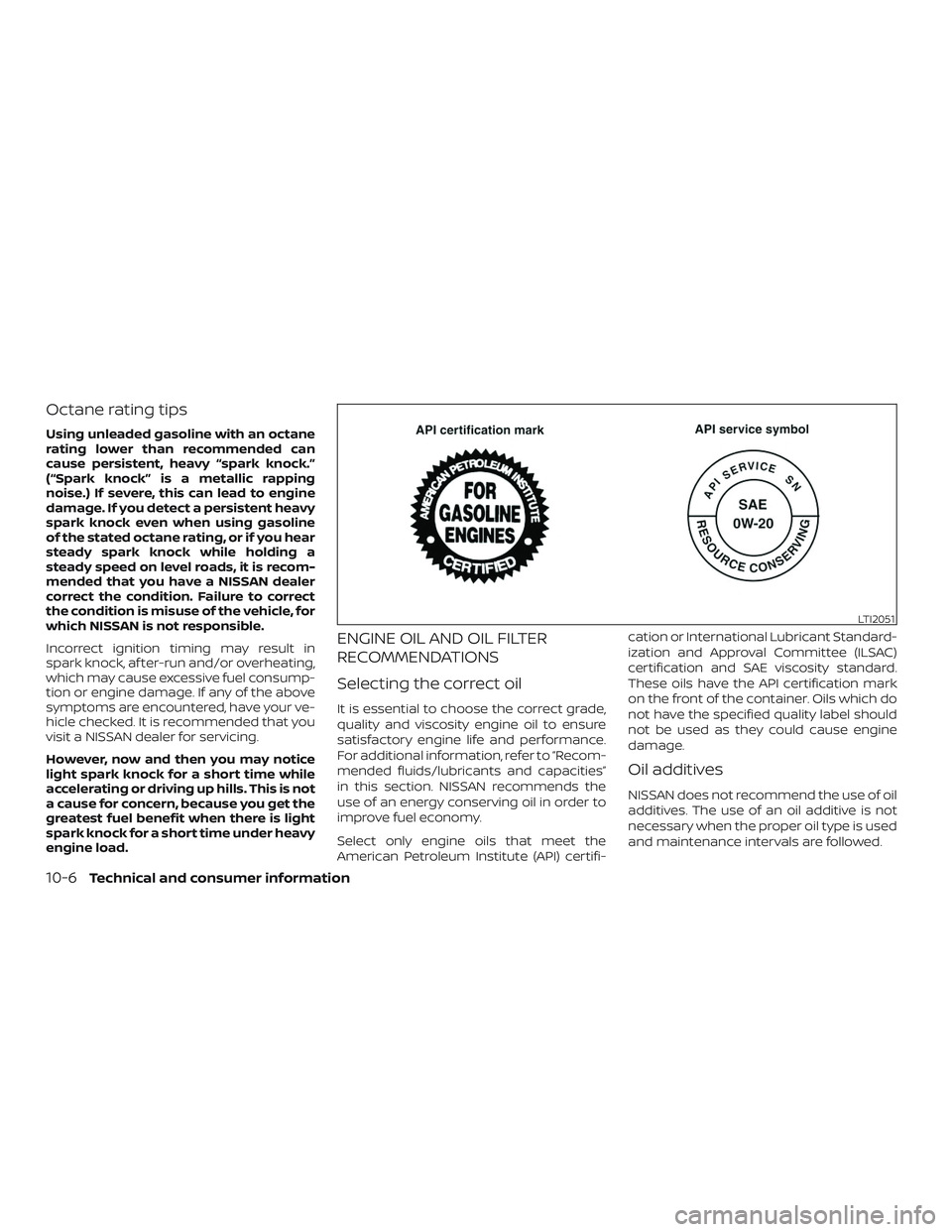
These oils have the API certification mark
on the front of the container. Oils which do
not have the specified quality label should
not be used as they could cause engine
damage.
Oil additives
NISSAN does not recommend the use of oil
additives. The use of an oil additive is not
necessary when the proper oil type is used
and maintenance intervals are followed.
LTI2051
10-6Technical and consumer information
Page 470 of 500

ENGINE
ModelVQ35DE
Type Gasoline, 4-cycle, DOHC
Cylinder arrangement 6-cylinder, V-block, Slanted at 60°
Bore x Stroke in (mm) 3.760 x 3.205 (95.5 x 81.4)
Displacement cu in (cm
3) 213.45 (3,498)
Firing order 1–2–3–4–5–6
Idle speed
No adjustment is necessary.
CVT in N (Neutral) position
Ignition timing (degree B.T.D.C. at idle speed)
CO%atidle
Spark plug
FXE22HR11
Spark plug gap (Nominal) in (mm) 0.043 (1.1)
Camshaf t operation Timing chain
This spark ignition system complies with the Canadian standard ICES-002.
SPECIFICATIONS
10-8Technical and consumer information
Page 482 of 500

Due to legal requirements in some states
and Canadian Provinces, your vehicle may
be required to be in what is called the
“ready condition” for an
Inspection/Maintenance (I/M) test of the
emission control system.
The vehicle is set to the “ready condition”
when it is driven through certain driving
patterns. Usually, the ready condition can
be obtained by ordinary usage of the ve-
hicle.
If a powertrain system component is re-
paired or the battery is disconnected, the
vehicle may be reset to a “not ready” condi-
tion. Before taking the I/M test, check the
vehicle’s inspection/maintenance test
readiness condition. Place the ignition
switch in the ON position without starting
the engine. If the Malfunction Indicator
Light (MIL) comes on steady for 20 seconds
and then blinks for 10 seconds , the I/M test
condition is “not ready”. If the MIL does not
blink af ter 20 seconds, the I/M test condi-
tion is “ready”. It is recommended that you
visit a NISSAN dealer to set the “ready con-
dition” or to prepare the vehicle for testing.This vehicle is equipped with an EDR. The
main purpose of an EDR is to record, in
certain collision or near collision-like situa-
tions, such as an air bag deployment or
hitting a road obstacle, data that will assist
in understanding how a vehicle’s systems
performed. The EDR is designed to record
data related to vehicle dynamics and
safety systems for a short period of time,
typically 30 seconds or less. The EDR in this
vehicle is designed to record such data as:
∙ How various systems in your vehicle were operating;
∙ Whether or not the driver and passen- ger safety belts were buckled/fastened;
∙ How far (if at all) the driver was depress- ing the accelerator and/or brake pedal;
and,
∙ How fast the vehicle was traveling.
∙ Sounds are not recorded. These data can help provide a better un-
derstanding of the circumstances in which
collisions and injuries occur. NOTE: EDR
data are recorded by your vehicle only if a
nontrivial collision situation occurs; no data
are recorded by the EDR under normal driv-
ing conditions and no personal data (e.g.
name, gender, age and collision location)
are recorded. However, other parties, such
as law enforcement, could combine the
EDR data with the type of personally iden-
tif ying data routinely acquired during a col-
lision investigation.
To read data recorded by an EDR, special
equipment is required and access to the
vehicle or the EDR is needed. In addition to
the vehicle manufacturer and NISSAN
dealer, other parties, such as law enforce-
ment, that have the special equipment, can
read the information if they have access to
the vehicle or the EDR. EDR data will only be
accessed with the consent of the vehicle
owner or lessee or as otherwise required or
permitted by law.
READINESS FOR INSPECTION/
MAINTENANCE (I/M) TEST
EVENT DATA RECORDERS (EDR)
10-20Technical and consumer information
Page 487 of 500
Engine oil...................8-6
Powersteeringfluid............8-11
Windshield-washer fluid .........8-12
F.M.V.S.S. certification label ..........10-11
Foglightswitch................2-54
Foldingrearseat.................1-5
Front air bag system
(See supplemental restraint system) . . . .1-51
Front and rear sonar system .......5-126
Front-door pocket ..............2-64
Front power seat adjustment .........1-3
Frontseats................... .1-2
Fuel Capacities and recommended
fuel/lubricants...............10-2
Fuel economy ...............5 -117
Fuel-filler cap ................3-23
Fuel-filler lid .................3-23
Fuel gauge ..................2-7
Fueloctanerating.............10-6
Fuel recommendation .......10-2,10-4
Loose fuel cap warning .........2-34
Fuelefficientdrivingtips...........5 -116
Fuel-filler door .................3-23
Fuel gauge ....................2-7
Fuses .......................8-19
Fusiblelinks...................8-20
G
Garage door opener, HomeLink® Universal
Transceiver ......2-76,2-77,2-79,2-79,2-80
Gascap.....................3-23 Gauge
Engine coolant temperature gauge . .2-6
Fuel gauge ..................2-7
Odometer ..................2-5
Speedometer ..............2-4,2-5
Tachometer .................2-6
Trip odometer .............2-4,2-5
General maintenance .............9-2
Glovebox....................2-65
Gloveboxlock.................2-65
H
Hazard warning flasher switch ........6-2
Headlight and turn signal switch ......2-48
Headlightcontrolswitch...........2-48
Headlights ...................8-23
Headrestraints................. .1-7
Heatedrearseats...............2-57
Heatedseats..................2-56
Heated seat switches ............2-56
Heated steering wheel ............2-58
Heater Heater and air conditioner (automatic)
(if so equipped) ..............4-29
Heater and air conditioner controls . .4-30
Heater operation ..............4-31
Heater and air conditioner (automatic) . .4-29
HomeLink® Universal
Transceiver ......2-76,2-77,2-79,2-79,2-80
Hood ...................... .3-21
Horn.......................2-55 I
Ignition Switch Push-button ignition switch .......5-11
Immobilizer system ..........2-44,5-14
Important vehicle information label . . . .10-11
In-cabinmicrofilter..............8-16
Increasing fuel economy ..........5-117
Indicator NISSAN Intelligent Key® battery discharge
indicator...................5-13
Indicator lights and audible reminders
(See warning/indicator lights and audible
reminders) .................2-8,2-13
Informationdisplay..............2-17
Inside automatic anti-glare mirror .....3-28
Instrument brightness control .......2-53
Instrument
panel .............0-6,2-2
Instrument panel dimmer switch .....2-53
Integrated Dynamics-control Module . .5-125
Intelligent Around View Monitor .......4-11
Intelligent Cruise Control (ICC) .......5-60
Intelligent Drive Alertness (I-DA) ......5-112
Intelligent Engine Brake (I-EB) .......5-125
Intelligent Forward Collision Warning
(I-FCW) .....................5-101
Intelligent Key system Key operating range ............3-8
Key operation ................3-9
Mechanical key ...............3-3
Remote keyless entry operation ....3-13
Troubleshooting guide ..........3-16
Warning signals ..............3-16
11-3