climate control NISSAN MAXIMA 2020 Owner´s Manual
[x] Cancel search | Manufacturer: NISSAN, Model Year: 2020, Model line: MAXIMA, Model: NISSAN MAXIMA 2020Pages: 500, PDF Size: 6.37 MB
Page 250 of 500
Air flow control
Pressing the MODE button manually con-
trols air flow and selects the air outlet:
— Air flows mainly from centerand side vents.
— Air flows mainly from centerand side vents and foot
outlets.
— Air flows mainly from foot out-lets and partly from defroster.
— Air flows mainly from defrosterand foot outlets.
To turn system off
Press the ON-OFF button.
Rear window and outside mirror
(if so equipped) defroster switch
For additional information, refer to “Rear
window and outside mirror (if so equipped)
defroster switch” in the “Instruments and
controls” section of this manual.
OPERATING TIPS
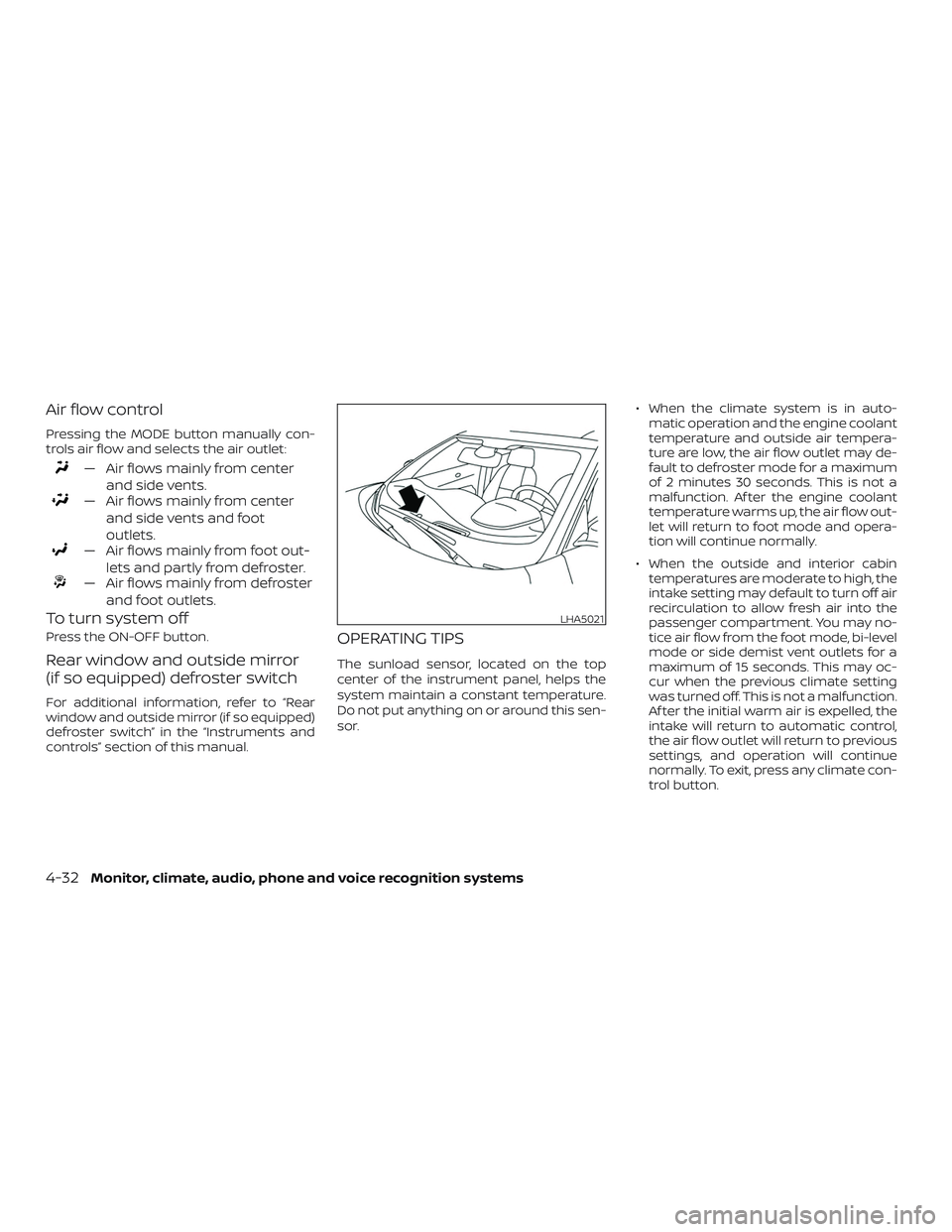
The sunload sensor, located on the top
center of the instrument panel, helps the
system maintain a constant temperature.
Do not put anything on or around this sen-
sor. ∙ When the climate system is in auto-
matic operation and the engine coolant
temperature and outside air tempera-
ture are low, the air flow outlet may de-
fault to defroster mode for a maximum
of 2 minutes 30 seconds. This is not a
malfunction. Af ter the engine coolant
temperature warms up, the air flow out-
let will return to foot mode and opera-
tion will continue normally.
∙ When the outside and interior cabin temperatures are moderate to high, the
intake setting may default to turn off air
recirculation to allow fresh air into the
passenger compartment. You may no-
tice air flow from the foot mode, bi-level
mode or side demist vent outlets for a
maximum of 15 seconds. This may oc-
cur when the previous climate setting
was turned off. This is not a malfunction.
Af ter the initial warm air is expelled, the
intake will return to automatic control,
the air flow outlet will return to previous
settings, and operation will continue
normally. To exit, press any climate con-
trol button.
LHA5021
4-32Monitor, climate, audio, phone and voice recognition systems
Page 252 of 500
The vehicle is equipped with a shark fin
antenna and an antenna pattern is printed
inside the rear window.
CAUTION
∙ Do not place metalized film near therear window glass or attach any metal
parts to it. This may cause poor recep-
tion or noise.
∙ When cleaning the inside of the rear window, be careful not to scratch or
damage the rear window antenna.
Lightly wipe along the antenna with a
dampened sof t cloth. When installing a CB, ham radio or car
phone in your vehicle, be sure to observe
the following precautions; otherwise, the
new equipment may adversely affect the
engine control system and other electronic
parts.
WARNING
∙ A cellular phone should not be used
for any purpose while driving so full
attention may be given to vehicle op-
eration. Some jurisdictions prohibit
the use of cellular phones while
driving.
∙ If you must make a call while your ve- hicle is in motion, the hands free cellu-
lar phone operational mode (if so
equipped) is highly recommended.
Exercise extreme caution at all times
so full attention may be given to ve-
hicle operation.
∙ If you are unable to devote full atten- tion to vehicle operation while talking
on the phone, pull off the road to a
safe location and stop your vehicle.
CAUTION
∙ Keep the antenna as far away as pos-sible from the electronic control
modules.
∙ Keep the antenna wire more than 8 in (20 cm) away from the electronic con-
trol system harnesses. Do not route
the antenna wire next to any harness.
∙ Adjust the antenna standing-wave ratio as recommended by the
manufacturer.
∙ Connect the ground wire from the CB radio chassis to the body.
∙ For additional information, it is rec- ommended that you visit a NISSAN
dealer.
ANTENNA CAR PHONE OR CB RADIO
4-34Monitor, climate, audio, phone and voice recognition systems
Page 479 of 500
Continuously Variable
Transmission
To tow a vehicle equipped with a continu-
ously variable transmission, an appropriate
vehicle dollyMUSTbe placed under the
towed vehicle’s drive wheels. Alwaysfollow
the dolly manufacturer’s recommenda-
tions when using their product. DOT (Department of Transportation) Qual-
ity Grades: All passenger car tires must
conform to federal safety requirements in
addition to these grades.
Quality grades can be found where appli-
cable on the tire sidewall between tread
shoulder and maximum section width. For
example:
Treadwear 200 Traction AA Temperature
A
Treadwear
The treadwear grade is a comparative rat-
ing based on the wear rate of the tire when
tested under controlled conditions on a
specified government test course. For ex-
ample, a tire graded 150 would wear one
and one-half (1 1/2) times as well on the
government course as a tire graded 100.
The relative performance of tires depends
upon the actual conditions of their use,
however, and may depart significantly from
the norm due to variations in driving habits,
service practices and differences in road
characteristics and climate.
Traction AA, A, B and C
The traction grades, from highest to low-
est, are AA, A, B, and C. Those grades repre-
sent the tire’s ability to stop on wet pave-ment as measured under controlled
conditions on specified government test
surfaces of asphalt and concrete. A tire
marked C may have poor traction perfor-
mance.
WARNING
The traction grade assigned to this tire
is based on straight-ahead braking
traction tests, and does not include ac-
celeration, cornering, hydroplaning, or
peak traction characteristics.
Temperature A, B and C
The temperature grades are A (the high-
est), B, and C, representing the tire’s resis-
tance to the generation of heat, and its
ability to dissipate heat when tested under
controlled conditions on a specified indoor
laboratory test wheel. Sustained high tem-
perature can cause the material of the tire
to degenerate and reduce tire life, and ex-
cessive temperature can lead to sudden
tire failure. The grade C corresponds to a
level of performance which all passenger
car tires must meet under the Federal Mo-
tor Vehicle Safety Standard No. 109. Grades
B and A represent higher levels of perfor-
mance on the laboratory test wheel than
the minimum required by law.
UNIFORM TIRE QUALITY GRADING
Technical and consumer information10-17
Page 486 of 500
Chimes, audible reminders.........2-16
Cleaningexteriorandinterior......7-2,7-5
Climatecontrolseatswitch.........2-55
C.M.V.S.S. certification label .........10-11
Coldweatherdriving ............5-130
Console box ..................2-66
Console light ..................2-75
Continuously Variable Transmission
(CVT) .......................5-16
Continuously Variable Transmission (CVT)
fluid......................8-10
Driving with Continuously Variable
Transmission (CVT) ............5-16
Transmission shif t selector lock
release....................5-20
Control panel and vehicle information
displayinteraction...............2-36
Controls Heater and air conditioner controls . .4-30
Coolant Capacities and recommended
fuel/lubricants...............10-2
Changing engine coolant .........8-5
Checking engine coolant level ......8-5
Engine coolant temperature gauge . .2-6
Corrosionprotection..............7-9
Cruisecontrol .................5-57
Cupholders...................2-67
D
Daytime Running Light System .......2-53
Defroster switch Rear window and outside mirror
defrosterswitch..............2-48 Dimensions and weights
...........10-9
Dimmer switch for instrument panel . . .2-53
Display......................2-17
Door locks ....................3-4
Drivebelt ....................8-15
Drive Mode Selector ..............5-23
Drive positioner,
Automatic..........3-31,3-32,3-33,3-34
Drive Sport Mode Selector ..........5-23
Driving Cold weather driving ..........5-130
Driving with Continuously Variable
Transmission (CVT) ............5-16
Precautions when starting and
driving.....................5-4
Drivingthevehicle...............5-16
Dynamic driver assistance switch .....2-59
E
E-call (SOS) Button ..............2-62
Economy - fuel ................5 -117
Emergency engine shutoff .......5-13,6-2
Emission control information label . . . .10-11
Emission control system warranty . . . .10-18
Engine Before starting the engine ........5-14
Capacities and recommended
fuel/lubricants...............10-2
Changing engine coolant .........8-5
Changing engine oil ............8-6
Changing engine oil filter .........8-6
Checking engine coolant level ......8-5
Checking engine oil level .........8-6Engine compartment check
locations...................8-3
Engine coolant temperature gauge . .2-6
Engine cooling system
..........8-4
Engine oil ...................8-6
Engine oil and oil filter
recommendation ..........10-2,10-6
Engine oil pressure warning light . . . .2-10
Engine oil viscosity .............10-7
Engine serial number ...........10-11
Engine specifications ...........10-8
Starting the engine ............5-15
Engine Block Heater .............5-131
Engine coolant temperature gauge ....2-6
EventDatarecorders............10-20
Exhaust gas (Carbon monoxide) .......5-4
Explanation of maintenance items .....9-2
Explanation of scheduled maintenance
items .......................9-5
Extended storage switch ..........2-63
Eyeglasscase................ .2-66
F
Flashers
(Seehazardwarningflasherswitch)....6-2
Flattire....................6-3,6-4
F
loormatpositioningaid...........7-8
Fluid Brakefluid..................8-11
Capacities and recommended
fuel/lubricants...............10-2
Continuously Variable Transmission
(CVT) fluid ..................8-10
Engine coolant ...............8-4
11-2