steering wheel NISSAN MAXIMA 2020 Owner´s Manual
[x] Cancel search | Manufacturer: NISSAN, Model Year: 2020, Model line: MAXIMA, Model: NISSAN MAXIMA 2020Pages: 500, PDF Size: 6.37 MB
Page 399 of 500
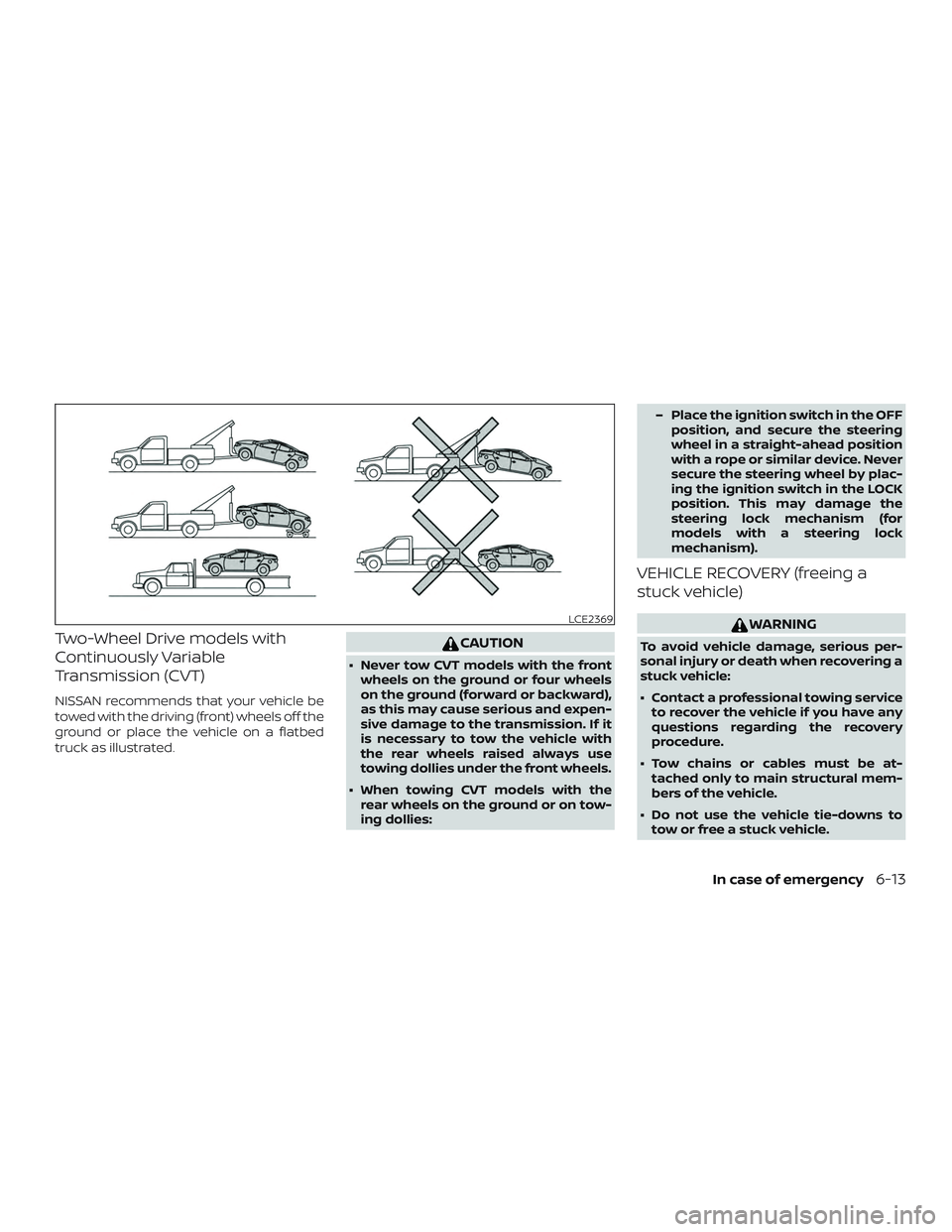
Two-Wheel Drive models with
Continuously Variable
Transmission (CVT)
NISSAN recommends that your vehicle be
towed with the driving (front) wheels off the
ground or place the vehicle on a flatbed
truck as illustrated.
CAUTION
∙ Never tow CVT models with the frontwheels on the ground or four wheels
on the ground (forward or backward),
as this may cause serious and expen-
sive damage to the transmission. If it
is necessary to tow the vehicle with
the rear wheels raised always use
towing dollies under the front wheels.
∙ When towing CVT models with the rear wheels on the ground or on tow-
ing dollies: – Place the ignition switch in the OFF
position, and secure the steering
wheel in a straight-ahead position
with a rope or similar device. Never
secure the steering wheel by plac-
ing the ignition switch in the LOCK
position. This may damage the
steering lock mechanism (for
models with a steering lock
mechanism).
VEHICLE RECOVERY (freeing a
stuck vehicle)
WARNING
To avoid vehicle damage, serious per-
sonal injury or death when recovering a
stuck vehicle:
∙ Contact a professional towing serviceto recover the vehicle if you have any
questions regarding the recovery
procedure.
∙ Tow chains or cables must be at- tached only to main structural mem-
bers of the vehicle.
∙ Do not use the vehicle tie-downs to tow or free a stuck vehicle.
LCE2369
In case of emergency6-13
Page 400 of 500
∙ Only use devices specifically designedfor vehicle recovery and follow the
manufacturer’s instructions.
∙ Always pull the recovery device straight out from the front of the ve-
hicle. Never pull at an angle.
∙ Route recovery devices so they do not touch any part of the vehicle except
the attachment point.
If your vehicle is stuck in sand, snow, mud,
etc., use a tow strap or other device de-
signed specifically for vehicle recovery. Al-
ways follow the manufacturer’s instruc-
tions for the recovery device.
Rocking a stuck vehicle
WARNING
∙ Stand clear of a stuck vehicle.
∙ Do not spin your tires at high speed. This could cause them to explode and
result in serious injury. Parts of your
vehicle could also overheat and be
damaged. If your vehicle is stuck in sand, snow, mud,
etc., use the following procedure:
1. Turn off the Vehicle Dynamic Control (VDC) system.
2. Make sure the area in front and behind the vehicle is clear of obstructions.
3. Turn the steering wheel right and lef t to clear an area around the front tires.
4. Slowly rock the vehicle forward and backward.
∙ Shif t back and forth between R (Re- verse) and D (Drive).
∙ Apply the accelerator as little as pos- sible to maintain the rocking motion.
∙ Release the accelerator pedal before shif ting between R (Reverse) and D
(Drive).
∙ Do not spin the tires above 35 mph (55 km/h).
5. If the vehicle cannot be freed af ter a few tries, contact a professional towing
service to remove the vehicle.
6-14In case of emergency
Page 411 of 500
8 Do-it-yourself
Maintenance precautions.......................8-2
Engine compartment check locations ...........8-3
Engine cooling system ..........................8-4
Checking engine coolant level ................8-5
Changing engine coolant .....................8-5
Engine oil ........................................8-6
Checking engine oil level .....................8-6
Changing engine oil and oil filter ..............8-6
Continuously Variable Transmission (CVT)
fluid ............................................ 8-10
Power Steering Fluid (PSF) .......................8-11
Brake fluid ....................................... 8-11
Windshield-washer fluid ........................8-12
Windshield-washer fluid reservoir ............8-12
Battery......................................... 8-13
Jump starting ............................... 8-14
Drive belt ....................................... 8-15
Spark plugs .................................... 8-15
Replacing spark plugs ....................... 8-15
Air cleaner ...................................... 8-16
In-cabin microfilter .......................... 8-16Windshield wiper blades
........................8-17
Cleaning .................................... 8-17
Replacing ................................... 8-17
Brakes.......................................... 8-18
Fuses ........................................... 8-19
Engine compartment ....................... 8-19
Passenger compartment ....................8-20
Battery replacement ........................... 8-21
NISSAN Intelligent Key® ......................8-22
Lights .......................................... 8-23
Headlights ................................... 8-23
Front park/turn signal/side marker
light ......................................... 8-23
Fog lights (if so equipped) ...................8-23
Exterior and interior lights ...................8-24
Wheels and tires ................................ 8-26
Tire pressure ................................ 8-26
Tire labeling ................................. 8-30
T
ypes of tires ................................ 8-33
Tire chains .................................. 8-34
Changing wheels and tires ..................8-34
Page 451 of 500
secondary latch keeps the hood from
opening when the primary latch is re-
leased.
When driving in areas using road salt or
other corrosive materials, check lubrica-
tion frequently.
Lights*:Clean the headlights on a regular
basis. Make sure that the headlights, stop
lights, tail lights, turn signal lights, and other
lights are all operating properly and in-
stalled securely. Also check headlight aim.
Road wheel nuts (lug nuts)*: When check-
ing the tires, make sure no wheel nuts are
missing, and check for any loose wheel
nuts. Tighten if necessary.
Tire rotation*: Tires should be rotated ev-
ery 7,500 miles (12,000 km).
Tires*: Check the pressure with a gauge
of ten and always prior to long distance
trips. If necessary, adjust the pressure in all
tires, including the spare, to the pressure
specified. Check carefully for damage, cuts
or excessive wear.
Tire Pressure Monitoring System (TPMS)
transmitter components: Replace the
TPMS transmitter grommet seal, valve core
and cap when the tires are replaced due to
wear or age.Wheel alignment and balance: If the vehicle
should pull to either side while driving on a
straight and level road, or if you detect un-
even or abnormal tire wear, there may be a
need for wheel alignment. If the steering
wheel or seat vibrates at normal highway
speeds, wheel balancing may be needed.
For additional information regarding tires,
refer to “Important Tire Safety Information”
(US) or “Tire Safety Information” (Canada) in
the Warranty Information Booklet.
Windshield: Clean the windshield on a
regular basis. Check the windshield at least
every six months for cracks or other dam-
age. Have a damaged windshield repaired
by a qualified repair facility. It is recom-
mended that you have a damaged wind-
shield repaired by a NISSAN dealer, or a
NISSAN Certified Collision Center. To locate
a collision center in your area, refer to
http://collision.nissanusa.com.
Windshield wiper blades*: Check for
cracks or wear if they do not wipe properly.
Inside the vehicle
The maintenance items listed here should
be checked on a regular basis, such as
when performing scheduled maintenance,
cleaning the vehicle, etc. Accelerator pedal:
Check the pedal for
smooth operation and make sure the
pedal does not catch or require uneven
effort. Keep the floor mat away from the
pedal.
Brake pedal: Check the pedal for smooth
operation. If the brake pedal suddenly goes
down further than normal, the pedal feels
spongy or the vehicle seems to take longer
to stop, have your vehicle checked imme-
diately. It is recommended that you visit a
NISSAN dealer for this service. Keep the
floor mat away from the pedal.
Brakes: Check that the brakes do not pull
the vehicle to one side when applied.
Continuously Variable Transmission
(CVT) P (Park) position mechanism: On a
fairly steep hill check that the vehicle is held
securely with the shif t lever in the P (Park)
position without applying any brakes.
Parking brake: Check the parking brake
operation regularly. The vehicle should be
securely held on a fairly steep hill with only
the parking brake applied. If the parking
brake needs adjustment, it is recom-
mended that you visit a NISSAN dealer for
this service.
Maintenance and schedules9-3
Page 452 of 500
Seats:Check seat position controls such
as seat adjusters, seatback recliner, etc., to
ensure they operate smoothly and all
latches lock securely in every position.
Check that the head restraints/headrests
move up and down smoothly and the locks
(if so equipped) hold securely in all latched
positions.
Seat belts: Check that all parts of the seat
belt system (for example, buckles, anchors,
adjusters and retractors) operate properly
and smoothly, and are installed securely.
Check the belt webbing for cuts, fraying,
wear or damage.
Steering wheel: Check for changes in the
steering system, such as excessive free
play, hard steering or strange noises.
Warning lights and chimes: Make sure all
warning lights and chimes are operating
properly.
Windshield defroster: Check that the air
comes out of the defroster outlets properly
and in sufficient quantity when operating
the heater or air conditioner.
Windshield wiper and washer*: Check
that the wipers and washer operate prop-
erly and that the wipers do not streak.Under the hood and vehicle
The maintenance items listed here should
be checked periodically (for example, each
time you check the engine oil or refuel).
Battery* (for maintenance free batter-
ies): This vehicle is equipped with a sealed
maintenance free battery. It is recom-
mended that you visit a NISSAN dealer for
service.
NOTE:
Care should be taken to avoid situations
that can lead to potential battery dis-
charge and potential no-start conditions
such as:
1. Installation or extended use of elec-
tronic accessories that consume bat-
tery power when the engine is not
running (Phone chargers, GPS, DVD
players, etc.).
2. Vehicle is not driven regularly and/or
only driven short distances.
In these cases, the battery may need to
be charged to maintain battery health.
Brake fluid level*: Make sure that the brake
fluid level is between the MAX and MIN lines
on the reservoir. Engine coolant level*:
Check the coolant
level when the engine is cold.
Engine drive belts*: Make sure the drive
belts are not frayed, worn, cracked or oily.
Engine oil level*: Check the level af ter
parking the vehicle on a level spot and
turning off the engine. Wait more than
15 minutes for the oil to drain back into the
oil pan.
Exhaust system: Make sure there are no
loose supports, cracks or holes. If the
sound of the exhaust seems unusual or
there is a smell of exhaust fumes, immedi-
ately have the exhaust system inspected. It
is recommended that you visit a NISSAN
dealer for this service. For additional infor-
mation, refer to “Exhaust gas (carbon mon-
oxide)” in the “Starting and driving” section
of this manual.
Fluid leaks: Check under the vehicle for
fuel, oil, water or other fluid leaks af ter the
vehicle has been parked for a while. Water
dripping from the air conditioner af ter use
is normal. If you should notice any leaks or if
fuel fumes are evident, check for the cause
and have it corrected immediately.
9-4Maintenance and schedules
Page 487 of 500
Engine oil...................8-6
Powersteeringfluid............8-11
Windshield-washer fluid .........8-12
F.M.V.S.S. certification label ..........10-11
Foglightswitch................2-54
Foldingrearseat.................1-5
Front air bag system
(See supplemental restraint system) . . . .1-51
Front and rear sonar system .......5-126
Front-door pocket ..............2-64
Front power seat adjustment .........1-3
Frontseats................... .1-2
Fuel Capacities and recommended
fuel/lubricants...............10-2
Fuel economy ...............5 -117
Fuel-filler cap ................3-23
Fuel-filler lid .................3-23
Fuel gauge ..................2-7
Fueloctanerating.............10-6
Fuel recommendation .......10-2,10-4
Loose fuel cap warning .........2-34
Fuelefficientdrivingtips...........5 -116
Fuel-filler door .................3-23
Fuel gauge ....................2-7
Fuses .......................8-19
Fusiblelinks...................8-20
G
Garage door opener, HomeLink® Universal
Transceiver ......2-76,2-77,2-79,2-79,2-80
Gascap.....................3-23 Gauge
Engine coolant temperature gauge . .2-6
Fuel gauge ..................2-7
Odometer ..................2-5
Speedometer ..............2-4,2-5
Tachometer .................2-6
Trip odometer .............2-4,2-5
General maintenance .............9-2
Glovebox....................2-65
Gloveboxlock.................2-65
H
Hazard warning flasher switch ........6-2
Headlight and turn signal switch ......2-48
Headlightcontrolswitch...........2-48
Headlights ...................8-23
Headrestraints................. .1-7
Heatedrearseats...............2-57
Heatedseats..................2-56
Heated seat switches ............2-56
Heated steering wheel ............2-58
Heater Heater and air conditioner (automatic)
(if so equipped) ..............4-29
Heater and air conditioner controls . .4-30
Heater operation ..............4-31
Heater and air conditioner (automatic) . .4-29
HomeLink® Universal
Transceiver ......2-76,2-77,2-79,2-79,2-80
Hood ...................... .3-21
Horn.......................2-55 I
Ignition Switch Push-button ignition switch .......5-11
Immobilizer system ..........2-44,5-14
Important vehicle information label . . . .10-11
In-cabinmicrofilter..............8-16
Increasing fuel economy ..........5-117
Indicator NISSAN Intelligent Key® battery discharge
indicator...................5-13
Indicator lights and audible reminders
(See warning/indicator lights and audible
reminders) .................2-8,2-13
Informationdisplay..............2-17
Inside automatic anti-glare mirror .....3-28
Instrument brightness control .......2-53
Instrument
panel .............0-6,2-2
Instrument panel dimmer switch .....2-53
Integrated Dynamics-control Module . .5-125
Intelligent Around View Monitor .......4-11
Intelligent Cruise Control (ICC) .......5-60
Intelligent Drive Alertness (I-DA) ......5-112
Intelligent Engine Brake (I-EB) .......5-125
Intelligent Forward Collision Warning
(I-FCW) .....................5-101
Intelligent Key system Key operating range ............3-8
Key operation ................3-9
Mechanical key ...............3-3
Remote keyless entry operation ....3-13
Troubleshooting guide ..........3-16
Warning signals ..............3-16
11-3
Page 490 of 500
Seat beltChildsafety................ .1-20
Infants and small children ........1-21
InjuredPerson............... .1-15
Largerchildren.............. .1-21
Precautions on seat belt usage .....1-11
Pregnant women ..............1-14
Seat belt extenders ............1-19
Seat belt maintenance ..........1-19
Seatbelts................1-11, 7-8
Shoulder belt height adjustment . . . .1-18
Three-pointtypewithretractor.....1-15
Seat belt extenders ..............1-19
Seatbeltwarninglight.........1-14, 2-13
Seats Adjustment ..................1-2
Armrests .................. .1-7
Automatic drive
positioner ........3-31,3-32,3-33,3-34
Frontseats..................1-2
Heatedseats................2-56
Rearseat...................1-5
Security indicator light ............2-15
Security system (NISSAN Vehicle Immobilizer
System), engine start ..........2-44,5-14
Security systems Vehicle security system .........2-42
Self-adjustingbrakes.............8-18
Service manual order form .........10-21
Servicing air conditioner ...........4-33
Shif ting Continuously Variable Transmission
(CVT) .....................5-18
Shoulder belt height adjustment ......1-18
Spark plug replacement ...........8-15
Spark plugs ...................8-15 Specifications
.................10-8
Speedometer ................2-4,2-5
Speedometer and odometer ........2-4
Spotlights(Seemaplight)..........2-75
SRS warning label ...............1-64
Stability control ................5-122
Standard maintenance ..........9-7,9-8
Starting Before starting the engine ........5-14
Jumpstarting.............6-9,8-14
Precautions when starting and
driving.....................5-4
Push starting ................6-11
Starting the engine ............5-15
Starting the engine ..............5-15
Steering Heated steering wheel ..........2-58
Powersteeringfluid............8-11
Powersteeringsystem.........5 -119
Steering wheel .................3-25
Stoplight....................8-24
Storage.....................2-64
Storagetray ..................2-65
Sunglasses case ................2-66
Sunglasses holder ..............2-66
Sunroof ...................2 -71, 7-7
S
unvisors....................3-27
Supplemental air bag warning
light.................... .1-64, 2-13
Supplemental front impact air bag
system ..................... .1-51
Supplemental restraint system Information and warning labels . . . .1-64
Precautions on supplemental restraint
system ................... .1-44Supplemental restraint system
(Supplemental air bag system)
.......1-44
Switch Autolightswitch..............2-49
Automatic power window switch . . .2-70
Foglightswitch..............2-54
Hazard warning flasher switch ......6-2
Headlight and turn signal switch . . . .2-48
Headlightcontrolswitch.........2-48
Instrument brightness control .....2-53
Power door lock switch ........3-5, 3-6
Rear window and outside mirror
defrosterswitch..............2-48
Turn signal switch .............2-53
T
Tachometer ...................2-6
Temperature gauge Engine coolant temperature gauge . .2-6
Thef t (NISSAN Vehicle Immobilizer System),
engine start ...............2-44,5-14
Three-waycatalyst...............5-4
Tire Flattire..................6-3,6-4
Spare tire ................6-5,8-37
Tire and Loading Information label . .10-12
Tire chains .................8-34
Tire pressure ................8-26
Tirerotation ................8-34
Types of tires ................8-33
Uniform tire quality grading .......10-17
Wheels and tires ..............8-26
Wheel/tire size ...............10-9
11-6