radio NISSAN MAXIMA 2021 Owner´s Manual
[x] Cancel search | Manufacturer: NISSAN, Model Year: 2021, Model line: MAXIMA, Model: NISSAN MAXIMA 2021Pages: 476, PDF Size: 3.32 MB
Page 325 of 476
Le présent appareil est conforme aux
CNR d'Industrie Canada applicables aux
appareils radio exempts de licence.
L'exploitation est autorisée aux deux
conditions suivantes:
1.L'appareil ne doit pas produire de
brouillage, et
2. L'utilisateur de l'appareil doit ac-
cepter tout brouillage radioélectrique
subi, même si le brouillage est suscep-
tible d'en compromettre le
fonctionnement.
Radio frequency radiation exposure
information:
This equipment complies with FCC and IC
radiation exposure limits set forth for an
uncontrolled environment.
This equipment should be installed and
operated with minimum distance of 30
cm between the radiator and your body.
This transmitter must not be co-located
or operating in conjunction with any
other antenna or transmitter.
Cet équipement est conforme aux lim-
ites d'exposition aux rayonnements IC
établies pour un environnement non
contrôlé. Cet équipement doit être installé et
utilisé avec un minimum de 30 cm de
distance entre la source de rayonnement
et votre corps.
FCC Notice
Changes or modifications not expressly
approved by the party responsible for
compliance could void the user’s author-
ity to operate the equipment.WARNING
Failure to follow the warnings and in-
structions for proper use of the I-FCW
system could result in serious injury or
death.
• The I-FCW system can help warn the
driver before a collision occurs but
will not avoid a collision. It is the driv-
er’s responsibility to stay alert, drive
safely and be in control of the vehicle
at all times.
The I-FCW system can help alert the driver
when there is a sudden braking of a second
vehicle traveling in front of the vehicle
ahead in the same lane.
INTELLIGENT FORWARD COLLISION
WARNING (I-FCW)
Starting and driving5-95
Page 355 of 476

TIRE PRESSURE MONITORING
SYSTEM (TPMS)
This vehicle is equipped with TPMS. It moni-
tors tire pressure of all tires except the
spare. When the low tire pressure warning
light is lit and the “Tire Pressure Low - Add
Air” warning appears in the vehicle infor-
mation display, one or more of your tires is
significantly under-inflated. If the vehicle is
being driven with low tire pressure, the
TPMS will activate and warn you of it by the
low tire pressure warning light. This system
will activate only when the vehicle is driven
at speeds above 16 mph (25 km/h). For ad-
ditional information, see “Warning lights, in-
dicator lights and audible reminders”
(P. 2-8) and “Tire Pressure Monitoring Sys-
tem (TPMS)” (P. 5-5).
WARNING
• Radio waves could adversely affect
electric medical equipment. Those
who use a pacemaker should contact
the electric medical equipment
manufacturer for the possible influ-
ences before use. •
If the low tire pressure warning light
illuminates while driving, avoid sud-
den steering maneuvers or abrupt
braking, reduce vehicle speed, pull
off the road to a safe location and
stop the vehicle as soon as possible.
Driving with under-inflated tires may
permanently damage the tires and
increase the likelihood of tire failure.
Serious vehicle damage could occur
and may lead to an accident and
could result in serious personal in-
jury. Check the tire pressure for all
four tires. Adjust the tire pressure to
the recommended COLD tire pres-
sure shown on the Tire and Loading
Information label to turn the low tire
pressure warning light OFF. If the
light still illuminates while driving af-
ter adjusting the tire pressure, a tire
may be flat or the TPMS may be mal-
functioning. If you have a flat tire, re-
place it with a spare tire as soon as
possible. If no tire is flat and all tires
are properly inflated, have the ve-
hicle checked. It is recommended
that you visit a NISSAN dealer for this
service. •
When using a wheel without the
TPMS such as the spare tire, the TPMS
will not function and the low tire
pressure warning light will flash for
approximately 1 minute. The light will
remain on af ter 1 minute. Have your
tires replaced and/or TPMS system
reset as soon as possible. It is recom-
mended that you visit a NISSAN
dealer for these services.
• Replacing tires with those not origi-
nally specified by NISSAN could af-
fect the proper operation of the
TPMS.
• Do not inject any tire liquid or aerosol
tire sealant into the tires, as this may
cause a malfunction of the tire pres-
sure sensors.
• If the light still comes on while driving
af ter adjusting the tire pressure, a
tire may be flat or the TPMS may be
malfunctioning. If you have a flat tire,
replace it with a spare tire as soon as
possible. If no tire is flat and all tires
are properly inflated, it is recom-
mended that you visit a NISSAN
dealer for this service.
FLAT TIRE
In case of emergency6-3
Page 370 of 476
2. Once it is released from the shelf, gentlypull the stop light towards the rear seat-
back
O3.
The high-mounted stop light must be
properly reinstalled before driving your
vehicle.
Use glass cleaner to remove smoke and
dust film from the glass surfaces. It is nor-
mal for glass to become coated with a film
af ter the vehicle is parked in the hot sun.
Glass cleaner and a sof t cloth will easily
remove this film.
To reinstall the high-mounted stop light,
reverse steps
O3, thenO2.
CAUTION
When cleaning the inside of the win-
dows, do not use sharp-edged tools,
abrasive cleaners or chlorine-based
disinfectant cleaners. They could dam-
age the electrical conductors, radio an-
tenna elements or rear window defog-
ger elements.
ALUMINUM ALLOY WHEELS
Wash the wheels regularly with a sponge
dampened in a mild soap solution, espe-
cially during winter months in areas where
road salt is used. If not removed, road salt
can discolor the wheels.
CAUTION
Follow the directions below to avoid
staining or discoloring the wheels:
• Do not use a cleaner that uses strong
acid or alkali contents to clean the
wheels.
• Do not apply wheel cleaners to the
wheels when they are hot. The wheel
temperature should be the same as
ambient temperature.
• Rinse the wheel to completely re-
move the cleaner within 15 minutes
af ter the cleaner is applied.
CHROME PARTS
Clean all chrome parts regularly with a
non-abrasive chrome polish to maintain
the finish.
TIRE DRESSINGS
NISSAN does not recommend the use of
tire dressings. Tire manufacturers apply a
coating to the tires to help reduce discolor-
ation of the rubber. If a tire dressing is ap-
plied to the tires, it may react with the coat-
ing and form a compound. This compound
may come off the tire while driving and
stain the vehicle paint.
If you choose to use a tire dressing, take the
following precautions:
• Use a water-based tire dressing. The coating on the tire dissolves more easily
than with an oil-based tire dressing.
• Apply a light coat of tire dressing to help prevent it from entering the tire tread/
grooves (where it would be difficult to
remove).
• Wipe off excess tire dressing using a dry towel. Make sure the tire dressing is com-
pletely removed from the tire
tread/grooves.
• Allow the tire dressing to dry as recom- mended by the tire dressing
manufacturer.
7-4Appearance and care
Page 402 of 476
If you have a flat tire, see “Flat tire”
(P. 6-3).
TIRE PRESSURE
Tire Pressure Monitoring System
(TPMS)
WARNING
Radio waves could adversely af-
fect electric medical equipment.
Those who use a pacemaker
should contact the electric medi-
cal equipment manufacturer for
the possible influences before
use.
This vehicle is equipped with the Tire
Pressure Monitoring System (TPMS).
It monitors tire pressure of all tires
except the spare. When the low tire
pressure warning light is lit and the
“Tire Pressure Low - Add Air” warning
appears in the vehicle information
display, one or more of your tires is
significantly under-inflated. If equipped, the system also displays
pressure of all tires (except the spare
tire) on the display screen by send-
ing a signal from a sensor that is
installed in each wheel.
The TPMS will activate only when the
vehicle is driven at speeds above 16
mph (25 km/h). Also, this system
may not detect a sudden drop in tire
pressure (for example a flat tire while
driving).
For additional information, see “Low
tire pressure warning light” (P. 2-12),
“Tire Pressure Monitoring System
(TPMS)” (P. 5-5) and “Flat tire” (P. 6-3).
Tire inflation pressure
Check the tire pressures (including
the spare) of ten and always prior to
long distance trips. The recom-
mended tire pressure specifications
are shown on the F.M.V.S.S./C.M.V.S.S.
certification label or the Tire and
Loading Information label under the
LDI2135
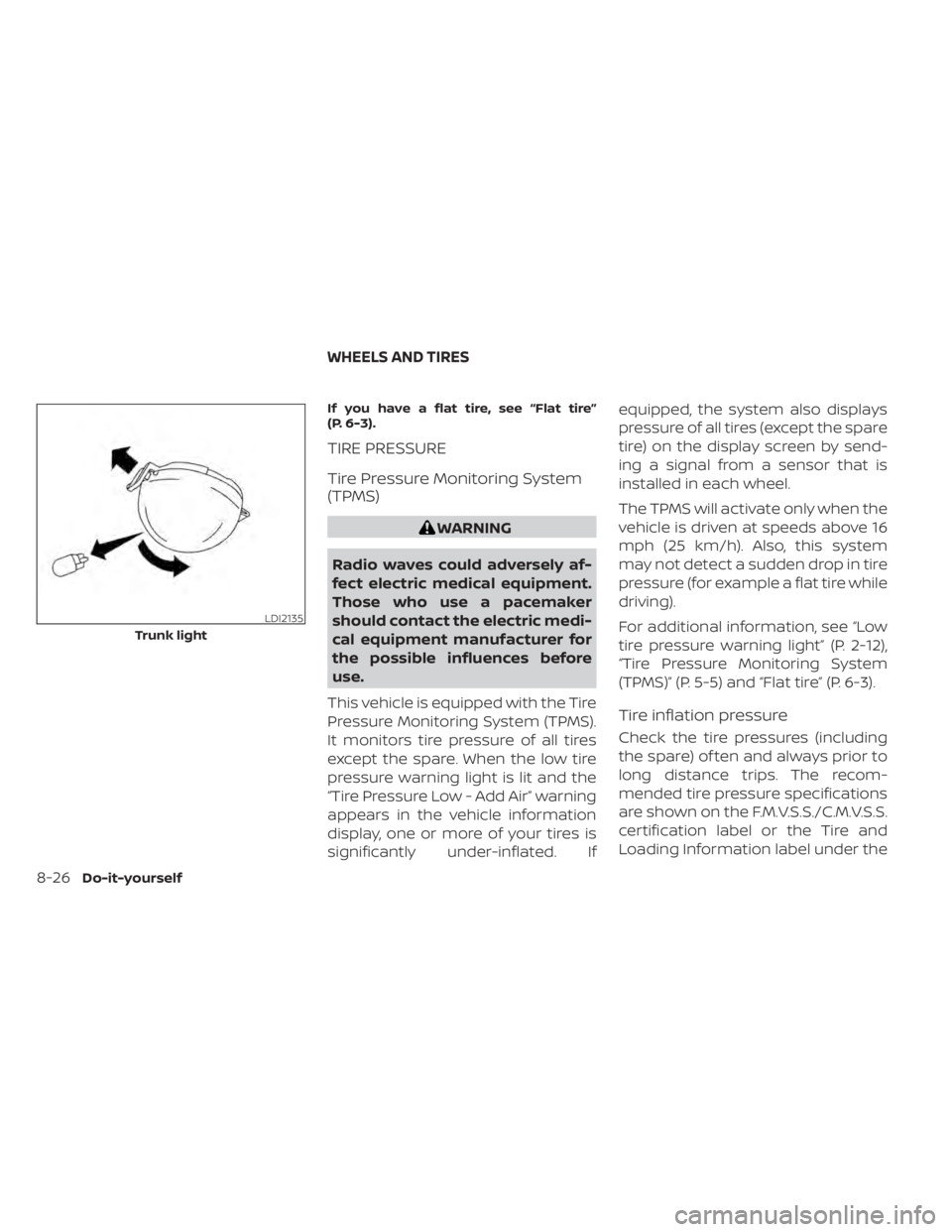
Trunk light
WHEELS AND TIRES
8-26Do-it-yourself
Page 461 of 476

11 Index
A
Active noise cancellationActive sound enhancement......5-121Active Ride Control (ARC).........5-116Air bag (See supplemental restraint
system).................... .1-43Air bag system
Front (See supplemental front impact air
bag system)
................1-51Air bag warning light.........1-64, 2-10Air bag warning light,
supplemental.............1-64, 2-10Air cleaner...................8-16Air cleaner housing filter..........8-16Air conditionerAir conditioner operation........4-29Air conditioner specification label. .10-12Air conditioner system refrigerant
recommendations.........10-2, 10-7Air conditioner system refrigerant and oil
recommendations.........10-2, 10-7Heater and air conditioner (automatic)
(if so equipped)..............4-28Heater and air conditioner controls.4-29Servicing air conditioner........4-32Alarm system (See vehicle security
system)................... .2-39Anchor point locations...........1-27Antenna....................4-32Antifreeze...................5-120
Armrests.....................1-7Autolight switch...............2-46Automatic
Automatic power window switch. . .2-67Automatic anti-glare inside mirror. . . .3-27Automatic door locks.............3-6Automatic Emergency Braking
(AEB)....................2-11,2-15Automatic Emergency Braking (AEB) with
Pedestrian Detection............5-85
B
Battery.................5- 120, 8-13Charge warning light...........2-10Battery replacement.............8-21Key fob...................8-21NISSAN Intelligent Key®.........8-22Before starting the engine.........5-14Belt (See drive belt)..............8-15Blind Spot Warning (BSW)..........5-36Booster seats.................1-40Brake
Brake fluid..................8-11Brake light (See stop light).......8-24Brake warning light............2-9Brake wear indicators.......2-16,8-18Parking brake operation.........5-21Self-adjusting brakes...........8-18Brake fluid...................8-11
Brakes.....................8-18Break-in schedule.............5-109Brightness controlInstrument panel.............2-50Bulb check/instrument panel........2-9Bulb replacement..............8-24
C
C.M.V.S.S. certification label.........10-11Capacities and recommended
fuel/lubricants................10-2Car phone or CB radio...........4-33Cargo (See vehicle loading
information)................ .10-14Check tire pressure.............2-29Child restraints.......1-20,1-21,1-22,1-24LATCH (Lower Anchors and Tethers for
CHildren) System.............1-24Precautions on child
restraints...........1-29,1-35, 1-40Top tether strap anchor point
locations..................1-27Child safety rear door lock..........3-6Cleaning exterior and interior.....7-2,7-5Climate control seat switch........2-52Cold weather driving............5-120Console box................. .2-63Console light.................2-72
Page 465 of 476

N
NISSAN Intelligent Key®..........3-2,3-7NISSAN Intelligent Key® battery discharge
indicator.....................5-13NISSAN Vehicle Immobilizer
System..................2-41, 5-14NissanConnect® Owner's Manual......4-2
O
Octane rating (See fuel octane rating). .10-5Odometer................... .2-5Oil
Capacities and recommended
fuel/lubricants
...............10-2Changing engine oil............8-6Changing engine oil filter.........8-6Checking engine oil level.........8-6Engine oil.................. .8-6Engine oil and oil filter
recommendation..........10-2, 10-6Engine oil viscosity.............10-6Outside mirror control............3-28Outside mirrors................3-28Overhead sunglasses holder........2-63Overheat
If your vehicle overheats.........6-11Owner's manual order form........10-22Owner's manual/service manual order
information................. .10-22
P
Parking
Parking brake operation.........5-21Parking/parking on hills.........5-111Parking brake..................5-21Personal lights.................2-73PowerPower door locks..............3-6Power outlet................2-59Powerrearwindows...........2-66Power steering fluid............8-11Power steering system.........5-112Power windows..............2-65Rear power windows...........2-66Power outlet................. .2-59Power steering................5-112Power steering fluid..............8-11Precautions
Maintenance precautions.........8-2Precautions on booster
seats...............1-29, 1-35, 1-40Precautions on child
restraints............1-29,1-35, 1-40Precautions on seat belt usage.....1-11Precautions on supplemental restraint
system................... .1-43Precautions when starting and driving.5-4Push starting..................6-11
R
Radio
Car phone or CB radio..........4-33Rain-sensing auto wiper system.....2-44Readiness for inspection maintenance (I/M)
test...................... .10-21Rear Automatic Braking (RAB).......5-80Rear Cross Traffic Alert (RCTA).......5-45Rear Door Alert.........2-26,2-27,2-58Rear power sunshade............2-70Rear power windows.............2-66Rear seat.................... .1-5Rear sun shade................2-70Rear window and outside mirror defroster
switch..................... .2-45RearView Monitor................4-3Recommended Fluids............10-2Recorders
Event Data................ .10-22Refrigerant recommendation. . . .10-2, 10-7Registering a vehicle in another
country.................... .10-10Remote Engine Start..........3-18,5-15Reporting safety defects (US only). . . .10-20
S
Safety
Child safety rear door lock.........3-6Child seat belts.....1-22,1-29, 1-35, 1-40Reporting safety defects (US only). .10-20
11-5