warning light NISSAN MAXIMA 2023 Owners Manual
[x] Cancel search | Manufacturer: NISSAN, Model Year: 2023, Model line: MAXIMA, Model: NISSAN MAXIMA 2023Pages: 494, PDF Size: 5.7 MB
Page 403 of 494
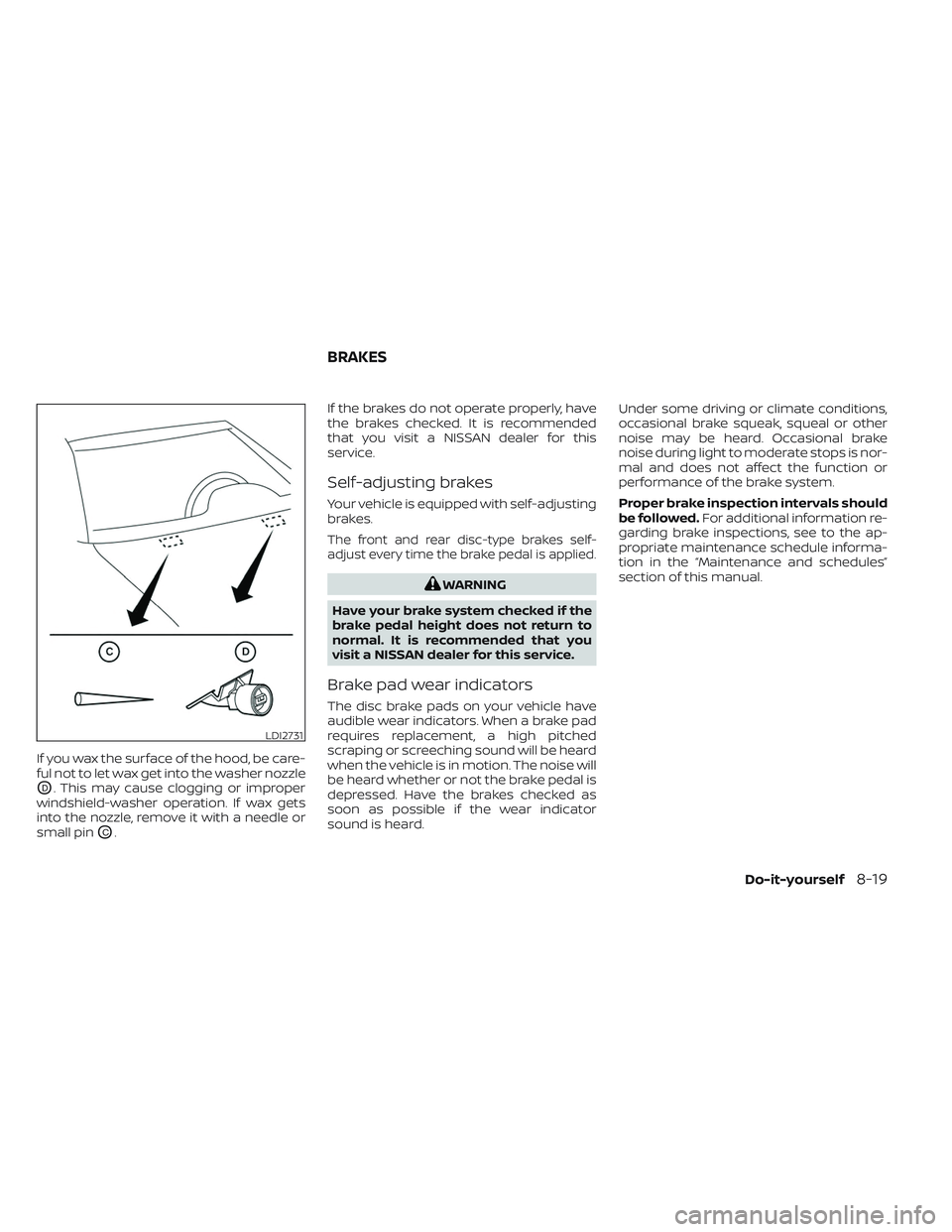
If you wax the surface of the hood, be care-
ful not to let wax get into the washer nozzle
OD. This may cause clogging or improper
windshield-washer operation. If wax gets
into the nozzle, remove it with a needle or
small pin
OC. If the brakes do not operate properly, have
the brakes checked. It is recommended
that you visit a NISSAN dealer for this
service.
Self-adjusting brakes
Your vehicle is equipped with self-adjusting
brakes.
The front and rear disc-type brakes self-
adjust every time the brake pedal is applied.
WARNING
Have your brake system checked if the
brake pedal height does not return to
normal. It is recommended that you
visit a NISSAN dealer for this service.
Brake pad wear indicators
The disc brake pads on your vehicle have
audible wear indicators. When a brake pad
requires replacement, a high pitched
scraping or screeching sound will be heard
when the vehicle is in motion. The noise will
be heard whether or not the brake pedal is
depressed. Have the brakes checked as
soon as possible if the wear indicator
sound is heard. Under some driving or climate conditions,
occasional brake squeak, squeal or other
noise may be heard. Occasional brake
noise during light to moderate stops is nor-
mal and does not affect the function or
performance of the brake system.
Proper brake inspection intervals should
be followed.
For additional information re-
garding brake inspections, see to the ap-
propriate maintenance schedule informa-
tion in the “Maintenance and schedules”
section of this manual.
LDI2731
BRAKES
Do-it-yourself8-19
Page 404 of 494
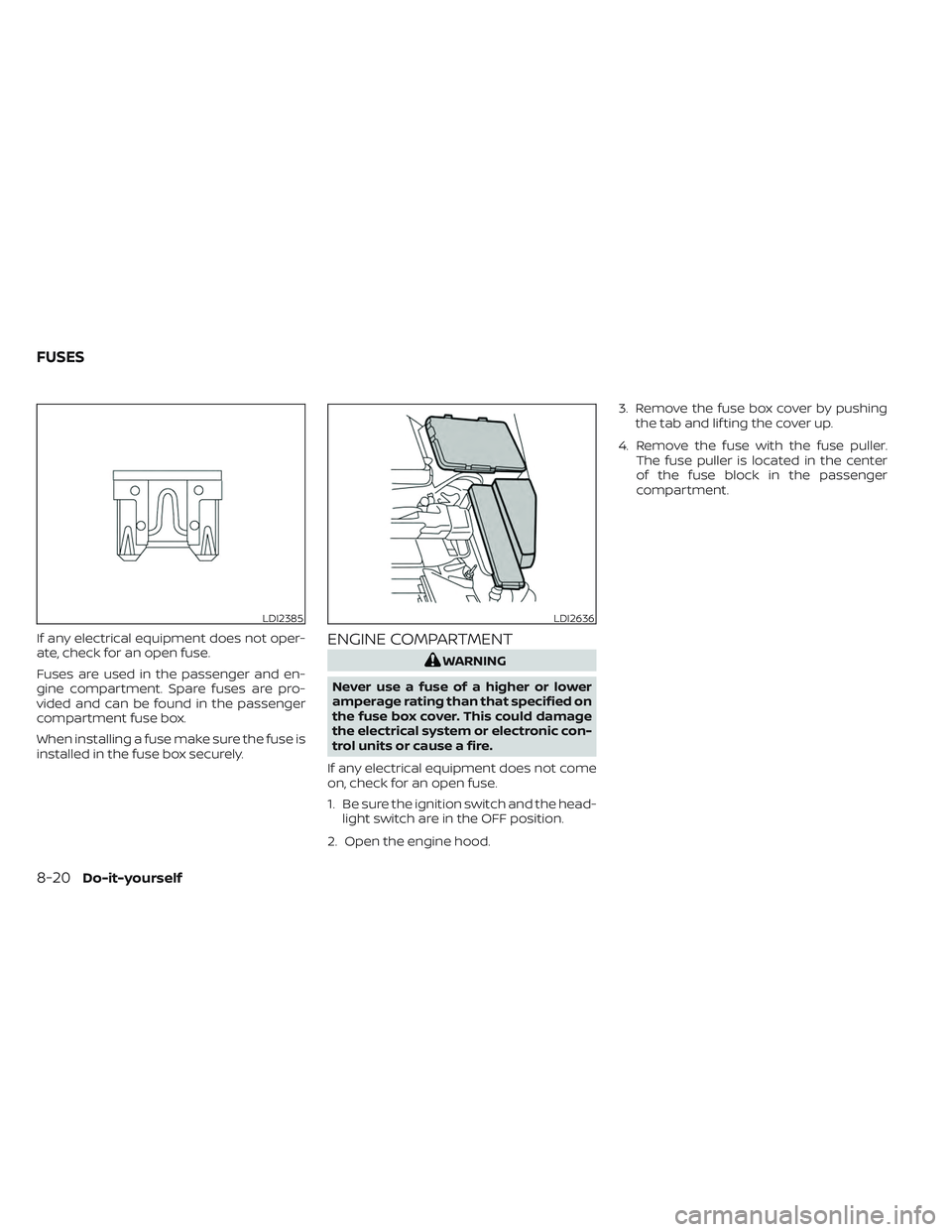
If any electrical equipment does not oper-
ate, check for an open fuse.
Fuses are used in the passenger and en-
gine compartment. Spare fuses are pro-
vided and can be found in the passenger
compartment fuse box.
When installing a fuse make sure the fuse is
installed in the fuse box securely.ENGINE COMPARTMENT
WARNING
Never use a fuse of a higher or lower
amperage rating than that specified on
the fuse box cover. This could damage
the electrical system or electronic con-
trol units or cause a fire.
If any electrical equipment does not come
on, check for an open fuse.
1. Be sure the ignition switch and the head- light switch are in the OFF position.
2. Open the engine hood. 3. Remove the fuse box cover by pushing
the tab and lif ting the cover up.
4. Remove the fuse with the fuse puller. The fuse puller is located in the center
of the fuse block in the passenger
compartment.
LDI2385LDI2636
FUSES
8-20Do-it-yourself
Page 405 of 494
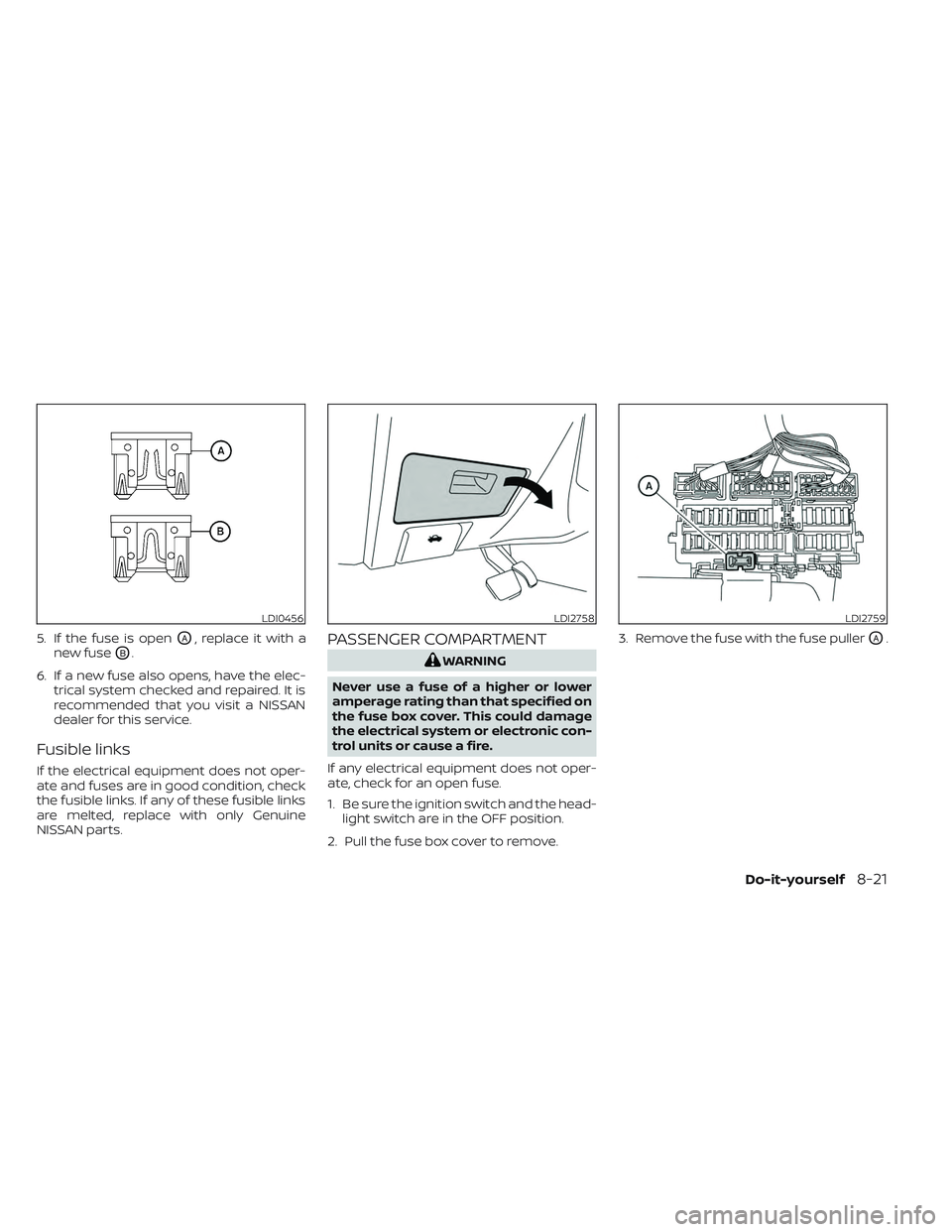
5. If the fuse is openOA, replace it with a
new fuse
OB.
6. If a new fuse also opens, have the elec- trical system checked and repaired. It is
recommended that you visit a NISSAN
dealer for this service.
Fusible links
If the electrical equipment does not oper-
ate and fuses are in good condition, check
the fusible links. If any of these fusible links
are melted, replace with only Genuine
NISSAN parts.
PASSENGER COMPARTMENT
WARNING
Never use a fuse of a higher or lower
amperage rating than that specified on
the fuse box cover. This could damage
the electrical system or electronic con-
trol units or cause a fire.
If any electrical equipment does not oper-
ate, check for an open fuse.
1. Be sure the ignition switch and the head- light switch are in the OFF position.
2. Pull the fuse box cover to remove. 3. Remove the fuse with the fuse puller
OA.
LDI0456LDI2758LDI2759
Do-it-yourself8-21
Page 411 of 494
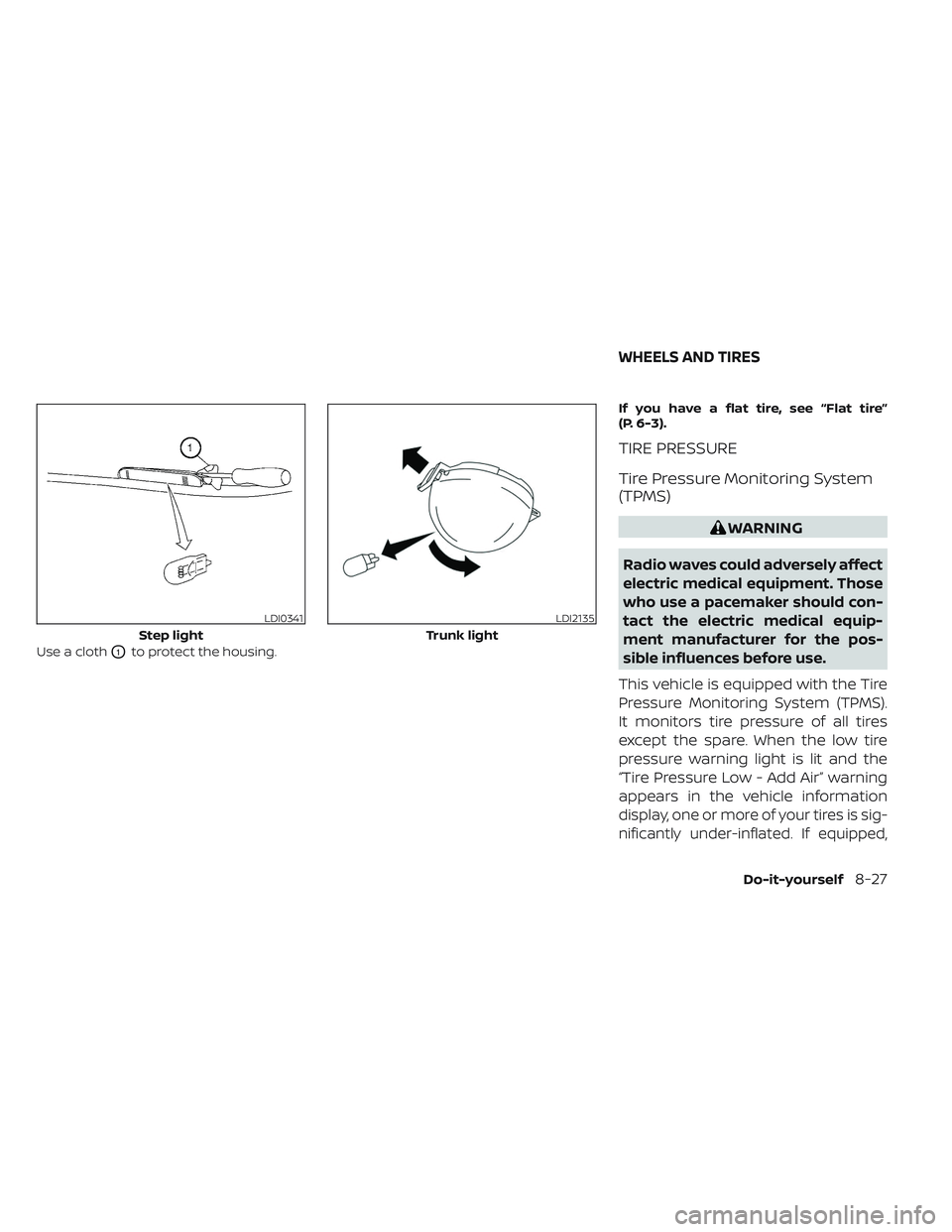
Use a clothO1to protect the housing.If you have a flat tire, see “Flat tire”
(P. 6-3).
TIRE PRESSURE
Tire Pressure Monitoring System
(TPMS)
WARNING
Radio waves could adversely affect
electric medical equipment. Those
who use a pacemaker should con-
tact the electric medical equip-
ment manufacturer for the pos-
sible influences before use.
This vehicle is equipped with the Tire
Pressure Monitoring System (TPMS).
It monitors tire pressure of all tires
except the spare. When the low tire
pressure warning light is lit and the
“Tire Pressure Low - Add Air” warning
appears in the vehicle information
display, one or more of your tires is sig-
nificantly under-inflated. If equipped,
LDI0341
Step light
LDI2135
Trunk light
WHEELS AND TIRES
Do-it-yourself8-27
Page 412 of 494
the system also displays pressure of all
tires (except the spare tire) on the dis-
play screen by sending a signal from a
sensor that is installed in each wheel.
The TPMS will activate only when the
vehicle is driven at speeds above 16
mph (25 km/h). Also, this system
may not detect a sudden drop in tire
pressure (for example a flat tire while
driving).
For additional information, see “Low
tire pressure warning light” (P. 2-12),
“Tire Pressure Monitoring System
(TPMS)” (P. 5-5) and “Flat tire” (P. 6-3).
Tire inflation pressure
Check the tire pressures (including
the spare) of ten and always prior to
long distance trips. The recom-
mended tire pressure specifications
are shown on the F.M.V.S.S./C.M.V.S.S.
certification label or the Tire and
Loading Information label under the"Cold Tire Pressure" heading. The
Tire and Loading Information label is
affixed to the driver side center pillar.
Tire pressures should be checked
regularly because:
• Most tires naturally lose air over
time.
• Tires can lose air suddenly when driven over potholes or other ob-
jects or if the vehicle strikes a curb
while parking.
The tire pressures should be
checked when the tires are cold. The
tires are considered COLD af ter the
vehicle has been parked for 3 or
more hours, or driven less than 1 mile
(1.6 km) at moderate speeds.
The TPMS with Easy-Fill Tire Alert pro-
vides visual and audible signals out-
side the vehicle for inflating the tires
to the recommended COLD tire pres-
sure. For additional information, see
“TPMS with Easy-Fill Tire Alert” (P. 5-7).
If the tires are used at speeds above
100 mph (162 km/h) where it is legal
to do so (on a race track for ex-
ample), the cold tire inflation pres-
sure must be increased. For addi-
tional information, see “Checking tire
pressure” (P. 8-31).
Set the tire pressure to the normal
cold tire inflation pressure when the
vehicle speed or load is reduced.
Incorrect tire pressure, including
under inflation, may adversely af-
fect tire life and vehicle handling.
8-28
Do-it-yourself
Page 422 of 494
•Improper service of the spare
tire may result in serious per-
sonal injury. If it is necessary to
repair the spare tire, it is rec-
ommended that you visit a
NISSAN dealer for this service.
• For additional information re-
garding tires, refer to “Impor-
tant Tire Safety Information”
(US) or “Tire Safety Informa-
tion” (Canada) in the Warranty
Information Booklet.
Replacing wheels and tires
When replacing a tire, use the same size,
tread design, speed rating and load carry-
ing capacity as originally equipped. Rec-
ommended types and sizes are shown in
“Wheels and tires” (P. 10-10).
WARNING
• The use of tires other than those rec-
ommended or the mixed use of tires
of different brands, construction
(bias, bias-belted or radial), or tread
patterns can adversely affect the
ride, braking, handling, Vehicle Dy-
namic Control (VDC) system, ground
clearance, body-to-tire clearance,
tire chain clearance, speedometer
calibration, headlight aim and bum-
per height. Some of these effects
may lead to accidents and could re-
sult in serious personal injury.
• If your vehicle was originally
equipped with four tires that were
the same size and you are only re-
placing two of the four tires, install
the new tires on the rear axle. Placing
new tires on the front axle may cause
loss of vehicle control in some driving
conditions and cause an accident
and personal injury. •
If the wheels are changed for any
reason, always replace with wheels
which have the same off-set dimen-
sion. Wheels of a different off-set
could cause premature tire wear, de-
grade vehicle handling characteris-
tics, affect the VDC system and/or in-
terference with the brake discs. Such
interference can lead to decreased
braking efficiency and/or early brake
pad/shoe wear. For additional infor-
mation on wheel-off set dimensions,
see to “Wheels and tires” (P. 10-10).
• When using a wheel without the
TPMS such as the spare tire, the TPMS
will not function and the low tire
pressure warning light will flash for
approximately 1 minute. The light will
remain on af ter 1 minute. Have your
tires replaced and/or TPMS system
reset as soon as possible. It is recom-
mended that you visit a NISSAN
dealer for this service.
•
Replacing tires with those not origi-
nally specified by NISSAN could affect
the proper operation of the TPMS.
8-38Do-it-yourself
Page 428 of 494
immediately. It is recommended that you
visit a NISSAN dealer for this service. Keep
the floor mat away from the pedal.
Brakes:Check that the brakes do not pull
the vehicle to one side when applied.
C
ontinuously Variable Transmission (CVT)
P (Park) position mechanism:On a fairly
steep hill check that the vehicle is held se-
curely with the shif t lever in the P (Park)
position without applying any brakes.
Parking brake:
Check the parking brake op-
eration regularly. The vehicle should be se-
curely held on a fairly steep hill with only the
parking brake applied. If the parking brake
needs adjustment, it is recommended that
you visit a NISSAN dealer for this service.
Seats: Check seat position controls such
as seat adjusters, seatback recliner, etc., to
ensure they operate smoothly and all
latches lock securely in every position.
Check that the head restraints/headrests
move up and down smoothly and the locks
(if so equipped) hold securely in all latched
positions.
Seat belts: Check that all parts of the seat
belt system (for example, buckles, anchors,
adjusters and retractors) operate properly
and smoothly, and are installed securely. Check the belt webbing for cuts, fraying,
wear or damage.
Steering wheel:
Check for changes in the
steering system, such as excessive free
play, hard steering or strange noises.
Warning lights and chimes: Make sure all
warning lights and chimes are operating
properly.
Windshield defroster: Check that the air
comes out of the defroster outlets properly
and in sufficient quantity when operating
the heater or air conditioner.
Windshield wiper and washer*: Check
that the wipers and washer operate prop-
erly and that the wipers do not streak.Under the hood and vehicle
The maintenance items listed here should
be checked periodically (for example, each
time you check the engine oil or refuel).
Battery* (for maintenance free batter-
ies): This vehicle is equipped with a sealed
maintenance free battery. It is recom-
mended that you visit a NISSAN dealer for
service.
NOTE:
Care should be taken to avoid situations
that can lead to potential battery dis-
charge and potential no-start conditions
such as:
1. Installation or extended use of elec- tronic accessories that consume bat-
tery power when the engine is not
running (Phone chargers, GPS, DVD
players, etc.).
2. Vehicle is not driven regularly and/or only driven short distances.
In these cases, the battery may need to
be charged to maintain battery health.
Brake fluid level*: Make sure that the brake
fluid level is between the MAX and MIN lines
on the reservoir.
Engine coolant level*: Check the coolant
level when the engine is cold.
Engine drive belts*: Make sure the drive
belts are not frayed, worn, cracked or oily.
Engine oil level*: Check the level af ter
parking the vehicle on a level spot and
turning off the engine. Wait more than 15
minutes for the oil to drain back into the oil
pan.
9-4Maintenance and schedules
Page 477 of 494
11 Index
A
Activenoisecancellation...........5-125Active sound enhancement .......5-125
ActiveRideControl(ARC)............5 -119
Air bag (See supplemental restraint
system) ........................ .1-41
Air bag system ...................1-49
Front (See supplemental front impact
air bag system) .................1-49
Air bag warning light, supplemental . . . .1-62
Airbagwarninglight.............. .1-62
Air cleaner housing filter .............8-17
Air cleaner .......................8-17
Air conditioner ....................4-30
Air conditioner operation ..........4-30
Air conditioner specification label . . .10-13
Air conditioner system refrigerant and
oil recommendations .........10-2,10-8
Air conditioner system refrigerant
recommendations ...........10-2,10-8
Heater and air conditioner (automatic)
(if so equipped) .................4-29
Heater and air conditioner controls . .4-30
Servicing air conditioner ..........4-33
Alarm system (See vehicle security
system) .........................2-40
Anchor point locations ..............1-26
Antenna ........................4-33
Anti-lock Braking System (ABS) .......5-114
Antifreeze ......................5-124 Armrests........................
.1-6
Autolightswitch...................2-47
Automatic anti-glare inside mirror .....3-27
Automatic door locks ...............3-5
Automatic Emergency Braking (AEB)
with Pedestrian Detection ...........5-85
Automatic Emergency Braking (AEB) . . .2-12
Automatic.......................2-71 Automaticpowerwindowswitch....2-71
B
Battery replacement ...............8-22
Keyfob.......................8-22
NISSAN Intelligent Key® ...........8-22
Battery ........................5-124 Charge warning light .............2-10
Before starting the engine ...........5-14
Belt(Seedrivebelt) ................8-16
Blind Spot Warning (BSW) ............5-37
Booster seats ................... .1-38
Brake Assist .....................5 -115
Brakefluid.......................8-12
Brake system ....................5 -113
Brake..........................5 -114
Anti-lock Braking System (ABS) .....5-114
Brakefluid.....................8-12
Brakelight(Seestoplight).........8-25
Brake system ..................5 -113
Brakewarninglight...............2-9 Brakewearindicators ........2-16,8-19
Parking brake operation
..........5-22
Self-adjustingbrakes.............8-19
Brakes..........................8-19
Break-in schedule ................5-109
Brightness control .................2-52
Instrument panel ...............2-52
Bulb check/instrument panel .........2-9
Bulb replacement .................8-25
C
C.M.V.S.S. certification label ..........10-12
Capacities and recommended
fuel/lubricants....................10-2
Car phone or CB radio ..............4-34
Cargo (See vehicle loading
information).....................10-15
Check tire pressure ................2-30
Childrestraints................... .1-19
LATCH (Lower Anchors and Tethers
forCHildren)System .............1-23
Precautions on child
restraints..............1-28, 1-34, 1-38
Top tether strap anchor point
locations..................... .1-26
Child safety rear door lock ............3-6
Cleaningexteriorandinterior .........7-2
Climatecontrolseatswitch..........2-54
Cold weather driving ..............5-124
Page 478 of 494
Console box......................2-66
Console light ......................2-76
Continuously Variable Transmission
(CVT) ............................5-16
Continuously Variable Transmission
(CVT) fluid ......................8-11
Driving with Continuously Variable
Transmission (CVT) ...............5-16
Transmission shif t selector lock
release........................5-20
Control panel and vehicle information
displayinteraction .................2-33
Controls.........................4-30 Heater and air conditioner controls. . .4-30
Coolant..........................10-2 Capacities and recommended
fuel/lubricants ..................10-2
Changing engine coolant ...........8-5
Checking engine coolant level .......8-5
Engine coolant temperature gauge . . .2-5
Corrosionprotection ................7-9
Cupholders......................2-67
D
Daytime Running Light System ........2-51
Defrosterswitch...................2-45 Rear window and outside mirror
defrosterswitch.................2-45
Dimensions and weights ............10-10
Dimmer switch for instrument panel . . .2-52
Display ..........................2-17 Informationdisplay...............2-17 Door locks
........................3-4
Drivebelt ........................8-16
Drive Mode Selector ................5-22
Drive Sport Mode Selector ...........5-22
Drivingthevehicle..................5-16
Driving .........................5-124 Cold weather driving .............5-124
Driving with Continuously Variable
Transmission (CVT) ...............5-16
Precautions when starting and
driving.........................5-4
Dynamic driver assistance switch ......2-58
E
Eco Drive Report....................2-7
Economy - fuel ....................5 -111
Emergency call (SOS) button ..........2-59
Emergency engine shutoff ...........5-13
Emission control information label .....10-12
Emission control system warranty . . . .10-20
Engine coolant temperature gauge .....2-5
Engine ..........................5-14
Before starting the engine ..........5-14
Capacities and recommended
fuel/lubricants ..................10-2
Changing engine coolant ...........8-5
Changing engine oil filter ...........8-7
Changing engine oil ...............8-7
Checking engine coolant level .......8-5
Checking engine oil level ...........8-6
Engine compartment check
locations .......................8-3 Engine coolant temperature gauge . . .2-5
Engine cooling system
.............8-4
Engine oil and oil filter
recommendation ............10-2,10-7
Engine oil pressure warning light .....2-10
Engine oil viscosity ...............10-7
Engine oil .......................8-6
Engine serial number .............10-12
Engine specifications .............10-9
Starting the engine ...............5-14
EventDatarecorders...............10-22
Exhaust gas (Carbon monoxide) ........5-4
Explanation of maintenance items ......9-2
Explanation of scheduled maintenance
items........................... .9-5
Extended storage switch ............2-63
Eyeglasscase.....................2-66
F
F.M.V.S.S. certification label ...........10-12
Flashers (See hazard warning flasher
switch)...........................6-2
Flattire...........................6-3
Floor mat positioning aid .............7-8
Fluid............................8-12 Brakefluid......................8-12
Capacities and recommended
fuel/lubricants ..................10-2
Continuously Variable Transmission
(CVT) fluid ......................8-11
Engine coolant ...................8-4
Engine oil .......................8-6
11-2
Page 479 of 494
Powersteeringfluid...............8-11
Windshield-washer fluid...........8-12
Foglightswitch ...................2-53
Foldingrearseat................... .1-5
Front air bag system (See supplemental
restraint system) ...................1-49
Front and rear sonar system .........5-119
Front power seat adjustment ..........1-3
Frontseats....................... .1-2
Front-door pocket .................2-64
Fuelefficientdrivingtips.............5 -110
Fuel gauge ........................2-6
Fuel-filler door .....................3-22
Fuel.............................10-2 Capacities and recommended
fuel/lubricants ..................10-2
Fuel economy ...................5 -111
Fuel gauge ......................2-6
Fueloctanerating................10-6
Fuel recommendation .........10-2,10-4
Fuel-filler cap ...................3-22
Fuel-filler lid ....................3-22
Loose fuel cap warning ............2-27
Fuses ...........................8-20
Fusiblelinks ......................8-21
G
Garage door opener, HomeLink®
Universal Transceiver ...............2-77
Gascap.........................3-22 Gauge
...........................2-5
Engine coolant temperature gauge . . .2-5
Fuel gauge ......................2-6
Odometer ......................2-4
Speedometer ....................2-4
Tachometer .....................2-5
Trip odometer ...................2-4
General maintenance ................9-2
Gloveboxlock ....................2-66
Glovebox........................2-66
H
Hazard warning flasher switch .........6-2
Headrestraints.................... .1-7
Headlight and turn signal switch .......2-46
Headlightcontrolswitch.............2-46
Headlights.......................8-24
Heatedmirrors....................3-29
Heatedrearseats..................2-56
Heated seat switches ...............2-55
Heatedseats.....................2-54
Heated steering wheel ..............2-57
Heater and air conditioner (automatic) . .4-29
Heater..........................4-29 Heater and air conditioner (automatic)
(if so equipped) ..................4-29
Heater and air conditioner controls. . .4-30
Heater operation .................4-31
HomeLink® Universal Transceiver ......2-77
Hood ...........................3-20
Horn............................2-53
I
Ignition Switch ....................5-10
Push-button ignition switch ........5-10
Immobilizer system ................2-42
Important vehicle information label . . . .10-12
In-cabinmicrofilter.................8-17
Increasing fuel economy ............5-111
Indicator lights and audible reminders
(See warning/indicator lights and audible
reminders) ....................... .2-8
Indicator.........................5-13 NISSAN Intelligent Key® battery
discharge indicator ...............5-13
Inside automatic anti-glare mirror ......3-27
Instrument brightness control ........2-52
Instrument panel dimmer switch ......2-52
Instrument panel ...................0-6
Integrated Dynamics-control Module . . .5-118
Intelligent Around View® Monitor .......4-11
Intelligent Cruise Control ............5-56
Intelligent Drive Alertness (I-DA) .......5-107
Intelligent Engine Brake (I-EB) .........5-118
Intelligent Forward Collision Warning
(I-FCW)..........................5-96
Intelligent Key system ................3-7
Key operating range ...............3-7
Key operation ....................3-8
Mechanical key ...................3-3
Remote keyless entry operation .....3-12
Troubleshooting guide ............3-15
Warning signals ..................3-15
11-3