cooling NISSAN MAXIMA 2023 User Guide
[x] Cancel search | Manufacturer: NISSAN, Model Year: 2023, Model line: MAXIMA, Model: NISSAN MAXIMA 2023Pages: 494, PDF Size: 5.7 MB
Page 388 of 494
8. Fusible links
9. Battery
10. Engine oil dipstick
11. Radiator cap
12. Power steering fluid reservoir
13. Windshield-washer fluid reservoir
NOTE:
Your vehicle may not be equipped
with an engine cover.
The engine cooling system is filled at the
factory with a pre-diluted mixture of 50%
Genuine NISSAN Long Life Antifreeze/
Coolant (blue) and 50% water to provide
year-round antifreeze and coolant pro-
tection. The antifreeze solution contains
rust and corrosion inhibitors. Additional
engine cooling system additives are not
necessary.
WARNING
• Never remove the radiator or coolant
reservoir cap when the engine is hot.
Wait until the engine and radiator
cool down. Serious burns could be
caused by high pressure fluid escap-
ing from the radiator. For additional
information, see “If your vehicle over-
heats” (P. 6-11).
• The radiator is equipped with a pres-
sure type radiator cap. To prevent en-
gine damage, use only a Genuine
NISSAN radiator cap.
CAUTION
• Never use any cooling system addi-
tives such as radiator sealer. Addi-
tives may clog the cooling system
and cause damage to the engine,
transmission and/or cooling system.
• When adding or replacing coolant, be
sure to use only Genuine NISSAN
Long Life Antifreeze/Coolant (blue)
or equivalent. Genuine NISSAN Long
Life Antifreeze/Coolant (blue) is pre-
diluted to provide antifreeze protec-
tion to -34° F (-37° C). If additional
freeze protection is needed due to
weather where you operate your ve-
hicle, add Genuine NISSAN Long Life
Antifreeze/Coolant (blue) concen-
trate following the directions on the
container. If an equivalent coolant
other than Genuine NISSAN Long Life
Antifreeze/Coolant (blue) is used, fol-
low the coolant manufacturer’s in-
structions to maintain minimum an-
tifreeze protection to -34° F (-37° C).
The use of other types of coolant so-
lutions other than Genuine NISSAN
Long Life Antifreeze/Coolant (blue)
or equivalent may damage the en-
gine cooling system.
ENGINE COOLING SYSTEM
8-4Do-it-yourself
Page 389 of 494
•The life expectancy of the factory-fill
coolant is 105,000 miles (168,000 km)
or 7 years. Mixing any other type of
coolant other than Genuine NISSAN
Long Life Antifreeze/Coolant (blue) (or
equivalent coolant), including Genuine
NISSAN Long Life Antifreeze/Coolant
(green), or the use of non-distilled wa-
ter may reduce the life expectancy of
the factory-fill coolant. For additional
information, see the “Maintenance
and schedules” section of this manual.
CHECKING ENGINE COOLANT
LEVEL
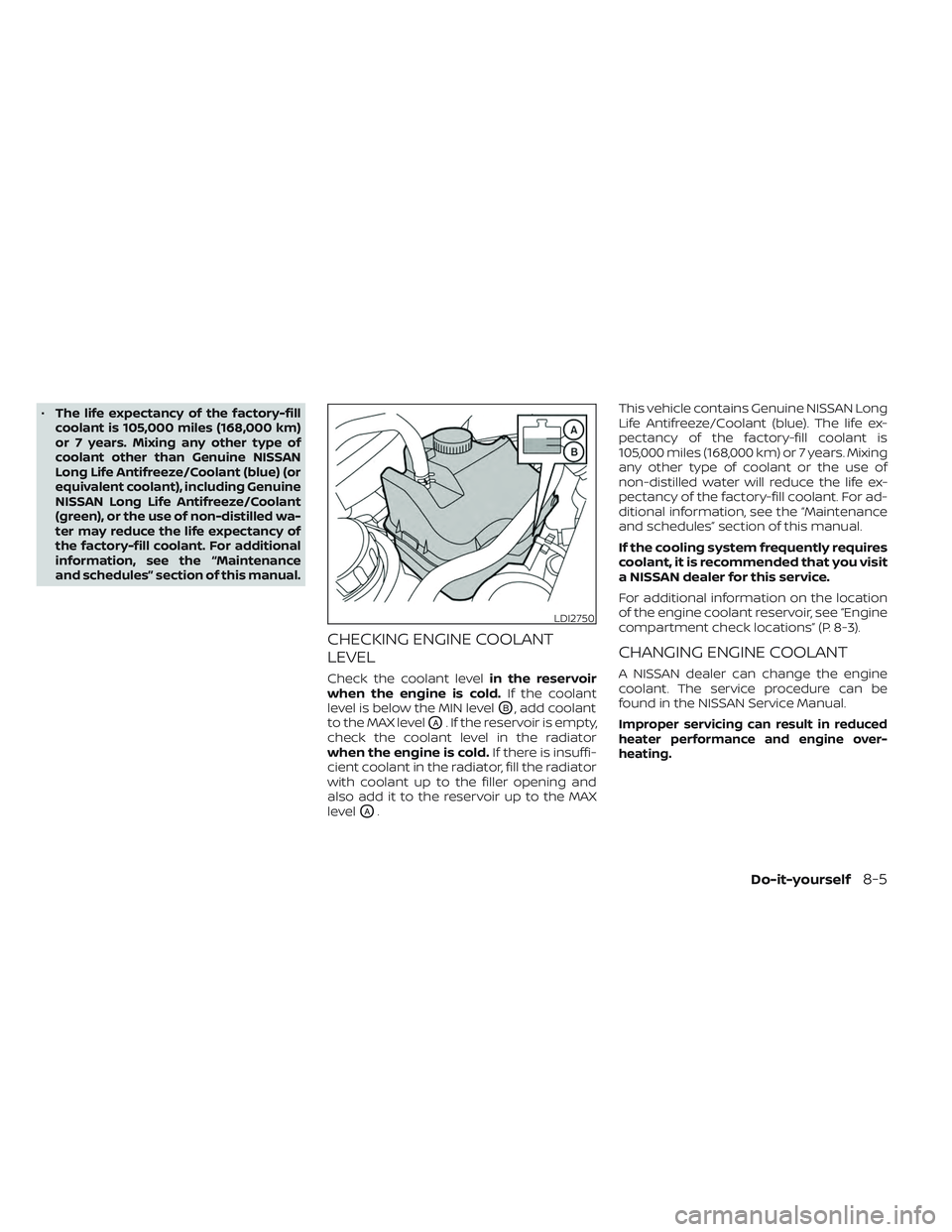
Check the coolant level in the reservoir
when the engine is cold. If the coolant
level is below the MIN level
OB, add coolant
to the MAX level
OA. If the reservoir is empty,
check the coolant level in the radiator
when the engine is cold. If there is insuffi-
cient coolant in the radiator, fill the radiator
with coolant up to the filler opening and
also add it to the reservoir up to the MAX
level
OA. This vehicle contains Genuine NISSAN Long
Life Antifreeze/Coolant (blue). The life ex-
pectancy of the factory-fill coolant is
105,000 miles (168,000 km) or 7 years. Mixing
any other type of coolant or the use of
non-distilled water will reduce the life ex-
pectancy of the factory-fill coolant. For ad-
ditional information, see the “Maintenance
and schedules” section of this manual.
If the cooling system frequently requires
coolant, it is recommended that you visit
a NISSAN dealer for this service.
For additional information on the location
of the engine coolant reservoir, see “Engine
compartment check locations” (P. 8-3).
CHANGING ENGINE COOLANT
A NISSAN dealer can change the engine
coolant. The service procedure can be
found in the NISSAN Service Manual.
Improper servicing can result in reduced
heater performance and engine over-
heating.
LDI2750
Do-it-yourself8-5
Page 430 of 494
NOTE:
NISSAN does not advocate the use of
non-OEM approved af termarket flush-
ing systems and strongly advises
against performing these services on a
NISSAN product. Many of the af termar-
ket flushing systems use non-OEM ap-
proved chemicals or solvents, the use of
which has not been validated by NISSAN.
For recommended fuel, lubricants, fluids,
grease, and refrigerant, see “Recom-
mended fluids/lubricants and capaci-
ties” (P. 10-2).
EMISSION CONTROL SYSTEM
MAINTENANCE:
Engine drive belts*:Check engine drive
belts for wear, fraying or cracking and for
proper tension. Replace any damaged
drive belts.
Engine air filter: Replace at specified inter-
vals. When driving for prolonged periods in
dusty conditions, check/replace the filter
more frequently.
Engine coolant*: Replace coolant at the
specified interval. When adding or replac-
ing coolant, be sure to use only Genuine NISSAN Long Life Antifreeze/Coolant (blue)
or equivalent with the proper mixture. (For
additional information on the proper mix-
ture for your area, see “Engine cooling sys-
tem” (P. 8-5.)
NOTE: Mixing any other type of coolant or
the use of non-distilled water may reduce
the recommended service interval of the
coolant.
Engine oil and oil filter:
Replace engine oil
and oil filter at the specified intervals. For
recommended oil grade and viscosity,
see “Recommended fluids/lubricants and
capacities” (P. 10-2).
Fuel tank vapor vent system*: Check
vapor lines for leaks or looseness. Tighten
connections or replace parts as necessary.
Fuel lines/connection*: Check the fuel
hoses, piping and connections for leaks,
looseness, or deterioration. Tighten con-
nections or replace parts as necessary.
Spark plugs: Replace at specified intervals.
Install new plugs of the same type as origi-
nally equipped.
CHASSIS AND BODY MAINTENANCE:
Brake lines and cables: Visually inspect for
proper installation. Check for chafing,
cracks, deterioration, and signs of leaking.
Replace any deteriorated or damaged
parts immediately.
Brake pads and rotors:
Check for wear, de-
terioration and fluid leaks. Replace any dete-
riorated or damaged parts immediately.
Exhaust system: Visually inspect the ex-
haust pipes, muffler and hangers for leaks,
cracks, deterioration, and damage. Tighten
connections or replace parts as necessary.
In-cabin microfilter: Replace at specified
intervals. When driving for prolonged peri-
ods in dusty conditions, replace the filter
more frequently.
Steering gear and linkage, axle and sus-
pension parts, drive shaf t boots: Check
for damage, looseness, and leakage of oil
or grease. Under severe driving conditions,
inspect more frequently.
Tire rotation: Rotate tires at the specified
interval shown in the maintenance sched-
ule. When rotating tires, check for damage
and uneven wear. Replace if necessary.
9-6Maintenance and schedules
Page 478 of 494
Console box......................2-66
Console light ......................2-76
Continuously Variable Transmission
(CVT) ............................5-16
Continuously Variable Transmission
(CVT) fluid ......................8-11
Driving with Continuously Variable
Transmission (CVT) ...............5-16
Transmission shif t selector lock
release........................5-20
Control panel and vehicle information
displayinteraction .................2-33
Controls.........................4-30 Heater and air conditioner controls. . .4-30
Coolant..........................10-2 Capacities and recommended
fuel/lubricants ..................10-2
Changing engine coolant ...........8-5
Checking engine coolant level .......8-5
Engine coolant temperature gauge . . .2-5
Corrosionprotection ................7-9
Cupholders......................2-67
D
Daytime Running Light System ........2-51
Defrosterswitch...................2-45 Rear window and outside mirror
defrosterswitch.................2-45
Dimensions and weights ............10-10
Dimmer switch for instrument panel . . .2-52
Display ..........................2-17 Informationdisplay...............2-17 Door locks
........................3-4
Drivebelt ........................8-16
Drive Mode Selector ................5-22
Drive Sport Mode Selector ...........5-22
Drivingthevehicle..................5-16
Driving .........................5-124 Cold weather driving .............5-124
Driving with Continuously Variable
Transmission (CVT) ...............5-16
Precautions when starting and
driving.........................5-4
Dynamic driver assistance switch ......2-58
E
Eco Drive Report....................2-7
Economy - fuel ....................5 -111
Emergency call (SOS) button ..........2-59
Emergency engine shutoff ...........5-13
Emission control information label .....10-12
Emission control system warranty . . . .10-20
Engine coolant temperature gauge .....2-5
Engine ..........................5-14
Before starting the engine ..........5-14
Capacities and recommended
fuel/lubricants ..................10-2
Changing engine coolant ...........8-5
Changing engine oil filter ...........8-7
Changing engine oil ...............8-7
Checking engine coolant level .......8-5
Checking engine oil level ...........8-6
Engine compartment check
locations .......................8-3 Engine coolant temperature gauge . . .2-5
Engine cooling system
.............8-4
Engine oil and oil filter
recommendation ............10-2,10-7
Engine oil pressure warning light .....2-10
Engine oil viscosity ...............10-7
Engine oil .......................8-6
Engine serial number .............10-12
Engine specifications .............10-9
Starting the engine ...............5-14
EventDatarecorders...............10-22
Exhaust gas (Carbon monoxide) ........5-4
Explanation of maintenance items ......9-2
Explanation of scheduled maintenance
items........................... .9-5
Extended storage switch ............2-63
Eyeglasscase.....................2-66
F
F.M.V.S.S. certification label ...........10-12
Flashers (See hazard warning flasher
switch)...........................6-2
Flattire...........................6-3
Floor mat positioning aid .............7-8
Fluid............................8-12 Brakefluid......................8-12
Capacities and recommended
fuel/lubricants ..................10-2
Continuously Variable Transmission
(CVT) fluid ......................8-11
Engine coolant ...................8-4
Engine oil .......................8-6
11-2