steering NISSAN MICRA 2015 Owner´s Manual
[x] Cancel search | Manufacturer: NISSAN, Model Year: 2015, Model line: MICRA, Model: NISSAN MICRA 2015Pages: 293, PDF Size: 3.21 MB
Page 198 of 293
3. Tire chains may be used. For additional in-formation, refer to “Tire chains” in the “Main-
tenance and do-it-yourself” section of this
manual.
SPECIAL WINTER EQUIPMENT
It is recommended that the following items be
carried in the vehicle during winter:
● A scraper and stiff-bristled brush to remove
ice and snow from the windows and wiper
blades.
● A sturdy, flat board to be placed under the
jack to give it firm support.
● A shovel to dig the vehicle out of snowdrifts.
● Extra washer fluid to refill the windshield-
washer fluid reservoir.
DRIVING ON SNOW OR ICE
WARNING
● Wet ice (0°C, 32°F and freezing rain) ,
very cold snow or ice can be slick and
very hard to drive on. The vehicle will
have much less traction or “grip” under
these conditions. Try to avoid driving on
wet ice until the road is salted or
sanded. ●
Whatever the condition, drive with cau-
tion. Accelerate and slow down with
care. If accelerating or downshifting too
fast, the drive wheels will lose even
more traction.
● Allow more stopping distance under
these conditions. Braking should be
started sooner than on dry pavement.
● Allow greater following distances on
slippery roads.
● Watch for slippery spots (glare ice) .
These may appear on an otherwise
clear road in shaded areas. If a patch of
ice is seen ahead, brake before reach-
ing it. Try not to brake while on the ice,
and avoid any sudden steering
maneuvers.
● Snow can trap dangerous exhaust
gases under your vehicle. Keep snow
clear of the exhaust pipe and from
around your vehicle.ENGINE BLOCK HEATER
Engine block heaters are used to assist with cold
temperature starting.
The engine block heater should be used when
the outside temperature is 20°F (-7°C) or lower.
WARNING
● Do not use your engine block heater
with an ungrounded electrical system or
a 2-pronged adapter. You can be seri-
ously injured by an electrical shock if
you use an ungrounded connection.
● Disconnect and properly store the en-
gine block heater cord before starting
the engine. Damage to the cord could
result in an electrical shock and can
cause serious injury.
● Use a heavy-duty 3-wire, 3-pronged ex-
tension cord rated for at least 10 A. Plug
the extension cord into a Ground Fault
Interrupt (GFI) protected, grounded
110-VAC outlet. Failure to use the
proper extension cord or a grounded
outlet can result in a fire or electrical
shock and cause serious personal
injury.
To use the engine block heater: 1. Turn the engine off.
2. Open the hood and unwrap the engine block heater cord.
3. Plug the engine block heater cord into a grounded 3-wire, 3-pronged extension
cord.
Starting and driving5-25
Page 212 of 293
3. Get out of the vehicle. Look and listen forsteam or coolant escaping from the radiator
before opening the hood. (If steam or cool-
ant is escaping, turn off the engine.) Do not
open the hood further until no steam or
coolant can be seen.
4. Open the engine hood.
5.
Visually check drive belts for damage or
looseness. Also check if the cooling fan is
running. The radiator hoses and radiator
should not leak water. If coolant is leaking, the
water pump belt is missing or loose, or the
cooling fan does not run, stop the engine.
WARNING
● Be careful not to allow your hands, hair,
jewelry or clothing to come into contact
with, or get caught in, engine belts or
the engine cooling fan. The engine cool-
ing fan can start at any time.
● If coolant is leaking, or the cooling fan
does not run, stop the engine.
6. After the engine cools down, check the cool- ant level in the engine coolant reservoir tank
with the engine running. Add coolant to the
engine coolant reservoir tank if necessary.
Have your vehicle repaired at a NISSAN
dealer. When towing your vehicle, all Provinces in
Canada and local regulations for towing must be
followed. Incorrect towing equipment could dam-
age your vehicle. Towing instructions are avail-
able from a NISSAN dealer. Local service opera-
tors are generally familiar with the applicable laws
and procedures for towing. To assure proper
towing and to prevent accidental damage to your
vehicle, NISSAN recommends having a service
operator tow your vehicle. It is advisable to have
the service operator carefully read the following
precautions:
WARNING
●
Never ride in a vehicle that is being
towed.
● Never get under your vehicle after it has
been lifted by a tow truck.
CAUTION
● When towing, make sure that the trans-
mission, axles, steering system and
powertrain are in working condition. If
any of these conditions apply, dollies or
a flatbed tow truck must be used.
● Always attach safety chains before
towing. For additional information about towing your ve-
hicle behind a recreational vehicle (RV) , refer to
“Flat towing” in the “Technical and Consumer
Information” section of this manual.
TOWING YOUR VEHICLE
In case of emergency6-13
Page 214 of 293
CAUTION
●Never tow automatic transmission
models with the front wheels on the
ground or four wheels on the ground
(forward or backward) , as this may
cause serious and expensive damage to
the transmission. If it is necessary to
tow the vehicle with the rear wheels
raised always use towing dollies under
the front wheels.
● When towing automatic transmission
models with the front wheels on towing
dollies, or when towing manual trans-
mission models with the front wheels
on the ground:
– Place the ignition switch to the OFF position, and secure the steering
wheel in a straight-ahead position
with a rope or similar device. Never
secure the steering wheel by placing
the ignition switch in the LOCK posi-
tion. This may damage the steering
lock mechanism.
– Place the shift lever in the N (Neutral) position. ●
When towing automatic or manual
transmission models with the rear
wheels on the ground (if you do not use
towing dollies): Always release the
parking brake.
● Observe the following restricted towing
speeds and distances for manual trans-
missions (M/T) only:
– Speed: Below 80 km/h (50 MPH)
– Distance: Less than 80 km (50 miles)
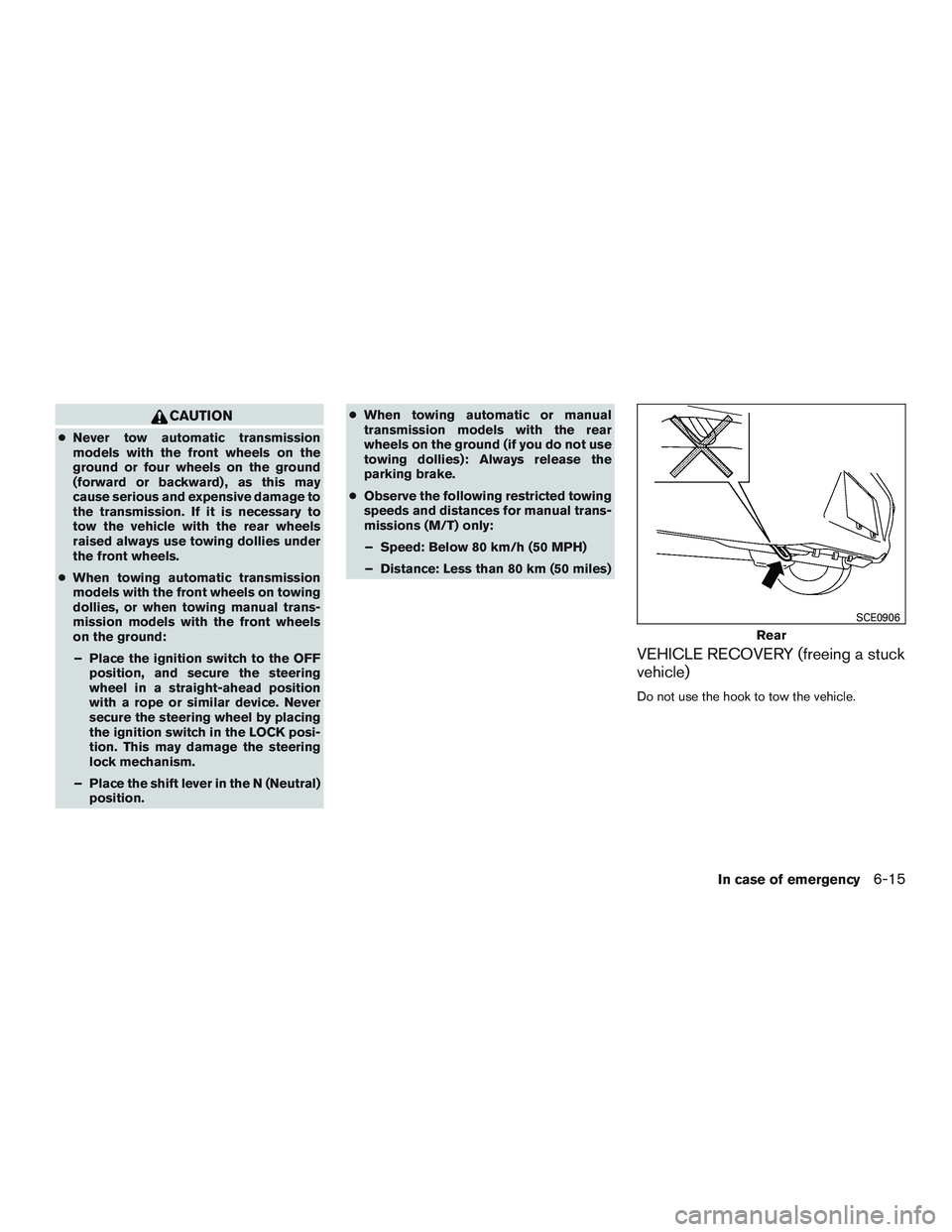
VEHICLE RECOVERY (freeing a stuck
vehicle)
Do not use the hook to tow the vehicle.
Rear
SCE0906
In case of emergency6-15
Page 215 of 293
Pulling a stuck vehicle
WARNING
To avoid vehicle damage, serious personal
injury or death when recovering a stuck
vehicle:
●Contact a professional towing service
to recover the vehicle if you have any
questions regarding the recovery
procedure.
● Do not use the vehicle tie-downs to tow
or free a stuck vehicle.
● Only use devices specifically designed
for vehicle recovery and follow the
manufacturer’s instructions.
● Always pull the recovery device straight
out from the front of the vehicle. Never
pull at an angle.
● Route recovery devices so they do not
touch any part of the vehicle except the
attachment point.
If your vehicle is stuck in sand, snow, mud, etc.,
use a tow strap or other device designed specifi-
cally for vehicle recovery. Always follow the
manufacturer’s instructions for the recovery de-
vice. NOTE:
Do not use the tie-down hooks for towing
or vehicle recovery.Rocking a stuck vehicle
WARNING
●
Stand clear of a stuck vehicle.
● Do not spin your tires at high speed.
This could cause them to explode and
result in serious injury. Parts of your
vehicle could also overheat and be
damaged.
If your vehicle is stuck in sand, snow, mud, etc.,
use the following procedure: 1. Make sure the area in front and behind the vehicle is clear of obstructions.
2. Turn the steering wheel right and left to clear an area around the front tires.
3. Slowly rock the vehicle forward and back- ward.
● Shift back and forth between R (Reverse)
and D (Drive) (A/T models) or 1st (Low)
and R (Reverse) (M/T models) .
● Apply the accelerator as little as possible
to maintain the rocking motion. ●
Release the accelerator pedal before
shifting between R (Reverse) and D
(Drive) (A/T models) or 1st (Low) and R
(Reverse) (M/T models) .
● Do not spin the tires above 55 km/h
(35 mph) .
4. If the vehicle cannot be freed after a few tries, contact a professional towing service
to remove the vehicle.
6-16In case of emergency
Page 224 of 293
When driving in areas using road salt or other
corrosive materials, check lubrication frequently.
Lights*Clean the headlights on a regular basis.
Make sure that the headlights, stop lights, tail
lights, turn signal lights, and other lights are all
operating properly and installed securely. Also
check headlight aim.
Road wheel nuts (lug nuts)* When checking
the tires, make sure no wheel nuts are missing,
and check for any loose wheel nuts. Tighten if
necessary.
Tire rotation* Tires should be rotated every
12,000 km (7,500 mi) .
Tires* Check the pressure with a gauge often
and always prior to long distance trips. If neces-
sary, adjust the pressure in all tires, including the
spare, to the pressure specified. Check carefully
for damage, cuts or excessive wear.
Wheel alignment and balance If the vehicle
should pull to either side while driving on a
straight and level road, or if you detect uneven or
abnormal tire wear, there may be a need for wheel
alignment. If the steering wheel or seat vibrates at
normal highway speeds, wheel balancing may be
needed.
●
For additional information regarding tires, re-
fer to the “Tire Safety Information” (Canada) in
the Warranty Information Booklet.
Windshield Clean the windshield on a regular
basis. Check the windshield at least every six
months for cracks or other damage. Have a dam-
aged windshield repaired by a qualified repair
facility.
Windshield wiper blades* Check for cracks or
wear if they do not wipe properly.
Inside the vehicle
The maintenance items listed here should be
checked on a regular basis, such as when per-
forming periodic maintenance, cleaning the ve-
hicle, etc.
Additional information on the following
items with an “*” is found in this section.
Accelerator pedal Check the pedal for smooth
operation and make sure the pedal does not bind
or require uneven effort. Keep the floor mat away
from the pedal.
Brake pedal Check the pedal for smooth opera-
tion. If the brake pedal suddenly goes down fur-
ther than normal, the pedal feels spongy or the
vehicle seems to take longer to stop, see a
NISSAN dealer immediately. Keep the floor mat
away from the pedal.
Brakes Check that the brakes do not pull the
vehicle to one side when applied. Parking brake
Check the parking brake opera-
tion regularly. The vehicle should be securely held
on a fairly steep hill with only the parking brake
applied. If the parking brake needs adjustment,
see a NISSAN dealer.
Seats Check seat position controls such as seat
adjusters, seatback recliner, etc. to ensure they
operate smoothly and all latches lock securely in
every position. Check that the head restraints
move up and down smoothly and the lock knobs
(if so equipped) hold securely in all adjustable
positions.
Seat belts Check that all parts of the seat belt
system (for example, buckles, anchors, adjusters
and retractors) operate properly and smoothly,
and are installed securely. Check the belt web-
bing for cuts, fraying, wear or damage.
Steering wheel Check for changes in the steer-
ing system, such as excessive freeplay, hard
steering or strange noises.
Warning lights and chimes Make sure all
warning lights and chimes are operating properly.
Windshield wiper and washer* Check that
the wipers and washer operate properly and that
the wipers do not streak.
Maintenance and do-it-yourself8-3
Page 286 of 293
10 Index
A
ABS (Anti-lock Braking System) ........5-20
Air bag (See supplemental restraint
system) .....................1-40
Air bag system Front (See supplemental front impact
air bag system) ...............1-47
Side and curtain (See supplemental side air
bag and curtain side-impact air
bag system) .................1-52
Airbagwarninglabels.............1-54
Airbagwarninglight...........1-55,2-10
Air bag warning light, supplemental . .1-55, 2-10
Air cleaner housing filter ............8-16
Air conditioner Air conditioner operation ......4-10,4-18
Air conditioner service ...........4-23
Air conditioner specification label .....9-12
Air conditioner system refrigerant and
oil recommendations .............9-7
Filter .....................8-17
Heater and air conditioner controls. .4-7, 4-15
Servicing air conditioner ..........4-23
Airflowcharts..............4-11,4-19
Alarm system
(See vehicle security system) .........2-13
Anchor point locations .............1-22
Antenna .....................4-45
Anti-lock brake warning light ..........2-8
Anti-lock Braking System (ABS) ........5-20
Audible reminders ...............2-12 Audio system
..................4-23
AMradioreception.............4-24
Compact disc (CD) player .....4-34,4-38
FM-AM radio with compact disc (CD)
player ....................4-31
FM/AM/SAT radio with compact disc (CD)
player ....................4-35
FMradioreception.............4-23
iPod® Player ................4-42
iPod® player operation ...........4-42
Radio ....................4-23
Steering wheel audio control switch . . .4-44
USB interface ................4-40
USB (Universal Serial Bus) Connection
Port .....................4-40
Automatic Automatic transmission fluid (ATF) ....8-11
Automatic transmission position indicator
light .....................2-10
Driving with automatic transmission .....5-8
Transmission shift selector lock release . .5-11
Automatic door locks ..............3-5
AUXjack.................4-35,4-39
B
Battery ..................5-24,8-13
Chargewarninglight.............2-8
Battery replacement Keyfob ...................8-24
Before starting the engine ............5-7
Belt (See drive belt) ..............8-15 Block heater
Engine ....................5-25
Bluetooth® hands-free phone system ....4-46
Boosterseats..................1-36
Brake Anti-lock Braking System (ABS) ......5-20
Brake fluid ..................8-12
Brakelight(Seestoplight).........8-29
Brake system ................5-19
Brakewarninglight..............2-8
Brakewearindicators........2-12,8-19
Parking brake operation ..........5-14
Self-adjusting brakes ............8-19
Brake fluid ....................8-12
Brakes ......................8-19
Brake system ..................5-19
Break-inschedule ...............5-16
Brightness control Instrument panel ..............2-18
Bulb check/instrument panel ..........2-7
Bulbreplacement................8-29
C
Capacities and recommended
fuel/lubricants ...................9-2
Cargo (See vehicle loading information) . . .9-13
Car phone or CB radio .............4-45
CDcareandcleaning .............4-43
CD player (See audio system) .....4-34,4-38
Page 287 of 293
Child restraints.......1-16,1-17,1-18,1-20
LATCH (Lower Anchors and Tethers for
CHildren) System ..............1-20
Precautions on child
restraints.........1-18,1-25,1-31,1-36
Top tether strap anchor point locations . .1-22
Child safety rear door lock ............3-5
Chimes, audible reminders ...........2-12
Cleaningexteriorandinterior...........7-2
Clock.......................4-33 (models without navigation system) ....4-33
Clockset.....................4-33
Clock set/adjustment ..............4-33
Clutch Clutch fluid ..................8-12
C.M.V.S.S. certification label ..........9-11
Cold weather driving ...............5-24
Compact disc (CD) player ........4-34,4-38
Controls Audiocontrols(steeringwheel).......4-44
Heater and air conditioner controls . .4-7, 4-15
Coolant Capacities and recommended
fuel/lubricants .................9-2
Changing engine coolant ...........8-8
Checking engine coolant level ........8-8
Corrosionprotection ...............7-5
Cruisecontrol..................5-15
Cupholders................2-22,2-23
Curtain side-impact air bag system
(See supplemental side air bag and curtain
side-impact air bag system) ...........1-52 D
Daytime light system ...............2-18
Defroster switch Rear window defroster switch .......2-16
Dimensionsandweights.............9-9
Dimmer switch for instrument panel ......2-18
Door locks .....................3-3
Door open warning light .............2-8
Drive belt .....................8-15
Driving Cold weather driving .............5-24
Driving with automatic transmission .....5-8
Driving with manual transmission ......5-12
Precautions when starting and driving ....5-2
Driving the vehicle .................5-8
E
Economy - fuel ..................5-17
Emission control information label .......9-11
Emission control system warranty .......9-18
Engine Before starting the engine ..........5-7
Block heater .................5-25
Capacities and recommended
fuel/lubricants .................9-2
Changingenginecoolant...........8-8
Changingengineoil.............8-10
Changing engine oil filter ..........8-11
Checking engine coolant level ........8-8
Checking engine oil level ...........8-9
Engine compartment check locations ....8-6
Engine cooling system ............8-7 Engineoil ...................8-9
Engine oil and oil filter recommendation . . .9-6
Engine oil pressure warning light
.......2-8
Engine oil viscosity ..............9-6
Engine serial number ............9-11
Engine specifications .............9-8
Starting the engine ..............5-7
Event data recorders ..............9-19
Exhaust gas (Carbon monoxide) .........5-2
Explanation of maintenance items ........8-2
Extended
storage switch ............8-23
F
Flashers (See hazard warning flasher switch) . .6-2
Flat tire .......................6-2
Floor mat positioning aid .............7-5
Fluid Automatic transmission fluid (ATF) .....8-11
Brake fluid ..................8-12
Capacities and recommended
fuel/lubricants.................9-2
Clutch fluid ..................8-12
Enginecoolant.................8-7
Engineoil ...................8-9
Front air bag system
(See supplemental restraint system) ......1-47
Frontseats.....................1-2
Fuel Capacities and recommended
fuel/lubricants.................9-2
Fuel economy ................5-17
Fuel-filler cap .................3-11
Fuel-filler door lock opener lever ......3-11
Fuel-filler lid .................3-11
10-2
Page 289 of 293
Fuel-filler door lock opener lever......3-11
Power door locks ...............3-4
Lowfuelwarninglight...............2-9
Low windshield-washer fluid warning light . . .2-9
Luggage (See vehicle loading information) . .9-13
M
Maintenance Generalmaintenance.............8-2
Insidethevehicle...............8-3
Maintenanceprecautions...........8-5
Outsidethevehicle..............8-2
Seat belt maintenance ............1-16
Under the hood and vehicle .........8-4
Maintenance requirements ............8-2
Malfunctionindicatorlight............2-11
Manual front seat adjustment ...........1-2
Manual windows .................2-26
Map pocket ....................2-21
Meters and gauges ................2-3
Instrument brightness control ........2-18
Mirror Inside mirror .................3-14
Outside mirror control ............3-15
Outside mirrors ...............3-15
Vanity mirror .................3-14
Mirrors ......................3-14
Multi-remote control system
(See remote keyless entry system) ........3-6 N
NISSAN vehicle immobilizer
system .................2-13,3-2,5-7
O
Octane rating (See fuel octane rating) ......9-5
Odometer .....................2-4
Oil Capacities and recommended
fuel/lubricants .................9-2
Changingengineoil.............8-10
Changing engine oil filter ..........8-11
Checking engine oil level ...........8-9
Engineoil ...................8-9
Engine oil and oil filter recommendation . . .9-6
Engine oil viscosity ..............9-6
Oneshotcall...................4-49
Outside mirror control ..............3-15
Outside mirrors .................3-15
Overdrive switch .................5-12
Overheat If your vehicle overheats ...........6-12
Owner’s manual order form ...........9-20
Owner’s manual/service manual order
information ....................9-20
P
Parking Parking brake operation ...........5-14
Parking/parking on hills ...........5-18
Phone, Bluetooth® hands-free system .....4-46Power
Power door locks ...............3-4
Poweroutlet.................2-21
Power rear windows .............2-26
Power steering system ...........5-19
Power windows ...............2-24
Rear power windows ............2-26
Poweroutlet...................2-21
Power steering ..................5-19
Precautions Maintenance precautions ...........8-5
Precautions on booster
seats...........1-18,1-25,1-31,1-36
Precautions on child
restraints .........1-18,1-25,1-31,1-36
Precautionsonseatbeltusage.......1-10
Precautions on supplemental restraint
system ....................1-40
Precautions when starting and driving ....5-2
Push starting ...................6-12
R
Radio CarphoneorCBradio ...........4-45
FM-AM
radio with compact disc (CD)
player.....................4-31
FM/AM/SAT radio with compact disc (CD)
player.....................4-35
Steering wheel audio control switch ....4-44
Readiness for inspection maintenance (I/M)
test........................9-19
Rear power windows ..............2-26
Rearseat......................1-4
RearView Monitor ..............4-2,4-3
10-4
Page 290 of 293
Rear window defroster switch.........2-16
Rear window wiper and washer switches . . .2-16
Recorders Eventdata..................9-19
Refrigerant recommendation ...........9-7
Registering your vehicle in another country . .9-10
Remote keyless entry system ...........3-6
Reporting safety defects (US only) .......9-18
S
Safety Child safety rear door lock ..........3-5
Childseatbelts.....1-18,1-25,1-31,1-36
Reporting safety defects (US only) .....9-18
Seat adjustment Front manual seat adjustment ........1-2
Rear seat adjustment .............1-4
Seat belt Child safety ..................1-16
Infantsandsmallchildren..........1-17
InjuredPerson................1-12
Largerchildren................1-17
Precautionsonseatbeltusage.......1-10
Pregnant women ...............1-12
Seat belt extenders .............1-15
Seat belt maintenance ............1-16
Seat belts ...................1-10
Shoulder belt height adjustment ......1-15
Three-point type with retractor .......1-12
Seat belt extenders ...............1-15
Seatbeltwarninglight ..............2-9
Seats Adjustment ...................1-2
Frontseats...................1-2 Manual front seat adjustment
.........1-2
Rear seat ....................1-4
Security indicator light ..............2-11
Security system (NISSAN vehicle immobilizer
system) , engine start .........2-13,3-2,5-7
Security systems Vehicle security system ...........2-13
Self-adjusting brakes ..............8-19
Service manual order form ...........9-20
Servicing air conditioner .............4-23
Shifting Automatic transmission ...........5-10
Manual transmission .............5-13
Shift lock release .................5-11
Shoulder belt height adjustment ........1-15
Side air bag system
(See supplemental side air bag and curtain
side-impact air bag system) ...........1-52
Spark plug replacement .............8-16
Sparkplugs ...................8-16
Specifications ...................9-8
Speedometer ...................2-3
SRS warning label ................1-54
Stability control .................5-21
Starting Before starting the engine ..........5-7
Jump starting .............6-10,8-15
Precautions when starting and driving ....5-2
Push starting .................6-12
Starting the engine ..............5-7
Starting the engine ................5-7
Steering Power steering system ...........5-19
Tilting steering wheel ............3-13
Steering wheel ..................3-13
Steering wheel audio control switch ......4-44S
toplight.....................8-29
Storage......................2-21
Storage tray ...................2-22
Sun visors ....................3-13
Supplemental air bag warning labels ......1-54
Supplemental air bag warning light . . .1-55, 2-10
Supplemental front impact air bag system . . .1-47
Supplemental restraint system Information and warning labels .......1-54
Precautions on supplemental restraint
system ....................1-40
Supplemental restraint system
(Supplemental air bag system) .........1-40
Supplemental side and curtain side-impact
air bag system ..................1-52
Switch Hazard warning flasher switch ........6-2
Headlightandturnsignalswitch......2-17
Headlight control switch ..........2-17
Ignition switch .................5-5
Instrument brightness control ........2-18
Overdrive switch ...............5-12
Powerdoorlockswitch............3-4
Rear window defroster switch .......2-16
Rear window wiper and washer
switches...................2-16
Turnsignalswitch..............2-19
Vehicle dynamic control (VDC) off
switch.....................2-20
Windshield wiper and washer switch . . .2-14
T
Tachometer ....................2-4
10-5
Page 291 of 293
Theft (NISSAN vehicle immobilizer system) ,
engine start..............2-13,3-2,5-7
Three-way catalyst ................5-2
Tilting steering wheel ..............3-13
Tire Flat tire .....................6-2
Spare tire ................6-3,8-42
Tire and Loading Information label .....9-12
Tire chains ..................8-40
Tirepressure.................8-34
Tirerotation..................8-40
Types of tires .................8-39
Uniform tire quality grading .........9-17
Wheels and tires ...............8-34
Wheel/tire size .................9-9
Towing Flattowing..................9-16
Towtrucktowing...............6-13
Trailertowing.................9-16
Towing a trailer ..................9-16
Transmission Automatic transmission fluid (ATF) .....8-11
Driving with automatic transmission .....5-8
Driving with manual transmission ......5-12
Shiftselectorlockrelease..........5-11
Travel (See registering your vehicle in another
country) ......................9-10
Trip computer ...................2-5
Trip odometer ...................2-4
Turnsignalswitch................2-19
U
Uniform tire quality grading ...........9-17
USB interface ..................4-40 Audio file operation
.............4-41
V
Vanity mirror ...................3-14
Vehicle dimensions and weights .........9-9
Vehicle dynamic control (VDC) off switch . . .2-20
Vehicle dynamic control (VDC) system .....5-21
Vehicle Dynamic Control (VDC) system ....5-21
Vehicle identification ...............9-10
Vehicle identification number (VIN)
(Chassis number) ................9-10
Vehicle identification number (VIN) plate ....9-10
Vehicle immobilizer system ......2-13,3-2,5-7
Vehicle loading information ...........9-13
Vehicle recovery .................6-15
Vehicle security system .............2-13
Vehicle security system (NISSAN vehicle immobi-
lizer system) , engine start ......2-13,3-2,5-7
Ventilators .....................4-6
Visors.......................3-13
Voice Prompt Interrupt ..............4-49
W
Warning Air bag warning light .........1-55,2-10
Anti-lock brake warning light .........2-8
Battery charge warning light .........2-8
Brake warning light ..............2-8
Door open warning light ...........2-8
Engine oil pressure warning light .......2-8
Hazard warning flasher switch ........6-2
Low fuel warning light .............2-9Low windshield-washer fluid warning light..2-9
Passenger air bag and status light .....1-49
Seat belt warning light ............2-9
Supplemental air bag warning light. .1-55, 2-10
Vehicle security system ...........2-13
Warning/indicator lights and audible
reminders ...................2-7
Warning labels (for SRS) ..........1-54
Warning/indicator lights and audible
reminders .....................2-7
Audible reminders ...............2-7
Indicatorlights.................2-7
Warninglights.................2-7
Warninglights...................2-7
Washer switch Rear window wiper and washer
switches ...................2-16
Windshield wiper and washer switch . . .2-14
Weights(Seedimensionsandweights).....9-9
Wheels and tires .................8-34
Wheel/tire size ...................9-9
When traveling or registering your vehicle in
anothercountry .................9-10
Windows Locking passengers’ windows .......2-26
Manual windows ...............2-26
Power rear windows .............2-26
Power windows ...............2-24
Rear power windows ............2-26
Windshield-washer fluid .............8-13
Windshield wiper and washer switch .....2-14
Windshield wiper blades ............8-17
Wiper
Rear window wiper and washer switches. .2-16
Windshield wiper and washer switch . . .2-14
Wiperblades.................8-17
10-6