parking brake NISSAN MICRA 2017 Owner´s Manual
[x] Cancel search | Manufacturer: NISSAN, Model Year: 2017, Model line: MICRA, Model: NISSAN MICRA 2017Pages: 318, PDF Size: 3.73 MB
Page 276 of 318
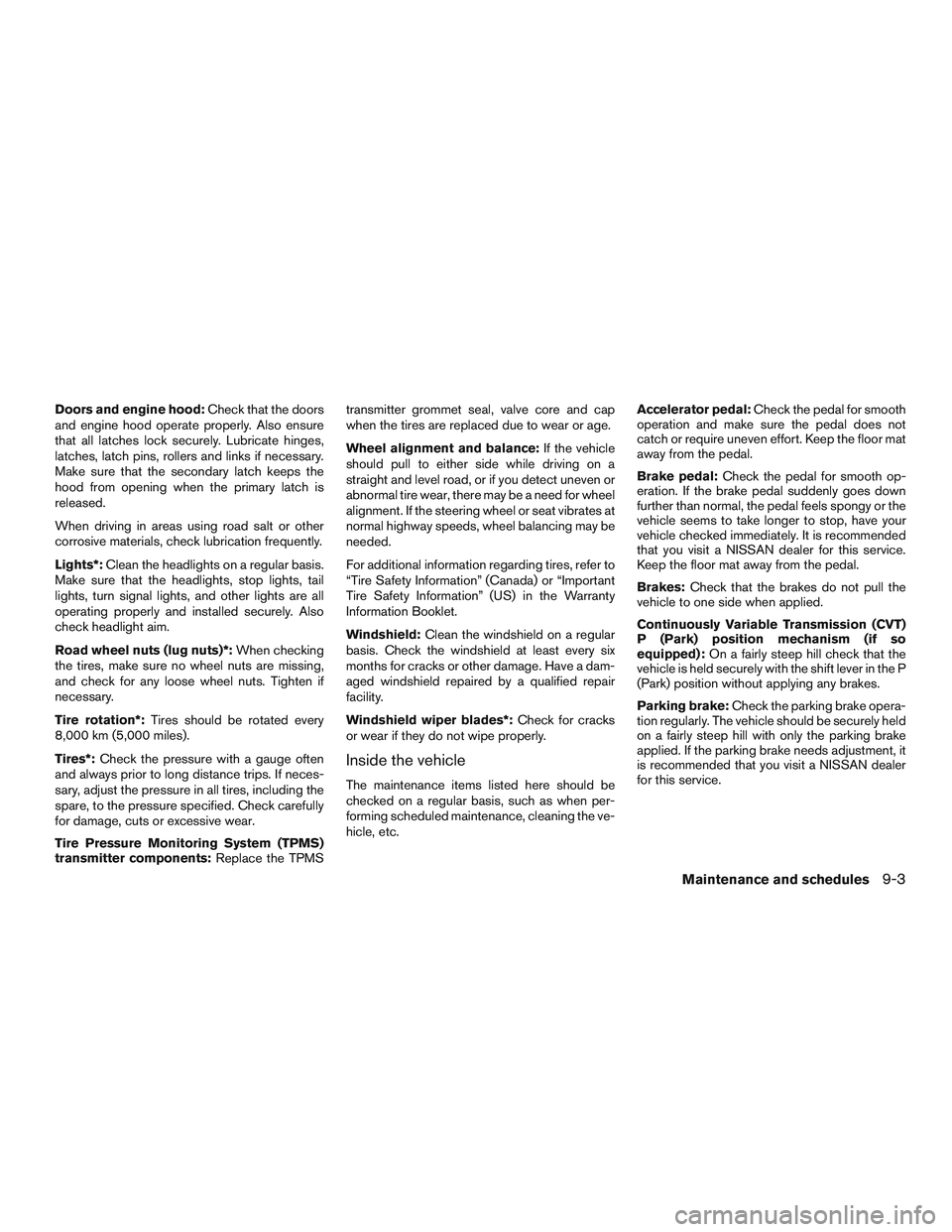
Doors and engine hood:Check that the doors
and engine hood operate properly. Also ensure
that all latches lock securely. Lubricate hinges,
latches, latch pins, rollers and links if necessary.
Make sure that the secondary latch keeps the
hood from opening when the primary latch is
released.
When driving in areas using road salt or other
corrosive materials, check lubrication frequently.
Lights*: Clean the headlights on a regular basis.
Make sure that the headlights, stop lights, tail
lights, turn signal lights, and other lights are all
operating properly and installed securely. Also
check headlight aim.
Road wheel nuts (lug nuts)*: When checking
the tires, make sure no wheel nuts are missing,
and check for any loose wheel nuts. Tighten if
necessary.
Tire rotation*: Tires should be rotated every
8,000 km (5,000 miles).
Tires*: Check the pressure with a gauge often
and always prior to long distance trips. If neces-
sary, adjust the pressure in all tires, including the
spare, to the pressure specified. Check carefully
for damage, cuts or excessive wear.
Tire Pressure Monitoring System (TPMS)
transmitter components: Replace the TPMStransmitter grommet seal, valve core and cap
when the tires are replaced due to wear or age.
Wheel alignment and balance:
If the vehicle
should pull to either side while driving on a
straight and level road, or if you detect uneven or
abnormal tire wear, there may be a need for wheel
alignment. If the steering wheel or seat vibrates at
normal highway speeds, wheel balancing may be
needed.
For additional information regarding tires, refer to
“Tire Safety Information” (Canada) or “Important
Tire Safety Information” (US) in the Warranty
Information Booklet.
Windshield: Clean the windshield on a regular
basis. Check the windshield at least every six
months for cracks or other damage. Have a dam-
aged windshield repaired by a qualified repair
facility.
Windshield wiper blades*: Check for cracks
or wear if they do not wipe properly.
Inside the vehicle
The maintenance items listed here should be
checked on a regular basis, such as when per-
forming scheduled maintenance, cleaning the ve-
hicle, etc. Accelerator pedal:
Check the pedal for smooth
operation and make sure the pedal does not
catch or require uneven effort. Keep the floor mat
away from the pedal.
Brake pedal: Check the pedal for smooth op-
eration. If the brake pedal suddenly goes down
further than normal, the pedal feels spongy or the
vehicle seems to take longer to stop, have your
vehicle checked immediately. It is recommended
that you visit a NISSAN dealer for this service.
Keep the floor mat away from the pedal.
Brakes: Check that the brakes do not pull the
vehicle to one side when applied.
Continuously Variable Transmission (CVT)
P (Park) position mechanism (if so
equipped): On a fairly steep hill check that the
vehicle is held securely with the shift lever in the P
(Park) position without applying any brakes.
Parking brake: Check the parking brake opera-
tion regularly. The vehicle should be securely held
on a fairly steep hill with only the parking brake
applied. If the parking brake needs adjustment, it
is recommended that you visit a NISSAN dealer
for this service.
Maintenance and schedules9-3
Page 277 of 318
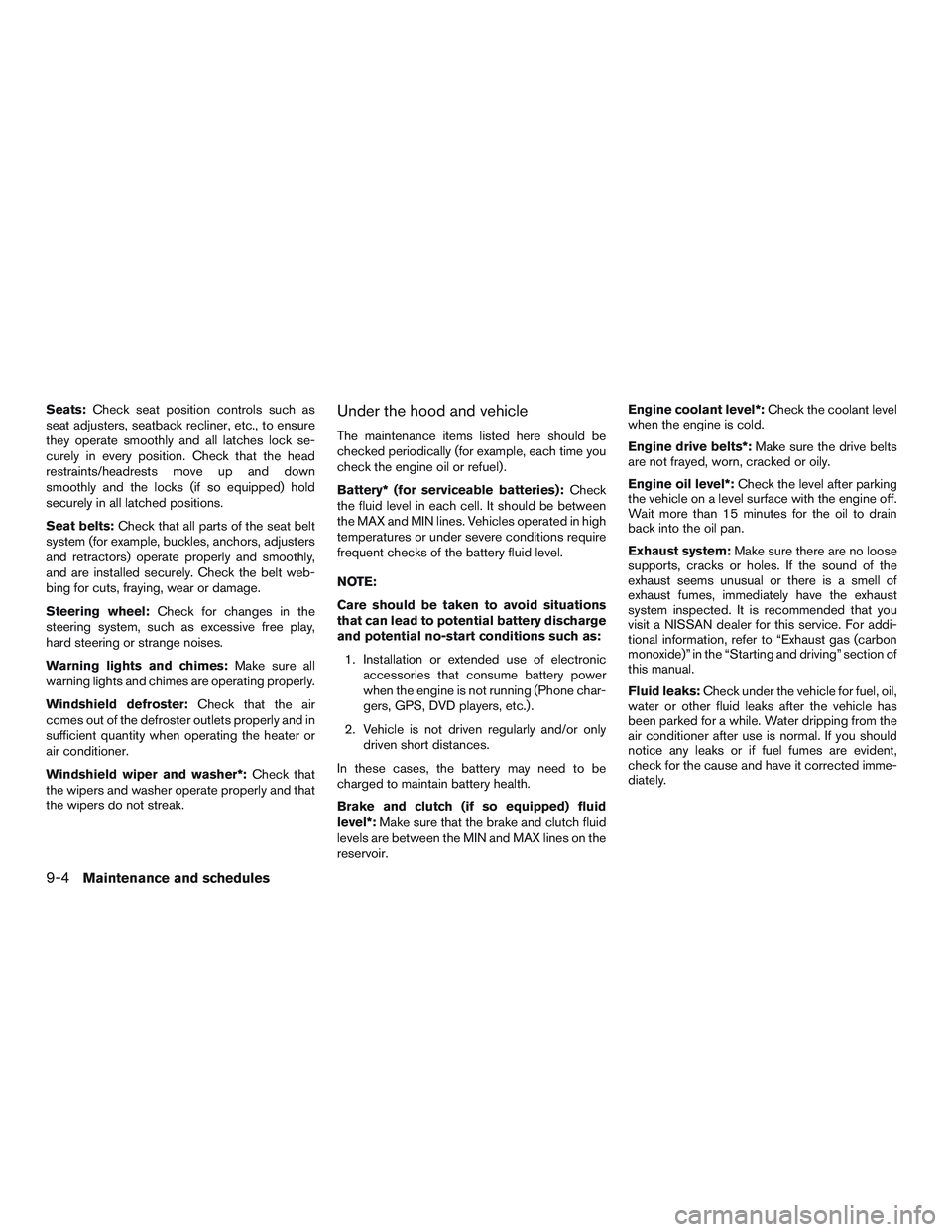
Seats:Check seat position controls such as
seat adjusters, seatback recliner, etc., to ensure
they operate smoothly and all latches lock se-
curely in every position. Check that the head
restraints/headrests move up and down
smoothly and the locks (if so equipped) hold
securely in all latched positions.
Seat belts: Check that all parts of the seat belt
system (for example, buckles, anchors, adjusters
and retractors) operate properly and smoothly,
and are installed securely. Check the belt web-
bing for cuts, fraying, wear or damage.
Steering wheel: Check for changes in the
steering system, such as excessive free play,
hard steering or strange noises.
Warning lights and chimes: Make sure all
warning lights and chimes are operating properly.
Windshield defroster: Check that the air
comes out of the defroster outlets properly and in
sufficient quantity when operating the heater or
air conditioner.
Windshield wiper and washer*: Check that
the wipers and washer operate properly and that
the wipers do not streak.Under the hood and vehicle
The maintenance items listed here should be
checked periodically (for example, each time you
check the engine oil or refuel) .
Battery* (for serviceable batteries): Check
the fluid level in each cell. It should be between
the MAX and MIN lines. Vehicles operated in high
temperatures or under severe conditions require
frequent checks of the battery fluid level.
NOTE:
Care should be taken to avoid situations
that can lead to potential battery discharge
and potential no-start conditions such as:
1. Installation or extended use of electronic accessories that consume battery power
when the engine is not running (Phone char-
gers, GPS, DVD players, etc.) .
2. Vehicle is not driven regularly and/or only driven short distances.
In these cases, the battery may need to be
charged to maintain battery health.
Brake and clutch (if so equipped) fluid
level*: Make sure that the brake and clutch fluid
levels are between the MIN and MAX lines on the
reservoir. Engine coolant level*:
Check the coolant level
when the engine is cold.
Engine drive belts*: Make sure the drive belts
are not frayed, worn, cracked or oily.
Engine oil level*: Check the level after parking
the vehicle on a level surface with the engine off.
Wait more than 15 minutes for the oil to drain
back into the oil pan.
Exhaust system: Make sure there are no loose
supports, cracks or holes. If the sound of the
exhaust seems unusual or there is a smell of
exhaust fumes, immediately have the exhaust
system inspected. It is recommended that you
visit a NISSAN dealer for this service. For addi-
tional information, refer to “Exhaust gas (carbon
monoxide)” in the “Starting and driving” section of
this manual.
Fluid leaks: Check under the vehicle for fuel, oil,
water or other fluid leaks after the vehicle has
been parked for a while. Water dripping from the
air conditioner after use is normal. If you should
notice any leaks or if fuel fumes are evident,
check for the cause and have it corrected imme-
diately.
9-4Maintenance and schedules
Page 310 of 318
11 Index
A
Air bag (See supplemental restraint
system) .....................1-41
Air bag system Front (See supplemental front impact
air bag system) ...............1-48
Side and curtain (See supplemental
side air bag and curtain side-impact
air bag system) ...............1-55
Airbagwarninglabels.............1-58
Airbagwarninglight...........1-58,2-10
Air bag warning light, supplemental . .1-58, 2-10
Air cleaner housing filter ............8-14
Air conditioner Air conditioner operation ......4-11,4-19
Air conditioner service ...........4-24
Air conditioner specification label ....10-12
Air conditioner system refrigerant and
oil recommendations ............10-7
Air conditioner system refrigerant
recommendations ..............10-7
Heater and air conditioner
controls ................4-8,4-16
Servicing air conditioner ..........4-24
Airflowcharts..............4-12,4-20
Alarm system
(See vehicle security system) .........2-13
Anchor point locations .............1-25
Antenna .....................4-46
Anti-lock brake warning light ..........2-8
Anti-lock Braking System (ABS) ........5-22Audible reminders
...............2-13
Audio system ..................4-24
AMradioreception.............4-25
Compact disc (CD) player .....4-35,4-39
FM/AM radio with compact disc (CD)
player.................4-32,4-36
FMradioreception.............4-24
iPod® Player ................4-43
iPod® player operation ...........4-43
Radio ....................4-24
Steering wheel audio control switch . . .4-45
USB interface ................4-41
USB (Universal Serial Bus) Connection
Port .....................4-41
Automatic Automatic power window switch .....2-27
Automatic transmission fluid (ATF) .....8-8
Automatic transmission position indicator
light .....................2-10
Driving with automatic transmission .....5-8
Transmission shift lever lock release ....5-11
Automatic door locks ..............3-5
AUXjack.................4-36,4-40
B
Battery ..................5-25,8-10
Chargewarninglight.............2-8
Battery replacement ..............8-20
Keyfob................8-20,8-20
Before starting the engine ............5-7
Belt (See drive belt) ..............8-12 Block heater
Engine ....................5-26
Bluetooth® hands-free phone system ....4-47
Boosterseats..................1-38
Brake Anti-lock Braking System (ABS) ......5-22
Brake assist (for Intelligent cruise control
system) ...................5-23
Brake fluid ..................8-9
Brakelight(Seestoplight).........8-26
Brake system ................5-21
Brakewarninglight..............2-8
Brakewearindicators........2-13,8-16
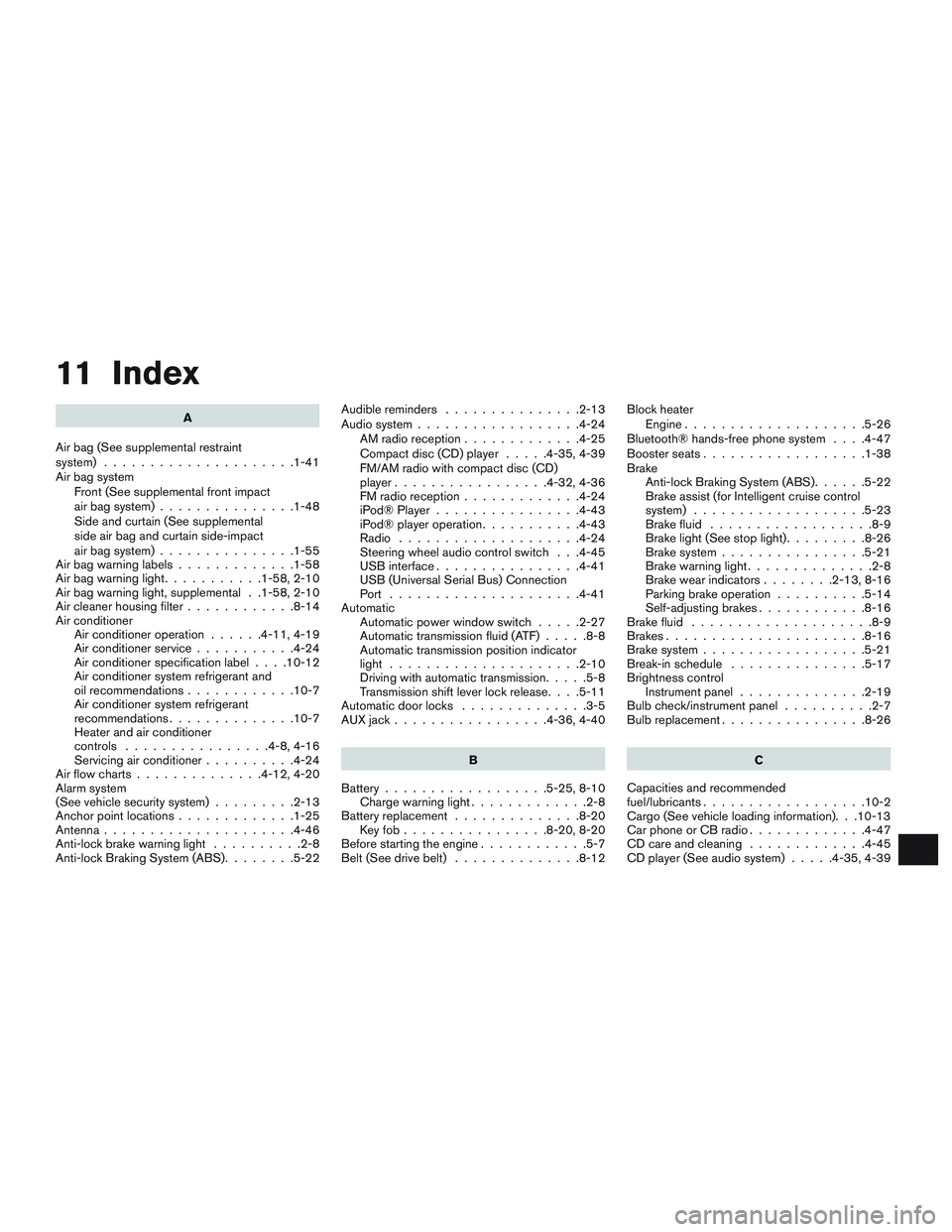
Parking brake operation ..........5-14
Self-adjusting brakes ............8-16
Brake fluid ....................8-9
Brakes ......................8-16
Brake system ..................5-21
Break-inschedule ...............5-17
Brightness control Instrument panel ..............2-19
Bulb check/instrument panel ..........2-7
Bulbreplacement................8-26
C
Capacities and recommended
fuel/lubricants ..................
10-2
Cargo (See vehicle loading information). . .10-13
Car phone or CB radio .............4-47
CDcareandcleaning .............4-45
CD player (See audio system) .....4-35,4-39
Page 313 of 318
Lights.......................8-21
LockChild safety rear door lock ..........3-5
Door locks ...................3-3
Power door locks ...............3-4
Loose fuel cap warning ..............2-5
Low windshield-washer fluid warning light . . .2-9
Luggage (See vehicle loading information) . .10-13
M
Maintenance Generalmaintenance.............9-2
Insidethevehicle...............9-3
Maintenanceprecautions...........8-2
Outsidethevehicle..............9-2
Seat belt maintenance ............1-18
Under the hood and vehicle .........9-4
Maintenance log .................9-13
Maintenance requirements ............9-2
Maintenance schedules ..............9-7
Maintenance under severe operation
conditions ....................9-12
Malfunctionindicatorlight............2-11
Manual front seat adjustment ...........1-3
Manual windows .................2-28
Map pocket ....................2-22
Meters and gauges ................2-3
Instrument brightness control ........2-19
Mirror Outside mirror control ............3-15
Outside mirrors ............3-14,3-15
Rearview ...................3-14
Vanity mirror .................3-13
Mirrors ......................3-14 N
NISSAN Vehicle Immobilizer System . . .2-13, 5-7
O
Octane rating (See fuel octane rating) .....10-5
Odometer .....................2-4
Oil Capacities and recommended
fuel/lubricants ................10-2
Changingengineoil..............8-7
Changing engine oil filter ...........8-8
Checking engine oil level ...........8-6
Engineoil ...................8-6
Engine oil and oil filter recommendation . .10-6
Engine oil viscosity ..............10-7
Oneshotcall...................4-50
Outside mirror control ..............3-15
Outside mirrors ..............3-14,3-15
Overdrive switch .................5-12
Overheat If your vehicle overheats ...........6-12
Owner’s manual order form ..........10-20
Owner’s manual/service manual order
information ...................10-20
P
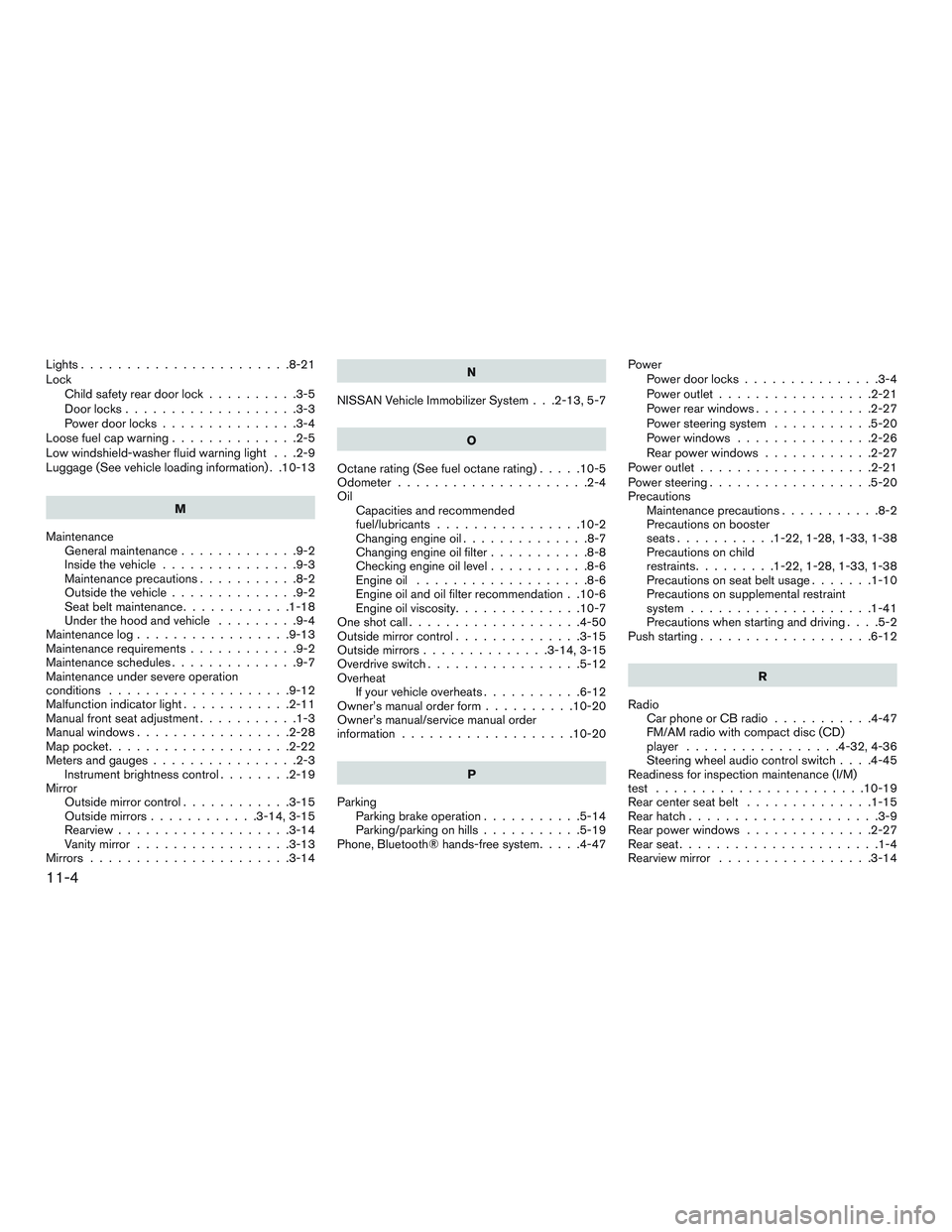
Parking Parking brake operation ...........5-14
Parking/parking on hills ...........5-19
Phone, Bluetooth® hands-free system .....4-47Power
Power door locks ...............3-4
Poweroutlet.................2-21
Power rear windows .............2-27
Power steering system ...........5-20
Power windows ...............2-26
Rear power windows ............2-27
Poweroutlet...................2-21
Power steering ..................5-20
Precautions Maintenance precautions ...........8-2
Precautions on booster
seats...........1-22,1-28,1-33,1-38
Precautions on child
restraints .........1-22,1-28,1-33,1-38
Precautionsonseatbeltusage.......1-10
Precautions
on supplemental restraint
system ....................1-41
Precautions when starting and driving ....5-2
Push starting ...................6-12
R
Radio CarphoneorCBradio ...........4-47
FM/AM radio with compact disc (CD)
player .................4-32,4-36
Steering wheel audio control switch ....4-45
Readiness for inspection maintenance (I/M)
test .......................10-19
Rearcenterseatbelt ..............1-15
Rear hatch .....................3-9
Rear power windows ..............2-27
Rearseat......................1-4
Rearview mirror .................3-14
11-4