engine NISSAN MICRA 2017 Owner´s Manual
[x] Cancel search | Manufacturer: NISSAN, Model Year: 2017, Model line: MICRA, Model: NISSAN MICRA 2017Pages: 318, PDF Size: 3.73 MB
Page 278 of 318
Radiator and hoses:Check the front of the
radiator and clean off any dirt, insects, leaves,
etc., that may have accumulated. Make sure the
hoses have no cracks, deformation, rot or loose
connections.
Underbody: The underbody is frequently ex-
posed to corrosive substances such as those
used on icy roads or to control dust. It is very
important to remove these substances from the
underbody, otherwise rust may form on the floor
pan, frame, fuel lines and exhaust system. At the
end of winter, the underbody should be thor-
oughly flushed with plain water, in those areas
where mud and dirt may have accumulated. For
additional information, refer to the “Appearance
and care” section of this manual.
Windshield-washer fluid*: Check that there is
adequate fluid in the reservoir. The following descriptions are provided to give
you a better understanding of the scheduled
maintenance items that should be regularly
checked or replaced. The maintenance schedule
indicates at which mileage/time intervals each
item requires service.
In addition to scheduled maintenance, your ve-
hicle requires that some items be checked during
normal day-to-day operation. For additional infor-
mation, refer to “General maintenance” in this
section.
Items marked with
“*”are recommended by
NISSAN for reliable vehicle operation. You are
not required to perform maintenance on these
items in order to maintain the warranties which
come with your NISSAN. Other maintenance
items and intervals are required.
When applicable, additional information can be
found in the “Do-it-yourself” section of this manual.
NOTE:
NISSAN does not advocate the use of non-
OEM approved aftermarket flushing sys-
tems and strongly advises against perform-
ing these services on a NISSAN product.
Many of the aftermarket flushing systems
use non-OEM approved chemicals or sol-
vents, the use of which has not been vali-
dated by NISSAN. For recommended fuel, lubricants, fluids,
grease, and refrigerant, refer to “Recom-
mended fluids/lubricants and capacities”
in the “Technical and consumer informa-
tion” section of this manual.
EMISSION CONTROL SYSTEM
MAINTENANCE:
Drive belts*:
Check engine drive belts for wear, fraying or
cracking and for proper tension. Replace any
damaged drive belts.
Engine air filter:
Replace at specified intervals. When driving for
prolonged periods in dusty conditions,
check/replace the filter more frequently.
Engine coolant*:
Replace coolant at the specified interval. When
adding or replacing coolant, be sure to use only
Genuine NISSAN Long Life Antifreeze/Coolant
(blue) or equivalent with the proper mixture. (For
additional information on the proper mixture for
your area, refer to “Engine cooling system” in the
“Do-it-yourself” section of this manual.)
EXPLANATION OF SCHEDULED
MAINTENANCE ITEMS
Maintenance and schedules9-5
Page 279 of 318
NOTE: Mixing any other type of coolant or
the use of non-distilled water may reduce
the recommended service interval of the
coolant.
Engine oil and oil filter:
Replace engine oil and oil filter at the specified
intervals. For recommended oil grade and viscos-
ity refer to “Recommended fluids/lubricants and
capacities” in the “Technical and consumer infor-
mation” section of this manual.
Engine valve clearance*:
Inspect only if valve noise increases. Adjust valve
clearance if necessary.
Evaporative emissions control vapour
lines*:
Check vapour lines for leaks or looseness.
Tighten connections or replace parts as neces-
sary.
Fuel filter:
Periodic maintenance is not required. (in-tank
type filter)
Fuel lines*:
Check the fuel hoses, piping and connections for
leaks, looseness, or deterioration. Tighten con-
nections or replace parts as necessary.Spark plugs:
Replace at specified intervals. Install new plugs
of the type as originally equipped.
CHASSIS AND BODY
MAINTENANCE:
Brake lines and cables:
Visually inspect for proper installation. Check for
chafing, cracks, deterioration, and signs of leak-
ing. Replace any deteriorated or damaged parts
immediately.
Brake pads, rotors, drums and linings:
Check for wear, deterioration and fluid leaks.
Replace any deteriorated or damaged parts im-
mediately.
Exhaust system:
Visually inspect the exhaust pipes, muffler and
hangers for leaks, cracks, deterioration, and dam-
age. Tighten connections or replace parts as
necessary.
In-cabin microfilter:
Replace at specified intervals. When driving for
prolonged periods in dusty conditions, replace
the filter more frequently.
Steering gear and linkage, axle and sus-
pension parts, drive shaft boots:Check for damage, looseness, and leakage of oil
or grease. Under severe driving conditions, in-
spect more frequently.
Tire rotation:
Tires should be rotated every 8,000 km
(5,000 miles) according to the instructions under
“General maintenance” in this section. When ro-
tating tires, check for damage and uneven wear.
Replace if necessary.
Transmission fluid/oil:
Visually inspect for signs of leakage at specified
intervals.
If towing a trailer, using a camper or car-top
carrier, or driving on rough or muddy roads:
● Replace the manual transaxle gear oil every
32,000 km (20,000 miles) or 24 months.
● Replace the CVT fluid every 96,000 km
(60,000 miles) or request the dealer to in-
spect the fluid deterioration data using a
CONSULT. If the deterioration data is more
than 210000, replace the CVT fluid. .
9-6Maintenance and schedules
Page 281 of 318
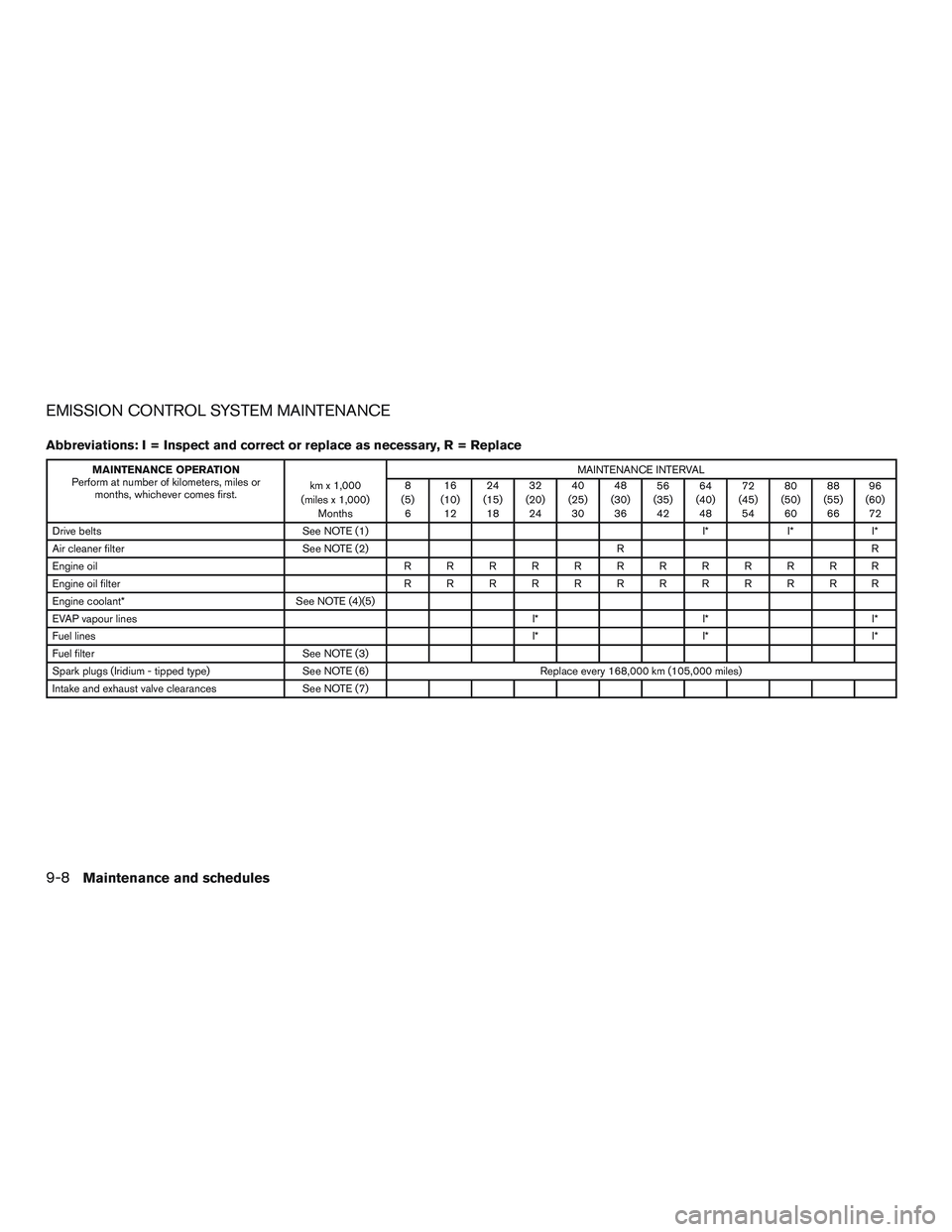
EMISSION CONTROL SYSTEM MAINTENANCE
Abbreviations: I = Inspect and correct or replace as necessary, R = Replace
MAINTENANCE OPERATION
Perform at number of kilometers, miles or months, whichever comes first. km x 1,000
(miles x 1,000) Months MAINTENANCE INTERVAL
8
(5) 6 16
(10) 12 24
(15) 18 32
(20) 24 40
(25) 30 48
(30) 36 56
(35) 42 64
(40) 48 72
(45) 54 80
(50) 60 88
(55) 66 96
(60) 72
Drive belts See NOTE (1) I*I*I*
Air cleaner filter See NOTE (2) RR
Engine oil RRRRRRRRRRRR
Engine oil filter RRRRRRRRRRRR
Engine coolant* See NOTE (4)(5)
EVAP vapour lines I*I*I*
Fuel lines I*I*I*
Fuel filter See NOTE (3)
Spark plugs (Iridium - tipped type) See NOTE (6)Replace every 168,000 km (105,000 miles)
Intake and exhaust valve clearances See NOTE (7)
9-8Maintenance and schedules
Page 282 of 318
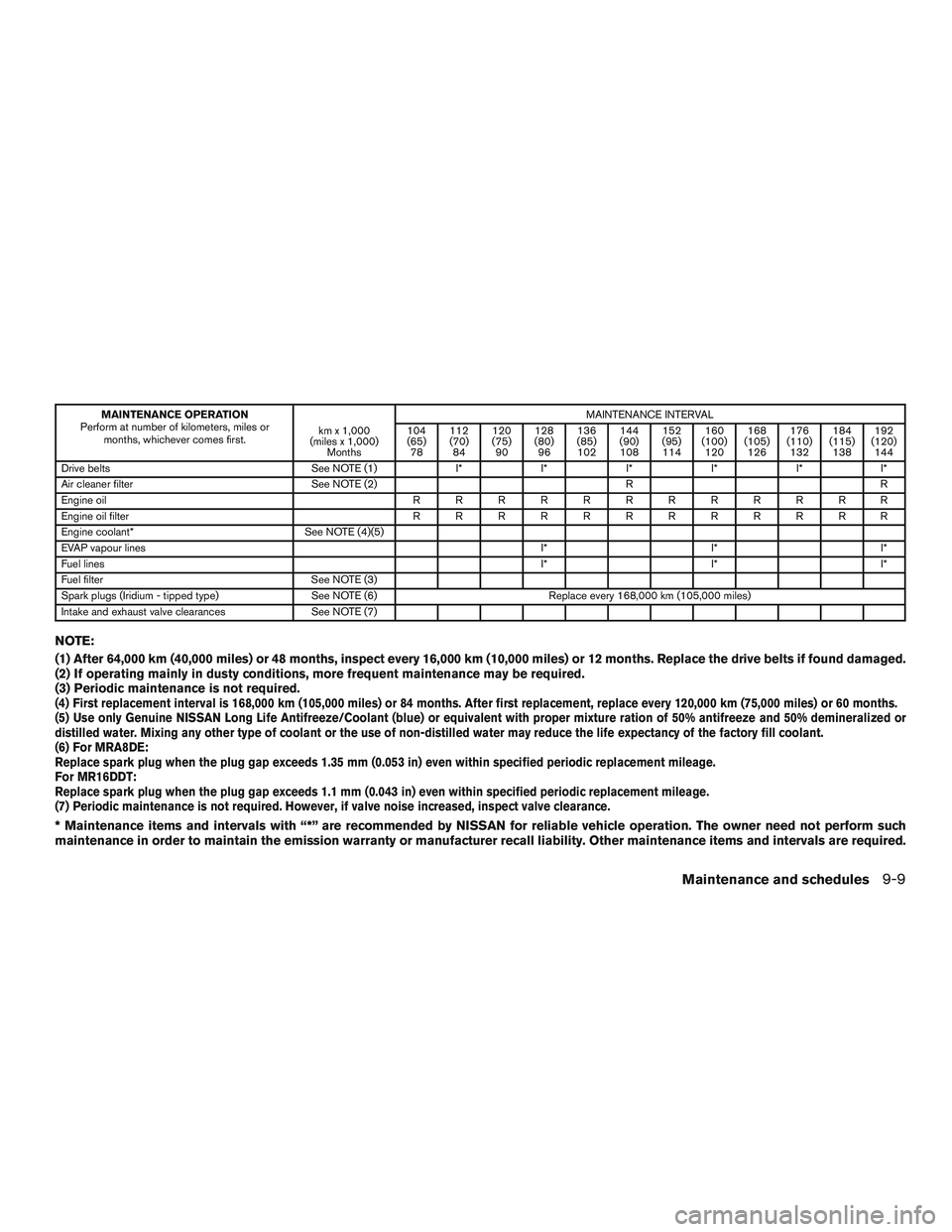
MAINTENANCE OPERATION
Perform at number of kilometers, miles or months, whichever comes first. km x 1,000
(miles x 1,000) Months MAINTENANCE INTERVAL
104
(65) 78 112
(70) 84 120
(75) 90 128
(80) 96 136
(85) 102 144
(90) 108 152
(95) 114 160
(100) 120 168
(105) 126 176
(110) 132 184
(115) 138 192
(120) 144
Drive belts See NOTE (1)I*I*I*I*I*I*
Air cleaner filter See NOTE (2) RR
Engine oil RRRRRRRRRRRR
Engine oil filter RRRRRRRRRRRR
Engine coolant* See NOTE (4)(5)
EVAP vapour lines I*I*I*
Fuel lines I*I*I*
Fuel filter See NOTE (3)
Spark plugs (Iridium - tipped type) See NOTE (6)Replace every 168,000 km (105,000 miles)
Intake and exhaust valve clearances See NOTE (7)
NOTE:
(1) After 64,000 km (40,000 miles) or 48 months, inspect every 16,000 km (10,000 miles) or 12 months. Replace the drive belts if found damaged.
(2) If operating mainly in dusty conditions, more frequent maintenance may be required.
(3) Periodic maintenance is not required.
(4) First replacement interval is 168,000 km (105,000 miles) or 84 months. After first replacement, replace every 120,000 km (75,000 miles) or 60 months.
(5) Use only Genuine NISSAN Long Life Antifreeze/Coolant (blue) or equivalent with proper mixture ration of 50% antifreeze and 50% demineralized or
distilled water. Mixing any other type of coolant or the use of non-distilled water may reduce the life expectancy of the factory fill coolant.
(6) For MRA8DE:
Replace spark plug when the plug gap exceeds 1.35 mm (0.053 in) even within specified periodic replacement mileage.
For MR16DDT:
Replace spark plug when the plug gap exceeds 1.1 mm (0.043 in) even within specified periodic replacement mileage.
(7) Periodic maintenance is not required. However, if valve noise increased, inspect valve clearance.
* Maintenance items and intervals with “*” are recommended by NISSAN for reliable vehicle operation. The owner need not perform such
maintenance in order to maintain the emission warranty or manufacturer recall liability. Other maintenance items and intervals are required.
Maintenance and schedules9-9
Page 290 of 318
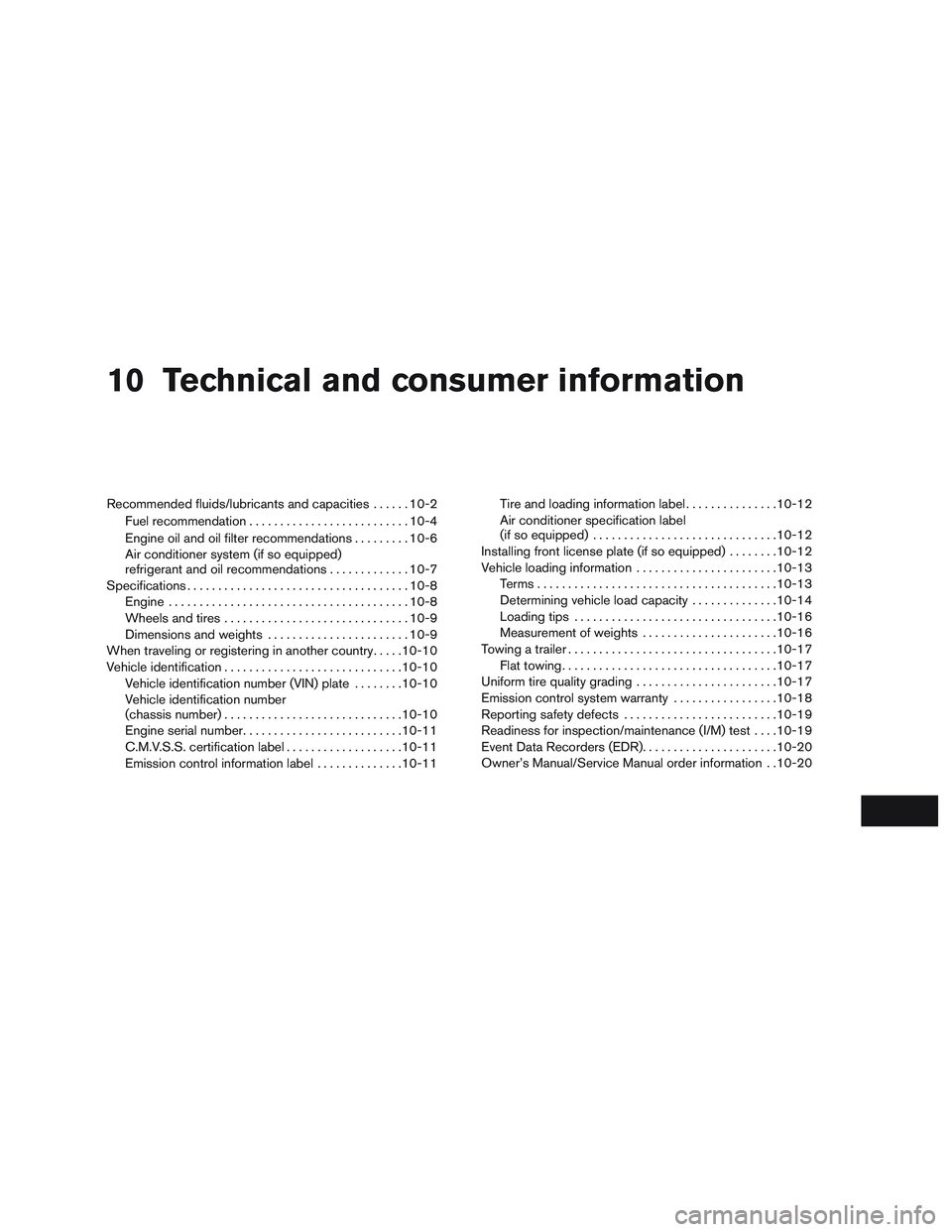
10 Technical and consumer information
Recommended fluids/lubricants and capacities......10-2
Fuel recommendation .......................... 10-4
Engine oil and oil filter recommendations .........10-6
Air conditioner system (if so equipped)
refrigerant and oil recommendations .............10-7
Specifications .................................... 10-8
Engine ....................................... 10-8
Wheels and tires .............................. 10-9
Dimensions and weights .......................10-9
When traveling or registering in another country .....10-10
Vehicle identification ............................. 10-10
Vehicle identification number (VIN) plate ........10-10
Vehicle identification number
(chassis number) ............................. 10-10
Engine serial number .......................... 10-11
C.M.V.S.S. certification label ...................10-11
Emission control information label ..............10-11 Tire and loading information label
...............10-12
Air conditioner specification label
(if so equipped) .............................. 10-12
Installing front license plate (if so equipped) ........10-12
Vehicle loading information .......................10-13
Terms ....................................... 10-13
Determining vehicle load capacity . . ............10-14
Loading tips ................................. 10-16
Measurement of weights ......................10-16
Towing a trailer .................................. 10-17
Flat towing ................................... 10-17
Uniform tire quality grading .......................10-17
Emission control system warranty .................10-18
Reporting safety defects ......................... 10-19
Readiness for inspection/maintenance (I/M) test ....10-19
Event Data Recorders (EDR) ......................10-20
Owner’s Manual/Service Manual order information . .10-20
Page 291 of 318
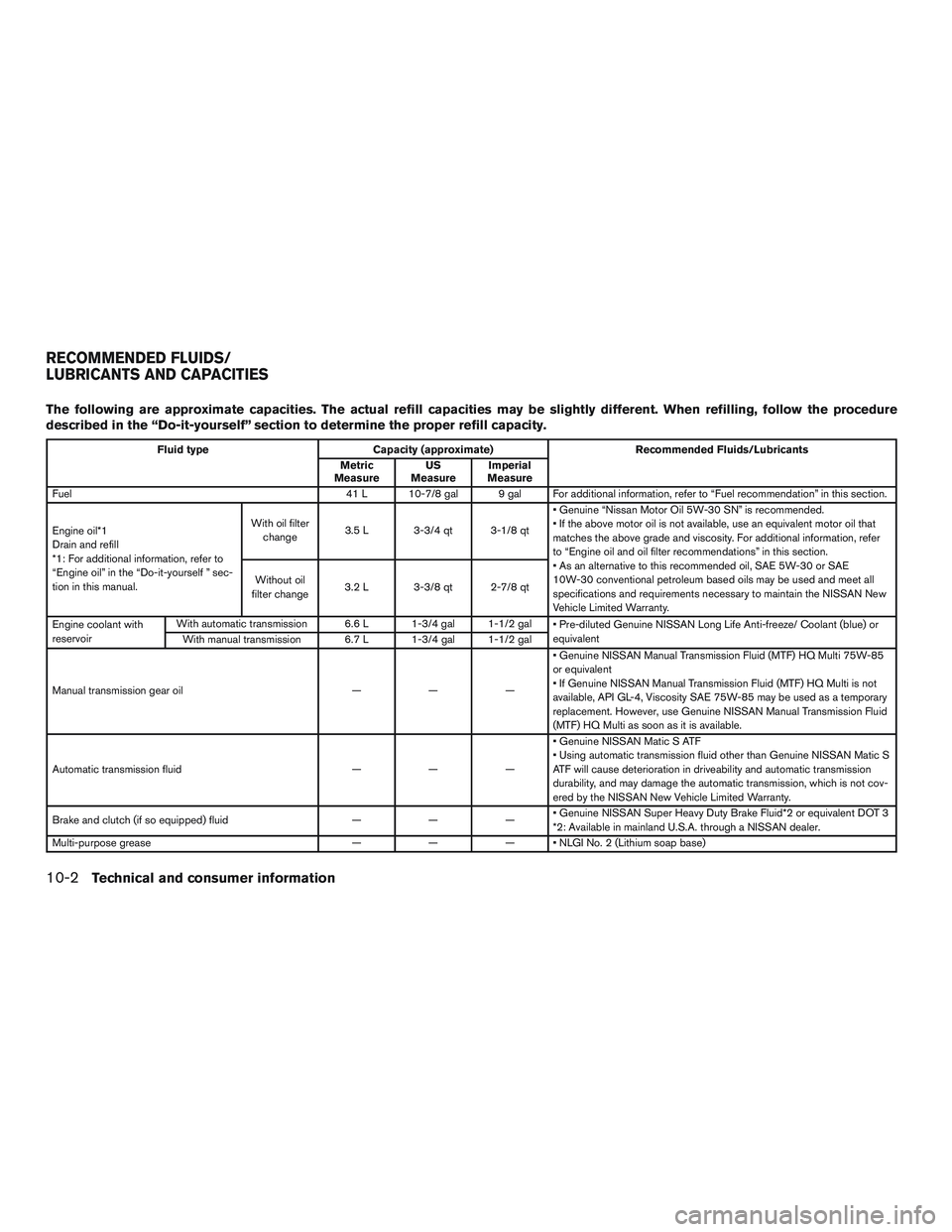
The following are approximate capacities. The actual refill capacities may be slightly different. When refilling, follow the procedure
described in the “Do-it-yourself” section to determine the proper refill capacity.
Fluid typeCapacity (approximate) Recommended Fluids/Lubricants
Metric
Measure US
Measure Imperial
Measure
Fuel 41 L 10-7/8 gal 9 gal For additional information, refer to “Fuel recommendation” in this section.
Engine oil*1
Drain and refill
*1: For additional information, refer to
“Engine oil” in the “Do-it-yourself ” sec-
tion in this manual. With oil filter
change 3.5 L 3-3/4 qt 3-1/8 qt • Genuine “Nissan Motor Oil 5W-30 SN” is recommended.
• If the above motor oil is not available, use an equivalent motor oil that
matches the above grade and viscosity. For additional information, refer
to “Engine oil and oil filter recommendations” in this section.
• As an alternative to this recommended oil, SAE 5W-30 or SAE
10W-30 conventional petroleum based oils may be used and meet all
specifications and requirements necessary to maintain the NISSAN New
Vehicle Limited Warranty.
Without oil
filter change 3.2 L 3-3/8 qt 2-7/8 qt
Engine coolant with
reservoir With automatic transmission 6.6 L 1-3/4 gal 1-1/2 gal
• Pre-diluted Genuine NISSAN Long Life Anti-freeze/ Coolant (blue) or
equivalent
With manual transmission 6.7 L 1-3/4 gal 1-1/2 gal
Manual transmission gear oil ———• Genuine NISSAN Manual Transmission Fluid (MTF) HQ Multi 75W-85
or equivalent
• If Genuine NISSAN Manual Transmission Fluid (MTF) HQ Multi is not
available, API GL-4, Viscosity SAE 75W-85 may be used as a temporary
replacement. However, use Genuine NISSAN Manual Transmission Fluid
(MTF) HQ Multi as soon as it is available.
Automatic transmission fluid ———• Genuine NISSAN Matic S ATF
• Using automatic transmission fluid other than Genuine NISSAN Matic S
ATF will cause deterioration in driveability and automatic transmission
durability, and may damage the automatic transmission, which is not cov-
ered by the NISSAN New Vehicle Limited Warranty.
Brake and clutch (if so equipped) fluid ———• Genuine NISSAN Super Heavy Duty Brake Fluid*2 or equivalent DOT 3
*2: Available in mainland U.S.A. through a NISSAN dealer.
Multi-purpose grease ——— • NLGI No. 2 (Lithium soap base)
RECOMMENDED FLUIDS/
LUBRICANTS AND CAPACITIES
10-2Technical and consumer information
Page 294 of 318
●E-15 fuel contains more than 10% oxy-
genate. E-15 fuel will adversely affect
the emission control devices and sys-
tems of the vehicle and should not be
used. Damage caused by such fuel is
not covered by the NISSAN New Ve-
hicle Limited Warranty.
● If a methanol blend is used, it should
contain no more than 5% methanol
(methyl alcohol, wood alcohol) . It
should also contain a suitable amount
of appropriate cosolvents and corro-
sion inhibitors. If not properly formu-
lated with appropriate cosolvents and
corrosion inhibitors, such methanol
blends may cause fuel system damage
and/or vehicle performance problems.
At this time, sufficient data is not avail-
able to ensure that all methanol blends
are suitable for use in NISSAN ve-
hicles.
If any driveability problems such as engine stall-
ing and difficult hot-starting are experienced after
using oxygenate-blend fuels, immediately
change to a non-oxygenate fuel or a fuel with a
low blend of MTBE.
Take care not to spill gasoline during refu-
eling. Gasoline containing oxygenates can
cause paint damage.E–15 fuel
E-15 fuel is a mixture of approximately 15% fuel
ethanol and 85% unleaded gasoline. E-15 can
only be used in vehicles designed to run on E-15
fuel. Do not use E-15 in your vehicle. U.S. gov-
ernment regulations require fuel ethanol dispens-
ing pumps to be identified with small, square,
orange and black label with the common abbre-
viation or the appropriate percentage for that
region.
E–85 fuel
E-85 fuel is a mixture of approximately 85% fuel
ethanol and 15% unleaded gasoline. E-85 can
only be used in a Flexible Fuel Vehicle (FFV) . Do
not use E-85 in your vehicle. U.S. government
regulations require fuel ethanol dispensing
pumps to be identified by a small, square, orange
and black label with the common abbreviation or
the appropriate percentage for that region.
Fuel containing MMT
MMT, or methylcyclopentadienyl manganese tri-
carbonyl, is an octane boosting additive. NISSAN
does not recommend the use of fuel containing
MMT. Such fuel may adversely affect vehicle per-
formance, including the emissions control sys-
tem. Note that while some fuel pumps label MMT
content, not all do, so you may have to consult
your gasoline retailer for more details.
Aftermarket fuel additives
NISSAN does not recommend the use of any
aftermarket fuel additives (for example, fuel injec-
tor cleaner, octane booster, intake valve deposit
removers, etc.) which are sold commercially.
Many of these additives intended for gum, varnish
or deposit removal may contain active solvents or
similar ingredients that can be harmful to the fuel
system and engine.
Octane rating tips
Using unleaded gasoline with an octane
rating lower than recommended can cause
persistent, heavy “spark knock.” (“Spark
knock” is a metallic rapping noise.) If se-
vere, this can lead to engine damage. If you
detect a persistent heavy spark knock even
when using gasoline of the stated octane
rating, or if you hear steady spark knock
while holding a steady speed on level
roads, it is recommended that you have a
NISSAN dealer correct the condition. Fail-
ure to correct the condition is misuse of the
vehicle, for which NISSAN is not respon-
sible.
Technical and consumer information10-5
Page 295 of 318
Incorrect ignition timing may result in spark
knock, after-run and/or overheating, which may
cause excessive fuel consumption or engine
damage. If any of the above symptoms are en-
countered, have your vehicle checked. It is rec-
ommended that you visit a NISSAN dealer for
servicing.
However, now and then you may notice
light spark knock for a short time while
accelerating or driving up hills. This is not a
cause for concern, because you get the
greatest fuel benefit when there is light
spark knock for a short time under heavy
engine load.
ENGINE OIL AND OIL FILTER
RECOMMENDATIONS
Selecting the correct oil
It is essential to choose the correct grade, quality
and viscosity engine oil to ensure satisfactory
engine life and performance. For additional infor-
mation, refer to “Recommended fluids/lubricants
and capacities” in this section. NISSAN recom-
mends the use of an energy conserving oil in
order to improve fuel economy.
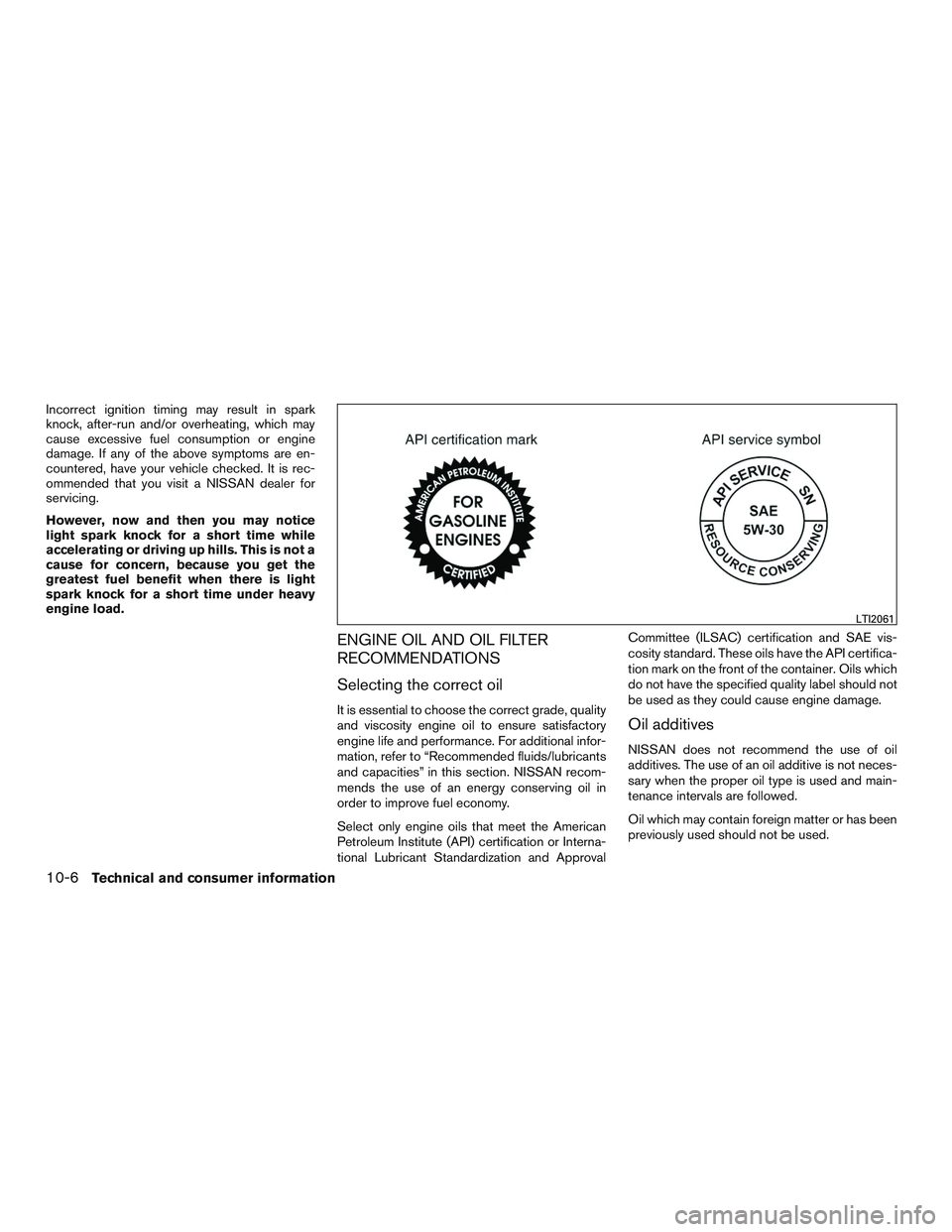
Select only engine oils that meet the American
Petroleum Institute (API) certification or Interna-
tional Lubricant Standardization and ApprovalCommittee (ILSAC) certification and SAE vis-
cosity standard. These oils have the API certifica-
tion mark on the front of the container. Oils which
do not have the specified quality label should not
be used as they could cause engine damage.Oil additives
NISSAN does not recommend the use of oil
additives. The use of an oil additive is not neces-
sary when the proper oil type is used and main-
tenance intervals are followed.
Oil which may contain foreign matter or has been
previously used should not be used.
LTI2061
10-6Technical and consumer information
Page 296 of 318
Oil viscosity
The engine oil viscosity or thickness changes
with temperature. Because of this, it is important
to select the engine oil viscosity based on the
temperatures at which the vehicle will be oper-
ated before the next oil change. Choosing an oil
viscosity other than that recommended could
cause serious engine damage.
Selecting the correct oil filter
Your new NISSAN vehicle is equipped with a
high-quality Genuine NISSAN oil filter. When
replacing, use a Genuine NISSAN oil filter or its
equivalent for the reason described in “Change
intervals.”
Change intervals
The oil and oil filter change intervals for your
engine are based on the use of the specified
quality oils and filters. Using engine oil and filters
that are not of the specified quality, or exceeding
recommended oil and filter change intervals
could reduce engine life. Damage to the engine
caused by improper maintenance or use of incor-
rect oil and filter quality and/or viscosity is not
covered by the NISSAN New Vehicle Limited
Warranty.Your engine was filled with a high-quality engine
oil when it was built. You do not have to change
the oil before the first recommended change
interval. Oil and filter change intervals depend
upon how you use your vehicle.
Operation under the following conditions may
require more frequent oil and filter changes:
● repeated short distance driving at cold out-
side temperatures
● driving in dusty conditions
● extensive idling
● towing a trailer
● stop and go commuting
For additional information, refer to the “Mainte-
nance and schedules” section of this manual.
AIR CONDITIONER SYSTEM (if so
equipped) REFRIGERANT AND OIL
RECOMMENDATIONS
The air conditioner system in your NISSAN
vehicle must be charged with the refriger-
ant HFC-134a (R-134a) and the oil, NISSAN
A/C system oil Type DH-PR or the exact
equivalents.
CAUTION
The use of any other refrigerant or oil will
cause severe damage to the air condition-
ing system and will require the replace-
ment of all air conditioner system
components.
The refrigerant HFC-134a (R-134a) in your
NISSAN vehicle does not harm the earth’s ozone
layer. Although this refrigerant does not affect the
earth’s atmosphere, certain government regula-
tions require the recovery and recycling of any
refrigerant during automotive air conditioner sys-
tem service. A NISSAN dealer has the trained
technicians and equipment needed to recover
and recycle your air conditioner system refriger-
ant.
It is recommended that you visit a NISSAN dealer
when servicing your air conditioner system.
Technical and consumer information10-7
Page 297 of 318
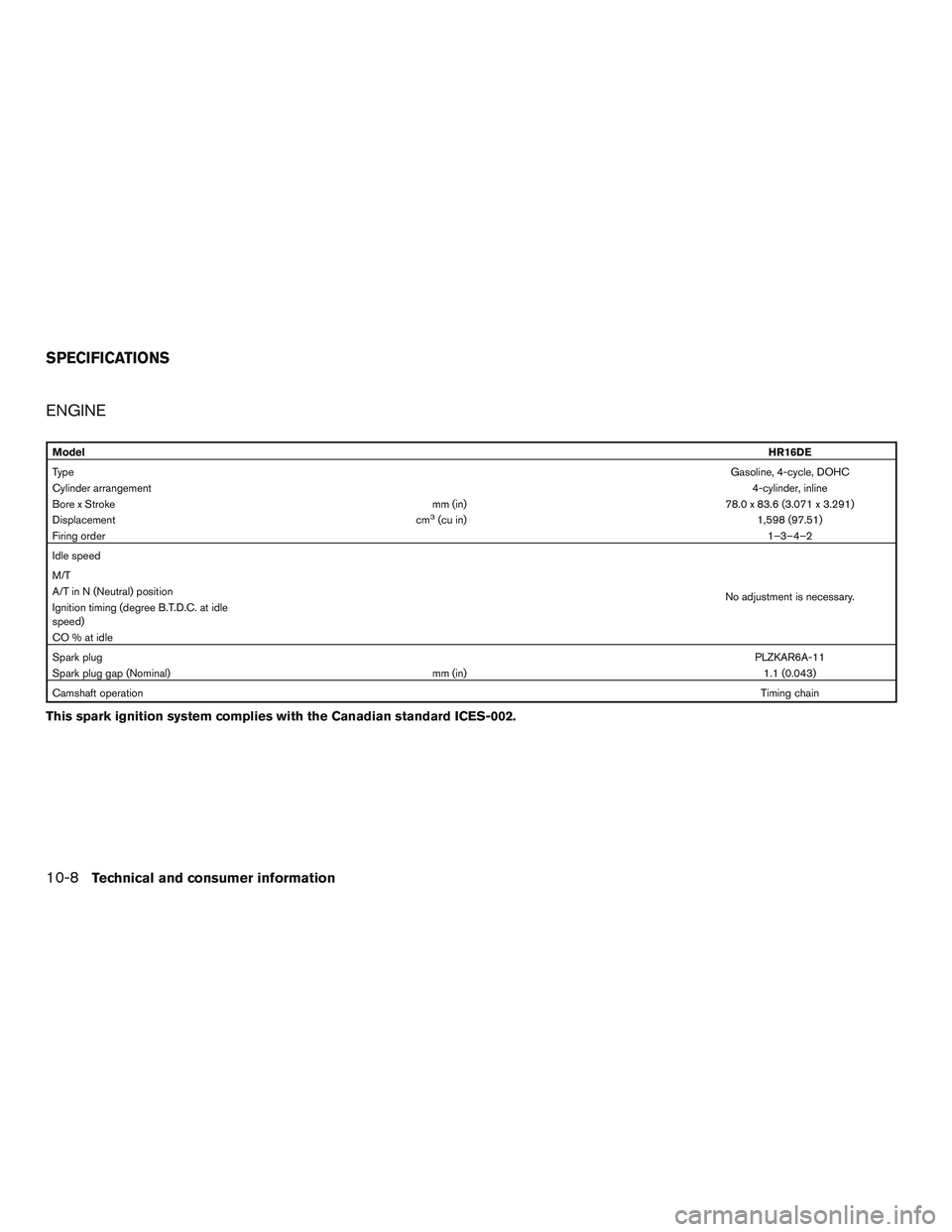
ENGINE
ModelHR16DE
Type Gasoline, 4-cycle, DOHC
Cylinder arrangement 4-cylinder, inline
Bore x Stroke mm (in)78.0 x 83.6 (3.071 x 3.291)
Displacement cm
3(cu in)1,598 (97.51)
Firing order 1–3–4–2
Idle speed
No adjustment is necessary.
M/T
A/T in N (Neutral) position
Ignition timing (degree B.T.D.C. at idle
speed)
CO%atidle
Spark plug
PLZKAR6A-11
Spark plug gap (Nominal) mm (in)1.1 (0.043)
Camshaft operation Timing chain
This spark ignition system complies with the Canadian standard ICES-002.
SPECIFICATIONS
10-8Technical and consumer information