flat tire NISSAN MURANO 2008 User Guide
[x] Cancel search | Manufacturer: NISSAN, Model Year: 2008, Model line: MURANO, Model: NISSAN MURANO 2008Pages: 444, PDF Size: 6.09 MB
Page 347 of 444
Black plate (19,1)
6 In case of emergency
Model "Z51-D" EDITED: 2008/ 6/ 23
Flat tire............................................................ 6-2
Tire Pressure Monitoring System (TPMS)............. 6-2
Changing a flat tire......................................... 6-2
Jump starting.................................................... 6-9
Push starting................................................... 6-10If your vehicle overheats..................................... 6-11
Towing your vehicle.......................................... 6-12
Towing recommended by NISSAN................... 6-13
Vehicle recovery (freeing a stuck vehicle)........... 6-15
Page 348 of 444
Black plate (346,1)
Model "Z51-D" EDITED: 2008/ 6/ 26
TIRE PRESSURE MONITORING SYS-
TEM (TPMS)This vehicle is equipped with the Tire Pressure
Monitoring System (TPMS) . It monitors tire
pressure of all tires except the spare. When
the low tire pressure warning light is lit, one or
more of your tires is significantly under-inflated.
If the vehicle is being driven with low tire
pressure, the TPMS will activate and warn you
of it by the low tire pressure warning light. This
system will activate only when the vehicle is
driven at speeds above 16 MPH (25 km/h) . For
more details, see “WARNING/INDICATOR
LIGHTS AND AUDIBLE REMINDERS” in the
“2. Instruments and controls” section and “TIRE
PRESSURE MONITORING SYSTEM (TPMS)”
in the “5. Starting and driving” section.
WARNING
.If the low tire pressure warning light
illuminates while driving, avoid sud-
den steering maneuvers or abrupt
braking, reduce vehicle speed, pull
off the road to a safe location and
stop the vehicle as soon as possi-
ble. Driving with under-inflated tires
may permanently damage the tires
and increase the likelihood of tire
failure. Serious vehicle damagecould occur and may lead to an
accident and could result in serious
personal injury. Check the tire pres-
sure for all four tires. Adjust the tire
pressure to the recommended COLD
tire pressure shown on the Tire and
Loading Information label to turn
the low tire pressure warning light
OFF. If you have a flat tire, replace it
with a spare tire as soon as possi-
ble.
.When a spare tire is mounted or a
wheel is replaced, the TPMS will not
function and the low tire pressure
warning light will flash for approxi-
mately 1 minute. The light will
remain on after 1 minute. Contact
your NISSAN dealer as soon as
possible for tire replacement and/
or system resetting.
.Replacing tires with those not ori-
ginally specified by NISSAN could
affect the proper operation of the
TPMS.
.Do not inject any tire liquid or
aerosol tire sealant into the tires,
as this may cause a malfunction of
the tire pressure sensors.
CHANGING A FLAT TIREIf you have a flat tire, follow the instructions
below.Stopping the vehicle1. Safely move the vehicle off the road and
away from traffic.
2. Turn on the hazard warning flashers.
3. Park on a level surface and apply the parking
brake. Move the selector lever to the P
(Park) position.
4. Turn off the engine.
5. Raise the hood to warn other traffic, and to
signal professional road assistance person-
nel that you need assistance.
6. Have all passengers get out of the vehicle
and stand in a safe place, away from traffic
and clear of the vehicle.
WARNING
.Make sure the parking brake is
securely applied and the transmis-
sion is shifted into the P (Park)
position.
.Never change tires when the vehicle
is on a slope, ice or slippery areas.
This is hazardous.
FLAT TIRE6-2
In case of emergency
Page 349 of 444
Black plate (347,1)
Model "Z51-D" EDITED: 2008/ 6/ 26
.Never change tires if oncoming
traffic is close to your vehicle. Wait
for professional road assistance.
MCE0001A
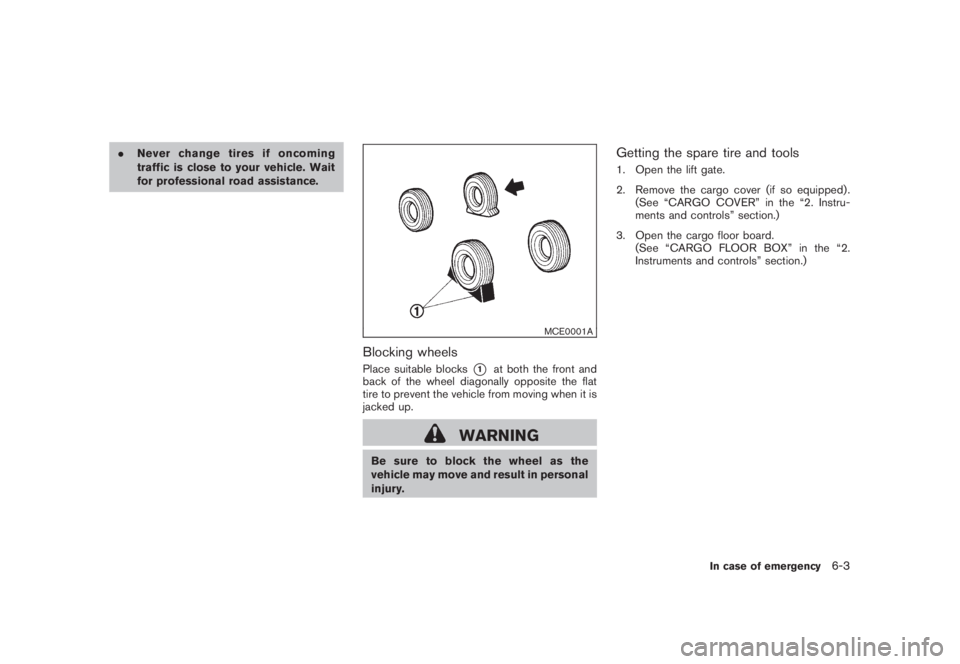
Blocking wheelsPlace suitable blocks
*1
at both the front and
back of the wheel diagonally opposite the flat
tire to prevent the vehicle from moving when it is
jacked up.
WARNING
Be sure to block the wheel as the
vehicle may move and result in personal
injury.
Getting the spare tire and tools1. Open the lift gate.
2. Remove the cargo cover (if so equipped) .
(See “CARGO COVER” in the “2. Instru-
ments and controls” section.)
3. Open the cargo floor board.
(See “CARGO FLOOR BOX” in the “2.
Instruments and controls” section.)
In case of emergency
6-3
Page 354 of 444
Black plate (352,1)
Model "Z51-D" EDITED: 2008/ 6/ 26
than 2 times, until they are tight.
4. Lower the vehicle slowly until the tire
touches the ground. Then, with the wheel
nut wrench, tighten the wheel nuts securely
in the sequence as illustrated. Lower the
vehicle completely.
WARNING
.Incorrect wheel nuts or improperly
tightened wheel nuts can cause the
wheel to become loose or come off.
This could cause an accident.
.Do not use oil or grease on the
wheel studs or nuts. This could
cause the nuts to become loose.
.Retighten the wheel nuts when the
vehicle has been driven for 600
miles (1,000 km) (also in cases of a
flat tire, etc.) .
.As soon as possible, tighten the
wheel nuts to the specified torque
with a torque wrench.
Wheel nut tightening torque:
80 ft-lb (108 N·m)
The wheel nuts must be kept tightened
to specification at all times. It is
recommended that wheel nuts be tigh-tened to specifications at each lubrica-
tion interval.
.Adjust tire pressure to the COLD
pressure.
COLD pressure:
After the vehicle has been parked for
three hours or more or driven less than
1 mile (1.6 km) .
COLD tire pressures are shown on the
Tire and Loading Information label
affixed to the driver side center pillar.
Stowing the damaged tire and the tools1. Securely store the damaged tire, jack and
tools in the storage area.
2. Replace the cargo box.
3. Close the cargo floor board.
4. Close the lift gate.
WARNING
.Always make sure that the spare tire
and jacking equipment are properly
secured after use. Such items can
become dangerous projectiles in an
accident or sudden stop.
.The T-type spare tire and small sizespare tire are designed for emer-
gency use. See specific instructions
under the heading “WHEELS AND
TIRES” in the “8. Maintenance and
do-it-yourself” section.
6-8
In case of emergency
Page 398 of 444
Black plate (396,1)
Model "Z51-D" EDITED: 2008/ 6/ 26
If you have a flat tire, see “FLAT TIRE” in
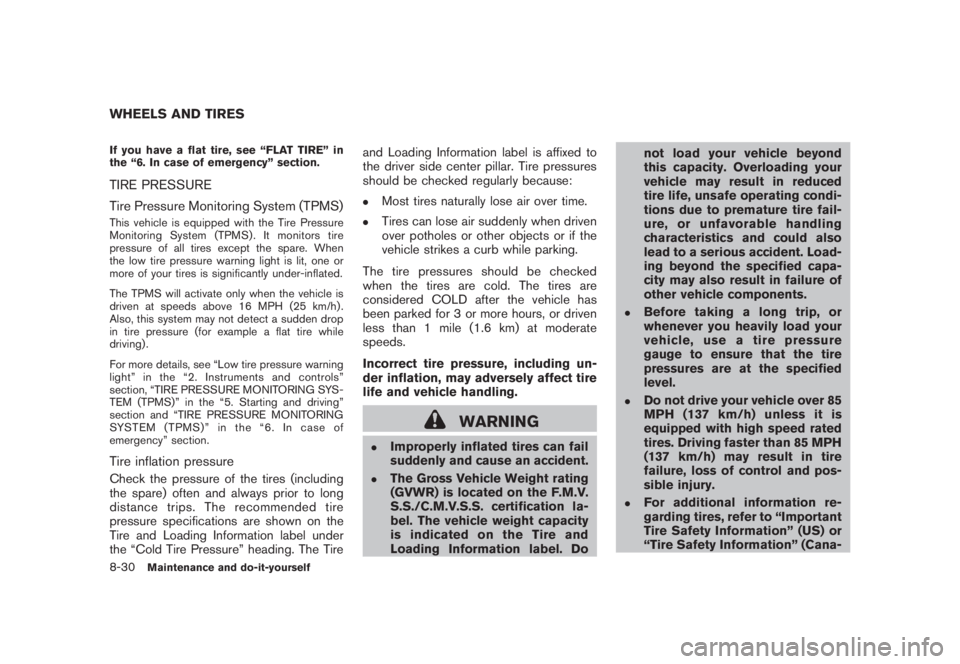
the “6. In case of emergency” section.TIRE PRESSURE
Tire Pressure Monitoring System (TPMS)This vehicle is equipped with the Tire Pressure
Monitoring System (TPMS) . It monitors tire
pressure of all tires except the spare. When
the low tire pressure warning light is lit, one or
more of your tires is significantly under-inflated.
The TPMS will activate only when the vehicle is
driven at speeds above 16 MPH (25 km/h) .
Also, this system may not detect a sudden drop
in tire pressure (for example a flat tire while
driving) .
For more details, see “Low tire pressure warning
light” in the “2. Instruments and controls”
section, “TIRE PRESSURE MONITORING SYS-
TEM (TPMS)” in the “5. Starting and driving”
section and “TIRE PRESSURE MONITORING
SYSTEM (TPMS)” in the “6. In case of
emergency” section.Tire inflation pressureCheck the pressure of the tires (including
the spare) often and always prior to long
distance trips. The recommended tire
pressure specifications are shown on the
Tire and Loading Information label under
the “Cold Tire Pressure” heading. The Tireand Loading Information label is affixed to
the driver side center pillar. Tire pressures
should be checked regularly because:
.
Most tires naturally lose air over time.
.
Tires can lose air suddenly when driven
over potholes or other objects or if the
vehicle strikes a curb while parking.
The tire pressures should be checked
when the tires are cold. The tires are
considered COLD after the vehicle has
been parked for 3 or more hours, or driven
less than 1 mile (1.6 km) at moderate
speeds.
Incorrect tire pressure, including un-
der inflation, may adversely affect tire
life and vehicle handling.
WARNING
.
Improperly inflated tires can fail
suddenly and cause an accident.
.
The Gross Vehicle Weight rating
(GVWR) is located on the F.M.V.
S.S./C.M.V.S.S. certification la-
bel. The vehicle weight capacity
is indicated on the Tire and
Loading Information label. Donot load your vehicle beyond
this capacity. Overloading your
vehicle may result in reduced
tire life, unsafe operating condi-
tions due to premature tire fail-
ure, or unfavorable handling
characteristics and could also
lead to a serious accident. Load-
ing beyond the specified capa-
city may also result in failure of
other vehicle components.
.
Before taking a long trip, or
whenever you heavily load your
vehicle, use a tire pressure
gauge to ensure that the tire
pressures are at the specified
level.
.
Do not drive your vehicle over 85
MPH (137 km/h) unless it is
equipped with high speed rated
tires. Driving faster than 85 MPH
(137 km/h) may result in tire
failure, loss of control and pos-
sible injury.
.
For additional information re-
garding tires, refer to “Important
Tire Safety Information” (US) or
“Tire Safety Information” (Cana-
WHEELS AND TIRES8-30
Maintenance and do-it-yourself
Page 400 of 444
Black plate (398,1)
Model "Z51-D" EDITED: 2008/ 6/ 26
*4
Cold tire pressure: Inflate the tires to
this pressure when the tires are cold.
Tires are considered COLD after the
vehicle has been parked for 3 or
more hours, or driven less than 1 mile
(1.6 km) at moderate speeds. The
recommended cold tire inflation is set
by the manufacturer to provide the
best balance of tire wear, vehicle
handling, driveability, tire noise, etc.,
up to the vehicle’s GVWR.
*5
Tire size — see “
TIRE LABELING”
later in this section.
*6
Spare tire size or compact spare tire
size (if so equipped)
SDI1949
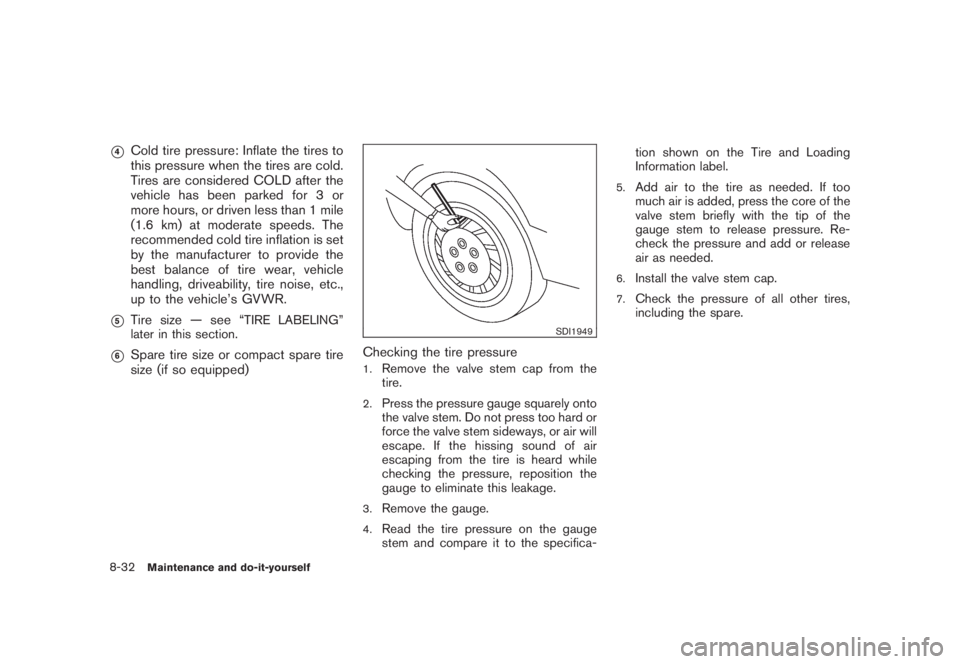
Checking the tire pressure1.
Remove the valve stem cap from the
tire.
2.
Press the pressure gauge squarely onto
the valve stem. Do not press too hard or
force the valve stem sideways, or air will
escape. If the hissing sound of air
escaping from the tire is heard while
checking the pressure, reposition the
gauge to eliminate this leakage.
3.
Remove the gauge.
4.
Read the tire pressure on the gauge
stem and compare it to the specifica-tion shown on the Tire and Loading
Information label.
5.
Add air to the tire as needed. If too
much air is added, press the core of the
valve stem briefly with the tip of the
gauge stem to release pressure. Re-
check the pressure and add or release
air as needed.
6.
Install the valve stem cap.
7.
Check the pressure of all other tires,
including the spare.
8-32
Maintenance and do-it-yourself
Page 401 of 444
Black plate (399,1)
Model "Z51-D" EDITED: 2008/ 6/ 26
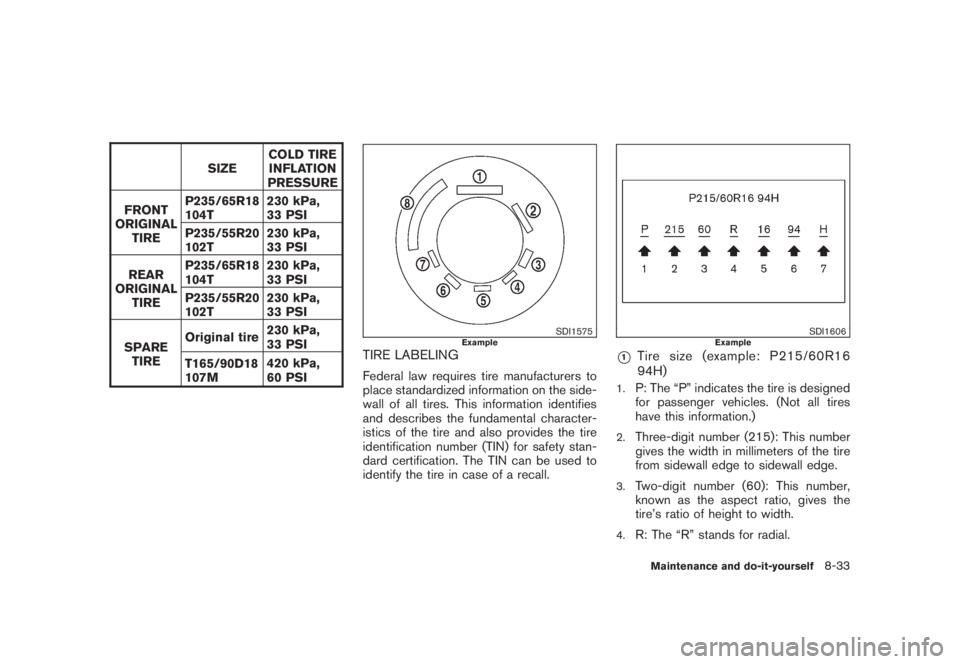
SIZECOLD TIRE
INFLATION
PRESSURE
FRONT
ORIGINAL
TIREP235/65R18
104T230 kPa,
33 PSI
P235/55R20
102T230 kPa,
33 PSI
REAR
ORIGINAL
TIREP235/65R18
104T230 kPa,
33 PSI
P235/55R20
102T230 kPa,
33 PSI
SPARE
TIREOriginal tire230 kPa,
33 PSI
T165/90D18
107M420 kPa,
60 PSI
SDI1575
Example
TIRE LABELINGFederal law requires tire manufacturers to
place standardized information on the side-
wall of all tires. This information identifies
and describes the fundamental character-
istics of the tire and also provides the tire
identification number (TIN) for safety stan-
dard certification. The TIN can be used to
identify the tire in case of a recall.
SDI1606
Example
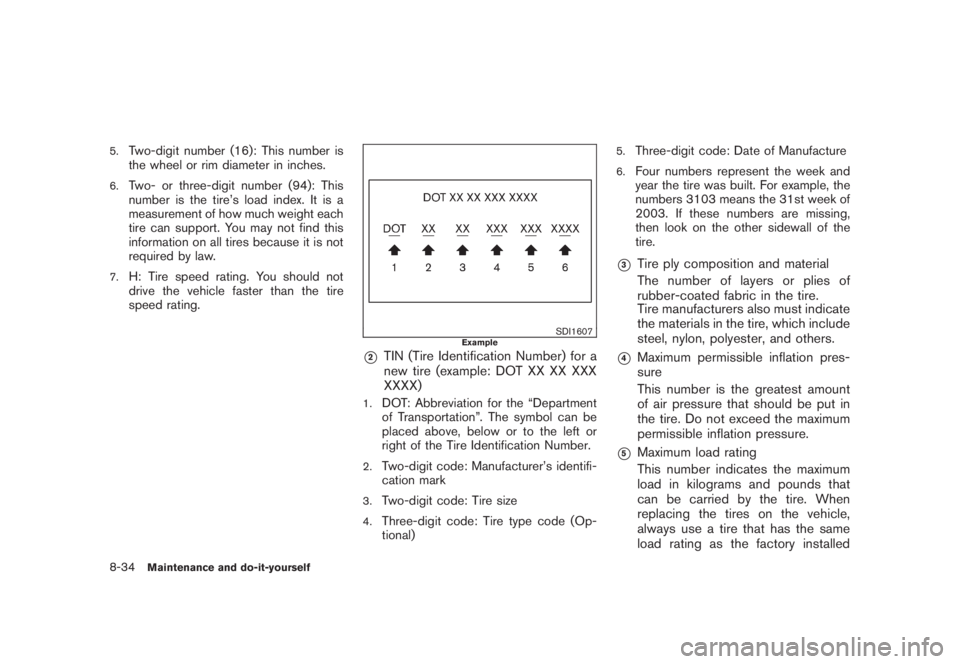
*1
Tire size (example: P215/60R16
94H)
1.
P: The “P” indicates the tire is designed
for passenger vehicles. (Not all tires
have this information.)
2.
Three-digit number (215): This number
gives the width in millimeters of the tire
from sidewall edge to sidewall edge.
3.
Two-digit number (60): This number,
known as the aspect ratio, gives the
tire’s ratio of height to width.
4.
R: The “R” stands for radial.
Maintenance and do-it-yourself
8-33
Page 402 of 444
Black plate (400,1)
Model "Z51-D" EDITED: 2008/ 6/ 26
5.
Two-digit number (16): This number is
the wheel or rim diameter in inches.
6.
Two- or three-digit number (94): This
number is the tire’s load index. It is a
measurement of how much weight each
tire can support. You may not find this
information on all tires because it is not
required by law.
7.
H: Tire speed rating. You should not
drive the vehicle faster than the tire
speed rating.
SDI1607
Example
*2
TIN (Tire Identification Number) for a
new tire (example: DOT XX XX XXX
XXXX)
1.
DOT: Abbreviation for the “Department
of Transportation”. The symbol can be
placed above, below or to the left or
right of the Tire Identification Number.
2.
Two-digit code: Manufacturer’s identifi-
cation mark
3.
Two-digit code: Tire size
4.
Three-digit code: Tire type code (Op-
tional)
5.
Three-digit code: Date of Manufacture
6.
Four numbers represent the week and
year the tire was built. For example, the
numbers 3103 means the 31st week of
2003. If these numbers are missing,
then look on the other sidewall of the
tire.
*3
Tire ply composition and material
The number of layers or plies of
rubber-coated fabric in the tire.
Tire manufacturers also must indicate
the materials in the tire, which include
steel, nylon, polyester, and others.
*4
Maximum permissible inflation pres-
sure
This number is the greatest amount
of air pressure that should be put in
the tire. Do not exceed the maximum
permissible inflation pressure.
*5
Maximum load rating
This number indicates the maximum
load in kilograms and pounds that
can be carried by the tire. When
replacing the tires on the vehicle,
always use a tire that has the same
load rating as the factory installed
8-34
Maintenance and do-it-yourself
Page 405 of 444
Black plate (403,1)
Model "Z51-D" EDITED: 2008/ 6/ 26
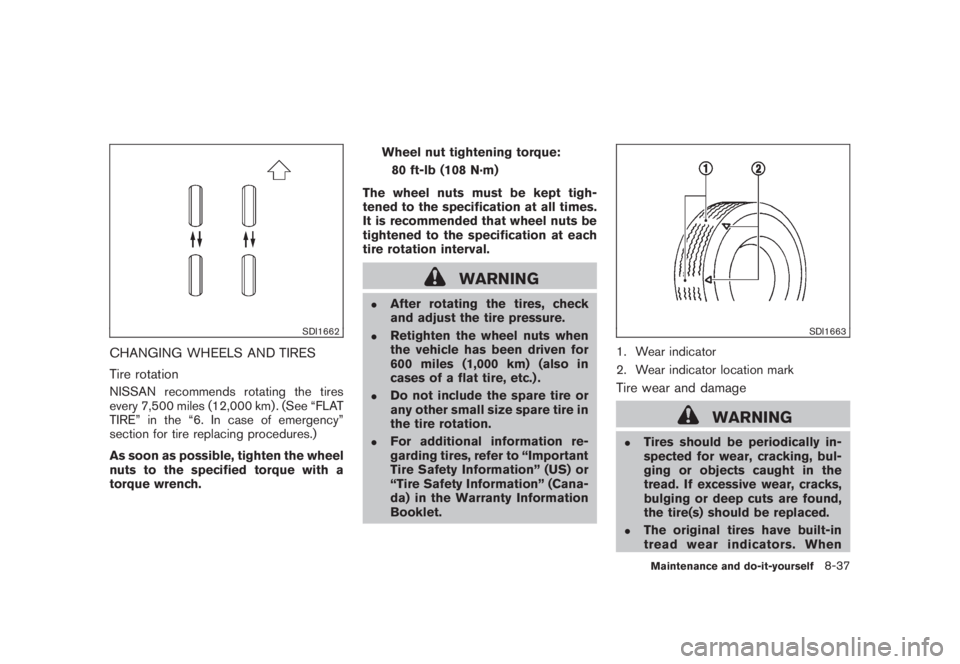
SDI1662
CHANGING WHEELS AND TIRES
Tire rotationNISSAN recommends rotating the tires
every 7,500 miles (12,000 km) . (See “FLAT
TIRE” in the “6. In case of emergency”
section for tire replacing procedures.)
As soon as possible, tighten the wheel
nuts to the specified torque with a
torque wrench.Wheel nut tightening torque:
80 ft-lb (108 N·m)
The wheel nuts must be kept tigh-
tened to the specification at all times.
It is recommended that wheel nuts be
tightened to the specification at each
tire rotation interval.
WARNING
.
After rotating the tires, check
and adjust the tire pressure.
.
Retighten the wheel nuts when
the vehicle has been driven for
600 miles (1,000 km) (also in
cases of a flat tire, etc.) .
.
Do not include the spare tire or
any other small size spare tire in
the tire rotation.
.
For additional information re-
garding tires, refer to “Important
Tire Safety Information” (US) or
“Tire Safety Information” (Cana-
da) in the Warranty Information
Booklet.
SDI1663
1. Wear indicator
2. Wear indicator location markTire wear and damage
WARNING
.
Tires should be periodically in-
spected for wear, cracking, bul-
ging or objects caught in the
tread. If excessive wear, cracks,
bulging or deep cuts are found,
the tire(s) should be replaced.
.
The original tires have built-in
tread wear indicators. WhenMaintenance and do-it-yourself
8-37
Page 409 of 444
Black plate (28,1)
9 Technical and consumer information
Model "Z51-D" EDITED: 2008/ 6/ 23
Capacities and recommended fuel/lubricants............ 9-2
Fuel recommendation...................................... 9-3
Engine oil and oil filter recommendation............... 9-5
Air conditioning system refrigerant and lubricant
recommendations........................................... 9-6
Specifications.................................................... 9-7
Engine......................................................... 9-7
Wheels and tires............................................ 9-7
Dimensions and weights.................................. 9-8
When traveling or registering your vehicle in
another country.................................................. 9-8
Vehicle identification........................................... 9-8
Vehicle identification number (VIN) plate.............. 9-8
Vehicle identification number (chassis number)...... 9-9
Engine serial number...................................... 9-9
F.M.V.S.S./C.M.V.S.S. certification label............... 9-9
Emission control information label.................... 9-10
Tire and loading information label..................... 9-10
Air conditioner specification label..................... 9-10
Installing front license plate................................ 9-11
Vehicle loading information................................. 9-12
Terms........................................................ 9-12Vehicle load capacity.................................... 9-12
Securing the load......................................... 9-14
Loading tips................................................ 9-15
Measurement of weights................................ 9-15
Towing a trailer................................................ 9-15
Maximum load limits...................................... 9-16
Maximum Gross Vehicle Weight (GVW)/
maximum Gross Axle Weight (GAW)................ 9-17
Towing load/specification............................... 9-19
Towing safety.............................................. 9-19
Flat towing................................................. 9-23
Uniform tire quality grading................................. 9-24
Treadwear.................................................. 9-24
Traction AA, A, B and C................................ 9-24
Temperature A, B and C................................ 9-24
Emission control system warranty......................... 9-25
Reporting safety defects (US only)....................... 9-25
Readiness for Inspection/Maintenance (I/M) test . ..... 9-25
Event data recorders (EDR)................................ 9-26
Owner’s Manual/Service Manual order information . . . 9-27
In the event of a collision............................... 9-27