service NISSAN MURANO 2008 Owner's Guide
[x] Cancel search | Manufacturer: NISSAN, Model Year: 2008, Model line: MURANO, Model: NISSAN MURANO 2008Pages: 444, PDF Size: 6.09 MB
Page 387 of 444
Black plate (385,1)
Model "Z51-D" EDITED: 2008/ 6/ 26
Contact a NISSAN dealer if checking or
replacement is required.If the brakes do not operate properly, have the
brakes checked by a NISSAN dealer.
SELF-ADJUSTING BRAKESYour vehicle is equipped with self-adjusting
brakes.
The disc-type brakes self-adjust every time the
brake pedal is applied.
WARNING
See a NISSAN dealer for a brake
system check if the brake pedal height
does not return to normal.BRAKE PAD WEAR INDICATORSThe disc brake pads on your vehicle have
audible wear indicators. When a brake pad
requires replacement, it will make a high pitched
scraping or screeching sound when the vehicle
is in motion. The sound will be heard whether or
not the brake pedal is depressed. Have the
brakes checked as soon as possible if the wear
indicator sound is heard.
Under some driving or climate conditions,
occasional brake squeak, squeal or other noise
may be heard. Occasional brake noise during
light to moderate stops is normal and does not
affect the function or performance of the brake
system.Proper brake inspection intervals should
be followed.For additional information, see the
maintenance log section of your “NISSAN
Service and Maintenance Guide”.
REAR WINDOW WIPER BLADE BRAKES
Maintenance and do-it-yourself
8-19
Page 406 of 444
Black plate (404,1)
Model "Z51-D" EDITED: 2008/ 6/ 26
wear indicators are visible, the
tire(s) should be replaced.
.
Tires degrade with age and use.
Have tires, including the spare,
over 6 years old checked by a
qualified technician, because
some tire damage may not be
obvious. Replace the tires as
necessary to prevent tire failure
and possible personal injury.
.
Improper service of the spare
tire may result in serious perso-
nal injury. If it is necessary to
repair the spare tire, contact a
NISSAN dealer.
.
For additional information re-
garding tires, refer to “Important
Tire Safety Information” (US) or
“Tire Safety Information” (Cana-
da) in the Warranty Information
Booklet.
Replacing wheels and tiresWhen replacing a tire, use the same size, tread
design, speed rating and load carrying capacity
as originally equipped. (See “SPECIFICA-
TIONS” in the “9. Technical and consumer
information” section for recommended types
and sizes of tires and wheels.)
WARNING
.The use of tires other than those
recommended or the mixed use of
tires of different brands, construc-
tion (bias, bias-belted or radial) , or
tread patterns can adversely affect
the ride, braking, handling, ground
clearance, body-to-tire clearance,
tire chain clearance, speedometer
calibration, headlight aim and bum-
per height. Some of these effects
may lead to accidents and could
result in serious personal injury.
.If the wheels are changed for any
reason, always replace with wheels
which have the same off-set dimen-
sion. Wheels of a different off-set
could cause premature tire wear,
degrade vehicle handling character-
istics and/or interference with the
brake discs/drums. Such interfer-
ence can lead to decreased braking
efficiency and/or early brake pad/
shoe wear. See “WHEELS AND
TIRES” in the “9. Technical and
consumer information” section of
this manual for wheel off-set dimen-
sions..When a spare tire is mounted or a
wheel is replaced, the TPMS will not
function and the low tire pressure
warning light will flash for approxi-
mately 1 minute. The light will
remain on after 1 minute. Contact
your NISSAN dealer as soon as
possible for tire replacement and/
or system resetting.
.Replacing tires with those not ori-
ginally specified by NISSAN could
affect the proper operation of the
TPMS.
.Do not install a damaged or de-
formed wheel or tire even if it has
been repaired. Such wheels or tires
could have structural damage and
could fail without warning.
.The use of retread tire is not re-
commended.
.For additional information regard-
ing tires, refer to “Important Tire
Safety Information” (US) or “Tire
Safety Information” (Canada) in the
Warranty Information Booklet.
8-38
Maintenance and do-it-yourself
Page 407 of 444
Black plate (405,1)
Model "Z51-D" EDITED: 2008/ 6/ 26
CAUTION
Always use tires of the same type, size,
brand, construction (bias, bias-belted
or radial) , and tread pattern on all four
wheels. Failure to do so may result in a
circumference difference between tires
on the front and rear axles which will
cause excessive tire wear and may
damage the transmission, transfer case
and differential gears (AWD models) .Wheel balanceUnbalanced wheels may affect vehicle handling
and tire life. Even with regular use, wheels can
get out of balance. Therefore, they should be
balanced as required.
Wheel balance service should be per-
formed with the wheels off the vehicle.
Spin balancing the wheels on the vehicle
could lead to mechanical damage.
For additional information regarding tires, refer
to “Important Tire Safety Information” (US) or
“Tire Safety Information” (Canada) in the War-
ranty Information Booklet.Care of wheels.Wash the wheels when washing the vehicle
to maintain their appearance..Clean the inner side of the wheels when the
wheel is changed or the underside of the
vehicle is washed.
.Do not use abrasive cleaners when washing
the wheels.
.Inspect wheel rims regularly for dents or
corrosion. Such damage may cause loss of
pressure or poor seal at the tire bead.
.NISSAN recommends that the road wheels
be waxed to protect against road salt in
areas where it is used during winter.
Spare tireWhen a spare tire is mounted (TEMPORARY
USE ONLY or conventional) , the TPMS will not
function.
Observe the following precautions if the TEM-
PORARY USE ONLY spare tire must be used,
otherwise your vehicle could be damaged or
involved in an accident.
WARNING
.The TEMPORARY USE ONLY spare
tire should be used for emergency
use. It should be replaced with the
standard tire at the first opportunity
to avoid possible tire or differential
damage..Drive carefully while the TEMPOR-
ARY USE ONLY spare tire is in-
stalled. Avoid sharp turns and
abrupt braking while driving.
.Periodically check spare tire infla-
tion pressure. Always keep the
pressure of the TEMPORARY USE
ONLY spare tire at 60 psi (420 kPa,
4.2 bar) . Always keep the pressure
of the full size spare tire (if so
equipped) at the recommended
pressure for standard tires, as in-
dicated on the Tire and Loading
Information label.
.With the TEMPORARY USE ONLY
spare tire installed do not drive your
vehicle at speeds faster than 50
MPH (80 km/h) .
.When driving on roads covered with
snow or ice, the TEMPORARY USE
ONLY spare tire should be used on
the rear wheels and original tire
used on the front wheels (drive
wheels) . Use tire chains only on
the front (original) tires.
.Tire tread of the TEMPORARY USE
ONLY spare tire will wear at a faster
rate than the standard tire. Replace
Maintenance and do-it-yourself
8-39
Page 409 of 444
Black plate (28,1)
9 Technical and consumer information
Model "Z51-D" EDITED: 2008/ 6/ 23
Capacities and recommended fuel/lubricants............ 9-2
Fuel recommendation...................................... 9-3
Engine oil and oil filter recommendation............... 9-5
Air conditioning system refrigerant and lubricant
recommendations........................................... 9-6
Specifications.................................................... 9-7
Engine......................................................... 9-7
Wheels and tires............................................ 9-7
Dimensions and weights.................................. 9-8
When traveling or registering your vehicle in
another country.................................................. 9-8
Vehicle identification........................................... 9-8
Vehicle identification number (VIN) plate.............. 9-8
Vehicle identification number (chassis number)...... 9-9
Engine serial number...................................... 9-9
F.M.V.S.S./C.M.V.S.S. certification label............... 9-9
Emission control information label.................... 9-10
Tire and loading information label..................... 9-10
Air conditioner specification label..................... 9-10
Installing front license plate................................ 9-11
Vehicle loading information................................. 9-12
Terms........................................................ 9-12Vehicle load capacity.................................... 9-12
Securing the load......................................... 9-14
Loading tips................................................ 9-15
Measurement of weights................................ 9-15
Towing a trailer................................................ 9-15
Maximum load limits...................................... 9-16
Maximum Gross Vehicle Weight (GVW)/
maximum Gross Axle Weight (GAW)................ 9-17
Towing load/specification............................... 9-19
Towing safety.............................................. 9-19
Flat towing................................................. 9-23
Uniform tire quality grading................................. 9-24
Treadwear.................................................. 9-24
Traction AA, A, B and C................................ 9-24
Temperature A, B and C................................ 9-24
Emission control system warranty......................... 9-25
Reporting safety defects (US only)....................... 9-25
Readiness for Inspection/Maintenance (I/M) test . ..... 9-25
Event data recorders (EDR)................................ 9-26
Owner’s Manual/Service Manual order information . . . 9-27
In the event of a collision............................... 9-27
Page 411 of 444
Black plate (409,1)
Model "Z51-D" EDITED: 2008/ 6/ 26
FUEL RECOMMENDATIONNISSAN recommends the use of unleaded
premium gasoline with an octane rating of at
least 91 AKI (Anti-Knock Index) number (Re-
search octane number 96) .
If unleaded premium gasoline is not available,
you may use unleaded regular gasoline with an
octane rating of at least 87 AKI number
(Research octane number 91) , but you may
notice a decrease in performance.
CAUTION
.Using a fuel other than that speci-
fied could adversely affect the emis-
sion control system, and may also
affect warranty coverage.
.Under no circumstances should a
leaded gasoline be used, because
this will damage the three-way cat-
alyst.
.Do not use E-85 fuel in your vehicle.
Your vehicle is not designed to run
on E-85 fuel. Using E-85 fuel can
damage the fuel system compo-
nents and is not covered by the
NISSAN new vehicle limited war-
ranty.
Gasoline specificationsNISSAN recommends using gasoline that meets
the World-Wide Fuel Charter (WWFC) speci-
fications where it is available. Many of the
automobile manufacturers developed this spe-
cification to improve emission control system
and vehicle performance. Ask your service
station manager if the gasoline meets the
WWFC specifications.Reformulated gasolineSome fuel suppliers are now producing refor-
mulated gasolines. These gasolines are specially
designed to reduce vehicle emissions. NISSAN
supports efforts towards cleaner air and sug-
gests that you use reformulated gasoline when
available.Gasoline containing oxygenatesSome fuel suppliers sell gasoline containing
oxygenates such as ethanol, MTBE and metha-
nol with or without advertising their presence.
NISSAN does not recommend the use of fuels
of which the oxygenate content and the fuel
compatibility for your NISSAN cannot be readily
determined. If in doubt, ask your service station
manager.
If you use oxygenate-blend gasoline, please take
the following precautions as the usage of such
fuels may cause vehicle performance problems
and/or fuel system damage..The fuel should be unleaded and have
an octane rating no lower than that
recommended for unleaded gasoline.
.If an oxygenate-blend, other than
methanol blend is used, it should
contain no more than 10% oxygenate.
(MTBE may, however, be added up to
15%.)
.If a methanol blend is used, it should
contain no more than 5% methanol
(methyl alcohol, wood alcohol) . It
should also contain a suitable amount
of appropriate cosolvents and corro-
sion inhibitors. If not properly formu-
lated with appropriate cosolvents and
corrosion inhibitors, such methanol
blends may cause fuel system damage
and/or vehicle performance problems.
At this time, sufficient data is not
available to ensure that all methanol
blends are suitable for use in NISSAN
vehicles.
If any driveability problems such as engine
stalling and difficult hot-starting are experienced
after using oxygenate-blend fuels, immediately
change to a non-oxygenate fuel or a fuel with a
low blend of MTBE.
Take care not to spill gasoline during
refueling. Gasoline containing oxygenates
can cause paint damage.
Technical and consumer information
9-3
Page 413 of 444
Black plate (411,1)
Model "Z51-D" EDITED: 2008/ 6/ 26
STI0505
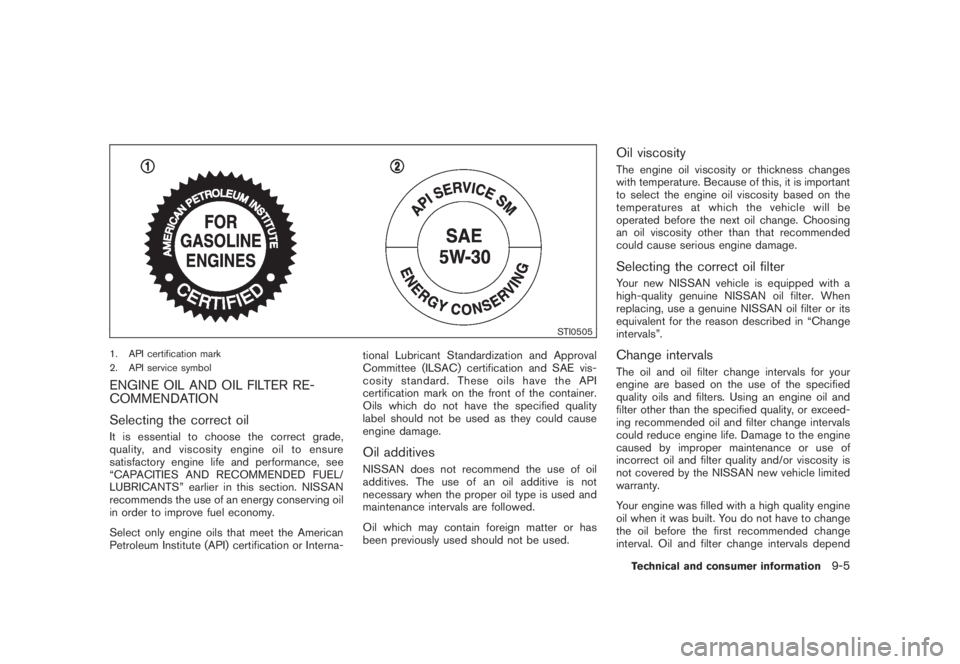
1. API certification mark
2. API service symbolENGINE OIL AND OIL FILTER RE-
COMMENDATION
Selecting the correct oilIt is essential to choose the correct grade,
quality, and viscosity engine oil to ensure
satisfactory engine life and performance, see
“CAPACITIES AND RECOMMENDED FUEL/
LUBRICANTS” earlier in this section. NISSAN
recommends the use of an energy conserving oil
in order to improve fuel economy.
Select only engine oils that meet the American
Petroleum Institute (API) certification or Interna-tional Lubricant Standardization and Approval
Committee (ILSAC) certification and SAE vis-
cosity standard. These oils have the API
certification mark on the front of the container.
Oils which do not have the specified quality
label should not be used as they could cause
engine damage.
Oil additivesNISSAN does not recommend the use of oil
additives. The use of an oil additive is not
necessary when the proper oil type is used and
maintenance intervals are followed.
Oil which may contain foreign matter or has
been previously used should not be used.
Oil viscosityThe engine oil viscosity or thickness changes
with temperature. Because of this, it is important
to select the engine oil viscosity based on the
temperatures at which the vehicle will be
operated before the next oil change. Choosing
an oil viscosity other than that recommended
could cause serious engine damage.Selecting the correct oil filterYour new NISSAN vehicle is equipped with a
high-quality genuine NISSAN oil filter. When
replacing, use a genuine NISSAN oil filter or its
equivalent for the reason described in “Change
intervals”.Change intervalsThe oil and oil filter change intervals for your
engine are based on the use of the specified
quality oils and filters. Using an engine oil and
filter other than the specified quality, or exceed-
ing recommended oil and filter change intervals
could reduce engine life. Damage to the engine
caused by improper maintenance or use of
incorrect oil and filter quality and/or viscosity is
not covered by the NISSAN new vehicle limited
warranty.
Your engine was filled with a high quality engine
oil when it was built. You do not have to change
the oil before the first recommended change
interval. Oil and filter change intervals depend
Technical and consumer information
9-5
Page 414 of 444
Black plate (412,1)
Model "Z51-D" EDITED: 2008/ 6/ 26
upon how you use your vehicle.
Operation under the following conditions may
require more frequent oil and filter changes.
.repeated short distance driving at cold
outside temperatures
.driving in dusty conditions
.extensive idling
.towing a trailer
.stop and go commuting
Refer to the “NISSAN Service and Maintenance
Guide” for the maintenance schedule.AIR CONDITIONING SYSTEM RE-
FRIGERANT AND LUBRICANT RE-
COMMENDATIONSThe air conditioning system in your
NISSAN vehicle must be charged with the
refrigerant HFC-134a (R-134a) and the oil,
NISSAN A/C system oil Type R or the exact
equivalents.
CAUTION
The use of any other refrigerant or oil
will cause severe damage to the air
conditioning system and will require
the replacement of all air conditionersystem components.
The refrigerant HFC-134a (R-134a) in your
NISSAN vehicle will not harm the earth’s ozone
layer. Although this refrigerant does not affect
the earth’s atmosphere, certain governmental
regulations require the recovery and recycling of
any refrigerant during automotive air condition-
ing system service. A NISSAN dealer has the
trained technicians and equipment needed to
recover and recycle your air conditioning system
refrigerant.
Contact a NISSAN dealer when servicing your
air conditioning system.9-6
Technical and consumer information
Page 430 of 444
Black plate (428,1)
Model "Z51-D" EDITED: 2008/ 6/ 26
the wheels and applying the parking
brake, transmission damage could oc-
cur.
1. Apply and hold the brake pedal.
2. Have someone place blocks on the downhill
side of the vehicle and trailer wheels.
3. After the wheel blocks are in place, slowly
release the brake pedal until the blocks
absorb the vehicle load.
4. Apply the parking brake.
5. Shift the transmission into P (Park) .
6. Turn off the engine.
To drive away:
1. Apply and hold the brake pedal.
2. Start the engine.
3. Shift the transmission into gear.
4. Release the parking brake.
5. Drive slowly until the vehicle and trailer are
clear from the blocks.
6. Apply and hold the brake pedal.
7. Have someone retrieve and store the blocks.
.When going down a hill, shift into a lower
gear and use the engine braking effect.When going up a long grade, downshift the
transmission to a lower gear and reduce
speed to reduce chances of engine over-
loading and/or overheating.
.If the engine coolant rises to an extremely
high temperature when the air conditioning
system is on, turn off the air conditioner.
Coolant heat can be additionally vented by
opening the windows, switching the fan
control to high and setting the temperature
control to the HOT position.
.Trailer towing requires more fuel than normal
circumstances.
.Avoid towing a trailer for the first 500 miles
(800 km) .
.Have your vehicle serviced more often than
at intervals specified in the recommended
maintenance schedule in the NISSAN Ser-
vice and Maintenance Guide.
.When making a turn, your trailer wheels will
be closer to the inside of the turn than your
vehicle wheels. To compensate for this,
make a larger than normal turning radius
during the turn.
.Crosswinds and rough roads will adversely
affect vehicle/trailer handling, possibly caus-
ing vehicle sway. When being passed by
larger vehicles, be prepared for possible
changes in crosswinds that could affectvehicle handling. If swaying does occur,
firmly grip the steering wheel, steer straight
ahead, and immediately (but gradually)
reduce vehicle speed. This combination will
help stabilize the vehicle. Never increase
speed.
Do the following if the trailer begins to sway:
1. Take your foot off the accelerator pedal to
allow the vehicle to coast and steer as
straight ahead as the road conditions allow.
This combination will help stabilize the
vehicle.
— Do not correct trailer sway by steering or
applying the brakes.
2. When the trailer sway stops, gently apply
the brakes and pull to the side of the road in
a safe area.
3. Try to rearrange the trailer load so it is
balanced as described earlier in this section.
.Be careful when passing other vehicles.
Passing while towing a trailer requires
considerably more distance than normal
passing. Remember the length of the trailer
must also pass the other vehicle before you
can safely change lanes.
.Down shift the transmission to a lower gear
for engine braking when driving down steep
or long hills. This will help slow the vehicle9-22
Technical and consumer information
Page 432 of 444
Black plate (430,1)
Model "Z51-D" EDITED: 2008/ 6/ 26
DOT (Department Of Transportation) Quality
Grades: All passenger car tires must conform to
federal safety requirements in addition to these
grades.
Quality grades can be found where applicable
on the tire sidewall between tread shoulder and
maximum section width. For example:
Treadwear 200 Traction AA Temperature ATREADWEARThe treadwear grade is a comparative rating
based on the wear rate of the tire when tested
under controlled conditions on a specified
government test course. For example, a tire
graded 150 would wear one and one-half
(1 1/2) times as well on the government course
as a tire graded 100. The relative performance
of tires depends upon actual conditions of their
use, however, and may depart significantly from
the norm due to variations in driving habits,
service practices and differences in road char-
acteristics and climate.TRACTION AA, A, B AND CThe traction grades, from highest to lowest, are
AA, A, B and C. Those grades represent the
tire’s ability to stop on wet pavement as
measured under controlled conditions on spe-
cified government test surfaces of asphalt and
concrete. A tire marked C may have poor
traction performance.
WARNING
The traction grade assigned to this tire
is based on straight-ahead braking
traction tests, and does not include
acceleration, cornering, hydroplaning,
or peak traction characteristics.TEMPERATURE A, B AND CThe temperature grades A (the highest) , B, and
C, representing the tire’s resistance to the
generation of heat and its ability to dissipate
heat when tested under controlled conditions on
a specified indoor laboratory test wheel. Sus-
tained high temperature can cause the material
of the tire to degenerate and reduce tire life, and
excessive temperature can lead to sudden tire
failure. The grade C corresponds to a level of
performance which all passenger car tires must
meet under the Federal Motor Vehicle Safety
Standard No. 109. Grades B and A represent
higher levels of performance on the laboratory
test wheel than the minimum required by law.
WARNING
The temperature grade for this tire is
established for a tire that is properly
inflated and not overloaded. Excessive
speed, under-inflation, or excessiveloading, either separately or in combi-
nation, can cause heat build-up and
possible tire failure.
UNIFORM TIRE QUALITY GRADING9-24
Technical and consumer information
Page 435 of 444
Black plate (433,1)
Model "Z51-D" EDITED: 2008/ 6/ 26
ment, could combine the EDR data with the type
of personally identifying data routinely acquired
during a crash investigation.
To read data recorded by an EDR, special
equipment is required and access to the vehicle
or the EDR is needed. In addition to the vehicle
manufacturer and NISSAN dealer, other parties,
such as law enforcement, that have the special
equipment, can read the information if they have
access to the vehicle or the EDR. EDR data will
only be accessed with the consent of the vehicle
owner or lessee or as otherwise required or
permitted by law.A genuine NISSAN Service Manual is the best
source of service and repair information for your
vehicle. Filled with wiring diagrams, illustrations
and step-by-step diagnostic and adjustment
procedures, this manual is the same one used
by the factory trained technicians working at a
NISSAN dealer. Also available are genuine
NISSAN Owner’s Manuals, and genuine
NISSAN Service and Owner’s Manuals for older
NISSAN models.
In the USA:
For current pricing and availability of genuine
NISSAN Service Manualsfor the 2000 model
year and later, contact:
1-800-450-9491
www.nissan-techinfo.com
For current pricing and availability of genuine
NISSAN Service Manualsfor the 1999 model
year and prior, see a NISSAN dealer, or contact:
1-800-247-5321
For current pricing and availability of genuine
NISSAN Owner’s Manualsfor this model year
and prior, see a NISSAN dealer, or contact:
1-800-247-5321
In Canada:
To purchase a copy of a genuine NISSAN
Service Manual or Owner’s Manual please
contact a NISSAN dealer. For the phone numberand location of a NISSAN dealer in your area call
the NISSAN Information Center at 1-800-387-
0122 and a bilingual NISSAN representative will
assist you.
Also available are genuine NISSAN Service and
Owner’s Manuals for older NISSAN models.
IN THE EVENT OF A COLLISIONUnfortunately, accidents do occur. In this
unlikely event, there is some important informa-
tion you should know.
Many insurance companies routinely authorize
the use of non-genuine collision parts in order to
cut costs, among other reasons.Insist on the use of Genuine NISSAN
Collision Parts!If you want your vehicle to be restored using
parts made to NISSAN’s original exacting
specifications — if you want to help it to last
and hold its resale value, the solution is simple.
Tell your insurance agent and your repair
shop to only use Genuine NISSAN Colli-
sion Parts.NISSAN does not warrant non-
NISSAN parts, nor does NISSAN’s warranty
apply to damage caused by a non-genuine part.
Using Genuine NISSAN Parts can help protect
your personal safety, preserve your warranty
protection and maintain the resale value of your
vehicle. And if your vehicle was leased, using
OWNER’S MANUAL/SERVICE
MANUAL ORDER INFORMATION
Technical and consumer information
9-27