seat adjustment NISSAN MURANO 2009 Owner´s Manual
[x] Cancel search | Manufacturer: NISSAN, Model Year: 2009, Model line: MURANO, Model: NISSAN MURANO 2009Pages: 443, PDF Size: 3.95 MB
Page 5 of 443
Black plate (1,1)
Table of
Contents
Model "Z51-D" Edited: 2007/ 10/ 2
Illustrated table of contents0
Safety — Seats, seat belts and supplemental
restraint system1
Instruments and controls2
Pre-driving checks and adjustments3
Monitor, heater, air conditioner, audio, phone and
voice recognition systems4
Starting and driving5
In case of emergency6
Appearance and care7
Maintenance and do-it-yourself8
Technical and consumer information9
Index10
Page 10 of 443
Black plate (7,1)
Model "Z51-D" EDITED: 2007/ 10/ 2
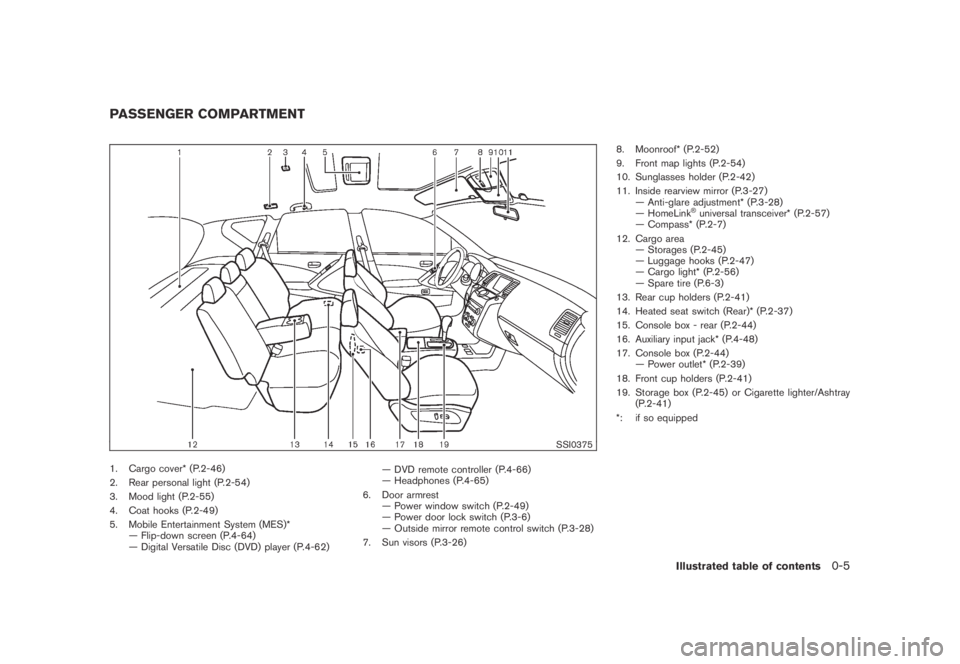
SSI0375
1. Cargo cover* (P.2-46)
2. Rear personal light (P.2-54)
3. Mood light (P.2-55)
4. Coat hooks (P.2-49)
5. Mobile Entertainment System (MES)*
— Flip-down screen (P.4-64)
— Digital Versatile Disc (DVD) player (P.4-62)— DVD remote controller (P.4-66)
— Headphones (P.4-65)
6. Door armrest
— Power window switch (P.2-49)
— Power door lock switch (P.3-6)
— Outside mirror remote control switch (P.3-28)
7. Sun visors (P.3-26)8. Moonroof* (P.2-52)
9. Front map lights (P.2-54)
10. Sunglasses holder (P.2-42)
11. Inside rearview mirror (P.3-27)
— Anti-glare adjustment* (P.3-28)
— HomeLink
®universal transceiver* (P.2-57)
— Compass* (P.2-7)
12. Cargo area
— Storages (P.2-45)
— Luggage hooks (P.2-47)
— Cargo light* (P.2-56)
— Spare tire (P.6-3)
13. Rear cup holders (P.2-41)
14. Heated seat switch (Rear)* (P.2-37)
15. Console box - rear (P.2-44)
16. Auxiliary input jack* (P.4-48)
17. Console box (P.2-44)
— Power outlet* (P.2-39)
18. Front cup holders (P.2-41)
19. Storage box (P.2-45) or Cigarette lighter/Ashtray
(P.2-41)
*: if so equipped
PASSENGER COMPARTMENT
Illustrated table of contents0-5
Page 16 of 443
Black plate (14,1)
Model "Z51-D" EDITED: 2007/ 10/ 2
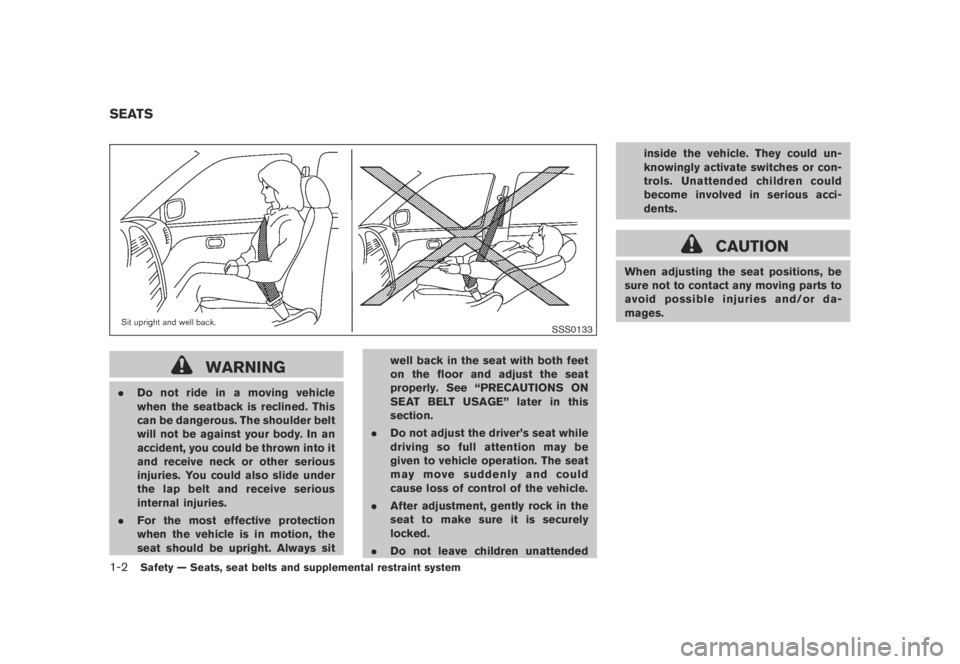
SSS0133
WARNING
.Do not ride in a moving vehicle
when the seatback is reclined. This
can be dangerous. The shoulder belt
will not be against your body. In an
accident, you could be thrown into it
and receive neck or other serious
injuries. You could also slide under
the lap belt and receive serious
internal injuries.
.For the most effective protection
when the vehicle is in motion, the
seat should be upright. Always sitwell back in the seat with both feet
on the floor and adjust the seat
properly. See “PRECAUTIONS ON
SEAT BELT USAGE” later in this
section.
.Do not adjust the driver’s seat while
driving so full attention may be
given to vehicle operation. The seat
may move suddenly and could
cause loss of control of the vehicle.
.After adjustment, gently rock in the
seat to make sure it is securely
locked.
.Do not leave children unattendedinside the vehicle. They could un-
knowingly activate switches or con-
trols. Unattended children could
become involved in serious acci-
dents.
CAUTION
When adjusting the seat positions, be
sure not to contact any moving parts to
avoid possible injuries and/or da-
mages.
SEATS
1-2Safety — Seats, seat belts and supplemental restraint system
Page 17 of 443
Black plate (15,1)
Model "Z51-D" EDITED: 2007/ 10/ 2
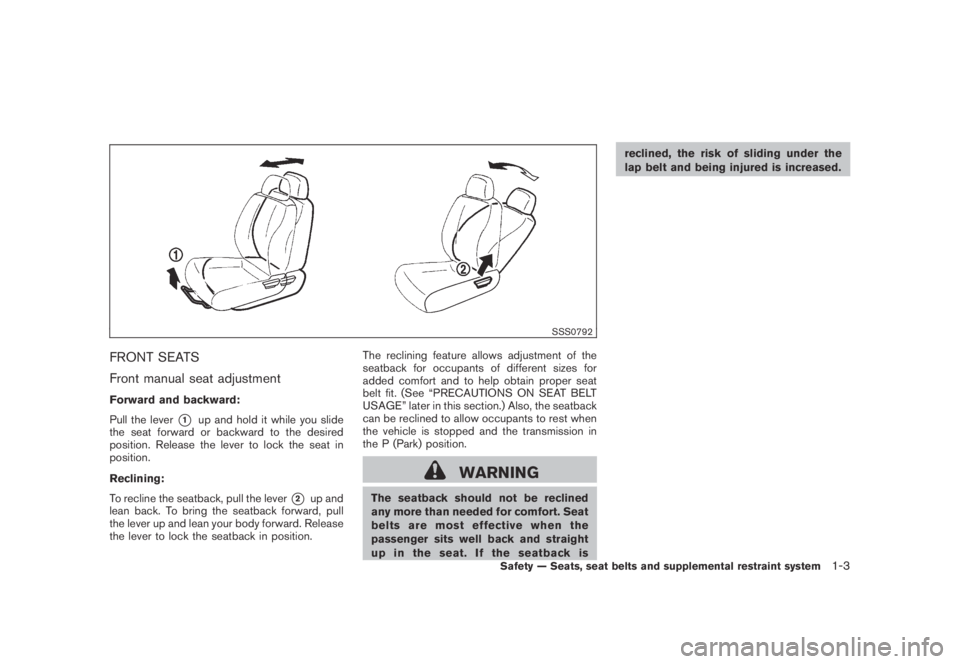
SSS0792
FRONT SEATS
Front manual seat adjustment
Forward and backward:
Pull the lever
*1up and hold it while you slide
the seat forward or backward to the desired
position. Release the lever to lock the seat in
position.
Reclining:
To recline the seatback, pull the lever
*2up and
lean back. To bring the seatback forward, pull
the lever up and lean your body forward. Release
the lever to lock the seatback in position.The reclining feature allows adjustment of the
seatback for occupants of different sizes for
added comfort and to help obtain proper seat
belt fit. (See “PRECAUTIONS ON SEAT BELT
USAGE” later in this section.) Also, the seatback
can be reclined to allow occupants to rest when
the vehicle is stopped and the transmission in
the P (Park) position.
WARNING
The seatback should not be reclined
any more than needed for comfort. Seat
belts are most effective when the
passenger sits well back and straight
up in the seat. If the seatback isreclined, the risk of sliding under the
lap belt and being injured is increased.
Safety — Seats, seat belts and supplemental restraint system1-3
Page 18 of 443
Black plate (16,1)
Model "Z51-D" EDITED: 2007/ 10/ 2
SSS0793
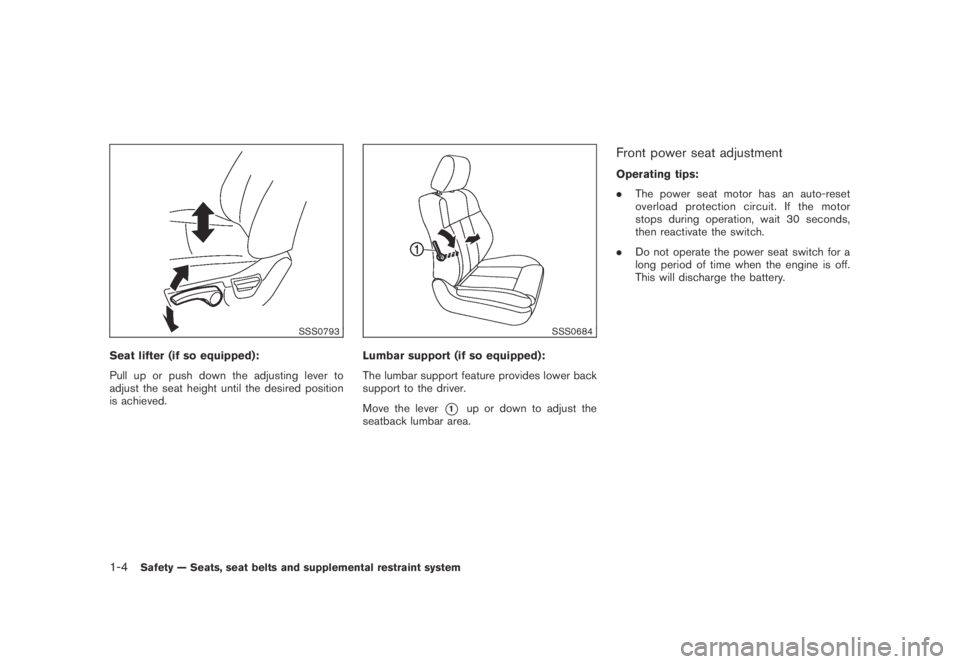
Seat lifter (if so equipped):
Pull up or push down the adjusting lever to
adjust the seat height until the desired position
is achieved.
SSS0684
Lumbar support (if so equipped):
The lumbar support feature provides lower back
support to the driver.
Move the lever
*1up or down to adjust the
seatback lumbar area.
Front power seat adjustment
Operating tips:
.The power seat motor has an auto-reset
overload protection circuit. If the motor
stops during operation, wait 30 seconds,
then reactivate the switch.
.Do not operate the power seat switch for a
long period of time when the engine is off.
This will discharge the battery.
1-4Safety — Seats, seat belts and supplemental restraint system
Page 19 of 443
Black plate (17,1)
Model "Z51-D" EDITED: 2007/ 10/ 2
SSS0819
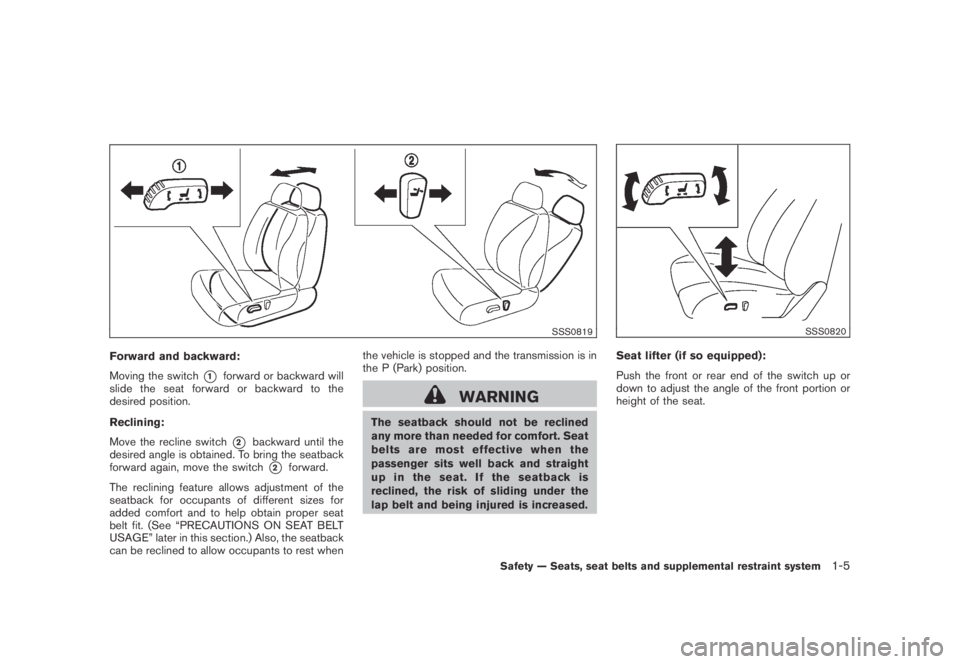
Forward and backward:
Moving the switch
*1forward or backward will
slide the seat forward or backward to the
desired position.
Reclining:
Move the recline switch
*2backward until the
desired angle is obtained. To bring the seatback
forward again, move the switch
*2forward.
The reclining feature allows adjustment of the
seatback for occupants of different sizes for
added comfort and to help obtain proper seat
belt fit. (See “PRECAUTIONS ON SEAT BELT
USAGE” later in this section.) Also, the seatback
can be reclined to allow occupants to rest whenthe vehicle is stopped and the transmission is in
the P (Park) position.
WARNING
The seatback should not be reclined
any more than needed for comfort. Seat
belts are most effective when the
passenger sits well back and straight
up in the seat. If the seatback is
reclined, the risk of sliding under the
lap belt and being injured is increased.
SSS0820
Seat lifter (if so equipped):
Push the front or rear end of the switch up or
down to adjust the angle of the front portion or
height of the seat.
Safety — Seats, seat belts and supplemental restraint system1-5
Page 22 of 443
Black plate (20,1)
Model "Z51-D" EDITED: 2007/ 10/ 2
SSS0227A
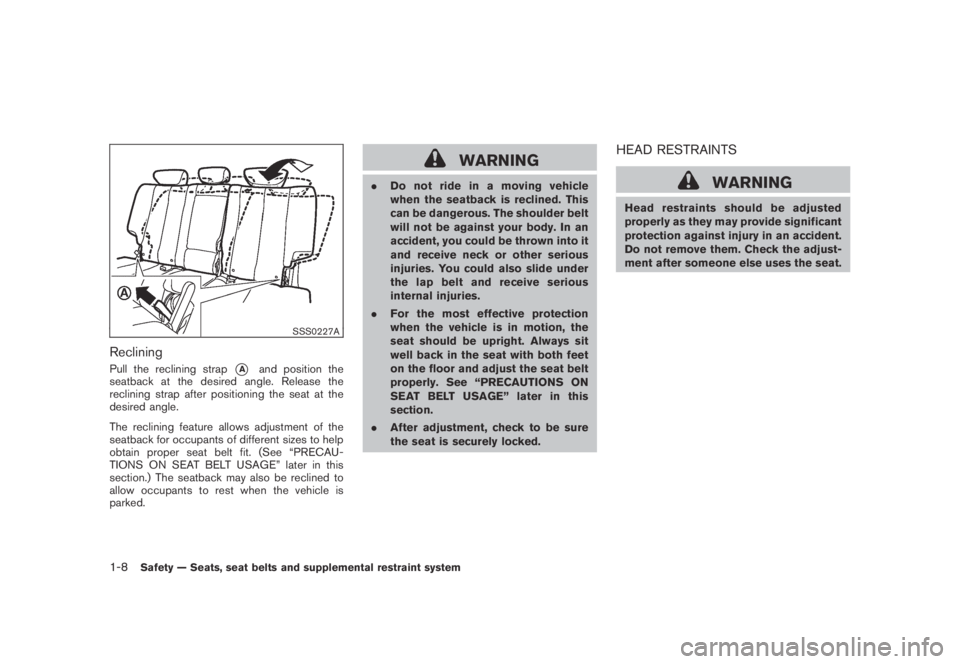
Reclining
Pull the reclining strap*Aand position the
seatback at the desired angle. Release the
reclining strap after positioning the seat at the
desired angle.
The reclining feature allows adjustment of the
seatback for occupants of different sizes to help
obtain proper seat belt fit. (See “PRECAU-
TIONS ON SEAT BELT USAGE” later in this
section.) The seatback may also be reclined to
allow occupants to rest when the vehicle is
parked.
WARNING
.Do not ride in a moving vehicle
when the seatback is reclined. This
can be dangerous. The shoulder belt
will not be against your body. In an
accident, you could be thrown into it
and receive neck or other serious
injuries. You could also slide under
the lap belt and receive serious
internal injuries.
.For the most effective protection
when the vehicle is in motion, the
seat should be upright. Always sit
well back in the seat with both feet
on the floor and adjust the seat belt
properly. See “PRECAUTIONS ON
SEAT BELT USAGE” later in this
section.
.After adjustment, check to be sure
the seat is securely locked.
HEAD RESTRAINTS
WARNING
Head restraints should be adjusted
properly as they may provide significant
protection against injury in an accident.
Do not remove them. Check the adjust-
ment after someone else uses the seat.
1-8Safety — Seats, seat belts and supplemental restraint system
Page 23 of 443
Black plate (21,1)
Model "Z51-D" EDITED: 2007/ 10/ 2
SSS0288
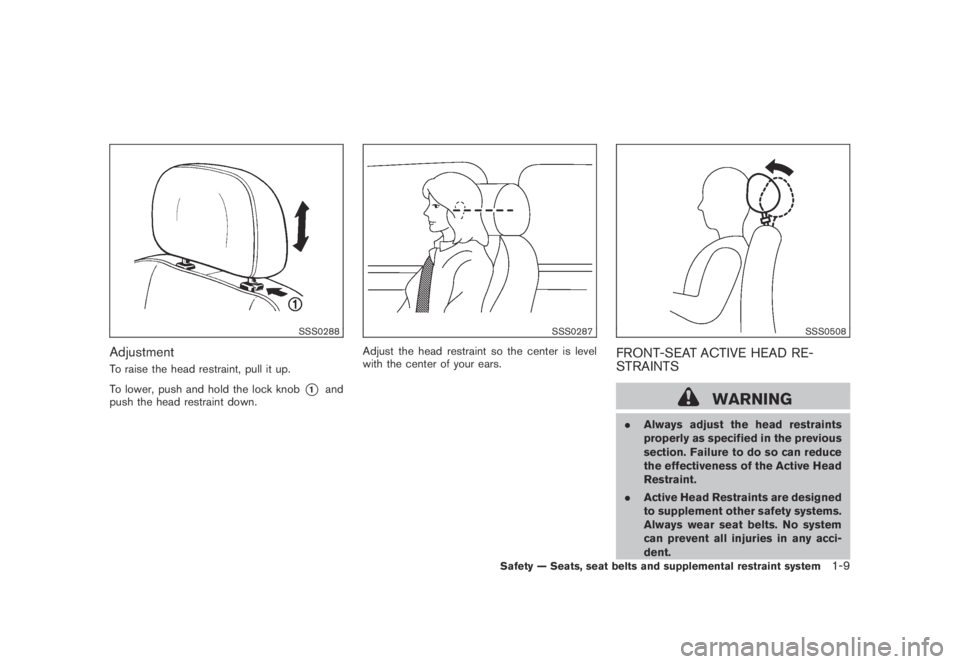
Adjustment
To raise the head restraint, pull it up.
To lower, push and hold the lock knob
*1and
push the head restraint down.
SSS0287
Adjust the head restraint so the center is level
with the center of your ears.
SSS0508
FRONT-SEAT ACTIVE HEAD RE-
STRAINTS
WARNING
.Always adjust the head restraints
properly as specified in the previous
section. Failure to do so can reduce
the effectiveness of the Active Head
Restraint.
.Active Head Restraints are designed
to supplement other safety systems.
Always wear seat belts. No system
can prevent all injuries in any acci-
dent.
Safety — Seats, seat belts and supplemental restraint system1-9
Page 31 of 443
Black plate (29,1)
Model "Z51-D" EDITED: 2007/ 10/ 2
SSS0351A
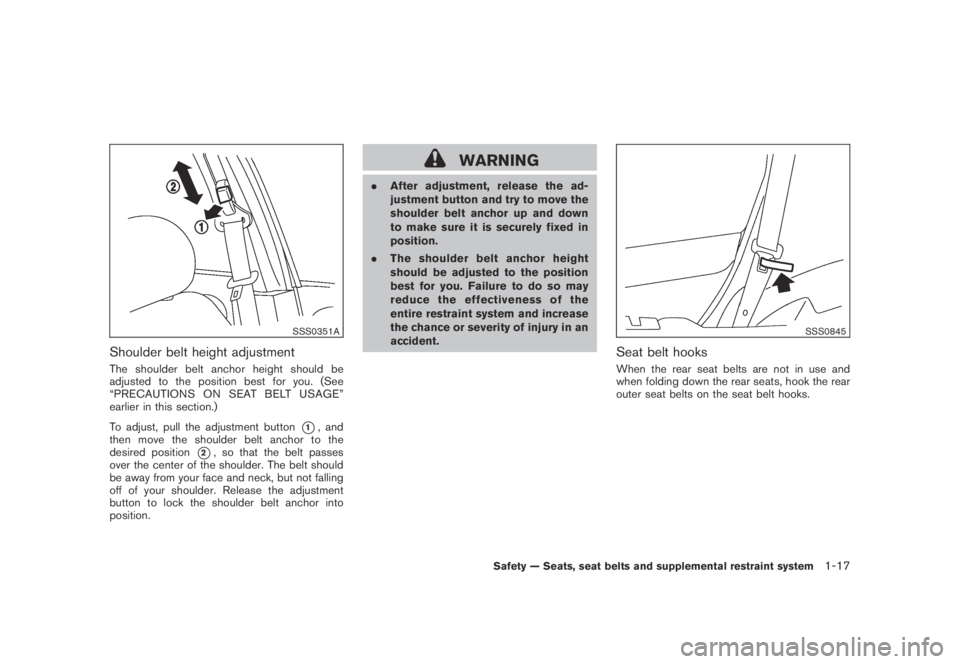
Shoulder belt height adjustment
The shoulder belt anchor height should be
adjusted to the position best for you. (See
“PRECAUTIONS ON SEAT BELT USAGE”
earlier in this section.)
To adjust, pull the adjustment button
*1, and
then move the shoulder belt anchor to the
desired position
*2, so that the belt passes
over the center of the shoulder. The belt should
be away from your face and neck, but not falling
off of your shoulder. Release the adjustment
button to lock the shoulder belt anchor into
position.
WARNING
.After adjustment, release the ad-
justment button and try to move the
shoulder belt anchor up and down
to make sure it is securely fixed in
position.
.The shoulder belt anchor height
should be adjusted to the position
best for you. Failure to do so may
reduce the effectiveness of the
entire restraint system and increase
the chance or severity of injury in an
accident.
SSS0845
Seat belt hooks
When the rear seat belts are not in use and
when folding down the rear seats, hook the rear
outer seat belts on the seat belt hooks.
Safety — Seats, seat belts and supplemental restraint system1-17
Page 37 of 443
Black plate (35,1)
Model "Z51-D" EDITED: 2007/ 10/ 2
loads imposed by correctly fitted
child restraints. Under no circum-
stances are they to be used for adult
seat belts or harnesses.
.Adjustable seatbacks should be
positioned to fit the child restraint,
but as upright as possible.
.After attaching the child restraint,
test it before you place the child in
it. Push it from side to side while
holding the seat near the LATCH
attachment or by the seat belt path.
Try to tug it forward and check to
see if the belt holds the restraint in
place. The child restraint should not
move more than 1 in (25 mm) . If the
restraint is not secure, tighten the
belt as necessary, or put the re-
straint in another seat and test it
again. You may need to try a differ-
ent child restraint. Not all child
restraints fit in all types of vehicles.
.When your child restraint is not in
use, keep it secured with the LATCH
System or a seat belt to prevent it
from being thrown around in case of
a sudden stop or accident.CAUTION
Remember that a child restraint left in a
closed vehicle can become very hot.
Check the seating surface and buckles
before placing your child in the child
restraint.
This vehicle is equipped with a universal child
restraint lower anchor system, referred to as the
Lower Anchors and Tethers for CHildren System
or LATCH. Some child restraints include two
rigid or webbing-mounted attachments that can
be connected to these lower anchors. For
details, see “Lower Anchors and Tethers for
CHildren SYSTEM (LATCH)” later in this sec-
tion.
If you do not have a LATCH compatible child
restraint, the vehicle seat belts can be used.
(See “CHILD RESTRAINT INSTALLATION
USING THE SEAT BELTS” later in this section.)
In general, child restraints are also designed to
be installed with the lap portion of a lap/shoulder
seat belt.
Several manufacturers offer child restraints for
infants and small children of various sizes. When
selecting any child restraint, keep the following
points in mind:
.Choose only a restraint with a label certifying
that it complies with Federal Motor VehicleSafety Standard 213 or Canadian Motor
Vehicle Safety Standard 213.
.Check the child restraint in your vehicle to
be sure it is compatible with the vehicle’s
seat and seat belt system.
.If the child restraint is compatible with your
vehicle, place your child in the child restraint
and check the various adjustments to be
sure the child restraint is compatible with
your child. Choose a child restraint that is
designed for your child’s height and weight.
Always follow all recommended procedures.
All U.S. states and Canadian provinces or
territories require that infants and small
children be restrained in an approved child
restraint at all times while the vehicle is
being operated.
Lower Anchors and Tethers for CHildren
SYSTEM (LATCH)
Your vehicle is equipped with special anchor
points that are used with Lower Anchors and
Tethers for CHildren System (LATCH) compa-
tible child restraints. This system may also be
referred to as the ISOFIX or ISOFIX compatible
system. With this system, you do not have to use
a vehicle seat belt to secure the child restraint.
The LATCH anchor points are provided to install
child restraints in the rear outboard seating
Safety — Seats, seat belts and supplemental restraint system1-23