wheel NISSAN MURANO 2018 Owner´s Manual
[x] Cancel search | Manufacturer: NISSAN, Model Year: 2018, Model line: MURANO, Model: NISSAN MURANO 2018Pages: 460, PDF Size: 5.06 MB
Page 437 of 460
∙ If the engine coolant temperature risesto a high temperature, refer to “If your
vehicle overheats” in the “In case of
emergency” section of this owner’s
manual.
∙ Trailer towing requires more fuel than normal circumstances.
∙ Avoid towing a trailer for your vehicle’s first 500 miles (805 km).
∙ For the first 500 miles (805 km) that you do tow, do not drive over 50 mph
(80 km/h).
∙ Have your vehicle serviced more of ten than at intervals specified in the recom-
mended Maintenance Schedule in the
“Maintenance and schedules” section of
this manual.
∙ When making a turn, your trailer wheels will be closer to the inside of the turn
than your vehicle wheels. To compen-
sate for this, make a larger than normal
turning radius during the turn.
∙
Crosswinds and rough roads will ad-
versely affect vehicle/trailer handling,
possibly causing vehicle sway. When be-
ing passed by larger vehicles, be pre-
pared for possible changes in cross-
winds that could affect vehicle handling.
Do the following if the trailer begins to
sway:
1. Take your foot off the accelerator pedal to allow the vehicle to coast and steer
as straight ahead as the road condi-
tions allow. This combination will help
stabilize the vehicle
– Do not correct trailer sway by steer- ing or applying the brakes.
2. When the trailer sway stops, gently ap- ply the brakes and pull to the side of the
road in a safe area.
3. Try to rearrange the trailer load so it is balanced as described in this section.
∙
Be careful when passing other vehicles.
Passing while towing a trailer requires
considerably more distance than normal
passing. Remember, the length of the
trailer must also pass the other vehicle
before you can safely change lanes.
∙Downshif t the transmission to a lower
gear for engine braking when driving
down steep or long hills. This will help slow
the vehicle without applying the brakes.
∙ Avoid holding the brake pedal down too long or too frequently. This could cause
the brakes to overheat, resulting in re-
duced braking efficiency. ∙ Increase your following distance to al-
low for greater stopping distances
while towing a trailer. Anticipate stops
and brake gradually.
∙ NISSAN recommends that the cruise control not be used while towing a
trailer.
∙ Some states or provinces have specific regulations and speed limits for ve-
hicles that are towing trailers. Obey the
local speed limits.
∙ Check your hitch, trailer wiring harness connections, and trailer wheel lug nuts
af ter 50 miles (80 km) of travel and at
every break.
∙ When launching a boat, don’t allow the water level to go over the exhaust tail
pipe or rear bumper.
∙ Make sure you disconnect the trailer lights before backing the trailer into the
water or the trailer lights may burn out.
When towing a trailer, final drive gear oil
should be replaced and transmission
oil/fluid should be changed more fre-
quently. For additional information, refer
to the “Do-it-yourself ” section of this
manual.
Technical and consumer information10-25
Page 438 of 460
FLAT TOWING FOR ALL–WHEEL
DRIVE VEHICLE (if so equipped)
Towing your vehicle with all four wheels on
the ground is sometimes called flat towing.
This method is sometimes used when
towing a vehicle behind a recreational ve-
hicle, such as a motor home.
CAUTION
∙ Failure to follow these guidelines canresult in severe transmission damage.
∙ Never flat tow your All-Wheel Drive (AWD) vehicle.
∙ DO NOT tow your All-Wheel Drive (AWD) vehicle with any wheels on the
ground. Doing so may cause serious
and expensive damage to the
powertrain.
∙ For emergency towing procedures re- fer to “Towing recommended by
NISSAN” in the “In case of emergency ”
section of this manual.
FLAT TOWING FOR FRONT WHEEL
DRIVE VEHICLE (if so equipped)
Towing your vehicle with all four wheels on
the ground is sometimes called flat towing.
This method is sometimes used when
towing a vehicle behind a recreational ve-
hicle, such as a motor home.
CAUTION
∙ Failure to follow these guidelines canresult in severe transmission damage.
∙ Whenever flat towing your vehicle, al- ways tow forward, never backward.
∙ Never tow your front wheel drive ve- hicle with the front tires on the
ground. Doing so may cause serious
and expensive damage to the
powertrain.
∙ DO NOT tow your front wheel drive continuously variable transmission
vehicle with all four wheels on the
ground (flat towing). Doing so WILL
DAMAGE internal transmission parts
due to lack of transmission
lubrication. ∙ For emergency towing procedures re-
fer to “Towing recommended by
NISSAN” in the “In case of emergency ”
section of this manual.
Continuously Variable
Transmission
To tow a vehicle equipped with a continu-
ously variable transmission, an appropriate
vehicle dolly MUSTbe placed under the
towed vehicle’s drive wheels. Alwaysfollow
the dolly manufacturer’s recommenda-
tions when using their product.
10-26Technical and consumer information
Page 439 of 460
DOT (Department of Transportation) Qual-
ity Grades: All passenger car tires must
conform to federal safety requirements in
addition to these grades.
Quality grades can be found where appli-
cable on the tire sidewall between tread
shoulder and maximum section width. For
example:
Treadwear 200 Traction AA Temperature
A
Treadwear
The treadwear grade is a comparative rat-
ing based on the wear rate of the tire when
tested under controlled conditions on a
specified government test course. For ex-
ample, a tire graded 150 would wear one
and one-half (1 1/2) times as well on the
government course as a tire graded 100.
The relative performance of tires depends
upon the actual conditions of their use,
however, and may depart significantly from
the norm due to variations in driving habits,
service practices and differences in road
characteristics and climate.
Traction AA, A, B and C
The traction grades, from highest to low-
est, are AA, A, B, and C. Those grades repre-
sent the tire’s ability to stop on wet pave-ment as measured under controlled
conditions on specified government test
surfaces of asphalt and concrete. A tire
marked C may have poor traction perfor-
mance.
WARNING
The traction grade assigned to this tire
is based on straight-ahead braking
traction tests, and does not include ac-
celeration, cornering, hydroplaning, or
peak traction characteristics.
Temperature A, B and C
The temperature grades are A (the high-
est), B, and C, representing the tire’s resis-
tance to the generation of heat, and its
ability to dissipate heat when tested under
controlled conditions on a specified indoor
laboratory test wheel. Sustained high tem-
perature can cause the material of the tire
to degenerate and reduce tire life, and ex-
cessive temperature can lead to sudden
tire failure. The grade C corresponds to a
level of performance which all passenger
car tires must meet under the Federal Mo-
tor Safety Standard No. 109. Grades B and A
represent higher levels of performance on
the laboratory test wheel than the mini-
mum required by law.
WARNING
The temperature grade for this tire is
established for a tire that is properly in-
flated and not overloaded. Excessive
speed, under-inflation, or excessive
loading, either separately or in combi-
nation, can cause heat build-up and
possible tire failure.
UNIFORM TIRE QUALITY GRADING
Technical and consumer information10-27
Page 441 of 460
You may notif y NISSAN by contact-
ing our Consumer Affairs Depart-
ment, toll-free, at 1-800-NISSAN-1.
For Canada
If you believe that your vehicle has a
defect which could cause a crash or
could cause injury or death, you
should immediately inform Trans-
port Canada in addition to notif ying
NISSAN.
If Transport Canada receives com-
plaints, it may open an investigation,
and if it finds that a safety defect
exists in a group of vehicles, it may
request that NISSAN conduct a recall
campaign. However, Transport
Canada cannot become involved in
individual problems between you,
your dealer, or NISSAN.You may contact Transport Canada’s
Defect Investigations and Recalls Divi-
sion toll free at 1-800-333-0510. You
may also report safety defects online
at: https://wwwapps.tc.gc.ca/Saf-
Sec-Sur/7/PCDB-BDPP/fc-
cp.aspx?lang=eng (English speakers)
or https://wwwapps.tc.gc.ca/Saf-
Sec-Sur/7/PCDB-BDPP/fc-
cp.aspx?lang=fra (French speakers)
Additional information concerning
motor vehicle safety may be obtained
from Transport Canada’s Road Safety
Information Centre at 1-800-333-0371
or online at www.tc.gc.ca/roadsafety
(English speakers) or
www.tc.gc.ca/securiteroutiere
(French speakers).
To notif y NISSAN of any safety con-
cerns please contact our Consumer
Information Centre toll free at 1-800-
387-0122.
WARNING
A vehicle equipped with All -Wheel Drive
(AWD) should never be tested using a
two wheel dynamometer (such as the
dynamometers used by some states for
emissions testing), or similar equip-
ment. Make sure you inform the test fa-
cility personnel that your vehicle is
equipped with AWD before it is placed
on a dynamometer. Using the wrong
test equipment may result in drivetrain
damage or unexpected vehicle move-
ment which could result in serious ve-
hicle damage or personal injury.
Due to legal requirements in some states
and Canadian Provinces, your vehicle may
be required to be in what is called the
“ready condition” for an
Inspection/Maintenance (I/M) test of the
emission control system.
The vehicle is set to the “ready condition”
when it is driven through certain driving
patterns. Usually, the ready condition can
be obtained by ordinary usage of the ve-
hicle.
READINESS FOR INSPECTION/
MAINTENANCE (I/M) TEST
Technical and consumer information10-29
Page 445 of 460
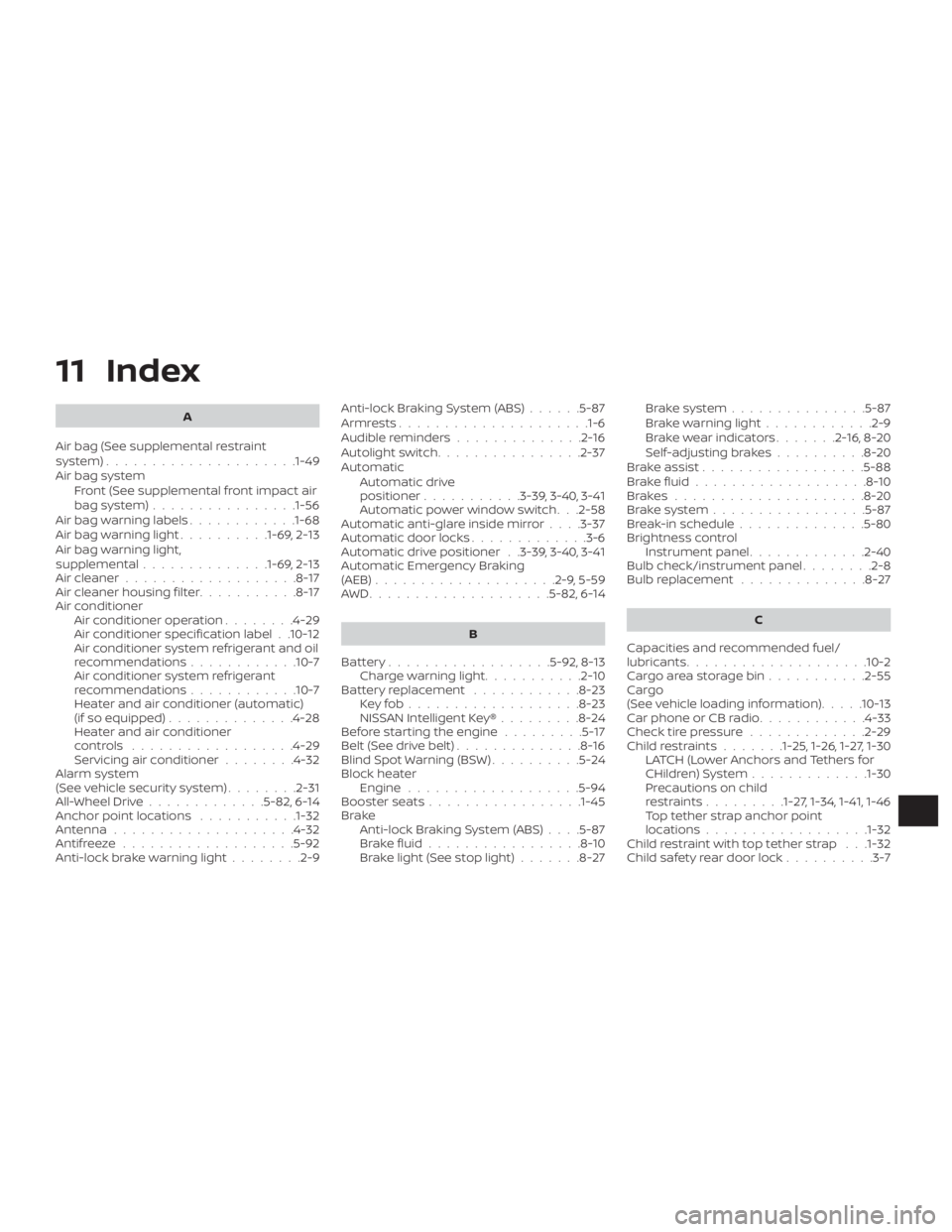
11 Index
A
Air bag (See supplemental restraint
system) .................... .1-49
Air bag system Front (See supplemental front impact air
bagsystem)................1-56
Air bag warning labels ............1-68
Airbagwarninglight..........1-69, 2-13
Air bag warning light,
supplemental ..............1-69, 2-13
Air cleaner ...................8-17
Air cleaner housing filter ...........8-17
Air conditioner Air conditioner operation ........4-29
Air conditioner specification label . .10-12
Air conditioner system refrigerant and oil
recommendations ............10-7
Air conditioner system refrigerant
recommendations ............10-7
Heater and air conditioner (automatic)
(if so equipped) ..............4-28
Heater and air conditioner
controls ..................4-29
Servicing air conditioner ........4-32
Alarm system
(See vehicle security system) ........2-31
All-Wheel Drive .............5-82,6-14
Anchor point locations ...........1-32
Antenna ....................4-32
Antifreeze ...................5-92
Anti-lock brake warning light ........2-9Anti-lock Braking System (ABS)
......5-87
Armrests.................... .1-6
Audible reminders ..............2-16
Autolightswitch................2-37
Automatic Automatic drive
positioner ...........3-39, 3-40, 3-41
Automatic power window switch . . .2-58
Automatic anti-glare inside mirror ....3-37
Automatic door locks .............3-6
Automatic drive positioner . .3-39, 3-40, 3-41
Automatic Emergency Braking
(AEB) ....................2-9,5-59
AWD....................5-82,6-14
B
Battery..................5-92,8-13 Charge warning light ...........2-10
Battery replacement ............8-23
Keyfob...................8-23
NISSAN Intelligent Key® .........8-24
Before starting the engine .........5-17
Belt(Seedrivebelt)..............8-16
Blind Spot Warning (BSW) ..........5-24
Block heater Engine ...................5-94
Booster seats .................1-45
Brake Anti-lock Braking System (ABS) ....5-87
Brakefluid.................8-10
Brakelight(Seestoplight).......8-27 Brakesystem...............5-87
Brakewarninglight............2-9
Brakewearindicators.......2-16,8-20
Self-adjustingbrakes..........8-20
Brakeassist..................5-88
Brakefluid...................8-10
Brakes.....................8-20
Brakesystem.................5-87
Break-in schedule ..............5-80
Brightness control Instrument panel .............2-40
Bulb check/instrument panel ........2-8
Bulb replacement ..............8-27
C
Capacities and recommended fuel/
l
ubricants....................10-2
Cargoareastoragebin...........2-55
Cargo
(See vehicle loading information) .....10-13
Car phone or CB radio ............4-33
Check tire pressure .............2-29
Childrestraints.......1-25, 1-26, 1-27, 1-30 LATCH (Lower Anchors and Tethers for
CHildren)System.............1-30
Precautions on child
restraints.........1-27, 1-34, 1-41, 1-46
Top tether strap anchor point
locations................. .1-32
Child restraint with top tether strap . . .1-32
Child safety rear door lock ..........3-7
Page 447 of 460
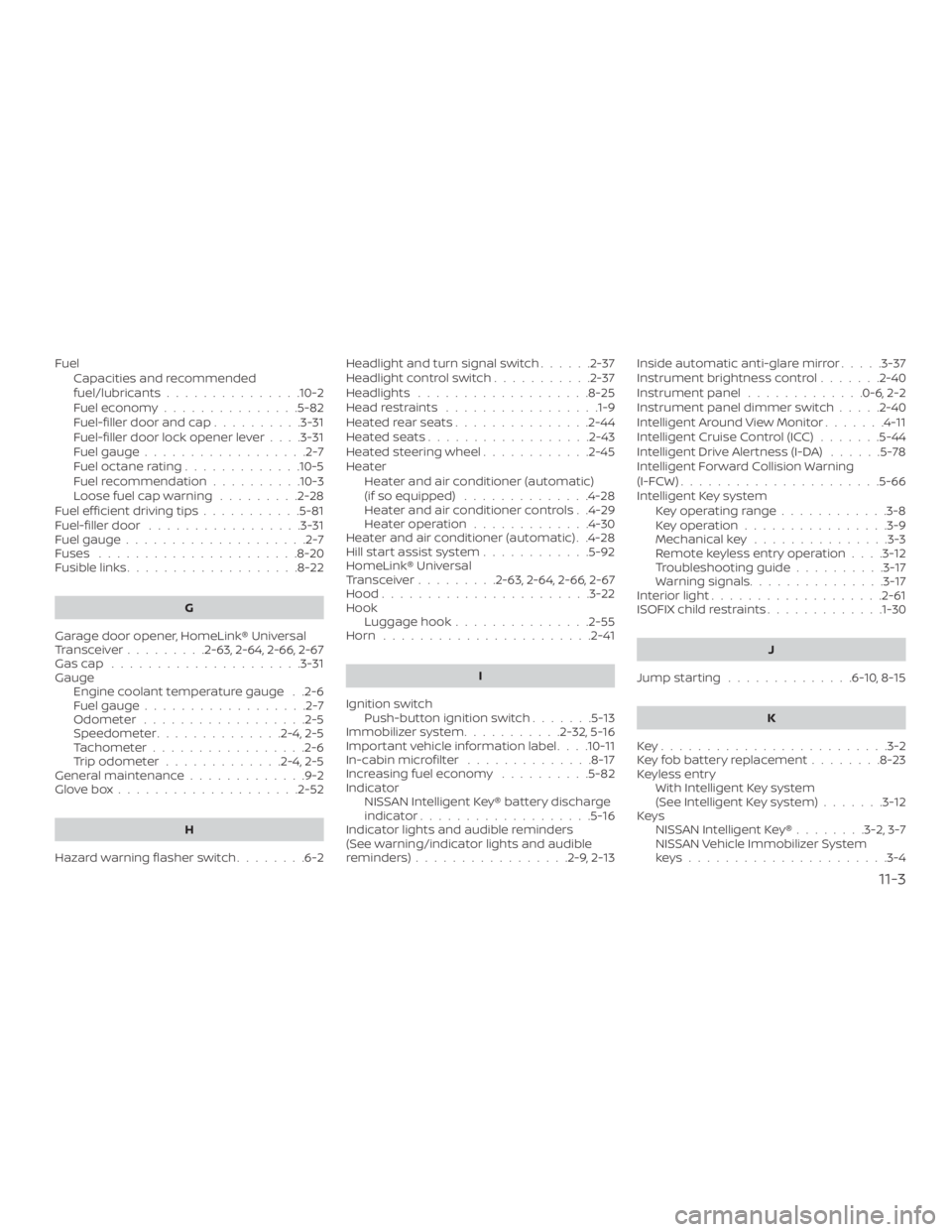
FuelCapacities and recommended
fuel/lubricants...............10-2
Fuel economy ...............5-82
Fuel-filler door and cap ..........3-31
Fuel-filler door lock opener lever ....3-31
Fuel gauge ..................2-7
Fueloctanerating.............10-5
Fuel recommendation ..........10-3
Loose fuel cap warning .........2-28
Fuelefficientdrivingtips...........5-81
Fuel-filler door .................3-31
Fuel gauge ....................2-7
Fuses ......................8-20
Fusiblelinks...................8-22
G
Garage door opener, HomeLink® Universal
Transceiver .........2-63,2-64,2-66,2-67
Gascap .....................3-31
Gauge Engine coolant temperature gauge . .2-6
Fuel gauge ..................2-7
Odometer ..................2-5
Speedometer ..............2-4,2-5
Tachometer .................2-6
Trip odometer .............2-4,2-5
General maintenance .............9-2
Glovebox....................2-52
H
Hazard warning flasher switch ........6-2Headlight and turn signal switch
......2-37
Headlightcontrolswitch...........2-37
Headlights ...................8-25
Headrestraints ................ .1-9
Heatedrearseats...............2-44
Heatedseats..................2-43
Heated steering wheel ............2-45
Heater Heater and air conditioner (automatic)
(if so equipped) ..............4-28
Heater and air conditioner controls . .4-29
Heater operation .............4-30
Heater and air conditioner (automatic) . .4-28
Hill start assist system ............5-92
HomeLink® Universal
Transceiver .........2-63,2-64,2-66,2-67
Hood .......................3-22
Hook Luggage hook ...............2-55
Horn .......................2-41
I
Ignition switch Push-button ignition switch .......5-13
Immobilizer system ...........2-32,5-16
Important vehicle information label . . . .10-11
In-cabinmicrofilter ..............8-17
Increasing fuel economy ..........5-82
Indicator NISSAN Intelligent Key® battery discharge
indicator...................5-16
Indicator lights and audible reminders
(See warning/indicator lights and audible
reminders) .................2-9,2-13 Inside automatic anti-glare mirror
.....3-37
Instrument brightness control .......2-40
Instrument panel .............0-6,2-2
Instrument panel dimmer switch .....2-40
Intelligent Around View Monitor .......4-11
Intelligent Cruise Control (ICC) .......5-44
Intelligent Drive Alertness (I-DA) ......5-78
Intelligent Forward Collision Warning
(I-FCW)......................5-66
Intelligent Key system Key operating range ............3-8
Key operation ................3-9
Mechanical key ...............3-3
Remote keyless entry operation ....3-12
T
roubleshooting guide ..........3-17
Warning signals ...............3-17
Interiorlight...................2-61
ISOFIX child restraints .............1-30
J
Jumpstarting..............6-10,8-15
K
Key........................ .3-2
Key fob battery replacement ........8-23
Keyless entry With Intelligent Key system
(See Intelligent Key system) .......3-12
Keys NISSAN Intelligent Key® ........3-2,3-7
NISSAN Vehicle Immobilizer System
keys......................3-4
11-3
Page 450 of 460
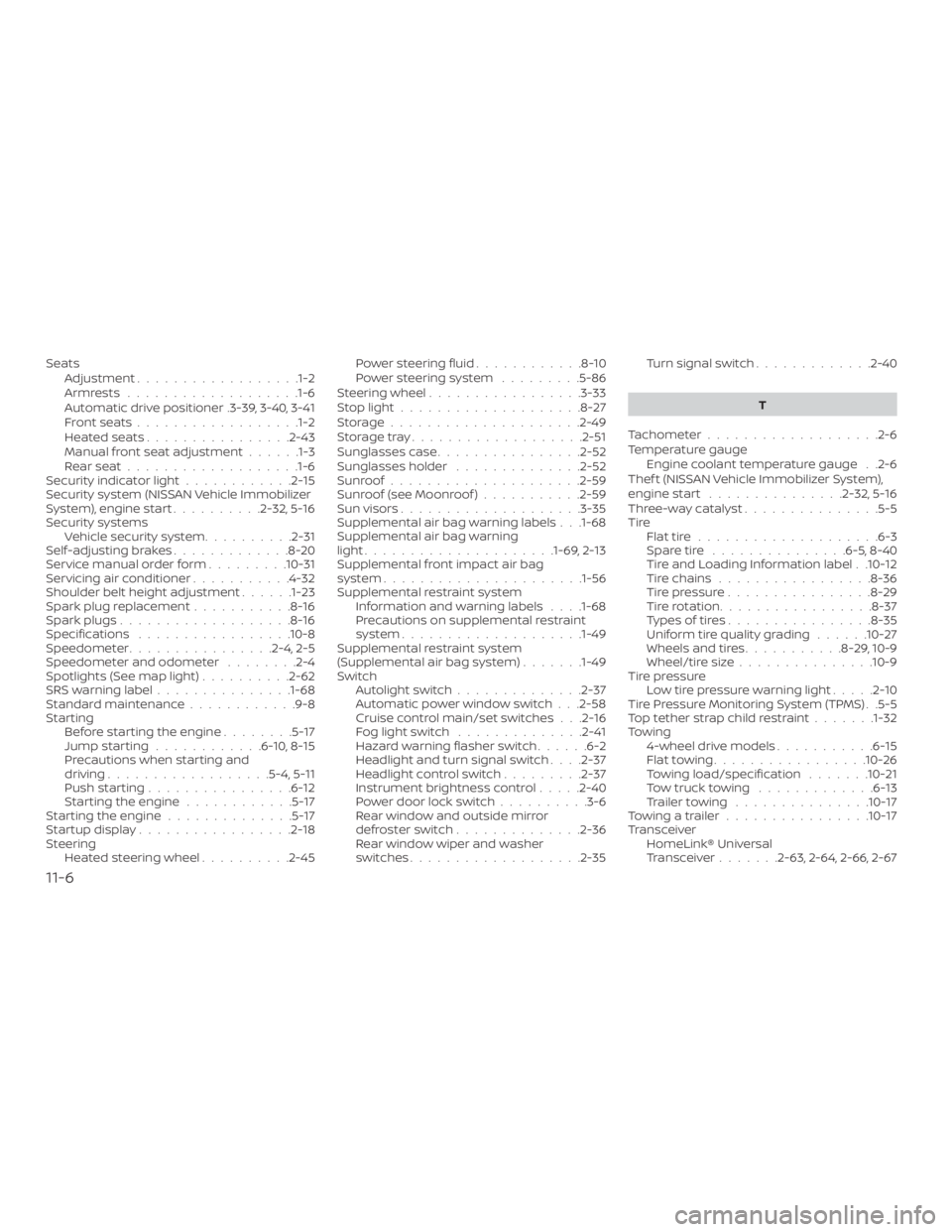
SeatsAdjustment ..................1-2
Armrests .................. .1-6
Automatic drive positioner .3-39, 3-40, 3-41
Frontseats..................1-2
Heatedseats................2-43
Manual front seat adjustment ......1-3
Rearseat.................. .1-6
Security indicator light ............2-15
Security system (NISSAN Vehicle Immobilizer
System), engine start ..........2-32,5-16
Security systems Vehicle security system ..........2-31
Self-adjustingbrakes.............8-20
Service manual order form .........10-31
Servicing air conditioner ...........4-32
Shoulder belt height adjustment ......1-23
Spark plug replacement ...........8-16
Spark plugs ...................8-16
Specifications .................10-8
Speedometer ................2-4,2-5
Speedometer and odometer ........2-4
Spotlights(Seemaplight)..........2-62
SRS warning label ...............1-68
Standard maintenance ............9-8
Starting Before starting the engine ........5-17
Jumpstarting............6-10,8-15
Precautions when starting and
driving ..................5-4,5-11
Push starting ................6-12
Starting the engine ............5-17
Starting the engine ..............5-17
Startupdisplay.................2-18
Steering Heated steering wheel ..........2-45 Powersteeringfluid............8-10
Powersteeringsystem .........5-86
Steering wheel .................3-33
Stoplight....................8-27
Storage.....................2-49
Storagetray...................2-51
Sunglasses case ................2-52
Sunglasses holder ..............2-52
Sunroof .....................2-59
Sunroof (see Moonroof ) ...........2-59
Sunvisors....................3-35
Supplemental air bag warning labels . . .1-68
Supplemental air bag warning
light.................... .1-69, 2-13
Supplemental front impact air bag
system ..................... .1-56
Supplemental restraint system Information and warning labels . . . .1-68
Precautions on supplemental restraint
system ................... .1-49
Supplemental restraint system
(Supplemental air bag system) .......1-49
Switch Autolightswitch..............2-37
Automatic power window switch . . .2-58
Cruise control main/set switches . . .2-16
Foglightswitch ..............2-41
Hazard warning flasher switch ......6-2
Headlight and turn signal switch ....2-37
Headlightcontrolswitch.........2-37
Instrument brightness control .....2-40
Power door lock switch ..........3-6
Rear window and outside mirror
defrosterswitch..............2-36
Rear window wiper and washer
switches ...................2-35 Turn signal switch
.............2-40
T
Tachometer ...................2-6
Temperature gauge Engine coolant temperature gauge . .2-6
Thef t (NISSAN Vehicle Immobilizer System),
engine start ...............
2-32,5-16
Three-waycatalyst...............5-5
Tire Flattire....................6-3
Spare tire ...............6-5,8-40
Tire and Loading Information label . .10-12
Tire chains .................8-36
Tire pressure ................8-29
Tirerotation.................8-37
Types of tires ................8-35
Uniform tire quality grading ......10-27
Wheels and tires ...........8-29,10-9
Wheel/tire size ...............10-9
Tire pressure Low tire pressure warning light .....2-10
Tire Pressure Monitoring System (TPMS) . .5-5
Toptetherstrapchildrestraint.......1-32
Towing 4-wheel drive models ...........6-15
Flattowing.................10-26
Towing load/specification .......10-21
Towtrucktowing .............6-13
Trailertowing ...............10-17
Towingatrailer................10-17
Transceiver HomeLink® Universal
Transceiver .......2-63,2-64,2-66,2-67
11-6
Page 451 of 460
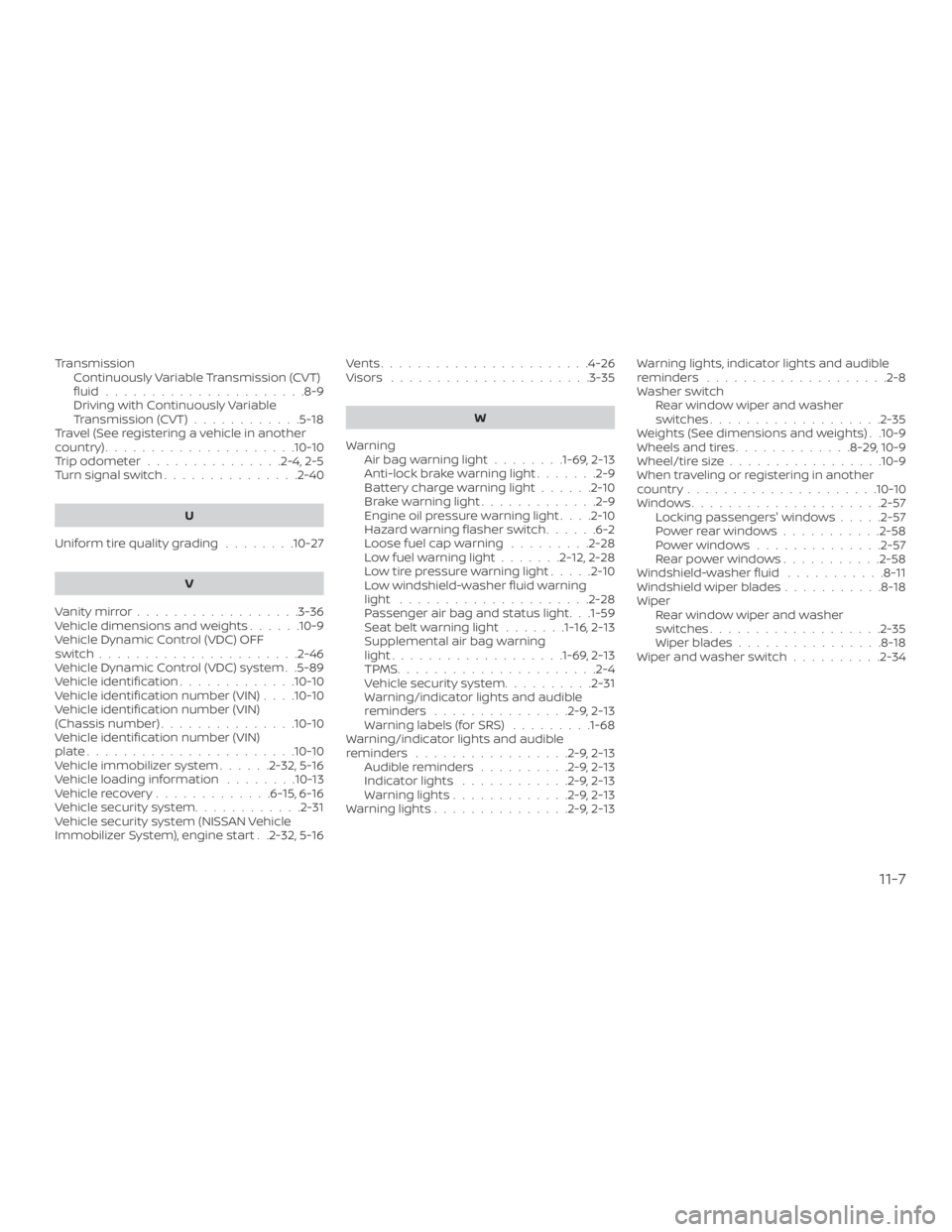
TransmissionContinuously Variable Transmission (CVT)
fluid......................8-9
Driving with Continuously Variable
Transmission (CVT) ............5-18
Travel (See registering a vehicle in another
country) .....................10-10
Trip odometer ...............2-4,2-5
Turn signal switch ...............2-40
U
Uniform tire quality grading ........10-27
V
Vanitymirror..................3-36
Vehicle dimensions and weights ......10-9
Vehicle Dynamic Control (VDC) OFF
switch......................2-46
Vehicle Dynamic Control (VDC) system . .5-89
Vehicle identification .............10-10
Vehicle identification number (VIN) . . . .10-10
Vehicle identification number (VIN)
(Chassis number) ...............10-10
Vehicle identification number (VIN)
plate.......................10-10
Vehicle immobilizer system ......2-32,5-16
Vehicle loading information ........10-13
Vehiclerecovery.............6-15,6-16
Vehicle security system ............2-31
Vehicle security system (NISSAN Vehicle
Immobilizer System), engine start . .2-32, 5-16 Vents.......................4-26
Visors .....................
.3-35
W
Warning Airbagwarninglight........1-69, 2-13
Anti-lock brake warning light .......2-9
Battery charge warning light ......2-10
Brakewarninglight.............2-9
Engine oil pressure warning light ....2-10
Hazard warning flasher switch ......6-2
Loose fuel cap warning .........2-28
Lowfuelwarninglight.......2-12,2-28
Lowtirepressurewarninglight.....2-10
Low windshield-washer fluid warning
light .....................2-28
Passenger air bag and status light. . .1-59
Seatbeltwarninglight.......1-16, 2-13
Supplemental air bag warning
light.................. .1-69, 2-13
TPMS......................2-4
Vehicle security system ..........2-31
Warning/indicator lights and audible
reminders ...............2-9,2-13
Warning labels (for SRS) .........1-68
Warning/indicator lights and audible
reminders .................2-9,2-13
Audible reminders ..........2-9,2-13
Indicatorlights ............2-9,2-13
Warninglights.............2-9,2-13
Warninglights...............2-9,2-13 Warning lights, indicator lights and audible
reminders
....................2-8
Washer switch Rear window wiper and washer
switches ...................2-35
Weights (See dimensions and weights) . .10-9
Wheels and tires .............8-29,10-9
Wheel/tire size .................10-9
When traveling or registering in another
country .....................10-10
Windows.....................2-57 Locking passengers' windows .....2-57
Powerrearwindows...........2-58
Powerwindows............. .2-57
Rearpowerwindows...........2-58
Windshield-washer fluid ...........8-11
Windshield wiper blades ...........8-18
Wiper Rear window wiper and washer
switches ...................2-35
Wiper blades ................8-18
Wiper and washer switch ..........2-34
11-7
Page 458 of 460
FUEL RECOMMENDATION:
Use unleaded regular gasoline with an oc-
tane rating of at least 87 AKI (Anti-Knock In-
dex) number (Research octane number 91).
CAUTION
∙ Only vehicles with the E-85 filler doorlabel can operate on E-85. Fuel system
or other damage can occur if E-85 is
used in vehicles that are not designed
to run on E-85.
∙ Using a fuel other than that specified could adversely affect the emission
control system, and may also affect
the warranty coverage.
∙ Under no circumstances should a leaded gasoline be used, because this
will damage the three-way catalyst.
∙ Do not use a fuel containing more than 15% ethanol in your vehicle. Your
vehicle is not designed to run on a fuel
containing more than 15% ethanol.
Using a fuel containing more than 15%
ethanol in a vehicle not specifically
designed for a fuel containing more
than 15% ethanol can adversely affect
the emission control devices and sys-
tems of the vehicle. Damage caused
by such fuel is not covered by the
NISSAN New Vehicle Limited Warranty. ∙ Do not use fuel that contains the oc-
tane booster methylcyclopentadienyl
manganese tricarbonyl (MMT). Using
fuel containing MMT may adversely
affect vehicle performance and ve-
hicle emissions. Not all fuel dispens-
ers are labeled to indicate MMT con-
tent, so you may have to consult your
gasoline retailer for more details.
Note that Federal and California laws
prohibit the use of MMT in reformu-
lated gasoline.
∙ U.S. government regulations require ethanol dispensing pumps to be iden-
tified by a small, square, orange and
black label with the common abbre-
viation or the appropriate percentage
for that region.
For additional information, refer to “Recom-
mended fluids/lubricants and capacities”
in the “Technical and consumer informa-
tion” section of this manual.
ENGINE OIL RECOMMENDATION:
• Genuine “Nissan Motor Oil 0W-20 SN”
For additional information, refer to “Engine
oil and oil filter recommendations” in the
“Technical and consumer information” sec-
tion of this manual.
COLD TIRE PRESSURE:
For additional information, refer to “Tire and
Loading Information label” in the “Technical
and consumer information” section of this
manual.
The label is typically located on the driver
side center pillar or on the driver’s door. For
additional information, refer to “Wheels and
tires” in the “Do-it-yourself ” section of this
manual.
RECOMMENDED NEW VEHICLE
BREAK-IN PROCEDURE:
During the first 1,200 miles (2,000 km) of
vehicle use, follow the break-in procedure
recommendations for the future reliability
and economy of your new vehicle. For ad-
ditional information, refer to “Break-in
schedule” in the “Starting and driving” sec-
tion of this manual. Failure to follow these
recommendations may result in vehicle
damage or shortened engine life.
GAS STATION INFORMATION