ECU NISSAN MURANO 2018 Owner´s Manual
[x] Cancel search | Manufacturer: NISSAN, Model Year: 2018, Model line: MURANO, Model: NISSAN MURANO 2018Pages: 460, PDF Size: 5.06 MB
Page 400 of 460
latches lock securely in every position.
Check that the head restraints/headrests
move up and down smoothly and the locks
(if so equipped) hold securely in all latched
positions.
Seat belts:Check that all parts of the seat
belt system (for example, buckles, anchors,
adjusters and retractors) operate properly
and smoothly, and are installed securely.
Check the belt webbing for cuts, fraying,
wear or damage.
Steering wheel: Check for changes in the
steering system, such as excessive free
play, hard steering or strange noises.
Warning lights and chimes: Make sure all
warning lights and chimes are operating
properly.
Windshield defroster: Check that the air
comes out of the defroster outlets properly
and in sufficient quantity when operating
the heater or air conditioner.
Windshield wiper and washer*: Check
that the wipers and washer operate prop-
erly and that the wipers do not streak.Under the hood and vehicle
The maintenance items listed here should
be checked periodically (for example, each
time you check the engine oil or refuel).
Battery*: Check the fluid level in each cell.
The fluid should be at the bottom of the
filler opening. Vehicles operated in high
temperatures or under severe conditions
require frequent checks of the battery fluid
level.
NOTE:
Care should be taken to avoid situations
that can lead to potential battery dis-
charge and potential no-start conditions
such as:
1. Installation or extended use of elec-
tronic accessories that consume bat-
tery power when the engine is not
running (Phone chargers, GPS, DVD
players, etc.).
2. Vehicle is not driven regularly and/or
only driven short distances.
In these cases, the battery may need to
be charged to maintain battery health. Brake fluid level*:
Make sure that the brake
fluid level is between the MAX and MIN lines
on the reservoir.
Engine coolant level*: Check the coolant
level when the engine is cold.
Engine drive belt*: Make sure the drive belt
is not frayed, worn, cracked or oily.
Engine oil level*: Check the level af ter
parking the vehicle on a level spot and
turning off the engine. Wait more than
15 minutes for the oil to drain back into the
oil pan.
Exhaust system: Make sure there are no
loose supports, cracks or holes. If the
sound of the exhaust seems unusual or
there is a smell of exhaust fumes, immedi-
ately have the exhaust system inspected. It
is recommended that you visit a NISSAN
dealer for this service. For additional infor-
mation, refer to “Exhaust gas (carbon mon-
oxide)” in the “Starting and driving” section
of this manual.
Fluid leaks: Check under the vehicle for
fuel, oil, water or other fluid leaks af ter the
vehicle has been parked for a while. Water
dripping from the air conditioner af ter use
is normal. If you should notice any leaks or if
9-4Maintenance and schedules
Page 413 of 460
10 Technical and consumer information
Recommended fluids/lubricants and
capacities...................................... 10-2
Fuel recommendation ....................... 10-3
Engine oil and oil filter
recommendations .......................... 10-6
Air conditioner system refrigerant and
oil recommendations ....................... 10-7
Specifications .................................. 10-8
Engine ...................................... 10-8
Wheels and tires ............................. 10-9
Dimensions and weights ....................10-9
When traveling or registering in another
country ........................................ 10-10
Vehicle identification .......................... 10-10
Vehicle Identification Number (VIN)
plate ....................................... 10-10
Vehicle identification number
(chassis number) ........................... 10-10
Engine serial number ........................ 10-11
F.M.V.S.S./C.M.V.S.S. certification label .........10-11
Emission control information label ..........10-11
Tire and Loading Information label .........10-12
Air conditioner specification label ...........10-12 Installing front license plate
....................10-12
Vehicle loading information ...................10-13
Terms ...................................... 10-13
Vehicle load capacity ....................... 10-14
Securing the load ........................... 10-15
Loading tips ................................ 10-16
Measurement of weights ...................10-16
Towing a trailer ................................ 10-17
Maximum load limits ....................... 10-17
Towing load/specification ..................10-21
Towing safety .............................. 10-21
Flat towing for all–wheel drive vehicle
(if so equipped) ............................. 10-26
Flat towing for front wheel drive vehicle
(if so equipped) ............................. 10-26
Uniform tire quality grading ....................10-27
Emission control system warranty .............10-28
R
eporting safety defects ......................10-28
Readiness for Inspection/Maintenance (I/M)
test ............................................ 10-29
Event Data Recorders (EDR) ....................10-30
Owner’s Manual/Service Manual order
information ................................... 10-31
Page 427 of 460
Steps for determining correct
load limit
1. Locate the statement “The com-bined weight of occupants and
cargo should never exceed XXX
lbs. or XXX kg” on your vehicle’s
Tire and Loading Information la-
bel.
2. Determine the combined weight of the driver and passengers
that will be riding in your vehicle.
3. Subtract the combined weight of the driver and passengers
from XXX lbs. or XXX kg.
4. The resulting figure equals the available amount of cargo and
luggage load capacity. For ex-
ample, if the XXX amount equals
1,400 lbs. and there will be five
150 lbs. passengers in your ve-
hicle, the amount of available
cargo and luggage load capac-
ity is 650 lbs. (1,400-750 (5 X 150) =
650 lbs.) or (640-340 (5 X 70) =
300 kg.) 5. Determine the combined weight
of luggage and cargo being
loaded on the vehicle. That
weight may not safely exceed
the available cargo and luggage
load capacity calculated in
step 4.
6. If your vehicle will be towing a trailer, load from your trailer will
be transferred to your vehicle.
Consult this manual to deter-
mine how this reduces the avail-
able cargo and luggage load ca-
pacity of your vehicle.
Before driving a loaded vehicle, con-
firm that you do not exceed the
GVWR or the GAWR for your vehicle.
For additional information, refer to
“Measurement of weights” in this
section.
Also check tires for proper inflation
pressures. For additional informa-
tion, refer to “Tire and Loading Infor-
mation label” in the “Do-it-yourself ”
section of this manual.
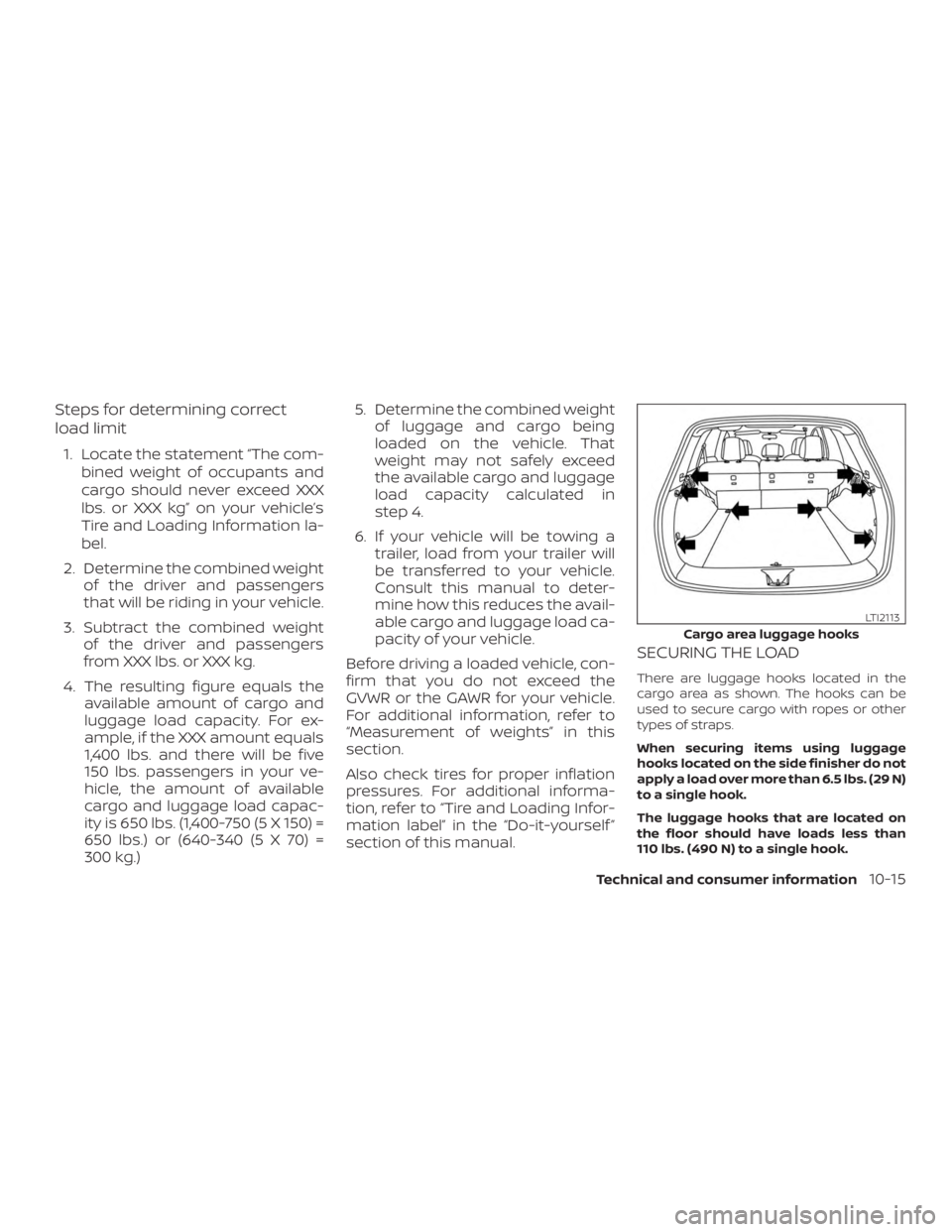
SECURING THE LOAD
There are luggage hooks located in the
cargo area as shown. The hooks can be
used to secure cargo with ropes or other
types of straps.
When securing items using luggage
hooks located on the side finisher do not
apply a load over more than 6.5 lbs. (29 N)
to a single hook.
The luggage hooks that are located on
the floor should have loads less than
110 lbs. (490 N) to a single hook.
Cargo area luggage hooks
LTI2113
Technical and consumer information10-15
Page 428 of 460
WARNING
∙ Properly secure all cargo with ropes orstraps to help prevent it from sliding
or shif ting. Do not place cargo higher
than the seatbacks. In a sudden stop
or collision, unsecured cargo could
cause personal injury.
∙ The child restraint top tether strap may be damaged by contact with
items in the cargo area. Secure any
items in the cargo area. Your child
could be seriously injured or killed in a
collision if the top tether strap is
damaged.
∙ Do not load your vehicle any heavier than the GVWR or the maximum front
and rear GAWRs. If you do, parts of
your vehicle can break, tire damage
could occur, or it can change the way
your vehicle handles. This could result
in loss of control and cause personal
injury.
LOADING TIPS
∙ The GVW must not exceed GVWR
or GAWR as specified on the
F.M.V.S.S./C.M.V.S.S. certification
label. ∙ Do not load the front and rear
axle to the GAWR. Doing so will
exceed the GVWR.
WARNING
∙ Properly secure all cargo with ropes or straps to help prevent
it from sliding or shif ting. Do not
place cargo higher than the
seatbacks. In a sudden stop or
collision, unsecured cargo could
cause personal injury.
∙ Do not load your vehicle any heavier than the GVWR or the
maximum front and rear
GAWRs. If you do, parts of your
vehicle can break, tire damage
could occur, or it can change the
way your vehicle handles. This
could result in loss of control
and cause personal injury. ∙ Overloading not only can
shorten the life of your vehicle
and the tire, but can also cause
unsafe vehicle handling and
longer braking distances. This
may cause a premature tire fail-
ure which could result in a seri-
ous accident and personal in-
jury. Failures caused by
overloading are not covered by
the vehicle’s warranty.
MEASUREMENT OF WEIGHTS
Secure loose items to prevent
weight shif ts that could affect the
balance of your vehicle. When the ve-
hicle is loaded, drive to a scale and
weigh the front and the rear wheels
separately to determine axle loads.
Individual axle loads should not ex-
ceed either of the Gross Axle Weight
Ratings (GAWR). The total of the axle
loads should not exceed the Gross
Vehicle Weight Rating (GVWR). These
ratings are given on the vehicle cer-
tification label. If weight ratings are
exceeded, move or remove items to
bring all weights below the ratings.
10-16
Technical and consumer information
Page 433 of 460
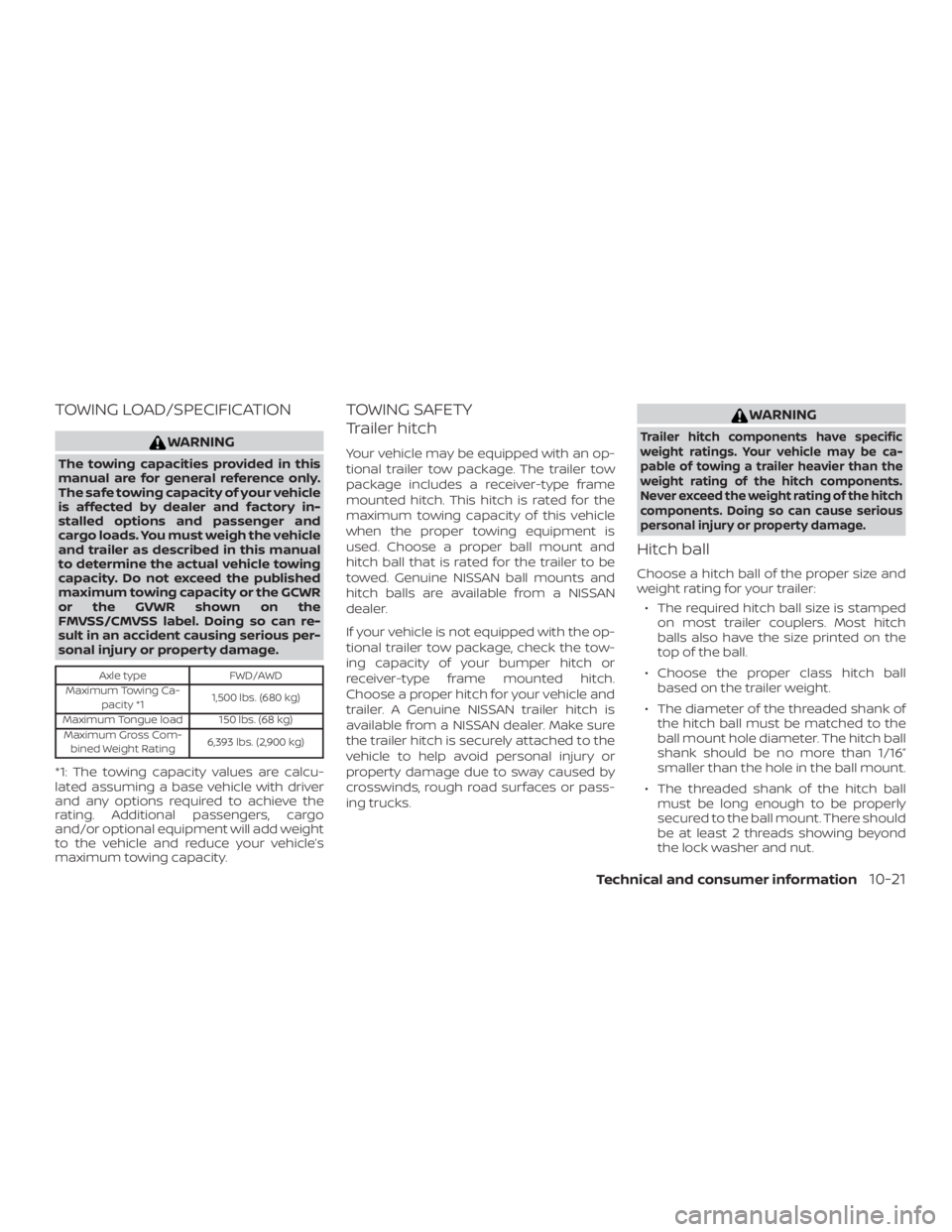
TOWING LOAD/SPECIFICATION
WARNING
The towing capacities provided in this
manual are for general reference only.
The safe towing capacity of your vehicle
is affected by dealer and factory in-
stalled options and passenger and
cargo loads. You must weigh the vehicle
and trailer as described in this manual
to determine the actual vehicle towing
capacity. Do not exceed the published
maximum towing capacity or the GCWR
or the GVWR shown on the
FMVSS/CMVSS label. Doing so can re-
sult in an accident causing serious per-
sonal injury or property damage.
Axle typeFWD/AWD
Maximum Towing Ca- pacity *1 1,500 lbs. (680 kg)
Maximum Tongue load 150 lbs. (68 kg) Maximum Gross Com- bined Weight Rating 6,393 lbs. (2,900 kg)
*1: The towing capacity values are calcu-
lated assuming a base vehicle with driver
and any options required to achieve the
rating. Additional passengers, cargo
and/or optional equipment will add weight
to the vehicle and reduce your vehicle’s
maximum towing capacity.
TOWING SAFETY
Trailer hitch
Your vehicle may be equipped with an op-
tional trailer tow package. The trailer tow
package includes a receiver-type frame
mounted hitch. This hitch is rated for the
maximum towing capacity of this vehicle
when the proper towing equipment is
used. Choose a proper ball mount and
hitch ball that is rated for the trailer to be
towed. Genuine NISSAN ball mounts and
hitch balls are available from a NISSAN
dealer.
If your vehicle is not equipped with the op-
tional trailer tow package, check the tow-
ing capacity of your bumper hitch or
receiver-type frame mounted hitch.
Choose a proper hitch for your vehicle and
trailer. A Genuine NISSAN trailer hitch is
available from a NISSAN dealer. Make sure
the trailer hitch is securely attached to the
vehicle to help avoid personal injury or
property damage due to sway caused by
crosswinds, rough road surfaces or pass-
ing trucks.
WARNING
Trailer hitch components have specific
weight ratings. Your vehicle may be ca-
pable of towing a trailer heavier than the
weight rating of the hitch components.
Never exceed the weight rating of the hitch
components. Doing so can cause serious
personal injury or property damage.
Hitch ball
Choose a hitch ball of the proper size and
weight rating for your trailer:
∙ The required hitch ball size is stamped on most trailer couplers. Most hitch
balls also have the size printed on the
top of the ball.
∙ Choose the proper class hitch ball based on the trailer weight.
∙ The diameter of the threaded shank of the hitch ball must be matched to the
ball mount hole diameter. The hitch ball
shank should be no more than 1/16”
smaller than the hole in the ball mount.
∙ The threaded shank of the hitch ball must be long enough to be properly
secured to the ball mount. There should
be at least 2 threads showing beyond
the lock washer and nut.
Technical and consumer information10-21
Page 435 of 460
Follow the instructions provided by the
manufacturer for installing and using the
sway control device.
Class I hitch
Class I trailer hitch equipment (receiver, ball
mount and hitch ball) can be used to tow
trailers of a maximum weight of 2,000 lbs.
(907 kg).
Tire pressures
∙ When towing a trailer, inflate thevehicle tires to the recom-
mended cold tire pressure indi-
cated on the Tire and Loading In-
formation label.
∙ Trailer tire condition, size, load rat- ing and proper inflation pressure
should be in accordance with the
trailer and tire manufacturer’s
specifications.
Safety chains
Always use suitable safety chains between
your vehicle and the trailer. The safety
chains should be crossed and should be
attached to the hitch, not to the vehicle
bumper or axle. The safety chains can be attached to the bumper if the hitch ball is
mounted to the bumper. Be sure to leave
enough slack in the chains to permit turn-
ing corners.
Trailer lights
CAUTION
When splicing into the vehicle electrical
system, a commercially available
power-type module/converter must be
used to provide power for all trailer
lighting. This unit uses the vehicle bat-
tery as a direct power source for all
trailer lights while using the vehicle tail
light, stop light and turn signal circuits
as a signal source. The
module/converter must draw no more
that 15 milliamps from the stop and tail
lamp circuits. Using a
module/converter that exceeds these
power requirements may damage the
vehicle’s electrical system. It is recom-
mended that you visit a reputable
trailer retailer to obtain the proper
equipment and to have it installed.
Trailer lights should comply with federal
and/or local regulations. For assistance in
hooking up trailer lights, it is recommended
that you contact a NISSAN dealer or repu- table trailer retailer. Vehicles equipped with
the optional trailer tow package are
equipped with a flat 4-pin connector, an
adapter will be needed to connect the
trailer lights to the vehicle. Adapters are
available at auto parts stores and hitch re-
tailers.Pre-towing tips
∙ Be certain your vehicle maintains a level
position when a loaded and/or un-
loaded trailer is hitched. Do not drive the
vehicle if it has an abnormal nose-up or
nose-down condition; check for im-
proper tongue load, overload, worn sus-
pension or other possible causes of ei-
ther condition.
∙ Always secure items in the trailer to pre- vent load shif t while driving.
∙ Keep the cargo load as low as possible in the trailer to keep the trailer center of
gravity low.
∙ Load the trailer so approximately 60% of the trailer load is in the front half and
40% is in the back half. Also make sure
the load is balanced side to side.
Technical and consumer information10-23
Page 436 of 460
∙ Check your hitch, trailer tire pressure,vehicle tire pressure, trailer light opera-
tion, and trailer wheel lug nuts every
time you attach a trailer to the vehicle.
∙ Be certain your rearview mirrors con- form to all federal, state or local regula-
tions. If not, install any mirrors required
for towing before driving the vehicle.
∙ Determine the overall height of the ve- hicle and trailer so the required clear-
ance is known.
Trailer towing tips
In order to gain skill and an understanding
of the vehicle’s behavior, you should prac-
tice turning, stopping and backing up in an
area which is free from traffic. Steering sta-
bility and braking performance will be
somewhat different than under normal
driving conditions.
∙ Always secure items in the trailer to pre- vent load shif t while driving.
∙ Lock the trailer hitch coupler with a pin or lock to prevent the coupler from in-
advertently becoming unlatched.
∙ Avoid abrupt starts, acceleration or stops.
∙ Avoid sharp turns or lane changes. ∙ Always drive your vehicle at a moderate
speed.
∙ When backing up, hold the bottom of the steering wheel with one hand. Move
your hand in the direction in which you
want the trailer to go. Make small cor-
rections and back up slowly. If possible,
have someone guide you when you are
backing up.
Always block the wheels on both vehicle
and trailer when parking. Parking on a
slope is not recommended; however, if you
must do so:
CAUTION
If you move the shif t lever to the P (Park)
position before blocking the wheels
and applying the parking brake, trans-
mission damage could occur.
1. Apply and hold the brake pedal.
2. Have someone place blocks on the downhill side of the vehicle and trailer
wheels.
3. Af ter the wheel blocks are in place, slowly release the brake pedal until the
blocks absorb the vehicle load.
4. Apply the parking brake. 5. Shif t the transmission into P (Park).
6. Turn off the engine.
To drive away: 1. Start the vehicle.
2. Apply and hold the brake pedal.
3. Shif t the transmission into gear.
4. Release the parking brake.
5. Drive slowly until the vehicle and trailer are clear from the blocks.
6. Apply and hold the brake pedal.
7. Have someone retrieve and store the blocks.
∙ While going downhill, the weight of the trailer pushing on the tow vehicle may
decrease overall stability. Therefore, to
maintain adequate control, reduce your
speed and shif t to a lower gear. Avoid
long or repeated use of the brakes
when descending a hill, as this reduces
their effectiveness and could cause
overheating. Shif ting to a lower gear in-
stead provides “engine braking” and re-
duces the need to brake as frequently.
10-24Technical and consumer information
Page 441 of 460
You may notif y NISSAN by contact-
ing our Consumer Affairs Depart-
ment, toll-free, at 1-800-NISSAN-1.
For Canada
If you believe that your vehicle has a
defect which could cause a crash or
could cause injury or death, you
should immediately inform Trans-
port Canada in addition to notif ying
NISSAN.
If Transport Canada receives com-
plaints, it may open an investigation,
and if it finds that a safety defect
exists in a group of vehicles, it may
request that NISSAN conduct a recall
campaign. However, Transport
Canada cannot become involved in
individual problems between you,
your dealer, or NISSAN.You may contact Transport Canada’s
Defect Investigations and Recalls Divi-
sion toll free at 1-800-333-0510. You
may also report safety defects online
at: https://wwwapps.tc.gc.ca/Saf-
Sec-Sur/7/PCDB-BDPP/fc-
cp.aspx?lang=eng (English speakers)
or https://wwwapps.tc.gc.ca/Saf-
Sec-Sur/7/PCDB-BDPP/fc-
cp.aspx?lang=fra (French speakers)
Additional information concerning
motor vehicle safety may be obtained
from Transport Canada’s Road Safety
Information Centre at 1-800-333-0371
or online at www.tc.gc.ca/roadsafety
(English speakers) or
www.tc.gc.ca/securiteroutiere
(French speakers).
To notif y NISSAN of any safety con-
cerns please contact our Consumer
Information Centre toll free at 1-800-
387-0122.
WARNING
A vehicle equipped with All -Wheel Drive
(AWD) should never be tested using a
two wheel dynamometer (such as the
dynamometers used by some states for
emissions testing), or similar equip-
ment. Make sure you inform the test fa-
cility personnel that your vehicle is
equipped with AWD before it is placed
on a dynamometer. Using the wrong
test equipment may result in drivetrain
damage or unexpected vehicle move-
ment which could result in serious ve-
hicle damage or personal injury.
Due to legal requirements in some states
and Canadian Provinces, your vehicle may
be required to be in what is called the
“ready condition” for an
Inspection/Maintenance (I/M) test of the
emission control system.
The vehicle is set to the “ready condition”
when it is driven through certain driving
patterns. Usually, the ready condition can
be obtained by ordinary usage of the ve-
hicle.
READINESS FOR INSPECTION/
MAINTENANCE (I/M) TEST
Technical and consumer information10-29
Page 445 of 460
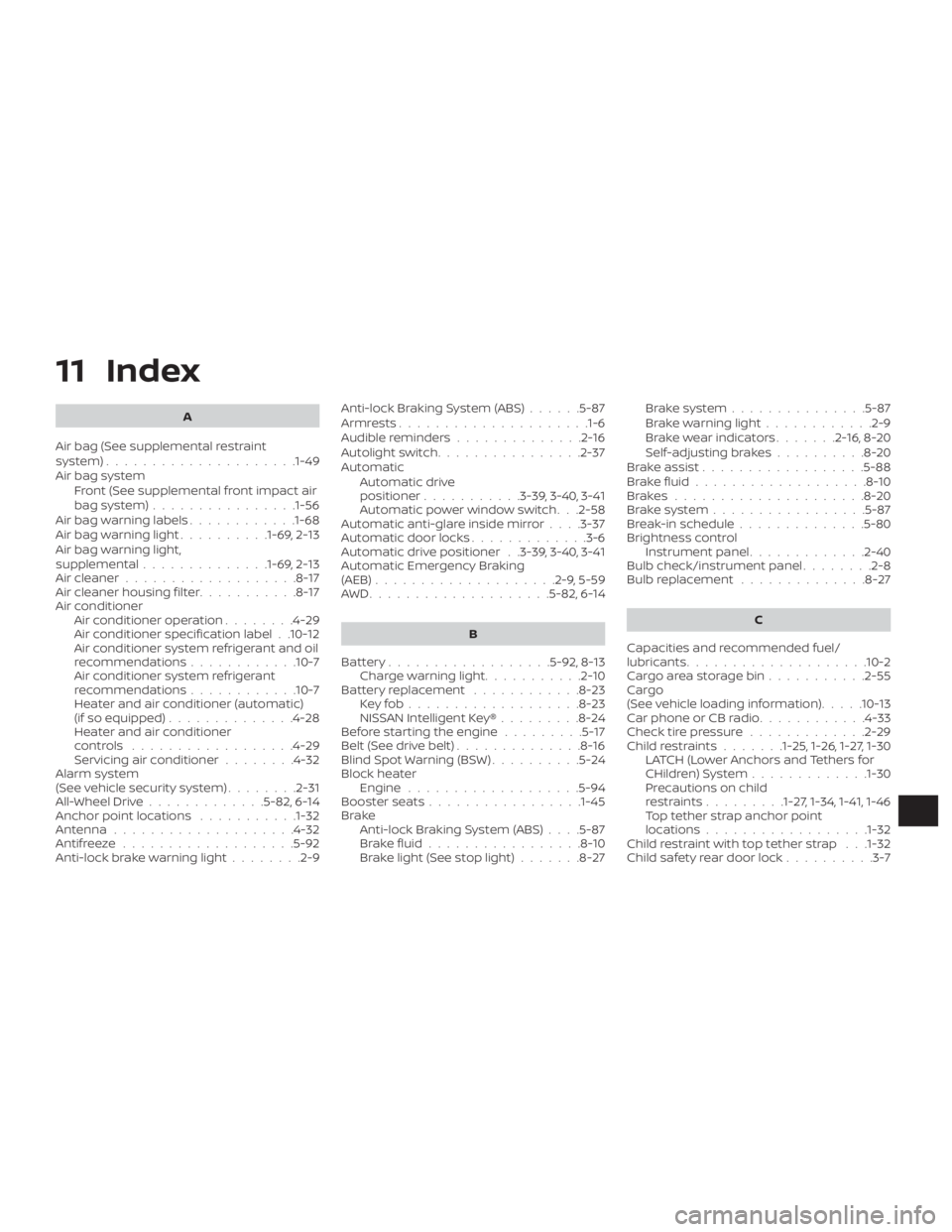
11 Index
A
Air bag (See supplemental restraint
system) .................... .1-49
Air bag system Front (See supplemental front impact air
bagsystem)................1-56
Air bag warning labels ............1-68
Airbagwarninglight..........1-69, 2-13
Air bag warning light,
supplemental ..............1-69, 2-13
Air cleaner ...................8-17
Air cleaner housing filter ...........8-17
Air conditioner Air conditioner operation ........4-29
Air conditioner specification label . .10-12
Air conditioner system refrigerant and oil
recommendations ............10-7
Air conditioner system refrigerant
recommendations ............10-7
Heater and air conditioner (automatic)
(if so equipped) ..............4-28
Heater and air conditioner
controls ..................4-29
Servicing air conditioner ........4-32
Alarm system
(See vehicle security system) ........2-31
All-Wheel Drive .............5-82,6-14
Anchor point locations ...........1-32
Antenna ....................4-32
Antifreeze ...................5-92
Anti-lock brake warning light ........2-9Anti-lock Braking System (ABS)
......5-87
Armrests.................... .1-6
Audible reminders ..............2-16
Autolightswitch................2-37
Automatic Automatic drive
positioner ...........3-39, 3-40, 3-41
Automatic power window switch . . .2-58
Automatic anti-glare inside mirror ....3-37
Automatic door locks .............3-6
Automatic drive positioner . .3-39, 3-40, 3-41
Automatic Emergency Braking
(AEB) ....................2-9,5-59
AWD....................5-82,6-14
B
Battery..................5-92,8-13 Charge warning light ...........2-10
Battery replacement ............8-23
Keyfob...................8-23
NISSAN Intelligent Key® .........8-24
Before starting the engine .........5-17
Belt(Seedrivebelt)..............8-16
Blind Spot Warning (BSW) ..........5-24
Block heater Engine ...................5-94
Booster seats .................1-45
Brake Anti-lock Braking System (ABS) ....5-87
Brakefluid.................8-10
Brakelight(Seestoplight).......8-27 Brakesystem...............5-87
Brakewarninglight............2-9
Brakewearindicators.......2-16,8-20
Self-adjustingbrakes..........8-20
Brakeassist..................5-88
Brakefluid...................8-10
Brakes.....................8-20
Brakesystem.................5-87
Break-in schedule ..............5-80
Brightness control Instrument panel .............2-40
Bulb check/instrument panel ........2-8
Bulb replacement ..............8-27
C
Capacities and recommended fuel/
l
ubricants....................10-2
Cargoareastoragebin...........2-55
Cargo
(See vehicle loading information) .....10-13
Car phone or CB radio ............4-33
Check tire pressure .............2-29
Childrestraints.......1-25, 1-26, 1-27, 1-30 LATCH (Lower Anchors and Tethers for
CHildren)System.............1-30
Precautions on child
restraints.........1-27, 1-34, 1-41, 1-46
Top tether strap anchor point
locations................. .1-32
Child restraint with top tether strap . . .1-32
Child safety rear door lock ..........3-7
Page 448 of 460
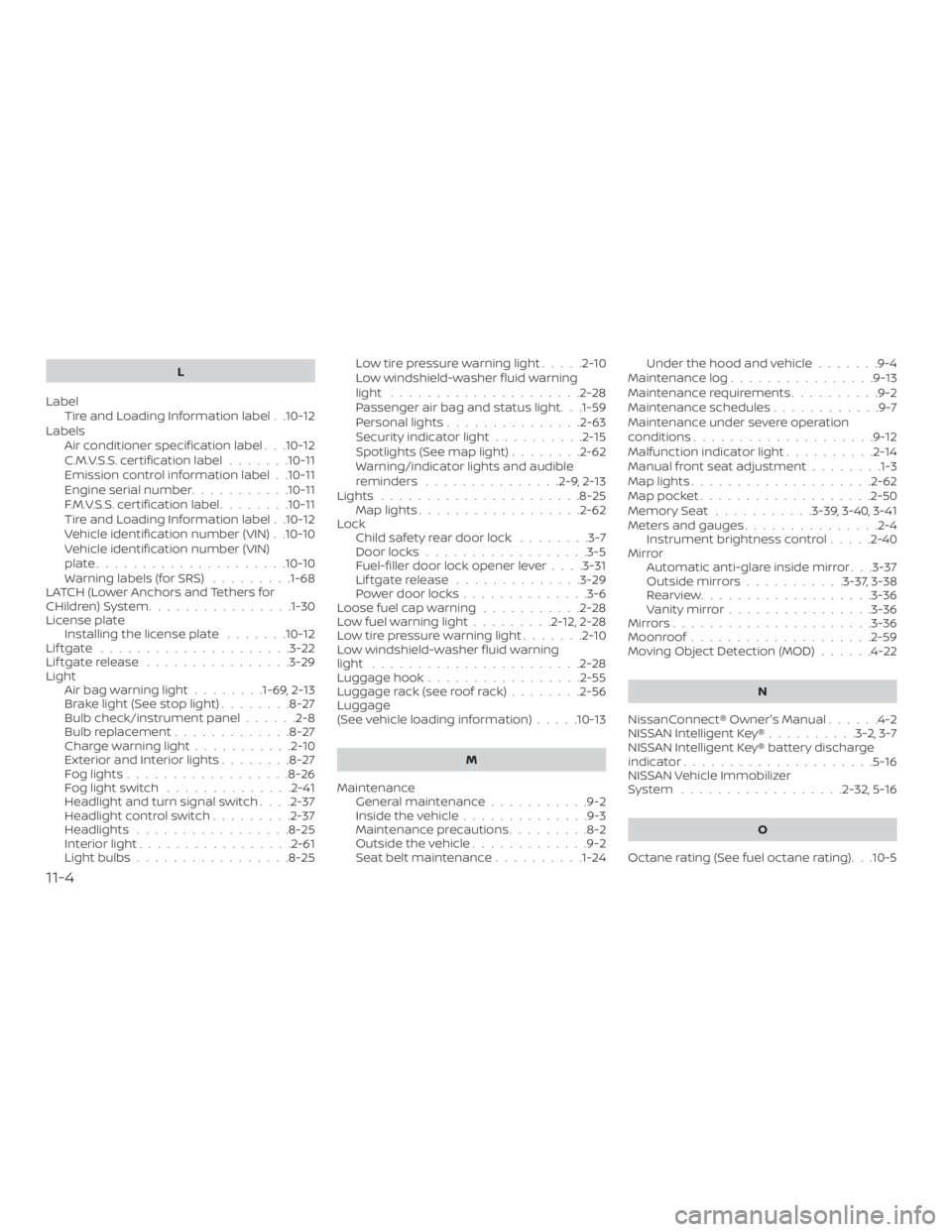
L
Label Tire and Loading Information label . .10-12
Labels Air conditioner specification label . . .10-12
C.M.V.S.S. certification label .......10-11
Emission control information label . .10-11
Engine serial number ...........10-11
F.M.V.S.S. certification label ........10-11
Tire and Loading Information label . .10-12
Vehicle identification number (VIN) . .10-10
Vehicle identification number (VIN)
plate.....................10-10
Warning labels (for SRS) .........1-68
LATCH (Lower Anchors and Tethers for
CHildren)System............... .1-30
License plate Installing the license plate .......10-12
Liftgate .....................3-22
Liftgaterelease ................3-29
Light Airbagwarninglight........1-69, 2-13
Brakelight(Seestoplight)........8-27
Bulb check/instrument panel ......2-8
Bulb replacement .............8-27
Charge warning light ...........2-10
ExteriorandInteriorlights........8-27
Foglights..................8-26
Foglightswitch ..............2-41
Headlight and turn signal switch ....2-37
Headlightcontrolswitch.........2-37
Headlights .................8-25
Interiorlight.................2-61
Lightbulbs.................8-25 Low tire pressure warning light
.....2-10
Low windshield-washer fluid warning
light .....................2-28
Passenger air bag and status light. . .1-59
Personal lights ...............2-63
Security indicator light ..........2-15
Spotlights(Seemaplight)........2-62
Warning/indicator lights and audible
reminders ...............2-9,2-13
Lights ......................8-25 Maplights..................2-62
Lock Child safety rear door lock ........3-7
Door locks ..................3-5
Fuel-filler door lock opener lever ....3-31
Liftgaterelease ..............3-29
Power door locks ..............3-6
Loose fuel cap warning ...........2-28
Lowfuelwarninglight.........2-12,2-28
Low tire pressure warning light .......2-10
Low windshield-washer fluid warning
light .......................2-28
Luggage hook .................2-55
Luggage rack (see roof rack) ........2-56
Luggage
(See vehicle loading information) .....10-13
M
Maintenance General maintenance ...........9-2
Insidethevehicle..............9-3
Maintenance precautions .........8-2
Outsidethevehicle.............9-2
Seat belt maintenance ..........1-24 Under the hood and vehicle
.......9-4
Maintenance log ................9-13
Maintenance requirements ..........9-2
Maintenance schedules ............9-7
Maintenance under severe operation
conditions....................9-12
Malfunctionindicatorlight..........2-14
Manual front seat adjustment ........1-3
Maplights....................2-62
Map pocket ...................2-50
Memory Seat ...........3-39,3-40,3-41
Meters and gauges ...............2-4
Instrument brightness control .....2-40
Mirror Automatic anti-glare inside mirror . . .3-37
Outsidemirrors...........3-37,3-38
Rearview...................3-36
Vanitymirror................3-36
Mirrors......................3-36
Moonroof ....................2-59
Moving Object Detection (MOD) ......4-22
N
NissanConnect® Owner's Manual ......4-2
NISSAN Intelligent Key® ..........3-2,3-7
NISS
AN Intelligent Key® battery discharge
indicator.................... .5-16
NISSAN Vehicle Immobilizer
System ..................2-32,5-16
O
Octane rating (See fuel octane rating). . .10-5
11-4