roof rack NISSAN MURANO 2019 Owner´s Manual
[x] Cancel search | Manufacturer: NISSAN, Model Year: 2019, Model line: MURANO, Model: NISSAN MURANO 2019Pages: 507, PDF Size: 6.1 MB
Page 85 of 507
∙ Modif ying or tampering with the frontpassenger seat may result in serious
personal injury. For example, do not
change the front seats by placing ma-
terial on the seat cushion or by install-
ing additional trim material, such as
seat covers, on the seat that are not
specifically designed to assure proper
air bag operation. Additionally, do not
stow any objects under the front pas-
senger seat or the seat cushion and
seatback. Such objects may interfere
with the proper operation of the occu-
pant classification sensor (weight
sensor).
∙ No unauthorized changes should be made to any components or wiring of
the seat belt system. This may affect
the front air bag system. Tampering
with the seat belt system may result
in serious personal injury. ∙ It is recommended that you visit a
NISSAN dealer for work on and around
the front air bag. It is also recom-
mended that you visit a NISSAN dealer
for installation of electrical equip-
ment. The Supplemental Restraint
System (SRS) wiring harnesses*
should not be modified or discon-
nected. Unauthorized electrical test
equipment and probing devices
should not be used on the air bag
system.
∙ A cracked windshield should be re- placed immediately by a qualified re-
pair facility. A cracked windshield
could affect the function of the
supplemental air bag system.
*The SRS wiring harness connectors are
yellow and orange for easy identifica-
tion.
When selling your vehicle, we request that
you inform the buyer about the front air
bag system and guide the buyer to the
appropriate sections in this Owner’s
Manual.
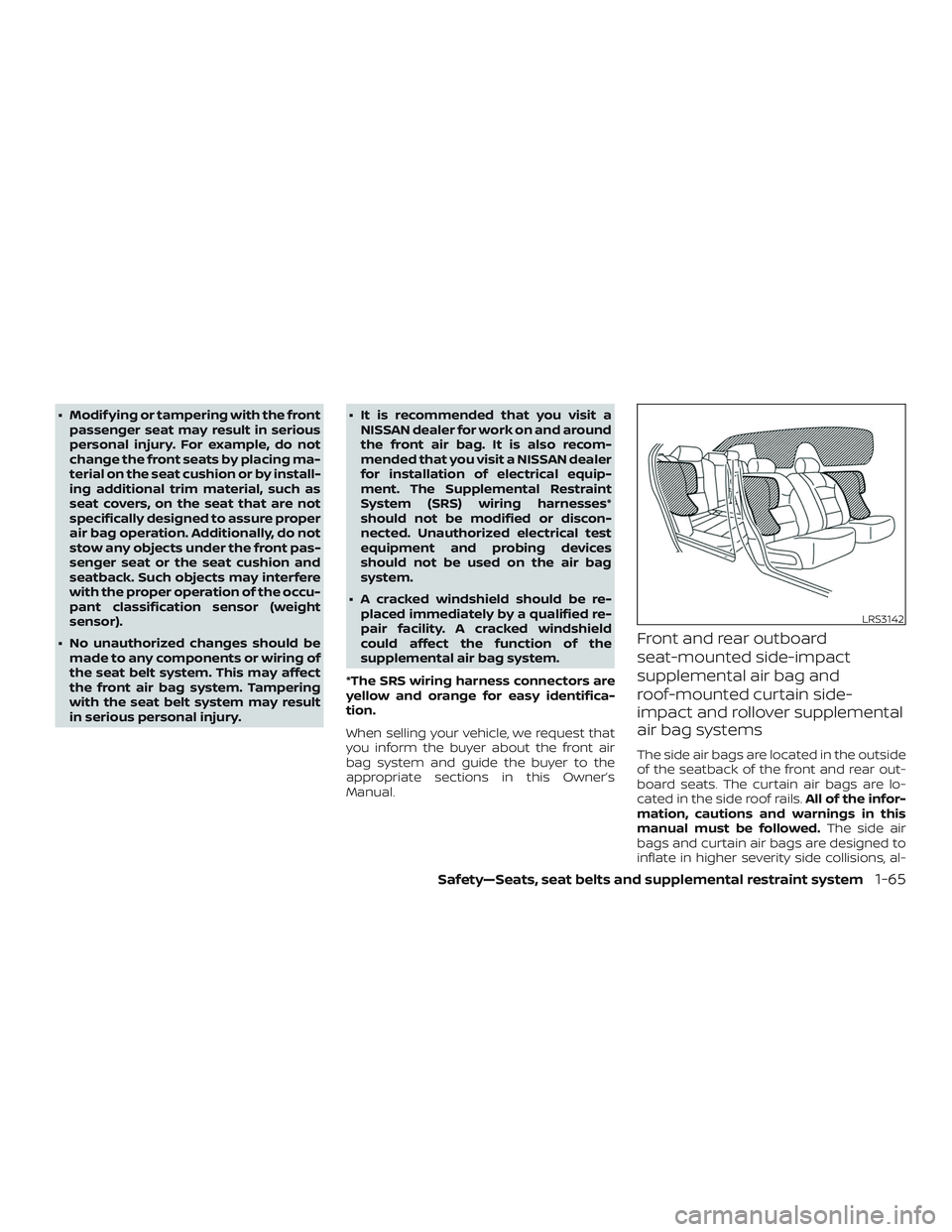
Front and rear outboard
seat-mounted side-impact
supplemental air bag and
roof-mounted curtain side-
impact and rollover supplemental
air bag systems
The side air bags are located in the outside
of the seatback of the front and rear out-
board seats. The curtain air bags are lo-
cated in the side roof rails. All of the infor-
mation, cautions and warnings in this
manual must be followed. The side air
bags and curtain air bags are designed to
inflate in higher severity side collisions, al-
LRS3142
Safety—Seats, seat belts and supplemental restraint system1-65
Page 95 of 507
Extended storage switch.......................2-54
Storage ........................................ 2-55
Front-door pockets .......................... 2-55
Console side pockets (if so equipped) ........2-56
Seatback pockets ........................... 2-56
Storagetrays................................ 2-57
Glovebox.................................... 2-58
Console box ................................. 2-58
Overhead sunglasses storage ...............2-58
Cup holders ................................. 2-59
Cargo area storage bin ......................2-61
Luggage hooks .............................. 2-61
Roof rack (if so equipped) ....................2-62
Windows ....................................... 2-63
Power windows ............................. 2-63
Power moonroof (if so equipped) ...............2-65Interior lights
................................... 2-68
Console light (if so equipped) ................2-68
Map lights ................................... 2-69
Personal lights .............................. 2-69
Luggage compartment light ................2-69
HomeLink® Universal Transceiver
(if so equipped) ................................. 2-70
Programming HomeLink® ...................2-70
Programming HomeLink® for Canadian
customers and gate openers ................2-72
Operating the HomeLink® Universal
Transceiver .................................. 2-73
Programming trouble-diagnosis ............2-73
Clearing the programmed information ......2-73
Reprogramming a single HomeLink®
button....................................... 2-73
If your vehicle is stolen .......................2-74
Page 101 of 507
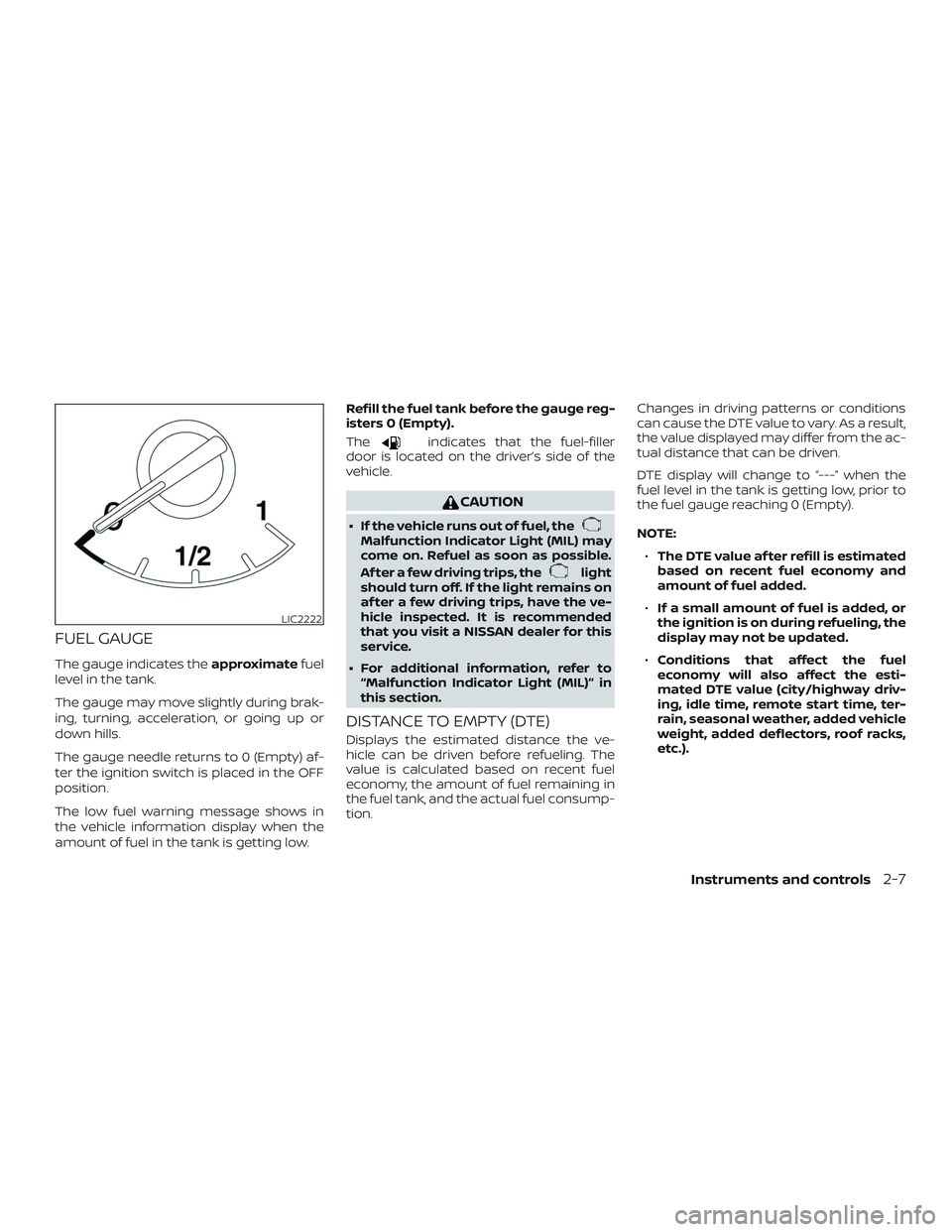
FUEL GAUGE
The gauge indicates theapproximatefuel
level in the tank.
The gauge may move slightly during brak-
ing, turning, acceleration, or going up or
down hills.
The gauge needle returns to 0 (Empty) af-
ter the ignition switch is placed in the OFF
position.
The low fuel warning message shows in
the vehicle information display when the
amount of fuel in the tank is getting low. Refill the fuel tank before the gauge reg-
isters 0 (Empty).
The
indicates that the fuel-filler
door is located on the driver’s side of the
vehicle.
CAUTION
∙ If the vehicle runs out of fuel, theMalfunction Indicator Light (MIL) may
come on. Refuel as soon as possible.
Af ter a few driving trips, the
light
should turn off. If the light remains on
af ter a few driving trips, have the ve-
hicle inspected. It is recommended
that you visit a NISSAN dealer for this
service.
∙ For additional information, refer to “Malfunction Indicator Light (MIL)” in
this section.
DISTANCE TO EMPTY (DTE)
Displays the estimated distance the ve-
hicle can be driven before refueling. The
value is calculated based on recent fuel
economy, the amount of fuel remaining in
the fuel tank, and the actual fuel consump-
tion. Changes in driving patterns or conditions
can cause the DTE value to vary. As a result,
the value displayed may differ from the ac-
tual distance that can be driven.
DTE display will change to “---” when the
fuel level in the tank is getting low, prior to
the fuel gauge reaching 0 (Empty).
NOTE:
∙ The DTE value af ter refill is estimated
based on recent fuel economy and
amount of fuel added.
∙ If a small amount of fuel is added, or
the ignition is on during refueling, the
display may not be updated.
∙ Conditions that affect the fuel
economy will also affect the esti-
mated DTE value (city/highway driv-
ing, idle time, remote start time, ter-
rain, seasonal weather, added vehicle
weight, added deflectors, roof racks,
etc.).
LIC2222
Instruments and controls2-7
Page 127 of 507
Cruise Target Speed SET (if so equipped)
This message will appear if the Cruise Con-
trol system is on when the SET switch is
pushed and the Cruise Control Alerts are
enabled.
For additional information, refer to “Cruise
control” in the “Starting and driving” section
of this manual.
Intelligent Cruise ON (if so equipped)
This message appears if the
Intelli-
gent Cruise Control (ICC) switch on the
steering wheel is pressed and Cruise Con-
trol Alerts are enabled in the vehicle infor-
mation display.
For additional information, refer to “Intelli-
gent Cruise Control (ICC)” in the “Starting
and driving” section of this manual.
Target Speed SET with Intelligent Dis-
tance Control (if so equipped)
This message will appear if the Intelligent
Cruise Control system is on when the SET
switch is pushed and the Cruise Control
Alerts are enabled.
For additional information, refer to “Cruise
control” in the “Starting and driving” section
of this manual. Your vehicle has two types of security sys-
tems:
∙ Vehicle security system
∙ NISSAN Vehicle Immobilizer System
VEHICLE SECURITY SYSTEM
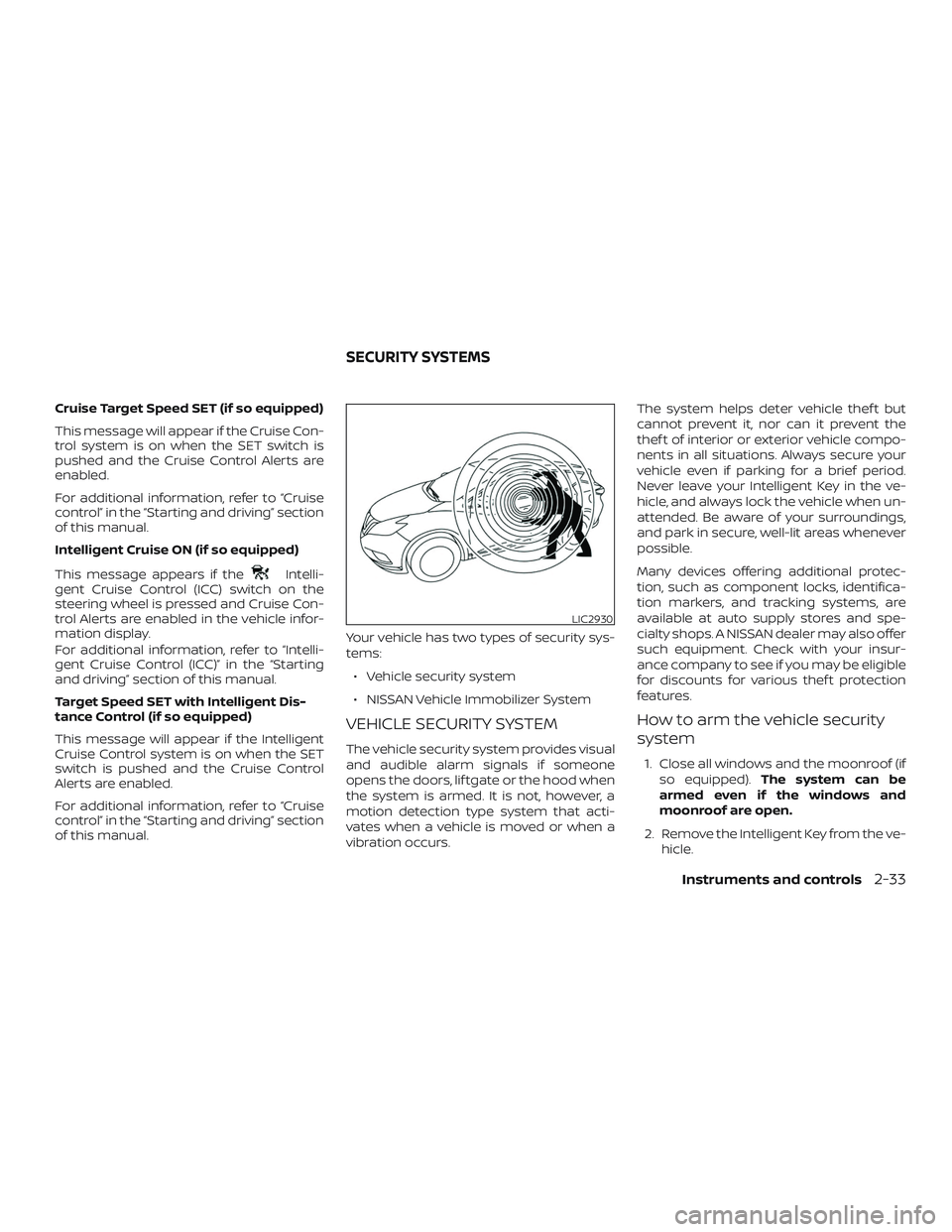
The vehicle security system provides visual
and audible alarm signals if someone
opens the doors, lif tgate or the hood when
the system is armed. It is not, however, a
motion detection type system that acti-
vates when a vehicle is moved or when a
vibration occurs. The system helps deter vehicle thef t but
cannot prevent it, nor can it prevent the
thef t of interior or exterior vehicle compo-
nents in all situations. Always secure your
vehicle even if parking for a brief period.
Never leave your Intelligent Key in the ve-
hicle, and always lock the vehicle when un-
attended. Be aware of your surroundings,
and park in secure, well-lit areas whenever
possible.
Many devices offering additional protec-
tion, such as component locks, identifica-
tion markers, and tracking systems, are
available at auto supply stores and spe-
cialty shops. A NISSAN dealer may also offer
such equipment. Check with your insur-
ance company to see if you may be eligible
for discounts for various thef t protection
features.
How to arm the vehicle security
system
1. Close all windows and the moonroof (if
so equipped). The system can be
armed even if the windows and
moonroof are open.
2. Remove the Intelligent Key from the ve- hicle.
LIC2930
SECURITY SYSTEMS
Instruments and controls2-33
Page 156 of 507
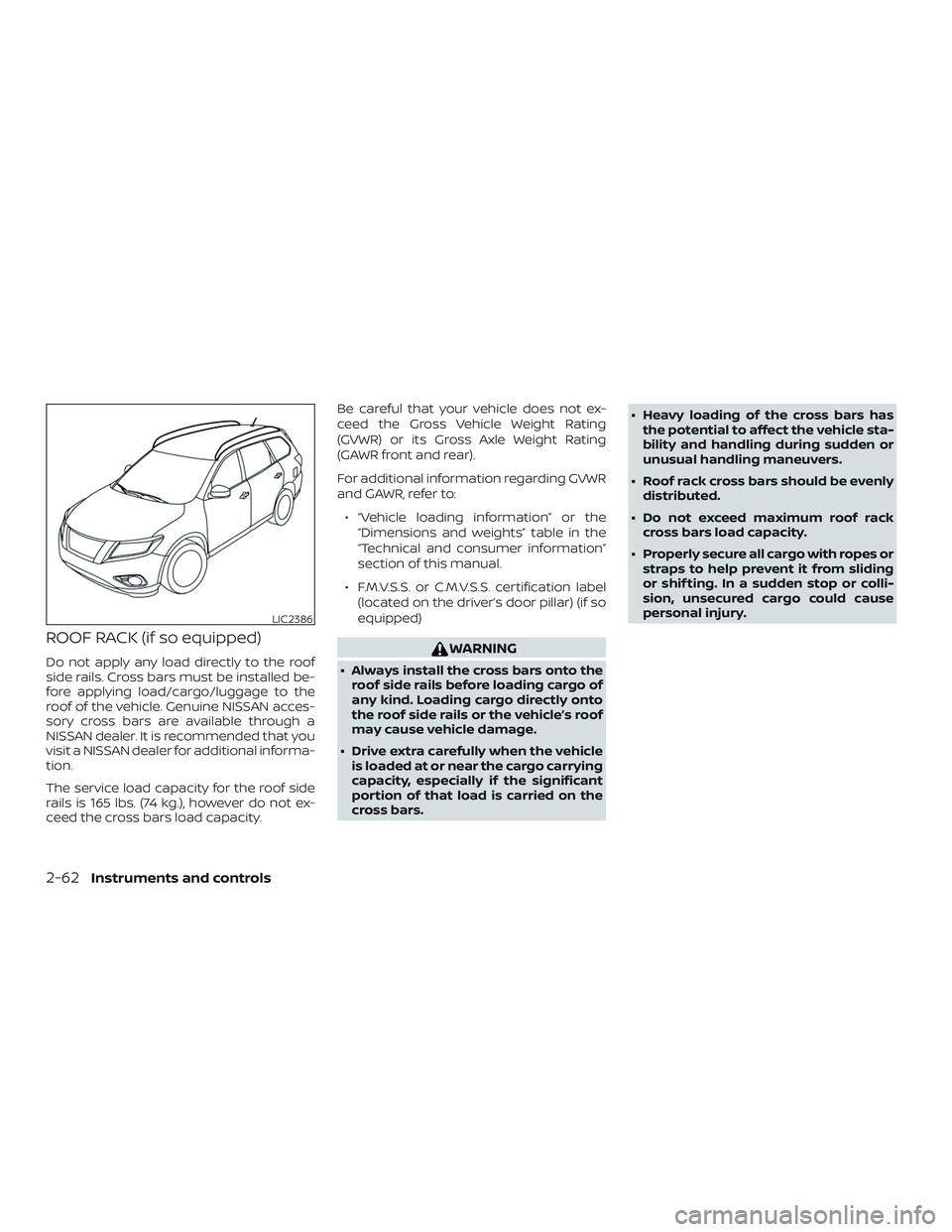
ROOF RACK (if so equipped)
Do not apply any load directly to the roof
side rails. Cross bars must be installed be-
fore applying load/cargo/luggage to the
roof of the vehicle. Genuine NISSAN acces-
sory cross bars are available through a
NISSAN dealer. It is recommended that you
visit a NISSAN dealer for additional informa-
tion.
The service load capacity for the roof side
rails is 165 lbs. (74 kg.), however do not ex-
ceed the cross bars load capacity.Be careful that your vehicle does not ex-
ceed the Gross Vehicle Weight Rating
(GVWR) or its Gross Axle Weight Rating
(GAWR front and rear).
For additional information regarding GVWR
and GAWR, refer to:
∙ “Vehicle loading information” or the “Dimensions and weights” table in the
“Technical and consumer information”
section of this manual.
∙ F.M.V.S.S. or C.M.V.S.S. certification label (located on the driver’s door pillar) (if so
equipped)WARNING
∙ Always install the cross bars onto theroof side rails before loading cargo of
any kind. Loading cargo directly onto
the roof side rails or the vehicle’s roof
may cause vehicle damage.
∙ Drive extra carefully when the vehicle is loaded at or near the cargo carrying
capacity, especially if the significant
portion of that load is carried on the
cross bars. ∙ Heavy loading of the cross bars has
the potential to affect the vehicle sta-
bility and handling during sudden or
unusual handling maneuvers.
∙ Roof rack cross bars should be evenly distributed.
∙ Do not exceed maximum roof rack cross bars load capacity.
∙ Properly secure all cargo with ropes or straps to help prevent it from sliding
or shif ting. In a sudden stop or colli-
sion, unsecured cargo could cause
personal injury.
LIC2386
2-62Instruments and controls
Page 250 of 507
WARNING
∙ Do not leave children or adults whowould normally require the assis-
tance of others alone in your vehicle.
Pets should also not be lef t alone.
They could accidentally injure them-
selves or others through inadvertent
operation of the vehicle. Also, on hot,
sunny days, temperatures in a closed
vehicle could quickly become high
enough to cause severe or possibly
fatal injuries to people or animals.
∙ Properly secure all cargo with ropes or straps to help prevent it from sliding
or shif ting. Do not place cargo higher
than the seatbacks. In a sudden stop
or collision, unsecured cargo could
cause personal injury.
∙ Exceeding the roof rack capacity can change the vehicle’s center of gravity
and adversely affect the handling and
stability of the vehicle resulting in an
accident causing death or serious
injury.
EXHAUST GAS (carbon monoxide)
WARNING
∙ Do not breathe exhaust gases; theycontain colorless and odorless carbon
monoxide. Carbon monoxide is dan-
gerous. It can cause unconsciousness
or death.
∙ If you suspect that exhaust fumes are entering the vehicle, drive with all
windows fully open, and have the ve-
hicle inspected immediately.
∙ Do not run the engine in closed spaces such as a garage.
∙ Do not park the vehicle with the en- gine running for any extended length
of time.
∙ Keep the lif tgate and rear vent win- dows closed while driving, otherwise
exhaust gases could be drawn into
the passenger compartment. If you
must drive with the lif tgate or rear
vent windows open, follow these
precautions:
1. Open all the windows. 2. Set the
air recirculation but-
ton to off and the fan control dial to
high to circulate the air.
∙ If electrical wiring or other cable con- nections must pass to a trailer
through the seal on the lif tgate or the
body, follow the manufacturer’s rec-
ommendation to prevent carbon
monoxide entry into the vehicle.
∙ The exhaust system and body should be inspected by a qualified mechanic
whenever:
a. The vehicle is raised for service.
b. You suspect that exhaust fumes are entering into the passenger
compartment.
c. You notice a change in the sound of the exhaust system.
d. You have had an accident involving damage to the exhaust system,
underbody, or rear of the vehicle.
PRECAUTIONS WHEN STARTING AND
DRIVING
5-4Starting and driving
Page 258 of 507
∙ If your engine stalls or you cannotmake it to the top of a steep hill, never
attempt to turn around. Your vehicle
could tip or roll over. Always back
straight down in R (Reverse) gear and
apply brakes to control your speed.
∙ Heavy braking going down a hill could cause your brakes to overheat and
fade, resulting in loss of control and
an accident. Apply brakes lightly and
use a low gear to control your speed.
∙ Unsecured cargo can be thrown around when driving over rough ter-
rain. Properly secure all cargo so it will
not be thrown forward and cause in-
jury to you or your passengers.
∙ Exceeding the roof rack capacity can raise the center of gravity excessively
and affect the handling and stability
of the vehicle.
∙ Secure heavy loads in the cargo area as far forward and as low as possible.
Do not equip the vehicle with tires
larger than specified in this manual.
This could cause your vehicle to roll
over. ∙ Do not grip the inside or spokes of the
steering wheel when driving off-road.
The steering wheel could move sud-
denly and injure your hands. Instead
drive with your fingers and thumbs on
the outside of the rim.
∙ Before operating the vehicle, ensure that the driver and all passengers
have their seat belts fastened.
∙ Always drive with the floor mats in place as the floor may become hot.
∙ Lower your speed when encountering strong crosswinds. With a higher cen-
ter of gravity, your NISSAN is more af-
fected by strong side winds. Slower
speeds ensure better vehicle control.
∙ Do not drive beyond the performance capability of the tires, even with AWD
engaged.
∙ For AWD equipped vehicles, do not at- tempt to raise two wheels off the
ground and shif t the transmission to
any drive or reverse position with the
engine running. Doing so may result
in drivetrain damage or unexpected
vehicle movement which could result
in serious vehicle damage or personal
injury. ∙ Do not attempt to test an AWD
equipped vehicle on a 2-wheel dyna-
mometer (such as the dynamometers
used by some states for emissions
testing) or similar equipment even if
the other two wheels are raised off the
ground. Make sure you inform test fa-
cility personnel that your vehicle is
equipped with AWD before it is placed
on a dynamometer. Using the wrong
test equipment may result in drive-
train damage or unexpected vehicle
movement which could result in seri-
ous vehicle damage or personal
injury.
∙ When a wheel is off the ground due to an unlevel surface, do not spin the
wheel excessively.
∙ Accelerating quickly, sharp steering maneuvers or sudden braking may
cause loss of control.
∙ If at all possible, avoid sharp turning maneuvers, particularly at high
speeds. Your NISSAN vehicle has a
higher center of gravity than a pas-
senger car. The vehicle is not de-
signed for cornering at the same
speeds as passenger cars.
5-12Starting and driving
Page 403 of 507
7 Appearance and care
Cleaning exterior................................ 7-2
Washing ...................................... 7-2
Waxing ....................................... 7-2
Removing spots .............................. 7-3
Underbody ................................... 7-3
Glass ......................................... 7-3
Aluminum alloy wheels (if so equipped) ....... 7-3
Chromeparts................................ 7-3
Tire dressings ................................ 7-3
Cleaning interior ................................. 7-4
Air fresheners ................................ 7-4 Power moonroof (if so equipped)
............. 7-5
Floor mats (if so equipped) ................... 7-5
Seatbelts ....................................7-6
Cleaning the seat tracks ...................... 7-7
Corrosion protection ............................ 7-7
Most common factors contributing to
vehicle corrosion ............................. 7-7
Environmental factors influence the
rate of corrosion .............................. 7-7
Protect your vehicle from corrosion ..........7-8
Page 502 of 507
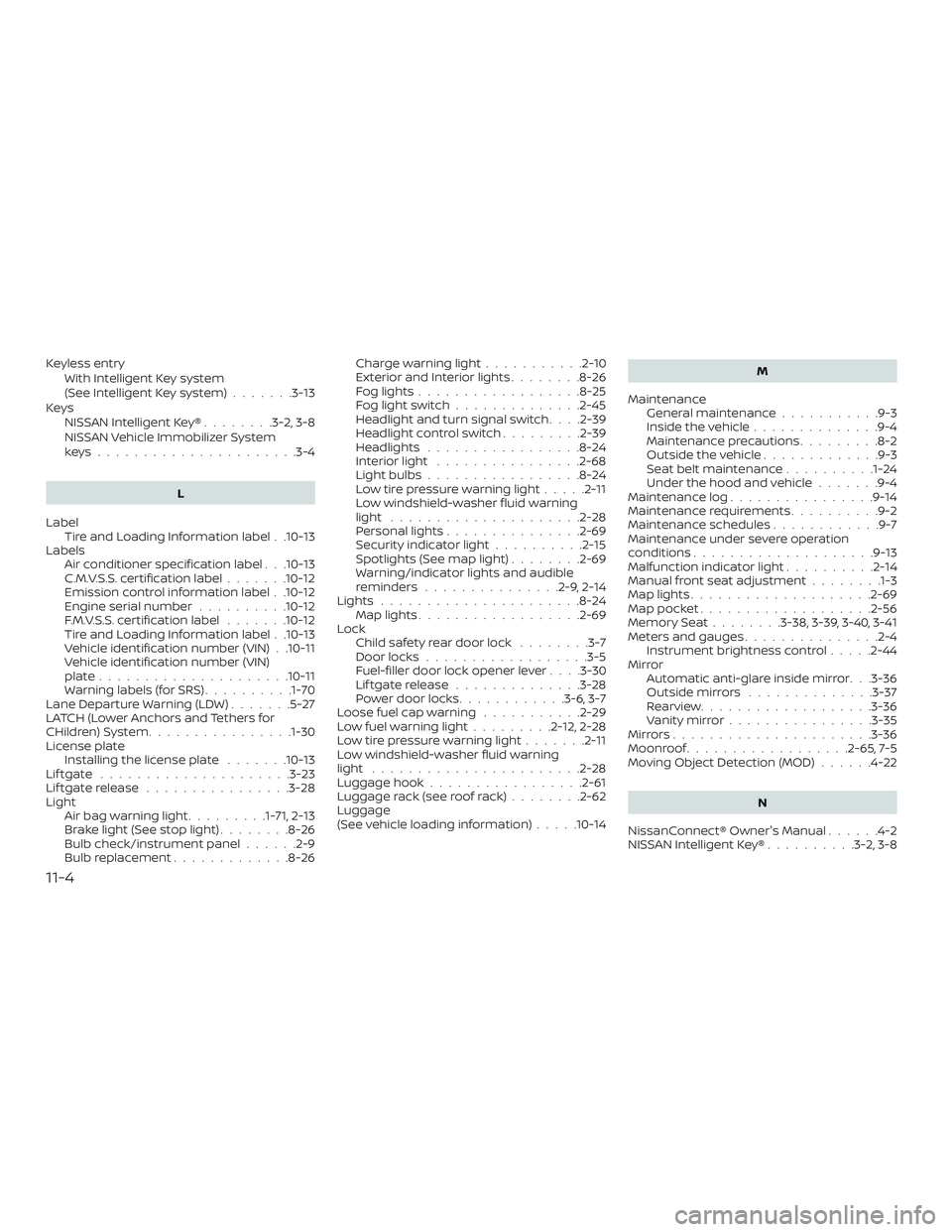
Keyless entryWith Intelligent Key system
(See Intelligent Key system) .......3-13
Keys NISSAN Intelligent Key® ........3-2,3-8
NISSAN Vehicle Immobilizer System
keys......................3-4
L
Label Tire and Loading Information label . .10-13
Labels Air conditioner specification label . . .10-13
C.M.V.S.S. certification label .......10-12
Emission control information label . .10-12
Engine serial number ..........10-12
F.M.V.S.S. certification label .......10-12
Tire and Loading Information label . .10-13
Vehicle identification number (VIN) . .10-11
Vehicle identification number (VIN)
plate.....................10-11
Warning labels (for SRS) ..........1-70
Lane Departure Warning (LDW) .......5-27
LATCH (Lower Anchors and Tethers for
CHildren)System............... .1-30
License plate Installing the license plate .......10-13
Liftgate .....................3-23
Liftgaterelease ................3-28
Light Airbagwarninglight.........1-71, 2-13
Brakelight(Seestoplight)........8-26
Bulb check/instrument panel ......2-9
Bulb replacement .............8-26 Charge warning light
...........2-10
ExteriorandInteriorlights........8-26
Foglights..................8-25
Foglightswitch..............2-45
Headlight and turn signal switch ....2-39
Headlightcontrolswitch.........2-39
Headlights .................8-24
Interiorlight ................2-68
Lightbulbs.................8-24
Low tire pressure warning light .....2-11
Low windshield-washer fluid warning
light .....................2-28
Personal lights ...............2-69
Security indicator light ..........2-15
Spotlights(Seemaplight)........2-69
Warning/indicator lights and audible
reminders ...............2-9,2-14
Lights......................8-24 Maplights..................2-69
Lock Child safety rear door lock ........3-7
Door locks ..................3-5
Fuel-filler door lock opener lever ....3-30
Liftgaterelease ..............3-28
Power door locks ............3-6,3-7
Loose fuel cap warning ...........2-29
Lowfuelwarninglight.........2-12,2-28
Low tire pressure warning light .......2-11
Low windshield-washer fluid warning
light .......................2-28
Luggage hook .................2-61
Luggage rack (see roof rack) ........2-62
Luggage
(See vehicle loading information) .....10-14 M
Maintenance General maintenance ...........9-3
Insidethevehicle..............9-4
Maintenance precautions .........8-2
Outsidethevehicle.............9-3
Seat belt maintenance ..........1-24
Under the hood and vehicle .......9-4
Maintenance log ................9-14
Maintenance requirements ..........9-2
Maintenance schedules ............9-7
Maintenance under severe operation
conditions....................9-13
Malfunctionindicatorlight..........2-14
Manual front seat adjustment ........1-3
Maplights....................2-69
Map pocket ...................2-56
Memory Seat ........3-38,3-39,3-40, 3-41
Meters and gauges ...............2-4
Instrument brightness control .....2-44
Mirror Automatic anti-glare inside mirror. . .3-36
Outsidemirrors ..............3-37
Rearview...................3-36
Vanitymirror................3-35
Mirrors..................... .3-36
Moonr
oof ..................2-65,7-5
Moving Object Detection (MOD) ......4-22
N
NissanConnect® Owner's Manual ......4-2
NISSAN Intelligent Key® ..........3-2,3-8
11-4
Page 503 of 507
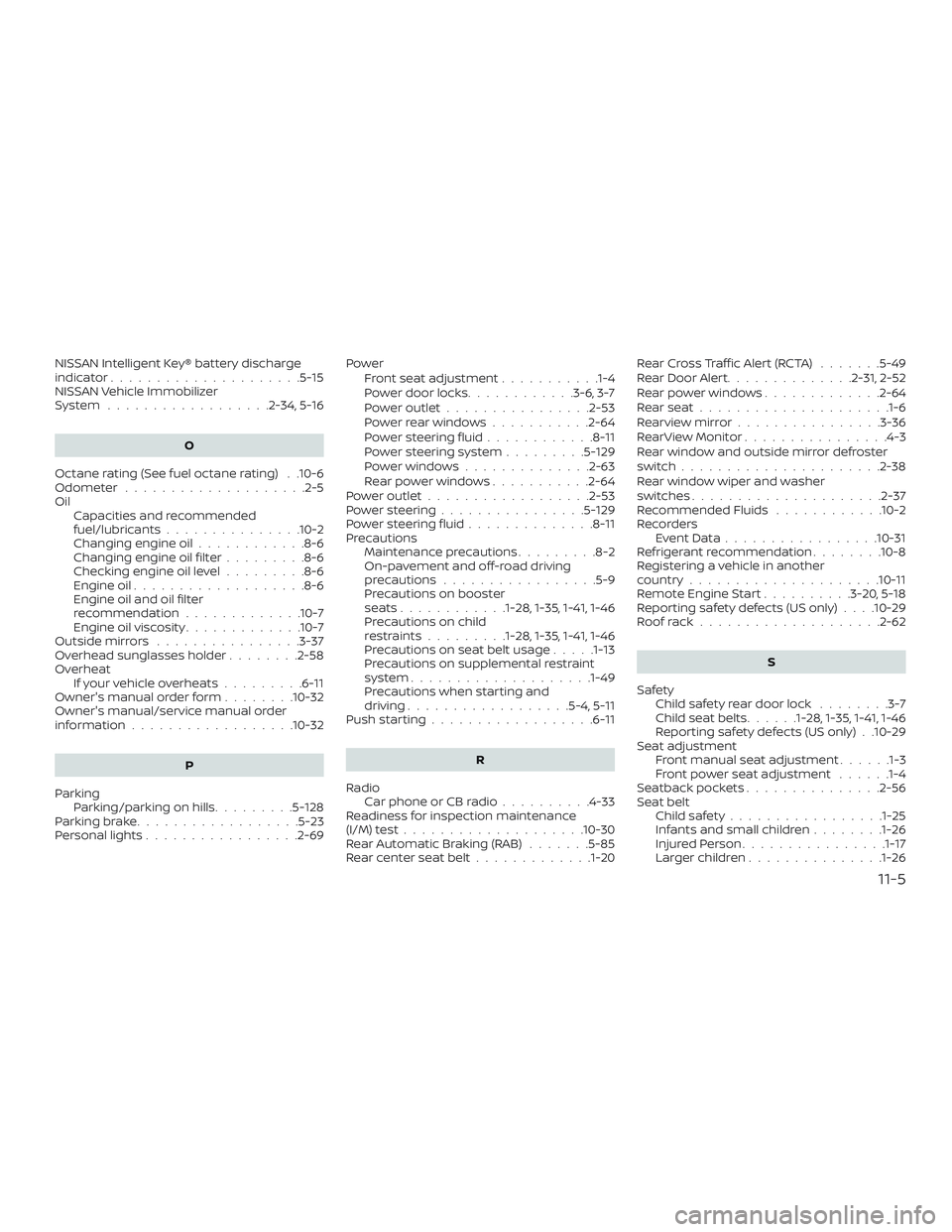
NISSAN Intelligent Key® battery discharge
indicator.....................5-15
NISSAN Vehicle Immobilizer
System ..................2-34,5-16O
Octane rating (See fuel octane rating) . .10-6
Odometer ....................2-5
Oil Capacities and recommended
fuel/lubricants...............10-2
Changing engine oil ............8-6
Changing engine oil filter .........8-6
Checking engine oil level .........8-6
Engine oil ...................8-6
Engine oil and oil filter
recommendation .............10-7
Engine oil viscosity .............10-7
Outsidemirrors ................3-37
Overhead sunglasses holder ........2-58
Overheat Ifyourvehicleoverheats.........6-11
Owner's manual order form ........10-32
Owner's manual/service manual order
information..................10-32
P
Parking Parking/parkingonhills.........5-128
Parkingbrake..................5-23
Personal lights .................2-69 Power
Front seat adjustment ...........1-4
Power door locks ............3-6,3-7
Poweroutlet................2-53
Powerrearwindows...........2-64
Powersteeringfluid............8-11
Power steering system .........5-129
Powerwindows..............2-63
Rearpowerwindows...........2-64
Poweroutlet..................2-53
Powersteering................5-129
Powersteeringfluid..............8-11
Precautions Maintenance precautions .........8-2
On-pavement and off-road driving
precautions .................5-9
Precautions on booster
seats............1-28, 1-35, 1-41, 1-46
Precautions on child
restraints.........1-28, 1-35, 1-41, 1-46
Precautions on seat belt usage .....1-13
Precautions on supplemental restraint
system ................... .1-49
Precautions when starting and
driving..................5-4,5-11
Push starting ..................6-11
R
Radio Car phone or CB radio ..........4-33
Readiness for inspection maintenance
(I/M) test ....................10-30
Rear Automatic Braking (RAB) .......5-85
Rearcenterseatbelt.............1-20 RearCrossTrafficAlert(RCTA) .......5-49
Rear Door Alert
..............2-31,2-52
Rearpowerwindows............ .2-64
Rearseat.................... .1-6
Rearviewmirror................3-36
RearViewMonitor................4-3
Rear window and outside mirror defroster
switch......................2-38
Rear window wiper and washer
switches .....................2-37
Recommended Fluids ............10-2
Recorders EventData.................10-31
Refrigerant recommendation ........10-8
Registering a vehicle in another
country .....................10-11
Remote Engine Start ..........3-20,5-18
Reporting safety defects (US only) . . . .10-29
Roofrack....................2-62
S
Safety Child safety rear door lock ........3-7
Childseatbelts......1-28, 1-35, 1-41, 1-46
Reporting safety defects (US only) . .10-29
Seat adjustment Front manual seat adjustment ......1-3
F
ront power seat adjustment ......1-4
Seatback pockets ...............2-56
Seat belt Childsafety.................1-25
Infants and small children ........1-26
InjuredPerson............... .1-17
Largerchildren.............. .1-26
11-5