weight NISSAN MURANO 2022 User Guide
[x] Cancel search | Manufacturer: NISSAN, Model Year: 2022, Model line: MURANO, Model: NISSAN MURANO 2022Pages: 508, PDF Size: 3.27 MB
Page 480 of 508
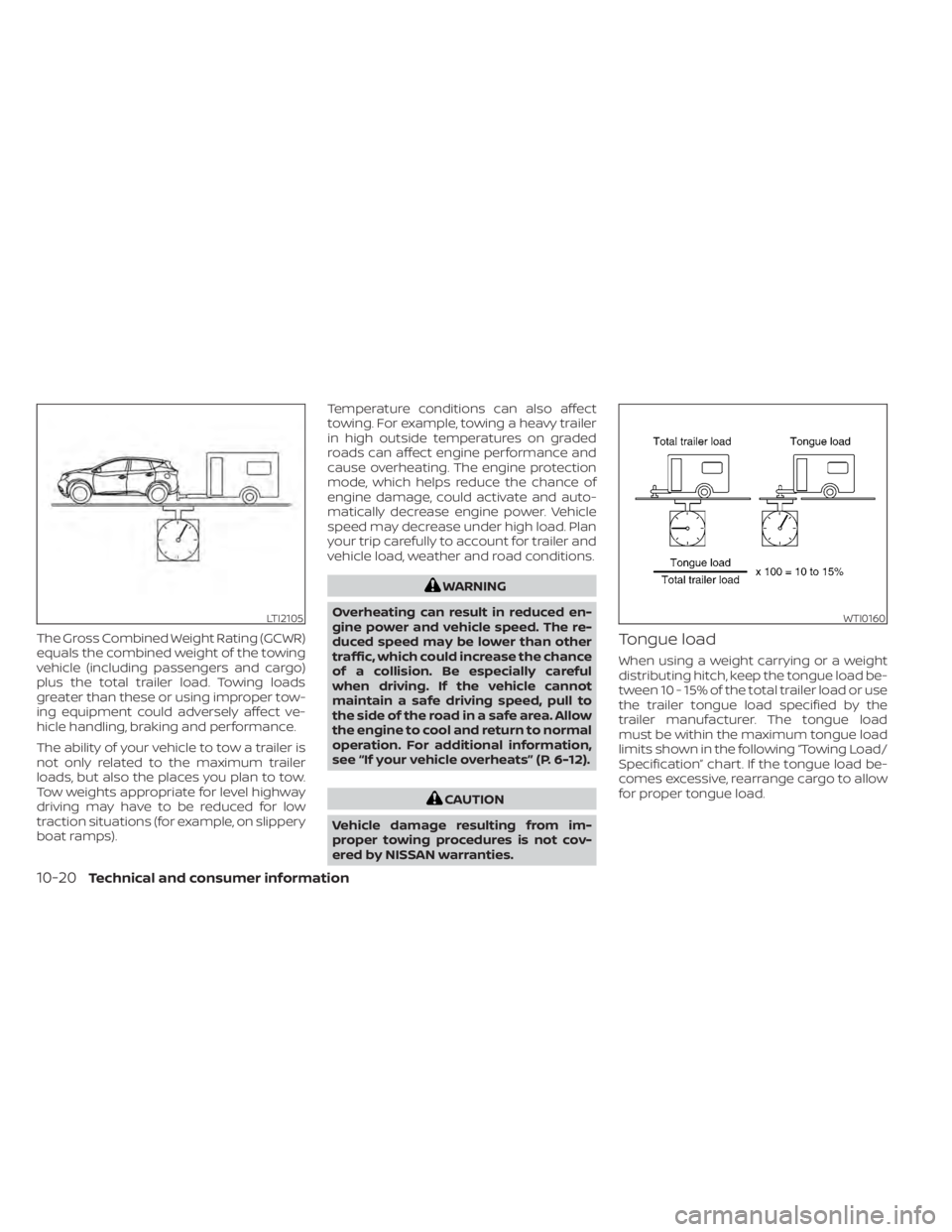
The Gross Combined Weight Rating (GCWR)
equals the combined weight of the towing
vehicle (including passengers and cargo)
plus the total trailer load. Towing loads
greater than these or using improper tow-
ing equipment could adversely affect ve-
hicle handling, braking and performance.
The ability of your vehicle to tow a trailer is
not only related to the maximum trailer
loads, but also the places you plan to tow.
Tow weights appropriate for level highway
driving may have to be reduced for low
traction situations (for example, on slippery
boat ramps).Temperature conditions can also affect
towing. For example, towing a heavy trailer
in high outside temperatures on graded
roads can affect engine performance and
cause overheating. The engine protection
mode, which helps reduce the chance of
engine damage, could activate and auto-
matically decrease engine power. Vehicle
speed may decrease under high load. Plan
your trip carefully to account for trailer and
vehicle load, weather and road conditions.
CAUTION
Vehicle damage resulting from im-
proper towing procedures is not cov-
ered by NISSAN warranties.
Tongue load
When using a weight carrying or a weight
distributing hitch, keep the tongue load be-
tween 10 - 15% of the total trailer load or use
the trailer tongue load specified by the
trailer manufacturer. The tongue load
must be within the maximum tongue load
limits shown in the following “Towing Load/
Specification” chart. If the tongue load be-
comes excessive, rearrange cargo to allow
for proper tongue load.
LTI2105WTI0160
10-20Technical and consumer information
Page 482 of 508
• Gross Vehicle Weight Rating (GVWR) fromF.M.V.S.S./C.M.V.S.S. certification label -
7,250 lbs. (3,289 kg).
• Gross Combined Weight Rating (GCWR) from “Towing Load/Specification" chart -
15,100 lbs. (6,849 kg).
• Maximum Trailer towing capacity from “Towing Load/Specification" chart - 9,100
lbs. (4,128 kg).
7,250 lbs. (3,289 kg) GVWR
– 6,350 lbs. (2,880 kg) GVW = 900 lbs. (409 kg) Available for tongue weight
15,100 lbs. (6,849 kg) GCWR
– 6,350 lbs. (2,880 kg) GVW = 9,123 lbs. (4,138 kg) Capacity available for towing
900 lbs. (409 kg) Available tongue weight
/ 8,750 lbs. (3,969 kg) Available capacity = 10 % tongueweight The available towing capacity may be less
than the maximum towing capacity due to
the passenger and cargo load in the
vehicle.
Remember to keep trailer tongue weight
between 10 - 15% of the trailer weight or
within the trailer tongue load specification
recommended by the trailer manufacturer.
If the tongue load becomes excessive, re-
arrange the cargo to obtain the proper
tongue load. Do not exceed the maximum
tongue weight specification shown in the
“Towing load/specification” chart even if
the calculated available tongue weight is
greater than 15%. If the calculated tongue
weight is less than 10%, reduce the total
trailer weight to match the available
tongue weight.
Always verif y that available capacities are
within the required ratings.
Trailer frontal area
Page 485 of 508
A weight-distributing hitch system (Class
IV) is recommended if you plan to tow trail-
ers with a maximum weight over 5,000 lbs.
(2,268 kg). Check with the trailer and towing
equipment manufacturers to determine if
they recommend the use of a weight-
distributing hitch system.
NOTE:
A weight-distributing hitch system may
affect the operation of trailer surge
brakes. If you are considering use of a
weight-distributing hitch system with a
surge brake-equipped trailer, check with
the surge brake, hitch or trailer manufac-
turer to determine if and how this can be
done.
Follow the instructions provided by the
manufacturer for installing and using the
weight-distributing hitch system.
General set-up instructions are as follows:
1. Park unloaded vehicle on a level surface.With the ignition switch in the ON posi-
tion and the doors closed, allow the ve-
hicle to stand for several minutes so that
it can level.
2. Measure the height of a reference point on the front and rear bumpers at the
center of the vehicle. 3. Attach the trailer to the vehicle and ad-
just the hitch equalizers so that the front
bumper height is within0-.5inches (0 –
13 mm) of the reference height mea-
sured in step 2. The rear bumper should
be no higher than the reference height
measured in step 2.
Page 496 of 508
Child safety rear door lock..........3-7Cleaning exterior and interior......7-2,7-4Cold weather driving............5-127Console box..................2-55Console light..................2-65Continuously Variable Transmission
(CVT).......................5-18Continuously Variable Transmission (CVT)
fluid......................8-10Driving with Continuously Variable
Transmission (CVT)............5-18Controls
Heater and air conditioner controls. .4-29CoolantCapacities and recommended
fuel/lubricants
...............10-2Changing engine coolant.........8-5Checking engine coolant level......8-5Engine coolant temperature gauge. . .2-6Corrosion protection..............7-7Cruise control................ .5-55Cup holders................. .2-56
D
Daytime running light system
(Canada only).................2-40Daytime Running Lights (DRL) system. .2-40Defroster switch
Rear window and outside mirror defroster
switch
................... .2-34Dimensions and weights..........10-10Dimmer switch for instrument panel. . .2-40
Door locks....................3-5Drive belt....................8-15Driving
Cold weather driving...........5-127Driving with Continuously Variable
Transmission (CVT)............5-18Precautions when starting and
driving................. .5-4, 5-11Driving the vehicle...............5-18Dynamic driver assistance switch.....2-47
E
E-call (SOS) Button..............2-48Economy - fuel................5-114Emergency engine shutoff.......5-15,6-2Emission control information label. . . .10-12Emission control system warranty. . . .10-30Engine
Before starting the engine........5-16Capacities and recommended
fuel/lubricants...............10-2Changing engine coolant.........8-5Changing engine oil............8-6Changing engine oil filter.........8-6Checking engine coolant level......8-5Checking engine oil level.........8-6Engine compartment check
locations.................. .8-3Engine coolant temperature gauge. . .2-6Engine cooling system...........8-4Engine oil...................8-6
Engine oil and oil filter
recommendation.............10-7Engine oil pressure warning light. . . .2-10Engine oil viscosity.............10-7Engine serial number..........10-12Engine specifications...........10-9Starting the engine............5-17Engine coolant temperature gauge. . . .2-6Event Data recorders............10-32Exhaust gas (Carbon monoxide)......5-4Explanation of maintenance items.....9-2Explanation of scheduled maintenance
items...................... .9-5Extended storage switch..........2-51Eyeglass case.................2-55
F
F.M.V.S.S. certification label.........10-12Flashers (See hazard warning flasher
switch)......................6-2Flat tire.................. .6-3, 6-4Floor mat positioning aid...........7-6Fluid
Brake fluid..................8-11Capacities and recommended
fuel/lubricants...............10-2Continuously Variable Transmission (CVT)
fluid......................8-10Engine coolant................8-4Engine oil.................. .8-6Power steering fluid............8-11Windshield-washer fluid.........8-12
11-2
Page 501 of 508
T
Tachometer...................2-5Temperature gauge
Engine coolant temperature gauge. . .2-6Thef t (NISSAN Vehicle Immobilizer System),
engine start...............2-31, 5-16Three-way catalyst...............5-4TireFlat tire................. .6-3, 6-4Spare tire...............6-5, 8-38Tire and Loading Information label. .10-13Tire chains.................8-34Tire pressure................8-27Tire rotation.................8-35Types of tires................8-33Uniform tire quality grading......10-29Wheel/tire size...............10-10Wheels and tires..........8-27,10-10Tire pressure
Low tire pressure warning light.....2-12Tire Pressure Monitoring System
(TPMS)...................... .5-5Top tether strap child restraint.......1-32Towing
2-wheel drive models...........6-15All-wheel drive models..........6-14Flat towing................ .10-28Tow truck towing..............6-13Towing load/specification.......10-23Trailer towing...............10-19Towing a trailer................10-19Traffic Sign Recognition (TSR)........5-24
Transceiver
HomeLink® Universal
Transceiver
.......2-66, 2-67, 2-69, 2-70TransmissionContinuously Variable Transmission (CVT)
fluid
......................8-10Driving with Continuously Variable
Transmission (CVT)............5-18Travel (See registering a vehicle in another
country).................... .10-11Trip odometer..................2-5Turn signal switch...............2-41
U
Uniform tire quality grading........10-29USB/iPod® Charging Ports.........4-32
V
Vanity mirror..................3-33Vehicle dimensions and weights.....10-10Vehicle Dynamic Control (VDC) OFF
switch..................... .2-47Vehicle Dynamic Control (VDC)
system.....................5-121Vehicle identification.............10-11Vehicle identification number (VIN)
(Chassis number)...............10-11Vehicle identification number (VIN)
plate...................... .10-11Vehicle immobilizer system.....2-31, 5-16Vehicle information display.........2-17
Vehicle loading information........10-15Vehicle recovery.............6-15,6-16Vehicle security system...........2-30Vehicle security system (NISSAN Vehicle
Immobilizer System), engine start. .2-31, 5-16Vents......................4-26Visors......................3-33
W
Warning
Air bag warning light.........1-70,2-11Anti-lock brake warning light. . . .2-9, 2-11Battery charge warning light......2-10Brake warning light.............2-9Engine oil pressure warning light. . . .2-10Hazard warning flasher switch......6-2Loose fuel cap warning..........2-25Low fuel warning light. . . .2-10, 2-14, 2-25Low tire pressure warning light.....2-12Low windshield-washer fluid warning
light......................2-25Seat belt warning light.......1-16,2-10Supplemental air bag warning
light...................1-70,2-11Vehicle security system.........2-30Warning labels (for SRS)..........1-70Warning/indicator lights and audible
reminders................2-9, 2-11Warning lights...............2-9, 2-11Warning lights, indicator lights and audible
reminders................... .2-8
11-7