lock NISSAN MURANO 2023 Owners Manual
[x] Cancel search | Manufacturer: NISSAN, Model Year: 2023, Model line: MURANO, Model: NISSAN MURANO 2023Pages: 518, PDF Size: 5.46 MB
Page 439 of 518
Doors and engine hood:Check that the
doors and engine hood operate properly.
Also ensure that all latches lock securely.
Lubricate hinges, latches, latch pins, rollers
and links if necessary. Make sure that the
secondary latch keeps the hood from
opening when the primary latch is
released.
When driving in areas using road salt or
other corrosive materials, check lubrica-
tion frequently.
Check that the gas stays or struts properly
and securely hold the hood, trunk, or rear
hatch in a fully open position. If the hood,
trunk, or rear hatch is not held open, have
the gas stays or struts replaced.
Lights*: Clean the headlights on a regular
basis. Make sure that the headlights, stop
lights, tail lights, turn signal lights, and other
lights are all operating properly and in-
stalled securely. Also check headlight aim.
Road wheel nuts (lug nuts)*: When check-
ing the tires, make sure no wheel nuts are
missing, and check for any loose wheel
nuts. Tighten if necessary.
Tire rotation*: Rotate tires at the specified
interval shown in the maintenance
schedule. Tires*:
Check the pressure with a gauge
of ten and always prior to long distance
trips. If necessary, adjust the pressure in all
tires, including the spare, to the pressure
specified. Check carefully for damage, cuts
or excessive wear.
Tire Pressure Monitoring System (TPMS)
tire pressure sensor: It is recommended
that you replace the TPMS tire pressure as-
sembly when the tires are replaced due to
wear or age.
Wheel alignment and balance: If the ve-
hicle should pull to either side while driving
on a straight and level road, or if you detect
uneven or abnormal tire wear, there may
be a need for wheel alignment. If the steer-
ing wheel or seat vibrates at normal high-
way speeds, wheel balancing may be
needed.
For additional information regarding tires,
refer to “Important Tire Safety Information”
(US) or “Tire Safety Information” (Canada) in
the Warranty Information Booklet.
Windshield: Clean the windshield on a
regular basis. Check the windshield at least
every six months for cracks or other dam-
age. Have a damaged windshield repaired
by a qualified repair facility. It is recom-
mended that you have a damaged wind- shield repaired by a NISSAN dealer, or a
NISSAN Certified Collision Center. To locate
a collision center in your area, refer to
http://collision.nissanusa.com.
Windshield wiper blades*:
Check for
cracks or wear if they do not wipe properly.
Inside the vehicle
The maintenance items listed here should
be checked on a regular basis, such as
when performing scheduled maintenance,
cleaning the vehicle, etc.
Accelerator pedal: Check the pedal for
smooth operation and make sure the
pedal does not catch or require uneven
effort. Keep the floor mat away from the
pedal.
Brake pedal: Check the pedal for smooth
operation. If the brake pedal suddenly goes
down further than normal, the pedal feels
spongy or the vehicle seems to take longer
to stop, have your vehicle checked imme-
diately. It is recommended that you visit a
NISSAN dealer for this service. Keep the
floor mat away from the pedal.
Brakes: Check that the brakes do not pull
the vehicle to one side when applied.
Maintenance and schedules9-3
Page 440 of 518
Continuously Variable Transmission
(CVT) P (Park) position mechanism:On a
fairly steep hill check that the vehicle is held
securely with the shif t lever in the P (Park)
position without applying any brakes.
Parking brake: Check the parking brake
operation regularly. The vehicle should be
securely held on a fairly steep hill with only
the parking brake applied. If the parking
brake needs adjustment, it is recom-
mended that you visit a NISSAN dealer for
this service.
Seats: Check seat position controls such
as seat adjusters, seatback recliner, etc., to
ensure they operate smoothly and all
latches lock securely in every position.
Check that the head restraints/headrests
move up and down smoothly and the locks
(if so equipped) hold securely in all latched
positions.
Seat belts: Check that all parts of the seat
belt system (for example, buckles, anchors,
adjusters and retractors) operate properly
and smoothly, and are installed securely.
Check the belt webbing for cuts, fraying,
wear or damage.
Steering wheel: Check for changes in the
steering system, such as excessive free
play, hard steering or strange noises. Warning lights and chimes:
Make sure all
warning lights and chimes are operating
properly.
Windshield defroster: Check that the air
comes out of the defroster outlets properly
and in sufficient quantity when operating
the heater or air conditioner.
Windshield wiper and washer*: Check
that the wipers and washer operate prop-
erly and that the wipers do not streak.
Under the hood and vehicle
The maintenance items listed here should
be checked periodically (for example, each
time you check the engine oil or refuel).
Battery* (for maintenance free batter-
ies): This vehicle is equipped with a sealed
maintenance free battery. It is recom-
mended that you visit a NISSAN dealer for
service.
NOTE:
Care should be taken to avoid situations
that can lead to potential battery dis-
charge and potential no-start conditions
such as:
1. Installation or extended use of elec- tronic accessories that consume bat-
tery power when the engine is not
running (Phone chargers, GPS, DVD
players, etc.).
2. Vehicle is not driven regularly and/or only driven short distances.
In these cases, the battery may need to
be charged to maintain battery health.
Brake fluid level*: Make sure that the brake
fluid level is between the MAX and MIN lines
on the reservoir.
Engine coolant level*: Check the coolant
level when the engine is cold.
Engine drive belt*: Make sure the drive
belts are not frayed, worn, cracked or oily.
Engine oil level*: Check the level af ter
parking the vehicle on a level spot and
turning off the engine. Wait more than 15
minutes for the oil to drain back into the oil
pan.
9-4Maintenance and schedules
Page 477 of 518
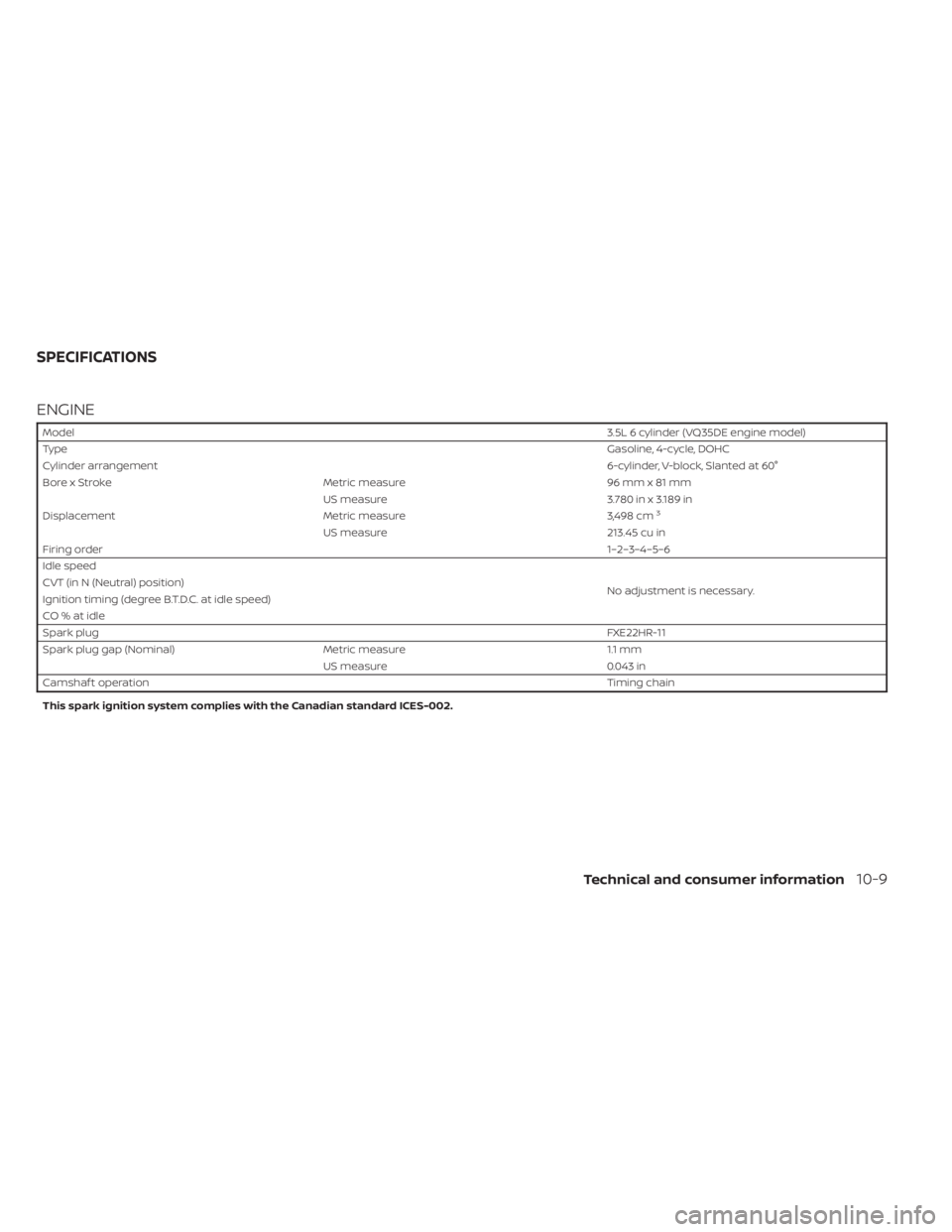
ENGINE
Model3.5L 6 cylinder (VQ35DE engine model)
Type Gasoline, 4-cycle, DOHC
Cylinder arrangement 6-cylinder, V-block, Slanted at 60°
Bore x Stroke Metric measure 96 mm x 81 mm
US measure 3.780 in x 3.189 in
Displacement Metric measure 3,498 cm
3
US measure213.45 cu in
Firing order 1–2–3–4–5–6
Idle speed
No adjustment is necessary.
CVT (in N (Neutral) position)
Ignition timing (degree B.T.D.C. at idle speed)
CO%atidle
Spark plug
FXE22HR-11
Spark plug gap (Nominal) Metric measure 1.1 mm
US measure 0.043 in
Camshaf t operation Timing chain
This spark ignition system complies with the Canadian standard ICES-002.
SPECIFICATIONS
Technical and consumer information10-9
Page 492 of 518
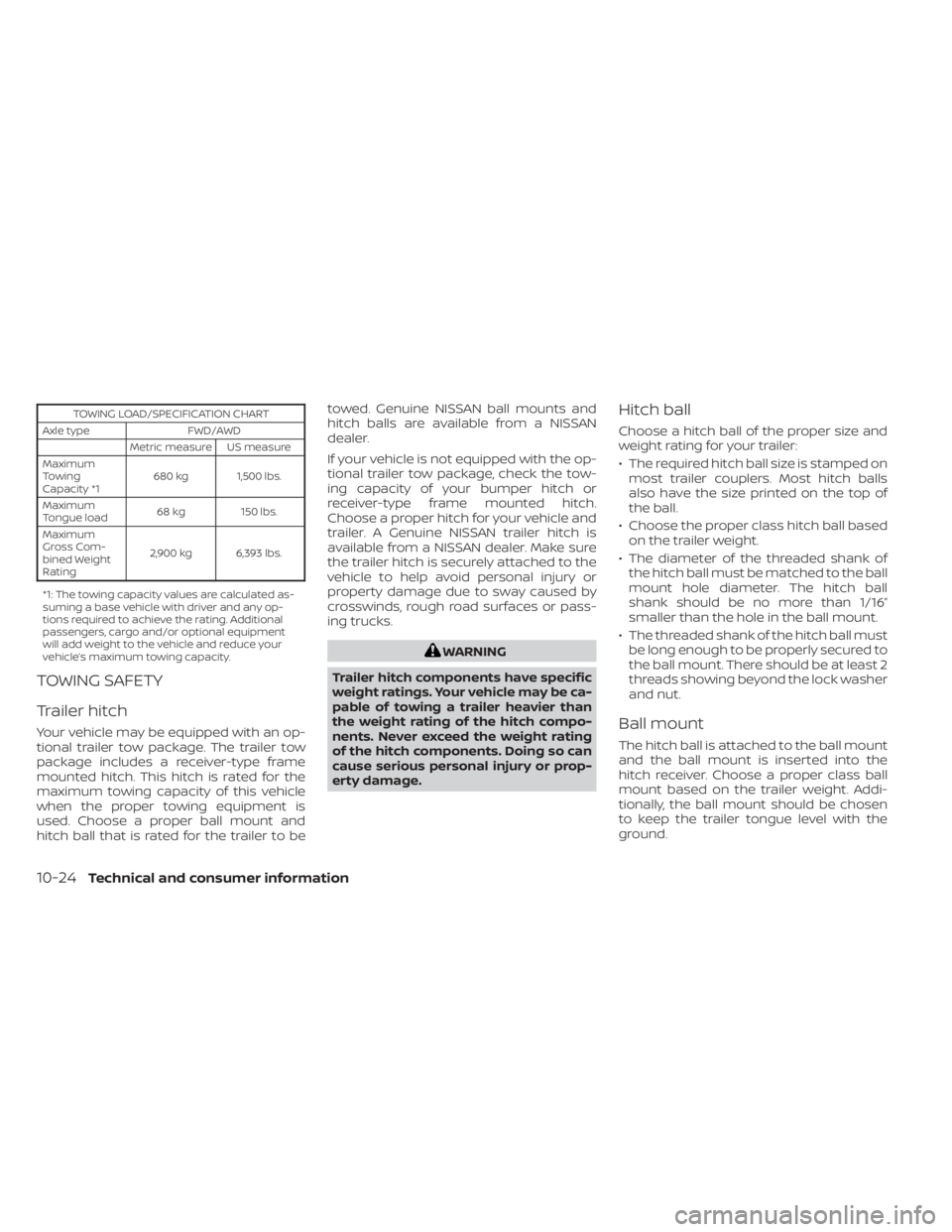
TOWING LOAD/SPECIFICATION CHART
Axle type FWD/AWD
Metric measure US measure
Maximum
Towing
Capacity *1 680 kg 1,500 lbs.
Maximum
Tongue load 68 kg
150 lbs.
Maximum
Gross Com-
bined Weight
Rating 2,900 kg 6,393 lbs.
*1: The towing capacity values are calculated as-
suming a base vehicle with driver and any op-
tions required to achieve the rating. Additional
passengers, cargo and/or optional equipment
will add weight to the vehicle and reduce your
vehicle’s maximum towing capacity.
TOWING SAFETY
Trailer hitch
Your vehicle may be equipped with an op-
tional trailer tow package. The trailer tow
package includes a receiver-type frame
mounted hitch. This hitch is rated for the
maximum towing capacity of this vehicle
when the proper towing equipment is
used. Choose a proper ball mount and
hitch ball that is rated for the trailer to be towed. Genuine NISSAN ball mounts and
hitch balls are available from a NISSAN
dealer.
If your vehicle is not equipped with the op-
tional trailer tow package, check the tow-
ing capacity of your bumper hitch or
receiver-type frame mounted hitch.
Choose a proper hitch for your vehicle and
trailer. A Genuine NISSAN trailer hitch is
available from a NISSAN dealer. Make sure
the trailer hitch is securely attached to the
vehicle to help avoid personal injury or
property damage due to sway caused by
crosswinds, rough road surfaces or pass-
ing trucks.
WARNING
Trailer hitch components have specific
weight ratings. Your vehicle may be ca-
pable of towing a trailer heavier than
the weight rating of the hitch compo-
nents. Never exceed the weight rating
of the hitch components. Doing so can
cause serious personal injury or prop-
erty damage.
Hitch ball
Choose a hitch ball of the proper size and
weight rating for your trailer:
• The required hitch ball size is stamped on most trailer couplers. Most hitch balls
also have the size printed on the top of
the ball.
• Choose the proper class hitch ball based on the trailer weight.
• The diameter of the threaded shank of the hitch ball must be matched to the ball
mount hole diameter. The hitch ball
shank should be no more than 1/16”
smaller than the hole in the ball mount.
• The threaded shank of the hitch ball must be long enough to be properly secured to
the ball mount. There should be at least 2
threads showing beyond the lock washer
and nut.
Ball mount
The hitch ball is attached to the ball mount
and the ball mount is inserted into the
hitch receiver. Choose a proper class ball
mount based on the trailer weight. Addi-
tionally, the ball mount should be chosen
to keep the trailer tongue level with the
ground.
10-24Technical and consumer information
Page 495 of 518
• Determine the overall height of the ve-hicle and trailer so the required clearance
is known.
Trailer towing tips
In order to gain skill and an understanding
of the vehicle's behavior, you should prac-
tice turning, stopping and backing up in
an area which is free from traffic. Steering
stability and braking performance will be
somewhat different than under normal
driving conditions.
• Always secure items in the trailer to pre-vent load shif t while driving.
• Lock the trailer hitch coupler with a pin or lock to prevent the coupler from inadver-
tently becoming unlatched.
• Avoid abrupt starts, acceleration or stops.
• Avoid sharp turns or lane changes.
• Always drive your vehicle at a moderate speed.
• When backing up, hold the bottom of the steering wheel with one hand. Move your
hand in the direction in which you want
the trailer to go. Make small corrections
and back up slowly. If possible, have
someone guide you when you are back-
ing up. Always block the wheels on both vehicle
and trailer when parking. Parking on a
slope is not recommended; however, if you
must do so:CAUTION
If you move the shif t lever to the P
(Park) position before blocking the
wheels and applying the parking brake,
transmission damage could occur.
1. Apply and hold the brake pedal.
2. Have someone place blocks on the downhill side of the vehicle and trailer
wheels.
3. Af ter the wheel blocks are in place, slowly release the brake pedal until the
blocks absorb the vehicle load.
4. Apply the parking brake.
5. Shif t the transmission into P (Park).
6. Turn off the engine.
To drive away:
1. Start the vehicle.
2. Apply and hold the brake pedal.
3. Shif t the transmission into gear. 4. Release the parking brake.
5. Drive slowly until the vehicle and trailer
are clear from the blocks.
6. Apply and hold the brake pedal.
7. Have someone retrieve and store the blocks.
• While going downhill, the weight of the trailer pushing on the tow vehicle may
decrease overall stability. Therefore, to
maintain adequate control, reduce your
speed and shif t to a lower gear. Avoid
long or repeated use of the brakes when
descending a hill, as this reduces their
effectiveness and could cause overheat-
ing. Shif ting to a lower gear instead pro-
vides “engine braking” and reduces the
need to brake as frequently.
• If the engine coolant temperature rises to a high temperature, see “If your vehicle
overheats” (P. 6-12).
• Trailer towing requires more fuel than normal circumstances.
• Avoid towing a trailer for your vehicle's first 500 miles (805 km).
• For the first 500 miles (805 km) that you do tow, do not drive over 50 mph (80
km/h).
Technical and consumer information10-27
Page 503 of 518
11 Index
A
Air bag (See supplemental restraint
system)........................ .1-48
Air bag system ....................1-56
Front (See supplemental front impact air
bag system) ...................1-56
Air bag warning labels ..............1-69
Air bag warning light, supplemental . . . .1-70
Airbagwarninglight.............. .1-70
Air cleaner housing filter .............8-17
Air cleaner .......................8-17
Air conditioner ....................4-30
Air conditioner operation ..........4-30
Air conditioner specification label . . .10-13
Air conditioner system refrigerant and oil
recommendations ...............10-8
Air conditioner system refrigerant
recommendations ...............10-8
Heater and air conditioner (automatic)
(if so equipped) .................4-29
Heater and air conditioner controls . .4-30
Servicing air conditioner ..........4-32
Alarm system (See vehicle security
system) .........................2-32
All-Wheel Drive ...................5 -117
Anchor point locations ..............1-32
Antenna ........................4-33
Anti-lock brake warning light .........2-10
Anti-lock Braking System (ABS) .......5-121
Antifreeze .......................5-131 Armrests........................
.1-6
Autolightswitch ..................2-39
Automatic anti-glare inside mirror .....3-34
Automatic door locks ...............3-6
Automatic Emergency Braking (AEB) with
Pedestrian Detection ..............5-88
Automatic Emergency Braking (AEB) . . .2-12
Automatic.......................2-66 Automatic power window switch . . .2-66
AWD...........................5 -117
B
Battery replacement...............8-23
Keyfob.......................8-23
NISSAN Intelligent Key® ...........8-24
Battery.........................5-131 Charge warning light .............2-10
Before starting the engine ...........5-16
Belt(Seedrivebelt) ................8-16
Blind Spot Warning (BSW) ............5-39
Booster seats ................... .1-44
Brake Assist .....................5-123
Brakefluid.......................8-11
Brake system ....................5-121
Brake..........................5-121 Anti-lock Braking System (ABS) .....5-121
Brakefluid.....................8-11
Brakelight(Seestoplight).........8-26
Brake system ..................5-121 Brakewarninglight..............2-10
Brakewearindicators ........2
-17, 8-20
Self-adjustingbrakes ............8-20
Brakes .........................8-20
Break-in schedule .................5-115
Brightness control .................2-43
Instrument panel ...............2-43
Bulb check/instrument panel ........2-10
Bulb replacement .................8-26
C
C.M.V.S.S. certification label ..........10-12
Capacities and recommended
fuel/lubricants....................10-2
Car phone or CB radio ..............4-33
Cargo (See vehicle loading
information).....................10-15
Cargoareastoragebin .............2-61
Check tire pressure ................2-29
Child restraint with top tether strap . . . .1-31
Childrestraints .................. .1-24
LATCH (Lower Anchors and Tethers for
CHildren)System................1-28
Precautions on child
restraints..............1-34, 1-40, 1-45
Top tether strap anchor point
locations..................... .1-32
Child safety rear door lock ............3-7
Cleaningexteriorandinterior .........7-2
Page 504 of 518
Coat hooks.......................2-62
Coldweatherdriving...............5-131
Console box ......................2-59
Console light ......................2-70
Continuously Variable Transmission
(CVT) ............................5-19
Continuously Variable Transmission (CVT)
fluid ..........................8-10
Driving with Continuously Variable
Transmission (CVT) ...............5-19
Controls.........................4-30 Heater and air conditioner controls. . .4-30
Coolant..........................10-2 Capacities and recommended
fuel/lubricants ..................10-2
Changing engine coolant ...........8-5
Checking engine coolant level .......8-5
Engine coolant temperature gauge . . .2-6
Corrosionprotection.................7-7
Cruisecontrol.....................5-56
Cupholders......................2-60
D
Daytime Running Light System ........2-43
Defrosterswitch...................2-37 Rear window and outside mirror defroster
switch.........................2-37
Dimensions and weights ............10-10
Dimmer switch for instrument panel . . .2-43
Door locks ........................3-5
Drivebelt ........................8-16
Drivingthevehicle..................5-18 Driving..........................5
-131
Cold weather driving .............5-131
Driving with Continuously Variable
Transmission (CVT) ...............5-19
Precautions when starting and
driving......................5-4,5-11
Dynamic driver assistance switch ......2-50
E
Eco Drive Report....................2-8
Economy - fuel ...................5 -116
Emergency call (SOS) button ..........2-51
Emergency engine shutoff ...........5-15
Emission control information label .....10-12
Emission control system warranty . . . .10-30
Engine coolant temperature gauge .....2-6
Engine ..........................5-16
Before starting the engine ..........5-16
Capacities and recommended
fuel/lubricants ..................10-2
Changing engine coolant ...........8-5
Changing engine oil filter ...........8-6
Changing engine oil ...............8-6
Checking engine coolant level .......8-5
Checking engine oil level ...........8-6
Engine compartment check
locations .......................8-3
Engine coolant temperature gauge . . .2-6
Engine cooling system .............8-4
Engine oil and oil filter
recommendation ................10-7
Engine oil pressure warning light .....2-11Engine oil viscosity
...............10-7
Engine oil .......................8-6
Engine serial number .............10-12
Engine specifications .............10-9
Starting the engine ...............5-17
EventDatarecorders...............10-32
Exhaust gas (Carbon monoxide) ........5-4
Explanation of maintenance items ......9-2
Explanation of scheduled maintenance
items........................... .9-5
Extended storage switch ............2-55
Eyeglasscase.....................2-59
F
F.M.V.S.S. certification label ...........10-12
Flashers (See hazard warning flasher
switch)...........................6-2
Flattire...........................6-3
Floor mat positioning aid .............7-6
Fluid ............................8-11 Brakefluid......................8-11
Capacities and recommended
fuel/lubricants ..................10-2
Continuously Variable Transmission (CVT)
fluid ..........................8-10
Engine coolant ...................8-4
Engine oil .......................8-6
Powersteeringfluid...............8-11
Windshield-washer fluid ...........8-12
Foglightswitch ...................2-44
Front air bag system (See supplemental
restraintsystem)...................1-56
11-2
Page 505 of 518
Front and rear sonar system.........5-126
Front power seat adjustment ..........1-4
Frontseats....................... .1-2
Front-door pocket .................2-56
Fuelefficientdrivingtips.............5 -115
Fuel gauge ........................2-7
Fuel-filler door ....................3-28
Fuel.............................10-2 Capacities and recommended
fuel/lubricants ..................10-2
Fuel economy ..................5 -116
Fuel gauge ......................2-7
Fueloctanerating................10-6
Fuel recommendation ............10-4
Fuel-filler cap ...................3-29
Fuel-filler door lock opener lever .....3-28
Fuel-filler lid ....................3-29
Loose fuel cap warning ............2-27
Fuses ...........................8-20
Fusiblelinks ......................8-21
G
Garage door opener, HomeLink® Universal
Transceiver .......................2-71
Gascap.........................3-29
Gauge ...........................2-6
Engine coolant temperature gauge . . .2-6
Fuel gauge ......................2-7
Odometer ......................2-5
Speedometer .................2-4,2-5
Tachometer .....................2-6
Trip odometer ...................2-5 General maintenance
................9-2
Glovebox........................2-59
H
Hazard warning flasher switch .........6-2
Headrestraints.................... .1-9
Headlight and turn signal switch .......2-38
Headlightcontrolswitch.............2-38
Headlights.......................8-25
Heatedmirrors................... .3-36
Heatedrearseats..................2-48
Heatedseats.....................2-45
Heated steering wheel ..............2-49
Heater and air conditioner (automatic) . .4-29
Heater..........................4-29 Heater and air conditioner (automatic)
(if so equipped) ..................4-29
Heater and air conditioner controls. . .4-30
Heater operation .................4-31
Hill start assist system ..............5-126
HomeLink® Universal Transceiver.......2-71
Hood ............................3-21
Hook ...........................2-62
Luggage hook ..................2-62
Horn............................2-45
I
Ignition switch .....................5-13
Push-button ignition switch ........5-13
Immobilizer system ................2-34
Important vehicle information label . . . .10-12In-cabinmicrofilter.................8-18
Increasing fuel economy
............5-116
Indicator lights and audible reminders
(See warning/indicator lights and audible
reminders) ...................... .2-10
Indicator.........................5-15 NISSAN Intelligent Key® battery discharge
indicator.......................5-15
Inside automatic anti-glare mirror .....3-34
Instrument brightness control ........2-43
Instrument panel dimmer switch ......2-43
Instrument panel ...................0-6
Intelligent Around View® Monitor .......4-11
Intelligent Cruise Control ............5-59
Intelligent Drive Alertness (I-DA) .......5-112
Intelligent Forward Collision Warning
(I-FCW)..........................5-99
Intelligent Key system ................3-8
Key operating range ...............3-8
Key operation ....................3-9
Mechanical key ...................3-3
Remote keyless entry operation .....3-12
Troubleshooting guide ............3-16
Warning signals ..................3-16
Intelligent Lane Intervention ..........5-33
Interiorlight..................... .2-69
ISOFIX child restraints ...............1-28
J
Jumpstarting.....................6-10
11-3
Page 506 of 518
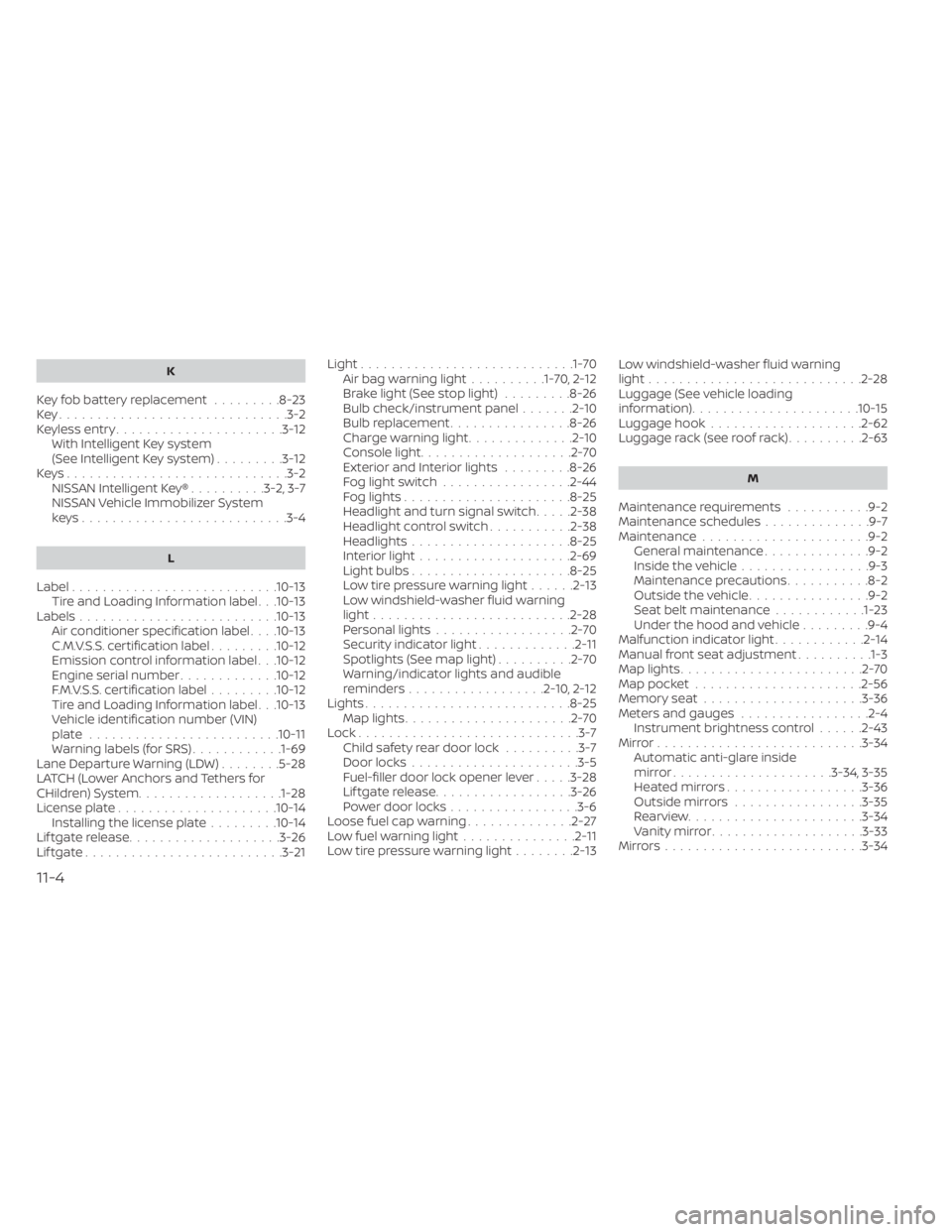
K
Key fob battery replacement.........8-23
Key..............................3-2
Keylessentry......................3-12 With Intelligent Key system
(See Intelligent Key system) .........3-12
Keys.............................3-2 NISSAN Intelligent Key® ..........3-2, 3-7
NISSAN Vehicle Immobilizer System
keys...........................3-4
L
Label ...........................10-13
Tire and Loading Information label . . .10-13
Labels ..........................10-13
Air conditioner specification label . . . .10-13
C.M.V.S.S. certification label .........10-12
Emission control information label . . .10-12
Engine serial number .............10-12
F.M.V.S.S. certification label .........10-12
Tire and Loading Information label . . .10-13
Vehicle identification number (VIN)
plate .........................10-11
Warning labels (for SRS) ............1-69
Lane Departure Warning (LDW) ........5-28
LATCH (Lower Anchors and Tethers for
CHildren)System.................. .1-28
License plate .....................10-14
Installing the license plate .........10-14
Liftgaterelease....................3-26
Liftgate..........................3-21 Light...........................
.1-70
Airbagwarninglight..........1-70, 2-12
Brakelight(Seestoplight) .........8-26
Bulb check/instrument panel .......2-10
Bulb replacement ................8-26
Charge warning light ..............2-10
Console light ....................2-70
ExteriorandInteriorlights .........8-26
Foglightswitch .................2-44
Foglights......................8-25
Headlight and turn signal switch .....2-38
Headlightcontrolswitch...........2-38
Headlights.....................8-25
Interiorlight....................2-69
Lightbulbs.....................8-25
Low tire pressure warning light ......2-13
Low windshield-washer fluid warning
light..........................2-28
Personal lights ..................2-70
Security indicator light .............2-11
Spotlights(Seemaplight)..........2-70
Warning/indicator lights and audible
reminders ..................2-10,2-12
Lights...........................8-25 Maplights......................2-70
Lock............................ .3-7
Child safety rear door lock ..........3-7
Door locks ......................3-5
Fuel-filler door lock opener lever .....3-28
Liftgaterelease..................3-26
Power door locks .................3-6
Loose fuel cap warning ..............2-27
Lowfuelwarninglight...............2-11
Low tire pressure warning light ........2-13Low windshield-washer fluid warning
light............................2-28
Luggage (See vehicle loading
information)......................10-15
Luggage hook
....................2-62
Luggage rack (see roof rack) ..........2-63
M
Maintenance requirements...........9-2
Maintenance schedules ..............9-7
Maintenance ......................9-2
General maintenance ..............9-2
Insidethevehicle.................9-3
Maintenance precautions ...........8-2
Outsidethevehicle................9-2
Seat belt maintenance ............1-23
Under the hood and vehicle .........9-4
Malfunctionindicatorlight........... .2-14
Manual front seat adjustment ..........1-3
Maplights........................2-70
Map pocket ......................2-56
Memory seat .....................3-36
Meters and gauges .................2-4
Instrument brightness control ......2-43
Mirror.......................... .3-34
Automatic anti-glare inside
mirror.....................3-34,3-35
Heatedmirrors..................3-36
Outsidemirrors .................3-35
Rearview...................... .3-34
Vanitymirror....................3-33
Mirrors..........................3-34
11-4
Page 507 of 518
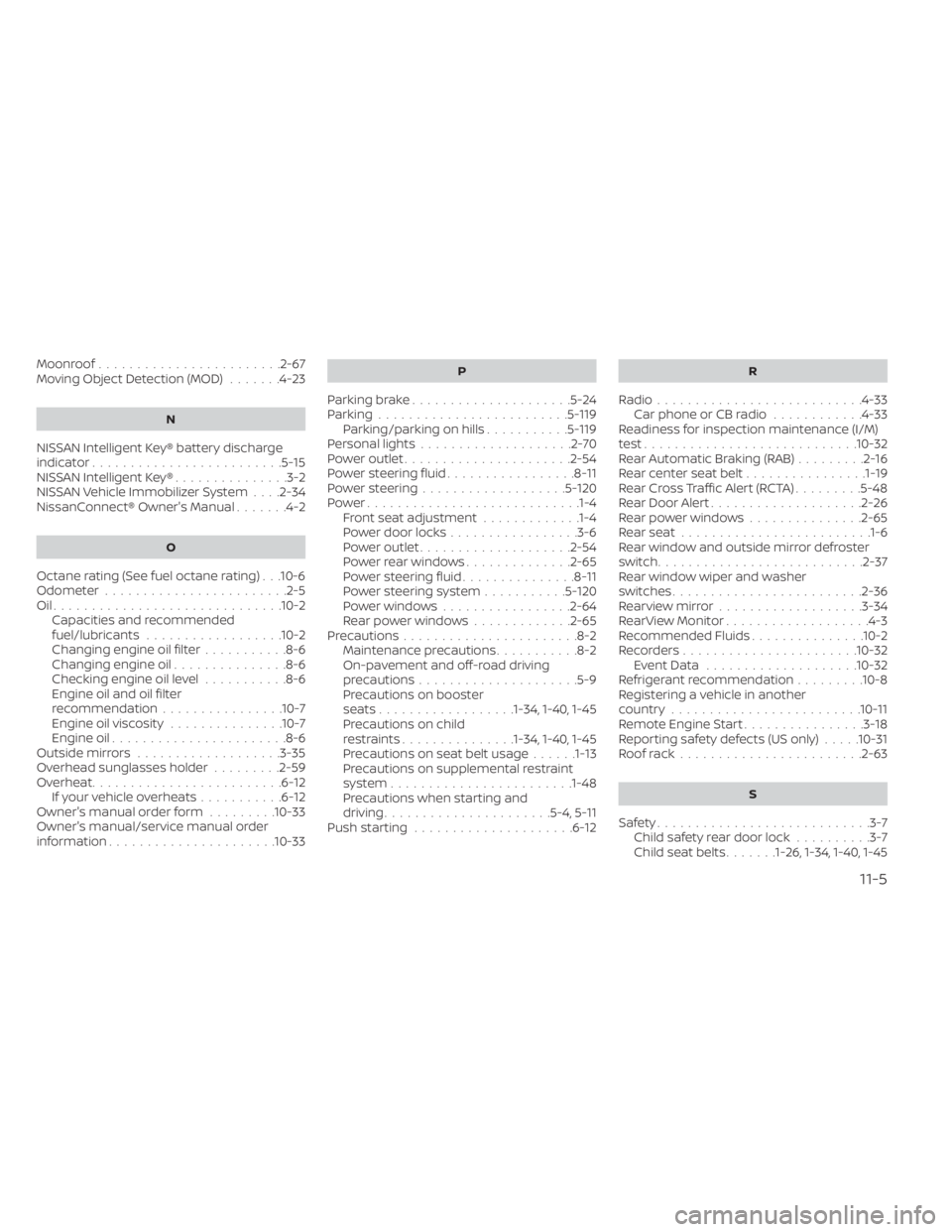
Moonroof........................2-67
Moving Object Detection (MOD) .......4-23
N
NISSAN Intelligent Key® battery discharge
indicator.........................5-15
NISSAN Intelligent Key®...............3-2
NISSAN Vehicle Immobilizer System ....2-34
NissanConnect® Owner's Manual .......4-2
O
Octane rating (See fuel octane rating) . . .10-6
Odometer........................2-5
Oil..............................10-2 Capacities and recommended
fuel/lubricants ..................10-2
Changing engine oil filter ...........8-6
Changing engine oil ...............8-6
Checking engine oil level ...........8-6
Engine oil and oil filter
recommendation ................10-7
Engine oil viscosity ...............10-7
Engine oil .......................8-6
Outsidemirrors ...................3-35
Overhead sunglasses holder .........2-59
Overheat.........................6-12 Ifyourvehicleoverheats...........6-12
Owner's manual order form .........10-33
Owner's manual/service manual order
information......................10-33
P
Parkingbrake.....................5-24
Parking.........................5 -119
Parking/parkingonhills...........5 -119
Personal lights ....................2-70
Poweroutlet......................2-54
Powersteeringfluid.................8-11
Powersteering...................5-120
Power........................... .1-4
Front seat adjustment .............1-4
Power door locks .................3-6
Poweroutlet....................2-54
Powerrearwindows..............2-65
Powersteeringfluid...............8-11
Powersteeringsystem...........5-120
Powerwindows.................2-64
Rearpowerwindows.............2-65
Precautions.......................8-2 Maintenance precautions ...........8-2
On-pavement and off-road driving
precautions.....................5-9
Precautions on booster
seats..................1-34, 1-40, 1-45
Precautions on child
restraints...............1-34, 1-40, 1-45
Precautionsonseatbeltusage......1-13
Precautions on supplemental restraint
system ....................... .1-48
Precautions when starting and
driving......................5-4,5-11
Push starting .....................6-12
R
Radio...........................4-33
Car phone or CB radio ............4-33
Readiness for inspection maintenance (I/M)
test............................10-32
Rear Automatic Braking (RAB) .........2-16
Rearcenterseatbelt................1-19
RearCrossTrafficAlert(RCTA).........5-48
Rear Door Alert ....................2-26
Rearpowerwindows...............2-65
Rearseat ........................ .1-6
Rear window and outside mirror defroster
switch...........................2-37
Rear window wiper and washer
switches .........................2-36
Rearviewmirror...................3-34
RearViewMonitor...................4-3
Recommended Fluids ...............10-2
Recorders.......................10-32 EventData ....................10-32
Refrigerant recommendation .........10-8
Registering a vehicle in another
country .........................10-11
Remote Engine Start ................3-18
Reporting safety defects (US only) .....10-31
Roofrack........................2-63
S
Safety............................3-7 Child safety rear door lock ..........3-7
Childseatbelts.......1-26, 1-34, 1-40, 1-45
11-5