Seat adjust NISSAN MURANO 2023 User Guide
[x] Cancel search | Manufacturer: NISSAN, Model Year: 2023, Model line: MURANO, Model: NISSAN MURANO 2023Pages: 518, PDF Size: 5.46 MB
Page 30 of 518
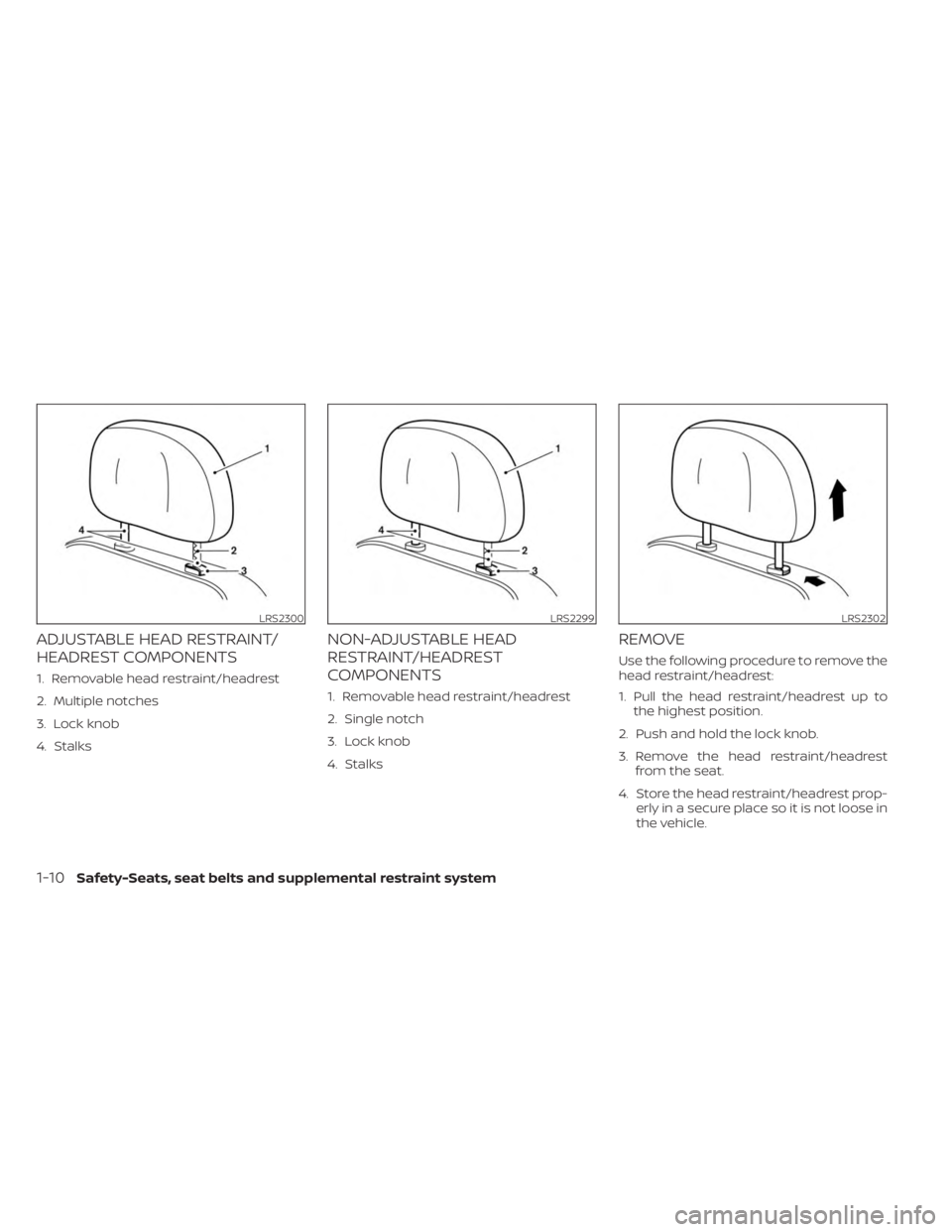
ADJUSTABLE HEAD RESTRAINT/
HEADREST COMPONENTS
1. Removable head restraint/headrest
2. Multiple notches
3. Lock knob
4. Stalks
NON-ADJUSTABLE HEAD
RESTRAINT/HEADREST
COMPONENTS
1. Removable head restraint/headrest
2. Single notch
3. Lock knob
4. Stalks
REMOVE
Use the following procedure to remove the
head restraint/headrest:
1. Pull the head restraint/headrest up tothe highest position.
2. Push and hold the lock knob.
3. Remove the head restraint/headrest from the seat.
4. Store the head restraint/headrest prop- erly in a secure place so it is not loose in
the vehicle.
LRS2300LRS2299LRS2302
1-10Safety-Seats, seat belts and supplemental restraint system
Page 31 of 518
5. Reinstall and properly adjust the headrestraint/headrest before an occupant
uses the seating position.
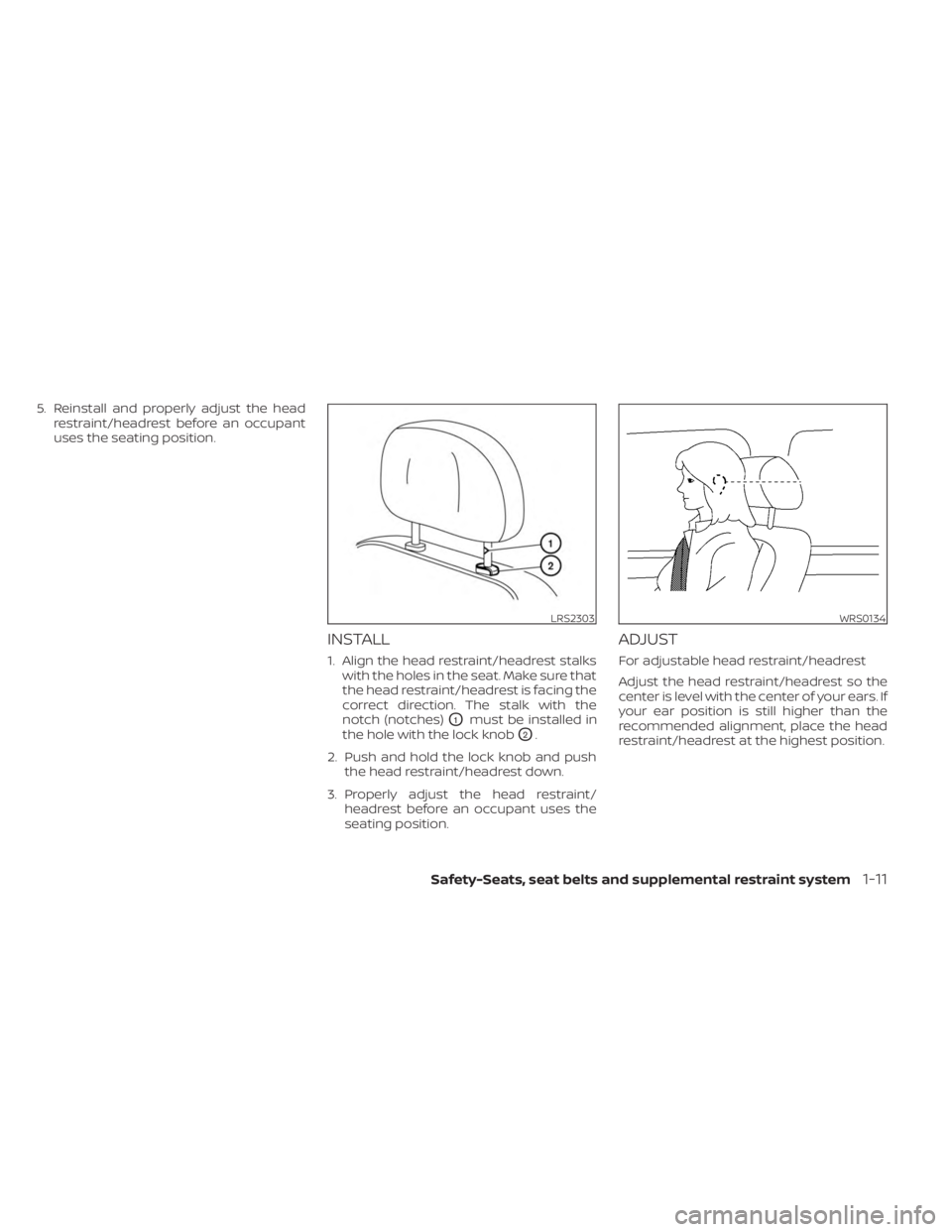
INSTALL
1. Align the head restraint/headrest stalkswith the holes in the seat. Make sure that
the head restraint/headrest is facing the
correct direction. The stalk with the
notch (notches)
O1must be installed in
the hole with the lock knob
O2.
2. Push and hold the lock knob and push the head restraint/headrest down.
3. Properly adjust the head restraint/ headrest before an occupant uses the
seating position.
ADJUST
For adjustable head restraint/headrest
Adjust the head restraint/headrest so the
center is level with the center of your ears. If
your ear position is still higher than the
recommended alignment, place the head
restraint/headrest at the highest position.
LRS2303WRS0134
Safety-Seats, seat belts and supplemental restraint system1-11
Page 33 of 518
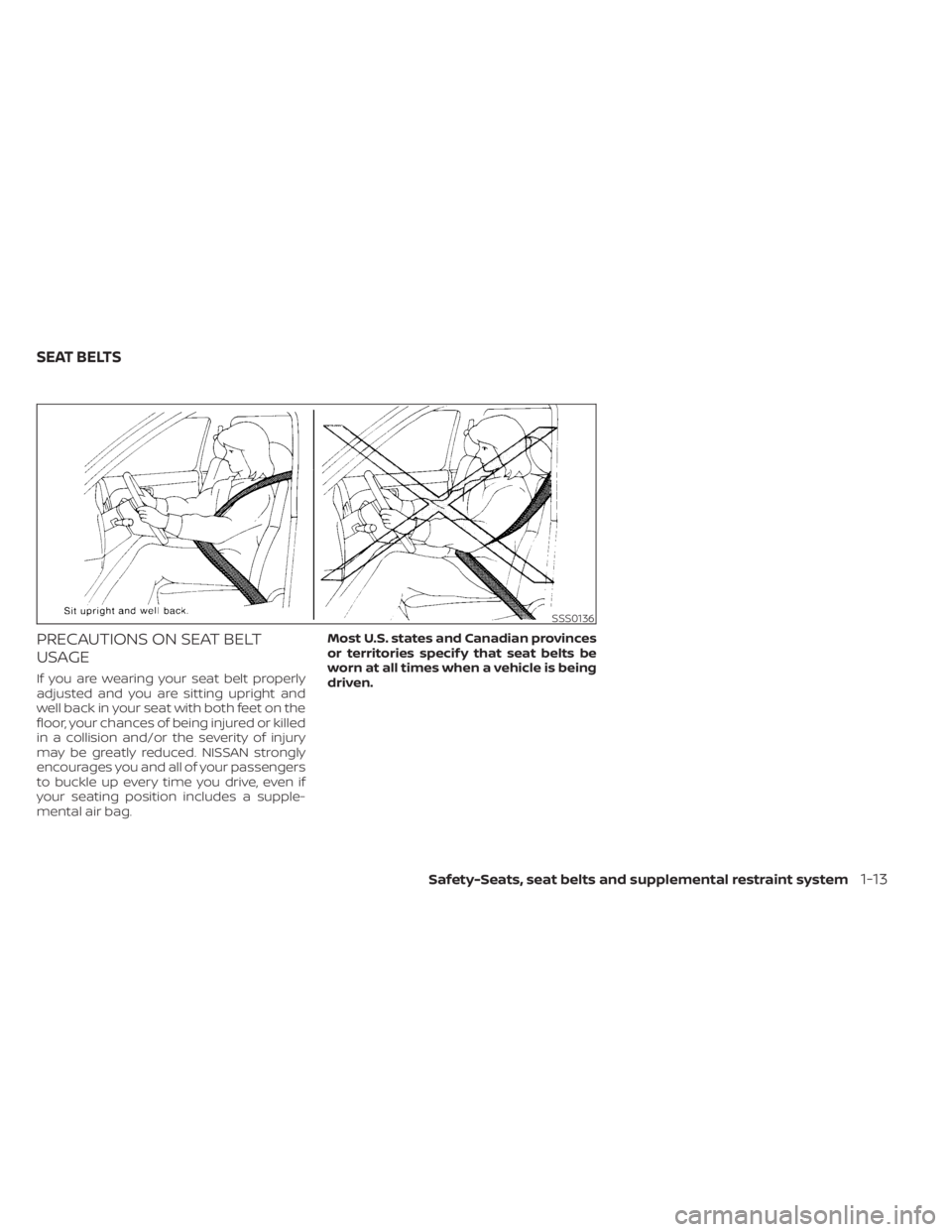
PRECAUTIONS ON SEAT BELT
USAGE
If you are wearing your seat belt properly
adjusted and you are sitting upright and
well back in your seat with both feet on the
floor, your chances of being injured or killed
in a collision and/or the severity of injury
may be greatly reduced. NISSAN strongly
encourages you and all of your passengers
to buckle up every time you drive, even if
your seating position includes a supple-
mental air bag.Most U.S. states and Canadian provinces
or territories specif y that seat belts be
worn at all times when a vehicle is being
driven.
SSS0136
SEAT BELTS
Safety-Seats, seat belts and supplemental restraint system1-13
Page 37 of 518
THREE-POINT TYPE SEAT BELT
WITH RETRACTOR
WARNING
• Every person who drives or rides in
this vehicle should use a seat belt at
all times. Children should be in the
rear seats and in an appropriate
restraint.
• Do not ride in a moving vehicle when
the seatback is reclined. This can be
dangerous. The shoulder belt will not
be against your body. In an accident,
you could be thrown into it and re-
ceive neck or other serious injuries.
You could also slide under the lap belt
and receive serious internal injuries.
• For the most effective protection
when the vehicle is in motion, the
seat should be upright. Always sit
well back and upright in the seat with
both feet on the floor and adjust the
seat belt properly. •
Do not allow children to play with the
seat belts. Most seating positions are
equipped with Automatic Locking
Retractor (ALR) mode seat belts. If
the seat belt becomes wrapped
around a child’s neck with the ALR
mode activated, the child can be se-
riously injured or killed if the seat belt
retracts and becomes tight. This can
occur even if the vehicle is parked.
Unbuckle the seat belt to release the
child. If the seat belt cannot be un-
buckled or is already unbuckled, re-
lease the child by cutting the seat
belt with a suitable tool (such as a
knife or scissors) to release the seat
belt.
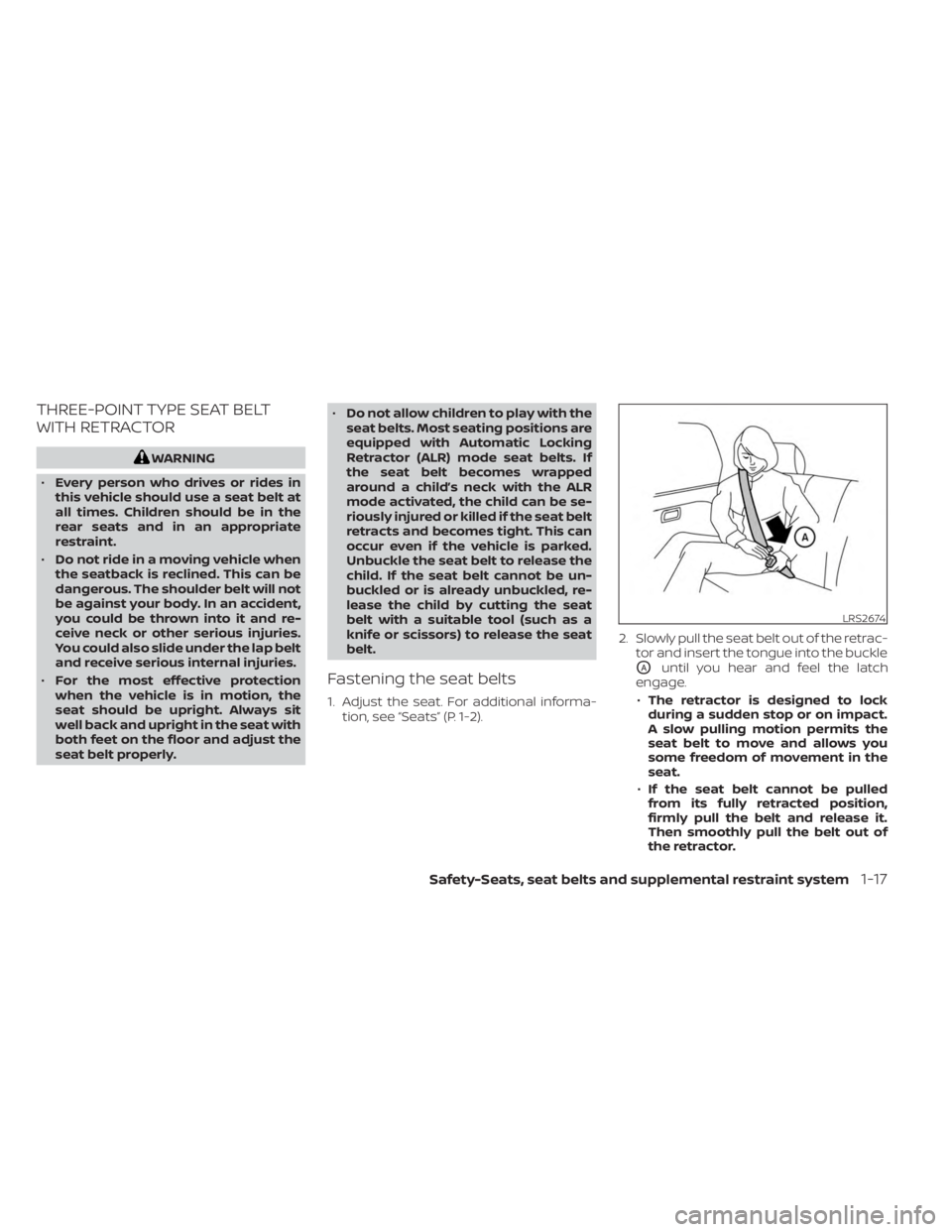
Fastening the seat belts
1. Adjust the seat. For additional informa- tion, see “Seats” (P. 1-2). 2. Slowly pull the seat belt out of the retrac-
tor and insert the tongue into the buckle
OAuntil you hear and feel the latch
engage.
• The retractor is designed to lock
during a sudden stop or on impact.
A slow pulling motion permits the
seat belt to move and allows you
some freedom of movement in the
seat.
• If the seat belt cannot be pulled
from its fully retracted position,
firmly pull the belt and release it.
Then smoothly pull the belt out of
the retractor.
LRS2674
Safety-Seats, seat belts and supplemental restraint system1-17
Page 42 of 518
WARNING
• Do not unfasten the rear center seat
belt connector except when folding
down the rear seat.
• When attaching the rear center seat
belt connector, be certain that the
seatbacks are completely secured in
the latched position and the rear
center seat belt connector is com-
pletely secured.
• If the rear center seat belt connector
and the seatbacks are not secured in
the correct position, serious personal
injury may result in an accident or
sudden stop.
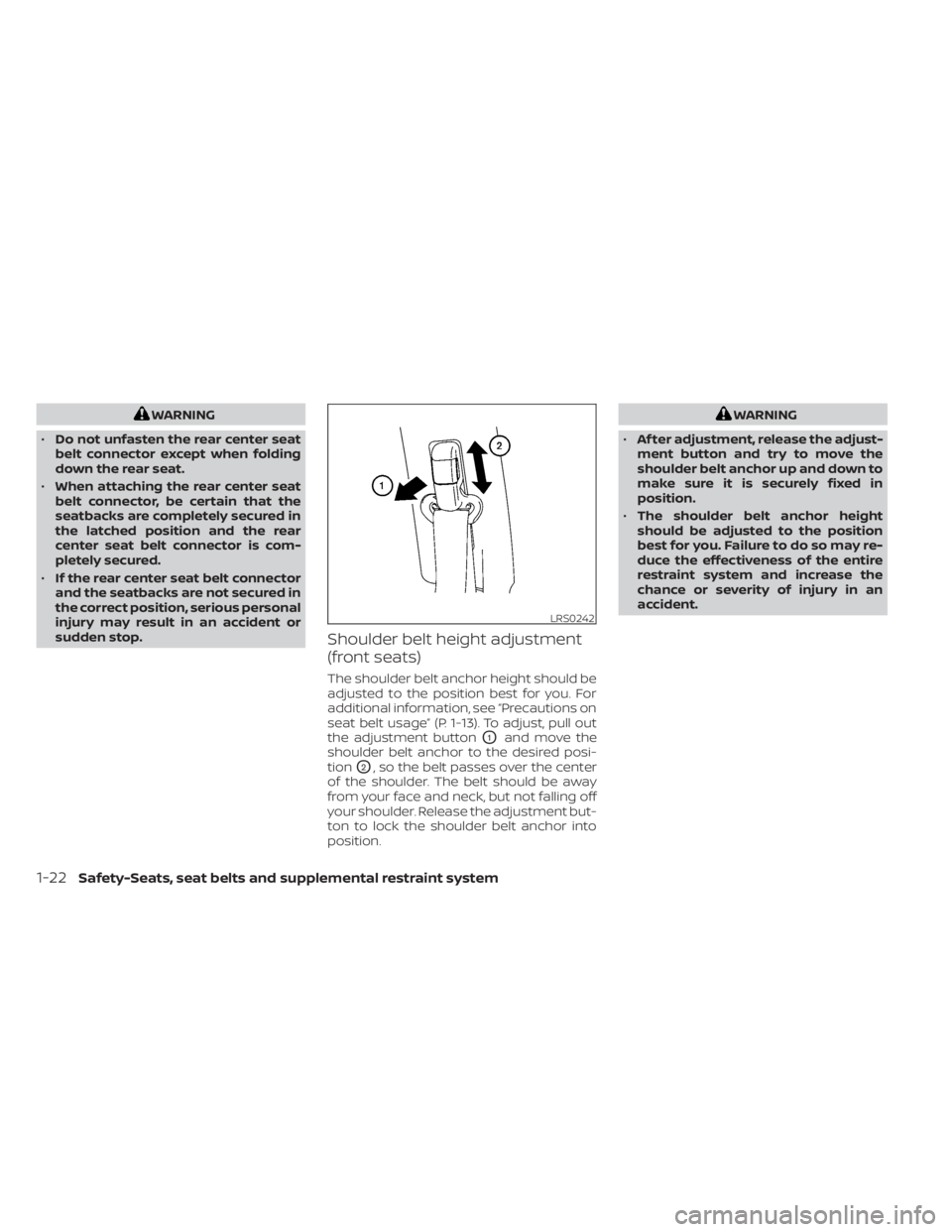
Shoulder belt height adjustment
(front seats)
The shoulder belt anchor height should be
adjusted to the position best for you. For
additional information, see “Precautions on
seat belt usage” (P. 1-13). To adjust, pull out
the adjustment button
O1and move the
shoulder belt anchor to the desired posi-
tion
O2, so the belt passes over the center
of the shoulder. The belt should be away
from your face and neck, but not falling off
your shoulder. Release the adjustment but-
ton to lock the shoulder belt anchor into
position.
WARNING
• Af ter adjustment, release the adjust-
ment button and try to move the
shoulder belt anchor up and down to
make sure it is securely fixed in
position.
• The shoulder belt anchor height
should be adjusted to the position
best for you. Failure to do so may re-
duce the effectiveness of the entire
restraint system and increase the
chance or severity of injury in an
accident.
LRS0242
1-22Safety-Seats, seat belts and supplemental restraint system
Page 48 of 518
This vehicle is equipped with a universal
child restraint anchor system, referred to
as the LATCH (Lower Anchors and Tethers
for CHildren) system. Some child restraints
include rigid or webbing-mounted attach-
ments that can be connected to these
anchors. For additional information, see
“LATCH (Lower Anchors and Tethers for
CHildren) system” (P. 1-28).
If you do not have a LATCH compatible
child restraint, the vehicle seat belts can be
used.
Several manufacturers offer child re-
straints for infants and children of various
sizes. When selecting any child restraint,
keep the following points in mind:
• Choose only a restraint with a label certi-f ying that it complies with Federal Motor
Vehicle Safety Standard 213 or Canadian
Motor Vehicle Safety Standard 213.
• Check the child restraint in your vehicle to be sure it is compatible with the vehicle's
seat and seat belt system. • If the child restraint is compatible with
your vehicle, place your child in the child
restraint and check the various adjust-
ments to be sure the child restraint is
compatible with your child. Choose a
child restraint that is designed for your
child's height and weight. Always follow
all recommended procedures.
• If the combined weight of the child and child restraint is less than 65 lbs. (29.5 kg),
you may use either the LATCH anchors or
the seat belt to install the child restraint
(not both at the same time).
• If the combined weight of the child and child restraint is greater than 65 lbs.
(29.5 kg), use the vehicle’s seat belt (not
the lower anchors) to install the child
restraint.
•
Be sure to follow the child restraint manu-
facturer’s instructions for installation.
All U.S. states and Canadian provinces or
territories require that infants and small
children be restrained in an approved
child restraint at all times while the ve-
hicle is being operated. Canadian law re-
quires the top tether strap on forward-
facing child restraints be secured to the
designated anchor point on the vehicle.
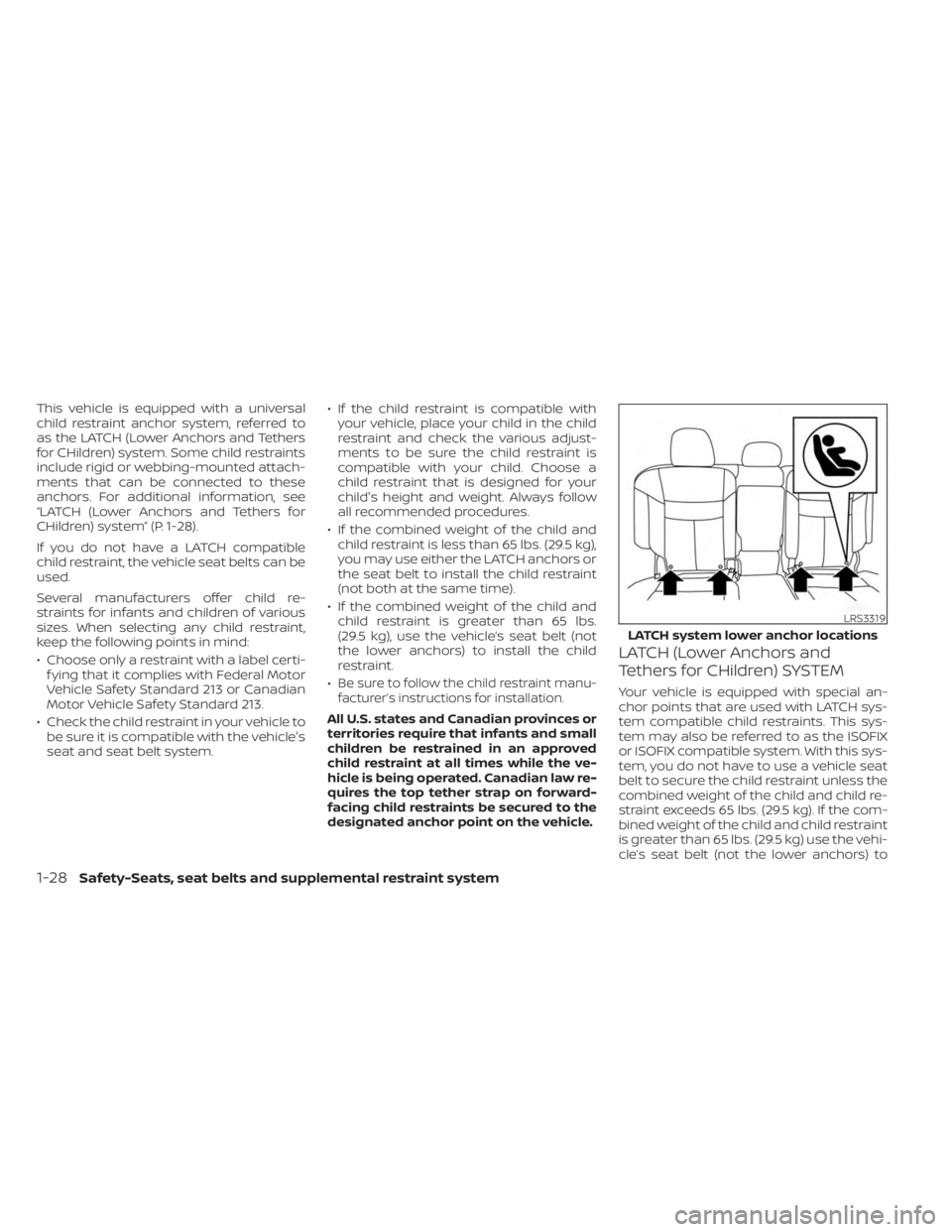
LATCH (Lower Anchors and
Tethers for CHildren) SYSTEM
Your vehicle is equipped with special an-
chor points that are used with LATCH sys-
tem compatible child restraints. This sys-
tem may also be referred to as the ISOFIX
or ISOFIX compatible system. With this sys-
tem, you do not have to use a vehicle seat
belt to secure the child restraint unless the
combined weight of the child and child re-
straint exceeds 65 lbs. (29.5 kg). If the com-
bined weight of the child and child restraint
is greater than 65 lbs. (29.5 kg) use the vehi-
cle’s seat belt (not the lower anchors) to
LRS3319
LATCH system lower anchor locations
1-28Safety-Seats, seat belts and supplemental restraint system
Page 50 of 518
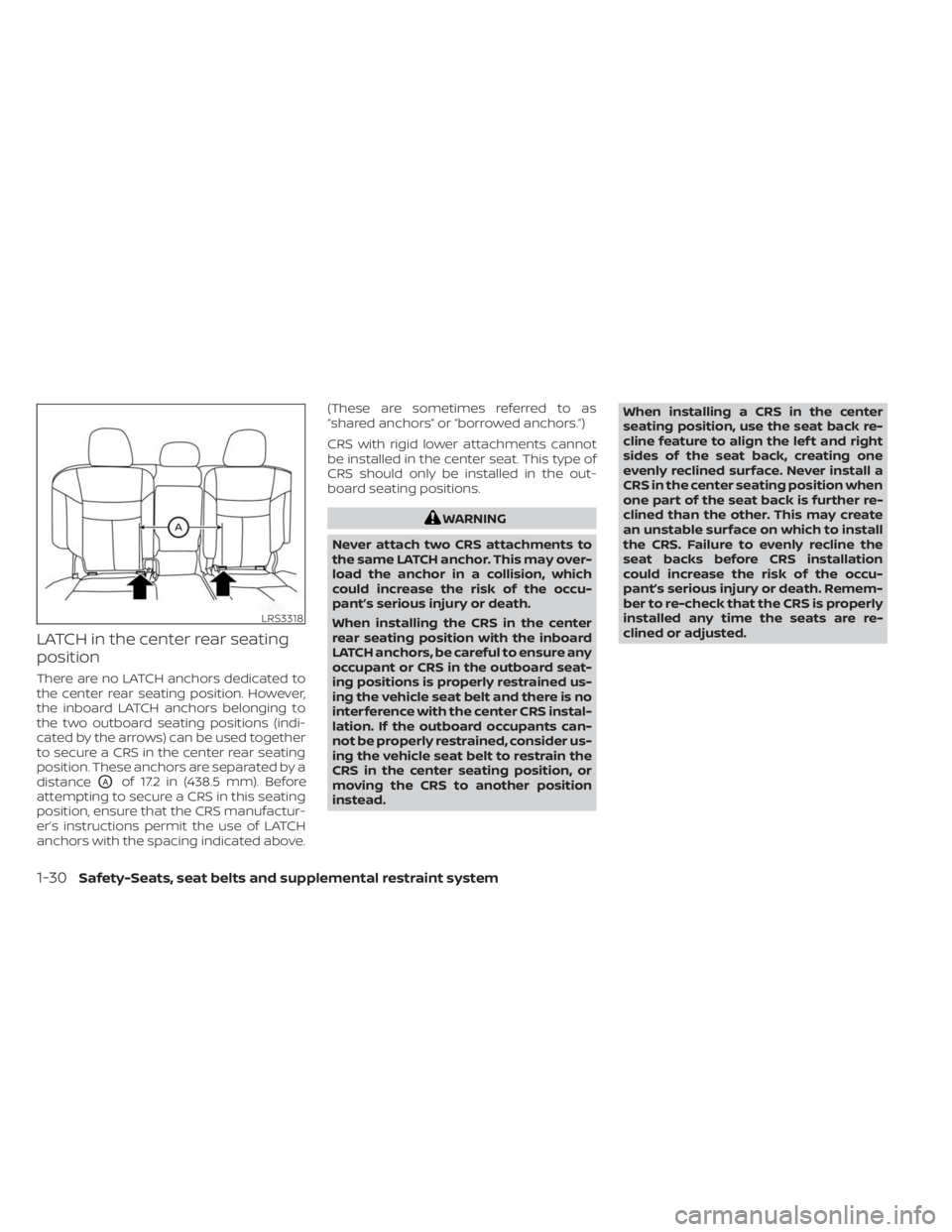
LATCH in the center rear seating
position
There are no LATCH anchors dedicated to
the center rear seating position. However,
the inboard LATCH anchors belonging to
the two outboard seating positions (indi-
cated by the arrows) can be used together
to secure a CRS in the center rear seating
position. These anchors are separated by a
distance
OAof 17.2 in (438.5 mm). Before
attempting to secure a CRS in this seating
position, ensure that the CRS manufactur-
er’s instructions permit the use of LATCH
anchors with the spacing indicated above. (These are sometimes referred to as
“shared anchors” or “borrowed anchors.”)
CRS with rigid lower attachments cannot
be installed in the center seat. This type of
CRS should only be installed in the out-
board seating positions.
WARNING
Never attach two CRS attachments to
the same LATCH anchor. This may over-
load the anchor in a collision, which
could increase the risk of the occu-
pant’s serious injury or death.
When installing the CRS in the center
rear seating position with the inboard
LATCH anchors, be careful to ensure any
occupant or CRS in the outboard seat-
ing positions is properly restrained us-
ing the vehicle seat belt and there is no
interference with the center CRS instal-
lation. If the outboard occupants can-
not be properly restrained, consider us-
ing the vehicle seat belt to restrain the
CRS in the center seating position, or
moving the CRS to another position
instead. When installing a CRS in the center
seating position, use the seat back re-
cline feature to align the lef t and right
sides of the seat back, creating one
evenly reclined surface. Never install a
CRS in the center seating position when
one part of the seat back is further re-
clined than the other. This may create
an unstable surface on which to install
the CRS. Failure to evenly recline the
seat backs before CRS installation
could increase the risk of the occu-
pant’s serious injury or death. Remem-
ber to re-check that the CRS is properly
installed any time the seats are re-
clined or adjusted.
LRS3318
1-30Safety-Seats, seat belts and supplemental restraint system
Page 57 of 518
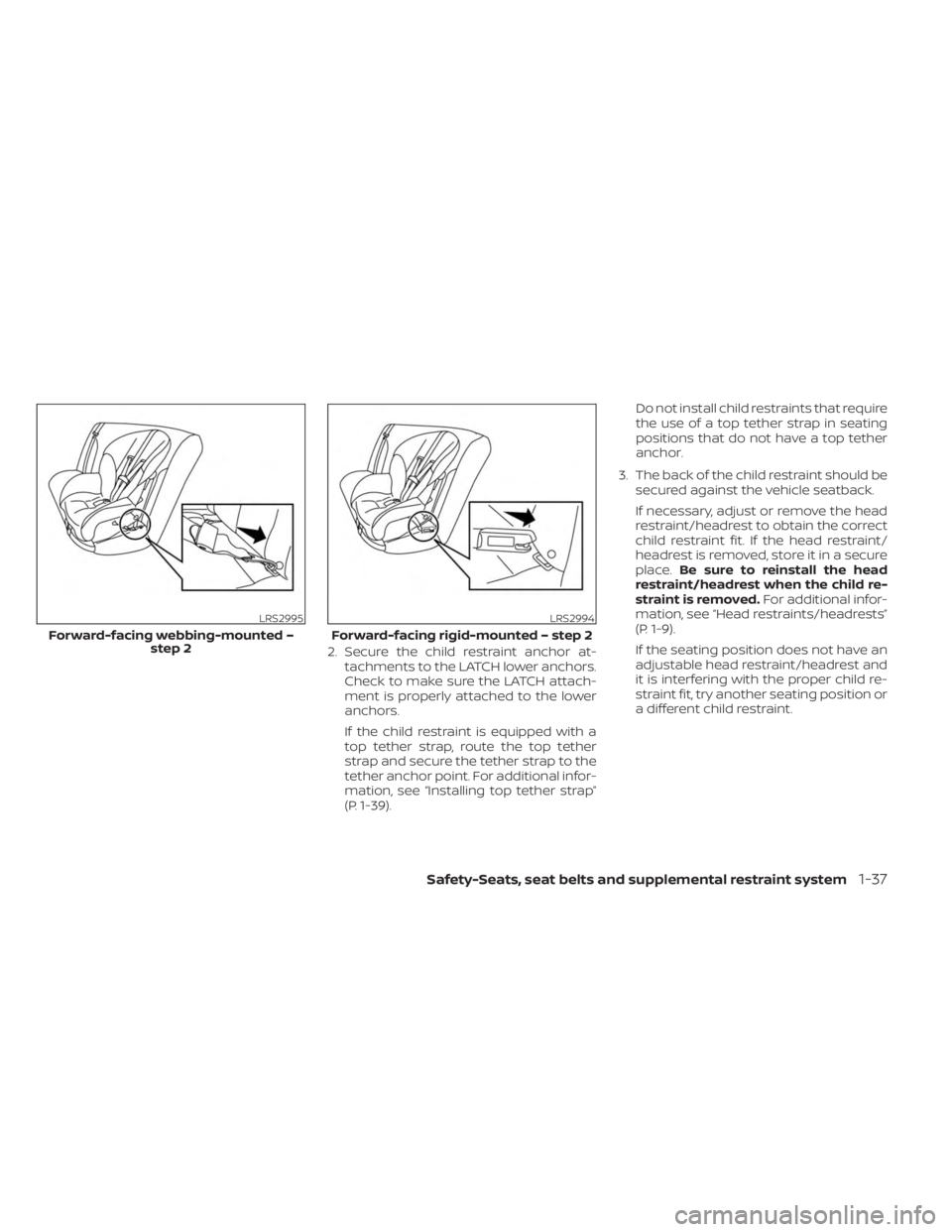
2. Secure the child restraint anchor at-tachments to the LATCH lower anchors.
Check to make sure the LATCH attach-
ment is properly attached to the lower
anchors.
If the child restraint is equipped with a
top tether strap, route the top tether
strap and secure the tether strap to the
tether anchor point. For additional infor-
mation, see “Installing top tether strap”
(P. 1-39). Do not install child restraints that require
the use of a top tether strap in seating
positions that do not have a top tether
anchor.
3. The back of the child restraint should be secured against the vehicle seatback.
If necessary, adjust or remove the head
restraint/headrest to obtain the correct
child restraint fit. If the head restraint/
headrest is removed, store it in a secure
place. Be sure to reinstall the head
restraint/headrest when the child re-
straint is removed. For additional infor-
mation, see “Head restraints/headrests”
(P. 1-9).
If the seating position does not have an
adjustable head restraint/headrest and
it is interfering with the proper child re-
straint fit, try another seating position or
a different child restraint.
LRS2995
Forward-facing webbing-mounted – step 2
LRS2994
Forward-facing rigid-mounted – step 2
Safety-Seats, seat belts and supplemental restraint system1-37
Page 60 of 518
FORWARD-FACING CHILD
RESTRAINT INSTALLATION USING
THE SEAT BELTS
WARNING
The three-point seat belt with Auto-
matic Locking Retractor (ALR) must be
used when installing a child restraint.
Failure to use the ALR mode will result
in the child restraint not being properly
secured. The restraint could tip over or
be loose and cause injury to a child in a
sudden stop or collision. Also, it can
change the operation of the front pas-
senger air bag. For additional informa-
tion, see “Front passenger air bag and
status light” (P. 1-59). For additional information, see all Warnings
and Cautions in “Child safety” (P. 1-24) and
“Child restraints” (P. 1-26) before installing a
child restraint.
Do not use the lower anchors if the com-
bined weight of the child and the child re-
straint exceeds 65 lbs. (29.5 kg). If the com-
bined weight of the child and the child
restraint is greater than 65 lbs. (29.5 kg), use
the vehicle's seat belt (not the lower an-
chors) to install the child restraint. Be sure
to follow the child restraint manufacturer's
instructions for installation. Follow these steps to install a forward-
facing child restraint using the vehicle seat
belt in the rear seats or in the front passen-
ger seat:
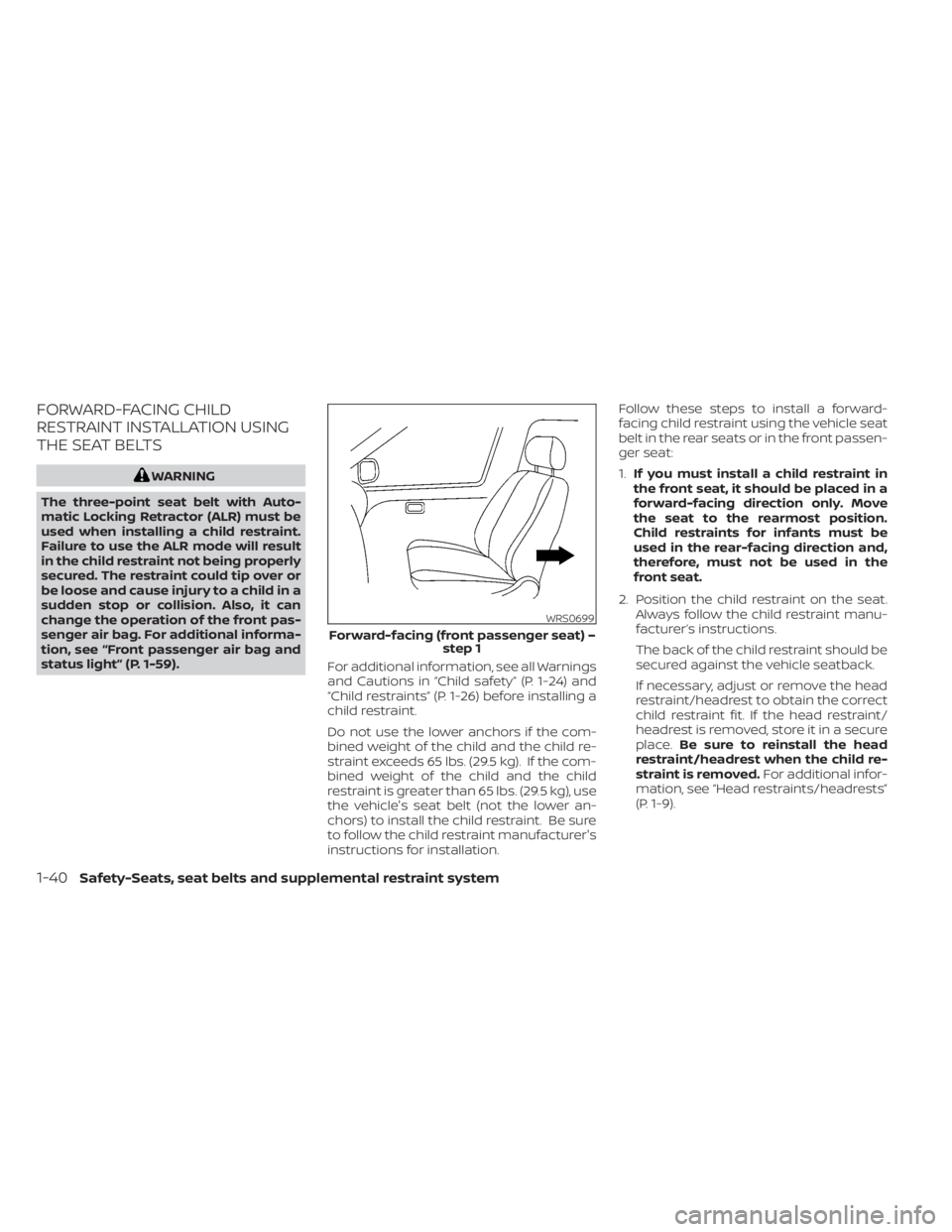
1.
If you must install a child restraint in
the front seat, it should be placed in a
forward-facing direction only. Move
the seat to the rearmost position.
Child restraints for infants must be
used in the rear-facing direction and,
therefore, must not be used in the
front seat.
2. Position the child restraint on the seat. Always follow the child restraint manu-
facturer’s instructions.
The back of the child restraint should be
secured against the vehicle seatback.
If necessary, adjust or remove the head
restraint/headrest to obtain the correct
child restraint fit. If the head restraint/
headrest is removed, store it in a secure
place. Be sure to reinstall the head
restraint/headrest when the child re-
straint is removed. For additional infor-
mation, see “Head restraints/headrests”
(P. 1-9).
WRS0699
Forward-facing (front passenger seat) – step 1
1-40Safety-Seats, seat belts and supplemental restraint system
Page 61 of 518
If the seating position does not have an
adjustable head restraint/headrest and
it is interfering with the proper child re-
straint fit, try another seating position or
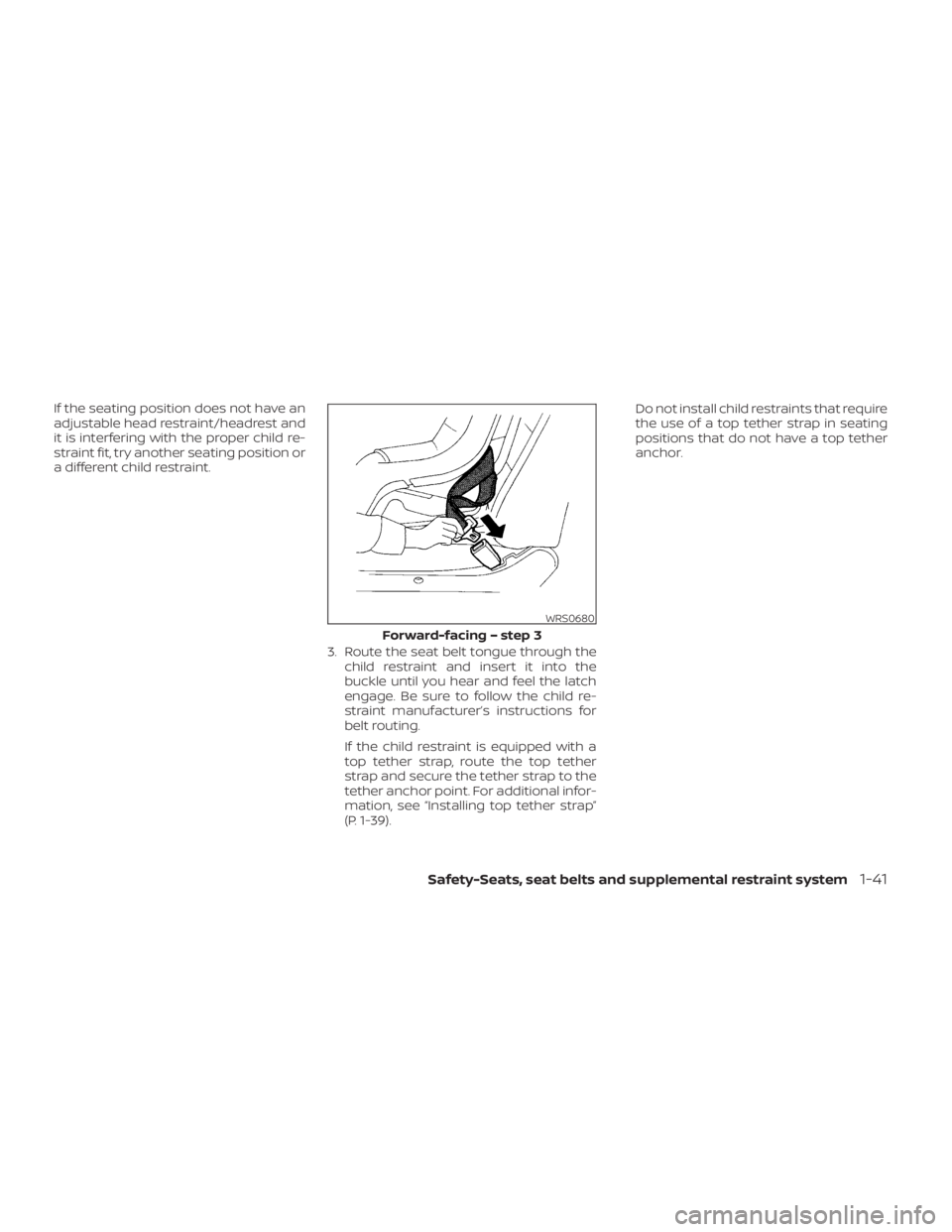
a different child restraint.3. Route the seat belt tongue through thechild restraint and insert it into the
buckle until you hear and feel the latch
engage. Be sure to follow the child re-
straint manufacturer’s instructions for
belt routing.
If the child restraint is equipped with a
top tether strap, route the top tether
strap and secure the tether strap to the
tether anchor point. For additional infor-
mation, see “Installing top tether strap”
(P. 1-39). Do not install child restraints that require
the use of a top tether strap in seating
positions that do not have a top tether
anchor.
WRS0680
Forward-facing – step 3
Safety-Seats, seat belts and supplemental restraint system1-41