ECU NISSAN MURANO PLATINUM 2015 Owner's Manual
[x] Cancel search | Manufacturer: NISSAN, Model Year: 2015, Model line: MURANO PLATINUM, Model: NISSAN MURANO PLATINUM 2015Pages: 424, PDF Size: 4.49 MB
Page 367 of 424
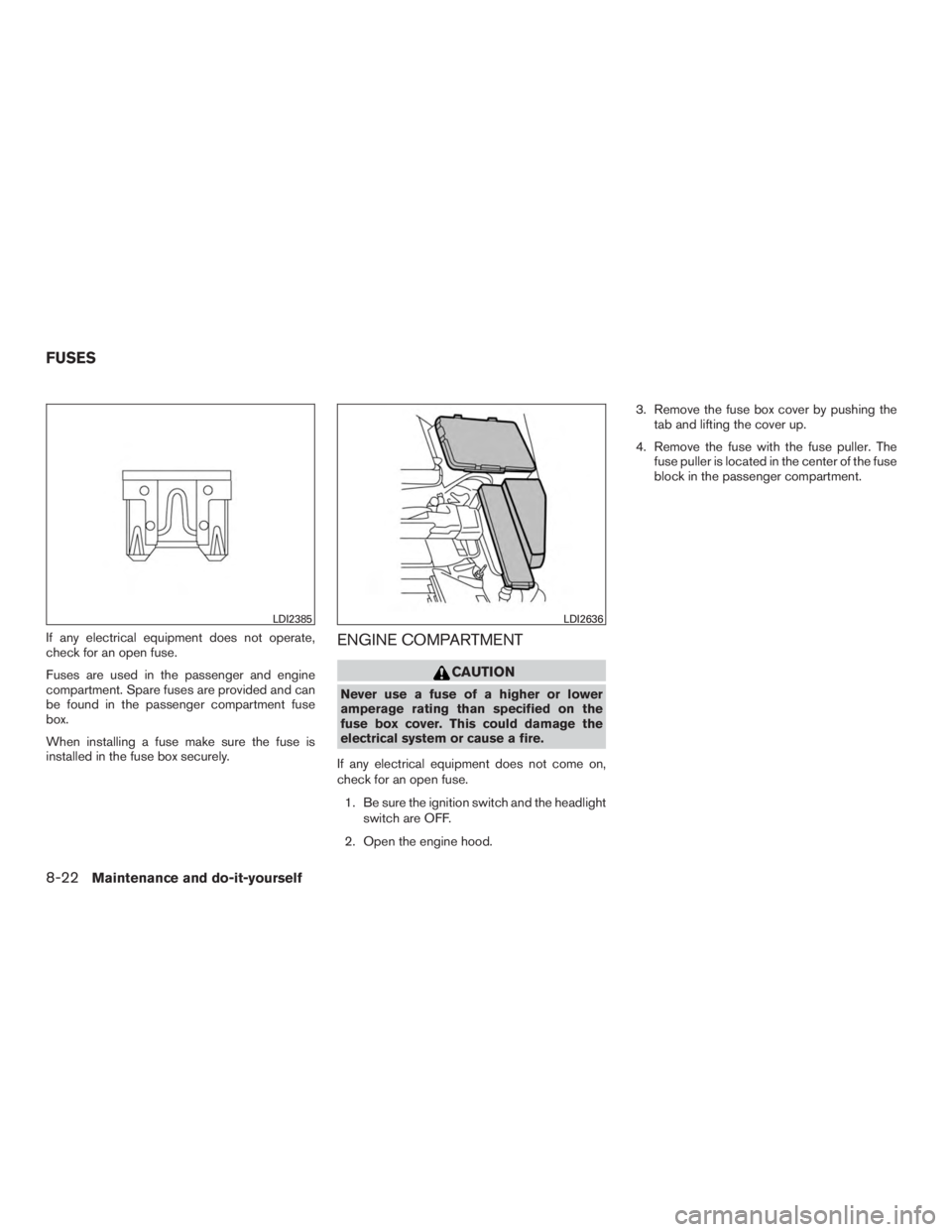
If any electrical equipment does not operate,
check for an open fuse.
Fuses are used in the passenger and engine
compartment. Spare fuses are provided and can
be found in the passenger compartment fuse
box.
When installing a fuse make sure the fuse is
installed in the fuse box securely.ENGINE COMPARTMENT
Page 401 of 424
WARNING
●Properly secure all cargo with ropes or
straps to help prevent it from sliding or
shifting. Do not place cargo higher than
the seatbacks. In a sudden stop or col-
lision, unsecured cargo could cause
personal injury.
● The child restraint top tether strap may
be damaged by contact with items in
the cargo area. Secure any items in the
cargo area. Your child could be seri-
ously injured or killed in a collision if
the top tether strap is damaged.
● Do not load your vehicle any heavier
than the GVWR or the maximum front
and rear GAWRs. If you do, parts of your
vehicle can break, tire damage could
occur, or it can change the way your
vehicle handles. This could result in loss
of control and cause personal injury.
LOADING TIPS
● The GVW must not exceed GVWR
or GAWR as specified on the
F.M.V.S.S./C.M.V.S.S. certification
label. ●
Do not load the front and rear axle to
the GAWR. Doing so will exceed the
GVWR.
Page 406 of 424
WARNING
Trailer hitch components have specific
weight ratings. Your vehicle may be ca-
pable of towing a trailer heavier than the
weight rating of the hitch components.
Never exceed the weight rating of the
hitch components. Doing so can cause
serious personal injury or property
damage.
Hitch ball
Choose a hitch ball of the proper size and weight
rating for your trailer:● The required hitch ball size is stamped on
most trailer couplers. Most hitch balls also
have the size printed on the top of the ball.
● Choose the proper class hitch ball based on
the trailer weight.
● The diameter of the threaded shank of the
hitch ball must be matched to the ball mount
hole diameter. The hitch ball shank should
be no more than 1/16” smaller than the hole
in the ball mount. ●
The threaded shank of the hitch ball must be
long enough to be properly secured to the
ball mount. There should be at least 2
threads showing beyond the lock washer
and nut.
Ball mount
The hitch ball is attached to the ball mount and
the ball mount is inserted into the hitch receiver.
Choose a proper class ball mount based on the
trailer weight. Additionally, the ball mount should
be chosen to keep the trailer tongue level with the
ground.
Weight carrying hitches
A weight carrying or “dead weight” ball mount is
one that is designed to carry the whole amount of
tongue weight and gross weight directly on the
ball mount and on the receiver.
Weight distribution hitch
This type of hitch is also called a “load-leveling” or
“equalizing” hitch. A set of bars attach to the ball
mount and to the trailer to distribute the tongue
weight (hitch weight) of your trailer. Many ve-
hicles can’t carry the full tongue weight of a given
trailer, and need some of the tongue weight
transferred through the frame and pushing down
on the front wheels. This gives stability to the tow
vehicle. A weight-distributing hitch system (Class IV) is
recommended if you plan to tow trailers with a
maximum weight over 5,000 lbs (2,268 kg).
Check with the trailer and towing equipment
manufacturers to determine if they recommend
the use of a weight-distributing hitch system.
NOTE:
A weight-distributing hitch system may af-
fect the operation of trailer surge brakes. If
you are considering use of a weight-
distributing hitch system with a surge
brake-equipped trailer, check with the
surge brake, hitch or trailer manufacturer
to determine if and how this can be done.
Follow the instructions provided by the manufac-
turer for installing and using the weight-
distributing hitch system.
General set-up instructions are as follows:
1. Park unloaded vehicle on a level surface. With the ignition on and the doors closed,
allow the vehicle to stand for several minutes
so that it can level.
2. Measure the height of a reference point on the front and rear bumpers at the center of
the vehicle.
Technical and consumer information9-21
Page 408 of 424
Pre-towing tips
●Be certain your vehicle maintains a level
position when a loaded and/or unloaded
trailer is hitched. Do not drive the vehicle if it
has an abnormal nose-up or nose-down
condition; check for improper tongue load,
overload, worn suspension or other possible
causes of either condition.
● Always secure items in the trailer to prevent
load shift while driving.
● Keep the cargo load as low as possible in
the trailer to keep the trailer center of gravity
low.
● Load the trailer so approximately 60% of the
trailer load is in the front half and 40% is in
the back half. Also make sure the load is
balanced side to side.
● Check your hitch, trailer tire pressure, ve-
hicle tire pressure, trailer light operation, and
trailer wheel lug nuts every time you attach a
trailer to the vehicle.
● Be certain your rearview mirrors conform to
all federal, state or local regulations. If not,
install any mirrors required for towing before
driving the vehicle. ●
Determine the overall height of the vehicle
and trailer so the required clearance is
known.
Trailer towing tips
In order to gain skill and an understanding of the
vehicle’s behavior, you should practice turning,
stopping and backing up in an area which is free
from traffic. Steering stability and braking perfor-
mance will be somewhat different than under
normal driving conditions.
● Always secure items in the trailer to prevent
load shift while driving.
● Lock the trailer hitch coupler with a pin or
lock to prevent the coupler from inadver-
tently becoming unlatched.
● Avoid abrupt starts, acceleration or stops.
● Avoid sharp turns or lane changes.
● Always drive your vehicle at a moderate
speed.
● When backing up, hold the bottom of the
steering wheel with one hand. Move your
hand in the direction in which you want the
trailer to go. Make small corrections and
back up slowly. If possible, have someone
guide you when you are backing up. Always block the wheels on both vehicle and
trailer when parking. Parking on a slope is not
recommended; however, if you must do so:
Page 413 of 424
https://wwwapps.tc.gc.ca/Saf-Sec-Sur/
7/PCDB-BDPP/fc-cp.aspx?lang=fra
(French speakers)
Additional information concerning motor
vehicle safety may be obtained from Trans-
port Canada’s Road Safety Information
Centre at 1-800-333-0371 or online at
www.tc.gc.ca/roadsafety (English speak-
ers) or www.tc.gc.ca/securiteroutiere
(French speakers) .
To notify NISSAN of any safety concerns
please contact our Consumer Information
Centre toll free at 1-800-387-0122.
Page 419 of 424
L
Labels Air conditioner specification label .....9-12
C.M.V.S.S. certification label ........9-11
Emissioncontrolinformationlabel.....9-11
Engine serial number ............9-11
F.M.V.S.S. certification label .........9-11
Tire and Loading Information label .....9-12
Vehicle identification number (VIN) .....9-10
Vehicle identification number (VIN) plate . .9-10
Warning labels (for SRS) ..........1-65
LATCH (Lower Anchors and Tethers for CHildren)
System ......................1-27
License plate Installing the license plate ..........9-12
Liftgate......................3-22
Liftgaterelease.................3-26
Light Airbagwarninglight.........1-66,2-11
Brake light (See stop light) .........8-28
Bulb check/instrument panel .........2-7
Bulb replacement ..............8-28
Charge warning light .............2-8
ExteriorandInteriorlights..........8-28
Foglights...................8-27
Foglightswitch ...............2-34
Headlight and turn signal switch ......2-30
Headlight control switch ..........2-30
Headlights ..................8-27
Interiorlight..................2-50
Lightbulbs..................8-27
Low tire pressure warning light ........2-9
Low windshield-washer fluid warning
light ..................2-11,2-23 Passenger air bag and status light
.....1-56
Personal lights ................2-51
Security indicator light ............2-13
Spotlights(Seemaplight) .........2-51
Warning/indicator lights and audible
reminders ................2-7,2-12
Lights.......................8-27 Maplights ..................2-51
Lock Child safety rear door lock ..........3-7
Door locks ...................3-4
Fuel-filler door lock opener lever ......3-27
Liftgaterelease...............3-26
Power door locks ............3-5,3-6
Loose fuel cap warning ..........2-23,3-27
Lowfuelwarninglight ..........2-11,2-23
Low tire pressure warning light ..........2-9
Low windshield-washer fluid warning
light ....................2-11,2-23
Luggage hook ..................2-44
Luggage rack (see roof rack) ..........2-44
Luggage (See vehicle loading information) . .9-13
M
Maintenance Generalmaintenance.............8-2
Insidethevehicle...............8-3
Maintenance precautions ...........8-5
Outside the vehicle ..............8-2
Seatbeltmaintenance............1-23
Underthehoodandvehicle .........8-4
Maintenancerequirements............8-2
Malfunction indicator light ............2-12
Manual front seat adjustment ...........1-3Maplights ....................2-51
Memory Seat
............3-35,3-36,3-37
Meters and gauges ................2-3
Instrument brightness control ........2-33
Mirror Inside mirror .................3-32
Outside mirror control ........3-33,3-34
Outside mirrors ...............3-34
Vanity mirror .................3-32
Mirrors ......................3-32
Moonroof .....................2-48
N
NISSAN Intelligent Key® ..........3-2,3-7
NISSAN Intelligent Key® battery discharge
i
ndicator .....................5-13
NISSAN vehicle immobilizer system . . .2-26, 5-14
O
Octane rating (See fuel octane rating) ......9-5
Odometer .....................2-4
Oil Capacities and recommended
fuel/lubricants.................9-2
Changingengineoil.............8-10
Changing engine oil filter ..........8-12
Checking engine oil level ...........8-9
Engineoil ...................8-9
Engine oil and oil filter recommendation . . .9-6
Engine oil viscosity ..............9-6
Oneshotcall...............4-54,4-54
Outside mirror control ..........3-33,3-34
10-4
Page 420 of 424
Outside mirrors.................3-34
Overheat Ifyourvehicleoverheats...........6-12
Owner’s manual order form ...........9-29
Owner’s manual/service manual order
information ....................9-29
P
Parking Parking brake operation ...........5-20
Parking/parking on hills ...........5-67
Personallights..................2-51
Power Front seat adjustment .............1-4
Power door locks ............3-5,3-6
Power outlet .................2-39
Power rear windows .............2-47
Power steering fluid .............8-13
Power steering system ...........5-68
Rear power windows ............2-47
Power outlet ...................2-39
Power steering ..................5-68
Power steering fluid ...............8-13
Precautions Maintenance precautions ...........8-5
On-pavement and off-road driving
precautions ..................5-6
Precautions on booster
seats...........1-25,1-32,1-39,1-43
Precautions on child
restraints .........1-25,1-32,1-39,1-43
Precautionsonseatbeltusage.......1-13
Precautions on supplemental restraint
system ....................1-46 Precautions when starting and
driving
...................5-2,5-8
Pre-tensioner seat belt system .........1-64
Push starting ...................6-12
R
Radio Car phone or CB radio ...........4-50
FM/AM/SAT radio with compact disc (CD)
player .....................4-38
Readiness for inspection maintenance (I/M)
test........................9-28
Rear center seat belt ..............1-19
Rear power windows ..............2-47
Rearseat......................1-6
RearView Monitor ..............4-2,4-7
Rear window and outside mirror defroster
switch .......................2-30
Rear window wiper and washer switches . . .2-29
Recorders Eventdata..................9-29
Refrigerant recommendation ...........9-7
Registering your vehicle in another country . .9-10
Remote Start ...............3-19,5-15
Reporting safety defects (US only) .......9-27
Roof rack .....................2-44
S
Safety Child safety rear door lock ..........3-7
Child seat belts .....1-25,1-32,1-39,1-43
Reporting safety defects (US only) .....9-27Seat adjustment
Front manual seat adjustment ........1-3
Front power seat adjustment .........1-4
Seatbackpockets................2-40
Seat belt Child safety ..................1-23
Infants and small children ..........1-24
Injured Person ................1-16
Largerchildren................1-24
Precautions on seat belt usage .......1-13
Pregnant women ...............1-16
Pre-tensioner seat belt system .......1-64
Rear center seat belt ............1-19
Seatbeltextenders .............1-22
Seatbeltmaintenance............1-23
S
eatbelts................1-13,7-5
Shoulder belt height adjustment ......1-22
Three-point type with retractor .......1-16
Seat belt extenders ...............1-22
Seatbeltwarninglight..........1-16,2-11
Seats Adjustment ...................1-2
Armrests....................1-7
Automatic drive positioner. . .3-35, 3-36, 3-37
Frontseats...................1-2
Heatedseats..........2-35, 2-36, 2-37
Manualfrontseatadjustment.........1-3
Rearseat....................1-6
Security indicator light ..............2-13
Security system (NISSAN vehicle immobilizer
system) , engine start ...........2-26,5-14
Security systems Vehicle security system ...........2-25
Self-adjusting brakes ..............8-21
Service manual order form ...........9-29
Servicing air conditioner .............4-29
10-5
Page 422 of 424
V
Vanity mirror ...................3-32
Vehicledimensionsandweights.........9-9
Vehicle dynamic control (VDC) off switch . . .2-38
Vehicle dynamic control (VDC) system .....5-70
Vehicle Dynamic Control (VDC) system ....5-70
Vehicle identification ...............9-10
Vehicle identification number (VIN) .......9-10
Vehicle identification number (VIN)
(Chassis number) ................9-10
Vehicle identification number (VIN) plate ....9-10
Vehicle immobilizer system ........2-26,5-14
Vehicleloadinginformation...........9-13
Vehicle recovery ..............6-15,6-16
Vehicle security system .............2-25
Vehicle security system (NISSAN vehicle immobi-
lizer system) , engine start ........2-26,5-14
Vents.......................4-25
Visors.......................3-31
Voice Prompt Interrupt ..............4-54
W
Warning Airbagwarninglight.........1-66,2-11
Anti-lock brake warning light ......2-7,2-8
Battery charge warning light .........2-8
Blind Spot Warning (BSW) warning
light......................5-21
Brake warning light ..............2-8
Engine oil pressure warning light ....2-8,2-9
Hazard warning flasher switch ........6-2
Loose fuel cap warning ........2-23,3-27 Lowfuelwarninglight ........2-11,2-23
Low tire pressure warning light
........2-9
Low windshield-washer fluid warning
light ..................2-11,2-23
Passenger air bag and status light .....1-56
Seatbeltwarninglight........1-16,2-11
Supplemental air bag warning light .1-66, 2-11
Vehicle security system ...........2-25
Warning/indicator lights and audible
reminders................2-7,2-12
Warning labels (for SRS) ..........1-65
Warning/indicator lights and audible
reminders..................2-7,2-12 Audible reminders ...........2-7,2-12
Indicatorlights.............2-7,2-12
Warninglights .............2-7,2-12
Warninglights ...............2-7,2-12
Washer switch Rear window wiper and washer
switches...................2-29
Wiper and washer switch ..........2-27
Weights(Seedimensionsandweights).....9-9
Wheels and tires .................8-29
Wheel/tire size ...................9-9
When traveling or registering your vehicle
in another country ................9-10
Windows .....................2-45
Locking passengers’ windows .......2-46
Power rear windows .............2-47
Rear power windows ............2-47
Windshield-washer fluid .............8-14
Windshieldwiperblades............8-19
Wiper Rear window wiper and washer
switches...................2-29
Wiper and washer switch ..........2-27 Wiperblades.................8-19
Wiper and washer switch ............2-27
10-7