engine overheat NISSAN MURANO PLATINUM 2018 Owners Manual
[x] Cancel search | Manufacturer: NISSAN, Model Year: 2018, Model line: MURANO PLATINUM, Model: NISSAN MURANO PLATINUM 2018Pages: 460, PDF Size: 4.89 MB
Page 140 of 460
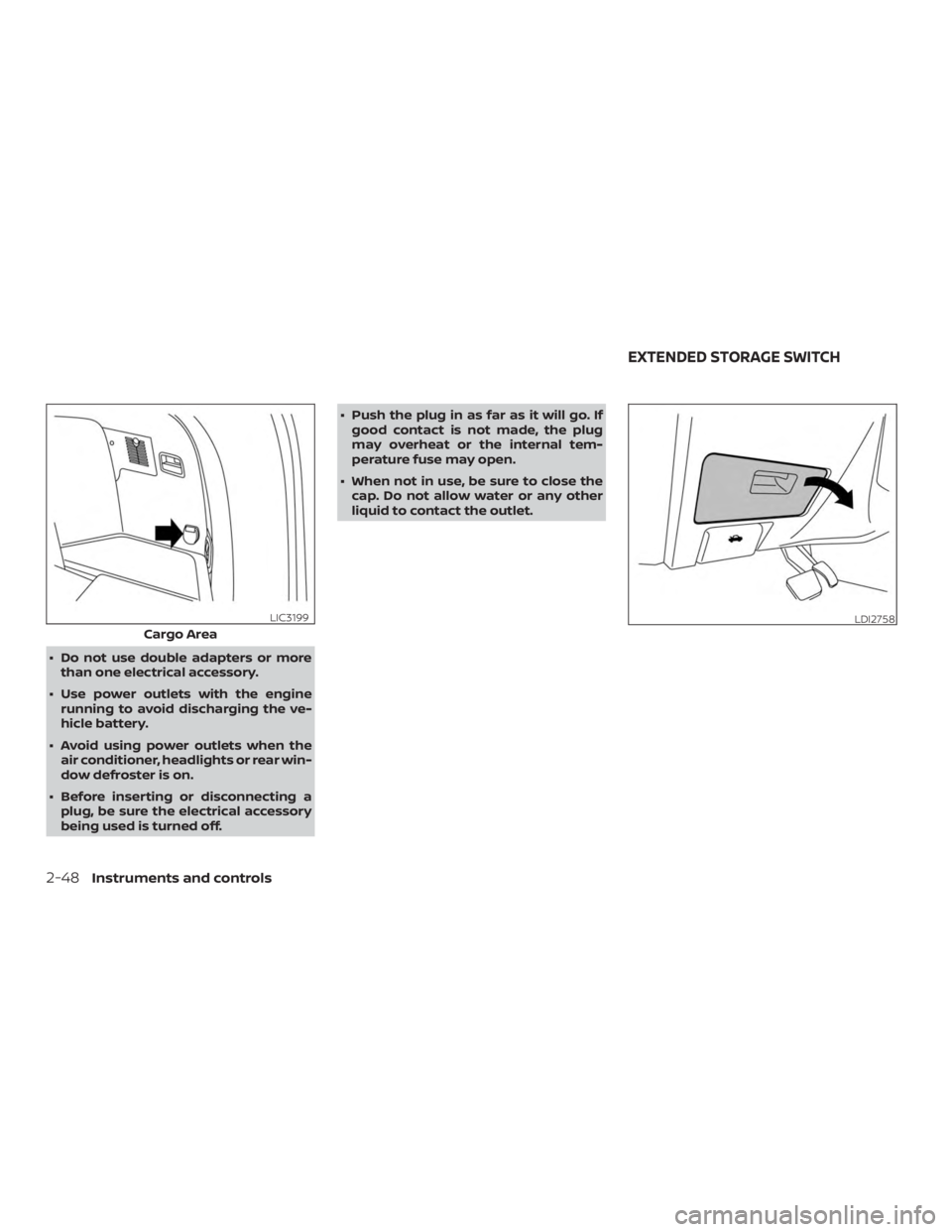
∙ Do not use double adapters or morethan one electrical accessory.
∙ Use power outlets with the engine running to avoid discharging the ve-
hicle battery.
∙ Avoid using power outlets when the air conditioner, headlights or rear win-
dow defroster is on.
∙ Before inserting or disconnecting a plug, be sure the electrical accessory
being used is turned off. ∙ Push the plug in as far as it will go. If
good contact is not made, the plug
may overheat or the internal tem-
perature fuse may open.
∙ When not in use, be sure to close the cap. Do not allow water or any other
liquid to contact the outlet.
Page 250 of 460
∙ If your engine stalls or you cannotmake it to the top of a steep hill, never
attempt to turn around. Your vehicle
could tip or roll over. Always back
straight down in R (Reverse) gear and
apply brakes to control your speed.
∙ Heavy braking going down a hill could cause your brakes to overheat and
fade, resulting in loss of control and
an accident. Apply brakes lightly and
use a low gear to control your speed.
∙ Unsecured cargo can be thrown around when driving over rough ter-
rain. Properly secure all cargo so it will
not be thrown forward and cause in-
jury to you or your passengers.
∙ Exceeding the roof rack capacity can raise the center of gravity excessively
and affect the handling and stability
of the vehicle.
∙ Secure heavy loads in the cargo area as far forward and as low as possible.
Do not equip the vehicle with tires
larger than specified in this manual.
This could cause your vehicle to roll
over. ∙ Do not grip the inside or spokes of the
steering wheel when driving off-road.
The steering wheel could move sud-
denly and injure your hands. Instead
drive with your fingers and thumbs on
the outside of the rim.
∙ Before operating the vehicle, ensure that the driver and all passengers
have their seat belts fastened.
∙ Always drive with the floor mats in place as the floor may become hot.
∙ Lower your speed when encountering strong crosswinds. With a higher cen-
ter of gravity, your NISSAN is more af-
fected by strong side winds. Slower
speeds ensure better vehicle control.
∙ Do not drive beyond the performance capability of the tires, even with AWD
engaged.
∙ For AWD equipped vehicles, do not at- tempt to raise two wheels off the
ground and shif t the transmission to
any drive or reverse position with the
engine running. Doing so may result
in drivetrain damage or unexpected
vehicle movement which could result
in serious vehicle damage or personal
injury. ∙ Do not attempt to test an AWD
equipped vehicle on a 2-wheel dyna-
mometer (such as the dynamometers
used by some states for emissions
testing), or similar equipment even if
the other two wheels are raised off the
ground. Make sure you inform test fa-
cility personnel that your vehicle is
equipped with AWD before it is placed
on a dynamometer. Using the wrong
test equipment may result in drive-
train damage or unexpected vehicle
movement which could result in seri-
ous vehicle damage or personal
injury.
∙ When a wheel is off the ground due to an unlevel surface, do not spin the
wheel excessively.
∙ Accelerating quickly, sharp steering maneuvers or sudden braking may
cause loss of control.
∙ If at all possible, avoid sharp turning maneuvers, particularly at high
speeds. Your NISSAN vehicle has a
higher center of gravity than a pas-
senger car. The vehicle is not de-
signed for cornering at the same
speeds as passenger cars.
5-12Starting and driving
Page 325 of 460
The brake system has two separate hy-
draulic circuits. If one circuit malfunctions,
you will still have braking at two wheels.
BRAKE PRECAUTIONS
Vacuum assisted brakes
The brake booster aids braking by using
engine vacuum. If the engine stops, you
can stop the vehicle by depressing the
brake pedal. However, greater foot pres-
sure on the brake pedal will be required to
stop the vehicle and stopping distance will
be longer.
Using the brakes
Avoid resting your foot on the brake pedal
while driving. This will overheat the brakes,
wear out the brake pads faster, and reduce
gas mileage.
To help reduce brake wear and to prevent
the brakes from overheating, reduce speed
and downshif t to a lower gear before going
down a slope or long grade. Overheated
brakes may reduce braking performance
and could result in loss of vehicle control.
Page 430 of 460
Temperature conditions can also affect
towing. For example, towing a heavy trailer
in high outside temperatures on graded
roads can affect engine performance and
cause overheating. The engine protection
mode, which helps reduce the chance of
engine damage, could activate and auto-
matically decrease engine power. Vehicle
speed may decrease under high load. Plan
your trip carefully to account for trailer and
vehicle load, weather and road conditions.
Page 449 of 460
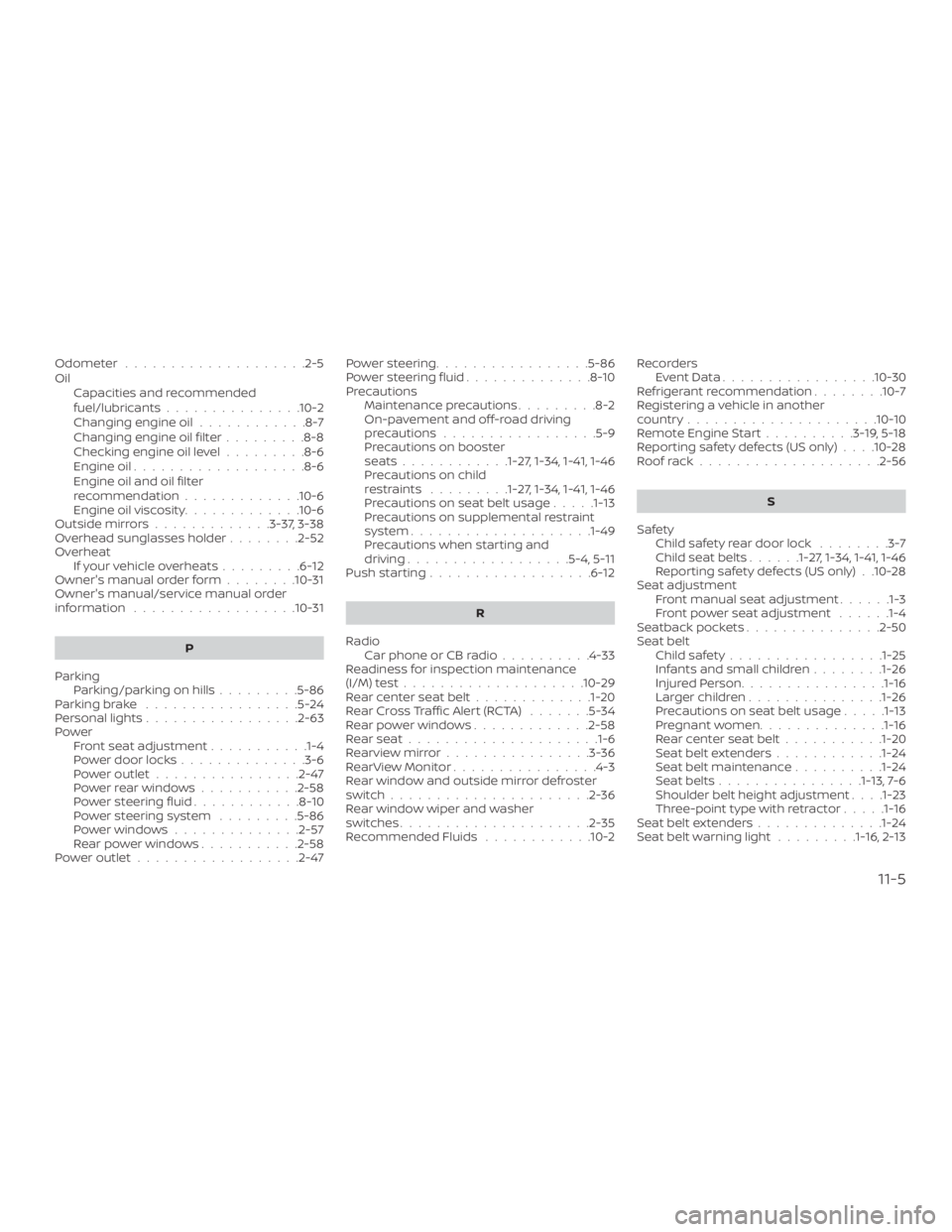
Odometer....................2-5
Oil Capacities and recommended
fuel/lubricants...............10-2
Changing engine oil ............8-7
Changing engine oil filter .........8-8
Checking engine oil level .........8-6
Engine oil ...................8-6
Engine oil and oil filter
recommendation .............10-6
Engine oil viscosity .............10-6
Outsidemirrors.............3-37,3-38
Overhead sunglasses holder ........2-52
Overheat Ifyourvehicleoverheats.........6-12
Owner's manual order form ........10-31
Owner's manual/service manual order
information ..................10-31
P
Parking Parking/parkingonhills.........5-86
Parkingbrake .................5-24
Personal lights .................2-63
Power Front seat adjustment ...........1-4
Power door locks ..............3-6
Poweroutlet................2-47
Powerrearwindows...........2-58
Powersteeringfluid............8-10
Power steering system .........5-86
Powerwindows..............2-57
Rearpowerwindows...........2-58
Poweroutlet..................2-47 Powersteering.................5-86
Powersteeringfluid..............8-10
Precautions
Maintenance precautions .........8-2
On-pavement and off-road driving
precautions .................5-9
Precautions on booster
seats............1-27, 1-34, 1-41, 1-46
Precautions on child
restraints .........1-27, 1-34, 1-41, 1-46
Precautions on seat belt usage .....1-13
Precautions on supplemental restraint
system ................... .1-49
Precautions when starting and
driving..................5-4,5-11
Push starting ..................6-12
R
Radio Car phone or CB radio ..........4-33
Readiness for inspection maintenance
(I/M) test ....................10-29
Rearcenterseatbelt.............1-20
RearCrossTrafficAlert(RCTA) .......5-34
Rearpowerwindows.............2-58
Rearseat.................... .1-6
Rearviewmirror................3-36
RearViewMonitor................4-3
Rear window and outside mirror defroster
switch......................2-36
Rear window wiper and washer
switches .....................2-35
Recommended Fluids ............10-2 Recorders
EventData.................10-30
Refrigerant recommendation ........10-7
Registering a vehicle in another
country .....................10-10
Remote Engine Start ..........3-19,5-18
Reporting safety defects (US only) . . . .10-28
Roofrack....................2-56
S
Safety Child safety rear door lock ........3-7
Childseatbelts......1-27, 1-34, 1-41, 1-46
Reporting safety defects (US only) . .10-28
Seat adjustment Front manual seat adjustment ......1-3
Front power seat adjustment ......1-4
Seatback pockets ...............2-50
Seat belt Childsafety.................1-25
Infants and small children ........1-26
I
njuredPerson............... .1-16
Largerchildren.............. .1-26
Precautionsonseatbeltusage.....1-13
Pregnant women ..............1-16
Rearcenterseatbelt...........1-20
Seat belt extenders ............1-24
Seat belt maintenance ..........1-24
Seatbelts................1-13, 7-6
Shoulder belt height adjustment . . . .1-23
Three-pointtypewithretractor.....1-16
Seat belt extenders ..............1-24
Seatbeltwarninglight.........1-16, 2-13
11-5