light NISSAN NOTE 2012 Manual Online
[x] Cancel search | Manufacturer: NISSAN, Model Year: 2012, Model line: NOTE, Model: NISSAN NOTE 2012Pages: 235, PDF Size: 2.29 MB
Page 198 of 235
ENGINE COMPARTMENT
CAUTION
Never use a fuse of higher or lower amperage
rating than that specified on the fuse box cover.
If any electrical equipment does not operate, check
for an open fuse.
1. Make sure the ignition switch and the headlight
switch are in the “OFF” position.2. Open the bonnet. For details, see “Bonnet
release” in the “3. Pre-driving checks and
adjustments” section.
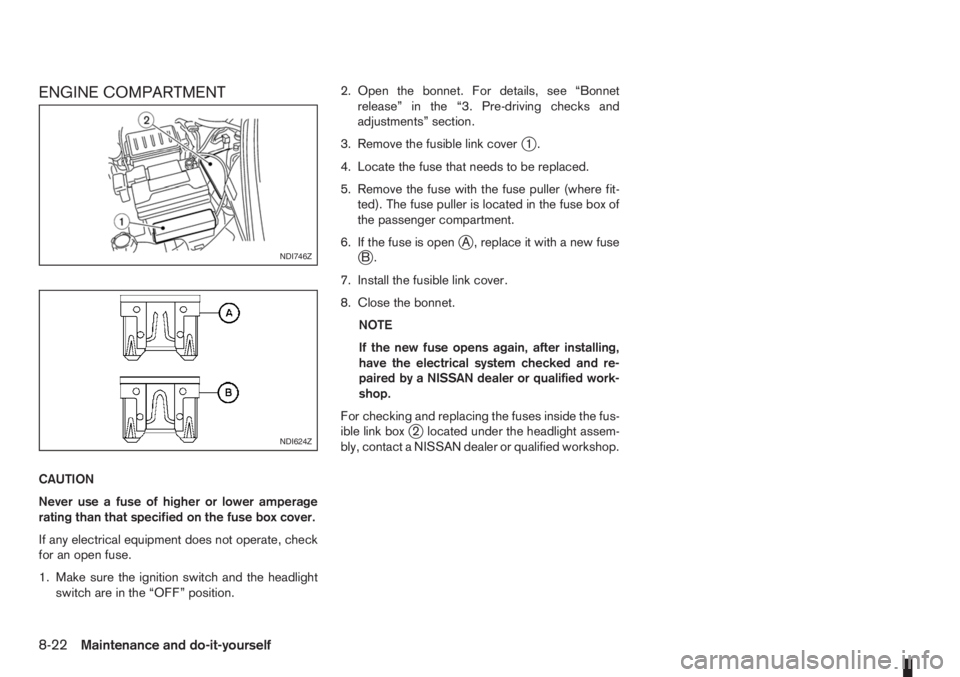
3. Remove the fusible link cover
j1.
4. Locate the fuse that needs to be replaced.
5. Remove the fuse with the fuse puller (where fit-
ted). The fuse puller is located in the fuse box of
the passenger compartment.
6. If the fuse is open
jA , replace it with a new fusejB.
7. Install the fusible link cover.
8. Close the bonnet.
NOTE
If the new fuse opens again, after installing,
have the electrical system checked and re-
paired by a NISSAN dealer or qualified work-
shop.
For checking and replacing the fuses inside the fus-
ible link box
j2 located under the headlight assem-
bly, contact a NISSAN dealer or qualified workshop.
NDI746Z
NDI624Z
8-22Maintenance and do-it-yourself
Page 199 of 235
HEADLIGHTS
Replacing the halogen headlight bulb
The headlight is a semi-sealed beam type which
uses a replaceable headlight (halogen) bulb. A bulb
can be replaced from inside the engine compart-
ment without removing the headlight assembly.
CAUTION
•High pressure halogen gas is sealed inside
the halogen bulb. The bulb may break if the
glass envelope is scratched or the bulb is
dropped.
•When handling the bulb, DO NOT TOUCH THE
GLASS ENVELOPE.
•Use the same number and wattage as origi-
nally installed.
•Aiming is usually not necessary after replac-
ing the bulb. When aiming adjustment is nec-
essary, contact a NISSAN dealer or qualified
workshop.
•Do not leave the bulb out of the headlight
reflector for a long period of time as dust,
moisture or smoke may enter the headlight
body and affect the performance of the head-
light.
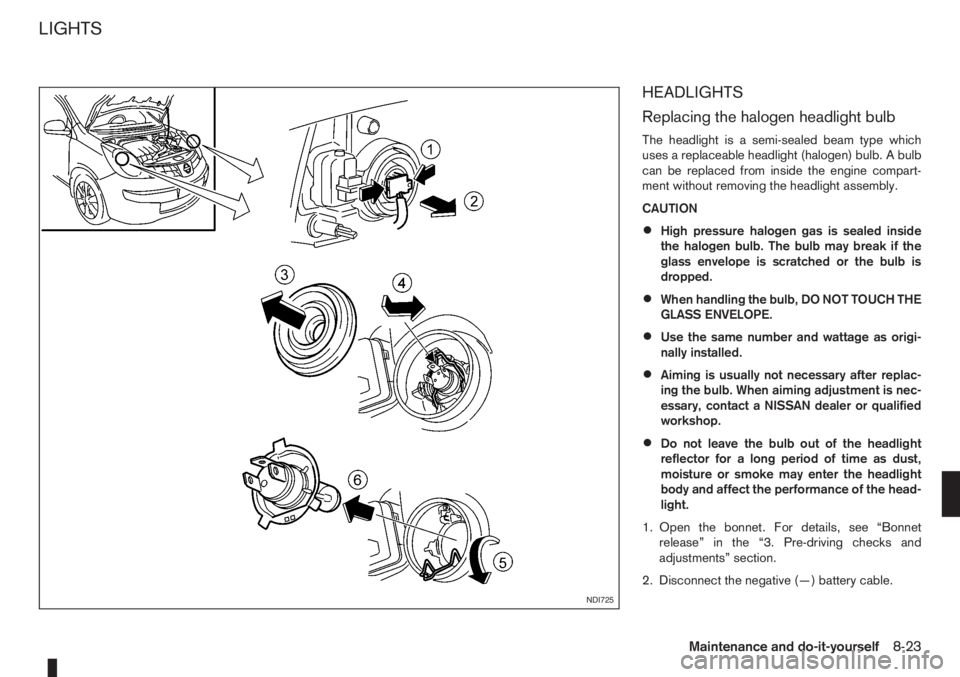
1. Open the bonnet. For details, see “Bonnet
release” in the “3. Pre-driving checks and
adjustments” section.
2. Disconnect the negative (—) battery cable.
NDI725
LIGHTS
Maintenance and do-it-yourself8-23
Page 200 of 235
3. Disconnect the electrical connector from the rear
end of the headlight bulb.
4. Remove the cap.
5. Push and turn the retaining spring to loosen it.
6. Remove the headlight bulb. Do not shake or ro-
tate the bulb during the removal.
7. Install the new bulb in the reverse order of re-
moval and make sure that the cap is securely
sealed with the headlight body.
8. Reconnect the negative (—) battery cable and
close the bonnet.
Contact a NISSAN dealer or qualified workshop, if
you need assistance for bulb replacement.
NOTE
Fog may temporarily form inside the lens of the
exterior lights in the rain or in a car wash. The fog
is caused by a temperature difference between
the inside and the outside of the lens. This is not
a malfunction. If large droplets can be seen, then
contact a NISSAN dealer or qualified workshop.EXTERIOR LIGHTS
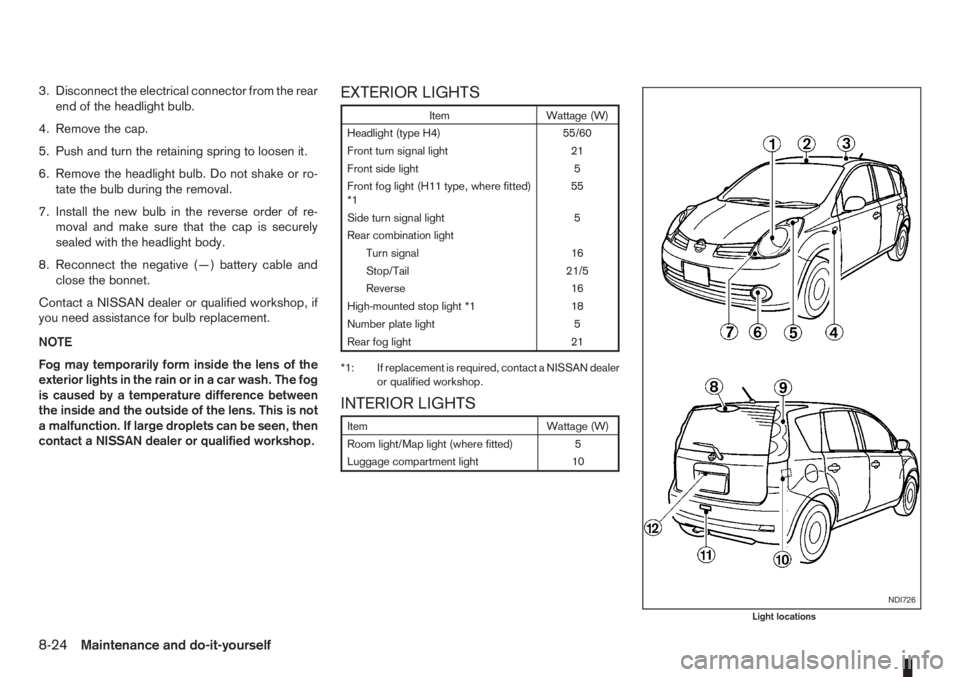
Item Wattage (W)
Headlight (type H4) 55/60
Front turn signal light 21
Front side light 5
Front fog light (H11 type, where fitted)
*155
Side turn signal light 5
Rear combination light
Turn signal 16
Stop/Tail 21/5
Reverse 16
High-mounted stop light *1 18
Number plate light 5
Rear fog light 21
*1: If replacement is required, contact a NISSAN dealer
or qualified workshop.
INTERIOR LIGHTS
Item Wattage (W)
Room light/Map light (where fitted) 5
Luggage compartment light 10
NDI726
Light locations
8-24Maintenance and do-it-yourself
Page 201 of 235
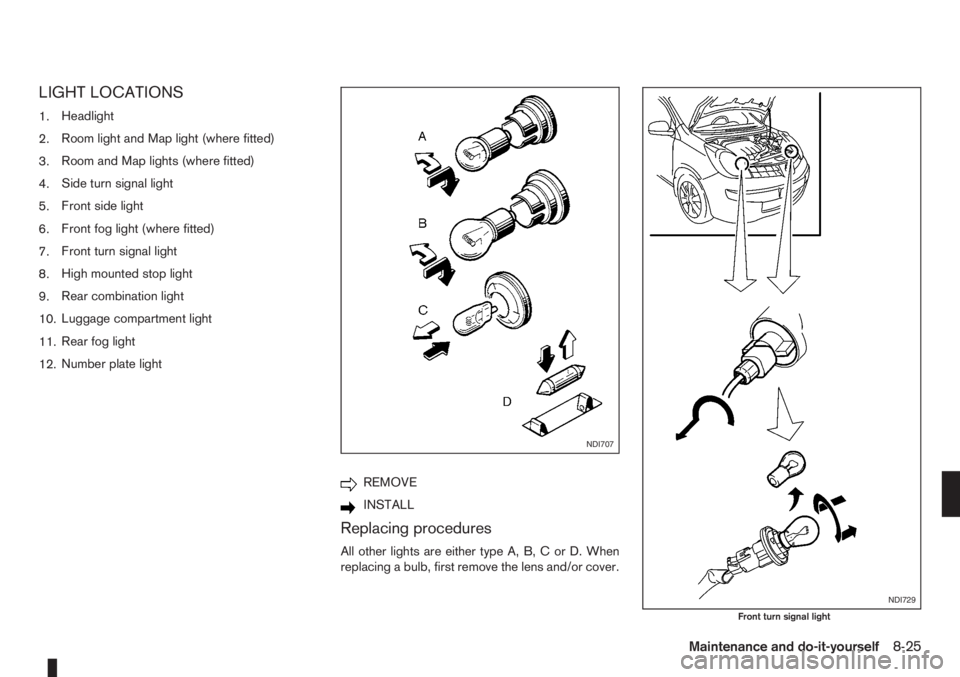
LIGHT LOCATIONS
1.Headlight
2.Room light and Map light (where fitted)
3.Room and Map lights (where fitted)
4.Side turn signal light
5.Front side light
6.Front fog light (where fitted)
7.Front turn signal light
8.High mounted stop light
9.Rear combination light
10.Luggage compartment light
11.Rear fog light
12.Number plate light
REMOVE
INSTALL
Replacing procedures
All other lights are either type A, B, C or D. When
replacing a bulb, first remove the lens and/or cover.
NDI707
NDI729
Front turn signal light
Maintenance and do-it-yourself8-25
Page 202 of 235
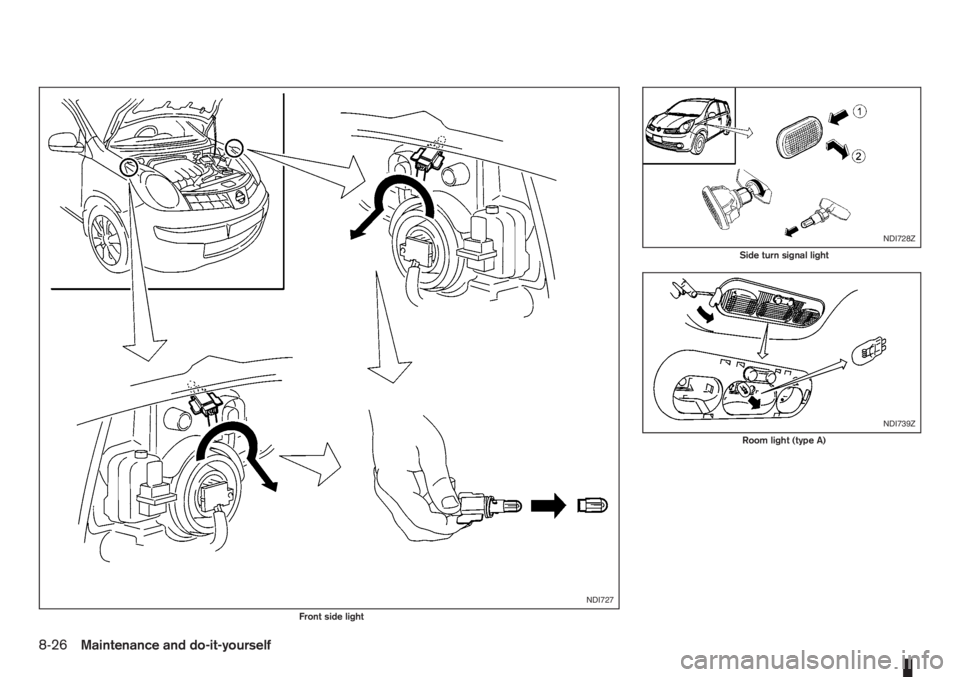
NDI727
Front side light
NDI728Z
Side turn signal light
NDI739Z
Room light (type A)
8-26Maintenance and do-it-yourself
Page 203 of 235

NDI740Z
Room/Map light (type B, where fitted)
NDI733
Luggage compartment light
NDI732
Number plate light
Maintenance and do-it-yourself8-27
Page 204 of 235
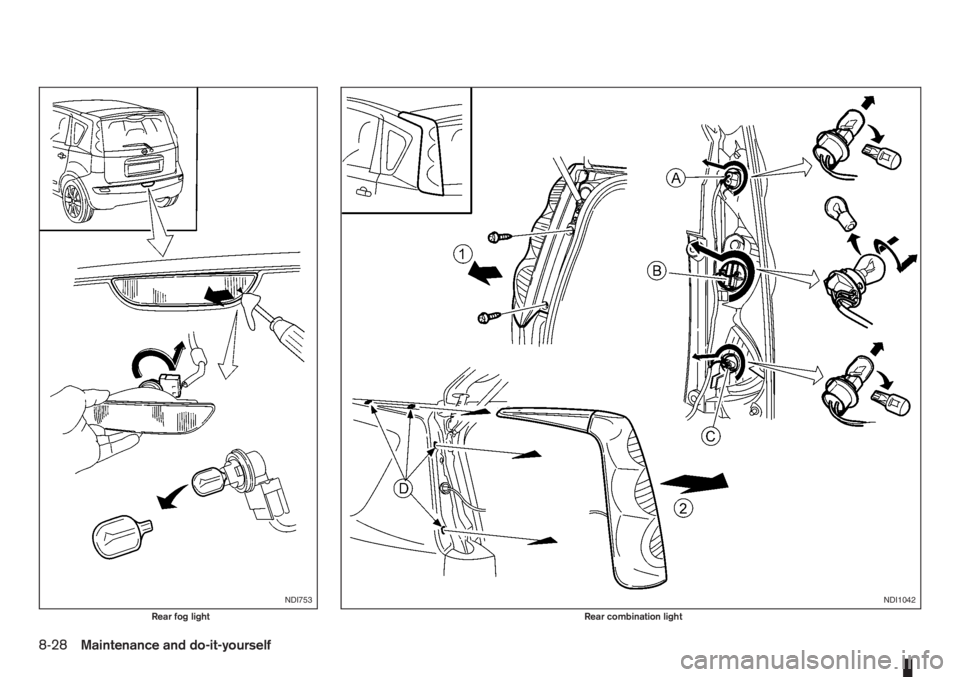
NDI753
Rear fog light
NDI1042
Rear combination light
8-28Maintenance and do-it-yourself
Page 205 of 235

A.Turn signal light
B.Stop/Tail light
C.Reverse light
Rear combination light
1. Open the backdoor.
2. Remove the bolts
j1 with a suitable tool.
3. Hold firmly the outboard edge of the light unit
j2
then pull carefully with force straight towards the
rear of the vehicle, as illustrated.
NOTE
If in doubt or you encounter any difficulties
when removing the light unit from its attach-
ments
jD , contact a NISSAN dealer or quali-
fied workshop.
CAUTION
In order to prevent body and paint damage,
ensure the vehicle body around the light unit
is protected when using lever tools to remove
the light unit.
4. Install the new bulb and check afterwards the
light operation.
5. Install the light unit in the reverse order of re-
moval (step 3 and 2) and close the backdoor.In case of a flat tyre, see “Flat tyre” in the “6. In case
of emergency” section.
TYRE INFLATION PRESSURE
Periodically check the tyre pressure (including the
spare tyre). An incorrect tyre pressure may ad-
versely affect tyre life and vehicle handling.
NOTE
Incorrectly inflated tyres can also lead to poor
steering ability and make the driver suspect a
steering problem: keep the vehicle’s tyres in-
flated to the correct pressure at all times.
The tyre pressure should be checked when tyres
are COLD. Tyres are considered COLD after the
vehicle has been parked for three or more hours, or
driven less than 1.6 km (1 mile). COLD tyre pres-
sures are shown on the tyre placard affixed to the
driver’s side centre pillar.
Insufficient pressure can lead to an overheating of
the tyre and subsequent internal damage. At high
speeds, this could result in tread separation and
even bursting of the tyre.
TYPES OF TYRES
CAUTION
•When changing or replacing tyres, be sure all
four tyres are of the same type (i.e., summer,
all season or snow) and construction.
•A NISSAN dealer or qualified workshop may
be able to help you with information about
tyre type, size, speed rating and availability.
•Replacement tyres may have a lower speed
rating than the factory equipped tyres, and
may not match the potential maximum vehicle
speed. Never exceed the maximum speed rat-
ing of the tyre.
All season tyres
NISSAN specifies all season tyres on some models
to provide good performance for use all year around,
including snowy and icy road conditions. All season
tyres are identified by ALL SEASON and/or M&S
on the tyre sidewall. Snow tyres have better snow
traction than all season tyres and may be more ap-
propriate in some areas.
Summer tyres
NISSAN specifies summer tyres as standard fit.
These tyres provide superior performance under
typical mild weather conditions.
If you plan to operate your vehicle in snowy or icy
conditions, NISSAN recommends the use of SNOW
or ALL SEASON tyres on all four wheels.
Snow tyres
If snow tyres are needed, it is necessary to select
tyres equivalent in size and load rating to the original
equipment tyres. If you do not, it can adversely af-
fect the safety and handling of your vehicle.
Generally, snow tyres will have lower speed ratings
than factory equipped tyres and may not match the
potential maximum vehicle speed. Never exceed the
maximum speed rating of the tyre.
For additional traction on icy roads, studded tyres
WHEELS AND TYRES
Maintenance and do-it-yourself8-29
Page 207 of 235
TYRE AGE
Remember tyre age. Never use a tyre over six years
old, regardless of whether they have been used or
not.
Tyres degrade with age as well as the use they are
subjected to. Have the tyres checked and balanced
frequently by a NISSAN dealer or qualified work-
shop. Report all accidents where the tyre is knocked
even if it is minor.
CHANGING TYRES AND WHEELS
WARNING
Do not install a deformed wheel or tyre even if it
has been repaired. Such wheels or tyres could
have structural damage and could fail without
warning.
When replacing a tyre, use the same size, speed
rating and load carrying capacity as originally
equipped. Recommended types and sizes are men-
tioned in “Wheels and tyres” in the “9. Technical
information” section.
The use of tyres other than those recommended or
the mixed use of tyres of different brands, construc-
tion (bias, bias-belted or radial), or tread patterns
can adversely affect the ride, braking, handling,
ground clearance, body-to-tyre clearance, snow
chain clearance, speedometer calibration, headlight
aim and bumper height.
WARNING
Some of these effects may lead to accidents and
could result in serious personal injury.
If the wheels are changed for any reason, always
replace with wheels which have the same offset
dimension. Wheels of a different offset could cause
early tyre wear, possibly degraded vehicle handling
characteristics and/or interference with the brake
discs/drums. Such interference can lead to
decreased braking efficiency and/or early brake
pad/shoe wear.
WHEEL BALANCE
Unbalanced wheels may affect vehicle handling and
tyre life. Even with regular use, wheels can get out
of balance. Therefore, they should be balanced as
required.
Wheel balance service should be performed with
the wheels off the vehicle. Spin balancing the front
wheels on the vehicle could lead to transmission
damage.
SPARE TYRE
The temporary-use spare wheel/tyre can be identi-
fied by the temporary-use spare tyre label which
contrasts to the standard road wheels. If in doubt,
contact a NISSAN dealer, qualified workshop or
see “Spare tyre” in the “6. In case of emergency”
section.
CARE OF WHEELS
For details, see “Care of wheels” in the “7. Appear-
ance and care” section.
Maintenance and do-it-yourself8-31
Page 210 of 235
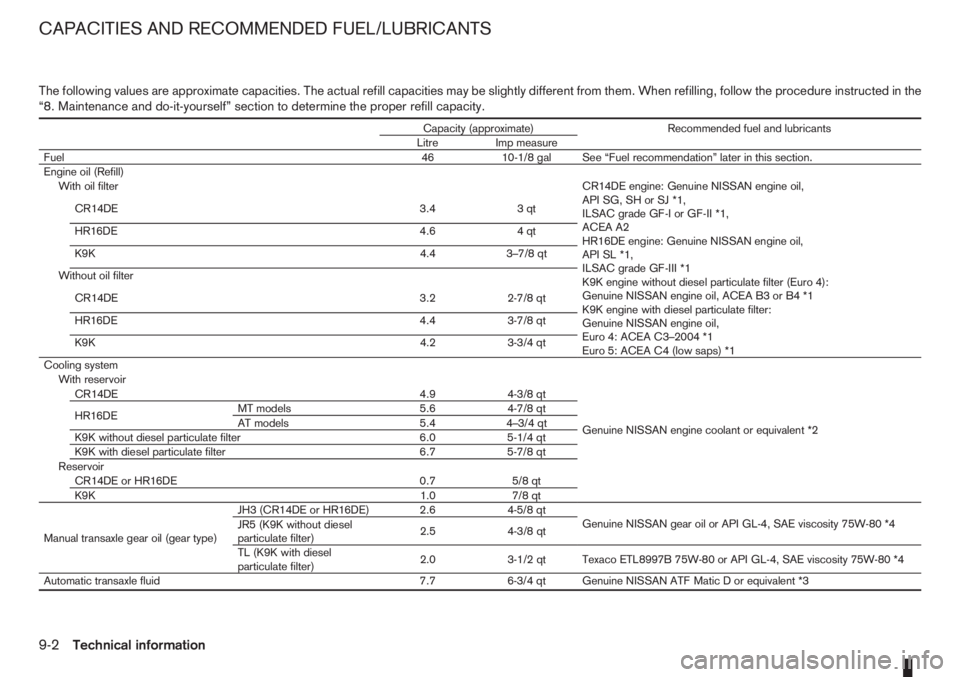
The following values are approximate capacities. The actual refill capacities may be slightly different from them. When refilling, follow the procedure instructed in the
“8. Maintenance and do-it-yourself” section to determine the proper refill capacity.
Capacity (approximate) Recommended fuel and lubricants
Litre Imp measure
Fuel 46 10-1/8 gal See “Fuel recommendation” later in this section
.Engine oil (Refill)
With oil filterCR14DE engine: Genuine NISSAN engine oil,
API SG, SH or SJ *1,
ILSAC grade GF-I or GF-II *1,
ACEA A2
HR16DE engine: Genuine NISSAN engine oil,
API SL *1,
ILSAC grade GF-III *1
K9K engine without diesel particulate filter (Euro 4):
Genuine NISSAN engine oil, ACEA B3 or B4 *1
K9K engine with diesel particulate filter:
Genuine NISSAN engine oil,
Euro 4: ACEA C3–2004 *1
Euro 5: ACEA C4 (low saps) *1 CR14DE 3.4 3 qt
HR16DE 4.6 4 qt
K9K 4.4 3–7/8 qt
Without oil filter
CR14DE 3.2 2-7/8 qt
HR16DE 4.4 3-7/8 qt
K9K 4.2 3-3/4 qt
Cooling system
Genuine NISSAN engine coolant or equivalent *2 With reservoir
CR14DE 4.9 4-3/8 qt
HR16DEMT models 5.6 4-7/8 qt
AT models 5.4 4–3/4 qt
K9K without diesel particulate filter 6.0 5-1/4 qt
K9K with diesel particulate filter 6.7 5-7/8 qt
Reservoir
CR14DE or HR16DE 0.7 5/8 qt
K9K 1.0 7/8 qt
Manual transaxle gear oil (gear type)JH3 (CR14DE or HR16DE) 2.6 4-5/8 qt
Genuine NISSAN gear oil or API GL-4, SAE viscosity 75W-80 *4
JR5 (K9K without diesel
particulate filter)2.5 4-3/8 qt
TL (K9K with diesel
particulate filter)2.0 3-1/2 qt Texaco ETL8997B 75W-80 or API GL-4, SAE viscosity 75W-80 *4
Automatic transaxle fluid 7.7 6-3/4 qt Genuine NISSAN ATF Matic D or equivalent *3
CAPACITIES AND RECOMMENDED FUEL/LUBRICANTS
9-2Technical information