engine coolant NISSAN NV PASSENGER VAN 2018 Owner's Manual
[x] Cancel search | Manufacturer: NISSAN, Model Year: 2018, Model line: NV PASSENGER VAN, Model: NISSAN NV PASSENGER VAN 2018Pages: 426, PDF Size: 4.52 MB
Page 335 of 426
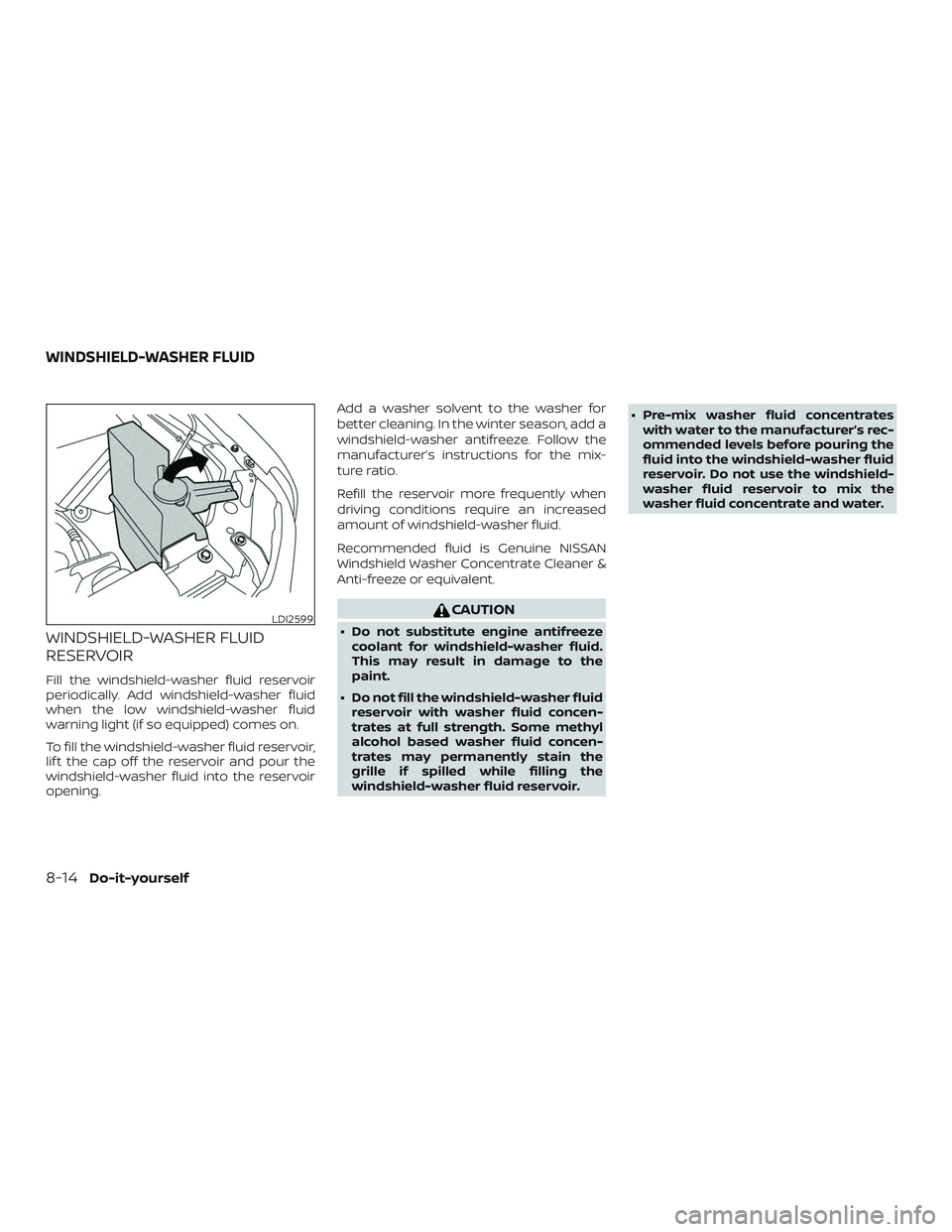
WINDSHIELD-WASHER FLUID
RESERVOIR
Fill the windshield-washer fluid reservoir
periodically. Add windshield-washer fluid
when the low windshield-washer fluid
warning light (if so equipped) comes on.
To fill the windshield-washer fluid reservoir,
lif t the cap off the reservoir and pour the
windshield-washer fluid into the reservoir
opening.Add a washer solvent to the washer for
better cleaning. In the winter season, add a
windshield-washer antifreeze. Follow the
manufacturer’s instructions for the mix-
ture ratio.
Refill the reservoir more frequently when
driving conditions require an increased
amount of windshield-washer fluid.
Recommended fluid is Genuine NISSAN
Windshield Washer Concentrate Cleaner &
Anti-freeze or equivalent.
CAUTION
∙ Do not substitute engine antifreeze
coolant for windshield-washer fluid.
This may result in damage to the
paint.
∙ Do not fill the windshield-washer fluid reservoir with washer fluid concen-
trates at full strength. Some methyl
alcohol based washer fluid concen-
trates may permanently stain the
grille if spilled while filling the
windshield-washer fluid reservoir. ∙ Pre-mix washer fluid concentrates
with water to the manufacturer’s rec-
ommended levels before pouring the
fluid into the windshield-washer fluid
reservoir. Do not use the windshield-
washer fluid reservoir to mix the
washer fluid concentrate and water.LDI2599
WINDSHIELD-WASHER FLUID
8-14Do-it-yourself
Page 369 of 426
Seats:Check seat position controls such
as seat adjusters, seatback recliner, etc., to
ensure they operate smoothly and all
latches lock securely in every position.
Check that the head restraints/headrests
move up and down smoothly and the locks
(if so equipped) hold securely in all latched
positions.
Seat belts: Check that all parts of the seat
belt system (for example, buckles, anchors,
adjusters and retractors) operate properly
and smoothly, and are installed securely.
Check the belt webbing for cuts, fraying,
wear or damage.
Steering wheel: Check for changes in the
steering system, such as excessive free
play, hard steering or strange noises.
Warning lights and chimes: Make sure all
warning lights and chimes are operating
properly.
Windshield defroster: Check that the air
comes out of the defroster outlets properly
and in sufficient quantity when operating
the heater or air conditioner.
Windshield wiper and washer*: Check
that the wipers and washer operate prop-
erly and that the wipers do not streak.Under the hood and vehicle
The maintenance items listed here should
be checked periodically (for example, each
time you check the engine oil or refuel).
Battery*: Check the fluid level in each cell.
The fluid should be at the bottom of the
filler opening. Vehicles operated in high
temperatures or under severe conditions
require frequent checks of the battery fluid
level.
NOTE:
Care should be taken to avoid situations
that can lead to potential battery dis-
charge and potential no-start conditions
such as:
1. Installation or extended use of elec-
tronic accessories that consume bat-
tery power when the engine is not
running (Phone chargers, GPS, DVD
players, etc.).
2. Vehicle is not driven regularly and/or
only driven short distances.
In these cases, the battery may need to
be charged to maintain battery health. Brake fluid level*:
Make sure that the brake
fluid level is between the MAX and MIN lines
on the reservoir.
Engine coolant level*: Check the coolant
level when the engine is cold.
Engine drive belts*: Make sure the drive
belts are not frayed, worn, cracked or oily.
Engine oil level*: Check the level af ter
parking the vehicle on a level spot and
turning off the engine. Wait more than
15 minutes for the oil to drain back into the
oil pan.
Exhaust system: Make sure there are no
loose supports, cracks or holes. If the
sound of the exhaust seems unusual or
there is a smell of exhaust fumes, immedi-
ately have the exhaust system inspected. It
is recommended that you visit a NISSAN
dealer for this service. For additional infor-
mation, refer to “Exhaust gas (carbon mon-
oxide)” in the “Starting and driving” section
of this manual.
Fluid leaks: Check under the vehicle for
fuel, oil, water or other fluid leaks af ter the
vehicle has been parked for a while. Water
dripping from the air conditioner af ter use
is normal. If you should notice any leaks or if
9-4Maintenance and schedules
Page 371 of 426
Engine coolant*:Replace coolant at the
specified interval. When adding or replac-
ing coolant, be sure to use only Genuine
NISSAN Long Life Antifreeze/Coolant (blue)
or equivalent with the proper mixture. (For
additional information on the proper mix-
ture for your area, refer to “Engine cooling
system” in the “Do-it-yourself ” section of
this manual.)
NOTE:
Mixing any other type of coolant or the
use of non-distilled water may reduce
the recommended service interval of the
coolant.
Engine oil and oil filter: Replace engine oil
and oil filter at the specified intervals. For
recommended oil grade and viscosity refer
to “Recommended fluids/lubricants and
capacities” in the “Technical and consumer
information” section of this manual.
Evaporative emissions control vapor
lines*: Check vapor lines for leaks or loose-
ness. Tighten connections or replace parts
as necessary.
Fuel lines*: Check the fuel hoses, piping
and connections for leaks, looseness, or
deterioration. Tighten connections or re-
place parts as necessary. Spark plugs:
Replace at specified intervals.
Install new plugs of the same type as origi-
nally equipped.
CHASSIS AND BODY
MAINTENANCE:
Brake lines and cables: Visually inspect for
proper installation. Check for chafing,
cracks, deterioration, and signs of leaking.
Replace any deteriorated or damaged
parts immediately.
Brake pads and rotors: Check for wear,
deterioration and fluid leaks. Replace any
deteriorated or damaged parts immedi-
ately.
Exhaust system: Visually inspect the ex-
haust pipes, muffler and hangers for leaks,
cracks, deterioration, and damage. Tighten
connections or replace parts as necessary.
In-cabin microfilter (if so equipped): Re-
place at specified intervals. When driving
for prolonged periods in dusty conditions,
replace the filter more frequently
Steering gear and linkage, axle and sus-
pension parts, drive shaf t boots: Check
for damage, looseness, and leakage of oil
or grease. Under severe driving conditions,
inspect more frequently. Tire rotation:
Tires should be rotated every
5,000 miles (8,000 km) according to the in-
structions under “Explanation of general
maintenance items” in this section. When
rotating tires, check for damage and un-
even wear. Replace if necessary.
Transmission fluid/oil, differential oil: Vi-
sually inspect for signs of leakage at speci-
fied intervals.
9-6Maintenance and schedules
Page 373 of 426
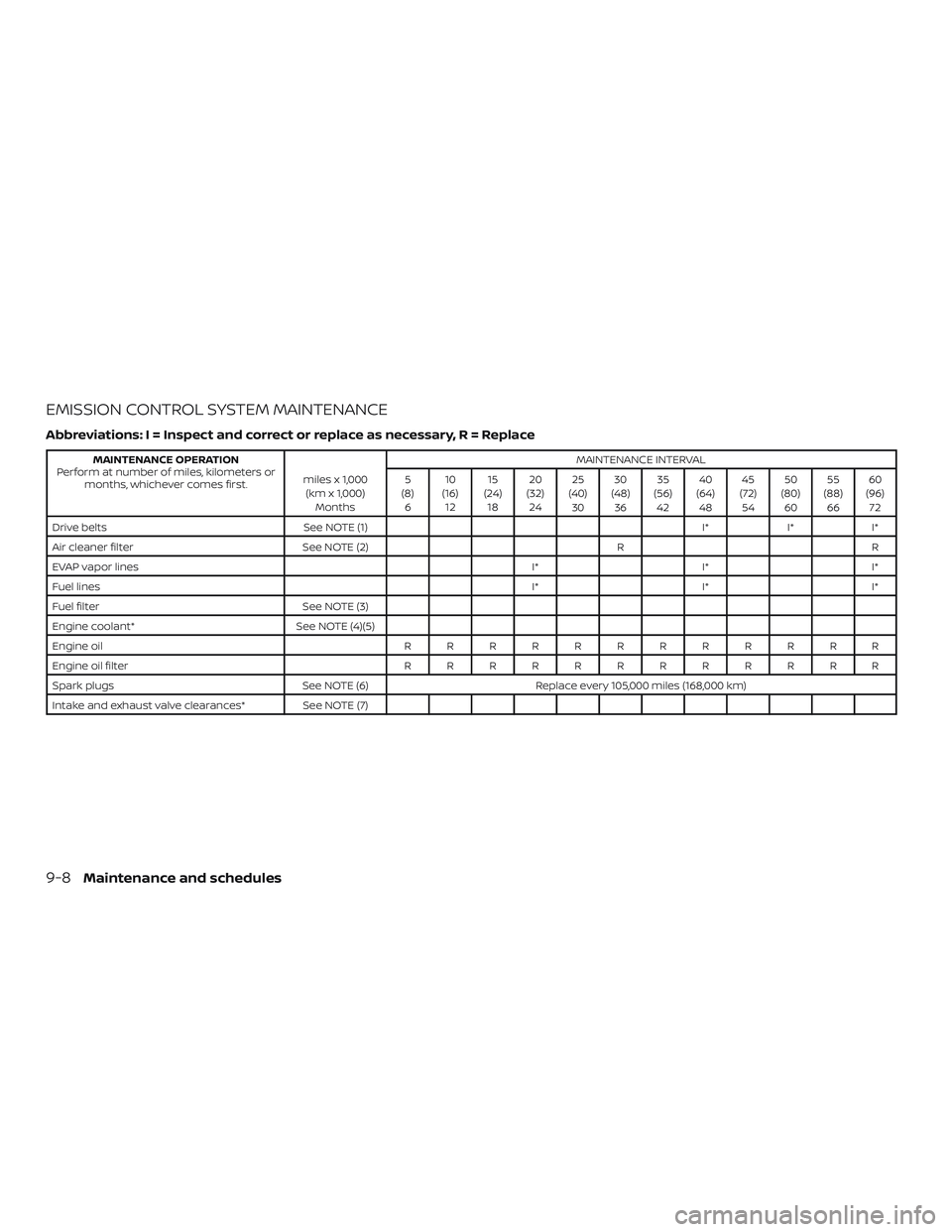
EMISSION CONTROL SYSTEM MAINTENANCE
Abbreviations: I = Inspect and correct or replace as necessary, R = Replace
MAINTENANCE OPERATION
Perform at number of miles, kilometers or months, whichever comes first. miles x 1,000
(km x 1,000) Months MAINTENANCE INTERVAL
5
(8) 6 10
(16) 12 15
(24) 18 20
(32) 24 25
(40) 30 30
(48) 36 35
(56) 42 40
(64) 48 45
(72) 54 50
(80) 60 55
(88) 66 60
(96) 72
Drive belts See NOTE (1) I*I*I*
Air cleaner filter See NOTE (2) RR
EVAP vapor lines I*I*I*
Fuel lines I*I*I*
Fuel filter See NOTE (3)
Engine coolant* See NOTE (4)(5)
Engine oil RRRRRRRRRRRR
Engine oil filter RRRRRRRRRRRR
Spark plugs See NOTE (6)Replace every 105,000 miles (168,000 km)
Intake and exhaust valve clearances* See NOTE (7)
9-8Maintenance and schedules
Page 374 of 426
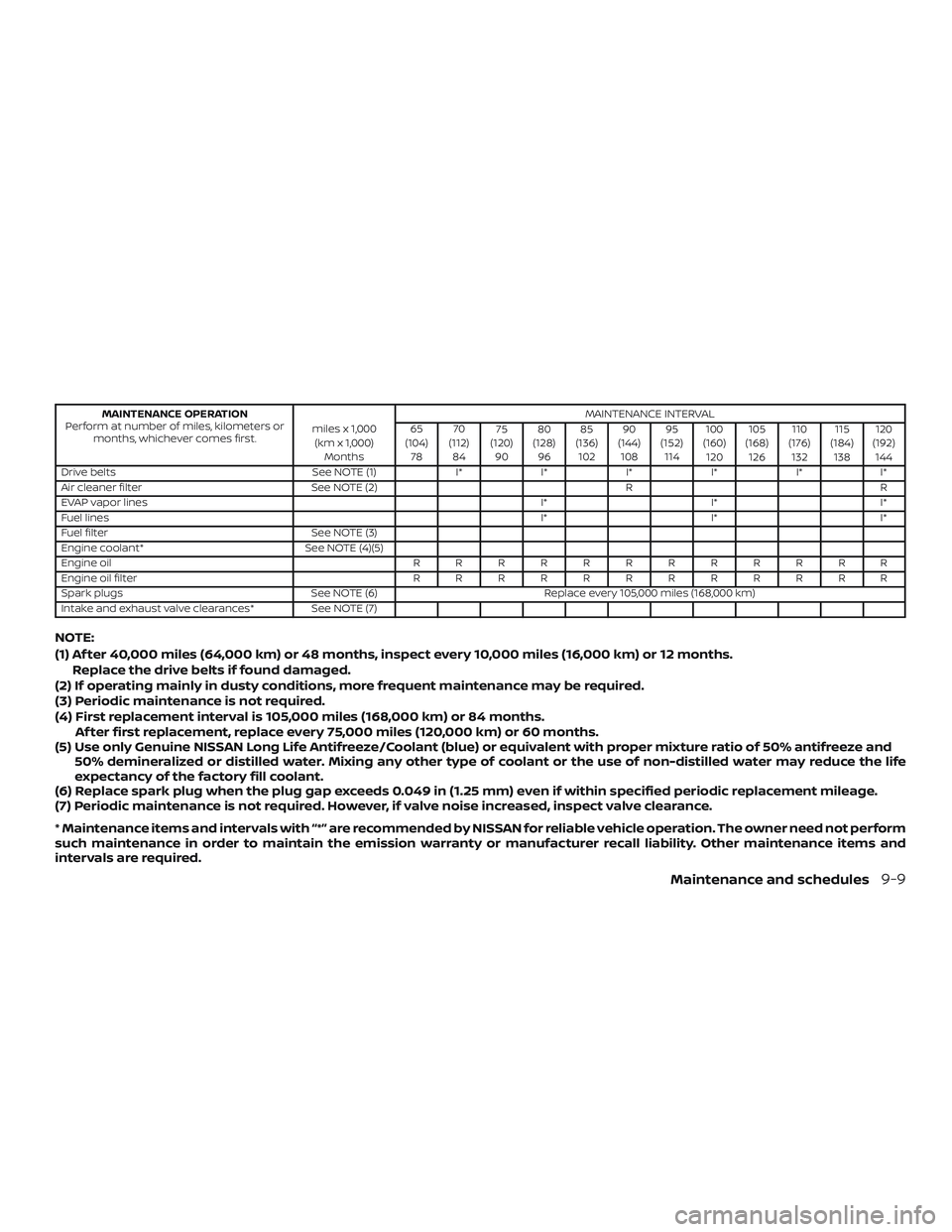
MAINTENANCE OPERATION
Perform at number of miles, kilometers or months, whichever comes first. miles x 1,000
(km x 1,000) Months MAINTENANCE INTERVAL
65
(104) 78 70
(112) 84 75
(120) 90 80
(128) 96 85
(136) 102 90
(144) 108 95
(152) 114 100
(160) 120 105
(168) 126 110
(176) 132 115
(184) 138 120
(192) 144
Drive belts See NOTE (1)I*I*I*I*I*I*
Air cleaner filter See NOTE (2) RR
EVAP vapor lines I*I*I*
Fuel lines I*I*I*
Fuel filter See NOTE (3)
Engine coolant* See NOTE (4)(5)
Engine oil RRRRRRRRRRRR
Engine oil filter RRRRRRRRRRRR
Spark plugs See NOTE (6)Replace every 105,000 miles (168,000 km)
Intake and exhaust valve clearances* See NOTE (7)
NOTE:
(1) Af ter 40,000 miles (64,000 km) or 48 months, inspect every 10,000 miles (16,000 km) or 12 months.
Replace the drive belts if found damaged.
(2) If operating mainly in dusty conditions, more frequent maintenance may be required.
(3) Periodic maintenance is not required.
(4) First replacement interval is 105,000 miles (168,000 km) or 84 months. Af ter first replacement, replace every 75,000 miles (120,000 km) or 60 months.
(5) Use only Genuine NISSAN Long Life Antifreeze/Coolant (blue) or equivalent with proper mixture ratio of 50% antifreeze and 50% demineralized or distilled water. Mixing any other type of coolant or the use of non-distilled water may reduce the life
expectancy of the factory fill coolant.
(6) Replace spark plug when the plug gap exceeds 0.049 in (1.25 mm) even if within specified periodic replacement mileage.
(7) Periodic maintenance is not required. However, if valve noise increased, inspect valve clearance.
* Maintenance items and intervals with “*” are recommended by NISSAN for reliable vehicle operation. The owner need not perform
such maintenance in order to maintain the emission warranty or manufacturer recall liability. Other maintenance items and
intervals are required.
Maintenance and schedules9-9
Page 383 of 426
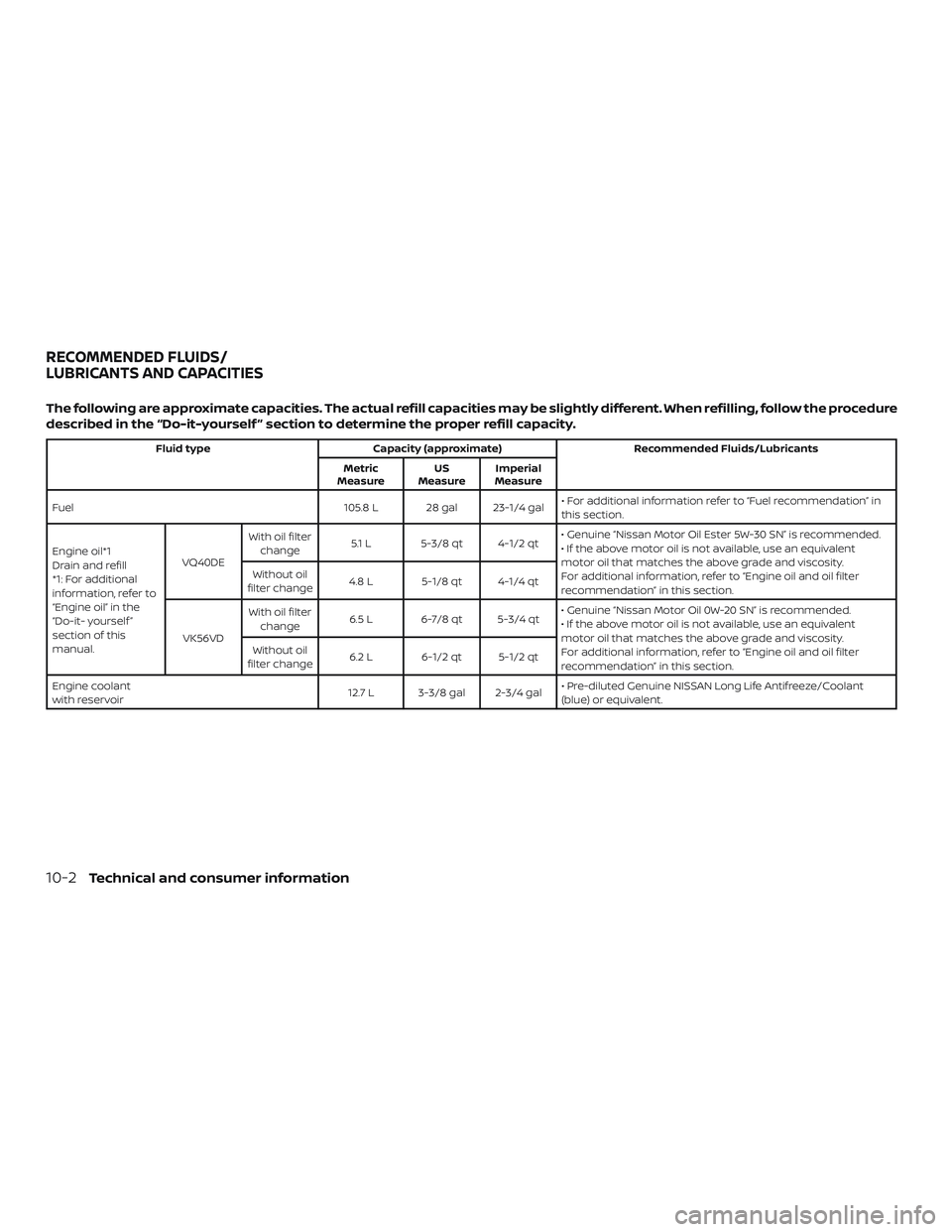
The following are approximate capacities. The actual refill capacities may be slightly different. When refilling, follow the procedure
described in the “Do-it-yourself ” section to determine the proper refill capacity.
Fluid typeCapacity (approximate) Recommended Fluids/Lubricants
Metric
Measure US
Measure Imperial
Measure
Fuel 105.8 L 28 gal 23-1/4 gal• For additional information refer to “Fuel recommendation” in
this section.
Engine oil*1
Drain and refill
*1: For additional
information, refer to
“Engine oil” in the
“Do-it- yourself ”
section of this
manual. VQ40DE
With oil filter
change 5.1 L 5-3/8 qt 4-1/2 qt • Genuine “Nissan Motor Oil Ester 5W-30 SN” is recommended.
• If the above motor oil is not available, use an equivalent
motor oil that matches the above grade and viscosity.
For additional information, refer to “Engine oil and oil filter
recommendation” in this section.
Without oil
filter change 4.8 L 5-1/8 qt 4-1/4 qt
VK56VD With oil filter
change 6.5 L 6-7/8 qt 5-3/4 qt • Genuine “Nissan Motor Oil 0W-20 SN” is recommended.
• If the above motor oil is not available, use an equivalent
motor oil that matches the above grade and viscosity.
For additional information, refer to “Engine oil and oil filter
recommendation” in this section.
Without oil
filter change 6.2 L 6-1/2 qt 5-1/2 qt
Engine coolant
with reservoir 12.7 L 3-3/8 gal 2-3/4 gal• Pre-diluted Genuine NISSAN Long Life Antifreeze/Coolant
(blue) or equivalent.
RECOMMENDED FLUIDS/
LUBRICANTS AND CAPACITIES
10-2Technical and consumer information
Page 410 of 426
1. Apply and hold the brake pedal.
2. Have someone place blocks on thedownhill side of the vehicle and trailer
wheels.
3. Af ter the wheel blocks are in place, slowly release the brake pedal until the
blocks absorb the vehicle load.
4. Apply the parking brake.
5. Shif t the transmission into P (Park).
6. Turn off the engine.
To drive away: 1. Start the vehicle.
2. Apply and hold the brake pedal.
3. Shif t the transmission into gear.
4. Release the parking brake.
5. Drive slowly until the vehicle and trailer are clear from the blocks.
6. Apply and hold the brake pedal.
7. Have someone retrieve and store the blocks. ∙ While going downhill, the weight of the
trailer pushing on the tow vehicle may
decrease overall stability. Therefore, to
maintain adequate control, reduce your
speed and shif t to a lower gear. Avoid
long or repeated use of the brakes
when descending a hill, as this reduces
their effectiveness and could cause
overheating. Shif ting to a lower gear in-
stead provides “engine braking” and re-
duces the need to brake as frequently.
∙ If the engine coolant temperature rises to a high temperature, refer to “If your
vehicle overheats” in the “In case of
emergency” section of this owner’s
manual.
∙ Trailer towing requires more fuel than normal circumstances.
∙ Avoid towing a trailer for your vehicle’s first 500 miles (805 km).
∙ For the first 500 miles (805 km) that you do tow, do not drive over 50 mph
(80 km/h).
∙ Have your vehicle serviced more of ten than at intervals specified in the recom-
mended Maintenance Schedule in the
“Maintenance and schedules” section of
this manual. ∙ When making a turn, your trailer wheels
will be closer to the inside of the turn
than your vehicle wheels. To compen-
sate for this, make a larger than normal
turning radius during the turn.
∙ Crosswinds and rough roads will ad- versely affect vehicle/trailer handling,
possibly causing vehicle sway. When
being passed by larger vehicles, be pre-
pared for possible changes in cross-
winds that could affect vehicle han-
dling.
Do the following if the trailer begins to
sway: 1. Take your foot off the accelerator pedal to allow the vehicle to coast and steer
as straight ahead as the road condi-
tions allow. This combination will help
stabilize the vehicle.
– Do not correct trailer sway by steer- ing or applying the brakes.
2. When the trailer sway stops, gently ap- ply the brakes and pull to the side of the
road in a safe area.
Technical and consumer information10-29
Page 419 of 426
Brakewarninglight............2-20
Brakewearindicators.......2-26,8-21
Parking brake operation.........5-18
Self-adjustingbrakes...........8-21
Brake assist ...................5-25
Brakefluid....................8-13
Brakes......................8-21
Brake system ..................5-24
Break-in schedule ...............5-20
Brightness/contrast button .........4-10
Brightness control Instrument panel .............2-33
Bulb replacement ...............8-30
C
Capacities and recommended
fuel/lubricants.................10-2
Cargolight...................2-53
Cargo (See
vehicle loading information) ........10-14
Car phone or CB radio ............4-74
CDcareandcleaning.............4-72
CD player (See
audio system) ...........4-45,4-51,4-58
Check engine indicator light
(See malfunction indicator lamp) .....2-24
Checking bulbs .................2-19
Check tire pressure ..............2-13
Childrestraints........1-29, 1-30, 1-32, 1-34 LATCH (Lower Anchors and Tethers
forCHildren)System ...........1-34
Precautions on child
restraints.........1-32, 1-40, 1-46, 1-52 Top tether strap anchor point
locations..................
.1-37
Child restraint with top tether strap . . . .1-37
Child safety sliding door lock .........3-8
Chimes, audible reminders .........2-26
Cleaningexteriorandinterior......7-2,7-4
Clock setting (models with
NavigationSystem)...............4-7
Clock setting (models without
NavigationSystem)....4-43,4-44,4-48,4-50
C.M.V.S.S. certification label .........10-12
Cold weather driving .............5-32
Compact disc (CD) player . . .4-45, 4-51, 4-58
Compass ....................2-14
Console box ..................2-44
Control panel buttons .............4-4
Back button .................4-7
Brightness/contrast button .......4-10
Settingbutton................4-7
Withnavigationsystem..........4-5
Controls Audio controls (steering wheel) .....4-72
Heater and air conditioner
controls................4-19,4-28
Rear seat air conditioner .........4-31
Coolant Capacities and recommended
fuel/lubricants...............10-2
Changing engine coolant .........8-7
Checking engine coolant level ......8-7
Engine coolant temperature gauge . .2-6
Corrosionprotection..............7-6
Cruisecontrol...........5-18,5-18,5-19
Cupholders...................2-47
Curtain side-impact and rollover
airbag..................... .1-63D
Daytime Running Lights (DRL) system . .2-32
Defroster switch Rear window and outside mirror
defrosterswitch..............2-30
Dimensions and weights ..........10-10
Dimmer switch for instrument panel . . .2-33
Display controls (see
control panel buttons) .............4-4
Door locks ....................3-3
Door open warning light ...........2-20
Drivebelt.....................8-17
Driving Coldweatherdriving...........5-32
Driving with automatic
transmission ................5-13
Precautions when starting
anddriving.............. .5-2, 5-3
Driving the vehicle ...............5-12
E
Economy - fuel .................5-22
Emission control information label . . . .10-12
Emission control system warranty . . . .10-32
Engine Before starting the engine ........5-10
C
apacities and recommended
fuel/lubricants...............10-2
Changing engine coolant .........8-7
Changing engine oil ............8-9
Changing engine oil filter .........8-11
Checking engine coolant level ......8-7
Checking engine oil level .........8-8
11-2
Page 420 of 426
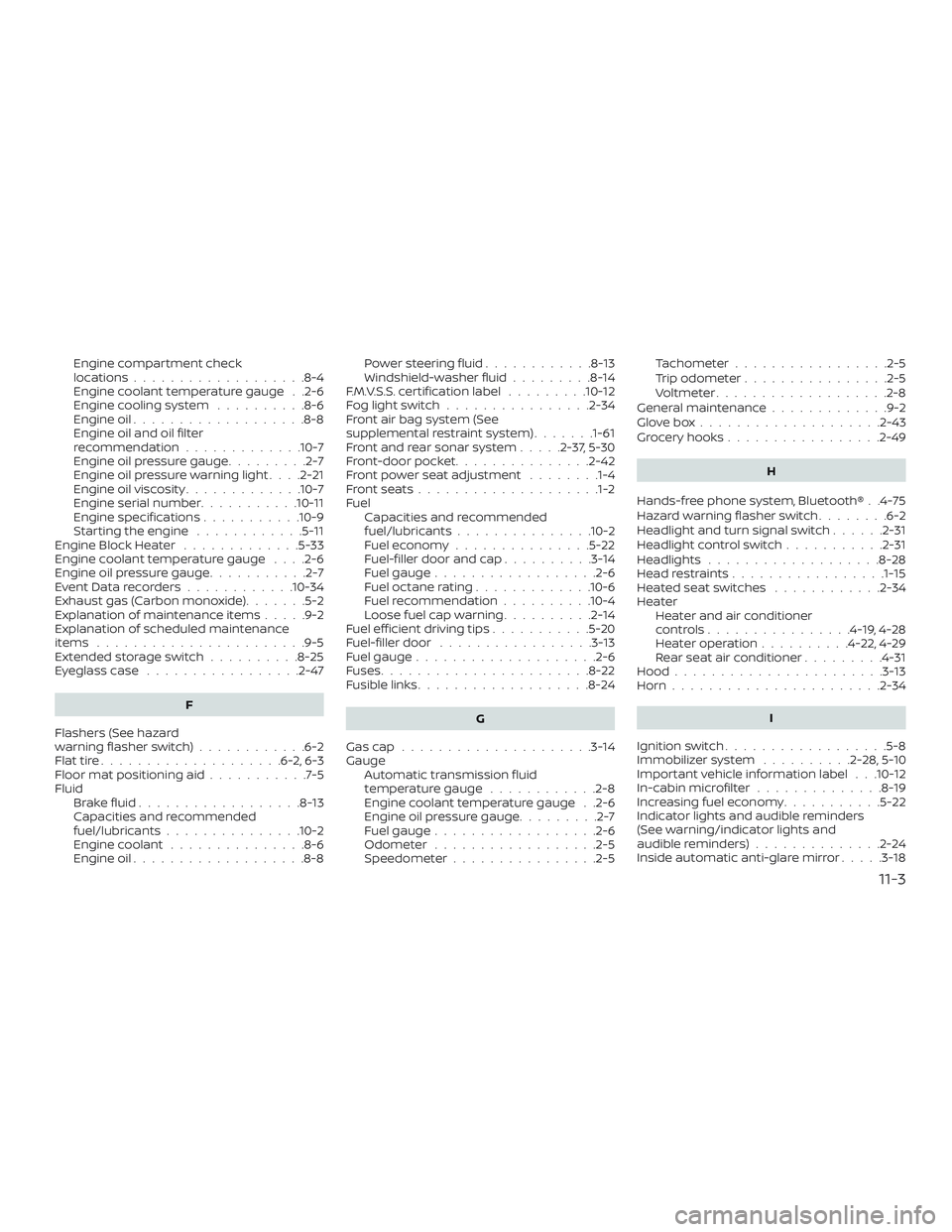
Engine compartment check
locations...................8-4
Engine coolant temperature gauge . .2-6
Engine cooling system..........8-6
Engine oil ...................8-8
Engine oil and oil filter
recommendation .............10-7
Engine oil pressure gauge .........2-7
Engine oil pressure warning light ....2-21
Engine oil viscosity .............10-7
Engine serial number ...........10-11
Engine specifications ...........10-9
Starting the engine ............5-11
Engine Block Heater .............5-33
Engine coolant temperature gauge ....2-6
Engine oil pressure gauge ...........2-7
EventDatarecorders............10-34
Exhaust gas (Carbon monoxide) .......5-2
Explanation of maintenance items .....9-2
Explanation of scheduled maintenance
items .......................9-5
Extended storage switch ..........8-25
Eyeglasscase .................2-47
F
Flashers (See hazard
warning flasher switch) ............6-2
Flattire....................6-2,6-3
Floormatpositioningaid...........7-5
Fluid Brakefluid..................8-13
Capacities and recommended
fuel/lubricants...............10-2
Engine coolant ...............8-6
Engine oil ...................8-8 Powersteeringfluid............8-13
Windshield-washer fluid
.........8-14
F.M.V.S.S. certification label .........10-12
Foglightswitch................2-34
Front air bag system (See
supplemental restraint system) .......1-61
Front and rear sonar system .....2-37,5-30
Front-door pocket ...............2-42
Front power seat adjustment ........1-4
Frontseats....................1-2
Fuel Capacities and recommended
fuel/lubricants...............10-2
Fuel economy ...............5-22
Fuel-filler door and cap ..........3-14
Fuel gauge ..................2-6
Fueloctanerating.............10-6
Fuel recommendation ..........10-4
Loose fuel cap warning ..........2-14
Fuel efficient driving tips ...........5-20
Fuel-filler door .................3-13
Fuel gauge ....................2-6
Fuses .......................8-22
Fusiblelinks...................8-24
G
Gascap .....................3-14
Gauge Automatic transmission fluid
temperature gauge ............2-8
Engine coolant temperature gauge . .2-6
Engine oil pressure gauge .........2-7
Fuel gauge ..................2-6
Odometer ..................2-5
Speedometer ................2-5 Tachometer
.................2-5
Trip odometer ................2-5
Voltmeter...................2-8
General maintenance .............9-2
Glovebox................... .2-43
Grocery hooks .................
2-49
H
Hands-free phone system, Bluetooth® . .4-75
Hazardwarningflasherswitch........6-2
Headlight and turn signal switch ......2-31
Headlightcontrolswitch...........2-31
Headlights...................8-28
Headrestraints.................1-15
Heated seat switches ............2-34
Heater Heater and air conditioner
controls................4-19,4-28
Heater operation ..........4-22,4-29
Rear seat air conditioner .........4-31
Hood .......................3-13
Horn.......................2-34
I
Ignition switch ..................5-8
Immobilizer system ..........2-28,5-10
Important vehicle information label . . .10-12
In-cabinmicrofilter ..............8-19
Increasing fuel economy ...........5-22
Indicator lights and audible reminders
(See warning/indicator lights and
audible reminders) ..............2-24
Inside automatic anti-glare mirror .....3-18
11-3
Page 423 of 426
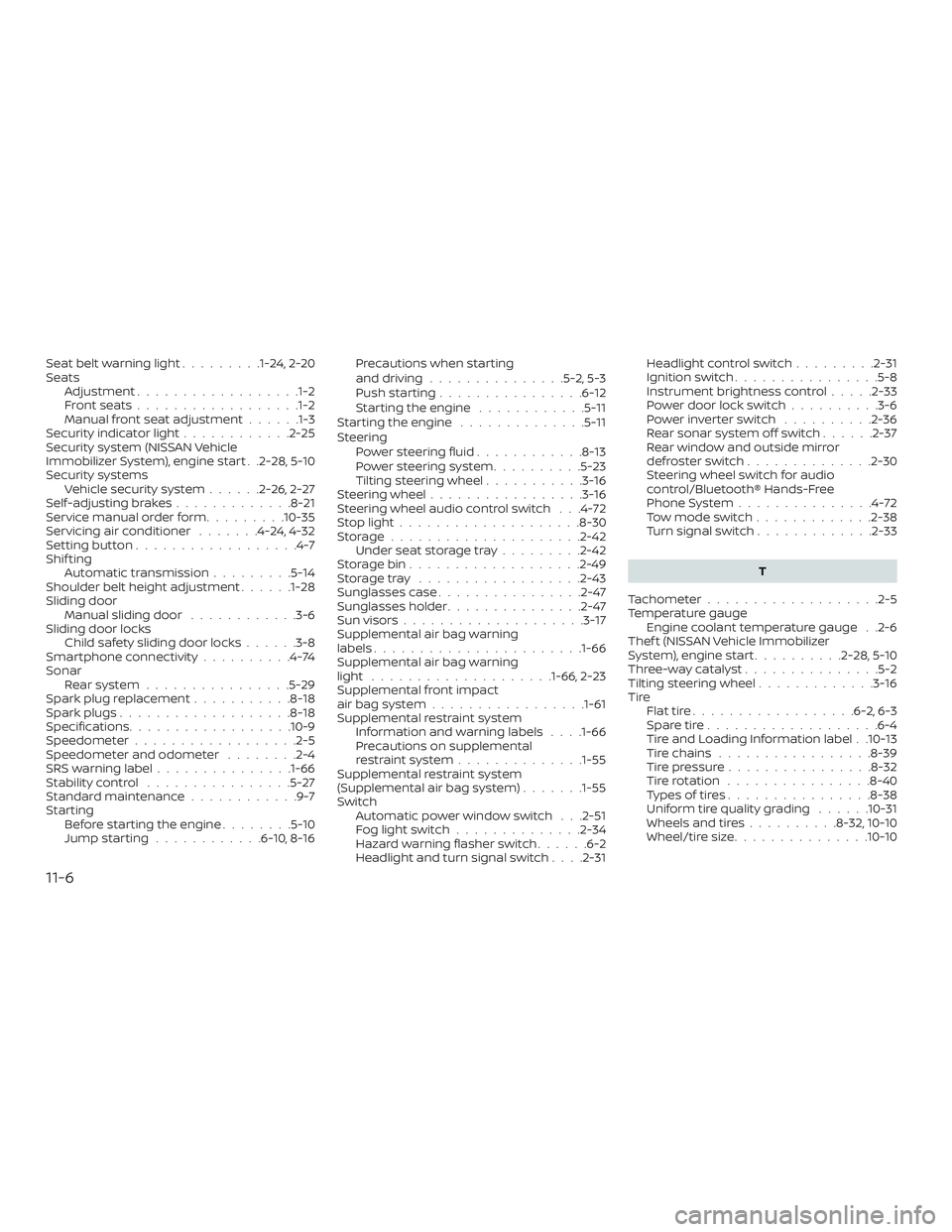
Seatbeltwarninglight.........1-24, 2-20
SeatsAdjustment ..................1-2
Frontseats..................1-2
Manual front seat adjustment ......1-3
Security indicator light ............2-25
Security system (NISSAN Vehicle
Immobilizer System), engine start . .2-28, 5-10
Security systems Vehicle security system ......2-26,2-27
Self-adjustingbrakes.............8-21
Service manual order form .........10-35
Servicing air conditioner .......4-24,4-32
Settingbutton..................4-7
Shif ting Automatic transmission .........5-14
Shoulder belt height adjustment ......1-28
Sliding door Manual sliding door ............3-6
Sliding door locks Child safety sliding door locks ......3-8
Smartphone connectivity ..........4-74
Sonar Rear system ................5-29
Spark plug replacement ...........8-18
Spark plugs ...................8-18
Specifications ..................10-9
Speedometer ..................2-5
Speedometer and odometer ........2-4
SRS warning label ...............1-66
Stability control ................5-27
Standard maintenance ............9-7
Starting Before starting the engine ........5-10
Jumpstarting............6-10,8-16 Precautions when starting
anddriving...............5-2,5-3
Push starting
................6-12
Starting the engine ............5-11
Starting the engine ..............5-11
Steering Powersteeringfluid............8-13
Powersteeringsystem..........5-23
Tilting steering wheel ...........3-16
Steering wheel .................3-16
Steering wheel audio control switch . . .4-72
Stoplight....................8-30
Storage.....................2-42 Under seat storage tray .........2-42
Storagebin...................2-49
Storagetray ..................2-43
Sunglasses case ................2-47
Sunglasses holder ...............2-47
Sunvisors....................3-17
Supplemental air bag warning
labels ...................... .1-66
Supplemental air bag warning
light ................... .1-66, 2-23
Supplemental front impact
airbagsystem................ .1-61
Supplemental restraint system Information and warning labels . . . .1-66
Precautions on supplemental
restraintsystem..............1-55
Supplemental restraint system
(Supplemental air bag system) .......1-55
Switch Automatic power window switch . . .2-51
Foglightswitch..............2-34
Hazard warning flasher switch ......6-2
Headlight and turn signal switch ....2-31Headlightcontrolswitch.........2-31
Ignition switch
................5-8
Instrument brightness control .....
2-33
Power door lock switch ..........3-6
Powerinverterswitch ..........2-36
Rear sonar system off switch ......2-37
Rear window and outside mirror
defrosterswitch..............2-30
Steering wheel switch for audio
control/Bluetooth® Hands-Free
Phone System ...............4-72
Tow mode switch .............2-38
Turn signal switch .............2-33
T
Tachometer ...................2-5
Temperature gauge Engine coolant temperature gauge . .2-6
Thef t (NISSAN Vehicle Immobilizer
System), engine start ..........2-28,5-10
Three-waycatalyst...............5-2
Tilting steering wheel .............3-16
Tire Flattire..................6-2,6-3
Spare tire ...................6-4
Tire and Loading Information label . .10-13
Tire chains .................8-39
Tire pressure ................8-32
Tirerotation ................8-40
Types of tires ................8-38
Uniform tire quality grading ......10-31
Wheels and tires ..........8-32,10-10
Wheel/tire size ...............10-10
11-6