fuel NISSAN NV200 2021 User Guide
[x] Cancel search | Manufacturer: NISSAN, Model Year: 2021, Model line: NV200, Model: NISSAN NV200 2021Pages: 300, PDF Size: 1.9 MB
Page 161 of 300
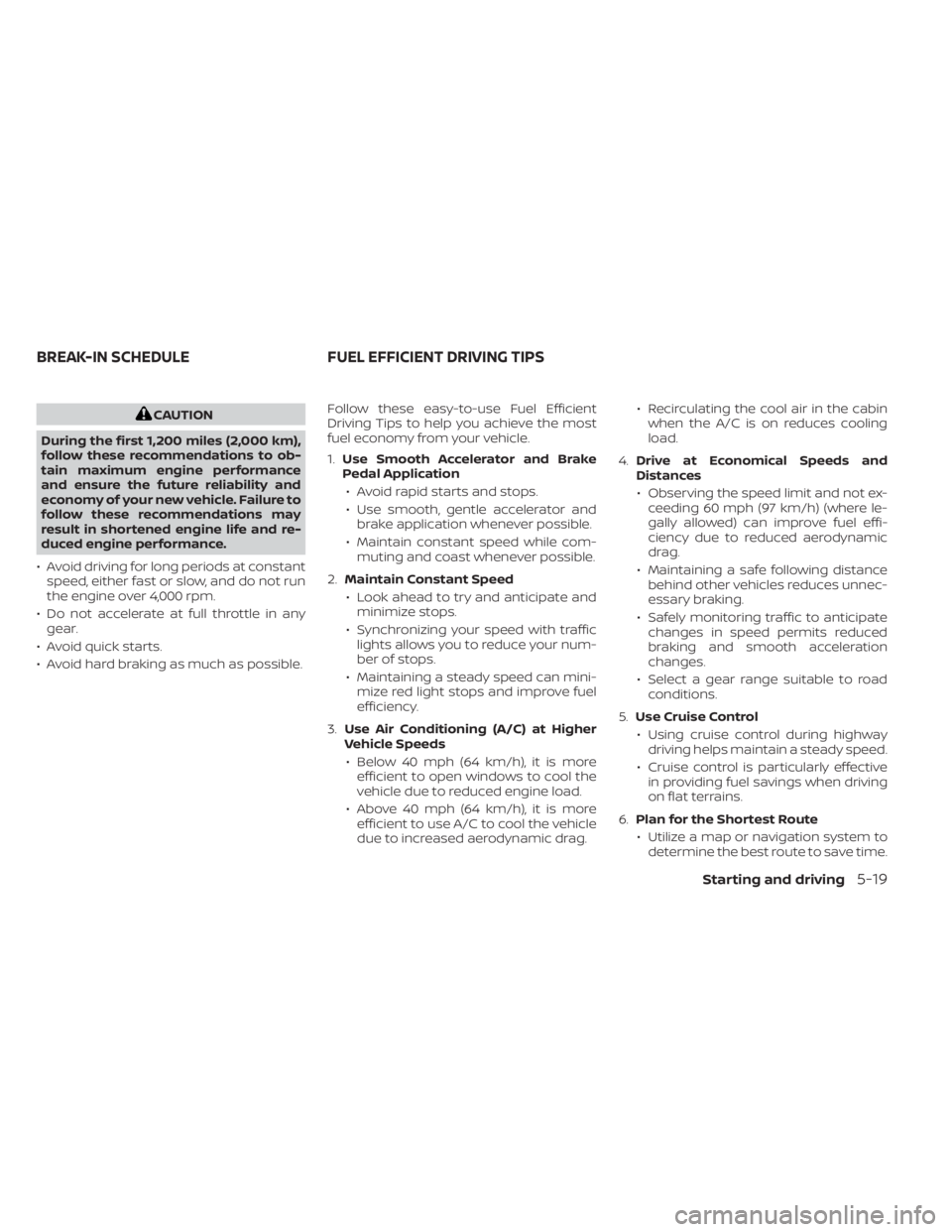
CAUTION
During the first 1,200 miles (2,000 km),
follow these recommendations to ob-
tain maximum engine performance
and ensure the future reliability and
economy of your new vehicle. Failure to
follow these recommendations may
result in shortened engine life and re-
duced engine performance.
• Avoid driving for long periods at constant speed, either fast or slow, and do not run
the engine over 4,000 rpm.
• Do not accelerate at full throttle in any gear.
• Avoid quick starts.
• Avoid hard braking as much as possible. Follow these easy-to-use Fuel Efficient
Driving Tips to help you achieve the most
fuel economy from your vehicle.
1.
Use Smooth Accelerator and Brake
Pedal Application
• Avoid rapid starts and stops.
• Use smooth, gentle accelerator and brake application whenever possible.
• Maintain constant speed while com- muting and coast whenever possible.
2. Maintain Constant Speed
• Look ahead to try and anticipate and minimize stops.
• Synchronizing your speed with traffic lights allows you to reduce your num-
ber of stops.
• Maintaining a steady speed can mini- mize red light stops and improve fuel
efficiency.
3. Use Air Conditioning (A/C) at Higher
Vehicle Speeds
• Below 40 mph (64 km/h), it is more efficient to open windows to cool the
vehicle due to reduced engine load.
• Above 40 mph (64 km/h), it is more efficient to use A/C to cool the vehicle
due to increased aerodynamic drag. • Recirculating the cool air in the cabin
when the A/C is on reduces cooling
load.
4. Drive at Economical Speeds and
Distances
• Observing the speed limit and not ex- ceeding 60 mph (97 km/h) (where le-
gally allowed) can improve fuel effi-
ciency due to reduced aerodynamic
drag.
• Maintaining a safe following distance behind other vehicles reduces unnec-
essary braking.
• Safely monitoring traffic to anticipate changes in speed permits reduced
braking and smooth acceleration
changes.
• Select a gear range suitable to road conditions.
5. Use Cruise Control
• Using cruise control during highway driving helps maintain a steady speed.
• Cruise control is particularly effective in providing fuel savings when driving
on flat terrains.
6. Plan for the Shortest Route
• Utilize a map or navigation system to determine the best route to save time.
BREAK-IN SCHEDULE FUEL EFFICIENT DRIVING TIPS
Starting and driving5-19
Page 199 of 300
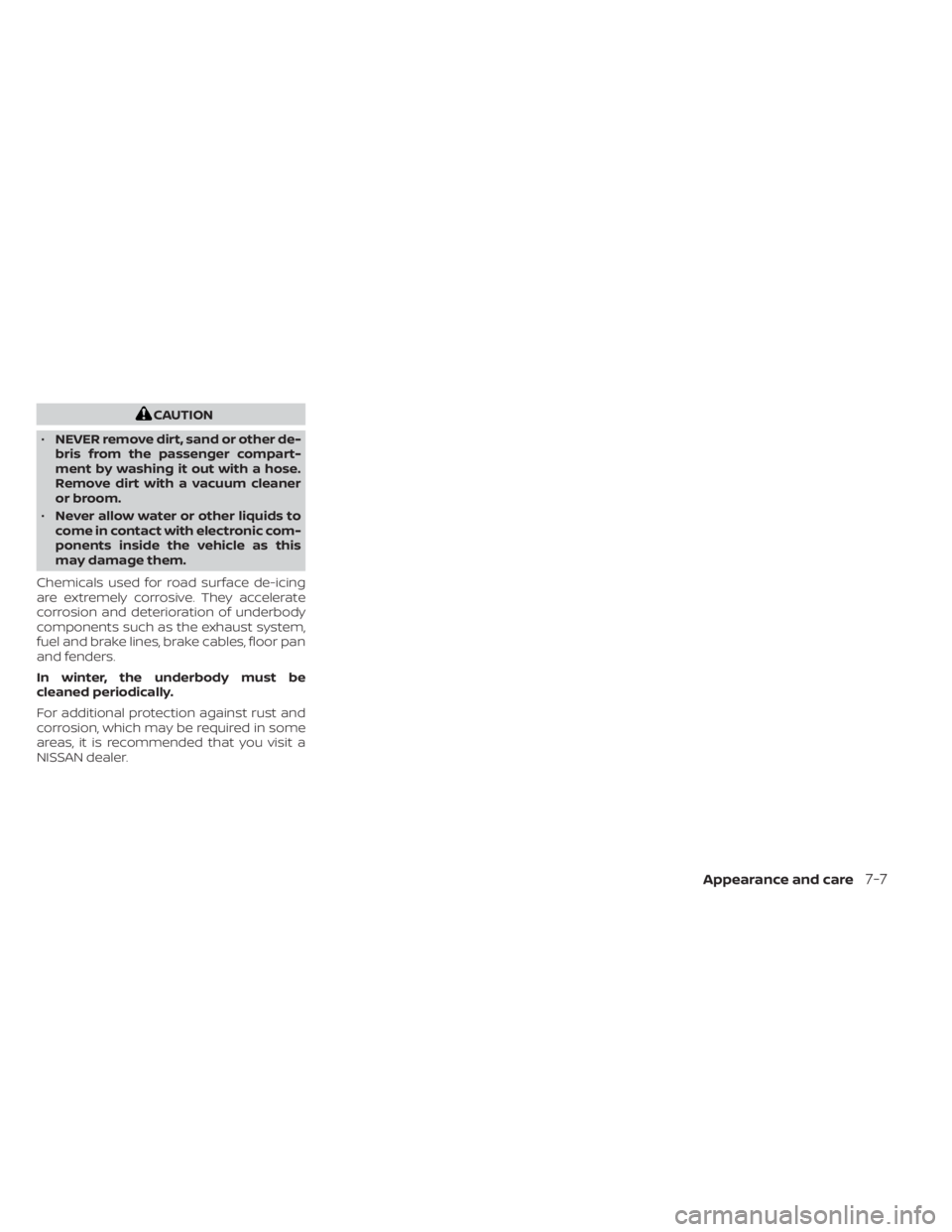
CAUTION
• NEVER remove dirt, sand or other de-
bris from the passenger compart-
ment by washing it out with a hose.
Remove dirt with a vacuum cleaner
or broom.
• Never allow water or other liquids to
come in contact with electronic com-
ponents inside the vehicle as this
may damage them.
Chemicals used for road surface de-icing
are extremely corrosive. They accelerate
corrosion and deterioration of underbody
components such as the exhaust system,
fuel and brake lines, brake cables, floor pan
and fenders.
In winter, the underbody must be
cleaned periodically.
For additional protection against rust and
corrosion, which may be required in some
areas, it is recommended that you visit a
NISSAN dealer.
Appearance and care7-7
Page 215 of 300
WARNING
Be sure the engine and ignition switch
are off and that the parking brake is
engaged securely.
CAUTION
Be sure to use the correct socket to re-
move the spark plugs. An incorrect
socket can damage the spark plugs.
If replacement is required, it is recom-
mended that you visit a NISSAN dealer for
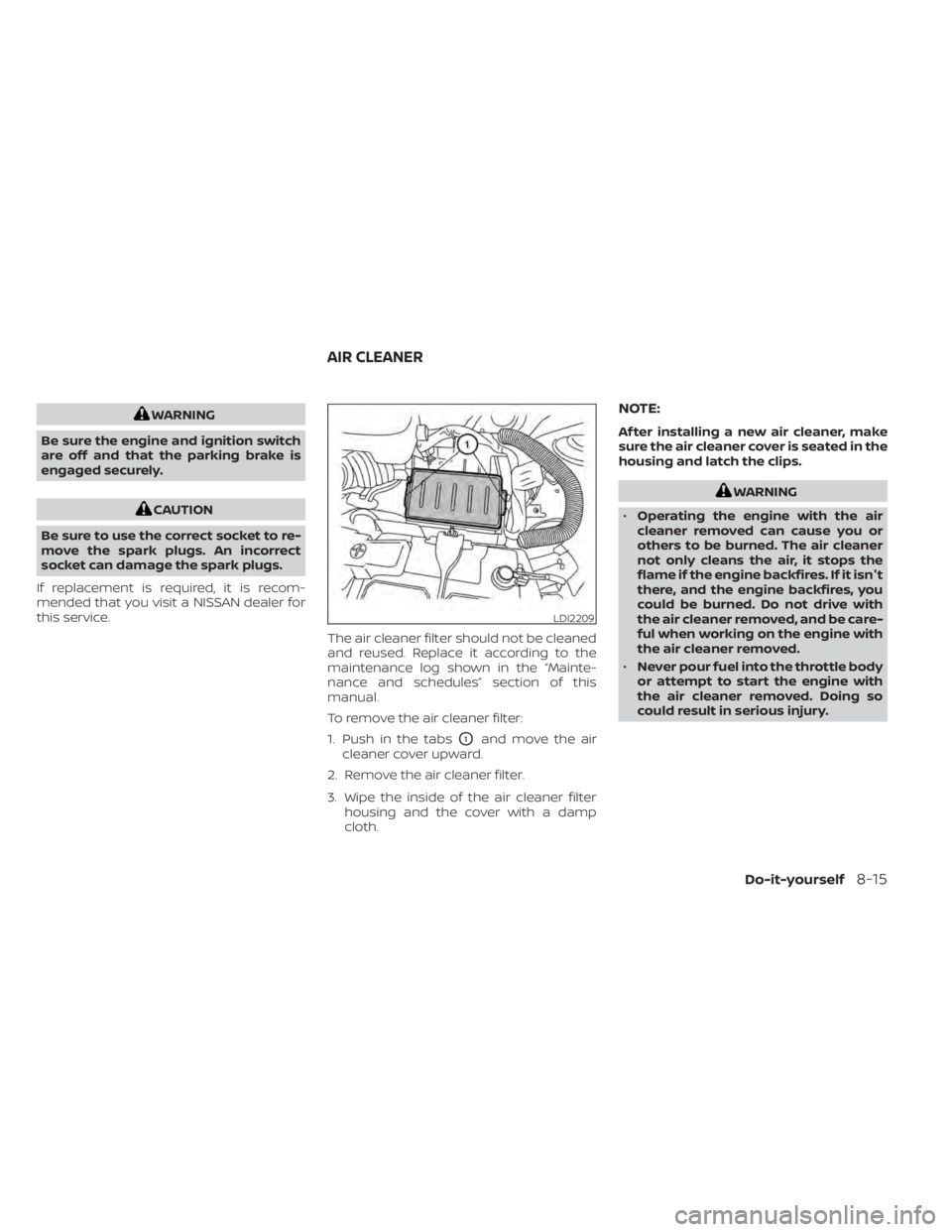
this service. The air cleaner filter should not be cleaned
and reused. Replace it according to the
maintenance log shown in the “Mainte-
nance and schedules” section of this
manual.
To remove the air cleaner filter:
1. Push in the tabs
O1and move the air
cleaner cover upward.
2. Remove the air cleaner filter.
3. Wipe the inside of the air cleaner filter housing and the cover with a damp
cloth.
NOTE:
Af ter installing a new air cleaner, make
sure the air cleaner cover is seated in the
housing and latch the clips.
WARNING
• Operating the engine with the air
cleaner removed can cause you or
others to be burned. The air cleaner
not only cleans the air, it stops the
flame if the engine backfires. If it isn't
there, and the engine backfires, you
could be burned. Do not drive with
the air cleaner removed, and be care-
ful when working on the engine with
the air cleaner removed.
• Never pour fuel into the throttle body
or attempt to start the engine with
the air cleaner removed. Doing so
could result in serious injury.
Do-it-yourself8-15
Page 268 of 300
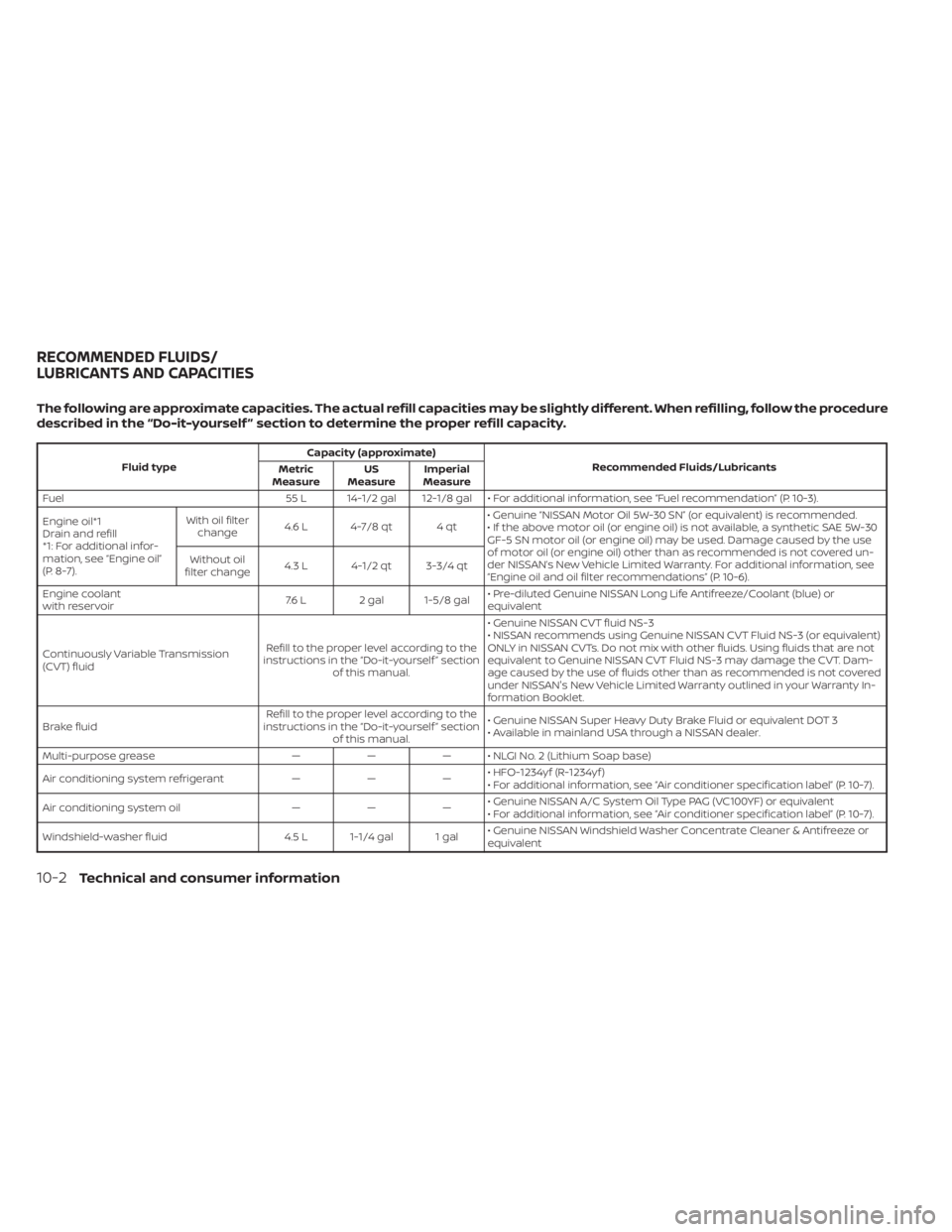
Fluid typeCapacity (approximate)
Recommended Fluids/Lubricants
Metric
Measure US
Measure Imperial
Measure
Fuel 55 L 14-1/2 gal 12-1/8 gal • For additional information, see “Fuel recommendation” (P. 10-3).
Engine oil*1
Drain and refill
*1: For additional infor-
mation, see “Engine oil”
(P. 8-7). With oil filter
change 4.6 L 4-7/8 qt 4 qt • Genuine “NISSAN Motor Oil 5W-30 SN” (or equivalent) is recommended.
• If the above motor oil (or engine oil) is not available, a synthetic SAE 5W-30
GF-5 SN motor oil (or engine oil) may be used. Damage caused by the use
of motor oil (or engine oil) other than as recommended is not covered un-
der NISSAN’s New Vehicle Limited Warranty. For additional information, see
“Engine oil and oil filter recommendations” (P. 10-6).
Without oil
filter change 4.3 L 4-1/2 qt 3-3/4 qt
Engine coolant
with reservoir 7.6 L 2 gal 1-5/8 gal• Pre-diluted Genuine NISSAN Long Life Antifreeze/Coolant (blue) or
equivalent
Continuously Variable Transmission
(CVT) fluid Refill to the proper level according to the
instructions in the “Do-it-yourself ” section of this manual. • Genuine NISSAN CVT fluid NS-3
• NISSAN recommends using Genuine NISSAN CVT Fluid NS-3 (or equivalent)
ONLY in NISSAN CVTs. Do not mix with other fluids. Using fluids that are not
equivalent to Genuine NISSAN CVT Fluid NS-3 may damage the CVT. Dam-
age caused by the use of fluids other than as recommended is not covered
under NISSAN's New Vehicle Limited Warranty outlined in your Warranty In-
formation Booklet.
Brake fluid Refill to the proper level according to the
instructions in the “Do-it-yourself ” section of this manual. • Genuine NISSAN Super Heavy Duty Brake Fluid or equivalent DOT 3
• Available in mainland USA through a NISSAN dealer.
Multi-purpose grease — — — • NLGI No. 2 (Lithium Soap base)
Air conditioning system refrigerant — — — • HFO-1234yf (R-1234yf )
• For additional information, see “Air conditioner specification label” (P. 10-7).
Air conditioning system oil — — — • Genuine NISSAN A/C System Oil Type PAG (VC100YF) or equivalent
• For additional information, see “Air conditioner specification label” (P. 10-7).
Windshield-washer fluid 4.5 L 1-1/4 gal 1 gal • Genuine NISSAN Windshield Washer Concentrate Cleaner & Antifreeze or
equivalent
RECOMMENDED FLUIDS/
LUBRICANTS AND CAPACITIES
10-2Technical and consumer information
Page 269 of 300
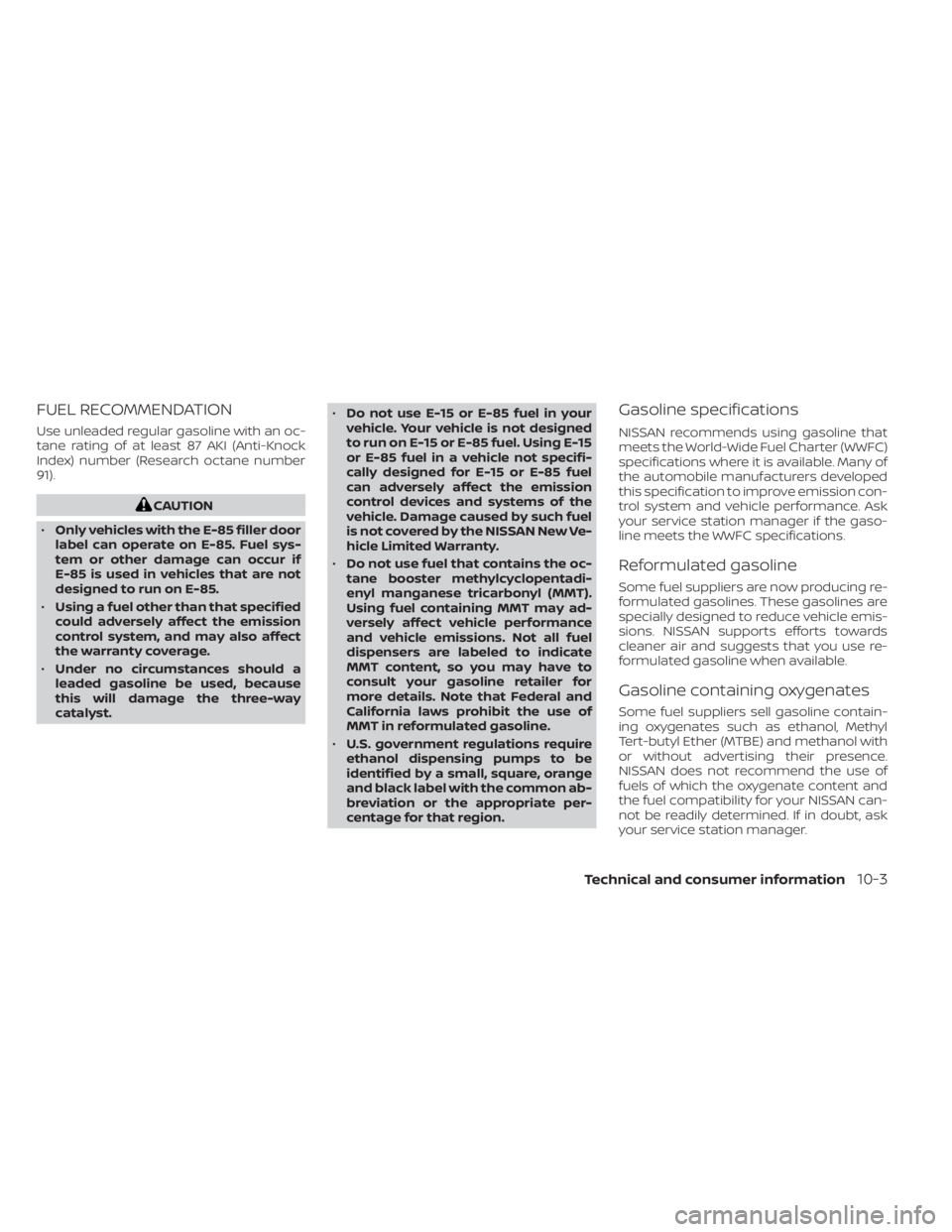
FUEL RECOMMENDATION
Use unleaded regular gasoline with an oc-
tane rating of at least 87 AKI (Anti-Knock
Index) number (Research octane number
91).
Page 292 of 300
Cruise control..................5-17Cup holders..................2-28
D
D-ring..................2-28,10-17Daytime light system.............2-22Defroster switchRear window and outside mirror defroster
switch
.....................2-21Dimensions and weights..........10-9Dimmer switch for instrument panel. . .2-23Door locks................ .3-3, 3-4Door open warning light...........2-10Drive belt....................8-14Driving
Cold weather driving...........5-32Driving with Continuously Variable
Transmission (CVT)..........5-8, 5-12Precautions when starting and
driving.....................5-2Driving the vehicle...............5-11
E
Economy - fuel................5-20Emission control information label. . . .10-11Emission control system warranty. . . .10-21EngineBefore starting the engine........5-9Capacities and recommended
fuel/lubricants...............10-2Changing engine coolant.........8-6
Changing engine oil.............8-7Changing engine oil filter.........8-7Checking engine coolant level......8-6Checking engine oil level..........8-7Engine cooling system...........8-5Engine oil...................8-7Engine oil and oil filter
recommendation.............10-6Engine oil pressure warning light. . . .2-10Engine oil viscosity.............10-6Engine serial number..........10-10Engine specifications...........10-8Starting the engine............5-10Engine Block Heater.............5-34Event Data recorders............10-23Exhaust gas (Carbon monoxide)......5-2Explanation of maintenance items.....9-2Explanation of scheduled maintenance
items...................... .9-5Extended storage switch..........8-20
F
F.M.V.S.S. certification label.........10-11Flashers (See hazard warning flasher
switch)......................6-2Flat tire...................6-2,6-3Floor mat positioning aid...........7-5Fluid
Brake fluid..................8-10Capacities and recommended
fuel/lubricants...............10-2
Continuously Variable Transmission (CVT)
fluid......................8-10Engine coolant................8-5Engine oil...................8-7Windshield-washer fluid..........8-11Front air bag system (See supplemental
restraint system)...............1-38Front seats....................1-2Front-door pocket...............2-27FuelCapacities and recommended
fuel/lubricants
...............10-2Fuel economy...............5-20Fuel gauge................. .2-6Fuel octane rating.............10-5Fuel recommendation..........10-3Fuel-filler door and cap..........3-14Fuel-filler door lock opener lever. . . .3-14Loose fuel cap warning..........2-5Fuel efficient driving tips...........5-19Fuel gauge................... .2-6Fuel-filler door.................3-14Fuses.......................8-18Fusible links...................8-19
G
Gas cap.....................3-14Gauge
Fuel gauge................. .2-6Speedometer..............2-3, 2-4Tachometer.................2-6Trip computer................2-7
11-2
Page 293 of 300
Trip odometer.............2-3, 2-4General maintenance.............9-2Glove box....................2-27
H
Hazard warning flasher switch........6-2Head restraints.................1-7Headlight and turn signal switch......2-21Headlight control switch...........2-21Headlights...................8-22HeaterHeater and air conditioner controls. .4-10Heater operation..............4-12Hill start assist system............5-28Hood.......................3-13Horn.......................2-24
I
Ignition switch................. .5-8Immobilizer system........2-18,3-2,5-9Important vehicle information label. . .10-11Increasing fuel economy..........5-20Indicator lights and audible reminders
(See warning/indicator lights and audible
reminders)
................... .2-8Instrument brightness control.......2-23Instrument panel.............0-6, 2-2Instrument panel dimmer switch.....2-23Interior light...............2-32, 2-33
J
Jump starting..............6-10,8-13
K
Key.........................3-2Key fob battery replacement........8-21Keyless entry
Without Intelligent Key system
(See remote keyless
entry system)
.............3-10,3-11KeysNISSAN Vehicle Immobilizer System
keys
......................3-2
L
LabelTire warning................10-12LabelsAir conditioner specification label. . .10-12C.M.V.S.S. certification label.......10-11Emission control information label. .10-11Engine serial number..........10-10F.M.V.S.S. certification label........10-11Tire and Loading Information label. .10-11Vehicle identification number (VIN). .10-10Vehicle identification number (VIN)
plate.................... .10-10Warning labels (for SRS)..........1-48
License plate
Installing the license plate........10-14LightAir bag warning light........1-49, 2-11Brake light (See stop light)........8-27Bulb check/instrument panel......2-9Bulb replacement.............8-27Charge warning light...........2-10Headlight and turn signal switch. . . .2-21Headlight control switch.........2-21Headlights..................8-22Interior light.............2-32, 2-33Light bulbs.................8-22Low tire pressure warning light.....2-12Low windshield-washer fluid warning
light......................2-14Passenger air bag and status light. . .1-40Security indicator light...........2-11Warning/indicator lights and audible
reminders.................. .2-8Lights......................8-22Map lights..................2-33Lock
Door locks................3-3, 3-4Fuel-filler door lock opener lever. . . .3-14Power door locks..............3-6Low fuel warning light............2-12Low tire pressure warning light.......2-12Low windshield-washer fluid warning
light........................2-14Luggage (See vehicle loading
information)................. .10-14
11-3
Page 294 of 300
M
MaintenanceGeneral maintenance...........9-2Inside the vehicle..............9-3Maintenance precautions.........8-2Outside the vehicle.............9-2Seat belt maintenance..........1-18Under the hood and vehicle.......9-4Maintenance requirements..........9-2Maintenance schedules............9-7Malfunction indicator light......2-10,2-14Manual front seat adjustment........1-3Map lights................... .2-33Meters and gauges...............2-3Instrument brightness control.....2-23Mirror
Outside mirrors...............3-17Rearview...................3-17Mirrors......................3-17
N
NISSAN Vehicle Immobilizer
System...................2-18,5-9NissanConnect® Owner's Manual......4-2
O
Octane rating (See fuel octane rating). .10-5Odometer/Twin trip odometer.......2-4
OilCapacities and recommended
fuel/lubricants
...............10-2Changing engine oil.............8-7Changing engine oil filter.........8-7Checking engine oil level..........8-7Engine oil...................8-7Engine oil and oil filter
recommendation.............10-6Engine oil viscosity.............10-6Outside mirrors................3-17OverheatIf your vehicle overheats.........6-12Owner's manual order form........10-23Owner's manual/service manual order
information................. .10-23
P
Parking
Parking/parking on hills..........5-21Parking brake..................5-17PowerPower door locks..............3-6Power outlet................2-26Power steering system..........5-22Power windows..............2-29Power outlet..................2-26Power steering.................5-22PrecautionsMaintenance precautions.........8-2
Precautions on booster
seats............1-21,1-23,1-24,1-28Precautions on child
restraints.........1-21,1-23,1-24,1-28Precautions on seat belt usage.....1-11Precautions on supplemental restraint
system................... .1-31Precautions when starting and
driving.....................5-2Push starting..................6-12
R
Radio
Car phone or CB radio..........4-18Readiness for inspection maintenance (I/M)
test...................... .10-22Rear Sonar System (RSS)..........5-28Rear sonar system OFF switch.......2-25Rear window and outside mirror defroster
switch......................2-21Rearview mirror................3-17RearView Monitor.............4-3, 4-5Recommended Fluids............10-2Recorders
Event Data................ .10-23Refrigerant recommendation........10-7Registering a vehicle in another
country.................... .10-10Remote keyless entry system. . . .3-10, 3-11Reporting safety defects (US only). . . .10-21
11-4
Page 296 of 300
Tire rotation.................8-37Types of tires................8-35Uniform tire quality grading......10-20Wheel/tire size...............10-9Wheels and tires...........8-29,10-9Tire pressure
Low tire pressure warning light.....2-12Tire Pressure Monitoring System (TPMS). .5-3Tire warning label..............10-12Top tether strap child restraint.......1-23Towing4-wheel drive models...........6-14Flat towing................ .10-19Tow truck towing..............6-13Trailer towing...............10-19Towing a trailer................10-19Transmission
Continuously Variable Transmission (CVT)
fluid
......................8-10Driving with Continuously Variable
Transmission (CVT)..........5-8, 5-12Travel (See registering a vehicle in another
country)................... .10-10Trip computer..................2-7Trip odometer...............2-3, 2-4Turn signal switch...............2-23
U
Uniform tire quality grading........10-20
V
Variable voltage control system......8-13Vehicle dimensions and weights......10-9Vehicle Dynamic Control (VDC) OFF
switch......................2-24Vehicle Dynamic Control (VDC) system. .5-25Vehicle identification............10-10Vehicle identification number (VIN). . . .10-10Vehicle identification number (VIN)
plate..................... .10-10Vehicle immobilizer system. . .2-18, 3-2, 5-9Vehicle loading information........10-14Vehicle recovery................6-15Vehicle security system...........2-17Vehicle security system (NISSAN Vehicle
Immobilizer System), engine start. .2-18, 5-9Ventilators...................4-10Visors......................3-16
W
Warning
Air bag warning light........1-49, 2-11Anti-lock brake warning
light................2-9, 2-12, 2-15Battery charge warning light......2-10Brake warning light.............2-9Door open warning light.........2-10Engine oil pressure warning light. . . .2-10Hazard warning flasher switch......6-2Low fuel warning light...........2-12Low tire pressure warning light.....2-12
Low windshield-washer fluid warning
light......................2-14Passenger air bag and status light. . .1-40Seat belt warning light.......1-14,2-11Supplemental air bag warning
light.................. .1-49, 2-11Vehicle security system..........2-17Warning labels (for SRS)..........1-48Warning/indicator lights and audible
reminders...................2-8Warning lights..................2-8Warning lights, indicator lights and audible
reminders................... .2-8Warning/indicator lights and audible
reminders....................2-8Audible reminders.............2-8Indicator lights................2-8Warning lights................2-8Weights (See dimensions and weights). .10-9Wheel/tire size.................10-9Wheels and tires............8-29,10-9When traveling or registering in another
country.................... .10-10Windows....................2-29Locking passengers' windows.....2-31Power windows..............2-29Windshield wiper blades...........8-16Windshield-washer fluid...........8-11Wiper
Wiper blades................8-16Wiper and washer switch..........2-20
11-6
Page 298 of 300
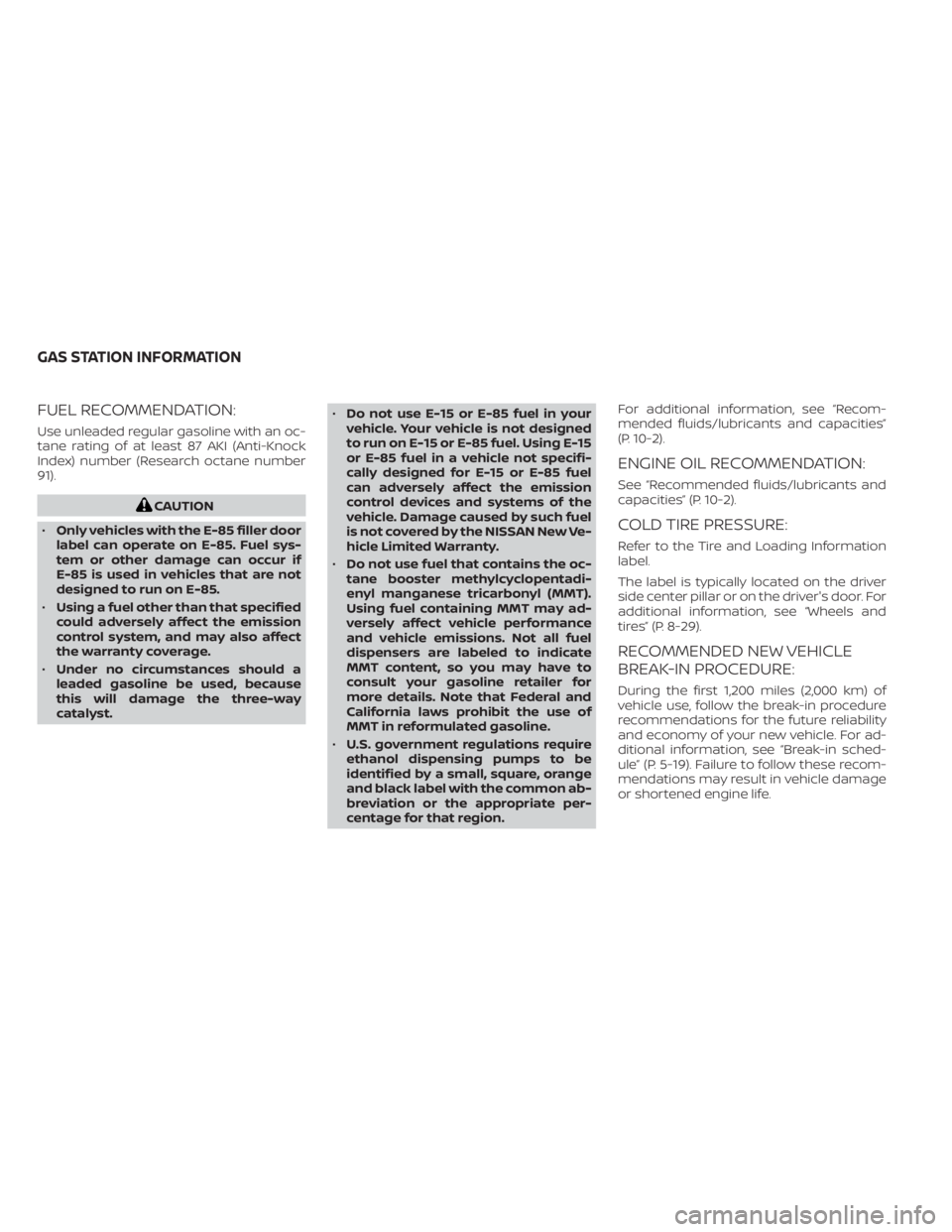
FUEL RECOMMENDATION:
Use unleaded regular gasoline with an oc-
tane rating of at least 87 AKI (Anti-Knock
Index) number (Research octane number
91).