glove box NISSAN PATHFINDER 1996 R50 / 2.G Owners Manual
[x] Cancel search | Manufacturer: NISSAN, Model Year: 1996, Model line: PATHFINDER, Model: NISSAN PATHFINDER 1996 R50 / 2.GPages: 223, PDF Size: 1.71 MB
Page 7 of 223
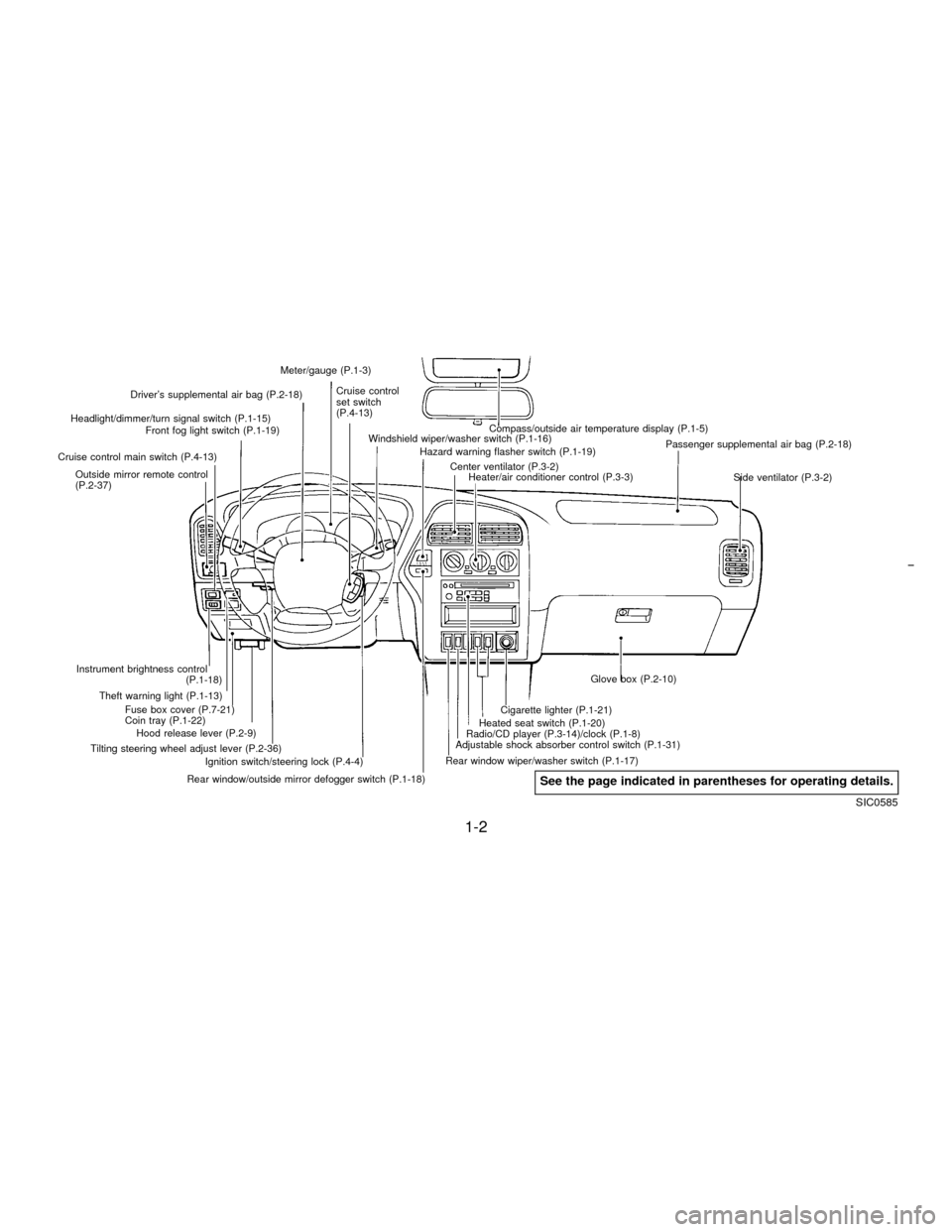
Driver's supplemental air bag (P.2-18)Cruise control
set switch
(P.4-13)
Outside mirror remote control
(P.2-37) Headlight/dimmer/turn signal switch (P.1-15)
Front fog light switch (P.1-19)Meter/gauge (P.1-3)
Windshield wiper/washer switch (P.1-16)
Hazard warning flasher switch (P.1-19)
Center ventilator (P.3-2)
Heater/air conditioner control (P.3-3)Compass/outside air temperature display (P.1-5)
Passenger supplemental air bag (P.2-18)
Side ventilator (P.3-2)
Glove box (P.2-10)
Cigarette lighter (P.1-21)
Radio/CD player (P.3-14)/clock (P.1-8)
Adjustable shock absorber control switch (P.1-31)
Rear window wiper/washer switch (P.1-17)
Rear window/outside mirror defogger switch (P.1-18)Ignition switch/steering lock (P.4-4)Heated seat switch (P.1-20)
Tilting steering wheel adjust lever (P.2-36)Hood release lever (P.2-9) Fuse box cover (P.7-21)
Coin tray (P.1-22) Theft warning light (P.1-13) Cruise control main switch (P.4-13)
Instrument brightness control
(P.1-18)
SIC0585
See the page indicated in parentheses for operating details.
1-2
Z01.2.1/R50-DX
Page 40 of 223
2 Pre-driving checks and adjustments
Key ......................................................................... 2-2
Door locks .............................................................. 2-2
Multi-remote control system (If so equipped) ......... 2-4
Battery replacement ................................................ 2-6
Spare tire carrier .................................................... 2-7
Back door locks ....................................................... 2-8
Rear window locks .................................................. 2-8
Hood release .......................................................... 2-9
Glove box lock ..................................................... 2-10
Fuel filler lid lock .................................................. 2-10
Fuel filler cap ....................................................... 2-11
Front seats ........................................................... 2-12
Rear seats ............................................................ 2-15
Supplemental restraint system
(Supplemental air bag system) ............................ 2-18Warning labels ...................................................... 2-22
Supplemental air bag warning light ..................... 2-22
Seat belts ............................................................. 2-24
Child restraints for infants and
small children ....................................................... 2-30
Tilting steering wheel ........................................... 2-36
Sun visor ............................................................... 2-37
Outside mirror control .......................................... 2-37
Outside mirrors .................................................... 2-38
Inside mirror ......................................................... 2-38
Luggage net .......................................................... 2-39
Luggage side finisher hook ................................... 2-39
Luggage hooks........................................................ 2-40
Luggage rack ........................................................ 2-41
Z01.2.1/R50-DX
Page 41 of 223
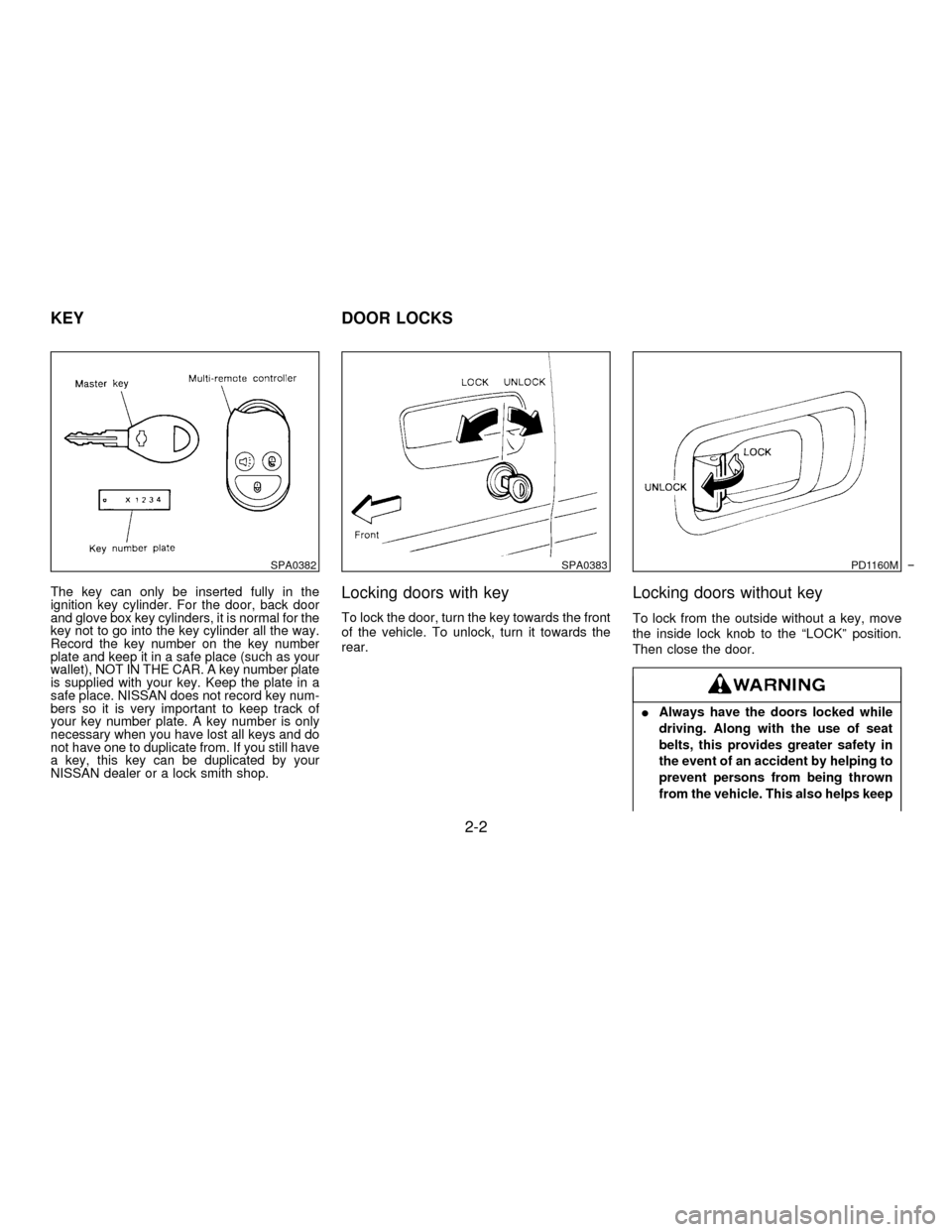
The key can only be inserted fully in the
ignition key cylinder. For the door, back door
and glove box key cylinders, it is normal for the
key not to go into the key cylinder all the way.
Record the key number on the key number
plate and keep it in a safe place (such as your
wallet), NOT IN THE CAR. A key number plate
is supplied with your key. Keep the plate in a
safe place. NISSAN does not record key num-
bers so it is very important to keep track of
your key number plate. A key number is only
necessary when you have lost all keys and do
not have one to duplicate from. If you still have
a key, this key can be duplicated by your
NISSAN dealer or a lock smith shop.Locking doors with key
To lock the door, turn the key towards the front
of the vehicle. To unlock, turn it towards the
rear.
Locking doors without key
To lock from the outside without a key, move
the inside lock knob to the ªLOCKº position.
Then close the door.
IAlways have the doors locked while
driving. Along with the use of seat
belts, this provides greater safety in
the event of an accident by helping to
prevent persons from being thrown
from the vehicle. This also helps keep
SPA0382SPA0383PD1160M
KEY DOOR LOCKS
2-2
Z01.2.1/R50-DX
Page 49 of 223

hood securely closed.
The glove box may be opened by turning the
key as shown.
Keep glove box lid closed while driving
to prevent injury in an accident or during
a sudden stop.
Opener lever
To open the fuel filler lid, push the opener lever
down. To lock, close the fuel filler lid securely.
SPA0388
SPA0389
GLOVE BOX LOCK FUEL FILLER LID LOCK
2-10
Z01.2.1/R50-DX
Page 59 of 223
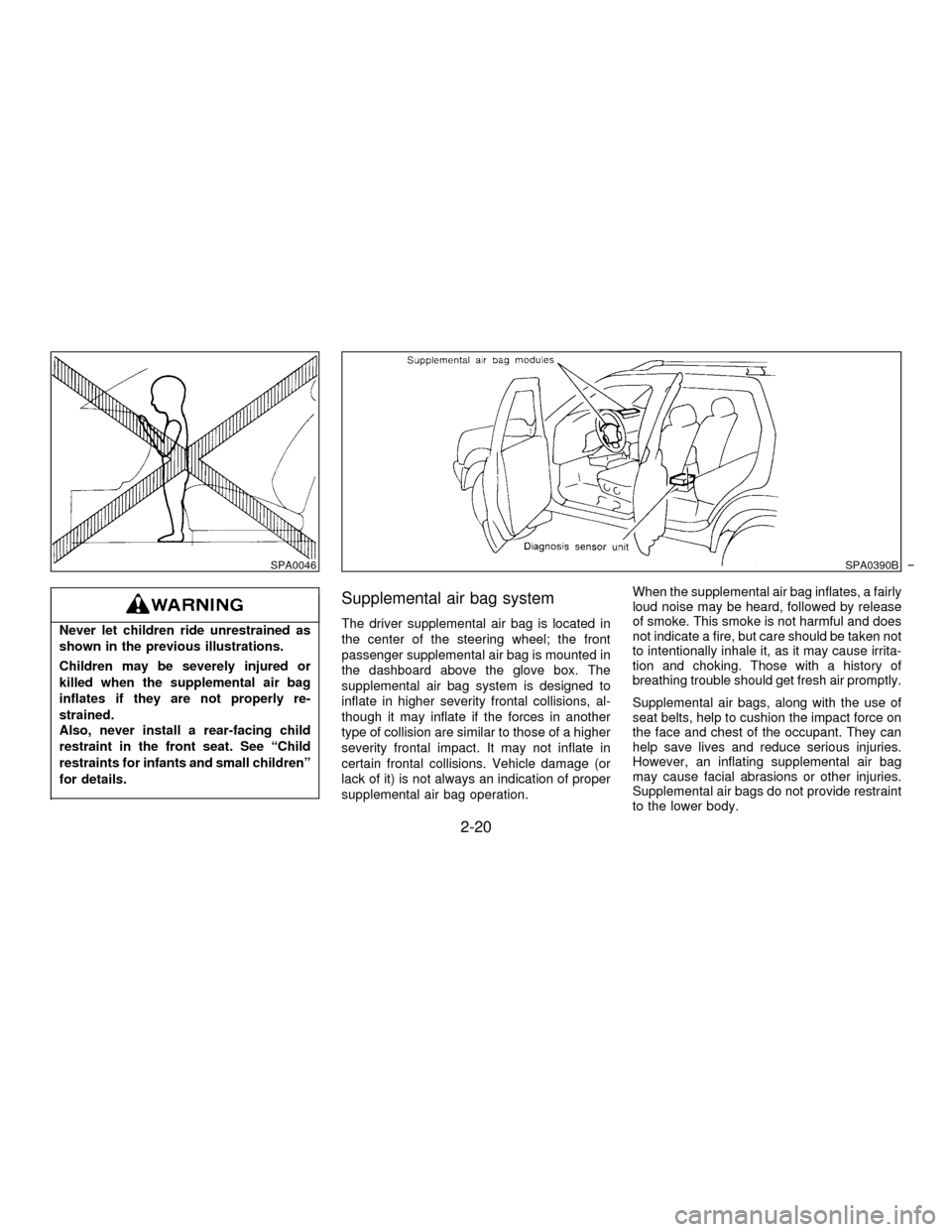
Never let children ride unrestrained as
shown in the previous illustrations.
Children may be severely injured or
killed when the supplemental air bag
inflates if they are not properly re-
strained.
Also, never install a rear-facing child
restraint in the front seat. See ªChild
restraints for infants and small childrenº
for details.
Supplemental air bag system
The driver supplemental air bag is located in
the center of the steering wheel; the front
passenger supplemental air bag is mounted in
the dashboard above the glove box. The
supplemental air bag system is designed to
inflate in higher severity frontal collisions, al-
though it may inflate if the forces in another
type of collision are similar to those of a higher
severity frontal impact. It may not inflate in
certain frontal collisions. Vehicle damage (or
lack of it) is not always an indication of proper
supplemental air bag operation.When the supplemental air bag inflates, a fairly
loud noise may be heard, followed by release
of smoke. This smoke is not harmful and does
not indicate a fire, but care should be taken not
to intentionally inhale it, as it may cause irrita-
tion and choking. Those with a history of
breathing trouble should get fresh air promptly.
Supplemental air bags, along with the use of
seat belts, help to cushion the impact force on
the face and chest of the occupant. They can
help save lives and reduce serious injuries.
However, an inflating supplemental air bag
may cause facial abrasions or other injuries.
Supplemental air bags do not provide restraint
to the lower body.
SPA0046SPA0390B
2-20
Z01.2.1/R50-DX
Page 139 of 223
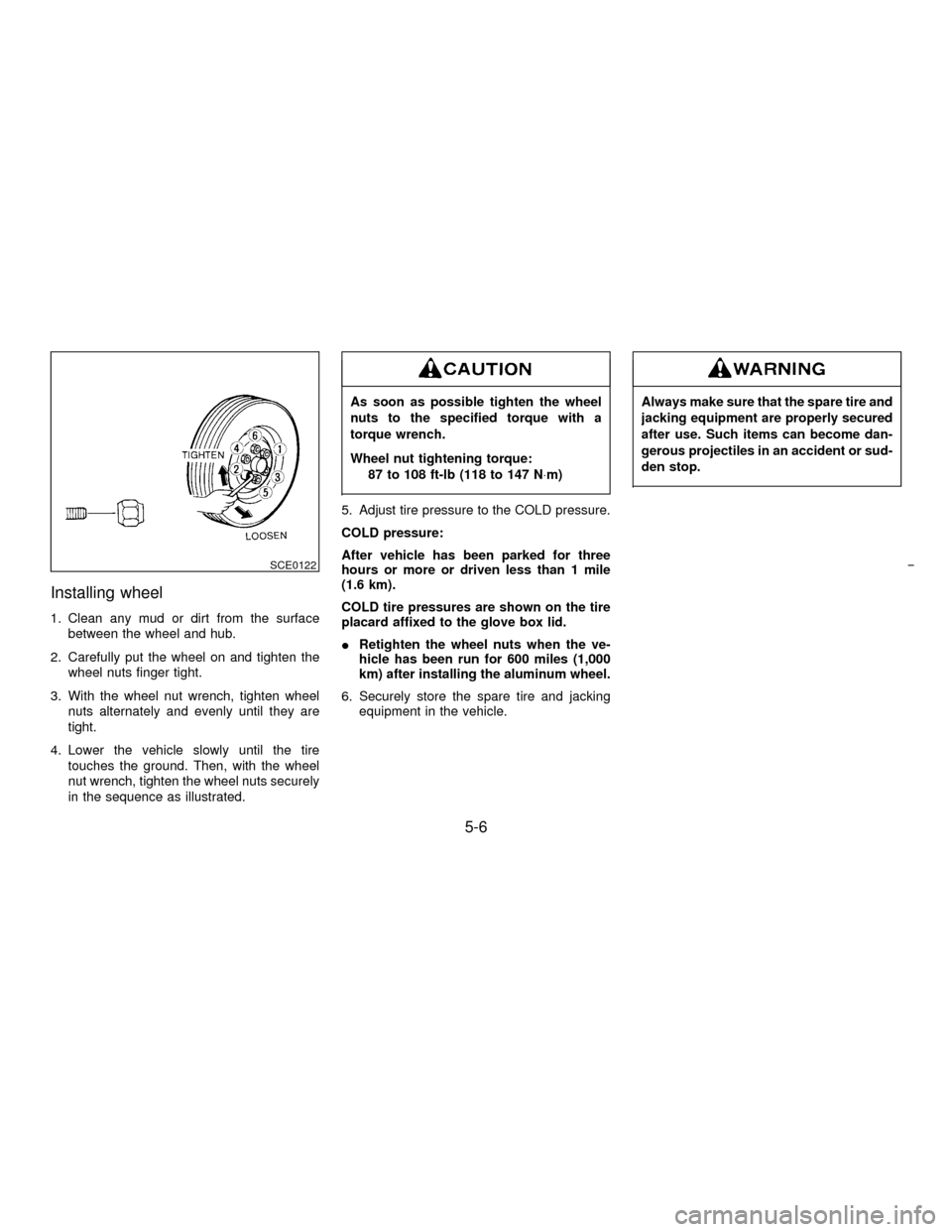
Installing wheel
1. Clean any mud or dirt from the surface
between the wheel and hub.
2. Carefully put the wheel on and tighten the
wheel nuts finger tight.
3. With the wheel nut wrench, tighten wheel
nuts alternately and evenly until they are
tight.
4. Lower the vehicle slowly until the tire
touches the ground. Then, with the wheel
nut wrench, tighten the wheel nuts securely
in the sequence as illustrated.
As soon as possible tighten the wheel
nuts to the specified torque with a
torque wrench.
Wheel nut tightening torque:
87 to 108 ft-lb (118 to 147 N×m)
5. Adjust tire pressure to the COLD pressure.
COLD pressure:
After vehicle has been parked for three
hours or more or driven less than 1 mile
(1.6 km).
COLD tire pressures are shown on the tire
placard affixed to the glove box lid.
IRetighten the wheel nuts when the ve-
hicle has been run for 600 miles (1,000
km) after installing the aluminum wheel.
6. Securely store the spare tire and jacking
equipment in the vehicle.
Always make sure that the spare tire and
jacking equipment are properly secured
after use. Such items can become dan-
gerous projectiles in an accident or sud-
den stop.
SCE0122
5-6
Z01.2.1/R50-DX
Page 214 of 223

Tire pressures
IWhen towing a trailer, inflate the vehicle
tires to the recommended cold tire pressure
indicated on the tire placard (affixed to the
glove box lid).
ITrailer tire condition, size, load rating and
proper inflation pressure should be in ac-
cordance with the trailer and tire manufac-
turers' specifications.
Safety chain
Always use a suitable chain between your
vehicle and the trailer. The chain should be
crossed and should be attached to the hitch,
not to the vehicle bumper or axle. Be sure to
leave enough slack in the chain to permit
turning corners.
Trailer lights
Trailer lights should comply with Federal
and/or local regulations.
When wiring vehicle for towing connection,
connect stop and tail light pickup into the
vehicle electrical circuit at point between
the sensor and stop light switch or light
switch.
Trailer brakes
If your trailer is equipped with a braking sys-
tem, make sure it conforms to Federal and/or
local regulations and that it is properly in-
stalled.
Never connect a trailer brake system
directly to the vehicle brake system.
Trailer towing tips
In order to gain skill and an understanding of
the vehicle's behavior, you should practice
turning, stopping and backing up in an area
which is free from traffic. Steering stability and
braking performance will be somewhat differ-
ent than under normal driving conditions.
IAlways secure items in the trailer to prevent
load shift while driving.
IAvoid abrupt starts, acceleration or stops.
IAvoid sharp turns or lane changes.
IAlways drive your vehicle at a moderate
speed.
IAlways block the wheels on both vehicle
and trailer when parking. Parking on aslope is not recommended; however, if you
must do so, and if your vehicle is equipped
with automatic transmission, first block the
wheels and apply the parking brake, and
then move the transmission shift lever into
the ªPº position. If you move the shift lever
to the ªPº position before blocking the
wheels and applying the parking brake,
transmission damage could occur.
IWhen going down a hill, shift into a lower
gear and use the engine braking effect.
When ascending a long grade, downshift
the transmission to a lower gear and reduce
speed to reduce chances of engine over-
loading and/or overheating.
However, for long steep grades, do not stay in
1st or 2nd gear when driving above 35 MPH
(56 km/h).
IIf the engine coolant rises to an extremely
high temperature when the air conditioning
system is on, turn off the air conditioner.
Coolant heat can be additionally vented by
opening the windows, switching the fan
control to high and setting the temperature
control to the ªHOTº position.
ITrailer towing requires more fuel than nor-
mal circumstances.
9-19
Z01.2.1/R50-DX
Page 219 of 223

Driving with manual transmission ............. 4-10
On-pavement and off-road driving
precautions .................................................. 4-3
Precautions when driving .......................... 4-23
Precautions when starting and driving ........ 4-2
E
Economy hints ................................................ 4-15
Emission control information label .................. 9-14
Emission control system warranty .................. 9-20
Engine ............................................................. 9-10
Before starting the engine ........................... 4-6
Changing engine coolant ............................ 7-5
Changing engine oil .................................... 7-8
Checking engine oil level ............................ 7-7
Engine coolant temperature gauge ............. 1-4
Engine cooling system ................................ 7-4
Engine oil..................................................... 7-7
Engine oil and oil filter
recommendation .......................................... 9-6
Engine serial number ................................ 9-13
Starting the engine .................................... 4-11
Exhaust gas (Carbon monoxide) ...................... 4-2
Explanation of maintenance items.................. 8-10
F
Flat tire .............................................................. 5-2
Fluid
Automatic transmission fluid ....................... 7-9
Brake and clutch fluid................................ 7-11
Power steering fluid................................... 7-11
Window washer fluid ................................. 7-12F.M.V.S.S. certification label........................... 9-14
Front fog light switch ...................................... 1-19
Front seats ...................................................... 2-12
Fuel
Capacities and recommended
fuel/lubricants .............................................. 9-2
Fuel filler cap ............................................. 2-11
Fuel filler lid lock ....................................... 2-10
Fuel gauge .................................................. 1-5
Fuel recommendation.................................. 9-4
Fuses .............................................................. 7-20
G
Gauge
Engine coolant temperature gauge ............. 1-4
Fuel gauge .................................................. 1-5
Meters and gauges ..................................... 1-3
General maintenance ....................................... 8-2
Glasses case .................................................. 1-23
Glove box lock ................................................ 2-10
H
Hazard warning flasher switch........................ 1-19
Head restraint ................................................. 2-15
Headlight and turn signal switch..................... 1-15
Headlights ....................................................... 7-22
Heated seat (If so equipped) .......................... 1-20
Heater and air conditioner ................................ 3-3
Heater operation ........................................ 3-4, 3-8
Hood release .................................................... 2-9I
If your vehicle is ever stolen ........................... 1-33
If your vehicle overheats .................................. 5-9
Ignition switch ................................................... 4-4
Inside mirror .................................................... 2-38
Inspection light ................................................ 1-30
Instrument brightness control ......................... 1-18
Integrated HomeLink
TMtransmitter
(If so equipped)............................................... 1-31
Interior light ..................................................... 1-29
J
Jump starting ........................................... 5-7, 7-13
K
Key .................................................................... 2-2
L
Light
Air bag warning light ................................. 2-22
Cigarette lighter and ash trays .................. 1-21
Front fog light switch ................................. 1-19
Headlight and turn signal switch ............... 1-15
Headlights.................................................. 7-22
Inspection light .......................................... 1-30
Interior light................................................ 1-29
Light bulbs ................................................. 7-22
Other lights ................................................ 7-23
Spot light ................................................... 1-30
Vanity mirror light ...................................... 1-30
10-2
Z01.2.1/R50-DX
Page 220 of 223
Warning/indicator light and buzzer.............. 1-9
Lock
Anti-lock brake system .............................. 4-24
Back door locks ........................................... 2-8
Child safety rear door lock .......................... 2-3
Clock............................................................ 1-8
Door locks ................................................... 2-2
Fuel filler lid lock ....................................... 2-10
Glove box lock........................................... 2-10
Power door lock .......................................... 2-3
Rear window locks ...................................... 2-8
Luggage board and box ................................. 1-25
Luggage hooks ............................................... 2-40
Luggage net .................................................... 2-39
Luggage rack .................................................. 2-41
Luggage side finisher hook ............................ 2-39
M
Maintenance
Explanation of maintenance items ............ 8-10
General maintenance .................................. 8-2
Periodic maintenance .................................. 8-5
Seat belt maintenance .............................. 2-30
Manual antenna .............................................. 3-24
Meters and gauges ........................................... 1-3
Mirror
Inside mirror .............................................. 2-38
Outside mirror control................................ 2-37
Outside mirror defogger (If so
equipped)................................................... 1-18
Outside mirrors .......................................... 2-38
Vanity mirror light ...................................... 1-30Multi-remote control system (If so equipped) ... 2-4
O
Oil
Changing engine oil .................................... 7-8
Changing oil filter ........................................ 7-9
Checking engine oil level ............................ 7-7
Engine oil..................................................... 7-7
Engine oil and oil filter
recommendation .......................................... 9-6
On-pavement and off-road driving precautions .. 4-
3
Operating the transmitter ................................ 1-33
Outside mirror control ..................................... 2-37
Outside mirror defogger (If so equipped) ....... 1-18
Outside mirrors ............................................... 2-38
Overheat
If your vehicle overheats ............................. 5-9
P
Parking ............................................................ 4-22
Parking brake ................................... 4-12, 7-18
Periodic maintenance ....................................... 8-5
Power
Power antenna (If so equipped)................ 3-24
Power door lock .......................................... 2-3
Power socket ............................................. 1-22
Power steering fluid................................... 7-11
Power support seat ................................... 2-13
Power window ........................................... 1-26
Precautions ....................................................... 7-2
Driving safety precautions ......................... 4-20On-pavement and off-road driving
precautions .................................................. 4-3
Precautions on seat belt usage ................ 2-24
Precautions when driving .......................... 4-23
Precautions when starting and driving ........ 4-2
Programming problem diagnosis .................... 1-33
Programming the HomeLink
TM
transmitter ....................................................... 1-32
Protecting against corrosion ............................. 6-5
Push starting ..................................................... 5-8
R
Radio............................................................... 3-14
AM-FM radio with cassette player ............ 3-15
AM-FM radio with compact disc
player ......................................................... 3-20
CB radio or car phone............................... 3-24
Rear seats ...................................................... 2-15
Rear window defogger switch......................... 1-18
Rear window locks ............................................ 2-8
Rear window wiper and washer switch .......... 1-17
Recommended sae viscosity number............... 9-8
Refrigerant recommendation ............................ 9-9
Reporting safety defects (U.S.A.) ................... 9-21
S
Safety
Child safety................................................ 2-24
Child safety rear door lock .......................... 2-3
Driving safety precautions ......................... 4-20
Reporting safety defects (U.S.A.) ............. 9-21
Seat adjustment .............................................. 2-12
10-3
Z01.2.1/R50-DX
Page 222 of 223

Recommended fuel:
Unleaded gasoline, at least 87 AKI number
(RON 91)
For further details such as gasohol or diesel
fuel grade, see ªFuel recommendationº in the
ªTechnical informationº section.
Recommended engine oil:
IAPI SG or SH and Energy Conserving II
IAPI Certification Mark
ISAE 5W-30 viscosity oil is preferred for all
ambient temperatures.
See ªEngine oil and oil filter recommendationº
in the ªTechnical and consumer informationº
section.
Tire cold pressure:
See the tire placard affixed to the glove box.
Recommended new vehicle break-
in procedure:
During the first 1,000 miles (1,600 km) of
vehicle use, follow the recommendations out-
lined in the ªBREAK-IN SCHEDULEº Informa-
tion found in the ªStarting and drivingº section
of this Owner's Manual. Follow these recom-
mendations for the future reliability and
economy of your new vehicle. Failure to follow
these recommendations may result in vehicledamage or shortened engine life. (page)
IIn case of emergency .......................... 5-1
(Flat tire, engine will not start, overheating,
towing)
IHow to start the engine ....................... 4-1
IHow to read the meters and
gauges ................................................. 1-1
IMaintenance schedule......................... 8-1
IDo-it-yourself operations ..................... 7-1
ITechnical information .......................... 9-1
GAS STATION INFORMATION QUICK REFERENCE
Z01.2.1/R50-DX