engine overheat NISSAN PATHFINDER 2001 R50 / 2.G User Guide
[x] Cancel search | Manufacturer: NISSAN, Model Year: 2001, Model line: PATHFINDER, Model: NISSAN PATHFINDER 2001 R50 / 2.GPages: 289, PDF Size: 2.45 MB
Page 214 of 289
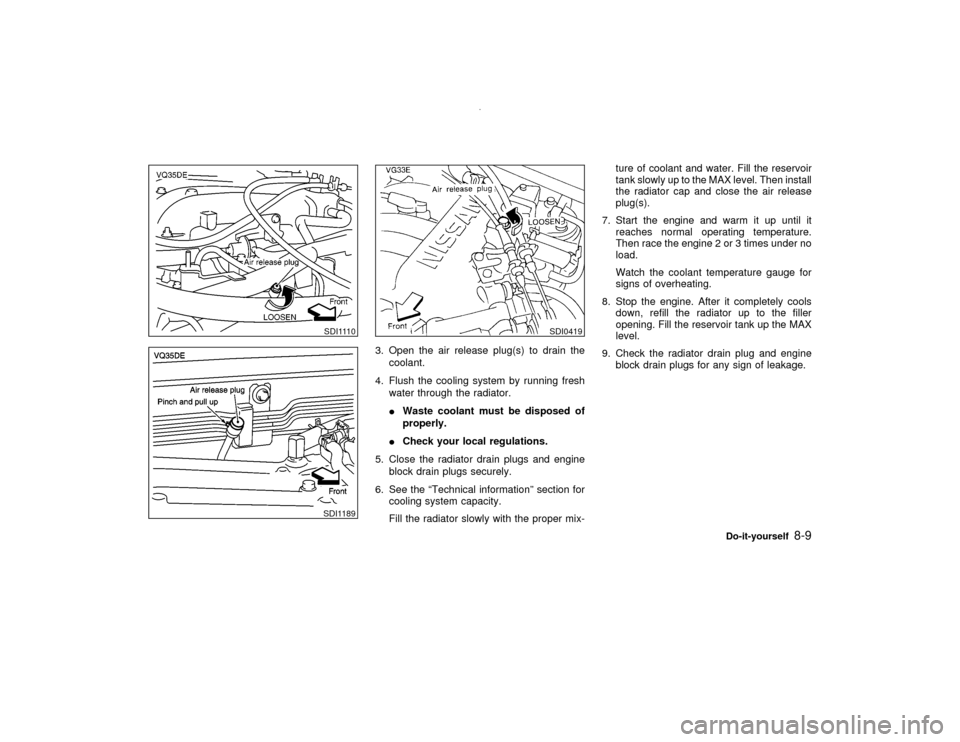
3. Open the air release plug(s) to drain the
coolant.
4. Flush the cooling system by running fresh
water through the radiator.
IWaste coolant must be disposed of
properly.
ICheck your local regulations.
5. Close the radiator drain plugs and engine
block drain plugs securely.
6. See the ªTechnical informationº section for
cooling system capacity.
Fill the radiator slowly with the proper mix-ture of coolant and water. Fill the reservoir
tank slowly up to the MAX level. Then install
the radiator cap and close the air release
plug(s).
7. Start the engine and warm it up until it
reaches normal operating temperature.
Then race the engine 2 or 3 times under no
load.
Watch the coolant temperature gauge for
signs of overheating.
8. Stop the engine. After it completely cools
down, refill the radiator up to the filler
opening. Fill the reservoir tank up the MAX
level.
9. Check the radiator drain plug and engine
block drain plugs for any sign of leakage.
SDI1110SDI1189
SDI0419
Do-it-yourself
8-9
Z
00.1.10/R50-D/V5
X
Page 260 of 289
Octane rating tipsIn most parts of North America, you should use
unleaded gasoline with an octane rating of at
least 91 AKI (Anti-Knock Index) number
(VQ35DE engine) or 87 AKI (Anti-knock Index)
number (VG33E engine). However, you may
use unleaded gasoline with an octane rating
as low as 85 AKI (Anti-Knock Index) number in
these high altitude areas [over 4,000 ft (1,219
m)] such as: Colorado, Montana, New Mexico,
Utah, Wyoming, northeastern Nevada, south-
ern Idaho, western South Dakota, western
Nebraska, and that part of Texas which is
directly south of New Mexico.
Using unleaded gasoline with an octane
rating lower than stated above can cause
persistent, heavy spark knock. (Spark
knock is a metallic rapping noise.) If se-
vere, this can lead to engine damage. If you
detect a persistent heavy spark knock even
when using gasoline of the stated octane
rating, or if you hear steady spark knock
while holding a steady speed on level
roads, have your dealer correct the condi-
tion. Failure to correct the condition is
misuse of the vehicle, for which NISSAN is
not responsible.
Incorrect ignition timing will result in knocking,
after-run or overheating. This in turn maycause excessive fuel consumption or damage
to the engine. If any of the above symptoms
are encountered, have your vehicle checked at
a NISSAN dealer or other competent service
facility.
However, now and then you may notice
light spark knock for a short time while
accelerating or driving up hills. This is no
cause for concern, because you get the
greatest fuel benefit when there is light
spark knock for a short time.
Technical and consumer information
10-5
Z
00.1.10/R50-D/V5
X
Page 274 of 289
IAfter the hitch is removed, seal the
bolt holes to prevent exhaust fumes,
water or dust from entering the pas-
senger compartment.
IRegularly check all hitch mounting
bolts are securely mounted.
ITo reduce the possibility of additional
damage if your vehicle is struck from
the rear, where practical, remove the
hitch and/or receiver when not in use.
INever connect a trailer brake system
directly to the vehicle brake system.Tire pressuresIWhen towing a trailer, inflate the vehicle
tires to the recommended cold tire pressure
indicated on the tire placard (affixed to the
glove box lid).
ITrailer tire condition, size, load rating and
proper inflation pressure should be in ac-
cordance with the trailer and tire manufac-
turers' specifications.Safety chainsAlways use a suitable chain between yourvehicle and the trailer. The chain should be
crossed and should be attached to the hitch,
not to the vehicle bumper or axle. Be sure to
leave enough slack in the chain to permit
turning corners.
Trailer lightsTrailer lights should comply with Federal
and/or local regulations.
When wiring vehicle for towing connection,
connect stop and tail light pickup into the
vehicle electrical circuit at point between
the sensor and stop light switch or light
switch.Trailer brakesIf your trailer is equipped with a braking sys-
tem, make sure it conforms to Federal and/or
local regulations and that it is properly in-
stalled.
WARNING
Never connect a trailer brake system
directly to the vehicle brake system.Trailer towing tipsIn order to gain skill and an understanding ofthe vehicle's behavior, you should practice
turning, stopping and backing up in an area
which is free from traffic. Steering stability and
braking performance will be somewhat differ-
ent than under normal driving conditions.
IAlways secure items in the trailer to prevent
load shift while driving.
IAvoid abrupt starts, acceleration or stops.
IAvoid sharp turns or lane changes.
IAlways drive your vehicle at a moderate
speed.
IAlways block the wheels on both vehicle
and trailer when parking. Parking on a
slope is not recommended; however, if you
must do so, and if your vehicle is equipped
with automatic transmission, first block the
wheels and apply the parking brake, and
then move the transmission selector lever
into the P position. If you move the selector
lever to the P position before blocking the
wheels and applying the parking brake,
transmission damage could occur.
IWhen going down a hill, shift into a lower
gear and use the engine braking effect.
When ascending a long grade, downshift
the transmission to a lower gear and reduce
speed to reduce chances of engine over-
loading and/or overheating.
Technical and consumer information
10-19
Z
00.1.10/R50-D/V5
X
Page 283 of 289

Child restraints ................................................ 1-31
Installation on front passenger seat .......... 1-42
Installation on rear seat outboard
positions .................................................... 1-35
Installation on rear seat center position .... 1-33
Precautions on child restraints .................. 1-31
Top tether strap anchor point locations .... 1-41
With top tether strap.................................. 1-40
Child safety ..................................................... 1-24
Child safety rear door lock................................ 3-4
Cigarette lighter (accessory) and ashtray....... 2-26
Circuit breaker, Fusible link ............................ 8-25
Cleaning exterior and interior .................... 7-2, 7-3
Clock ............................................................... 2-25
Clutch
Clutch pedal .............................................. 8-24
Fluid ........................................................... 8-15
Housing drain (4x4 only) ........................... 8-37
Cold weather driving ....................................... 5-34
Compact Disc (CD) autochanger operation ... 4-24
Compact Disc (CD) player (See audio
system) ........................................................... 4-17
Compact disc (CD) player operation .............. 4-11
Compact spare tire ......................................... 8-36
Compass display .............................................. 2-7
Console box .................................................... 2-29
Controls
Audio controls............................................ 4-11
Audio controls (rear).................................. 4-11
Audio controls (steering wheel)................. 4-11
Heater and air conditioner controls ............. 4-2
Heater and air conditioner controls
(automatic)................................................... 4-8Coolant
Capacities and recommended fuel/
lubricants ................................................... 10-2
Changing engine coolant ............................ 8-7
Checking engine coolant level .................... 8-6
Corrosion protection ......................................... 7-4
Cruise control.................................................. 5-17
Cup holders .................................................... 2-28
D
Daytime running light system ......................... 2-21
Defogger switch, Glass hatch and outside mirror
defogger switch............................................... 2-19
Dimensions and weights ............................... 10-11
Door open warning light ................................. 2-11
Drive belts ....................................................... 8-19
Drive positioner, Automatic ............................. 3-16
Driving
Cold weather driving ................................. 5-34
Driving with automatic transmission.......... 5-10
Driving with manual transmission ............. 5-14
On-pavement and offroad driving ............... 5-3
Precautions when starting and driving ........ 5-2
Safety precautions....................................... 5-4
E
Economy, Fuel ................................................ 5-19
Electric sunroof ............................................... 2-36
Emission control information label ................ 10-14
Emission control system warranty ................ 10-21Engine
Before starting the engine ........................... 5-9
Block heater .............................................. 5-35
Capacities and recommended fuel/
lubricants ................................................... 10-2
Changing engine coolant ............................ 8-7
Changing engine oil .................................. 8-11
Changing engine oil filter .......................... 8-12
Checking engine coolant level .................... 8-6
Checking engine oil level .......................... 8-10
Coolant temperature gauge ........................ 2-4
Engine compartment check locations ......... 8-4
Engine cooling system ................................ 8-6
Engine oil................................................... 8-10
Engine oil and oil filter recommendation... 10-6
Engine oil viscosity .................................... 10-6
Engine serial number .............................. 10-13
Engine specifications................................. 10-9
If your engine overheats ........................... 6-11
Starting the engine ...................................... 5-9
Exhaust gas (Carbon monoxide) ...................... 5-2
F
F.M.V.S.S. certification label......................... 10-13
Filter, Air cleaner housing filter ....................... 8-20
Flashers (See hazard warning flasher
switch) ............................................................. 2-23
Flat tire .............................................................. 6-2
Floor mat cleaning ............................................ 7-4
Fluid
Automatic transmission fluid (ATF) ........... 8-13
Brake and clutch fluid................................ 8-15
Brake fluid ................................................. 8-15
Z
00.1.10/R50-D/V5
X
11-2
Page 285 of 289

Engine serial number .............................. 10-13
Vehicle identification number (VIN)......... 10-12
Light
Air bag warning light ................................. 1-21
Bulb replacement ...................................... 8-26
Front fog light switch ................................. 2-23
Headlamps (Bulb replacement)................. 8-28
Headlight switch ........................................ 2-20
Headlights (Bulb replacement) .................. 8-28
Personal lights ........................................... 2-39
Replacement ............................................. 8-26
Vanity mirror light ...................................... 2-40
Warning/indicator lights and
chimes ................................................ 2-9, 2-13
Loading information (See vehicle loading
information) ................................................... 10-15
Lock
Door locks ................................................... 3-2
Glass hatch lock ........................................ 3-11
Glove box lock........................................... 2-29
Power door lock .......................................... 3-2
Rear door lock ........................................... 3-10
Rear door opener ...................................... 3-10
Low fuel warning light ..................................... 2-12
Luggage hooks ............................................... 2-31
Luggage rack .................................................. 2-34
M
Maintenance
Battery ....................................................... 8-18
Explanation of maintenance items ............ 9-10
General maintenance .................................. 9-2
Inside the vehicle ........................................ 9-2Maintenance precautions ............................ 8-2
Outside the vehicle...................................... 9-2
Periodic maintenance schedules ................ 9-5
Seat belt maintenance .............................. 1-31
Under the hood and vehicle ........................ 9-4
Manual front seat adjustment ........................... 1-2
Meters and gauges ........................................... 2-3
Mirror
Inside mirror .............................................. 3-14
Outside mirror............................................ 3-15
Outside mirror control................................ 3-15
Outside mirrors .......................................... 3-15
Multi-remote control system.............................. 3-5
N
Net, Cargo net ................................................ 2-33
New vehicle break-in ...................................... 5-19
Nissan vehicle Immobilizer System ................ 2-15
Nissan Vehicle Immobilizer System, Engine
start ................................................................... 5-8
O
Odometer .......................................................... 2-3
Oil
Capacities and recommended fuel/
lubricants ................................................... 10-2
Changing engine oil .................................. 8-11
Changing engine oil filter .......................... 8-12
Checking engine oil level .......................... 8-10
Engine oil................................................... 8-10
Engine oil viscosity .................................... 10-6Outside mirror ................................................. 3-15
Outside mirror control ..................................... 3-15
Outside mirrors ............................................... 3-15
Outside temperature display ............................. 2-6
Overdrive switch ............................................. 5-13
Overheat, If your vehicle overheats................ 6-11
P
Parking
Brake check............................................... 8-22
Parking brake check.................................. 5-16
Parking brake operation ............................ 5-16
Parking on hills .......................................... 5-16
Parking/parking on hills .................................. 5-30
Periodic maintenance schedules ...................... 9-5
Personal lights ................................................ 2-39
Power
Front seat adjustment ................................. 1-4
Power door lock .......................................... 3-2
Power outlet .............................................. 2-25
Power steering fluid................................... 8-15
Power steering system .............................. 5-31
Power windows ......................................... 2-35
Pre-tensioner seat belt system ....................... 1-19
Precautions
Braking precautions................................... 5-32
Cruise control operations .......................... 5-18
Cruise control precautions ........................ 5-17
Driving safety............................................... 5-4
Maintenance precautions ..................... 8-2, 9-2
On child restraints ..................................... 1-31
On seat belt usage .................................... 1-23
On supplemental restraint system ............ 1-10
Z
00.1.10/R50-D/V5
X
11-4