fuel filter NISSAN PATHFINDER 2001 R50 / 2.G Owners Manual
[x] Cancel search | Manufacturer: NISSAN, Model Year: 2001, Model line: PATHFINDER, Model: NISSAN PATHFINDER 2001 R50 / 2.GPages: 289, PDF Size: 2.45 MB
Page 207 of 289
When performing any inspection or mainte-
nance work on your vehicle, always take care
to prevent serious accidental injury to yourself
or damage to the vehicle. The following are
general precautions which should be closely
observed.
WARNING
IPark the vehicle on a level surface,
apply the parking brake securely and
block the wheels to prevent the ve-
hicle from moving. For a manual
transmission, move the shift lever to
Neutral. For an automatic transmis-
sion, move the selector lever to the P
(Park) position.
IBe sure the ignition key is in the OFF
or LOCK position when performing
any replacement or repair.
IIf you must work with the engine
running, keep your hands, clothing,
hair and tools away from moving fans
belts and any other moving parts.
IIt is advisable to secure or remove
any loose clothing and any jewelry,such as rings, watches, etc. before
working on your vehicle.
IAlways wear eye protection when-
ever you work on your vehicle.
IIf you must run the engine in an
enclosed space such as a garage, be
sure there is proper ventilation for
exhaust gases to escape.
INever get under the vehicle while it is
supported only by a jack. If it is nec-
essary to work under the vehicle,
support it with safety stands.
IKeep smoking materials, flame and
sparks away from fuel and battery.
IYour vehicle is equipped with an au-
tomatic engine cooling fan. It may
come on at any time without warning,
even if the ignition key is in the OFF
position and the engine is not run-
ning. To avoid injury, always discon-
nect the negative battery cable before
working near the fan.
IOn gasoline engine models with themultiport fuel injection (MFI) system,
the fuel filter or fuel lines should be
serviced by a NISSAN dealer because
the fuel lines are under high pressure
even when the engine is off.
CAUTION
IDo not work under the engine hood
while it is hot. Turn off the engine and
wait until it cools down.
INever connect or disconnect either
the battery or any transistorized com-
ponent connector while the ignition
key is on.
INever leave the engine or the auto-
matic transmission related compo-
nent harness connector discon-
nected while the ignition key is on.
IAvoid direct contact with used engine
oil and coolant. Improperly disposed
engine oil, engine coolant, and/or
other vehicle fluids can hurt the envi-
MAINTENANCE PRECAUTIONS8-2
Do-it-yourself
Z
00.1.10/R50-D/V5
X
Page 217 of 289
washer. Securely tighten the drain plug with
a wrench. Do not use excessive force.
Drain plug tightening torque:
22 to 29 ft-lb (29 to 39 N×m)
7. Refill engine with recommended oil through
the oil filler opening, then install the oil filler
cap securely.
See ªCapacities and recommended
fuel/lubricantsº in the ª10. Technical and
consumer informationº section for drain and
refill capacity.
The drain and refill capacity depends on the
oil temperature and drain time. Use these
specifications for reference only. Always
use the dipstick to determine when the
proper amount of oil is in the engine.
8. Start the engine.
Check for leakage around the drain plug.
Correct as required.
9. Turn the engine off and wait more than 10
minutes. Check the oil level with the dip-
stick. Add engine oil if necessary.
WARNING
IProlonged and repeated contact withused engine oil may cause skin can-
cer.
ITry to avoid direct skin contact with
used oil. If skin contact is made, wash
thoroughly with soap or hand cleaner
as soon as possible.
IKeep used engine oil out of reach of
children.
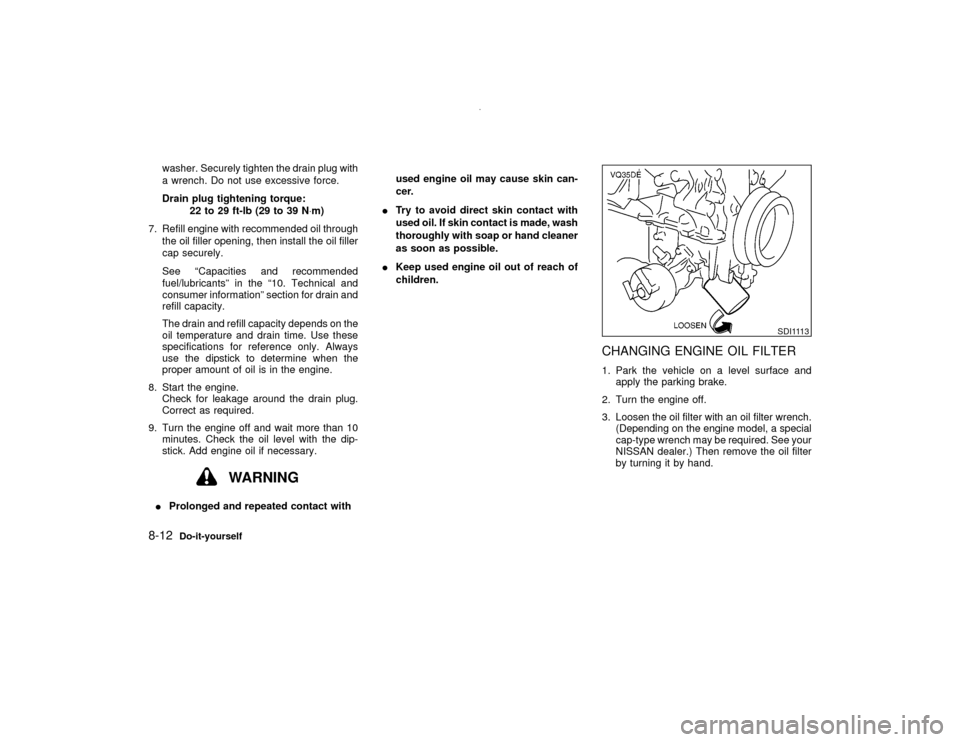
CHANGING ENGINE OIL FILTER1. Park the vehicle on a level surface and
apply the parking brake.
2. Turn the engine off.
3. Loosen the oil filter with an oil filter wrench.
(Depending on the engine model, a special
cap-type wrench may be required. See your
NISSAN dealer.) Then remove the oil filter
by turning it by hand.
SDI1113
8-12
Do-it-yourself
Z
00.1.10/R50-D/V5
X
Page 225 of 289
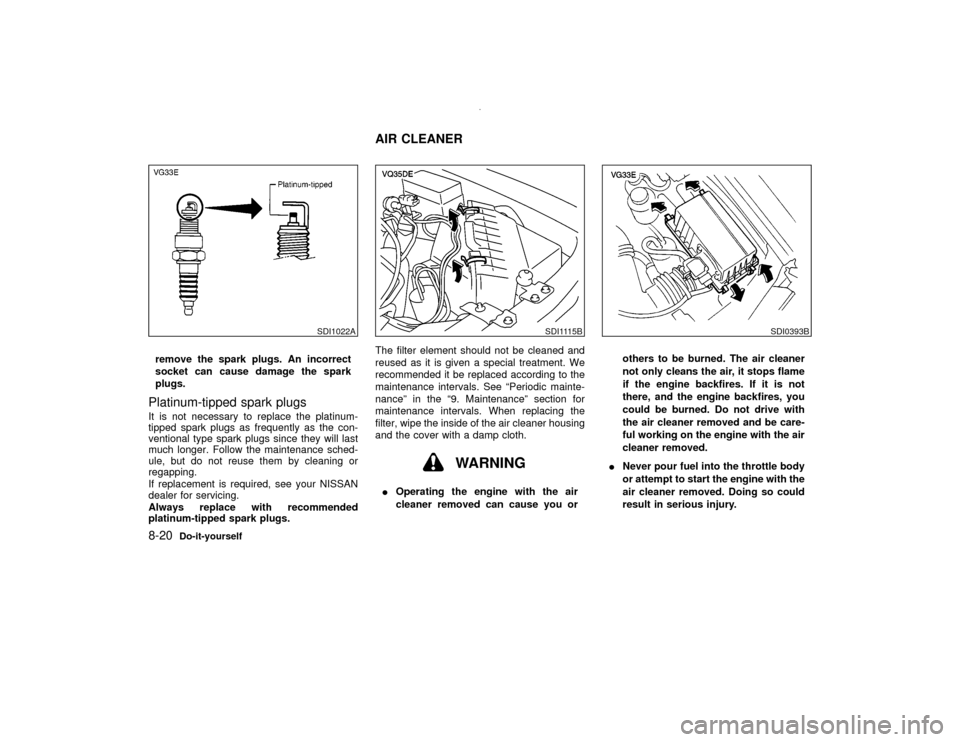
remove the spark plugs. An incorrect
socket can cause damage the spark
plugs.Platinum-tipped spark plugsIt is not necessary to replace the platinum-
tipped spark plugs as frequently as the con-
ventional type spark plugs since they will last
much longer. Follow the maintenance sched-
ule, but do not reuse them by cleaning or
regapping.
If replacement is required, see your NISSAN
dealer for servicing.
Always replace with recommended
platinum-tipped spark plugs.The filter element should not be cleaned and
reused as it is given a special treatment. We
recommended it be replaced according to the
maintenance intervals. See ªPeriodic mainte-
nanceº in the ª9. Maintenanceº section for
maintenance intervals. When replacing the
filter, wipe the inside of the air cleaner housing
and the cover with a damp cloth.
WARNING
IOperating the engine with the air
cleaner removed can cause you orothers to be burned. The air cleaner
not only cleans the air, it stops flame
if the engine backfires. If it is not
there, and the engine backfires, you
could be burned. Do not drive with
the air cleaner removed and be care-
ful working on the engine with the air
cleaner removed.
INever pour fuel into the throttle body
or attempt to start the engine with the
air cleaner removed. Doing so could
result in serious injury.
SDI1022A
SDI1115B
SDI0393B
AIR CLEANER
8-20
Do-it-yourself
Z
00.1.10/R50-D/V5
X
Page 249 of 289

Schedule 1Abbreviations: R = Replace I = Inspect. Correct or replace if necessary. [ ]: At the mileage intervals onlyMAINTENANCE OPERATIONMAINTENANCE INTERVAL
Perform at number of miles, kilometers or
months, whichever comes first.Miles´1,000 3.75 7.5 11.25 15 18.75 22.5 26.25 30 33.75 37.5 41.25 45 48.75 52.5 56.25 60
(km´1,000) (6) (12) (18) (24) (30) (36) (42) (48) (54) (60) (66) (72) (78) (84) (90) (96)
Months 3 6 9 12 15 18 21 24 27 30 33 36 39 42 45 48
Emission control system maintenance
Drive beltsI* I*
Air cleaner filter See NOTE (1) [R] [R]
EVAP vapor linesI* I*
Fuel linesI* I*
Fuel filter See NOTE (2)*
Engine coolant See NOTE (3)R*
Engine oilRRRRRRRRRRRRRRRR
Engine oil filter
(Use Part No. 15208 31U00 or equivalent.)RRRRRRRRRRRRRRRR
Spark plugs (PLATINUM-TIPPED type for VQ35DE) Replace every 105,000 miles (169,000 km)
Spark plugs (PLATINUM-TIPPED type for VG33E)[R]
Intkae & exhaust valve clearance (for VQ35DE) See NOTE (4)
Timing belt (for VG33E)Replace every 105,000 miles (169,000 km)NOTE: (1) If operating mainly in dusty conditions, more frequent maintenance may be required.
(2) When the filter becomes clogged, the vehicle speed cannot be increased as the driver wishes. In such an event, replace the filter.
(3) After 60,000 miles (96,000 km) or 48 months, replace every 30,000 miles (48,000 km) or 24 months.
(4) If valve noise increases, inspect valve clearance.
HMaintenance items and intervals with ª*º are recommended by NISSAN for reliable vehicle operation. The owner need not perform such
maintenance in order to maintain the emission warranty or manufacturer recall liability. Other maintenance items and intervals are required.9-6
Maintenance
Z
00.1.10/R50-D/V5
X
Page 251 of 289

Schedule 2Abbreviations: R = Replace I = Inspect. Correct or replace if necessary. [ ]: At the mileage intervals onlyMAINTENANCE OPERATIONMAINTENANCE INTERVAL
Perform at number of miles, kilometers or
months, whichever comes first.Miles´1,000 7.5 15 22.5 30 37.5 45 52.5 60
(km´1,000) (12) (24) (36) (48) (60) (72) (84) (96)
Months 6 12 18 24 30 36 42 48
Emission control system maintenance
Drive beltsI* I*
Air cleaner filter[R] [R]
EVAP vapor linesI* I*
Fuel linesI* I*
Fuel filter See NOTE (1)*
Engine coolant See NOTE (2)R*
Engine oilRRRRRRRR
Engine oil filter (Use Part No. 15208 31U00 or equivalent.)RRRRRRRR
Spark plugs (PLATINUM-TIPPED type for VQ35DE) Replace every 105,000 miles (169,000 km)
Spark plugs (PLATINUM-TIPPED type for VG33E)[R]
Intake & exhaust valve clearance (for VQ35DE) See NOTE (3)
Timing belt (for VG33E) Replace every 105,000 miles (169,000 km)
NOTE: (1) When the filter becomes clogged, the vehicle speed cannot be increased as the driver wishes. In such an event, replace the filter.
(2) After 60,000 miles (96,000 km) or 48 months, replace every 30,000 miles (48,000 km) or 24 months.
(3) If valve noise increases, inspect valve clearance.
HMaintenance items and intervals with ª*º are recommended by NISSAN for reliable vehicle operation. The owner need not perform such
maintenance in order to maintain the emission warranty or manufacturer recall liability. Other maintenance items and intervals are required.9-8
Maintenance
Z
00.1.10/R50-D/V5
X
Page 253 of 289

Maintenance for off-road driving
(
only)
Whenever you drive offroad through sand,
mud or water as deep as the wheel hub, more
frequent maintenance may be required of the
following items:G
Brake pads and discs
G
Brake lining and drums
G
Brake lines and hoses
G
Wheel bearing grease
G
Differential, transmission and transfer oil
G
Steering linkage
G
Propeller shafts and front drive shafts
G
Air cleaner filter
G
Clutch housing (See ªClutch housing drainº
in the ª8. Do-it-yourselfº section for check-
ing water entry.)
These items should be checked frequently to
assure safe and proper operation of your ve-
hicle.
EXPLANATION OF MAINTENANCE
ITEMS
Emission control system
maintenanceAdditional information on the following
items with * is found in the ª8. Do-it-
yourselfº section.
Drive belts*:
Check drive belts for wear, fraying or cracking
and also for proper tension. Replace the drive
belts if found damaged.
Air cleaner filter:
Under normal driving conditions, the air
cleaner filter should be replaced in accordance
with the maintenance schedule. However,
driving the vehicle in dusty areas may cause
more rapid clogging of the element. Conse-
quently, the element may have to be replaced
more frequently.
EVAP vapor lines:
Check vapor lines and connections for failure
or looseness. If leaks are found, replace the
lines.
Fuel lines:
Check the fuel hoses, piping and connectionsfor leaks, looseness or deterioration. Replace
any parts if they are damaged.
Fuel filter:
When the filter becomes clogged, the vehicle
speed cannot be increased as the driver
wishes. In such an event, replace the filter.
Engine coolant*:
Flush and refill the cooling system.
Engine oil & oil filter*:
Under normal driving conditions, the engine oil
and oil filter should be replaced in accordance
with the maintenance schedule. However, un-
der severe driving conditions, they may have
to be replaced more frequently.
Spark plugs*:
Replace with new plugs having the correct
heat range.
Intake & exhaust valve clearance:
Check the valve clearance if valve noise in-
creases.
Timing belt:
Replace the timing belt for driving the cam-
shafts.
9-10
Maintenance
Z
00.1.10/R50-D/V5
X
Page 256 of 289

10 Technical and consumer informationCapacities and recommended fuel/lubricants ......... 10-2
Fuel recommendation ......................................... 10-4
Engine oil and oil filter recommendation ............ 10-6
Recommended SAE oil viscosity number .......... 10-7
Air conditioning system refrigerant and lubricant
recommendations ............................................... 10-8
Specifications .......................................................... 10-9
Engine ................................................................ 10-9
Wheels and tires ................................................... 10-11
Dimensions and weights .................................. 10-11
When traveling or registering your vehicle in another
country................................................................... 10-12
Vehicle identification ............................................. 10-12
Vehicle identification number (VIN) plate ......... 10-12
Vehicle identification number (Chassis
number) ............................................................ 10-12
Engine serial number ....................................... 10-13
F.M.V.S.S. certification label ............................ 10-13
Emission control information label ................... 10-14Tire placard ...................................................... 10-14
Air conditioner specification label ..................... 10-14
Vehicle loading information ................................... 10-15
Terms ............................................................... 10-15
Determining vehicle load capacity.................... 10-15
Loading tips ...................................................... 10-15
Towing a trailer ..................................................... 10-16
Maximum load limits ......................................... 10-16
Towing load/specification chart ........................ 10-18
Towing safety ................................................... 10-18
Uniform tire quality grading .............................. 10-20
Emission control system warranty ........................ 10-21
Reporting safety defects (US only) ....................... 10-21
Readiness for inspection/maintenance (I/M) test
(US only) ............................................................... 10-22
Owner's Manual/Service Manual order
information............................................................. 10-24
In the event of a collision ................................. 10-24
Z
00.1.10/R50-D/V5
X
Page 257 of 289

The following values are approximate capacities. The actual refill capacities may be a little different from them. When refilling, follow the
procedure instructed in the ª8. Do-it-yourselfº section to determine the proper refill capacity.
Capacity (Approximate)
Recommended specifications
US
measureImp
measureLiter
Fuel 20-7/8 gal 17-3/8 gal 79Unleaded gasoline with an octane rating
of at least 91 AKI (RON 96) (VQ35DE) or
87AKI (RON 91) (VG33E)*1
Engine oil*4
Drain and refill
with oil filter
change5-1/4 qt 4-3/8 qt 5.0IAPI Certification Mark*2 *3
IAPI grade SG/SH, Energy Conserving I
& II or API grade SJ, Energy Conserv-
ing*2 *3
IILSAC grade GF-I & GF-II*2 *3 without oil filter
change5-1/8 qt 4-1/4 qt 4.8
Cooling system
(with heater and
reservoir tank)9-3/4 qt 8-1/8 qt 9.2Genuine Nissan Anti-Freeze Coolant or
equivalent
*1: See later in this section for fuel recommendation.
*2: See later in this section for recommended SAE viscosity number.
*3: See later in this section for engine oil and oil filter recommendation.
*4: See ªChanging engine oilº in the ª8. Do-it-yourselfº section for further details.CAPACITIES AND
RECOMMENDED
FUEL/LUBRICANTS10-2
Technical and consumer information
Z
00.1.10/R50-D/V5
X
Page 261 of 289

ENGINE OIL AND OIL FILTER
RECOMMENDATION
Selecting the correct oilIt is essential to choose the correct quality, and
viscosity oil to ensure satisfactory engine life
and performance. Nissan recommends the
use of a low friction oil (energy conserving oil)
in order to improve fuel economy and con-
serve energy. Oils which do not have the
specified quality label should not be used as
they could cause engine damage.
Only those engine oils with the American Pe-
troleum Institute (API) CERTIFICATIONMARK on the front of the container should be
used. This type of oil supersedes the existing
API SG, SH and SJ and Energy Conserving I
& II categories.
If you cannot find engine oil with the API
CERTIFICATION MARK, use an API grade
SG/SH, Energy ConservingI&IIorAPIgrade
SJ, Energy Conserving oil. An oil with a single
designation SG or SH, or in combination with
other categories (for example, SG/CC or
SG/CD) may also be used if one with the API
CERTIFICATION MARK cannot be found. An
ILSAC grade GF-I & GF-II oil can also be used.
Mineral based or synthetic type oils may beused in your NISSAN vehicle. These oils must
however, meet the API quality and SAE vis-
cosity ratings specified for your vehicle. Do not
mix mineral based and synthetic type oils in
the engine at the same time.
Oil additivesNISSAN does not recommend the use of oil
additives. The use of an oil additive is not
necessary when the proper oil type is used
and maintenance intervals are followed.
Oil which may contain foreign matter or has
been previously used should not be used.Oil viscosityThe engine oil viscosity or thickness changes
with temperature. Because of this, it is impor-
tant that the engine oil viscosity be selected
based on the temperatures at which the ve-
hicle will be operated before the next oil
change. The chart recommended SAE viscos-
ity number shows the recommended oil vis-
cosities for the expected ambient tempera-
tures. Choosing an oil viscosity other than that
recommended could cause serious engine
damage.Selecting the correct oil filterYour new vehicle is equipped with a high-
quality genuine Nissan oil filter. When replac-
STI0077
10-6
Technical and consumer information
Z
00.1.10/R50-D/V5
X
Page 282 of 289

11 Index
A
ABS (Anti-lock brake system) ......................... 5-32
Air bag system
Front (See supplemental front airbag
system) ...................................................... 1-16
Side (See supplemental side air bag
system) ...................................................... 1-18
Air bag warning labels .................................... 1-20
Air bag warning light.............................. 1-21, 2-12
Air cleaner housing filter ................................. 8-20
Air conditioner
Air conditioner operation ...................... 4-2, 4-8
Air conditioner service ................ 4-2, 4-8, 4-10
Air conditioner specification
label .......................................... 4-2, 4-8, 10-14
Air conditioner system refrigerant and
lubrication recommendations ............... 4-2, 4-8
Heater and air conditioner (automatic) (if so
equipped)..................................................... 4-8
Heater and air conditioner controls ............. 4-2
Servicing air conditioner .............................. 4-2
Air conditioning system refrigerant and lubricant
recommendations ........................................... 10-8
Air flow charts ............................................ 4-5, 4-8
Alcohol, drugs and driving ................................ 5-4
AM-FM radio with cassette player .................. 4-11
AM-FM radio with cassette player and compact
disc player....................................................... 4-11
AM-FM radio with compact disc player .......... 4-11Anchor point locations
Top tether strap ......................................... 1-41
Antenna
Manual ....................................................... 4-26
Power ........................................................ 4-26
Anti-lock Brake System (ABS) ........................ 5-32
Appearance care
Exterior appearance care ............................ 7-2
Interior appearance care ............................. 7-3
Armrest ............................................................. 1-9
Ashtray (See cigarette lighter and ashtray) .... 2-26
Audible reminders ........................................... 2-15
Audio system .................................................. 4-11
Autochanger, Compact Disc (CD) .................. 4-24
Automatic
Automatic transmission fluid (ATF) ........... 8-13
Drive positioner ......................................... 3-16
Driving with automatic transmission.......... 5-10
Seat positioner, seat ................................. 3-16
Transmission selector lever lock
release ....................................................... 5-13
Avoiding collision and rollover .......................... 5-4
B
Battery............................................................. 8-18
Battery saver system................................. 2-20
Battery replacement, (See multi-remote control
system) ............................................................. 3-8Before starting the engine ................................ 5-9
Belts (See drive belts) .................................... 8-19
Brake
Anti-lock brake system (ABS) ................... 5-32
Brake and clutch fluid................................ 8-15
Brake booster ............................................ 8-23
Brake fluid ................................................. 8-15
Brake pedal ............................................... 8-22
Brake pedal check..................................... 8-23
Parking brake check ........................ 5-16, 8-22
Parking brake operation ............................ 5-16
System....................................................... 5-32
Warning light ............................................. 2-10
Break-in schedule ........................................... 5-19
Bulb check/instrument panel ............................ 2-9
Bulb replacement ............................................ 8-26
C
Capacities and recommended
fuel/lubricants .................................................. 10-2
Car phone ....................................................... 4-28
Car phone or CB radio ................................... 4-28
Cargo (See vehicle loading information) ........ 2-32
Cargo net ........................................................ 2-32
Cassette player (See audio system) .............. 4-22
Cassette tape operation ................................. 4-11
Catalytic converter, Three way catalyst............ 5-3
CD care and cleaning ..................................... 4-19
Z
00.1.10/R50-D/V5
X