Switch NISSAN PATHFINDER 2009 Owner´s Manual
[x] Cancel search | Manufacturer: NISSAN, Model Year: 2009, Model line: PATHFINDER, Model: NISSAN PATHFINDER 2009Pages: 471, PDF Size: 5.9 MB
Page 59 of 471
PRECAUTIONS ON
SUPPLEMENTAL RESTRAINT
SYSTEM
This Supplemental Restraint System (SRS) sec-
tion contains important information concerning
the following systems:
cDriver and passenger supplemental front-
impact air bag (NISSAN Advanced Air Bag
System)
cFront seat-mounted side-impact supple-
mental air bag
cRoof-mounted curtain side-impact and roll-
over supplemental air bag
cSeat belt with pretensioner
Supplemental front- impact air bag system:
The NISSAN Advanced Air Bag System can help
cushion the impact force to the head and chest of
the driver and front passenger in certain frontal
collisions.
Front seat-mounted side-impact supple-
mental air bag system:This system can help
cushion the impact force to the chest area of the
driver and front passenger in certain side impact
collisions. The side air bag is designed to inflate
on the side where the vehicle is impacted.Roof-mounted curtain side-impact and
rollover supplemental air bag system:This
system can help cushion the impact force to the
head of occupants in front and rear outboard
seating positions in certain side-impact or roll-
over collisions. In a side impact, the curtain and
rollover air bags are designed to inflate on the
side where the vehicle is impacted. In a rollover,
both curtain and rollover air bags are designed to
inflate and remain inflated for a short time.
These supplemental restraint systems are de-
signed tosupplementthe crash protection pro-
vided by the seat belts and arenot a substitute
for them. Seat belts should always be correctly
worn and the occupant seated a suitable dis-
tance away from the steering wheel, instrument
panel and door finishers. See “Seat belts” earlier
in this section for instructions and precautions on
seat belt usage.
The supplemental air bags operate only
when the ignition switch is in the ON or
START position.
After placing the ignition switch in the ON
position, the supplemental air bag warning
light illuminates. The supplemental air bag
warning light will turn off after about 7
seconds if the system is operational.
SUPPLEMENTAL RESTRAINT
SYSTEM
Safety—Seats, seat belts and supplemental restraint system1-41
ZREVIEW COPYÐ2009 Pathfinder(pat)
Owners ManualÐUSA_English(nna)
05/29/08Ðdebbie
X
Page 66 of 471
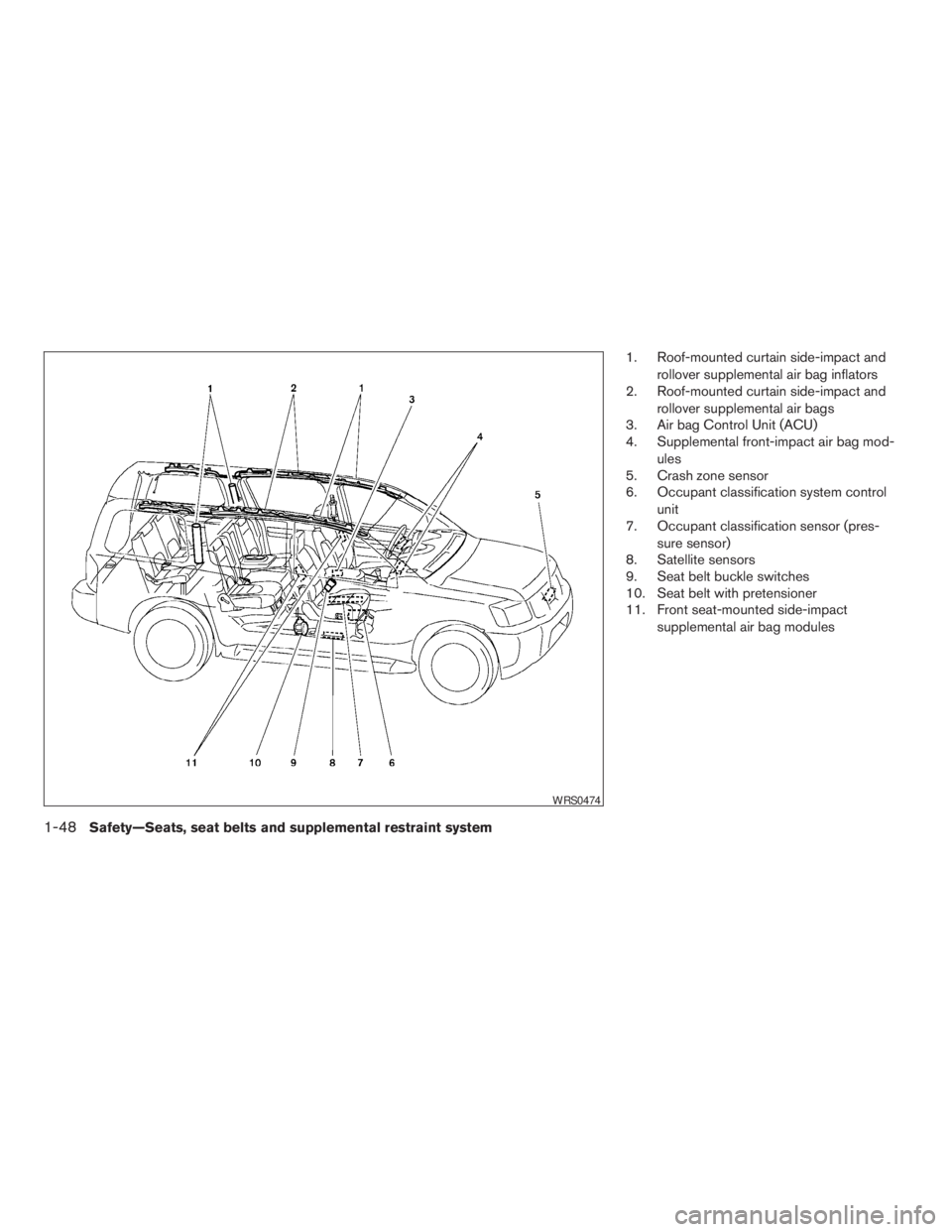
1. Roof-mounted curtain side-impact and
rollover supplemental air bag inflators
2. Roof-mounted curtain side-impact and
rollover supplemental air bags
3. Air bag Control Unit (ACU)
4. Supplemental front-impact air bag mod-
ules
5. Crash zone sensor
6. Occupant classification system control
unit
7. Occupant classification sensor (pres-
sure sensor)
8. Satellite sensors
9. Seat belt buckle switches
10. Seat belt with pretensioner
11. Front seat-mounted side-impact
supplemental air bag modules
WRS0474
1-48Safety—Seats, seat belts and supplemental restraint system
ZREVIEW COPYÐ2009 Pathfinder(pat)
Owners ManualÐUSA_English(nna)
05/29/08Ðdebbie
X
Page 67 of 471
NISSAN Advanced Air Bag System
(front seats)
This vehicle is equipped with the NISSAN Ad-
vanced Air Bag System for the driver and front
passenger seats. This system is designed to
meet certification requirements under U.S. regu-
lations. It is also permitted in Canada.However,
all of the information, cautions and warn-
ings in this manual still apply and must be
followed.
The driver supplemental front-impact air bag is
located in the center of the steering wheel. The
passenger supplemental front-impact air bag is
mounted in the dashboard above the glove box.
The front air bags are designed to inflate in higher
severity frontal collisions, although they may in-
flate if the forces in another type of collision are
similar to those of a higher severity frontal impact.
They may not inflate in certain frontal collisions.
Vehicle damage (or lack of it) is not always an
indication of proper front air bag system opera-
tion.
The NISSAN Advanced Air Bag System has dual
stage inflators. It also monitors information from
the crash zone sensor, the Air bag Control Unit
(ACU) , seat belt buckle sensors, occupant clas-
sification sensor (pressure sensor) and passen-
ger seat belt tension sensor. Inflator operation is
based on the severity of a collision and seat beltusage for the driver. For the front passenger, it
additionally monitors the weight of an occupant
or object on the seat and seat belt tension. Based
on information from the sensors, only one front air
bag may inflate in a crash, depending on the
crash severity and whether the front occupants
are belted or unbelted. Additionally, the front
passenger air bag may be automatically turned
OFF under some conditions, depending on the
weight detected on the passenger seat and how
the seat belt is used. If the front passenger air bag
is OFF, the passenger air bag status light will be
illuminated (if the seat is unoccupied, the light will
not be illuminated, but the air bag will be off) . See
“Front passenger air bag and status light” later in
this section for further details. One front air bag
inflating does not indicate improper performance
of the system.
If you have any questions about your air bag
system, please contact NISSAN or your NISSAN
dealer. If you are considering modification of your
vehicle due to a disability, you may also contact
NISSAN. Contact information is contained in the
front of this Owner’s Manual.
When a front air bag inflates, a fairly loud noise
may be heard, followed by the release of smoke.
This smoke is not harmful and does not indicate a
fire. Care should be taken to not inhale it, as it maycause irritation and choking. Those with a history
of a breathing condition should get fresh air
promptly.
Front air bags, along with the use of seat belts,
help to cushion the impact force on the face and
chest of the front occupants. They can help save
lives and reduce serious injuries. However, an
inflating front air bag may cause facial abrasions
or other injuries. Front air bags do not provide
restraint to the lower body.
Even with NISSAN advanced air bags, seat belts
should be correctly worn and the driver and pas-
senger seated upright as far as practical away
from the steering wheel or instrument panel. The
front air bags inflate quickly in order to help
protect the front occupants. Because of this, the
force of the front air bag inflating can increase the
risk of injury if the occupant is too close to, or is
against, the front air bag module during inflation.
The front air bags deflate quickly after a collision.
The front air bags operate only when the
ignition switch is in the ON or START posi-
tion.
After placing the ignition switch in the ON
position, the supplemental air bag warning
light illuminates. The supplemental air bag
warning light will turn off after about 7
seconds if the system is operational.
Safety—Seats, seat belts and supplemental restraint system1-49
ZREVIEW COPYÐ2009 Pathfinder(pat)
Owners ManualÐUSA_English(nna)
05/29/08Ðdebbie
X
Page 71 of 471
Front seat-mounted side-impact
supplemental air bag and roof-
mounted curtain side-impact and
rollover supplemental air bag systems
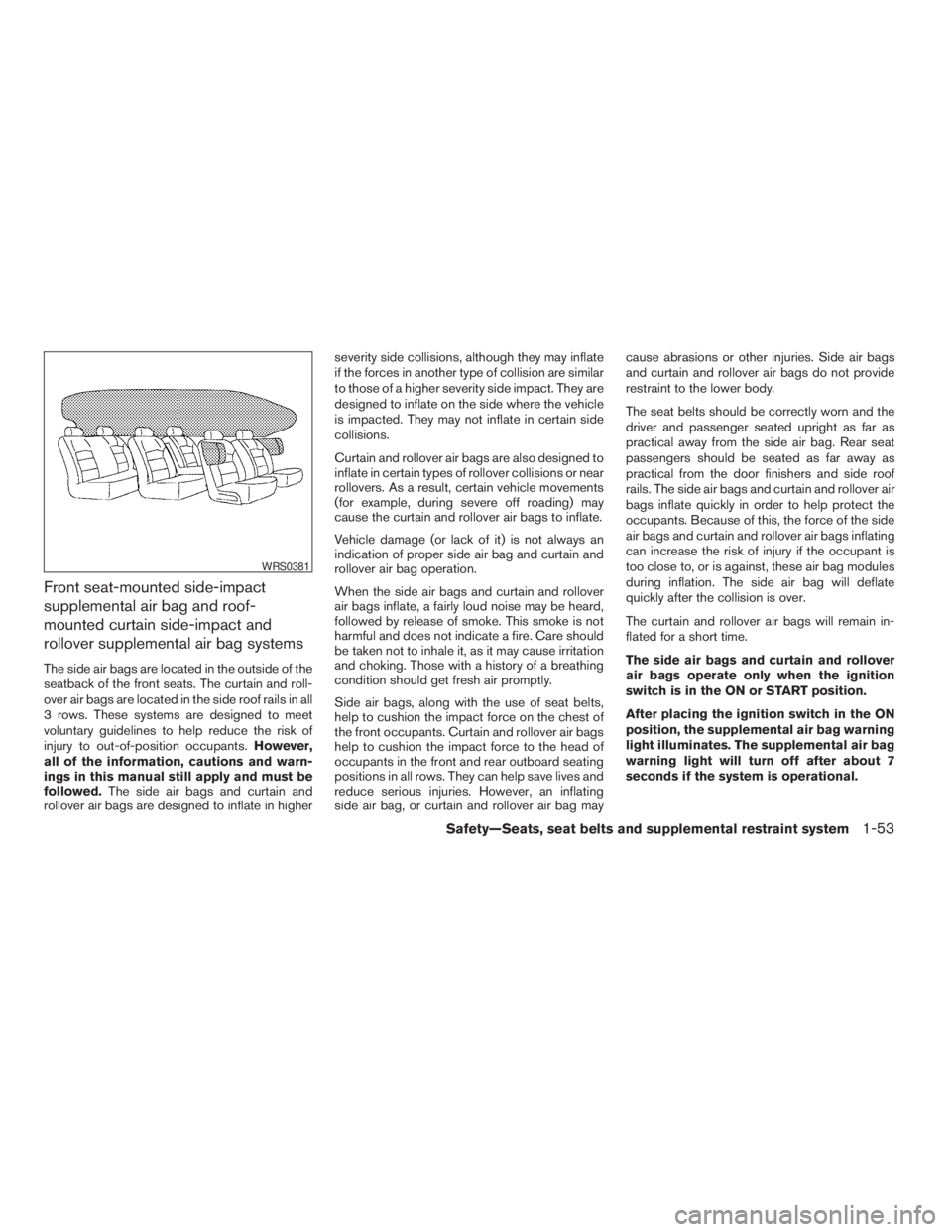
The side air bags are located in the outside of the
seatback of the front seats. The curtain and roll-
over air bags are located in the side roof rails in all
3 rows. These systems are designed to meet
voluntary guidelines to help reduce the risk of
injury to out-of-position occupants.However,
all of the information, cautions and warn-
ings in this manual still apply and must be
followed.The side air bags and curtain and
rollover air bags are designed to inflate in higherseverity side collisions, although they may inflate
if the forces in another type of collision are similar
to those of a higher severity side impact. They are
designed to inflate on the side where the vehicle
is impacted. They may not inflate in certain side
collisions.
Curtain and rollover air bags are also designed to
inflate in certain types of rollover collisions or near
rollovers. As a result, certain vehicle movements
(for example, during severe off roading) may
cause the curtain and rollover air bags to inflate.
Vehicle damage (or lack of it) is not always an
indication of proper side air bag and curtain and
rollover air bag operation.
When the side air bags and curtain and rollover
air bags inflate, a fairly loud noise may be heard,
followed by release of smoke. This smoke is not
harmful and does not indicate a fire. Care should
be taken not to inhale it, as it may cause irritation
and choking. Those with a history of a breathing
condition should get fresh air promptly.
Side air bags, along with the use of seat belts,
help to cushion the impact force on the chest of
the front occupants. Curtain and rollover air bags
help to cushion the impact force to the head of
occupants in the front and rear outboard seating
positions in all rows. They can help save lives and
reduce serious injuries. However, an inflating
side air bag, or curtain and rollover air bag maycause abrasions or other injuries. Side air bags
and curtain and rollover air bags do not provide
restraint to the lower body.
The seat belts should be correctly worn and the
driver and passenger seated upright as far as
practical away from the side air bag. Rear seat
passengers should be seated as far away as
practical from the door finishers and side roof
rails. The side air bags and curtain and rollover air
bags inflate quickly in order to help protect the
occupants. Because of this, the force of the side
air bags and curtain and rollover air bags inflating
can increase the risk of injury if the occupant is
too close to, or is against, these air bag modules
during inflation. The side air bag will deflate
quickly after the collision is over.
The curtain and rollover air bags will remain in-
flated for a short time.
The side air bags and curtain and rollover
air bags operate only when the ignition
switch is in the ON or START position.
After placing the ignition switch in the ON
position, the supplemental air bag warning
light illuminates. The supplemental air bag
warning light will turn off after about 7
seconds if the system is operational.
WRS0381
Safety—Seats, seat belts and supplemental restraint system1-53
ZREVIEW COPYÐ2009 Pathfinder(pat)
Owners ManualÐUSA_English(nna)
05/29/08Ðdebbie
X
Page 73 of 471
cIf you need to dispose of a pretensioner
or scrap the vehicle, contact a NISSAN
dealer. Correct pretensioner disposal
procedures are set forth in the appropri-
ate NISSAN Service Manual. Incorrect
disposal procedures could cause per-
sonal injury.
The pretensioner system activates in conjunction
with the front air bag system. The pretensioner
system also activates with the curtain and rollover
air bags in certain types of rollover collisions or
near rollovers. Working with the seat belt retrac-
tor, it helps tighten the seat belt when the vehicle
becomes involved in certain types of collisions,
helping to restrain front seat occupants.
The pretensioner is encased with the seat belt
retractor. These seat belts are used the same way
as conventional seat belts.
When a pretensioner activates, smoke is re-
leased and a loud noise may be heard. This
smoke is not harmful and does not indicate a fire.
Care should be taken not to inhale it, as it may
cause irritation and choking. Those with a history
of a breathing condition should get fresh air
promptly.
After pretensioner activation, load limiters allow
the seat belt to release webbing (if necessary) to
reduce forces against the chest.If any abnormality occurs in the pretensioner sys-
tem, the supplemental air bag warning
light
will not come on, will flash intermit-
tently or will turn on for 7 seconds and remain on
after the ignition switch has been placed in the
ON or START position. In this case, the preten-
sioner system may not function properly. They
must be checked and repaired. Take your vehicle
to the nearest NISSAN dealer.
When selling your vehicle, we request that you
inform the buyer about the pretensioner system
and guide the buyer to the appropriate sections
in this Owner’s Manual.
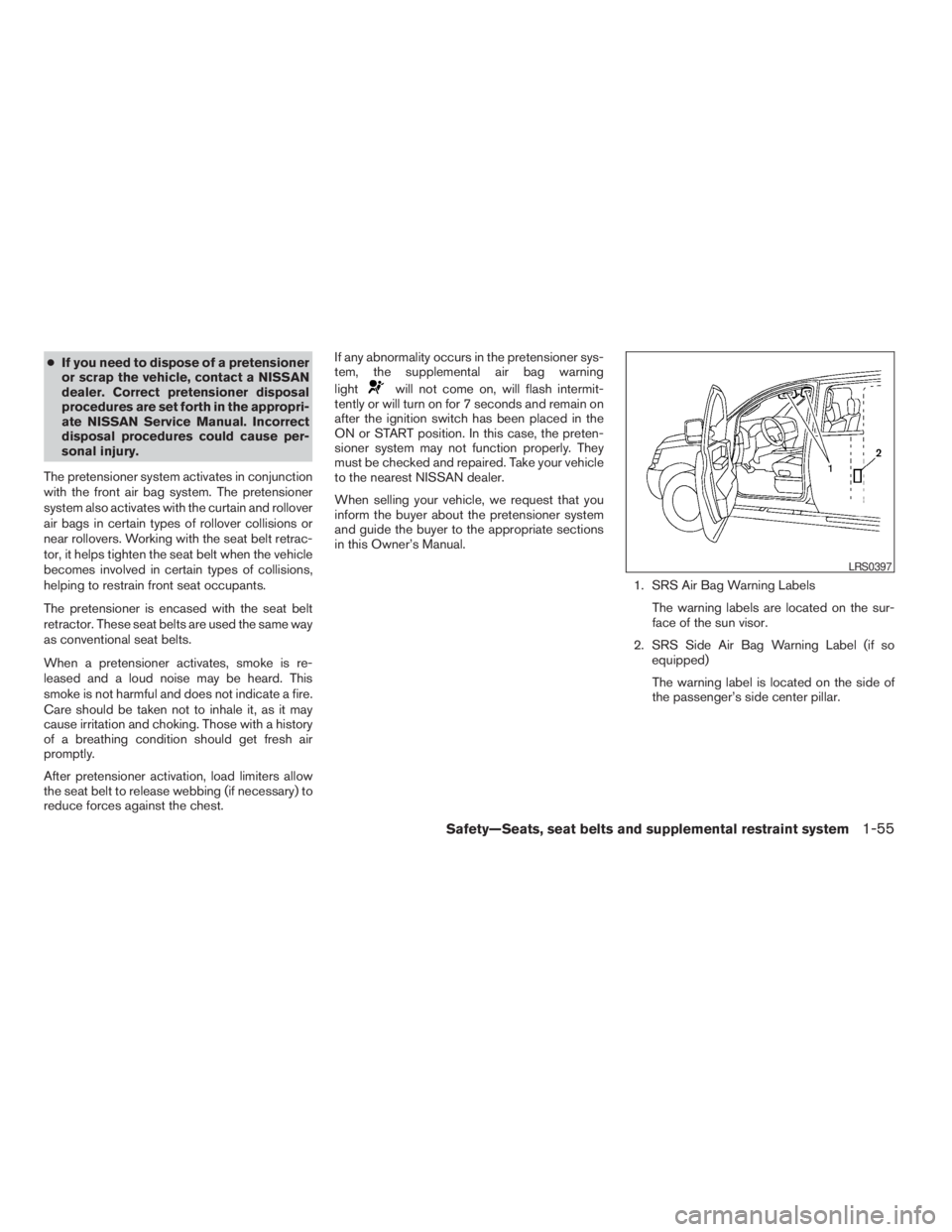
1. SRS Air Bag Warning Labels
The warning labels are located on the sur-
face of the sun visor.
2. SRS Side Air Bag Warning Label (if so
equipped)
The warning label is located on the side of
the passenger’s side center pillar.
LRS0397
Safety—Seats, seat belts and supplemental restraint system1-55
ZREVIEW COPYÐ2009 Pathfinder(pat)
Owners ManualÐUSA_English(nna)
05/29/08Ðdebbie
X
Page 74 of 471
SUPPLEMENTAL AIR BAG
WARNING LABELS
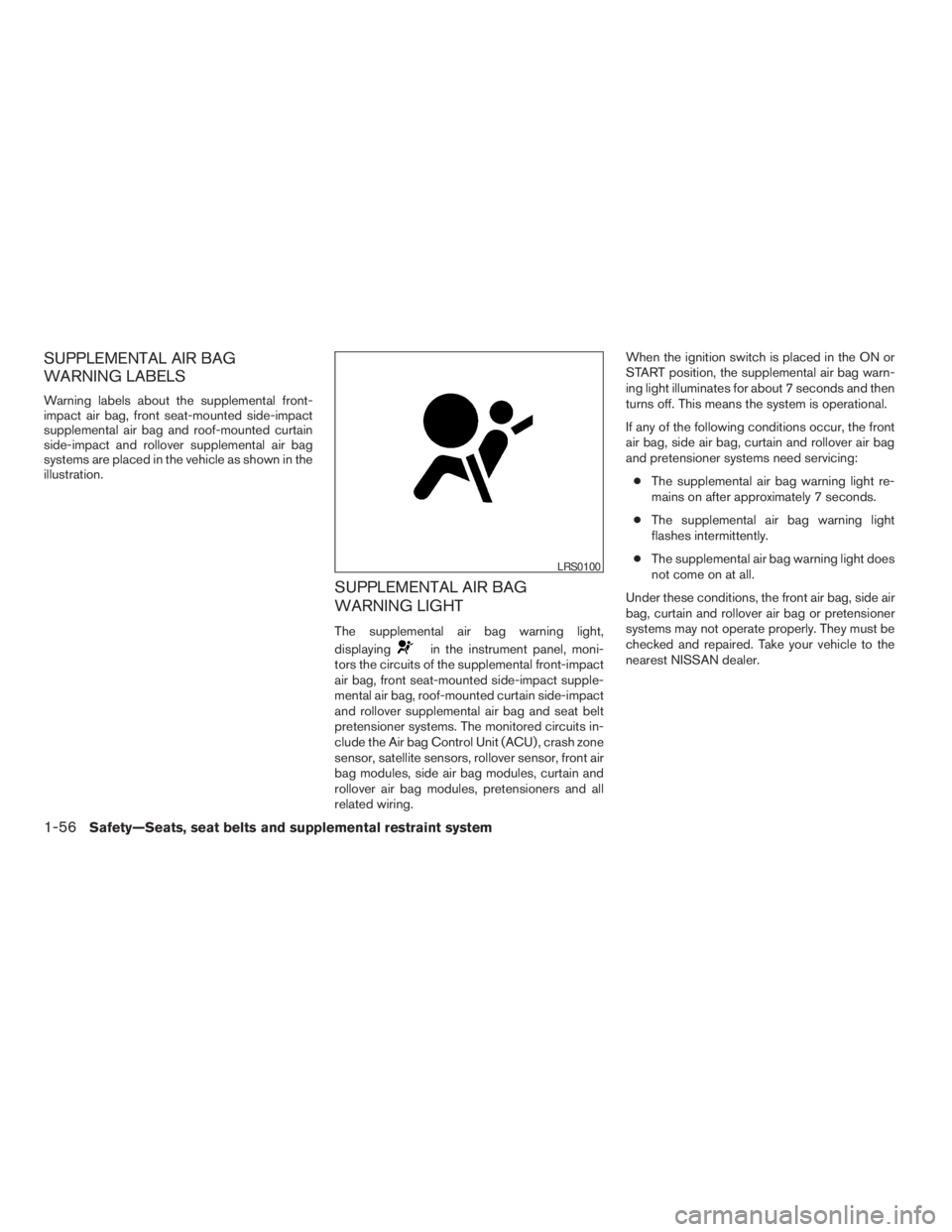
Warning labels about the supplemental front-
impact air bag, front seat-mounted side-impact
supplemental air bag and roof-mounted curtain
side-impact and rollover supplemental air bag
systems are placed in the vehicle as shown in the
illustration.
SUPPLEMENTAL AIR BAG
WARNING LIGHT
The supplemental air bag warning light,
displaying
in the instrument panel, moni-
tors the circuits of the supplemental front-impact
air bag, front seat-mounted side-impact supple-
mental air bag, roof-mounted curtain side-impact
and rollover supplemental air bag and seat belt
pretensioner systems. The monitored circuits in-
clude the Air bag Control Unit (ACU) , crash zone
sensor, satellite sensors, rollover sensor, front air
bag modules, side air bag modules, curtain and
rollover air bag modules, pretensioners and all
related wiring.When the ignition switch is placed in the ON or
START position, the supplemental air bag warn-
ing light illuminates for about 7 seconds and then
turns off. This means the system is operational.
If any of the following conditions occur, the front
air bag, side air bag, curtain and rollover air bag
and pretensioner systems need servicing:
cThe supplemental air bag warning light re-
mains on after approximately 7 seconds.
cThe supplemental air bag warning light
flashes intermittently.
cThe supplemental air bag warning light does
not come on at all.
Under these conditions, the front air bag, side air
bag, curtain and rollover air bag or pretensioner
systems may not operate properly. They must be
checked and repaired. Take your vehicle to the
nearest NISSAN dealer.
LRS0100
1-56Safety—Seats, seat belts and supplemental restraint system
ZREVIEW COPYÐ2009 Pathfinder(pat)
Owners ManualÐUSA_English(nna)
05/29/08Ðdebbie
X
Page 75 of 471
WARNING
If the supplemental air bag warning light
is on, it could mean that the front air bag,
side air bag, curtain and rollover air bag
and/or pretensioner systems will not op-
erate in an accident. To help avoid injury
to yourself or others, have your vehicle
checked by a NISSAN dealer as soon as
possible.
Repair and replacement procedure
The front air bags, side air bags, curtain and
rollover air bags and pretensioners are designed
to inflate on a one-time-only basis. As a reminder,
unless it is damaged, the supplemental air bag
warning light remains illuminated after inflation
has occurred. Repair and replacement of these
supplemental air bag systems should be done
only by a NISSAN dealer.
When maintenance work is required on the ve-
hicle, the front air bags, side air bags, curtain and
rollover air bags, pretensioners and related parts
should be pointed out to the person performing
the maintenance. The ignition switch should al-
ways be in the LOCK position when working
under the hood or inside the vehicle.
WARNING
cOnce a front air bag, side air bag, or
curtain and rollover air bag has inflated,
the air bag module will not function
again and must be replaced. Addition-
ally, if any of the front air bags inflate,
the activated pretensioners must also
be replaced. The air bag module and
pretensioner should be replaced by a
NISSAN dealer. The air bag module and
pretensioner cannot be repaired.
cThe front air bag, side air bag, curtain
and rollover air bag systems and the
pretensioner system should be in-
spected by a NISSAN dealer if there is
any damage to the front end or side
portion of the vehicle.
cIf you need to dispose of a supplemen-
tal air bag or pretensioner or scrap the
vehicle, contact a NISSAN dealer. Cor-
rect supplemental air bag and preten-
sioner system disposal procedures are
set forth in the appropriate NISSAN
Service Manual. Incorrect disposal pro-
cedures could cause personal injury.
Safety—Seats, seat belts and supplemental restraint system1-57
ZREVIEW COPYÐ2009 Pathfinder(pat)
Owners ManualÐUSA_English(nna)
05/29/08Ðdebbie
X
Page 76 of 471
2 Instruments and controls
Instrument panel...................................2-2
Meters and gauges................................2-3
Speedometer and odometer.....................2-4
Trip computer (if so equipped)...................2-5
Tachometer....................................2-6
Engine coolant temperature gauge...............2-6
Fuel gauge....................................2-7
Engine oil pressure gauge.......................2-8
Voltmeter......................................2-8
Compass display (if so equipped)...................2-9
Compass display...............................2-9
Warning/indicator lights and audible reminders......2-13
Checking bulbs...............................2-14
Warning lights................................2-14
Indicator lights................................2-19
Audible reminders.............................2-22
Security systems.................................2-23
Vehicle security system.........................2-23
NISSAN vehicle immobilizer system.............2-24
Windshield wiper and washer switch...............2-26
Switch operation..............................2-26
Rear window wiper and washer switch..............2-27Rear window and outside mirror (if so equipped)
defroster switch..................................2-27
Headlight and turn signal switch....................2-28
Headlight control switch........................2-28
Daytime running light system (Canada only)......2-30
Instrument brightness control...................2-31
Turn signal switch.............................2-31
Fog light switch (if so equipped)................2-32
Hazard warning flasher switch.....................2-32
Horn............................................2-33
Heated steering wheel (if so equipped).............2-33
Heated seat (if so equipped).......................2-34
Vehicle Dynamic Control (VDC) OFF switch.........2-34
Hill descent control switch (if so equipped)..........2-35
Power outlet.....................................2-36
Storage.........................................2-37
Storage trays.................................2-37
Storage bins..................................2-38
2nd row under-seat storage bin.................2-39
Console box..................................2-39
Glove box....................................2-40
Sunglasses holder.............................2-40
ZREVIEW COPYÐ2009 Pathfinder(pat)
Owners ManualÐUSA_English(nna)
05/29/08Ðdebbie
X
Page 78 of 471
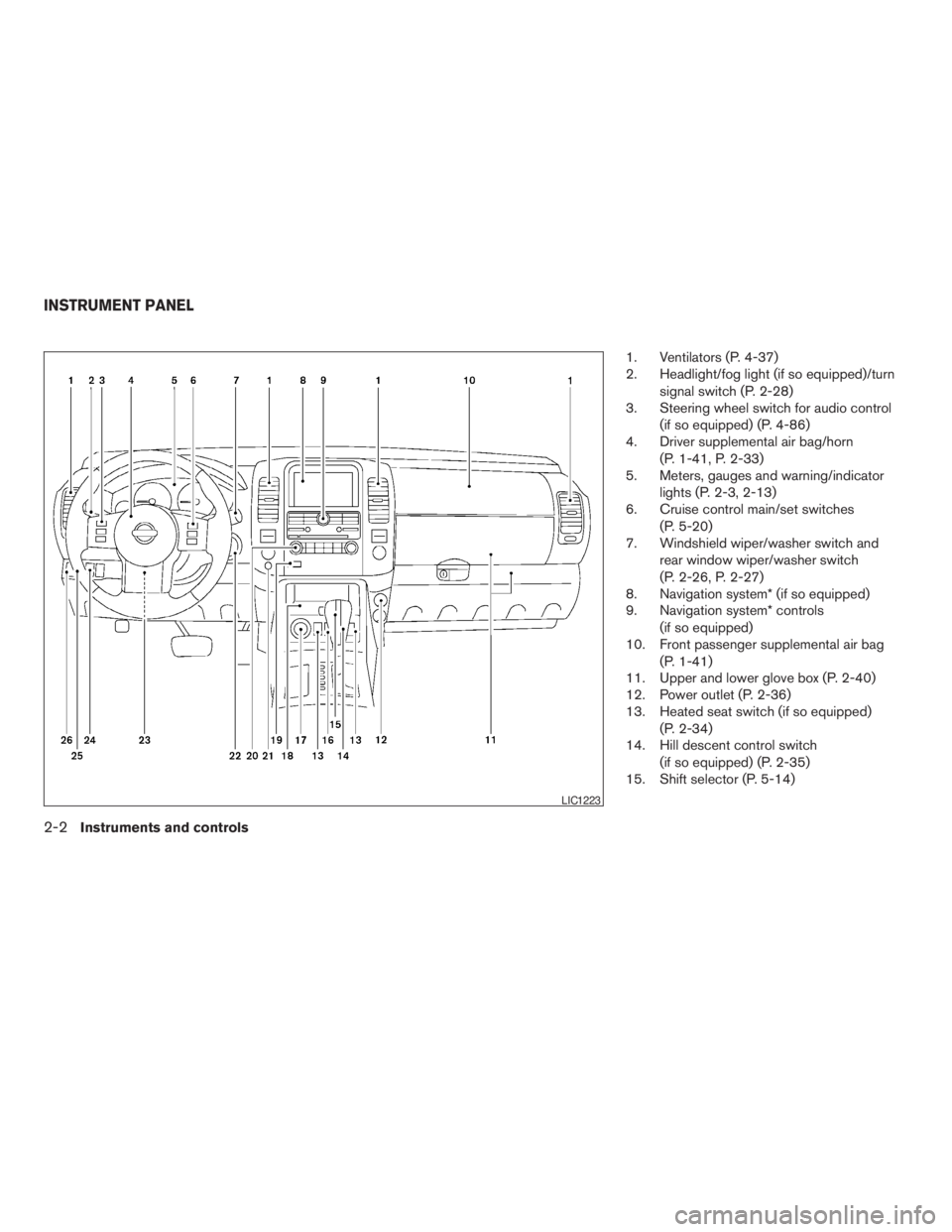
1. Ventilators (P. 4-37)
2. Headlight/fog light (if so equipped)/turn
signal switch (P. 2-28)
3. Steering wheel switch for audio control
(if so equipped) (P. 4-86)
4. Driver supplemental air bag/horn
(P. 1-41, P. 2-33)
5. Meters, gauges and warning/indicator
lights (P. 2-3, 2-13)
6. Cruise control main/set switches
(P. 5-20)
7. Windshield wiper/washer switch and
rear window wiper/washer switch
(P. 2-26, P. 2-27)
8. Navigation system* (if so equipped)
9. Navigation system* controls
(if so equipped)
10. Front passenger supplemental air bag
(P. 1-41)
11. Upper and lower glove box (P. 2-40)
12. Power outlet (P. 2-36)
13. Heated seat switch (if so equipped)
(P. 2-34)
14. Hill descent control switch
(if so equipped) (P. 2-35)
15. Shift selector (P. 5-14)
LIC1223
INSTRUMENT PANEL
2-2Instruments and controls
ZREVIEW COPYÐ2009 Pathfinder(pat)
Owners ManualÐUSA_English(nna)
05/29/08Ðdebbie
X
Page 79 of 471
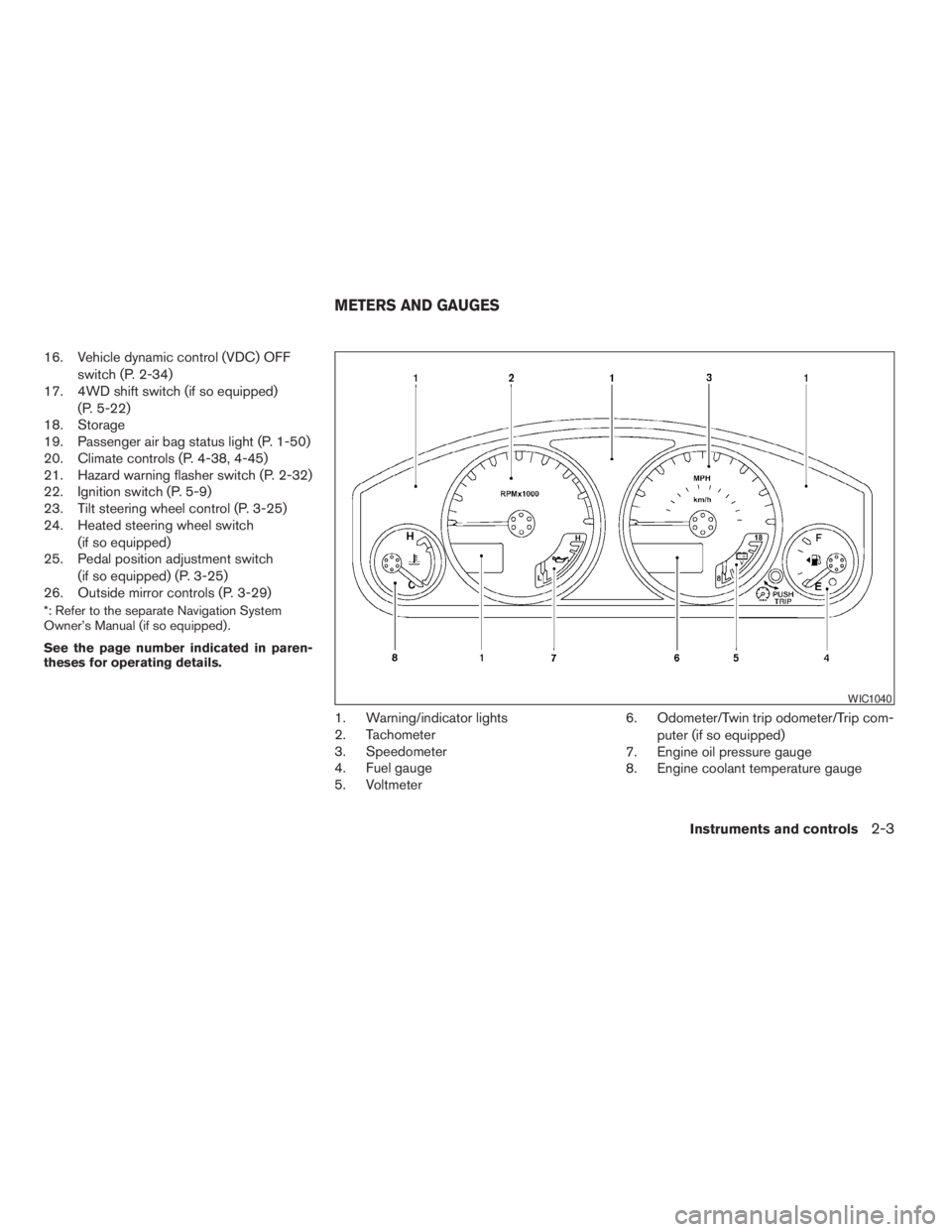
16. Vehicle dynamic control (VDC) OFF
switch (P. 2-34)
17. 4WD shift switch (if so equipped)
(P. 5-22)
18. Storage
19. Passenger air bag status light (P. 1-50)
20. Climate controls (P. 4-38, 4-45)
21. Hazard warning flasher switch (P. 2-32)
22. Ignition switch (P. 5-9)
23. Tilt steering wheel control (P. 3-25)
24. Heated steering wheel switch
(if so equipped)
25. Pedal position adjustment switch
(if so equipped) (P. 3-25)
26. Outside mirror controls (P. 3-29)
*: Refer to the separate Navigation System
Owner’s Manual (if so equipped) .
See the page number indicated in paren-
theses for operating details.
1. Warning/indicator lights
2. Tachometer
3. Speedometer
4. Fuel gauge
5. Voltmeter6. Odometer/Twin trip odometer/Trip com-
puter (if so equipped)
7. Engine oil pressure gauge
8. Engine coolant temperature gauge
WIC1040
METERS AND GAUGES
Instruments and controls2-3
ZREVIEW COPYÐ2009 Pathfinder(pat)
Owners ManualÐUSA_English(nna)
05/29/08Ðdebbie
X