CD player NISSAN PATHFINDER 2017 R52 / 4.G Owner's Manual
[x] Cancel search | Manufacturer: NISSAN, Model Year: 2017, Model line: PATHFINDER, Model: NISSAN PATHFINDER 2017 R52 / 4.GPages: 555, PDF Size: 6.13 MB
Page 352 of 555
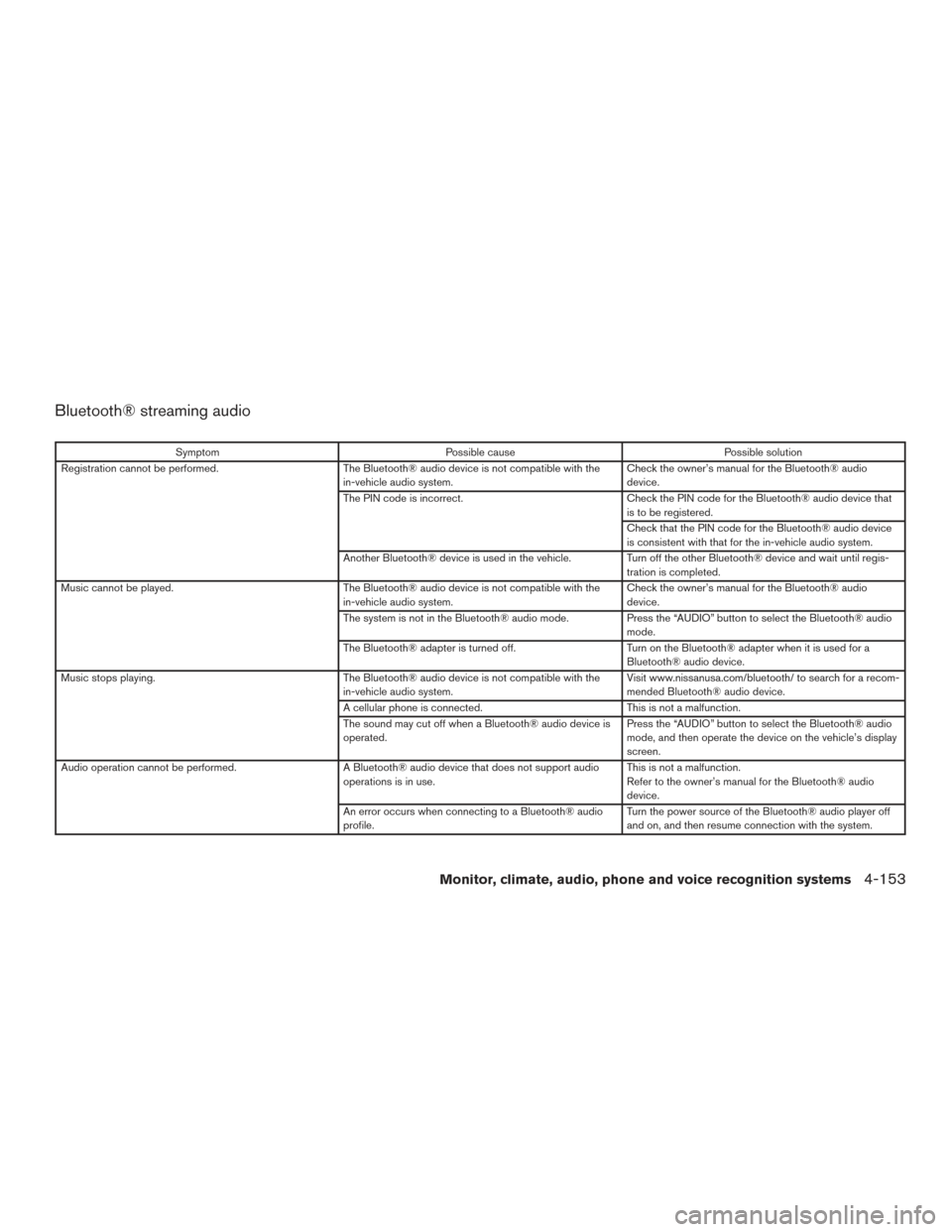
Bluetooth® streaming audio
SymptomPossible cause Possible solution
Registration cannot be performed. The Bluetooth® audio device is not compatible with the
in-vehicle audio system. Check the owner’s manual for the Bluetooth® audio
device.
The PIN code is incorrect. Check the PIN code for the Bluetooth® audio device that
is to be registered.
Check that the PIN code for the Bluetooth® audio device
is consistent with that for the in-vehicle audio system.
Another Bluetooth® device is used in the vehicle. Turn off the other Bluetooth® device and wait until regis-
tration is completed.
Music cannot be played. The Bluetooth® audio device is not compatible with the
in-vehicle audio system. Check the owner’s manual for the Bluetooth® audio
device.
The system is not in the Bluetooth® audio mode. Press the “AUDIO” button to select the Bluetooth® audio
mode.
The Bluetooth® adapter is turned off. Turn on the Bluetooth® adapter when it is used for a
Bluetooth® audio device.
Music stops playing. The Bluetooth® audio device is not compatible with the
in-vehicle audio system. Visit www.nissanusa.com/bluetooth/ to search for a recom-
mended Bluetooth® audio device.
A cellular phone is connected. This is not a malfunction.
The sound may cut off when a Bluetooth® audio device is
operated. Press the “AUDIO” button to select the Bluetooth® audio
mode, and then operate the device on the vehicle’s display
screen.
Audio operation cannot be performed. A Bluetooth® audio device that does not support audio
operations is in use. This is not a malfunction.
Refer to the owner’s manual for the Bluetooth® audio
device.
An error occurs when connecting to a Bluetooth® audio
profile. Turn the power source of the Bluetooth® audio player off
and on, and then resume connection with the system.
Monitor, climate, audio, phone and voice recognition systems4-153
Page 376 of 555
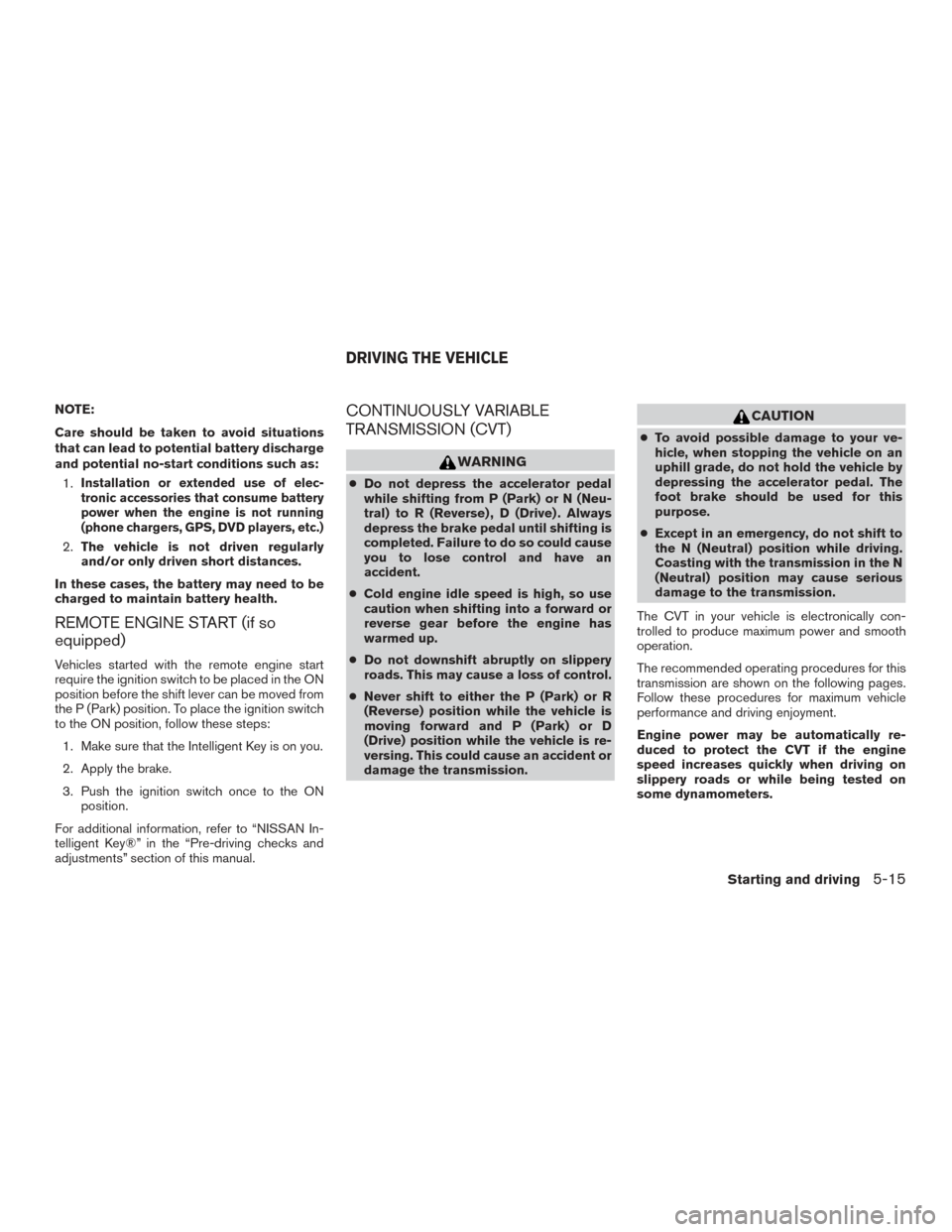
NOTE:
Care should be taken to avoid situations
that can lead to potential battery discharge
and potential no-start conditions such as:1.
Installation or extended use of elec-
tronic accessories that consume battery
power when the engine is not running
(phone chargers, GPS, DVD players, etc.)
2. The vehicle is not driven regularly
and/or only driven short distances.
In these cases, the battery may need to be
charged to maintain battery health.
REMOTE ENGINE START (if so
equipped)
Vehicles started with the remote engine start
require the ignition switch to be placed in the ON
position before the shift lever can be moved from
the P (Park) position. To place the ignition switch
to the ON position, follow these steps: 1. Make sure that the Intelligent Key is on you.
2. Apply the brake.
3. Push the ignition switch once to the ON position.
For additional information, refer to “NISSAN In-
telligent Key®” in the “Pre-driving checks and
adjustments” section of this manual.
CONTINUOUSLY VARIABLE
TRANSMISSION (CVT)
WARNING
● Do not depress the accelerator pedal
while shifting from P (Park) or N (Neu-
tral) to R (Reverse) , D (Drive) . Always
depress the brake pedal until shifting is
completed. Failure to do so could cause
you to lose control and have an
accident.
● Cold engine idle speed is high, so use
caution when shifting into a forward or
reverse gear before the engine has
warmed up.
● Do not downshift abruptly on slippery
roads. This may cause a loss of control.
● Never shift to either the P (Park) or R
(Reverse) position while the vehicle is
moving forward and P (Park) or D
(Drive) position while the vehicle is re-
versing. This could cause an accident or
damage the transmission.
CAUTION
●To avoid possible damage to your ve-
hicle, when stopping the vehicle on an
uphill grade, do not hold the vehicle by
depressing the accelerator pedal. The
foot brake should be used for this
purpose.
● Except in an emergency, do not shift to
the N (Neutral) position while driving.
Coasting with the transmission in the N
(Neutral) position may cause serious
damage to the transmission.
The CVT in your vehicle is electronically con-
trolled to produce maximum power and smooth
operation.
The recommended operating procedures for this
transmission are shown on the following pages.
Follow these procedures for maximum vehicle
performance and driving enjoyment.
Engine power may be automatically re-
duced to protect the CVT if the engine
speed increases quickly when driving on
slippery roads or while being tested on
some dynamometers.
DRIVING THE VEHICLE
Starting and driving5-15
Page 472 of 555
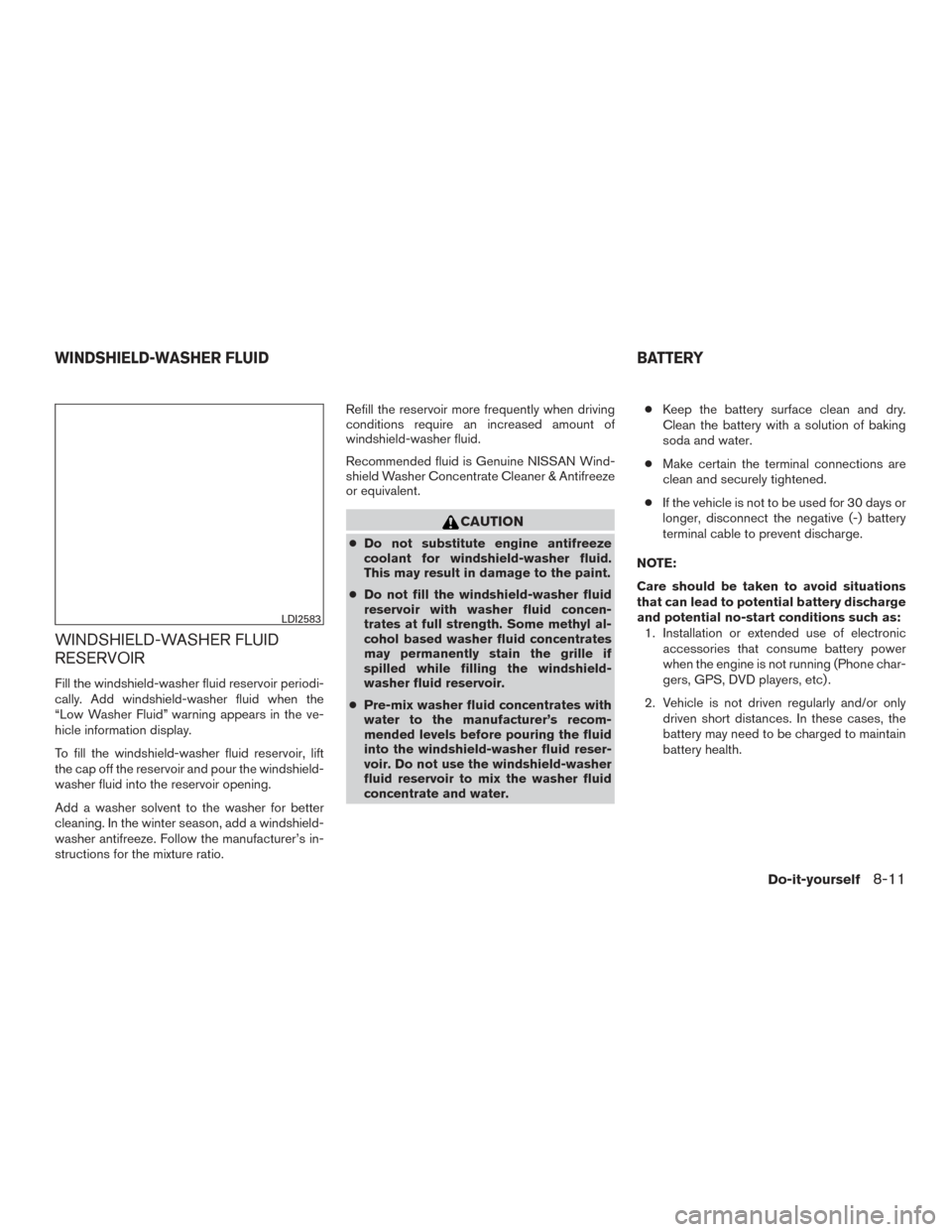
WINDSHIELD-WASHER FLUID
RESERVOIR
Fill the windshield-washer fluid reservoir periodi-
cally. Add windshield-washer fluid when the
“Low Washer Fluid” warning appears in the ve-
hicle information display.
To fill the windshield-washer fluid reservoir, lift
the cap off the reservoir and pour the windshield-
washer fluid into the reservoir opening.
Add a washer solvent to the washer for better
cleaning. In the winter season, add a windshield-
washer antifreeze. Follow the manufacturer’s in-
structions for the mixture ratio.Refill the reservoir more frequently when driving
conditions require an increased amount of
windshield-washer fluid.
Recommended fluid is Genuine NISSAN Wind-
shield Washer Concentrate Cleaner & Antifreeze
or equivalent.
CAUTION
●
Do not substitute engine antifreeze
coolant for windshield-washer fluid.
This may result in damage to the paint.
● Do not fill the windshield-washer fluid
reservoir with washer fluid concen-
trates at full strength. Some methyl al-
cohol based washer fluid concentrates
may permanently stain the grille if
spilled while filling the windshield-
washer fluid reservoir.
● Pre-mix washer fluid concentrates with
water to the manufacturer’s recom-
mended levels before pouring the fluid
into the windshield-washer fluid reser-
voir. Do not use the windshield-washer
fluid reservoir to mix the washer fluid
concentrate and water. ●
Keep the battery surface clean and dry.
Clean the battery with a solution of baking
soda and water.
● Make certain the terminal connections are
clean and securely tightened.
● If the vehicle is not to be used for 30 days or
longer, disconnect the negative (-) battery
terminal cable to prevent discharge.
NOTE:
Care should be taken to avoid situations
that can lead to potential battery discharge
and potential no-start conditions such as: 1. Installation or extended use of electronic accessories that consume battery power
when the engine is not running (Phone char-
gers, GPS, DVD players, etc) .
2. Vehicle is not driven regularly and/or only driven short distances. In these cases, the
battery may need to be charged to maintain
battery health.
LDI2583
WINDSHIELD-WASHER FLUID BATTERY
Do-it-yourself8-11
Page 501 of 555
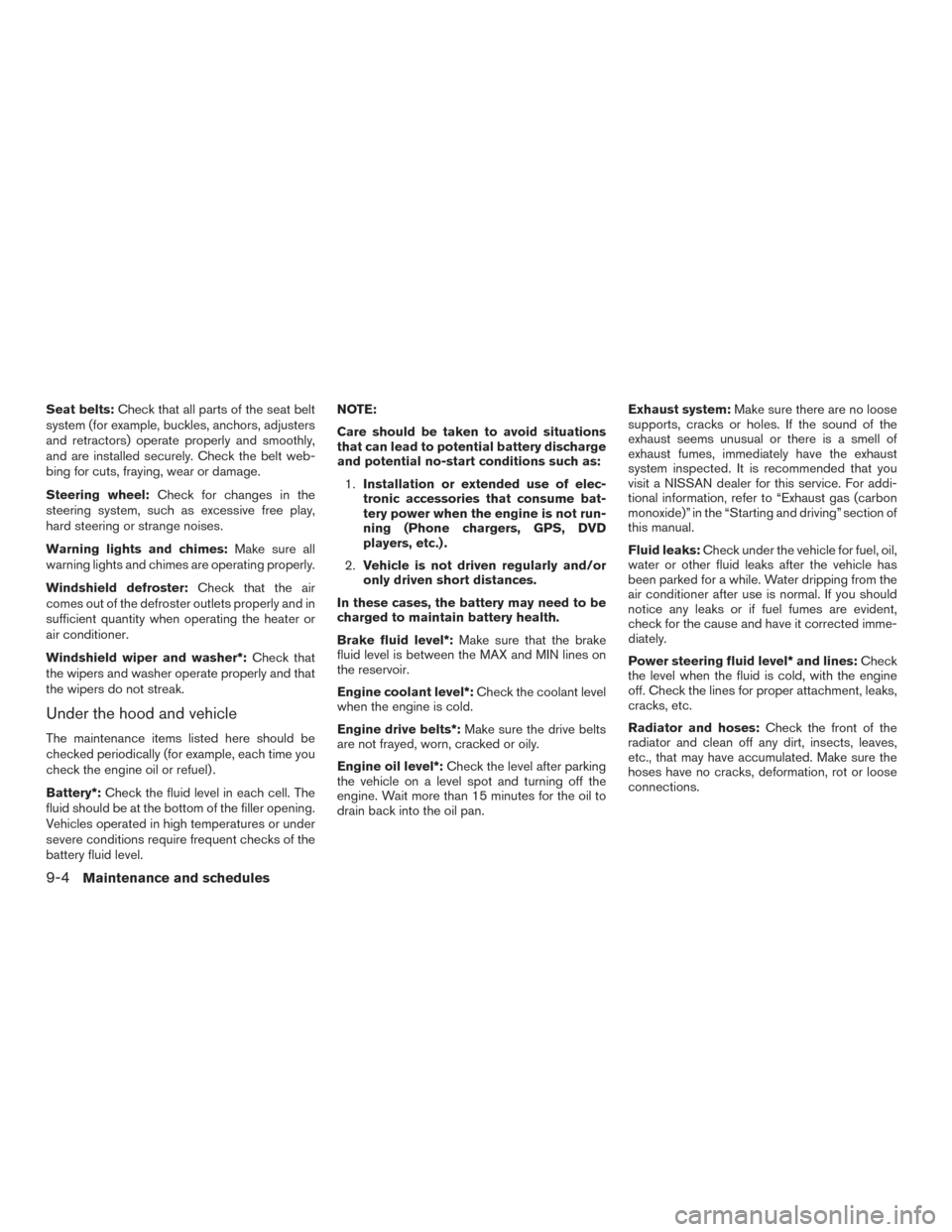
Seat belts:Check that all parts of the seat belt
system (for example, buckles, anchors, adjusters
and retractors) operate properly and smoothly,
and are installed securely. Check the belt web-
bing for cuts, fraying, wear or damage.
Steering wheel: Check for changes in the
steering system, such as excessive free play,
hard steering or strange noises.
Warning lights and chimes: Make sure all
warning lights and chimes are operating properly.
Windshield defroster: Check that the air
comes out of the defroster outlets properly and in
sufficient quantity when operating the heater or
air conditioner.
Windshield wiper and washer*: Check that
the wipers and washer operate properly and that
the wipers do not streak.
Under the hood and vehicle
The maintenance items listed here should be
checked periodically (for example, each time you
check the engine oil or refuel) .
Battery*: Check the fluid level in each cell. The
fluid should be at the bottom of the filler opening.
Vehicles operated in high temperatures or under
severe conditions require frequent checks of the
battery fluid level. NOTE:
Care should be taken to avoid situations
that can lead to potential battery discharge
and potential no-start conditions such as:
1. Installation or extended use of elec-
tronic accessories that consume bat-
tery power when the engine is not run-
ning (Phone chargers, GPS, DVD
players, etc.) .
2. Vehicle is not driven regularly and/or
only driven short distances.
In these cases, the battery may need to be
charged to maintain battery health.
Brake fluid level*: Make sure that the brake
fluid level is between the MAX and MIN lines on
the reservoir.
Engine coolant level*: Check the coolant level
when the engine is cold.
Engine drive belts*: Make sure the drive belts
are not frayed, worn, cracked or oily.
Engine oil level*: Check the level after parking
the vehicle on a level spot and turning off the
engine. Wait more than 15 minutes for the oil to
drain back into the oil pan. Exhaust system:
Make sure there are no loose
supports, cracks or holes. If the sound of the
exhaust seems unusual or there is a smell of
exhaust fumes, immediately have the exhaust
system inspected. It is recommended that you
visit a NISSAN dealer for this service. For addi-
tional information, refer to “Exhaust gas (carbon
monoxide)” in the “Starting and driving” section of
this manual.
Fluid leaks: Check under the vehicle for fuel, oil,
water or other fluid leaks after the vehicle has
been parked for a while. Water dripping from the
air conditioner after use is normal. If you should
notice any leaks or if fuel fumes are evident,
check for the cause and have it corrected imme-
diately.
Power steering fluid level* and lines: Check
the level when the fluid is cold, with the engine
off. Check the lines for proper attachment, leaks,
cracks, etc.
Radiator and hoses: Check the front of the
radiator and clean off any dirt, insects, leaves,
etc., that may have accumulated. Make sure the
hoses have no cracks, deformation, rot or loose
connections.
9-4Maintenance and schedules
Page 546 of 555
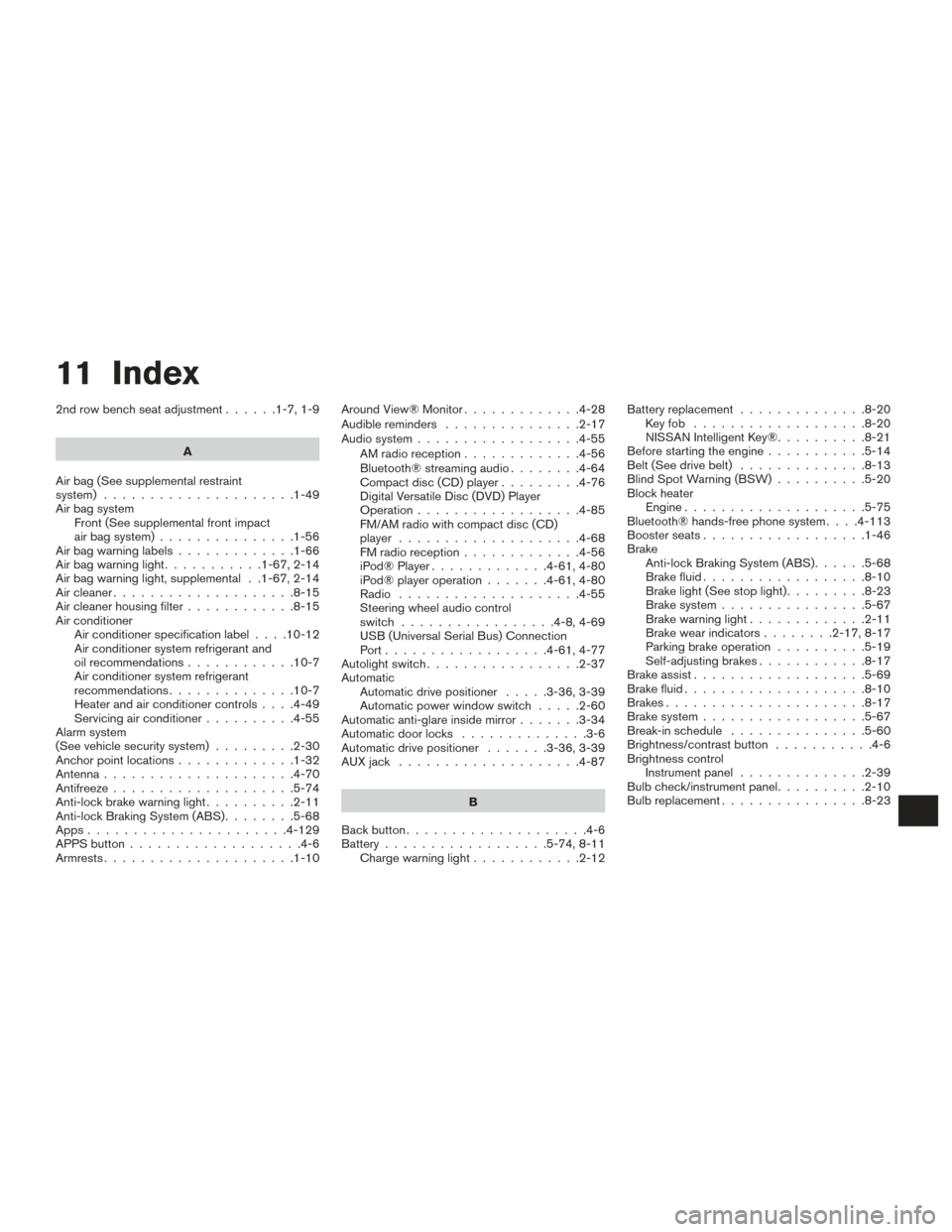
11 Index
2nd row bench seat adjustment......1-7,1-9
A
Air bag (See supplemental restraint
system) .....................1-49
Air bag system Front (See supplemental front impact
air bag system) ...............1-56
Airbagwarninglabels.............1-66
Airbagwarninglight...........1-67,2-14
Air bag warning light, supplemental . .1-67, 2-14
Aircleaner....................8-15
Air cleaner housing filter ............8-15
Air conditioner Air conditioner specification label ....10-12
Air conditioner system refrigerant and
oil recommendations ............10-7
Air conditioner system refrigerant
recommendations ..............10-7
Heater and air conditioner controls ....4-49
Servicing air conditioner ..........4-55
Alarm system
(See vehicle security system) .........2-30
Anchor point locations .............1-32
Antenna .....................4-70
Antifreeze ....................5-74
Anti-lock brake warning light ..........2-11
Anti-lock Braking System (ABS) ........5-68
Apps ......................4-129
APPS button ...................4-6
Armrests.....................1-10 AroundView®Monitor.............4-28
Audible reminders
...............2-17
Audio system ..................4-55
AMradioreception.............4-56
Bluetooth® streaming audio ........4-64
Compact disc (CD) player .........4-76
Digital Versatile Disc (DVD) Player
Operation ..................4-85
FM/AM radio with compact disc (CD)
player ....................4-68
FMradioreception.............4-56
iPod® Player .............4-61,4-80
iPod® player operation .......4-61,4-80
Radio ....................4-55
Steering wheel audio control
switch .................4-8,4-69
USB (Universal Serial Bus) Connection
Port..................4-61,4-77
Autolight switch .................2-37
Automatic Automatic drive positioner .....3-36,3-39
Automatic power window switch .....2-60
Automatic anti-glare inside mirror .......3-34
Automatic door locks ..............3-6
Automatic drive positioner .......3-36,3-39
AUXjack ....................4-87
B
Backbutton....................4-6
Battery ..................5-74,8-11
Chargewarninglight............2-12 Battery replacement
..............8-20
Keyfob ...................8-20
NISSAN Intelligent Key® ..........8-21
Before starting the engine ...........5-14
Belt (See drive belt) ..............8-13
Blind Spot Warning (BSW) ..........5-20
Block heater Engine ....................5-75
Bluetooth® hands-free phone system ....4-113
Boosterseats..................1-46
Brake Anti-lock Braking System (ABS) ......5-68
Brake fluid ..................8-10
Brakelight(Seestoplight).........8-23
Brake system ................5-67
Brakewarninglight.............2-11
Brakewearindicators........2-17,8-17
Parking brake operation ..........5-19
Self-adjusting brakes ............8-17
Brake assist ...................5-69
Brake fluid ....................8-10
Brakes ......................
8
-17
Brake system ..................5-67
Break-inschedule ...............5-60
Brightness/contrast button ...........4-6
Brightness control Instrument panel ..............2-39
Bulb check/instrument panel ..........2-10
Bulbreplacement................8-23
Page 547 of 555
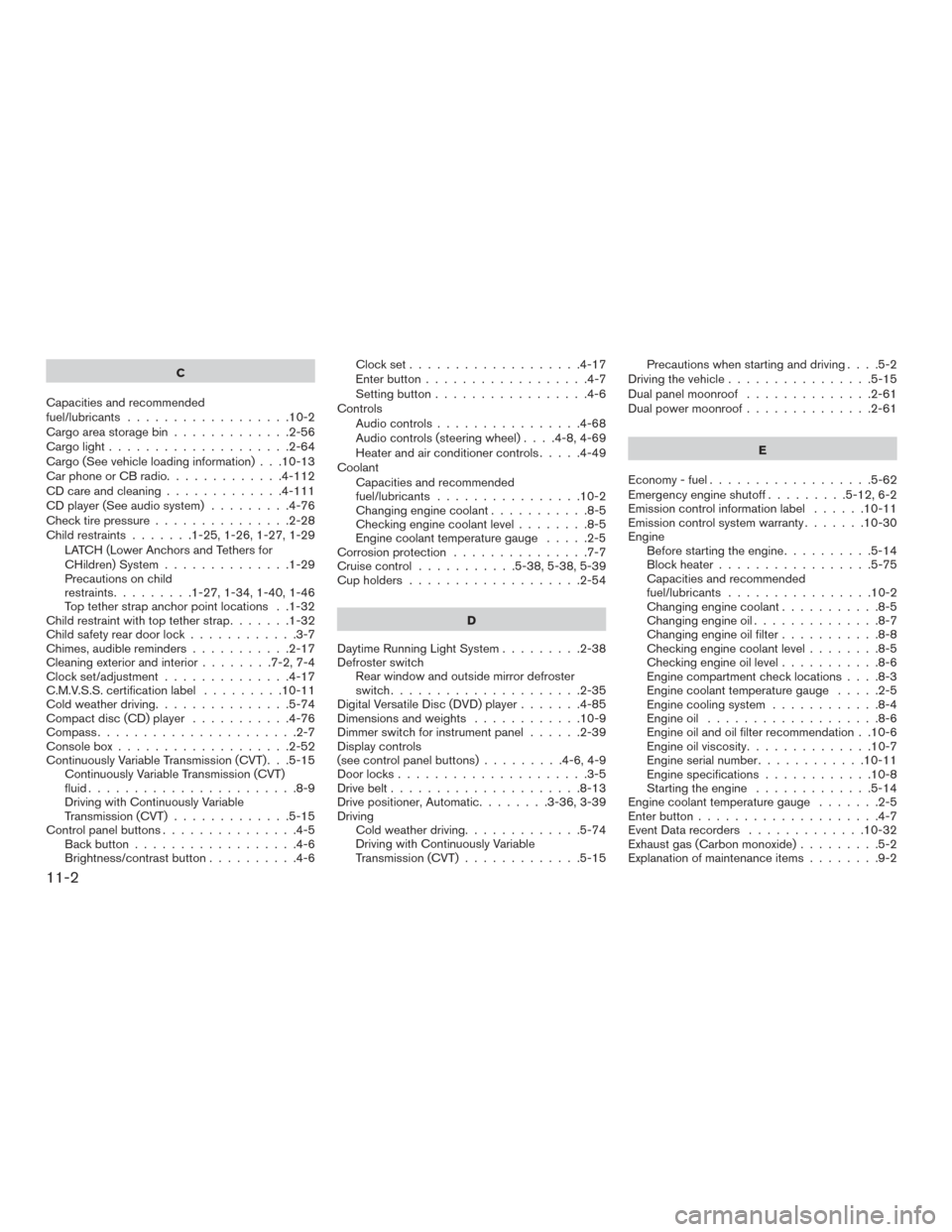
C
Capacities and recommended
fuel/lubricants ..................10-2
Cargoareastoragebin.............2-56
Cargolight....................2-64
Cargo (See vehicle loading information) . . .10-13
Car phone or CB radio .............4-112
CD care and cleaning .............4-111
CD player (See audio system) .........4-76
Check tire pressure ...............2-28
Child restraints .......1-25,1-26,1-27,1-29
LATCH (Lower Anchors and Tethers for
CHildren) System ..............1-29
Precautions on child
restraints.........1-27,1-34,1-40,1-46
Top tether strap anchor point locations . .1-32
Child restraint with top tether strap .......1-32
Child safety rear door lock ............3-7
Chimes, audible reminders ...........2-17
Cleaningexteriorandinterior........7-2,7-4
Clock set/adjustment ..............4-17
C.M.V.S.S. certification label .........10-11
Cold weather driving ...............5-74
Compact disc (CD) player ...........4-76
Compass ......................2-7
Consolebox...................2-52
Continuously Variable Transmission (CVT) . . .5-15 Continuously Variable Transmission (CVT)
fluid .......................8-9
Driving with Continuously Variable
Transmission (CVT) .............5-15
Control panel buttons ...............4-5
Backbutton..................4-6
Brightness/contrast button ..........4-6 Clockset...................4-17
Enterbutton..................4-7
Setting button
.................4-6
Controls Audio controls ................4-68
Audio controls (steering wheel) ....4-8,4-69
Heater and air conditioner controls .....4-49
Coolant Capacities and recommended
fuel/lubricants ................10-2
Changingenginecoolant...........8-5
Checking engine coolant level ........8-5
Engine coolant temperature gauge .....2-5
Corrosion protection ...............7-7
Cruisecontrol ...........5-38,5-38,5-39
Cupholders...................2-54
D
Daytime Running Light System .........2-38
Defroster switch Rear window and outside mirror defroster
switch.....................2-35
Digital Versatile Disc (DVD) player .......4-85
Dimensionsandweights ............10-9
Dimmer switch for instrument panel ......2-39
Display controls
(seecontrolpanelbuttons).........4-6,4-9
Door locks .....................3-5
Drive belt .....................8-13
Drive positioner, Automatic ........3-36,3-39
Driving Cold weather driving .............5-74
Driving with Continuously Variable
Transmission (CVT) .............5-15 Precautions when starting and driving
....5-2
Driving the vehicle ................5-15
Dual panel moonroof ..............2-61
Dual power moonroof ..............2-61
E
Economy-fuel..................5-62
Emergency engine shutoff .........5-12,6-2
Emission control information label ......10-11
Emission control system warranty .......10-30
Engine Before starting the engine ..........
5
-14
Blockheater.................5-75
Capacities and recommended
fuel/lubricants ................10-2
Changing engine coolant ...........8-5
Changingengineoil..............8-7
Changing engine oil filter ...........8-8
Checking engine coolant level ........8-5
Checking engine oil level ...........8-6
Engine compartment check locations ....8-3
Engine coolant temperature gauge .....2-5
Engine cooling system ............8-4
Engineoil ...................8-6
Engine oil and oil filter recommendation . .10-6
Engine oil viscosity ..............10-7
Engine serial number ............10-11
Engine specifications ............10-8
Starting the engine .............5-14
Engine coolant temperature gauge .......2-5
Enter button ....................4-7
Event Data recorders .............10-32
Exhaust gas (Carbon monoxide) .........5-2
Explanation of maintenance items ........9-2
11-2
Page 549 of 555
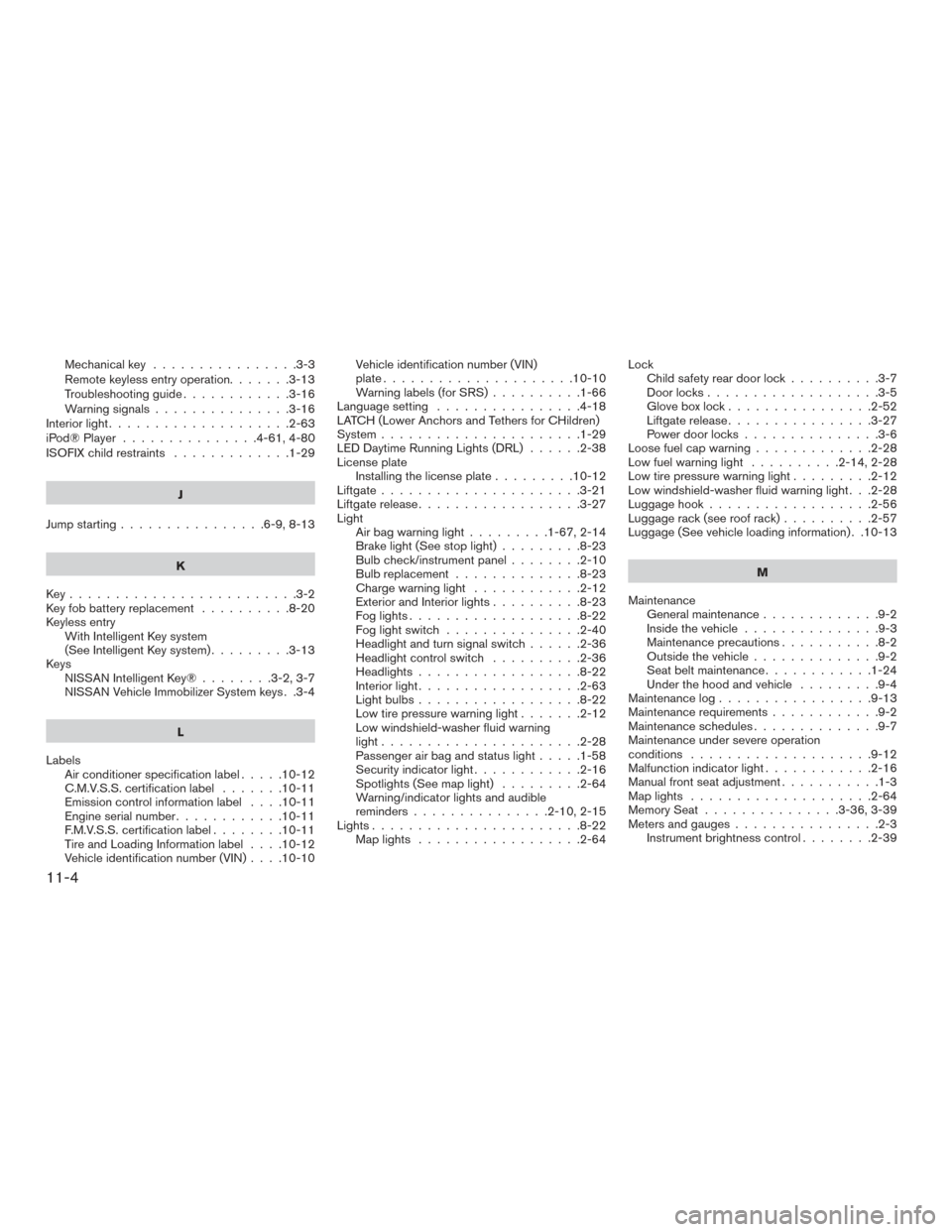
Mechanicalkey ................3-3
Remote keyless entry operation.......3-13
Troubleshooting guide............3-16
Warning signals ...............3-16
Interiorlight....................2-63
iPod®Player ...............4-61,4-80
ISOFIX child restraints .............1-29
J
Jump starting ................6-9,8-13
K
Key.........................3-2
Key fob battery replacement ..........8-20
Keyless entry With Intelligent Key system
(See Intelligent Key system) .........3-13
Keys NISSAN Intelligent Key® ........3-2,3-7
NISSAN Vehicle Immobilizer System keys . .3-4
L
Labels Air conditioner specification label .....10-12
C.M.V.S.S. certification label .......10-11
Emissioncontrolinformationlabel ....10-11
Engine serial number ............10-11
F.M.V.S.S. certification label ........10-11
Tire and Loading Information label ....10-12
Vehicle identification number (VIN) ....10-10Vehicle identification number (VIN)
plate.....................10-10
Warning labels (for SRS)
..........1-66
Language setting ................4-18
LATCH (Lower Anchors and Tethers for CHildren)
System ......................1-29
LED Daytime Running Lights (DRL) ......2-38
License plate Installing the license plate .........10-12
Liftgate ......................3-21
Liftgate release ..................3-27
Light Air bag warning light .........1-67,2-14
Brake light (See stop light) .........8-23
Bulb check/instrument panel ........2-10
Bulbreplacement..............8-23
Charge warning light ............2-12
Exterior and Interior lights ..........8-23
Foglights...................8-22
Foglightswitch ...............2-40
Headlight and turn signal switch ......2-36
Headlight control switch ..........2-36
Headlights..................8-22
Interiorlight..................2-63
Lightbulbs..................8-22
Low tire pressure warning light .......2-12
Low windshield-washer fluid warning
light......................2-28
Passenger air bag and status light .....1-58
Security indicator light ............2-16
Spotlights(Seemaplight) .........2-64
Warning/indicator lights and audible
reminders ...............2-10,2-15
Lights.......................8-22 Maplights ..................2-64 Lock
Child safety rear door lock ..........3-7
Door locks ...................3-5
Gloveboxlock................2-52
Liftgate release ................3-27
Power door locks ...............3-6
Loose fuel cap warning .............2-28
Low fuel warning light ..........2-14,2-28
Low tire pressure warning light .........2-12
Low windshield-washer fluid warning light . . .2-28
Luggage hook ..................2-56
Luggage rack (see roof rack) ..........2-57
Luggage (See vehicle loading information) . .10-13
M
Maintenance General maintenance .............
9-2
Insidethevehicle...............9-3
Maintenance precautions ...........8-2
Outside the vehicle ..............9-2
Seat belt maintenance ............1-24
Under the hood and vehicle .........9-4
Maintenancelog.................9-13
Maintenance requirements ............9-2
Maintenance schedules ..............9-7
Maintenance under severe operation
conditions ....................9-12
Malfunction indicator light ............2-16
Manual front seat adjustment ...........1-3
Maplights ....................2-64
Memory Seat ...............3-36,3-39
Meters and gauges ................2-3
Instrument brightness control ........2-39
11-4
Page 550 of 555
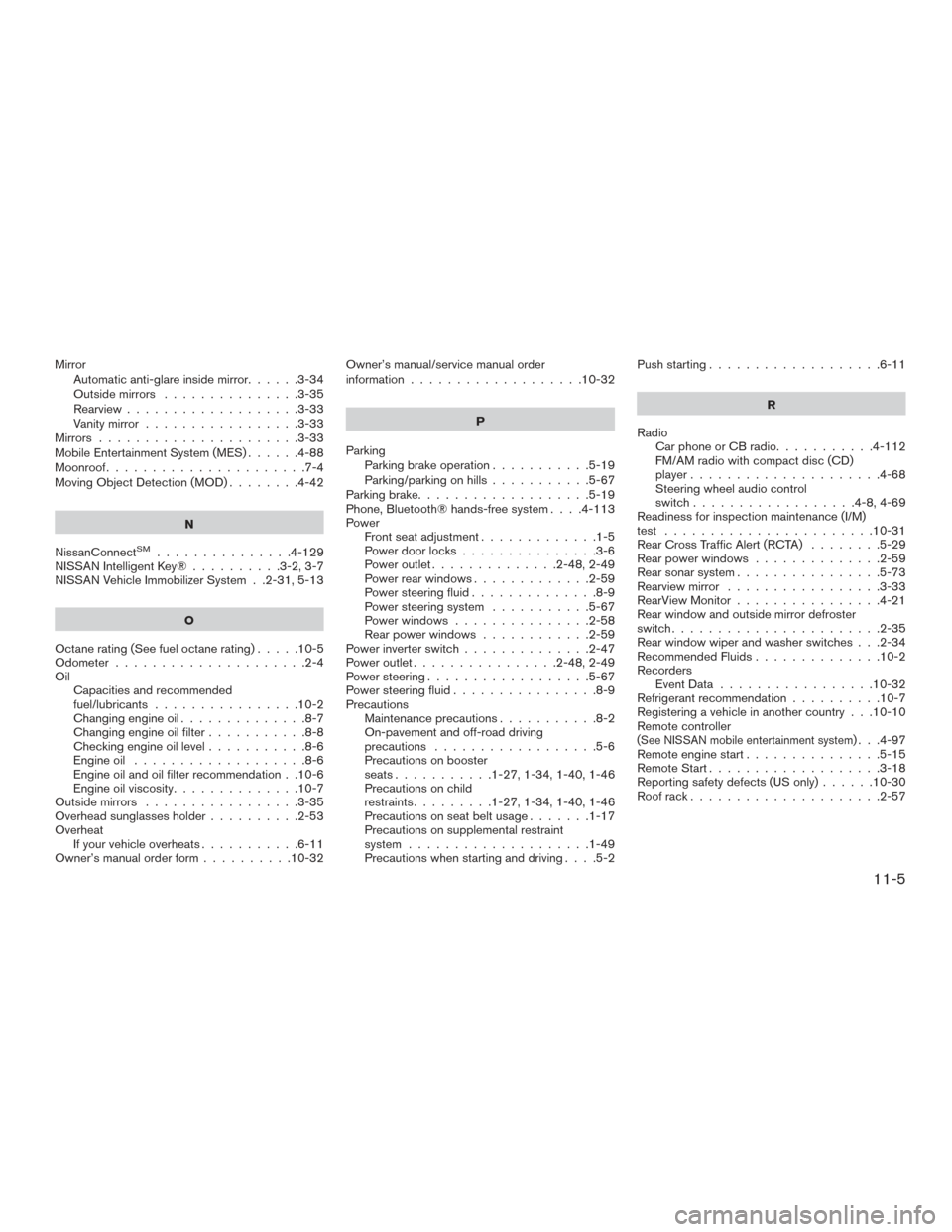
MirrorAutomatic anti-glare inside mirror ......3-34
Outside mirrors ...............3-35
Rearview ...................3-33
Vanity mirror .................3-33
Mirrors ......................3-33
Mobile Entertainment System (MES) ......4-88
Moonroof ......................7-4
Moving Object Detection (MOD) ........4-42
N
NissanConnect
SM...............4-129
NISSAN Intelligent Key® ..........3-2,3-7
NISSAN Vehicle Immobilizer System . .2-31, 5-13
O
Octanerating(Seefueloctanerating).....10-5
Odometer .....................2-4
Oil Capacities and recommended
fuel/lubricants ................10-2
Changing engine oil ..............8-7
Changing engine oil filter ...........8-8
Checking engine oil level ...........8-6
Engine oil ...................8-6
Engine oil and oil filter recommendation . .10-6
Engine oil viscosity ..............10-7
Outside mirrors .................3-35
Overhead sunglasses holder ..........2-53
Overheat Ifyourvehicleoverheats...........6-11
Owner’s manual order form ..........10-32Owner’s manual/service manual order
information
...................10-32
P
Parking Parking brake operation ...........5-19
Parking/parking on hills ...........5-67
Parking brake ...................5-19
Phone, Bluetooth® hands-free system ....4-113
Power Front seat adjustment .............1-5
Power door locks ...............3-6
Power outlet ..............2-48,2-49
Power rear windows .............2-59
Power steering fluid ..............8-9
Power steering system ...........5-67
Power windows ...............2-58
Rear power windows ............2-59
Power inverter switch ..............2-47
Power outlet ................2-48,2-49
Power steering ..................5-67
Power steering fluid ................8-9
Precautions Maintenance precautions ...........8-2
On-pavement and off-road driving
precautions ..................5-6
Precautions on booster
seats...........1-27,1-34,1-40,1-46
Precautions on child
restraints .........1-27,1-34,1-40,1-46
Precautions on seat belt usage .......1-17
Precautions on supplemental restraint
system ....................1-49
Precautions when starting and driving ....5-2Push starting
...................6-11
R
Radio CarphoneorCBradio...........4-112
FM/AM radio with compact disc (CD)
player .....................4-68
Steering wheel audio control
switch..................4-8,4-69
Readiness for inspection maintenance (I/M)
test .......................10-31
Rear Cross Traffic Alert (RCTA) ........5-29
Rear power windows ..............2-59
Rear sonar system ................5-73
Rearview mirror .................3-33
RearView Monitor ................4-21
Rear window and outside mirror defroster
switch.......................2-35
Rear window
wiper and washer switches . . .2-34
Recommended Fluids ..............10-2
Recorders EventData .................10-32
Refrigerant recommendation ..........10-7
Registering a vehicle in another country . . .10-10
Remote controller
(See NISSAN mobile entertainment system). . .4-97
Remote engine start ...............5-15
Remote Start ...................3-18
Reporting safety defects (US only) ......10-30
Roof rack .....................2-57
11-5