engine NISSAN PATHFINDER 2018 Owner´s Manual
[x] Cancel search | Manufacturer: NISSAN, Model Year: 2018, Model line: PATHFINDER, Model: NISSAN PATHFINDER 2018Pages: 474, PDF Size: 5.51 MB
Page 441 of 474
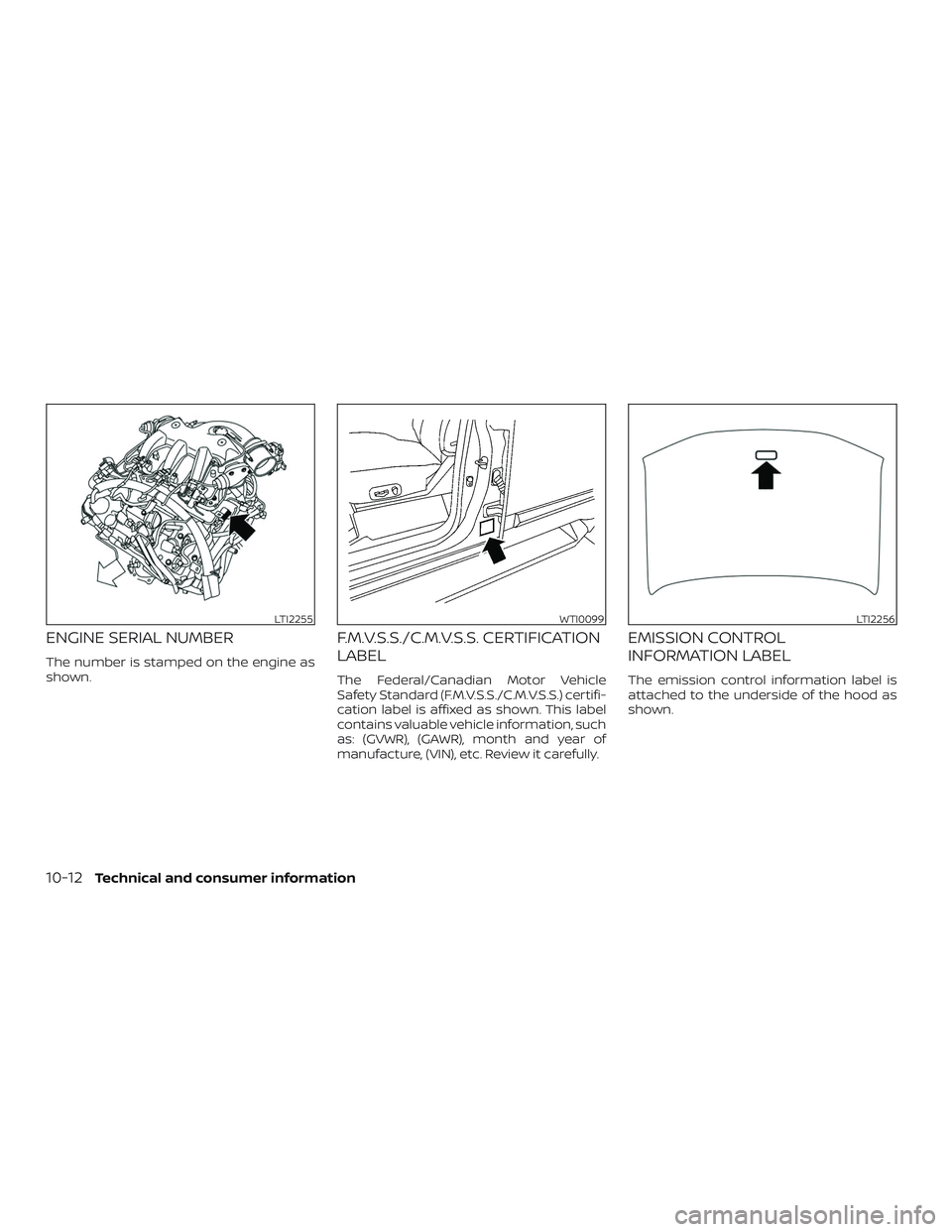
ENGINE SERIAL NUMBER
The number is stamped on the engine as
shown.
F.M.V.S.S./C.M.V.S.S. CERTIFICATION
LABEL
The Federal/Canadian Motor Vehicle
Safety Standard (F.M.V.S.S./C.M.V.S.S.) certifi-
cation label is affixed as shown. This label
contains valuable vehicle information, such
as: (GVWR), (GAWR), month and year of
manufacture, (VIN), etc. Review it carefully.
EMISSION CONTROL
INFORMATION LABEL
The emission control information label is
attached to the underside of the hood as
shown.
LTI2255WTI0099LTI2256
10-12Technical and consumer information
Page 447 of 474
WARNING
Overloading or improper loading of a
trailer and its cargo can adversely affect
vehicle handling, braking and perfor-
mance and may lead to accidents.
CAUTION
∙ Do not tow a trailer or haul a heavyload for the first 500 miles (805 km).
Your engine, axle or other parts could
be damaged.
∙ For the first 500 miles (805 km) that you tow a trailer, do not drive over
50 mph (80 km/h) and do not make
starts at full throttle. This helps the
engine and other parts of your vehicle
wear in at the heavier loads.
Your new vehicle was designed to be used
primarily to carry passengers and cargo.
Remember that towing a trailer places ad-
ditional loads on your vehicle’s engine,
drive train, steering, braking and other sys-
tems. A NISSAN Towing Guide (U.S. only) is avail-
able on the website at
www.nissanusa.com.
This guide includes
information on trailer towing capability and
the special equipment required for proper
towing.
MAXIMUM LOAD LIMITS
Maximum trailer loads
Never allow the total trailer load to exceed
the value specified in the following Towing
Load/Specification Chart found in this sec-
tion. The total trailer load equals trailer
weight plus its cargo weight.
∙ When towing a trailer load of
3,500 lbs. (1,587 kg) or more, trailers
with a brake system MUST be used.
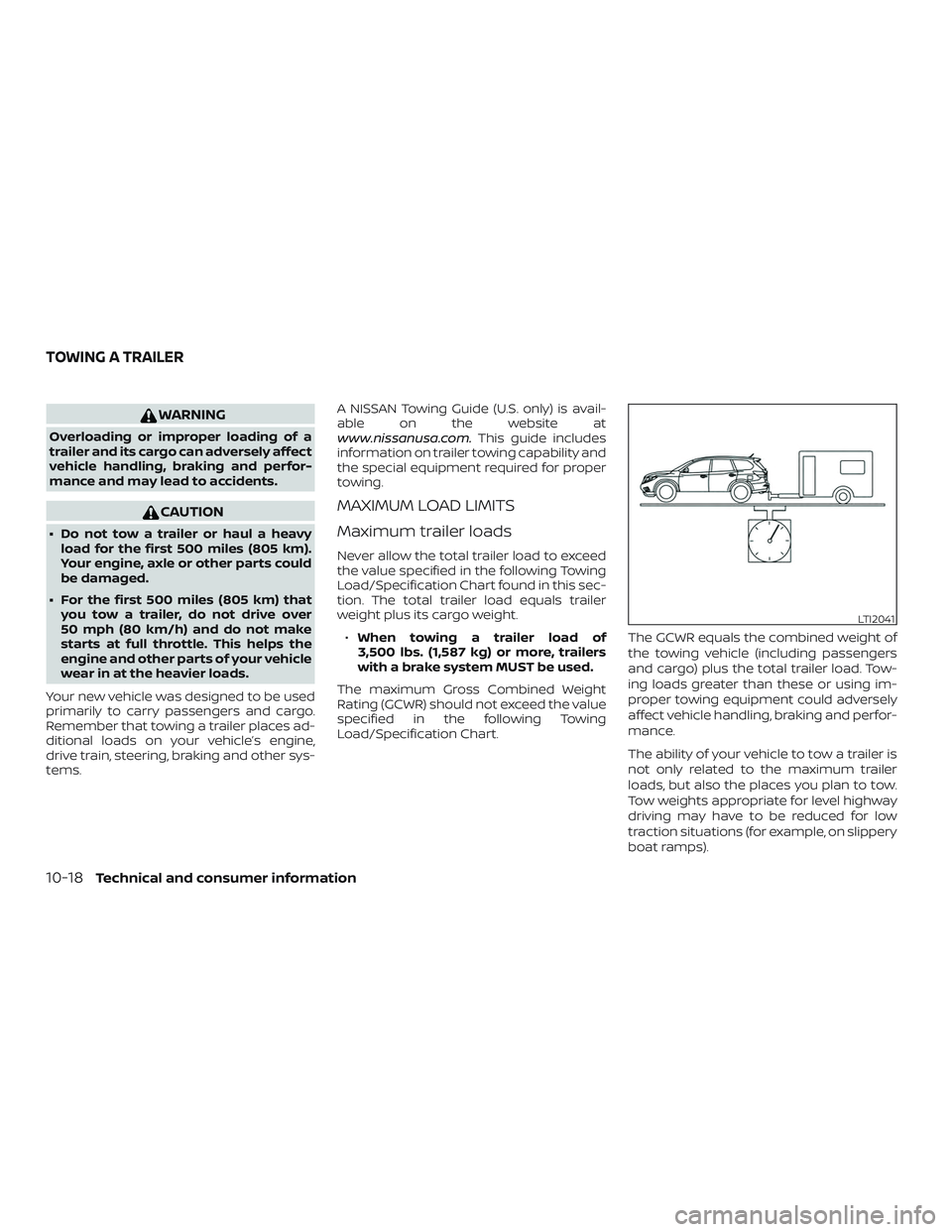
The maximum Gross Combined Weight
Rating (GCWR) should not exceed the value
specified in the following Towing
Load/Specification Chart. The GCWR equals the combined weight of
the towing vehicle (including passengers
and cargo) plus the total trailer load. Tow-
ing loads greater than these or using im-
proper towing equipment could adversely
affect vehicle handling, braking and perfor-
mance.
The ability of your vehicle to tow a trailer is
not only related to the maximum trailer
loads, but also the places you plan to tow.
Tow weights appropriate for level highway
driving may have to be reduced for low
traction situations (for example, on slippery
boat ramps).
LTI2041
TOWING A TRAILER
10-18Technical and consumer information
Page 448 of 474
Temperature conditions can also affect
towing. For example, towing a heavy trailer
in high outside temperatures on graded
roads can affect engine performance and
cause overheating. The engine protection
mode, which helps reduce the chance of
engine damage, could activate and auto-
matically decrease engine power. Vehicle
speed may decrease under high load. Plan
your trip carefully to account for trailer and
vehicle load, weather and road conditions.
WARNING
Overheating can result in reduced en-
gine power and vehicle speed. The re-
duced speed may be lower than other
traffic, which could increase the chance
of a collision. Be especially careful when
driving. If the vehicle cannot maintain a
safe driving speed, pull to the side of the
road in a safe area. Allow the engine to
cool and return to normal operation. For
additional information, refer to “If your
vehicle overheats” in the “In case of
emergency ” section of this manual.
CAUTION
Vehicle damage resulting from im-
proper towing procedures is not cov-
ered by NISSAN warranties.
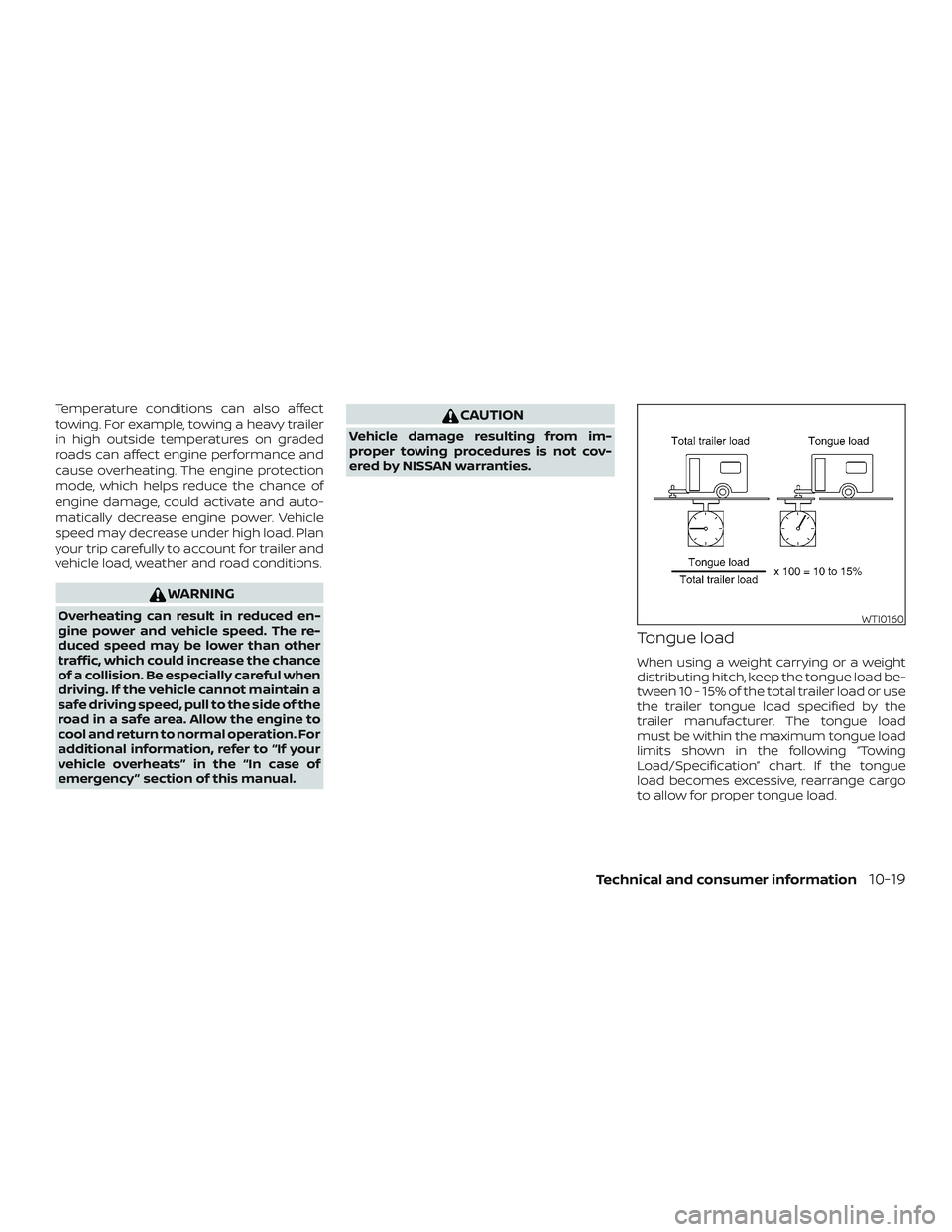
Tongue load
When using a weight carrying or a weight
distributing hitch, keep the tongue load be-
tween 10 - 15% of the total trailer load or use
the trailer tongue load specified by the
trailer manufacturer. The tongue load
must be within the maximum tongue load
limits shown in the following “Towing
Load/Specification” chart. If the tongue
load becomes excessive, rearrange cargo
to allow for proper tongue load.
WTI0160
Technical and consumer information10-19
Page 457 of 474
Pre-towing tips
∙ Be certain your vehicle maintains a levelposition when a loaded and/or un-
loaded trailer is hitched. Do not drive the
vehicle if it has an abnormal nose-up or
nose-down condition; check for im-
proper tongue load, overload, worn sus-
pension or other possible causes of ei-
ther condition.
∙ Always secure items in the trailer to pre- vent load shif t while driving.
∙ Keep the cargo load as low as possible in the trailer to keep the trailer center of
gravity low.
∙ Load the trailer so approximately 60% of the trailer load is in the front half and
40% is in the back half. Also make sure
the load is balanced side to side.
∙ Check your hitch, trailer tire pressure, vehicle tire pressure, trailer light opera-
tion, and trailer wheel lug nuts every
time you attach a trailer to the vehicle.
∙ Be certain your rearview mirrors con- form to all federal, state or local regula-
tions. If not, install any mirrors required
for towing before driving the vehicle. ∙ Determine the overall height of the ve-
hicle and trailer so the required clear-
ance is known.
Trailer towing tips
In order to gain skill and an understanding
of the vehicle’s behavior, you should prac-
tice turning, stopping and backing up in an
area which is free from traffic. Steering sta-
bility and braking performance will be
somewhat different than under normal
driving conditions.
∙ Always secure items in the trailer to pre- vent load shif t while driving.
∙ Lock the trailer hitch coupler with a pin or lock to prevent the coupler from in-
advertently becoming unlatched.
∙ Avoid abrupt starts, acceleration or stops.
∙ Avoid sharp turns or lane changes.
∙ Always drive your vehicle at a moderate speed. ∙ When backing up, hold the bottom of
the steering wheel with one hand. Move
your hand in the direction in which you
want the trailer to go. Make small cor-
rections and back up slowly. If possible,
have someone guide you when you are
backing up.
Always block the wheels on both vehicle
and trailer when parking. Parking on a
slope is not recommended; however, if you
must do so:
CAUTION
If you move the shif t lever to the P (Park)
position before blocking the wheels
and applying the parking brake, trans-
mission damage could occur.
1. Apply and hold the brake pedal.
2. Have someone place blocks on the downhill side of the vehicle and trailer
wheels.
3. Af ter the wheel blocks are in place, slowly release the brake pedal until the
blocks absorb the vehicle load.
4. Apply the parking brake.
5. Shif t the transmission into P (Park).
6. Turn off the engine.
10-28Technical and consumer information
Page 458 of 474
To drive away:1. Start the vehicle.
2. Apply and hold the brake pedal.
3. Shif t the transmission into gear.
4. Release the parking brake.
5. Drive slowly until the vehicle and trailer are clear from the blocks.
6. Apply and hold the brake pedal.
7. Have someone retrieve and store the blocks.
∙ While going downhill, the weight of the trailer pushing on the tow vehicle may
decrease overall stability. Therefore, to
maintain adequate control, reduce your
speed and shif t to a lower gear. Avoid
long or repeated use of the brakes
when descending a hill, as this reduces
their effectiveness and could cause
overheating. Shif ting to a lower gear in-
stead provides “engine braking” and re-
duces the need to brake as frequently.
∙ If the engine coolant temperature rises to a high temperature, refer to “If your
vehicle overheats” in the “In case of
emergency” section of this manual. ∙ Trailer towing requires more fuel than
normal circumstances.
∙ Avoid towing a trailer for your vehicle’s first 500 miles (805 km).
∙ For the first 500 miles (805 km) that you do tow, do not drive over 50 mph
(80 km/h).
∙ Have your vehicle serviced more of ten than at intervals specified in the recom-
mended Maintenance Schedule in the
“Maintenance and schedules” section of
this manual.
∙ When making a turn, your trailer wheels will be closer to the inside of the turn
than your vehicle wheels. To compen-
sate for this, make a larger than normal
turning radius during the turn.
∙ Crosswinds and rough roads will ad- versely affect vehicle/trailer handling,
possibly causing vehicle sway. When
being passed by larger vehicles, be pre-
pared for possible changes in cross-
winds that could affect vehicle han-
dling. Do the following if the trailer begins to
sway:
1. Take your foot off the accelerator pedal to allow the vehicle to coast and steer
as straight ahead as the road condi-
tions allow. This combination will help
stabilize the vehicle.
– Do not correct trailer sway by steer- ing or applying the brakes.
2. When the trailer sway stops, gently ap- ply the brakes and pull to the side of the
road in a safe area.
3. Try to rearrange the trailer load so it is balanced. For additional information,
refer to “Pre-towing tips” in this section.
∙
Be careful when passing other vehicles.
Passing while towing a trailer requires
considerably more distance than normal
passing. Remember, the length of the
trailer must also pass the other vehicle
before you can safely change lanes.
∙ Use the Tow Mode or downshif t the transmission to a lower gear for engine
braking when driving down steep or
long hills. This will help slow the vehicle
without applying the brakes.
Technical and consumer information10-29
Page 459 of 474
∙ Avoid holding the brake pedal down toolong or too frequently. This could cause
the brakes to overheat, resulting in re-
duced braking efficiency.
∙ Increase your following distance to al- low for greater stopping distances
while towing a trailer. Anticipate stops
and brake gradually.
∙ NISSAN recommends that the cruise control not be used while towing a
trailer.
∙ Some states or provinces have specific regulations and speed limits for ve-
hicles that are towing trailers. Obey the
local speed limits.
∙ Check your hitch, trailer wiring harness connections, and trailer wheel lug nuts
af ter 50 miles (80 km) of travel and at
every break.
∙ When launching a boat, don’t allow the water level to go over the exhaust tail
pipe or rear bumper.
∙ Make sure you disconnect the trailer lights before backing the trailer into the
water or the trailer lights may burn out. When towing a trailer, final drive gear oil
should be replaced and transmission
oil/fluid should be changed more fre-
quently. For additional information, refer
to the “Do-it-yourself ” section in this
manual.
Tow mode
Using tow mode is recommended when
pulling a heavy trailer or hauling a heavy
load. Press the TOW MODE switch to acti-
vate tow mode. The indicator light on the
TOW MODE switch illuminates when tow
mode is selected. Press the TOW MODE
switch again to turn tow mode off. Tow
mode is automatically canceled when the
ignition switch is turned off.
Tow mode includes the following features:
∙ Grade logic — Adjusts transmission shif ts when pulling a trailer or hauling a
load up a grade.
∙ Downhill Speed Control (DSC) — auto- matically downshif ts when driving
down a grade with a trailer or heavy
load to help control vehicle speed. Driving the vehicle in the tow mode with no
trailer/load or light trailer/light load will not
cause any damage. However, fuel
economy may be reduced and the
transmission/engine driving characteris-
tics may feel unusual.
When towing a trailer, final drive gear oil
should be replaced and transmission
oil/fluid should be changed more fre-
quently. For additional information, refer
to the “Do-it-yourself ” section of this
manual.
FLAT TOWING FOR 4–WHEEL DRIVE
VEHICLE (if so equipped)
Towing your vehicle with all four wheels on
the ground is sometimes called flat towing.
This method is sometimes used when
towing a vehicle behind a recreational ve-
hicle, such as a motor home.
10-30Technical and consumer information
Page 464 of 474
If a powertrain system component is re-
paired or the battery is disconnected, the
vehicle may be reset to a “not ready” condi-
tion. Before taking the I/M test, check the
vehicle’s inspection/maintenance test
readiness condition. Place the ignition
switch in the ON position without starting
the engine. If the Malfunction Indicator
Light (MIL) comes on steady for 20 seconds
and then blinks for 10 seconds, the I/M test
condition is “not ready”. If the MIL does not
blink af ter 20 seconds, the I/M test condi-
tion is “ready”. It is recommended that you
visit a NISSAN dealer to set the “ready con-
dition” or to prepare the vehicle for testing.This vehicle is equipped with an Event Data
Recorder (EDR). The main purpose of an
EDR is to record, in certain crash or near
crash-like situations, such as an air bag
deployment or hitting a road obstacle, data
that will assist in understanding how a ve-
hicle’s systems performed. The EDR is de-
signed to record data related to vehicle dy-
namics and safety systems for a short
period of time, typically 30 seconds or less.
The EDR in this vehicle is designed to re-
cord such data as:
∙ How various systems in your vehicle were operating;
∙ Whether or not the driver and passen- ger safety belts were buckled/fastened;
∙ How far (if at all) the driver was depress- ing the accelerator and/or brake pedal;
and,
∙ How fast the vehicle was traveling.
∙ Sounds are not recorded. These data can help provide a better un-
derstanding of the circumstances in which
crashes and injuries occur. NOTE: EDR data
are recorded by your vehicle only if a non-
trivial crash situation occurs; no data are
recorded by the EDR under normal driving
conditions and no personal data (e.g.
name, gender, age and crash location) are
recorded. However, other parties, such as
law enforcement, could combine the EDR
data with the type of personally identif ying
data routinely acquired during a crash in-
vestigation.
To read data recorded by an EDR, special
equipment is required and access to the
vehicle or the EDR is needed. In addition to
the vehicle manufacturer and NISSAN
dealer, other parties, such as law enforce-
ment, that have the special equipment, can
read the information if they have access to
the vehicle or the EDR. EDR data will only be
accessed with the consent of the vehicle
owner or lessee or as otherwise required or
permitted by law.
EVENT DATA RECORDERS (EDR)
Technical and consumer information10-35
Page 466 of 474
11 Index
2nd row bench seat adjustment. . . .1-7, 1-9
A
Air bag (See supplemental restraint
system) .................... .1-53
Air bag system Front (See supplemental front impact air
bagsystem)............... .1-60
Air bag warning labels ............1-71
Airbagwarninglight..........1-72, 2-16
Air bag warning light,
supplemental ..............1-72, 2-16
Air cleaner ...................8-16
Air cleaner housing filter ..........8-16
Air conditioner Air conditioner operation ........4-33
Air conditioner specification label . .10-13
Air conditioner system refrigerant and oil
recommendations ............10-8
Air conditioner system refrigerant
recommendations ............10-8
Heater and air conditioner controls .4-33
Servicing air conditioner ........4-40
Alarm system
(See vehicle security system) .......2-34
Anchor point locations ...........1-35
Antenna ....................4-41
Antifreeze ...................5-80
Anti-lock brake warning light ........2-12
Anti-lock Braking System (ABS) ......5-73
Armrests................... .1-10Audible reminders
..............2-19
Autolightswitch ...............2-40
Automatic Automatic drive positioner ....3-47,3-50
Automatic power window switch . . .2-66
Automatic anti-glare inside mirror ....3-45
Automatic door locks .............3-7
Automatic drive positioner ......3-47,3-50
Automatic Emergency
Braking (AEB) ..............2-12,5-58
B
Battery..................5-80,8-12 Charge warning light ...........2-13
Battery replacement .............8-21
Keyfob...................8-21
NISSAN Intelligent Key® .........8-21
Before starting the engine .........5-15
Belt(Seedrivebelt)..............8-14
Blind Spot Warning (BSW) ..........5-22
Booster seats .................1-49
Brake Anti-lock Braking System (ABS) ....5-73
Brakefluid.................8-10
Brakelight(Seestoplight).......8-24
Brakesystem...............5-73
Brakewarninglight............2-12
Brakewearindicators.......2-19,8-18
Parking brake operation ........5-22
Self-adjustingbrakes ..........8-18
Brake assist ..................5-74 Brakefluid...................8-10
Brakes......................8-18
Brakesystem................
.5-73
Break-in schedule ..............5-65
Brightness control Instrument panel .............2-42
Bulb check/instrument panel .......2-11
Bulb replacement ..............8-24
C
Capacities and recommended fuel/
lubricants....................10-2
Cargoareastoragebin...........2-62
Cargolight...................2-73
Cargo
(See vehicle loading information) . . . .10-14
Car phone or CB radio ............4-41
Check
tire pressure ..............2-31
Childrestraints.......1-27, 1-28, 1-30, 1-32 LATCH (Lower Anchors and Tethers for
CHildren)System.............1-32
Precautions on child
restraints.........1-30, 1-37, 1-43, 1-49
Top tether strap anchor point
locations................. .1-35
Child restraint with top tether strap . . .1-34
Child safety rear door lock ..........3-7
Chimes, audible reminders .........2-19
Cleaningexteriorandinterior .....7-2,7-4
Climatecontrolseatswitch........2-44
C.M.V.S.S. certification label .........10-12
Page 467 of 474
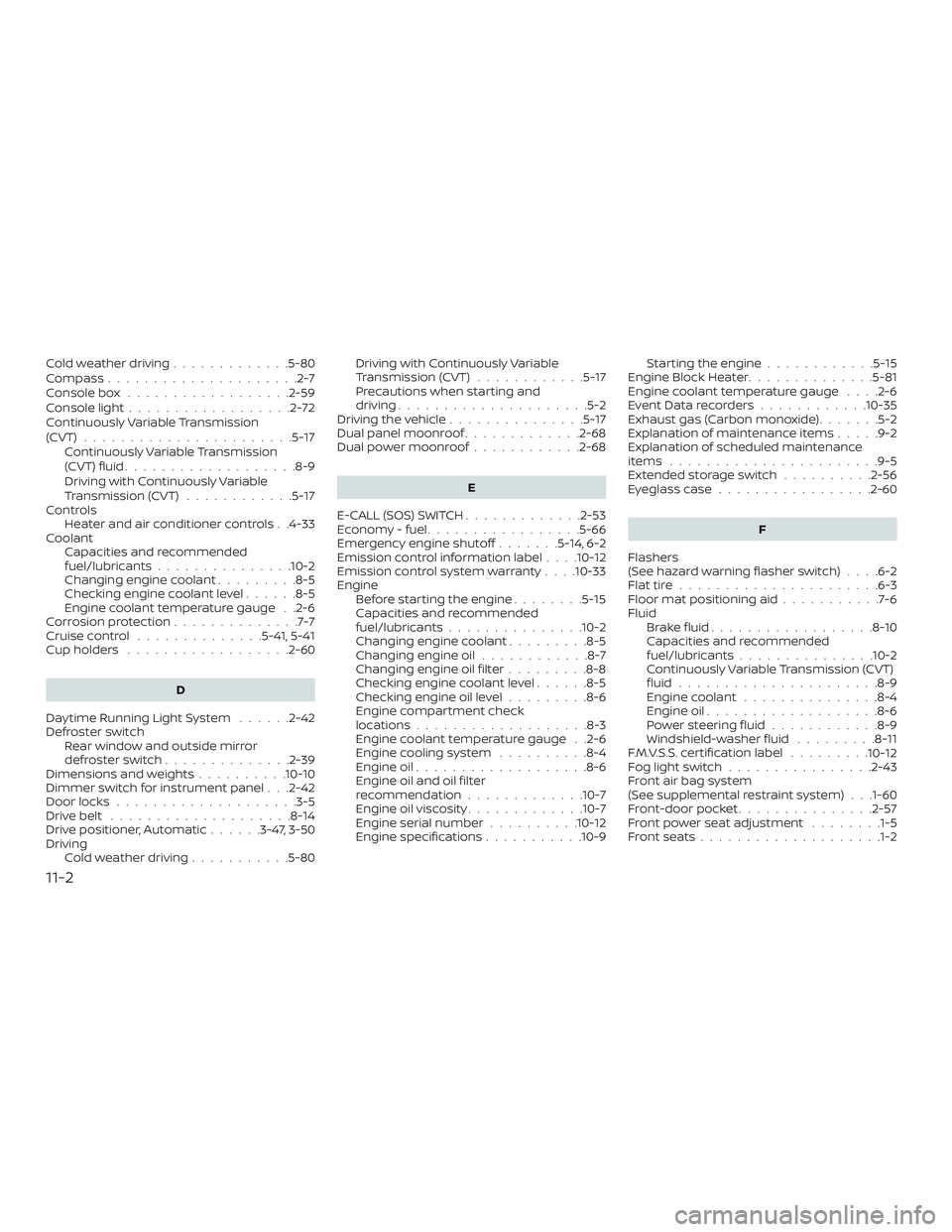
Coldweatherdriving.............5-80
Compass.....................2-7
Console box ..................2-59
Console light ..................2-72
Continuously Variable Transmission
(CVT) .......................5-17
Continuously Variable Transmission
(CVT) fluid ...................8-9
Driving with Continuously Variable
Transmission (CVT) ............5-17
Controls Heater and air conditioner controls . .4-33
Coolant Capacities and recommended
fuel/lubricants...............10-2
Changing engine coolant .........8-5
Checking engine coolant level ......8-5
Engine coolant temperature gauge . .2-6
Corrosionprotection..............7-7
Cruisecontrol ..............5-41,5-41
Cupholders ..................2-60
D
Daytime Running Light System ......2-42
Defroster switch Rear window and outside mirror
defrosterswitch..............2-39
Dimensions and weights ..........10-10
Dimmer switch for instrument panel . . .2-42
Door locks ....................3-5
Drivebelt ....................8-14
Drive positioner, Automatic ......3-47,3-50
Driving Coldweatherdriving...........5-80 Driving with Continuously Variable
Transmission (CVT)
............5-17
Precautions when starting and
driving.....................5-2
Drivingthevehicle...............5-17
Dual panel moonroof .............2-68
Dual power moonroof ............2-68
E
E-CALL (SOS) SWITCH .............2-53
Economy - fuel .................5-66
Emergency engine shutoff .......5-14,6-2
Emission control information label . . . .10-12
Emission control system warranty . . . .10-33
Engine Before starting the engine ........5-15
Capacities and recommended
fuel/lubricants...............10-2
Changing engine coolant .........8-5
Changing engine oil ............8-7
Changing engine oil filter .........8-8
Checking engine coolant level ......8-5
Checking engine oil level .........8-6
Engine compartment check
locations...................8-3
Engine coolant temperature gauge . .2-6
Engine cooling system ..........8-4
Engine oil ...................8-6
Engine oil and oil filter
recommendation .............10-7
Engine oil viscosity .............10-7
Engine serial number ..........10-12
Engine specifications ...........10-9 Starting the engine
............5-15
Engine Block Heater ..............5-81
Engine coolant temperature gauge ....2-6
EventDatarecorders............10-35
Exhaust gas (Carbon monoxide) .......5-2
Explanation of maintenance items .....9-2
Explanation of scheduled maintenance
items .......................9-5
Extended storage switch ..........2-56
Eyeglasscase.................2-60
F
Flashers
(Seehazardwarningflasherswitch)....6-2
Flattire......................6-3
Floormatpositioningaid...........7-6
Fluid Brakefluid..................8-10
Capacities and recommended
fuel/lubricants...............10-2
Continuously Variable Transmission (CVT)
fluid......................8-9
Engine coolant ...............8-4
Engine oil ...................8-6
Powersteeringfluid............8-9
Windshield-washer fluid .........8-11
F.M.V.S.S. certification label .........
10-12
Foglightswitch................2-43
Front air bag system
(See supplemental restraint system) . . .1-60
Front-door pocket ...............2-57
Front power seat adjustment ........1-5
Frontseats....................1-2
11-2
Page 468 of 474
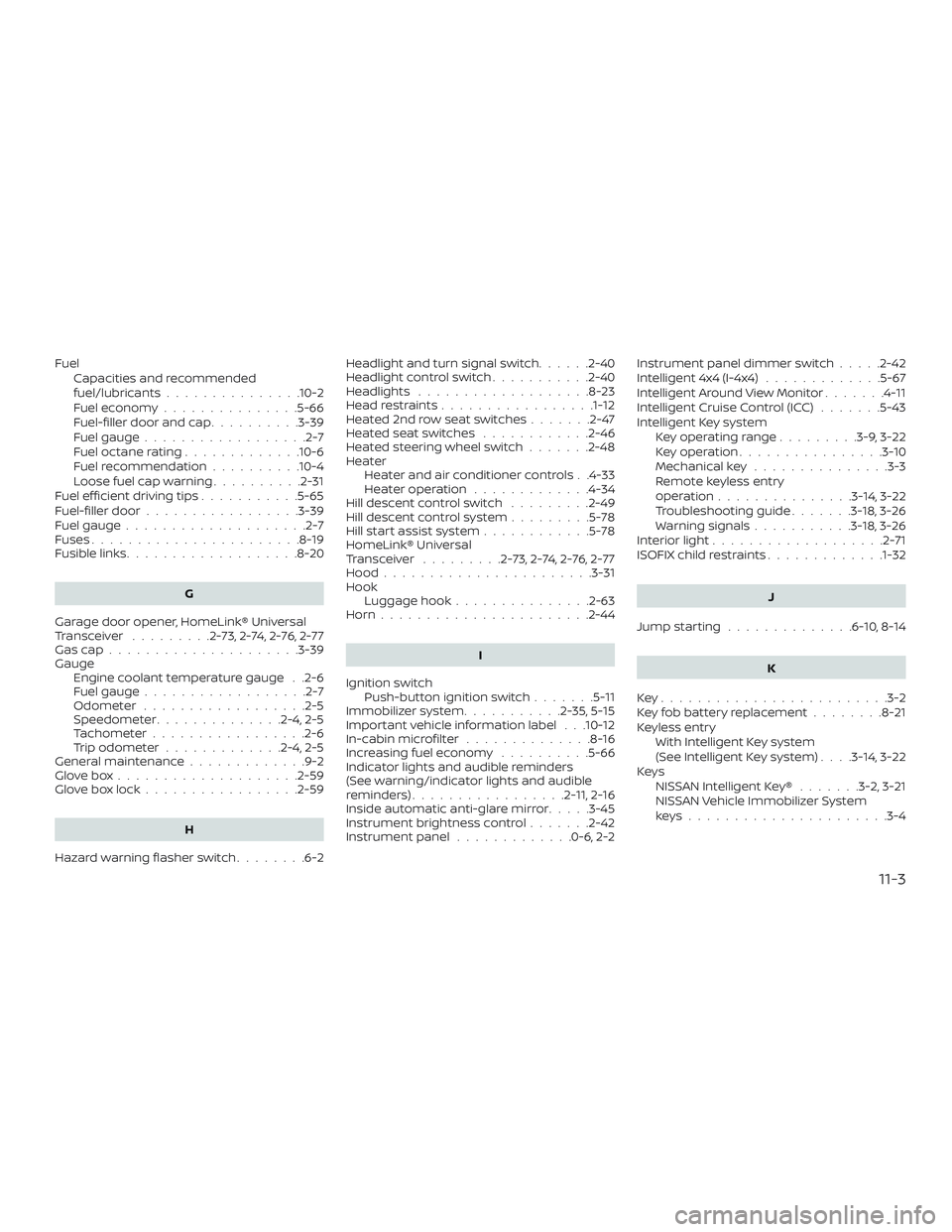
FuelCapacities and recommended
fuel/lubricants...............10-2
Fuel economy ...............5-66
Fuel-filler door and cap ..........3-39
Fuel gauge ..................2-7
Fueloctanerating.............10-6
Fuel recommendation ..........10-4
Loose fuel cap warning ..........2-31
Fuelefficientdrivingtips...........5-65
Fuel-filler door .................3-39
Fuel gauge ....................2-7
Fuses .......................8-19
Fusiblelinks...................8-20
G
Garage door opener, HomeLink® Universal
Transceiver .........2-73,2-74,2-76,2-77
Gascap.....................3-39
Gauge Engine coolant temperature gauge . .2-6
Fuel gauge ..................2-7
Odometer ..................2-5
Speedometer ..............2-4,2-5
Tachometer .................2-6
Trip odometer .............2-4,2-5
General maintenance .............9-2
Glovebox....................2-59
Gloveboxlock.................2-59
H
Hazard warning flasher switch ........6-2Headlight and turn signal switch
......2-40
Headlightcontrolswitch...........2-40
Headlights ...................8-23
Headrestraints.................1-12
Heated 2nd row seat switches .......2-47
Heated seat switches ............2-46
Heated steering wheel switch .......2-48
Heater Heater and air conditioner controls . .4-33
Heater operation .............4-34
Hill descent control switch .........2-49
Hill descent control system .........5-78
Hill start assist system ............5-78
HomeLink® Universal
Transceiver .........2 -73, 2-74, 2-76, 2-77
Hood ...................... .3-31
Hook Luggage hook ...............2-63
Horn.......................2-44
I
Ignition switch Push-button ignition switch .......5-11
Immobilizer system ...........2-35,5-15
Important vehicle information label . . .10-12
In-cabinmicrofilter..............8-16
Increasing fuel economy ..........5-66
Indicator lights and audible reminders
(See warning/indicator lights and audible
reminders) .................2 -11, 2-16
Inside automatic anti-glare mirror .....3-45
Instrument brightness control .......2-42
Instrument panel .............0-6,2-2 Instrument panel dimmer switch
.....2-42
Intelligent 4x4 (I-4x4) .............5-67
Intelligent Around View Monitor .......4-11
Intelligent Cruise Control (ICC) .......5-43
Intelligent Key system Key operating range .........3-9,3-22
Key operation ................3-10
Mechanical key ...............3-3
Remote keyless entry
oper
ation ...............3-14,3-22
Troubleshooting guide .......3-18,3-26
Warning signals ...........3-18,3-26
Interiorlight...................2-71
ISOFIX child restraints .............1-32
J
Jumpstarting..............6-10, 8-14
K
Key........................ .3-2
Key fob battery replacement ........8-21
Keyless entry With Intelligent Key system
(See Intelligent Key system) ....3-14,3-22
Keys NISSAN Intelligent Key® .......3-2,3-21
NISSAN Vehicle Immobilizer System
keys......................3-4
11-3