brakes NISSAN PATHFINDER 2019 Owner´s Manual
[x] Cancel search | Manufacturer: NISSAN, Model Year: 2019, Model line: PATHFINDER, Model: NISSAN PATHFINDER 2019Pages: 476, PDF Size: 5.61 MB
Page 455 of 476
∙ To reduce the possibility of additionaldamage if your vehicle is struck from
the rear, where practical, remove the
receiver when not in use.
∙ Regularly check that all trailer hitch mounting bolts are securely
mounted.
Tire pressures
∙ When towing a trailer, inflate the
vehicle tires to the recom-
mended cold tire pressure indi-
cated on the Tire and Loading In-
formation label.
∙ Trailer tire condition, size, load rat- ing and proper inflation pressure
should be in accordance with the
trailer and tire manufacturer’s
specifications.
Safety chains
Always use suitable safety chains between
your vehicle and the trailer. The safety
chains should be crossed and should be
attached to the hitch, not to the vehicle
bumper or axle. The safety chains can be
attached to the bumper if the hitch ball is mounted to the bumper. Be sure to leave
enough slack in the chains to permit turn-
ing corners.
Trailer lights
CAUTION
When splicing into the vehicle electrical
system, a commercially available
power-type module/converter must be
used to provide power for all trailer
lighting. This unit uses the vehicle bat-
tery as a direct power source for all
trailer lights while using the vehicle tail
light, stop light and turn signal circuits
as a signal source. The
module/converter must draw no more
that 15 milliamps from the stop and tail
lamp circuits. Using a
module/converter that exceeds these
power requirements may damage the
vehicle’s electrical system. See a repu-
table trailer retailer to obtain the proper
equipment and to have it installed.
Trailer lights should comply with federal
and/or local regulations. For assistance in
hooking up trailer lights, it is recommended
that you contact a NISSAN dealer or repu-
table trailer retailer. Vehicles equipped with
the optional trailer tow package are equipped with a 7-pin trailer harness con-
nector. If your trailer is equipped with a flat
4-pin connector, an adapter will be needed
to connect the trailer lights to the vehicle.
Adapters are available at auto parts stores
and hitch retailers.Trailer brakes
When towing a trailer load of 3,500 lbs.
(1,587 kg) or more, trailers with a brake
system MUST be used.
However, most
states require a separate braking system
on trailers with a loaded weight above a
specific amount. Make sure the trailer
meets the local regulations and the regu-
lations where you plan to tow.
Several types of braking systems are avail-
able.
Surge Brakes - The surge brake actuator is
mounted on the trailer tongue with a hy-
draulic line running to each trailer wheel.
Surge brakes are activated by the trailer
pushing against the hitch ball when the
tow vehicle is braking. Hydraulic surge
brakes are common on rental trailers and
some boat trailers. In this type of system,
there is no hydraulic or electric connection
for brake operation between the tow ve-
hicle and the trailer.
Technical and consumer information10-25
Page 456 of 476
Electric Trailer Brakes -Electric braking
systems are activated by an electronic sig-
nal sent from a trailer brake controller (spe-
cial brake-sensing module). For additional
information, refer to “Electric trailer brake
controller” in this section.
Have a professional supplier of towing
equipment make sure the trailer brakes are
properly installed and demonstrate proper
brake function testing.
WARNING
Never connect a trailer brake system di-
rectly to the vehicle brake system.
Electric trailer brake controller (if
so equipped)
Trailers equipped with electric brakes may
require the installation of an af termarket
trailer brake controller.
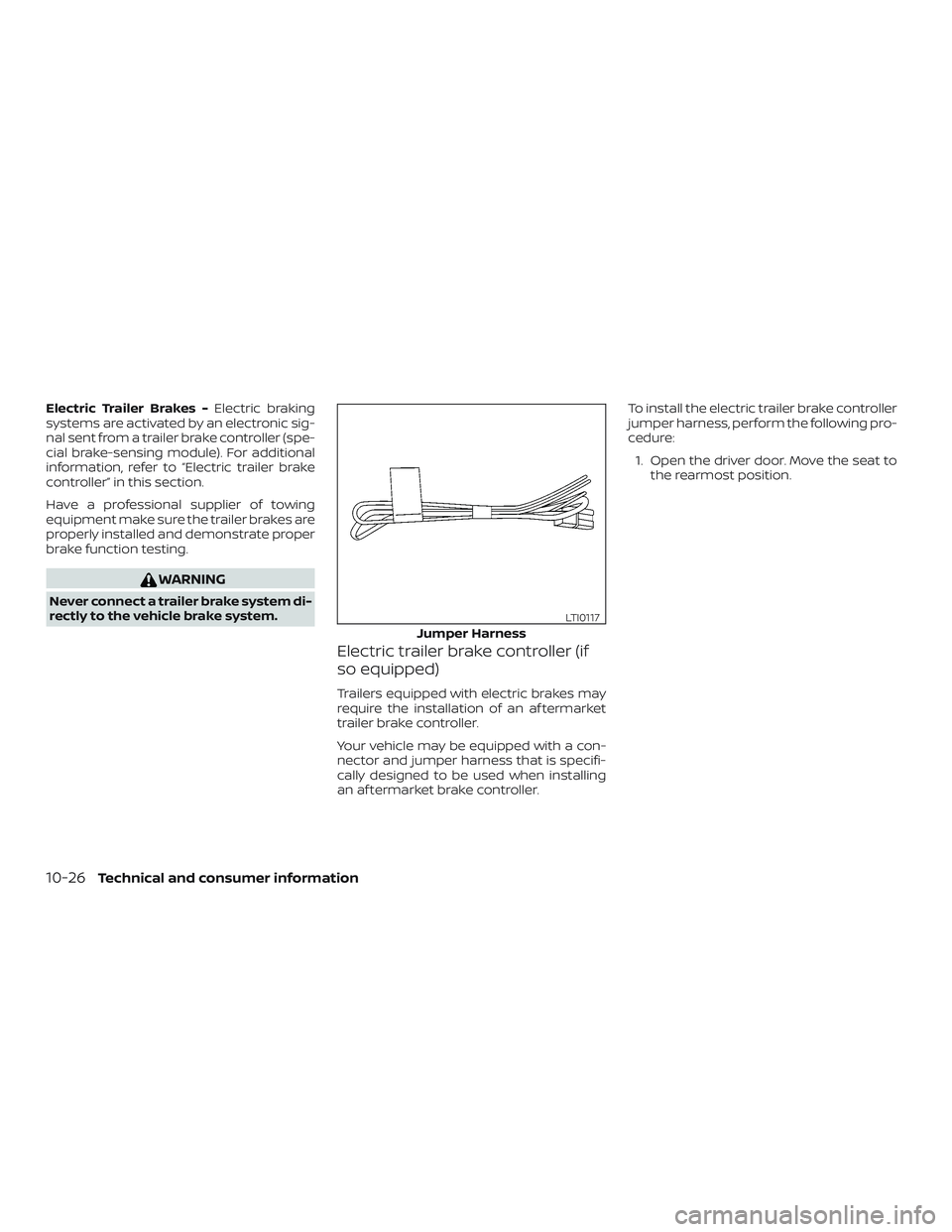
Your vehicle may be equipped with a con-
nector and jumper harness that is specifi-
cally designed to be used when installing
an af termarket brake controller. To install the electric trailer brake controller
jumper harness, perform the following pro-
cedure:
1. Open the driver door. Move the seat to the rearmost position.
Jumper Harness
LTI0117
10-26Technical and consumer information
Page 459 of 476
7. Have someone retrieve and store theblocks.
∙ While going downhill, the weight of the trailer pushing on the tow vehicle may
decrease overall stability. Therefore, to
maintain adequate control, reduce your
speed and shif t to a lower gear. Avoid
long or repeated use of the brakes
when descending a hill, as this reduces
their effectiveness and could cause
overheating. Shif ting to a lower gear in-
stead provides “engine braking” and re-
duces the need to brake as frequently.
∙ If the engine coolant temperature rises to a high temperature, refer to “If your
vehicle overheats” in the “In case of
emergency” section of this manual.
∙ Trailer towing requires more fuel than normal circumstances.
∙ Avoid towing a trailer for your vehicle’s first 500 miles (805 km).
∙ For the first 500 miles (805 km) that you do tow, do not drive over 50 mph
(80 km/h). ∙ Have your vehicle serviced more of ten
than at intervals specified in the recom-
mended Maintenance Schedule in the
“Maintenance and schedules” section of
this manual.
∙ When making a turn, your trailer wheels will be closer to the inside of the turn
than your vehicle wheels. To compen-
sate for this, make a larger than normal
turning radius during the turn.
∙ Crosswinds and rough roads will ad- versely affect vehicle/trailer handling,
possibly causing vehicle sway. When
being passed by larger vehicles, be pre-
pared for possible changes in cross-
winds that could affect vehicle han-
dling.
Do the following if the trailer begins to
sway: 1. Take your foot off the accelerator pedal to allow the vehicle to coast and steer
as straight ahead as the road condi-
tions allow. This combination will help
stabilize the vehicle.
– Do not correct trailer sway by steer- ing or applying the brakes. 2. When the trailer sway stops, gently ap-
ply the brakes and pull to the side of the
road in a safe area.
3. Try to rearrange the trailer load so it is balanced. For additional information,
refer to “Pre-towing tips” in this section.
∙ Be careful when passing other vehicles. Passing while towing a trailer requires
considerably more distance than nor-
mal passing. Remember, the length of
the trailer must also pass the other ve-
hicle before you can safely change
lanes.
∙ Use the Tow Mode or downshif t the transmission to a lower gear for engine
braking when driving down steep or
long hills. This will help slow the vehicle
without applying the brakes.
∙ Avoid holding the brake pedal down too long or too frequently. This could cause
the brakes to overheat, resulting in re-
duced braking efficiency.
∙ Increase your following distance to al- low for greater stopping distances
while towing a trailer. Anticipate stops
and brake gradually.
Technical and consumer information10-29
Page 467 of 476
11 Index
2nd row bench seat adjustment......1-9
A
Air bag (See supplemental restraint
system) .................... .1-53
Air bag system Front (See supplemental front impact air
bagsystem)............... .1-60
Air bag warning labels ............1-71
Airbagwarninglight..........1-72, 2-16
Air bag warning light,
supplemental ..............1-72, 2-16
Air cleaner ...................8-16
Air cleaner housing filter ..........8-16
Air conditioner Air conditioner operation ........4-33
Air conditioner specification label . .10-13
Air conditioner system refrigerant and oil
recommendations ............10-8
Heater and air conditioner
controls...................4-33
Servicing air conditioner ........4-40
Alarm system
(See vehicle security system) .......2-33
Anchor point locations ...........1-35
Antenna ....................4-41
Antifreeze ...................5-80
Anti-lock brake warning light ........2-12
Anti-lock Braking System (ABS) ......5-73
Armrests................... .1-10
Audible reminders ..............2-19 Autolightswitch ...............2-40
Automatic
Automatic drive positioner ....3-48,3-51
Automatic power window switch . . .2-66
Automatic anti-glare inside mirror ....3-46
Automatic door locks .............3-7
Automatic drive positioner ......3-48, 3-51
Automatic Emergency Braking
(AEB) ...................2-12,5-58
B
Battery..................5-80,8-13 Charge warning light ...........2-13
Battery replacement ............8-22
Keyfob...................8-22
NISSAN Intelligent Key® .........8-22
Before starting the engine .........5-15
Belt(Seedrivebelt)..............8-15
Blind Spot Warning (BSW) ..........5-22
Booster seats .................1-49
Brake Anti-lock Braking System (ABS) ....5-73
Brakefluid .................8-11
Brakelight(Seestoplight).......8-25
Brakesystem...............5-73
Brakewarninglight............2-12
Brakewearindicators.......2-19,8-19
Parking brake operation .........5-21
Self-adjustingbrakes ..........8-19
Brake Assist ..................5-74
Brakefluid ...................8-11 Brakes......................8-19
Brakesystem................
.5-73
Break-in schedule ..............5-65
Brightness control Instrument panel .............2-42
Bulb check/instrument panel .......2-11
Bulb replacement ..............8-25
C
Capacities and recommended fuel/
lubricants....................10-2
Cargoareastoragebin...........2-62
C
argolight...................2-73
Cargo
(See vehicle loading information) . . . .10-14
Car phone or CB radio ............4-41
Check tire pressure .............2-30
Childrestraints.......1-27, 1-28, 1-30, 1-32 LATCH (Lower Anchors and Tethers for
CHildren)System.............1-32
Precautions on child
restraints.........1-30, 1-37, 1-43, 1-49
Top tether strap anchor point
locations................. .1-35
Child restraint with top tether strap . . .1-34
Child safety rear door lock ..........3-7
Chimes, audible reminders .........2-19
Cleaningexteriorandinterior .....7-2,7-4
Climate-controlled seat switches .....2-44
C.M.V.S.S. certification label .........10-12
Coldweatherdriving ............5-80
Page 472 of 476
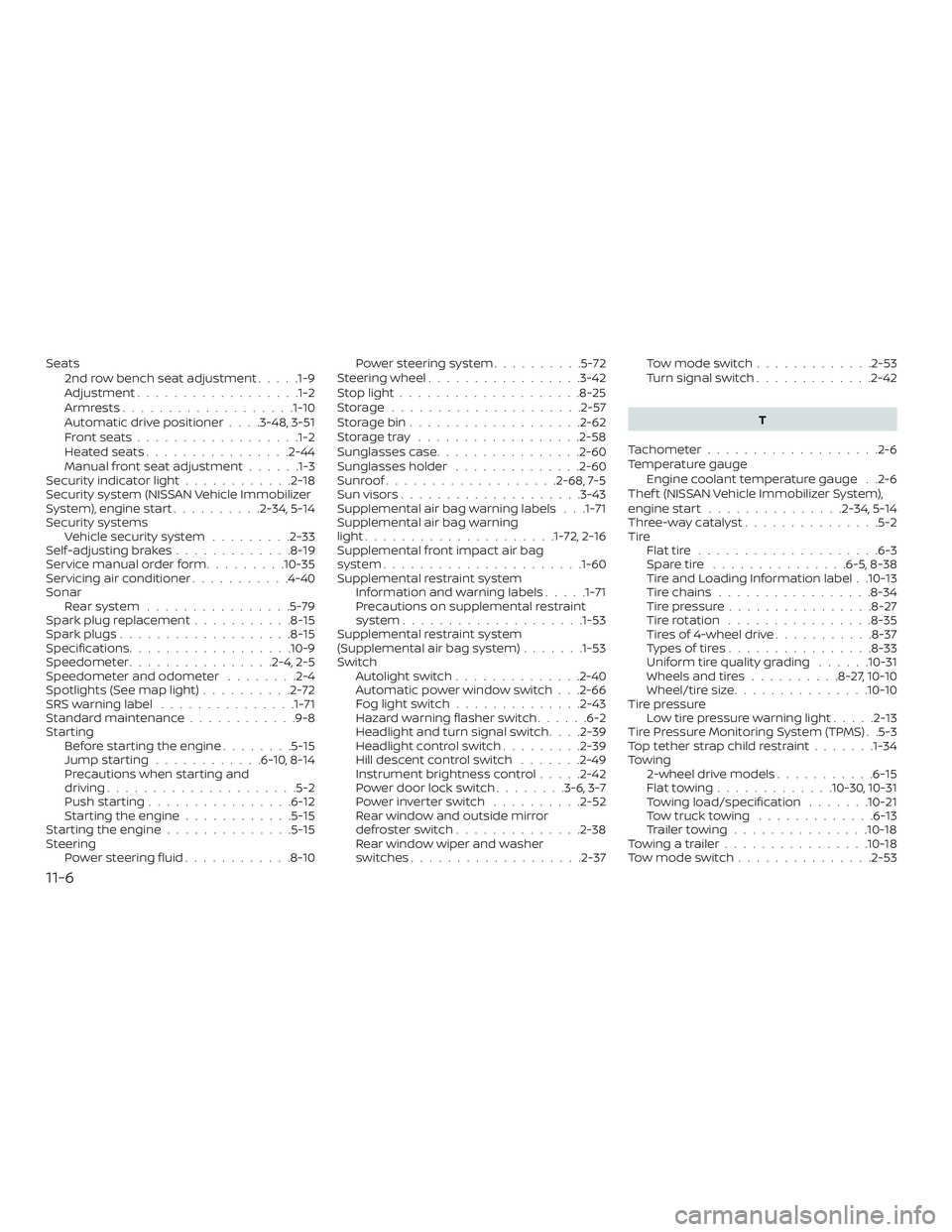
Seats2nd row bench seat adjustment .....1-9
Adjustment ..................1-2
Armrests...................1-10
Automatic drive positioner ....3-48,3-51
Frontseats..................1-2
Heatedseats................2-44
Manual front seat adjustment ......1-3
Security indicator light ............2-18
Security system (NISSAN Vehicle Immobilizer
System), engine start ..........2-34,5-14
Security systems Vehicle security system .........2-33
Self-adjustingbrakes.............8-19
Service manual order form .........10-35
Servicing air conditioner ...........4-40
Sonar Rear system ................5-79
Spark plug replacement ...........8-15
Spark plugs ...................8-15
Specifications ..................10-9
Speedometer ................2-4,2-5
Speedometer and odometer ........2-4
Spotlights(Seemaplight)..........2-72
SRS warning label ...............1-71
Standard maintenance ............9-8
Starting Before starting the engine ........5-15
Jumpstarting............6-10,8-14
Precautions when starting and
driving .....................5-2
Push starting ................6-12
Starting the engine ............5-15
Starting the engine ..............5-15
Steering Powersteeringfluid............8-10 Powersteeringsystem..........5-72
Steering wheel .................3-42
Stoplight....................8-25
Storage .....................2-57
Storagebin...................2-62
Storagetray ..................2-58
Sunglasses case ................2-60
Sunglasses holder ..............2-60
Sunroof ...................2-68,7-5
Sunvisors....................3-43
Supplemental air bag warning labels . . .1-71
Supplemental air bag warning
light.................... .1-72, 2-16
Supplemental front impact air bag
system ..................... .1-60
Supplemental restraint system Information and warning labels .....1-71
Precautions on supplemental restraint
system ................... .1-53
Supplemental restraint system
(Supplemental air bag system) .......1-53
Switch Autolightswitch..............2-40
Automatic power window switch . . .2-66
Foglightswitch..............2-43
Hazard warning flasher switch ......6-2
Headlight and turn signal switch ....2-39
Headlightcontrolswitch.........2-39
Hill descent control switch .......2-49
Instrument brightness control .....2-42
Power door lock switch ........3-6, 3-7
Powerinverterswitch ..........2-52
Rear window and outside mirror
defrosterswitch..............2-38
Rear window wiper and washer
switches ...................2-37 Tow mode switch
.............2-53
Turn signal switch .............2-42
T
Tachometer ...................
2-6
Temperature gauge Engine coolant temperature gauge . .2-6
Thef t (NISSAN Vehicle Immobilizer System),
engine start ...............2-34,5-14
Three-waycatalyst...............5-2
Tire Flattire....................6-3
Spare tire ...............6-5,8-38
Tire and Loading Information label . .10-13
Tire chains .................8-34
Tire pressure ................8-27
Tirerotation ................8-35
Tires of 4-wheel drive ...........8-37
Types of tires ................8-33
Uniform tire quality grading ......10-31
Wheels and tires ..........8-27,10-10
Wheel/tire size ...............10-10
Tire pressure Low tire pressure warning light .....2-13
Tire Pressure Monitoring System (TPMS) . .5-3
Toptetherstrapchildrestraint.......1-34
Towing 2-wheel drive models ...........6-15
Flattowing.............10-30,10-31
Towing load/specification .......10-21
Towtrucktowing .............6-13
Trailertowing...............10-18
Towingatrailer................10-18
Tow mode switch ...............2-53
11-6