Fuel recommend NISSAN PATHFINDER 2020 Owner´s Manual
[x] Cancel search | Manufacturer: NISSAN, Model Year: 2020, Model line: PATHFINDER, Model: NISSAN PATHFINDER 2020Pages: 482, PDF Size: 5.51 MB
Page 422 of 482
Seats:Check seat position controls such
as seat adjusters, seatback recliner, etc., to
ensure they operate smoothly and all
latches lock securely in every position.
Check that the head restraints/headrests
move up and down smoothly and the locks
(if so equipped) hold securely in all latched
positions.
Seat belts: Check that all parts of the seat
belt system (for example, buckles, anchors,
adjusters and retractors) operate properly
and smoothly, and are installed securely.
Check the belt webbing for cuts, fraying,
wear or damage.
Steering wheel: Check for changes in the
steering system, such as excessive free
play, hard steering or strange noises.
Warning lights and chimes: Make sure all
warning lights and chimes are operating
properly.
Windshield defroster: Check that the air
comes out of the defroster outlets properly
and in sufficient quantity when operating
the heater or air conditioner.
Windshield wiper and washer*: Check
that the wipers and washer operate prop-
erly and that the wipers do not streak.Under the hood and vehicle
The maintenance items listed here should
be checked periodically (for example, each
time you check the engine oil or refuel).
Battery* (for maintenance free batter-
ies): This vehicle is equipped with a sealed
maintenance free battery. It is recom-
mended that you visit a NISSAN dealer for
service.
NOTE:
Care should be taken to avoid situations
that can lead to potential battery dis-
charge and potential no-start conditions
such as:
1. Installation or extended use of elec-
tronic accessories that consume bat-
tery power when the engine is not
running (Phone chargers, GPS, DVD
players, etc.).
2. Vehicle is not driven regularly and/or
only driven short distances.
In these cases, the battery may need to
be charged to maintain battery health.
Brake fluid level*: Make sure that the brake
fluid level is between the MAX and MIN lines
on the reservoir. Engine coolant level*:
Check the coolant
level when the engine is cold.
Engine drive belts*: Make sure the drive
belts are not frayed, worn, cracked or oily.
Engine oil level*: Check the level af ter
parking the vehicle on a level spot and
turning off the engine. Wait more than
15 minutes for the oil to drain back into the
oil pan.
Exhaust system: Make sure there are no
loose supports, cracks or holes. If the
sound of the exhaust seems unusual or
there is a smell of exhaust fumes, immedi-
ately have the exhaust system inspected. It
is recommended that you visit a NISSAN
dealer for this service. For additional infor-
mation, refer to “Exhaust gas (carbon mon-
oxide)” in the “Starting and driving” section
of this manual.
Fluid leaks: Check under the vehicle for
fuel, oil, water or other fluid leaks af ter the
vehicle has been parked for a while. Water
dripping from the air conditioner af ter use
is normal. If you should notice any leaks or if
fuel fumes are evident, check for the cause
and have it corrected immediately.
9-4Maintenance and schedules
Page 423 of 482
Power steering fluid level* and lines:
Check the level when the fluid is cold, with
the engine off. Check the lines for proper
attachment, leaks, cracks, etc.
Radiator and hoses:Check the front of the
radiator and clean off any dirt, insects,
leaves, etc., that may have accumulated.
Make sure the hoses have no cracks, defor-
mation, rot or loose connections.
Underbody: The underbody is frequently
exposed to corrosive substances such as
those used on icy roads or to control dust. It
is very important to remove these sub-
stances, otherwise rust may form on the
floor pan, frame, fuel lines and around the
exhaust system. At the end of winter, the
underbody should be thoroughly flushed
with plain water, being careful to clean
those areas where mud and dirt may accu-
mulate. For additional information, refer to
the “Appearance and care” section of this
manual.
Windshield-washer fluid*: Check that
there is adequate fluid in the reservoir. The following descriptions are provided to
give you a better understanding of the
scheduled maintenance items that should
be regularly checked or replaced. The
maintenance schedule indicates at which
mileage/time intervals each item requires
service.
In addition to scheduled maintenance,
your vehicle requires that some items be
checked during normal day-to-day opera-
tion. For additional information, refer to
“General maintenance” in this section.
Items marked with
“*”are recommended
by NISSAN for reliable vehicle operation.
You are not required to perform mainte-
nance on these items in order to maintain
the warranties which come with your
NISSAN. Other maintenance items and in-
tervals are required.
When applicable, additional information
can be found in the “Do-it-yourself ” section
of this manual. NOTE:
NISSAN does not advocate the use of
non-OEM approved af termarket flush-
ing systems and strongly advises
against performing these services on a
NISSAN product. Many of the af termar-
ket flushing systems use non-OEM ap-
proved chemicals or solvents, the use of
which has not been validated by NISSAN.
For recommended fuel, lubricants, fluids,
grease, and refrigerant, refer to “Recom-
mended fluids/lubricants and capaci-
ties” in the “Technical and consumer in-
formation” section of this manual.
EMISSION CONTROL SYSTEM
MAINTENANCE:
Drive belts*:
Check engine drive belts for
wear, fraying or cracking and for proper
tension. Replace any damaged drive belts.
Engine air filter: Replace at specified inter-
vals. When driving for prolonged periods in
dusty conditions, check/replace the filter
more frequently.
EXPLANATION OF SCHEDULED
MAINTENANCE ITEMS
Maintenance and schedules9-5
Page 424 of 482
Engine coolant*:Replace coolant at the
specified interval. When adding or replac-
ing coolant, be sure to use only Genuine
NISSAN Long Life Antifreeze/Coolant (blue)
or equivalent with the proper mixture. (For
additional information on the proper mix-
ture for your area, refer to “Engine cooling
system” in the “Do-it-yourself ” section of
this manual.)
NOTE:
Mixing any other type of coolant or the
use of non-distilled water may reduce
the recommended service interval of the
coolant.
Engine oil and oil filter: Replace engine oil
and oil filter at the specified intervals. For
recommended oil grade and viscosity, refer
to “Recommended fluids/lubricants and
capacities” in the “Technical and consumer
information” section of this manual.
Engine valve clearance*: Inspect only if
valve noise increases. Adjust valve clear-
ance if necessary.
Evaporative emissions control vapor
lines*: Check vapor lines for leaks or loose-
ness. Tighten connections or replace parts
as necessary. Fuel lines*:
Check the fuel hoses, piping
and connections for leaks, looseness, or
deterioration. Tighten connections or re-
place parts as necessary.
Spark plugs: Replace at specified intervals.
Install new plugs of the same type as origi-
nally equipped.
CHASSIS AND BODY
MAINTENANCE:
Brake lines and cables: Visually inspect for
proper installation. Check for chafing,
cracks, deterioration, and signs of leaking.
Replace any deteriorated or damaged
parts immediately.
Brake pads and rotors: Check for wear,
deterioration and fluid leaks. Replace any
deteriorated or damaged parts immedi-
ately.
Exhaust system: Visually inspect the ex-
haust pipes, muffler and hangers for leaks,
cracks, deterioration, and damage. Tighten
connections or replace parts as necessary.
In-cabin microfilter: Replace at specified
intervals. When driving for prolonged peri-
ods in dusty conditions, replace the filter
more frequently. Propeller shaf t(s):
Check for damage,
looseness, and grease leakage.
Steering gear and linkage, axle and sus-
pension parts, drive shaf t boots: Check
for damage, looseness, and leakage of oil
or grease. Under severe driving conditions,
inspect more frequently.
Tire rotation: Tires should be rotated every
7,500 miles (12,000 km) according to the in-
structions under “Explanation of general
maintenance items” in this section. When
rotating tires, check for damage and un-
even wear. Replace if necessary.
Transmission fluid/oil, differential oil
and transfer case oil: Visually inspect for
signs of leakage at specified intervals.
If towing a trailer, using a camper or car-top
carrier, or driving on rough or muddy roads,
replace the CVT fluid every 60,000 miles
(96,000 km) or request the dealer to inspect
the fluid deterioration data using a CON-
SULT. If the deterioration data is more than
210000, replace the CVT fluid.
9-6Maintenance and schedules
Page 433 of 482
10 Technical and consumer information
Recommended fluids/lubricants and
capacities...................................... 10-2
Fuel recommendation ....................... 10-4
Engine oil and oil filter
recommendations .......................... 10-6
Air conditioner system refrigerant and
oil recommendations ....................... 10-7
Specifications .................................. 10-8
Engine ...................................... 10-8
Wheels and tires ............................. 10-9
Dimensions and weights ....................10-9
When traveling or registering in another
country ........................................ 10-10
Vehicle identification .......................... 10-10
Vehicle Identification Number (VIN)
plate ....................................... 10-10
Vehicle identification number
(chassis number) ........................... 10-10
Engine serial number ........................ 10-11
F.M.V.S.S./C.M.V.S.S. certification label .........10-11
Emission control information label ..........10-11
Tire and Loading Information label .........10-12
Air conditioner specification label ...........10-12 Installing front license plate
....................10-12
Vehicle loading information ...................10-13
Terms ...................................... 10-13
Vehicle load capacity ....................... 10-14
Securing the load ........................... 10-15
Loading tips ................................ 10-16
Measurement of weights ...................10-16
Towing a trailer ................................ 10-17
Maximum load limits ....................... 10-17
Towing load/specification ..................10-20
Towing safety .............................. 10-21
Flat towing for 4–Wheel drive vehicle
(if so equipped) ............................. 10-29
Flat towing for front wheel drive vehicle
(if so equipped) ............................. 10-30
Uniform tire quality grading ....................10-30
Emission control system warranty .............10-31
R
eporting safety defects ......................10-32
Readiness for Inspection/Maintenance (I/M)
test ............................................ 10-33
Event Data Recorders (EDR) ....................10-34
Owner’s Manual/Service Manual order
information ................................... 10-34
Page 434 of 482
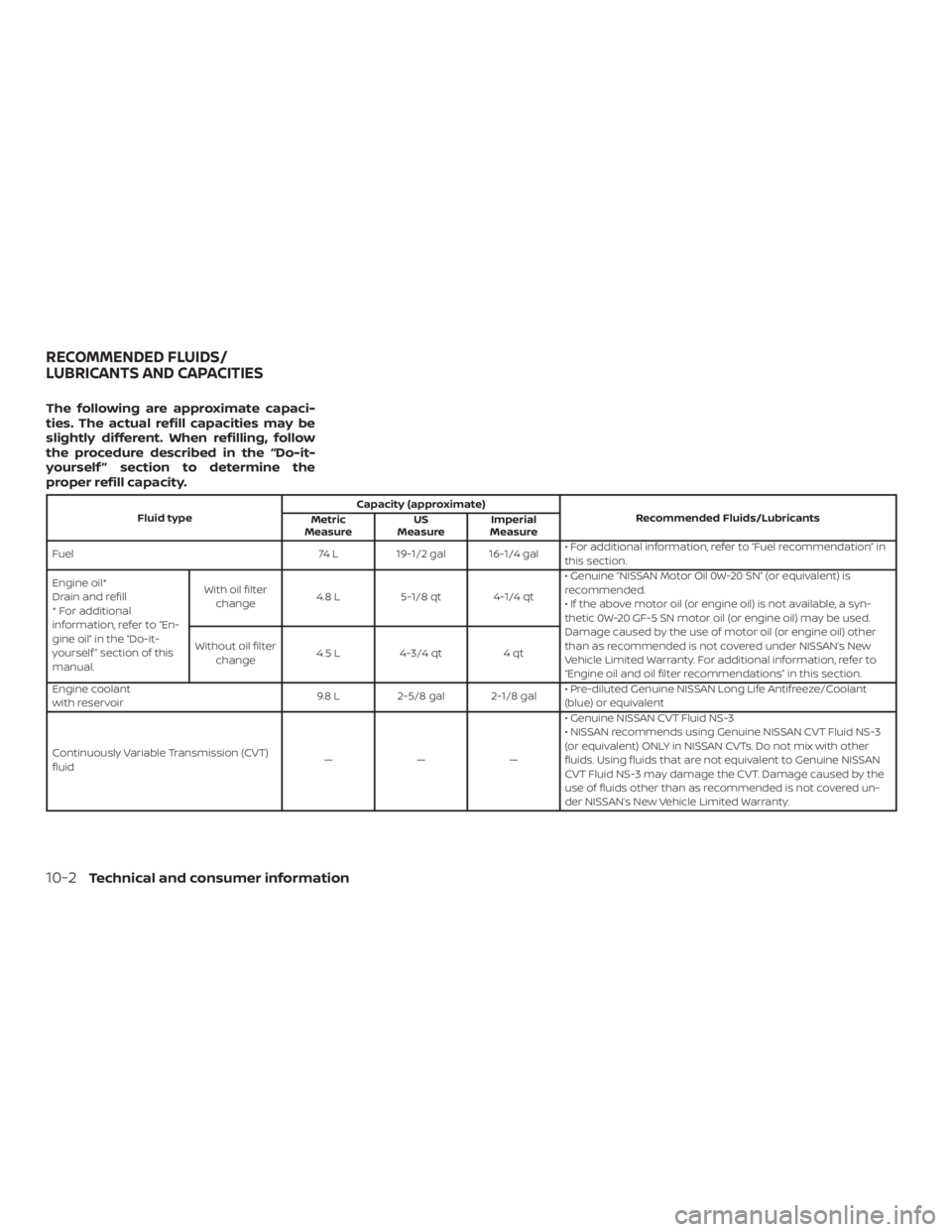
The following are approximate capaci-
ties. The actual refill capacities may be
slightly different. When refilling, follow
the procedure described in the “Do-it-
yourself ” section to determine the
proper refill capacity.
Fluid typeCapacity (approximate)
Recommended Fluids/Lubricants
Metric
Measure US
Measure Imperial
Measure
Fuel 74 L 19-1/2 gal 16-1/4 gal • For additional information, refer to “Fuel recommendation” in
this section.
Engine oil*
Drain and refill
* For additional
information, refer to “En-
gine oil” in the “Do-it-
yourself ” section of this
manual. With oil filter
change 4.8 L
5-1/8 qt 4-1/4 qt • Genuine “NISSAN Motor Oil 0W-20 SN” (or equivalent) is
recommended.
• If the above motor oil (or engine oil) is not available, a syn-
thetic 0W-20 GF-5 SN motor oil (or engine oil) may be used.
Damage caused by the use of motor oil (or engine oil) other
than as recommended is not covered under NISSAN’s New
Vehicle Limited Warranty. For additional information, refer to
“Engine oil and oil filter recommendations” in this section.
Without oil filter
change 4.5 L
4-3/4 qt 4 qt
Engine coolant
with reservoir 9.8 L
2-5/8 gal 2-1/8 gal • Pre-diluted Genuine NISSAN Long Life Antifreeze/Coolant
(blue) or equivalent
Continuously Variable Transmission (CVT)
fluid ———• Genuine NISSAN CVT Fluid NS-3
• NISSAN recommends using Genuine NISSAN CVT Fluid NS-3
(or equivalent) ONLY in NISSAN CVTs. Do not mix with other
fluids. Using fluids that are not equivalent to Genuine NISSAN
CVT Fluid NS-3 may damage the CVT. Damage caused by the
use of fluids other than as recommended is not covered un-
der NISSAN’s New Vehicle Limited Warranty.
RECOMMENDED FLUIDS/
LUBRICANTS AND CAPACITIES
10-2Technical and consumer information
Page 436 of 482

FUEL RECOMMENDATION
Use unleaded regular gasoline with an oc-
tane rating of at least 87 AKI (Anti-Knock
Index) number (Research octane number
91).
CAUTION
∙ Only vehicles with the E-85 filler doorlabel can operate on E-85. Fuel system
or other damage can occur if E-85 is
used in vehicles that are not designed
to run on E-85.
∙ Using a fuel other than that specified could adversely affect the emission
control system, and may also affect
the warranty coverage.
∙ Under no circumstances should a leaded gasoline be used, because this
will damage the three-way catalyst. ∙ Do not use a fuel containing more
than 15% ethanol in your vehicle. Your
vehicle is not designed to run on a fuel
containing more than 15% ethanol.
Using a fuel containing more than 15%
ethanol in a vehicle not specifically
designed for a fuel containing more
than 15% ethanol can adversely affect
the emission control devices and sys-
tems of the vehicle. Damage caused
by such fuel is not covered by the
NISSAN New Vehicle Limited Warranty.
∙
Do not use fuel that contains the oc-
tane booster methylcyclopentadienyl
manganese tricarbonyl (MMT). Using
fuel containing MMT may adversely af-
fect vehicle performance and vehicle
emissions. Not all fuel dispensers are
labeled to indicate MMT content, so you
may have to consult your gasoline re-
tailer for more details. Note that Fed-
eral and California laws prohibit the use
of MMT in reformulated gasoline.
∙ U.S. government regulations require ethanol dispensing pumps to be iden-
tified by a small, square, orange and
black label with the common abbre-
viation or the appropriate percentage
for that region.
Gasoline specifications
NISSAN recommends using gasoline that
meets the World-Wide Fuel Charter (WWFC)
specifications where it is available. Many of
the automobile manufacturers developed
this specification to improve emission con-
trol system and vehicle performance. Ask
your service station manager if the gaso-
line meets the WWFC specifications.
Reformulated gasoline
Some fuel suppliers are now producing re-
formulated gasolines. These gasolines are
specially designed to reduce vehicle emis-
sions. NISSAN supports efforts towards
cleaner air and suggests that you use re-
formulated gasoline when available.
Gasoline containing oxygenates
Some fuel suppliers sell gasoline contain-
ing oxygenates such as ethanol, Methyl
Tert-butyl Ether (MTBE) and methanol with
or without advertising their presence.
NISSAN does not recommend the use of
fuels of which the oxygenate content and
the fuel compatibility for your NISSAN can-
not be readily determined. If in doubt, ask
your service station manager.
10-4Technical and consumer information
Page 437 of 482
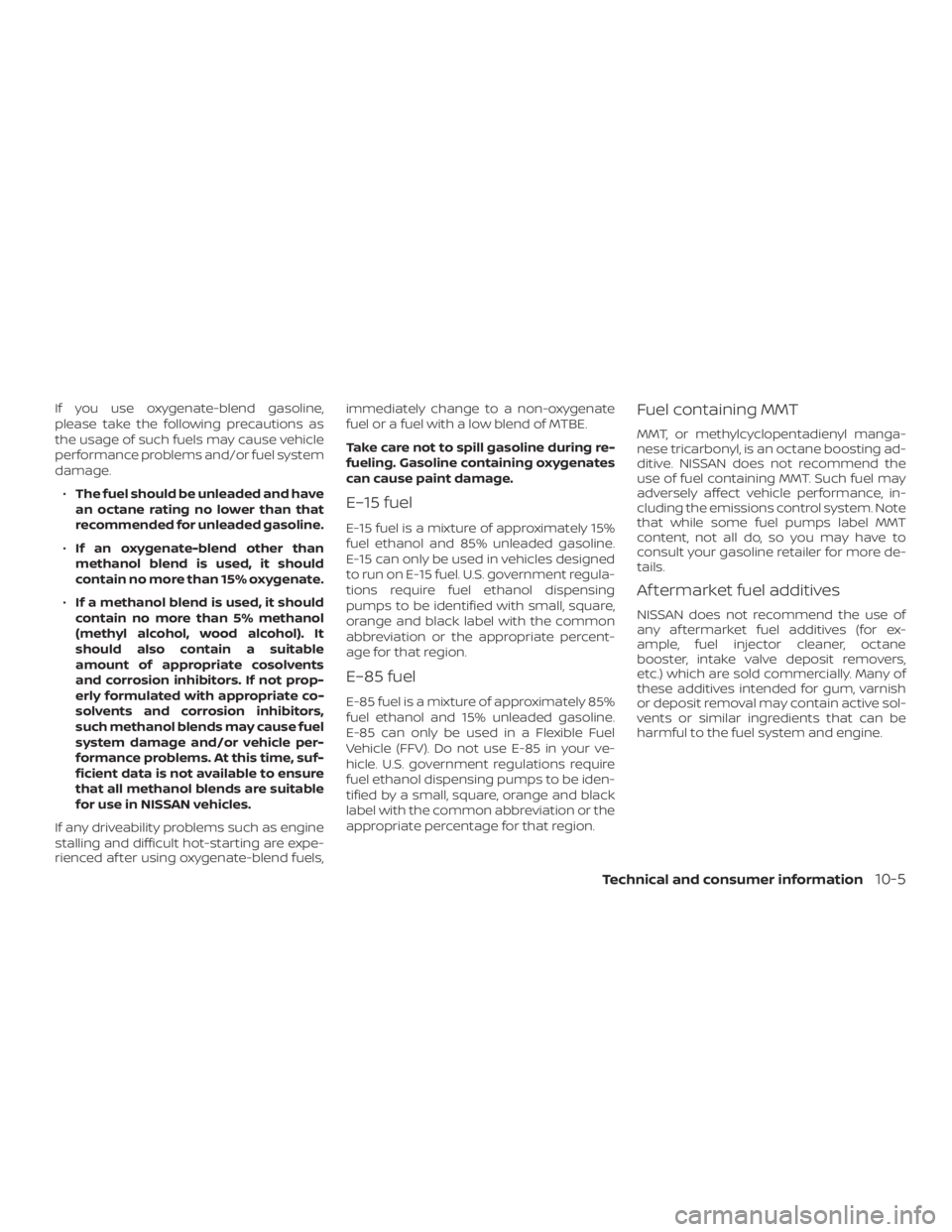
If you use oxygenate-blend gasoline,
please take the following precautions as
the usage of such fuels may cause vehicle
performance problems and/or fuel system
damage.∙ The fuel should be unleaded and have
an octane rating no lower than that
recommended for unleaded gasoline.
∙ If an oxygenate-blend other than
methanol blend is used, it should
contain no more than 15% oxygenate.
∙ If a methanol blend is used, it should
contain no more than 5% methanol
(methyl alcohol, wood alcohol). It
should also contain a suitable
amount of appropriate cosolvents
and corrosion inhibitors. If not prop-
erly formulated with appropriate co-
solvents and corrosion inhibitors,
such methanol blends may cause fuel
system damage and/or vehicle per-
formance problems. At this time, suf-
ficient data is not available to ensure
that all methanol blends are suitable
for use in NISSAN vehicles.
If any driveability problems such as engine
stalling and difficult hot-starting are expe-
rienced af ter using oxygenate-blend fuels, immediately change to a non-oxygenate
fuel or a fuel with a low blend of MTBE.
Take care not to spill gasoline during re-
fueling. Gasoline containing oxygenates
can cause paint damage.
E–15 fuel
E-15 fuel is a mixture of approximately 15%
fuel ethanol and 85% unleaded gasoline.
E-15 can only be used in vehicles designed
to run on E-15 fuel. U.S. government regula-
tions require fuel ethanol dispensing
pumps to be identified with small, square,
orange and black label with the common
abbreviation or the appropriate percent-
age for that region.
E–85 fuel
E-85 fuel is a mixture of approximately 85%
fuel ethanol and 15% unleaded gasoline.
E-85 can only be used in a Flexible Fuel
Vehicle (FFV). Do not use E-85 in your ve-
hicle. U.S. government regulations require
fuel ethanol dispensing pumps to be iden-
tified by a small, square, orange and black
label with the common abbreviation or the
appropriate percentage for that region.
Fuel containing MMT
MMT, or methylcyclopentadienyl manga-
nese tricarbonyl, is an octane boosting ad-
ditive. NISSAN does not recommend the
use of fuel containing MMT. Such fuel may
adversely affect vehicle performance, in-
cluding the emissions control system. Note
that while some fuel pumps label MMT
content, not all do, so you may have to
consult your gasoline retailer for more de-
tails.
Af termarket fuel additives
NISSAN does not recommend the use of
any af termarket fuel additives (for ex-
ample, fuel injector cleaner, octane
booster, intake valve deposit removers,
etc.) which are sold commercially. Many of
these additives intended for gum, varnish
or deposit removal may contain active sol-
vents or similar ingredients that can be
harmful to the fuel system and engine.
Technical and consumer information10-5
Page 438 of 482
Octane rating tips
Using unleaded gasoline with an octane
rating lower than recommended can
cause persistent, heavy “spark knock.”
(“Spark knock” is a metallic rapping
noise.) If severe, this can lead to engine
damage. If you detect a persistent heavy
spark knock even when using gasoline
of the stated octane rating, or if you hear
steady spark knock while holding a
steady speed on level roads, it is recom-
mended that you have a NISSAN dealer
correct the condition. Failure to correct
the condition is misuse of the vehicle, for
which NISSAN is not responsible.
Incorrect ignition timing may result in
spark knock, af ter-run and/or overheating,
which may cause excessive fuel consump-
tion or engine damage. If any of the above
symptoms are encountered, have your ve-
hicle checked. It is recommended that you
visit a NISSAN dealer for servicing.
However, now and then you may notice
light spark knock for a short time while
accelerating or driving up hills. This is not
a cause for concern, because you get the
greatest fuel benefit when there is light
spark knock for a short time under heavy
engine load.
ENGINE OIL AND OIL FILTER
RECOMMENDATIONS
Selecting the correct oil
It is essential to choose the correct grade,
quality and viscosity engine oil to ensure
satisfactory engine life and performance.
For additional information, refer to “Recom-
mended fluids/lubricants and capacities”
in this section. NISSAN recommends the
use of an energy conserving oil in order to
improve fuel economy.
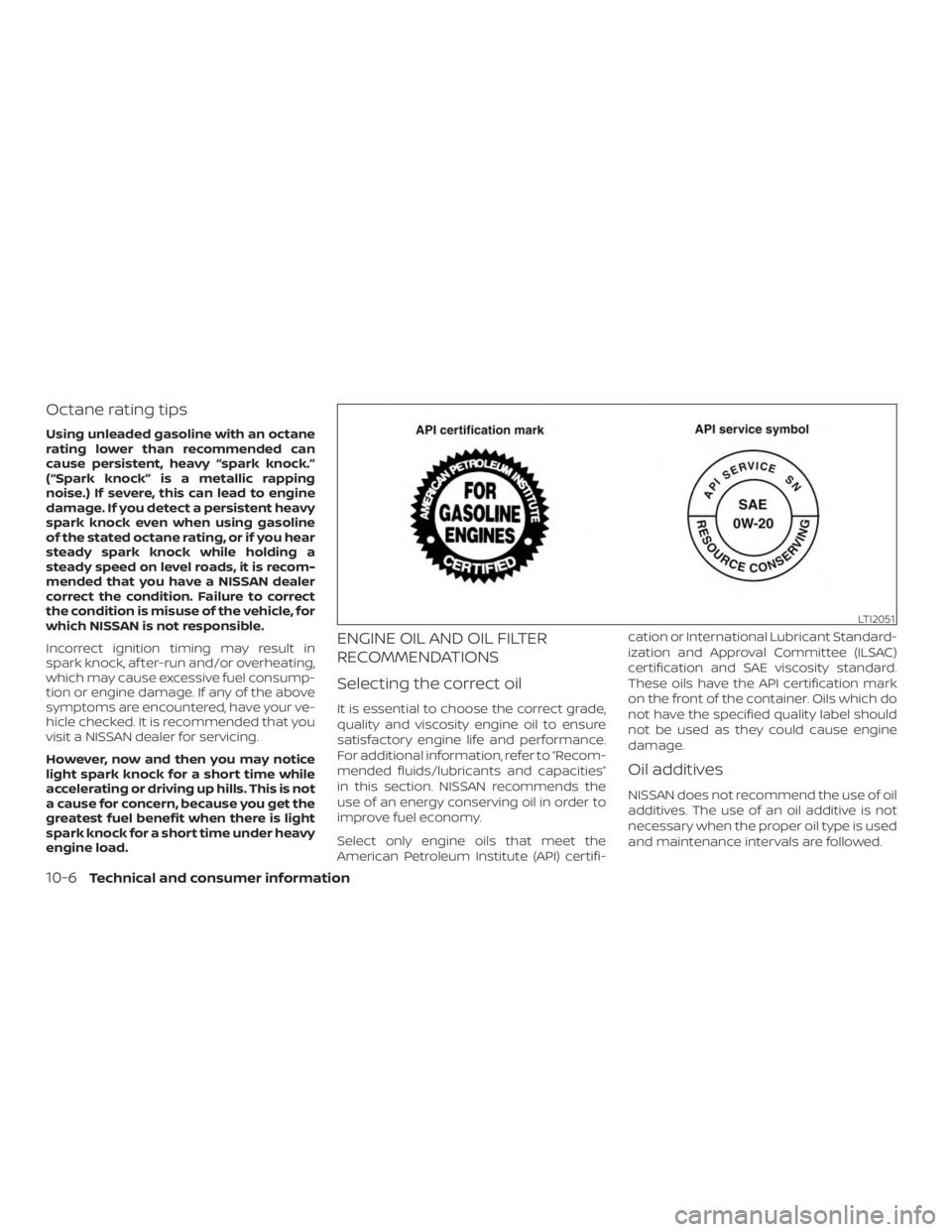
Select only engine oils that meet the
American Petroleum Institute (API) certifi-cation or International Lubricant Standard-
ization and Approval Committee (ILSAC)
certification and SAE viscosity standard.
These oils have the API certification mark
on the front of the container. Oils which do
not have the specified quality label should
not be used as they could cause engine
damage.
Oil additives
NISSAN does not recommend the use of oil
additives. The use of an oil additive is not
necessary when the proper oil type is used
and maintenance intervals are followed.
LTI2051
10-6Technical and consumer information
Page 461 of 482
∙ Avoid holding the brake pedal down toolong or too frequently. This could cause
the brakes to overheat, resulting in re-
duced braking efficiency.
∙ Increase your following distance to al- low for greater stopping distances
while towing a trailer. Anticipate stops
and brake gradually.
∙ NISSAN recommends that the cruise control not be used while towing a
trailer.
∙ Some states or provinces have specific regulations and speed limits for ve-
hicles that are towing trailers. Obey the
local speed limits.
∙ Check your hitch, trailer wiring harness connections, and trailer wheel lug nuts
af ter 50 miles (80 km) of travel and at
every break.
∙ When launching a boat, don’t allow the water level to go over the exhaust tail
pipe or rear bumper.
∙ Make sure you disconnect the trailer lights before backing the trailer into the
water or the trailer lights may burn out.
When towing a trailer, final drive gear oil
should be replaced and transmission oil/fluid should be changed more fre-
quently. For additional information, refer
to the “Do-it-yourself ” section in this
manual.
Tow mode
Using tow mode is recommended when
pulling a heavy trailer or hauling a heavy
load. Push the TOW MODE switch to acti-
vate tow mode. Push the TOW MODE
switch again to turn tow mode off. Tow
mode is automatically canceled when the
ignition switch is turned off.
Tow mode includes the following features:
∙ Grade logic — Adjusts transmission shif ts when pulling a trailer or hauling a
load up a grade.
∙ Downhill Speed Control (DSC) — auto- matically downshif ts when driving
down a grade with a trailer or heavy
load to help control vehicle speed.
Driving the vehicle in the tow mode with no
trailer/load or light trailer/light load will not
cause any damage. However, fuel
economy may be reduced and the
transmission/engine driving characteris-
tics may feel unusual. When towing a trailer, final drive gear oil
should be replaced and transmission
oil/fluid should be changed more fre-
quently. For additional information, refer
to the “Do-it-yourself ” section of this
manual.FLAT TOWING FOR 4–WHEEL DRIVE
VEHICLE (if so equipped)
Towing your vehicle with all four wheels on
the ground is sometimes called flat towing.
This method is sometimes used when
towing a vehicle behind a recreational ve-
hicle, such as a motor home.
CAUTION
∙ Failure to follow these guidelines can
result in severe transmission damage.
∙ Never flat tow your 4-wheel drive (4WD) vehicle.
∙ DO NOT tow your 4-wheel drive (4WD) vehicle with any wheels on the
ground. Doing so may cause serious
and expensive damage to the
powertrain.
Technical and consumer information10-29
Page 467 of 482
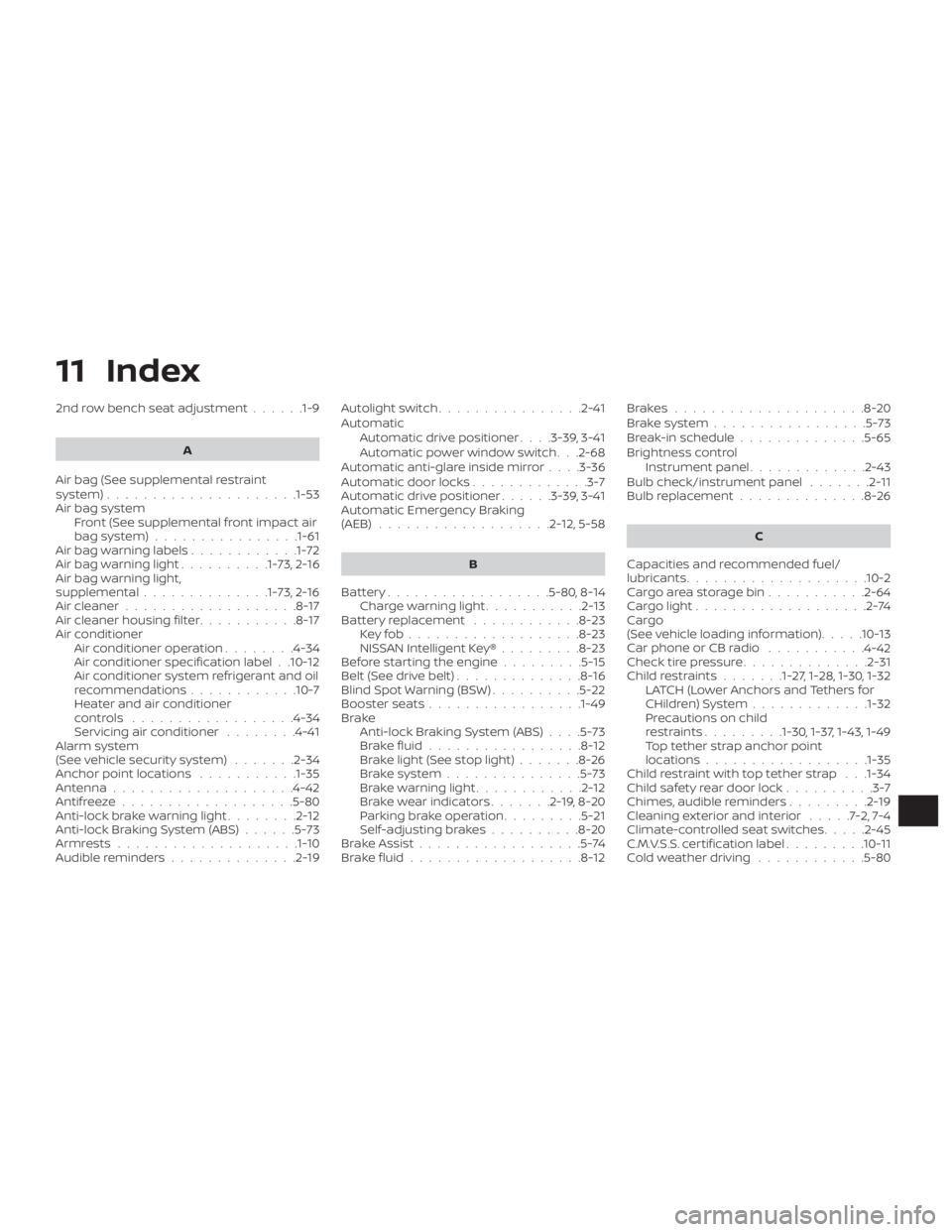
11 Index
2nd row bench seat adjustment......1-9
A
Air bag (See supplemental restraint
system) .................... .1-53
Air bag system Front (See supplemental front impact air
bagsystem)............... .1-61
Air bag warning labels ............1-72
Airbagwarninglight..........1-73, 2-16
Air bag warning light,
supplemental ..............1-73, 2-16
Air cleaner ...................8-17
Air cleaner housing filter ...........8-17
Air conditioner Air conditioner operation ........4-34
Air conditioner specification label . .10-12
Air conditioner system refrigerant and oil
recommendations ............10-7
Heater and air conditioner
controls ..................4-34
Servicing air conditioner ........4-41
Alarm system
(See vehicle security system) .......2-34
Anchor point locations ...........1-35
Antenna ....................4-42
Antifreeze ...................5-80
Anti-lock brake warning light ........2-12
Anti-lock Braking System (ABS) ......5-73
Armrests................... .1-10
Audible reminders ..............2-19 Autolightswitch................2-41
Automatic
Automatic drive positioner ....3-39,3-41
Automatic power window switch. . .2-68
Automatic anti-glare inside mirror . . . .3-36
Automatic door locks .............3-7
Automatic drive positioner ......3-39,3-41
Automatic Emergency Braking
(AEB) ...................2-12,5-58
B
Battery..................5-80,8-14 Charge warning light ...........2-13
Battery replacement ............8-23
Keyfob...................8-23
NISSAN Intelligent Key® .........8-23
Before starting the engine .........5-15
Belt(Seedrivebelt)..............8-16
Blind Spot Warning (BSW) ..........5-22
Booster seats .................1-49
Brake Anti-lock Braking System (ABS) ....5-73
Brakefluid.................8-12
Brakelight(Seestoplight).......8-26
Brakesystem...............5-73
Brakewarninglight............2-12
Brakewearindicators.......2-19,8-20
Parking brake operation .........5-21
Self-adjustingbrakes..........8-20
Brake Assist ..................5-74
Brakefluid...................8-12 Brakes.....................8-20
Brakesystem................
.5-73
Break-in schedule ..............5-65
Brightness control Instrument panel .............2-43
Bulb check/instrument panel .......2-11
Bulb replacement .............. 8-26
C
Capacities and recommended fuel/
lubricants....................10-2
Cargoareastoragebin...........2-64
Cargolight...................2-74
Cargo
(See vehicle loading information) .....10-13
Car phone or CB radio ...........
4-42
Check tire pressure ..............2-31
Childrestraints.......1-27, 1-28, 1-30, 1-32 LATCH (Lower Anchors and Tethers for
CHildren)System.............1-32
Precautions on child
restraints.........1-30, 1-37, 1-43, 1-49
Top tether strap anchor point
locations................. .1-35
Child restraint with top tether strap . . .1-34
Child safety rear door lock ..........3-7
Chimes, audible reminders .........2-19
Cleaningexteriorandinterior .....7-2,7-4
Climate-controlled seat switches .....2-45
C.M.V.S.S. certification label .........10-11
Coldweatherdriving ............5-80