steering NISSAN PATHFINDER 2021 User Guide
[x] Cancel search | Manufacturer: NISSAN, Model Year: 2021, Model line: PATHFINDER, Model: NISSAN PATHFINDER 2021Pages: 482, PDF Size: 5.33 MB
Page 280 of 482
∙ If your engine stalls or you cannotmake it to the top of a steep hill, never
attempt to turn around. Your vehicle
could tip or roll over. Always back
straight down in R (Reverse) gear and
apply brakes to control your speed.
∙ Heavy braking going down a hill could cause your brakes to overheat and
fade, resulting in loss of control and
an accident. Apply brakes lightly and
use a low gear to control your speed.
∙ Unsecured cargo can be thrown around when driving over rough ter-
rain. Properly secure all cargo so it will
not be thrown forward and cause in-
jury to you or your passengers.
∙ Secure heavy loads in the cargo area as far forward and as low as possible.
Do not equip the vehicle with tires
larger than specified in this manual.
This could cause your vehicle to roll
over.
∙ Do not grip the inside or spokes of the steering wheel when driving off-road.
The steering wheel could move sud-
denly and injure your hands. Instead
drive with your fingers and thumbs on
the outside of the rim. ∙ Before operating the vehicle, ensure
that the driver and all passengers
have their seat belts fastened.
∙ Always drive with the floor mats in place as the floor may become hot.
∙ Lower your speed when encountering strong crosswinds. With a higher cen-
ter of gravity, your NISSAN is more af-
fected by strong side winds. Slower
speeds ensure better vehicle control.
∙ Do not drive beyond the performance capability of the tires, even with 4WD
engaged.
∙ For 4WD equipped vehicles, do not at- tempt to raise two wheels off the
ground and shif t the transmission to
any drive or reverse position with the
engine running. Doing so may result
in drivetrain damage or unexpected
vehicle movement which could result
in serious vehicle damage or personal
injury. ∙ Do not attempt to test a 4WD
equipped vehicle on a 2-wheel dyna-
mometer (such as the dynamometers
used by some states for emissions
testing), or similar equipment even if
the other two wheels are raised off the
ground. Make sure you inform test fa-
cility personnel that your vehicle is
equipped with 4WD before it is placed
on a dynamometer. Using the wrong
test equipment may result in drive-
train damage or unexpected vehicle
movement which could result in seri-
ous vehicle damage or personal
injury.
∙ When a wheel is off the ground due to an unlevel surface, do not spin the
wheel excessively.
∙ Accelerating quickly, sharp steering maneuvers or sudden braking may
cause loss of control.
∙ If at all possible, avoid sharp turning maneuvers, particularly at high
speeds. Your NISSAN vehicle has a
higher center of gravity than a pas-
senger car. The vehicle is not de-
signed for cornering at the same
speeds as passenger cars.
5-10Starting and driving
Page 332 of 482
∙ The system is designed to automati-cally check the sensor’s functionality,
within certain limitations. The system
may not detect some forms of ob-
structions of the sensor area such as
ice, snow, stickers, etc. In these cases,
the system may not be able to worn
the driver properly. Be sure that you
check, clean and clear the sensor area
regularly.
∙ Excessive noise will interfere with the warning chime sound, and the chime
may not be heard.
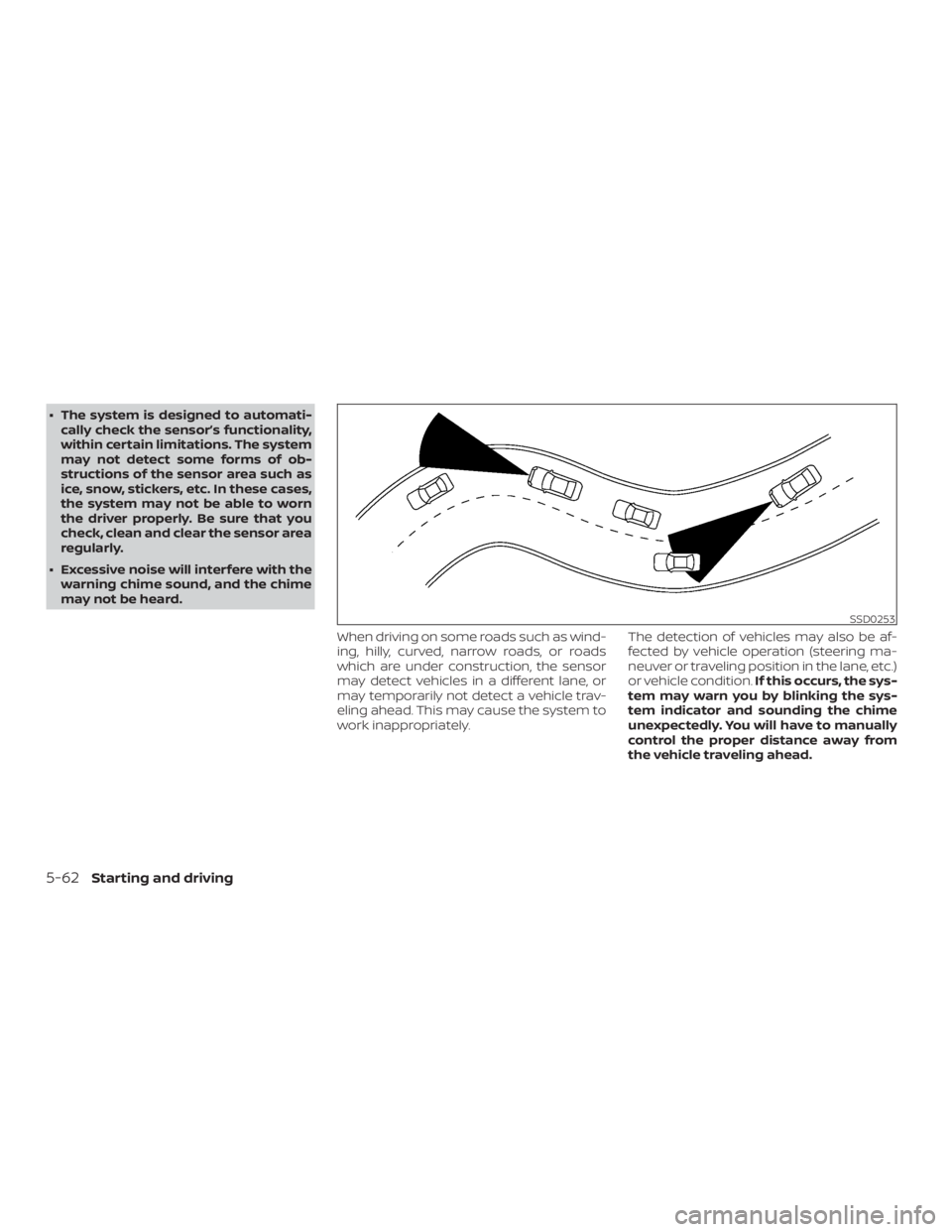
When driving on some roads such as wind-
ing, hilly, curved, narrow roads, or roads
which are under construction, the sensor
may detect vehicles in a different lane, or
may temporarily not detect a vehicle trav-
eling ahead. This may cause the system to
work inappropriately. The detection of vehicles may also be af-
fected by vehicle operation (steering ma-
neuver or traveling position in the lane, etc.)
or vehicle condition.
If this occurs, the sys-
tem may warn you by blinking the sys-
tem indicator and sounding the chime
unexpectedly. You will have to manually
control the proper distance away from
the vehicle traveling ahead.
Page 344 of 482
– When replacing tires, install thespecified size of tires on all four
wheels.
– When installing a spare tire, make sure that it is the proper size and
type as specified on the Tire and
Loading Information label. For ad-
ditional information, refer to “Tire
and Loading Information label” in
the “Technical and consumer infor-
mation” section of this manual.
– For additional information, refer to “Wheels and tires” in the “Do-it-
yourself ” section of this manual.
The ABS controls the brakes so the wheels
do not lock during hard braking or when
braking on slippery surfaces. The system
detects the rotation speed at each wheel
and varies the brake fluid pressure to pre-
vent each wheel from locking and sliding.
By preventing each wheel from locking, the
system helps the driver maintain steering
control and helps to minimize swerving
and spinning on slippery surfaces.
Using the system
Depress the brake pedal and hold it down.
Depress the brake pedal with firm steady
pressure, but do not pump the brakes. The Anti-lock Braking System will operate to
prevent the wheels from locking up. Steer
the vehicle to avoid obstacles.
Page 345 of 482
WARNING
The Brake Assist is only an aid to assist
braking operation and is not a collision
warning or avoidance device. It is the
driver’s responsibility to stay alert, drive
safely and be in control of the vehicle at
all times.The VDC system uses various sensors to
monitor driver inputs and vehicle motion.
Under certain driving conditions, the VDC
system helps to perform the following
functions:
∙ Controls brake pressure to reduce wheel slip on one slipping drive wheel
so power is transferred to a non-
slipping drive wheel on the same axle.
∙ Controls brake pressure and engine output to reduce drive wheel slip based
on vehicle speed (traction control func-
tion).
∙ Controls brake pressure at individual wheels and engine output to help the
driver maintain control of the vehicle in
the following conditions:
– Understeer (vehicle tends to not fol- low the steered path despite in-
creased steering input)
– Oversteer (vehicle tends to spin due to certain road or driving conditions)
The VDC system can help the driver to
maintain control of the vehicle, but it can-
not prevent loss of vehicle control in all driv-
ing situations. When the VDC system operates, the
Page 368 of 482
CAUTION
∙ Never tow CVT models with the frontwheels on the ground or four wheels
on the ground (forward or backward),
as this may cause serious and expen-
sive damage to the transmission. If it
is necessary to tow the vehicle with
the rear wheels raised always use
towing dollies under the front wheels.
∙ When towing CVT models with the rear wheels on the ground or on tow-
ing dollies:
– Place the ignition switch in the OFF position, and secure the steering
wheel in a straight-ahead position
with a rope or similar device. Never
secure the steering wheel by plac-
ing the ignition switch in the LOCK
position. This may damage the
steering lock mechanism (for
models with a steering lock
mechanism).
VEHICLE RECOVERY (freeing a
stuck vehicle)
Page 459 of 482
Pre-towing tips
∙ Be certain your vehicle maintains a levelposition when a loaded and/or un-
loaded trailer is hitched. Do not drive the
vehicle if it has an abnormal nose-up or
nose-down condition; check for im-
proper tongue load, overload, worn sus-
pension or other possible causes of ei-
ther condition.
∙ Always secure items in the trailer to pre- vent load shif t while driving.
∙ Keep the cargo load as low as possible in the trailer to keep the trailer center of
gravity low.
∙ Load the trailer so approximately 60% of the trailer load is in the front half and
40% is in the back half. Also make sure
the load is balanced side to side.
∙ Check your hitch, trailer tire pressure, vehicle tire pressure, trailer light opera-
tion, and trailer wheel lug nuts every
time you attach a trailer to the vehicle.
∙ Be certain your rearview mirrors con- form to all federal, state or local regula-
tions. If not, install any mirrors required
for towing before driving the vehicle. ∙ Determine the overall height of the ve-
hicle and trailer so the required clear-
ance is known.
Trailer towing tips
In order to gain skill and an understanding
of the vehicle’s behavior, you should prac-
tice turning, stopping and backing up in an
area which is free from traffic. Steering sta-
bility and braking performance will be
somewhat different than under normal
driving conditions.
∙ Always secure items in the trailer to pre- vent load shif t while driving.
∙ Lock the trailer hitch coupler with a pin or lock to prevent the coupler from in-
advertently becoming unlatched.
∙ Avoid abrupt starts, acceleration or stops.
∙ Avoid sharp turns or lane changes.
∙ Always drive your vehicle at a moderate speed. ∙ When backing up, hold the bottom of
the steering wheel with one hand. Move
your hand in the direction in which you
want the trailer to go. Make small cor-
rections and back up slowly. If possible,
have someone guide you when you are
backing up.
Always block the wheels on both vehicle
and trailer when parking. Parking on a
slope is not recommended; however, if you
must do so:
Page 468 of 482
Compass.....................2-8
Console box ..................2-60
Console light ..................2-73
Continuously Variable Transmission
(CVT) .......................5-16
Continuously Variable Transmission
(CVT) fluid ..................8-11
Driving with Continuously Variable
Transmission (CVT) ............5-16
Controls Heater and air conditioner controls . .4-34
Coolant Capacities and recommended
fuel/lubricants...............10-2
Changing engine coolant .........8-6
Checking engine coolant level ......8-6
Engine coolant temperature gauge . .2-6
Corrosionprotection..............7-7
Cruisecontrol ..............5-41,5-41
Cupholders...................2-62
D
Daytime Running Light System .......2-43
Defroster switch Rear window and outside mirror
defrosterswitch..............2-39
Dimensions and weights ...........10-9
Dimmer switch for instrument panel . . .2-43
Door locks ....................3-5
Drivebelt ....................8-16
Drive positioner, Automatic ......3-39,3-41
Driving Coldweatherdriving...........5-80 Driving with Continuously Variable
Transmission (CVT)
............5-16
Precautions when starting and
driving.....................5-2
Drivingthevehicle...............5-16
Dual panel moonroof .............2-69
Dual power moonroof ............2-69
E
E-CALL (SOS) SWITCH .............2-53
Economy - fuel .................5-67
Emergency engine shutoff .......5-13,6-2
Emission control information label . . . .10-11
Emission control system warranty . . . .10-31
Engine Before starting the engine ........5-15
Capacities and recommended
fuel/lubricants...............10-2
Changing engine coolant .........8-6
Changing engine oil ............8-7
Changing engine oil filter .........8-7
Checking engine coolant level ......8-6
Checking engine oil level .........8-7
Engine compartment check
locations...................8-4
Engine coolant temperature gauge . .2-6
Engine cooling system ..........8-5
Engine oil ...................8-7
Engine oil and oil filter
recommendation .............10-6
Engine oil viscosity .............10-7
Engine serial number ...........10-11
Engine specifications ...........10-8 Starting the engine
............5-15
Engine Block Heater ..............5-81
Engine coolant temperature gauge ....2-6
EventDatarecorders............10-34
Exhaust gas (Carbon monoxide) .......5-2
Explanation of maintenance items .....9-2
Explanation of scheduled maintenance
items .......................9-5
Extended storage switch ..........2-57
Eyeglasscase..................2-61
F
Flashers
(Seehazardwarningflasherswitch)....6-2
Flattire......................6-3
Floormatpositioningaid...........7-6
Fluid Brakefluid..................8-12
Capacities and recommended
fuel/lubricants...............10-2
Continuously Variable Transmission
(CVT) fluid ..................8-11
Engine coolant ...............8-5
Engine oil ...................8-7
Powersteeringfluid............8-11
Windshield-washer fluid .........
8-12
F.M.V.S.S. certification label ..........10-11
Foglightswitch................2-44
Front air bag system
(See supplemental restraint system) . . . .1-61
Front-door pocket ..............2-58
Front power seat adjustment ........1-5
Frontseats....................1-2
11-2
Page 469 of 482
FuelCapacities and recommended
fuel/lubricants...............10-2
Fuel economy ...............5-67
Fuel-filler door and cap ..........3-30
Fuel gauge ..................2-7
Fueloctanerating.............10-6
Fuel recommendation ..........10-4
Loose fuel cap warning ..........2-31
Fuelefficientdrivingtips...........5-66
Fuel-filler door .................3-30
Fuel gauge ....................2-7
Fuses .......................8-21
Fusiblelinks...................8-22
G
Garage door opener, HomeLink® Universal
Transceiver ..........2-74,2-75,2-77,2-78
Gascap.....................3-30
Gauge Engine coolant temperature gauge . .2-6
Fuel gauge ..................2-7
Odometer ..................2-5
Speedometer ..............2-4,2-5
Tachometer .................2-6
Trip odometer .............2-4,2-5
General maintenance .............9-2
Glovebox....................2-60
Gloveboxlock.................2-60 H
Hazard warning flasher switch ........6-2
Headlight and turn signal switch ......2-40
Headlightcontrolswitch...........2-40
Headlights ...................8-25
Headrestraints.................1-12
Heated 2nd row seat switches .......2-47
Heatedseats..................2-45
Heated seat switches ............2-46
Heated steering wheel switch ....2-48,2-49
Heater Heater and air conditioner controls . .4-34
Heater operation .............4-35
Hill descent control switch .........2-50
Hill descent control system .........5-78
Hill start assist system ............5-78
HomeLink® Universal
Transceiver ..........2-74,2-75,2-77,2-78
Hood .......................3-23
Hook Luggage hook ...............2-64
Horn.......................2-45
I
Ignition switch Push-button ignition switch .......5-11
Immobilizer system ...........2-35,5-14
Important vehicle information label . . . .10-11
In-cabinmicrofilter..............8-18
Increasing fuel economy ...........5-67
Indicator lights and audible reminders
(See warning/indicator lights and audible
reminders) .................2 -11, 2-16Inside automatic anti-glare mirror
.....3-36
Instrument brightness control .......2-43
Instrument panel .............0-6,2-2
Instrument panel dimmer switch .....2-43
Intelligent 4x4 (I-4x4) .............5-67
Intelligent Around View Monitor .......4-11
Intelligent Cruise Control (ICC) .......5-43
Intelligent Key system Key operating range ............3-9
Key operation ................3-10
Mechanical key ...............3-3
Remote keyless entry operation ....
3-13
Troubleshooting guide ..........3-18
Warning signals ..............3-18
Interiorlight...................2-72
ISOFIX child restraints .............1-32
J
Jumpstarting..............6-10,8-16
K
Key........................ .3-2
Key fob battery replacement ........8-23
Keyless entry With Intelligent Key system
(See Intelligent Key system) .......3-13
Keys NISSAN Intelligent Key® ........3-2,3-7
NISSAN Vehicle Immobilizer System
keys......................3-4
11-3
Page 471 of 482
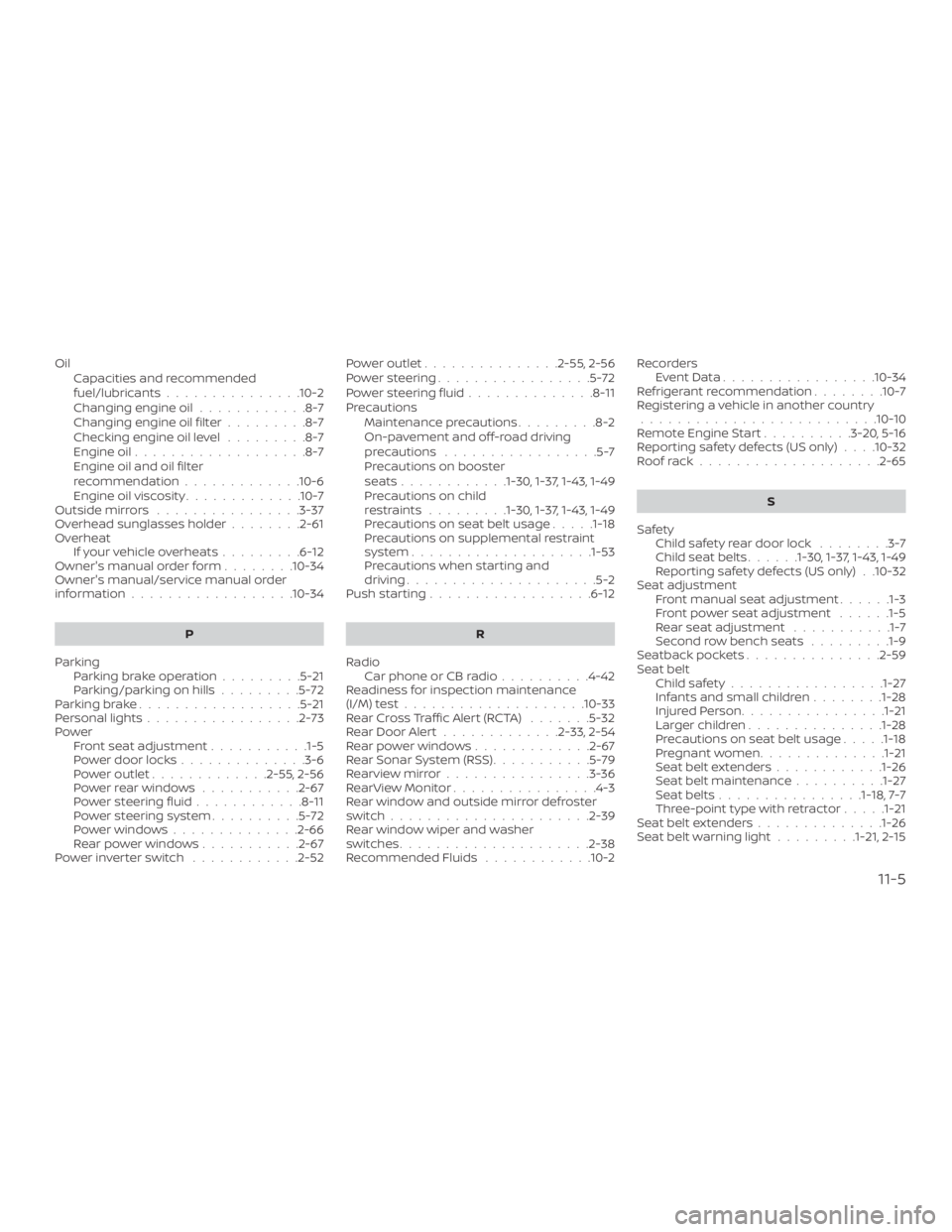
OilCapacities and recommended
fuel/lubricants...............10-2
Changing engine oil ............8-7
Changing engine oil filter .........8-7
Checking engine oil level .........8-7
Engine oil ...................8-7
Engine oil and oil filter
recommendation .............10-6
Engine oil viscosity .............10-7
Outsidemirrors ................3-37
Overhead sunglasses holder ........2-61
Overheat Ifyourvehicleoverheats.........6-12
Owner's manual order form ........10-34
Owner's manual/service manual order
information..................10-34
P
Parking Parking brake operation .........5-21
Parking/parkingonhills.........5-72
Parkingbrake..................5-21
Personal lights .................2-73
Power Front seat adjustment ...........1-5
Power door locks ..............3-6
Poweroutlet.............2-55,2-56
Powerrearwindows...........2-67
Powersteeringfluid............8-11
Power steering system ..........5-72
Powerwindows..............2-66
Rearpowerwindows...........2-67
Powerinverterswitch ............2-52 Poweroutlet...............2-55,2-56
Powersteering.................5-72
Powersteeringfluid..............8-11
Precautions
Maintenance precautions .........8-2
On-pavement and off-road driving
precautions .................5-7
Precautions on booster
seats............1-30, 1-37, 1-43, 1-49
Precautions on child
restraints.........1-30, 1-37, 1-43, 1-49
Precautions on seat belt usage .....1-18
Precautions on supplemental restraint
system ................... .1-53
Precautions when starting and
driving.....................5-2
Push starting ..................6-12
R
Radio Car phone or CB radio ..........4-42
Readiness for inspection maintenance
(I/M) test ....................10-33
RearCrossTrafficAlert(RCTA) .......5-32
Rear Door Alert .............2-33,2-54
Rearpowerwindows.............2-67
Rear Sonar System (RSS) ...........5-79
Rearviewmirror................3-36
RearViewMonitor................4-3
Rear window and outside mirror defroster
switch......................2-39
Rear window wiper and washer
switches .....................2-38
Recommended Fluids ............10-2 Recorders
EventData.................10-34
Refrigerant recommendation ........10-7
Registering a vehicle in another country ..........................10-10
Remote Engine Start ..........3-20,5-16
Reporting safety defects (US only) . . . .10-32
Roofrack....................2-65
S
Safety Child safety rear door lock ........3-7
Childseatbelts......1-30, 1-37, 1-43, 1-49
Reporting safety defects (US only) . .10-32
Seat adjustment Front manual seat adjustment ......1-3
Front power seat adjustment ......1-5
Rear seat adjustment ...........1-7
Second row bench seats .........1-9
Seatback pockets ...............2-59
Se
at beltChildsafety................ .1-27
Infants and small children ........1-28
InjuredPerson............... .1-21
Largerchildren.............. .1-28
Precautionsonseatbeltusage.....1-18
Pregnant women ..............1-21
Seat belt extenders ............1-26
Seat belt maintenance ..........1-27
Seatbelts................1-18, 7-7
Three-pointtypewithretractor.....1-21
Seat belt extenders ..............1-26
Seatbeltwarninglight.........1-21, 2-15
11-5
Page 472 of 482
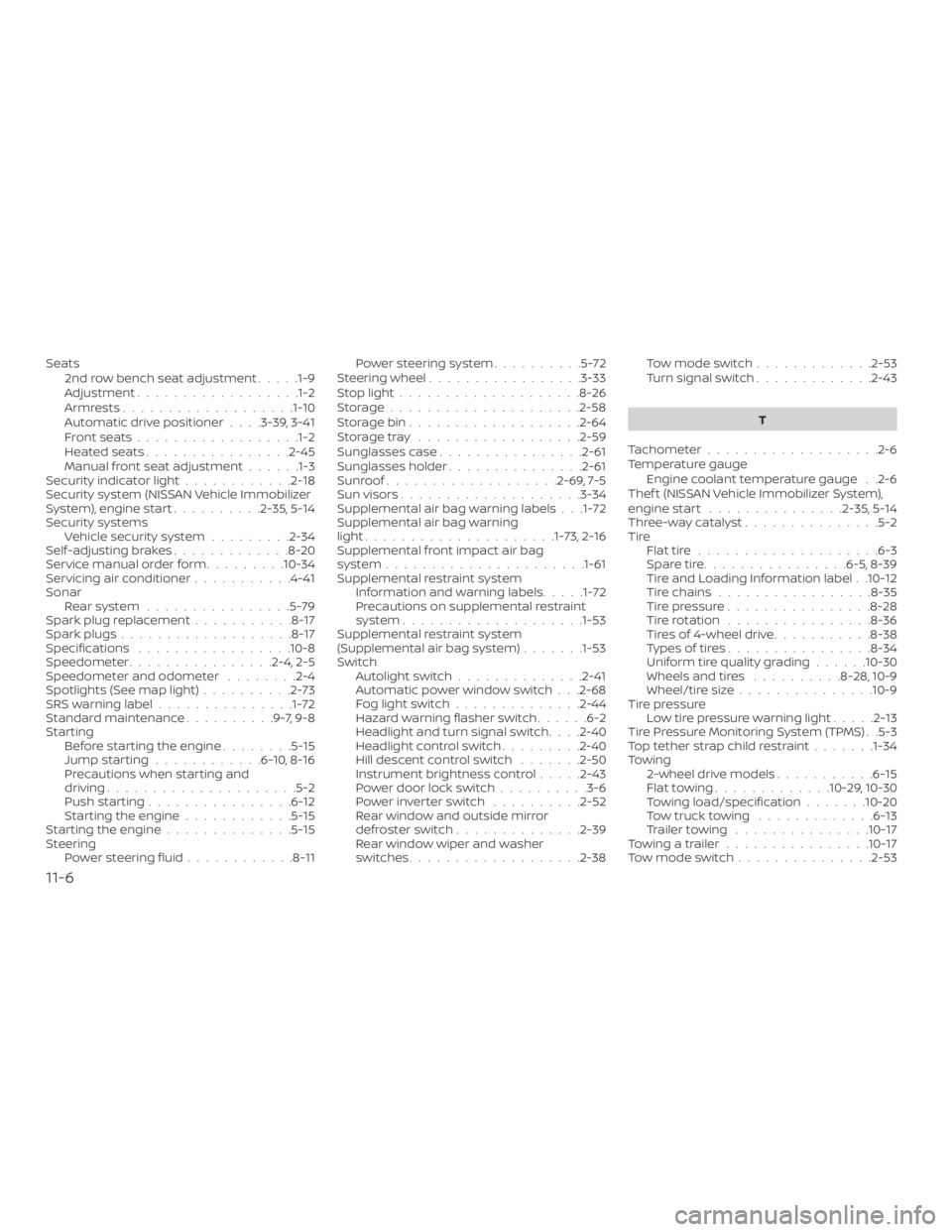
Seats2nd row bench seat adjustment .....1-9
Adjustment ..................1-2
Armrests...................1-10
Automatic drive positioner ....3-39,3-41
Frontseats..................1-2
Heatedseats................2-45
Manual front seat adjustment ......1-3
Security indicator light ............2-18
Security system (NISSAN Vehicle Immobilizer
System), engine start ..........2-35,5-14
Security systems Vehicle security system .........2-34
Self-adjustingbrakes.............8-20
Service manual order form .........10-34
Servicing air conditioner ...........4-41
Sonar Rear system ................5-79
Spark plug replacement ...........8-17
Spark plugs ...................8-17
Specifications .................10-8
Speedometer ................2-4,2-5
Speedometer and odometer ........2-4
Spotlights(Seemaplight)..........2-73
SRS warning label ...............1-72
Standard maintenance ..........9-7,9-8
Starting Before starting the engine ........5-15
Jumpstarting............6-10,8-16
Precautions when starting and
driving .....................5-2
Push starting ................6-12
Starting the engine ............5-15
Starting the engine ..............5-15
Steering Powersteeringfluid............8-11 Powersteeringsystem..........5-72
Steering wheel .................3-33
Stoplight....................8-26
Storage.....................2-58
Storagebin...................2-64
Storagetray ..................2-59
Sunglasses case ................2-61
Sunglasses holder ...............2-61
Sunroof ...................2-69,7-5
Sunvisors....................3-34
Supplemental air bag warning labels . . .1-72
Supplemental air bag warning
light.................... .1-73, 2-16
Supplemental front impact air bag
system ..................... .1-61
Supplemental restraint system Information and warning labels .....1-72
Precautions on supplemental restraint
system ................... .1-53
Supplemental restraint system
(Supplemental air bag system) .......1-53
Switch Autolightswitch..............2-41
Automatic power window switch . . .2-68
Foglightswitch..............2-44
Hazard warning flasher switch ......6-2
Headlight and turn signal switch ....2-40
Headlightcontrolswitch.........2-40
Hill descent control switch .......2-50
Instrument brightness control .....2-43
Power door lock switch ..........3-6
Powerinverterswitch ..........2-52
Rear window and outside mirror
defrosterswitch..............2-39
Rear window wiper and washer
switches ...................2-38 Tow mode switch
.............2-53
Turn signal switch .............2-43
T
Tachometer ...................2-6
T
emperature gauge Engine coolant temperature gauge . .2-6
Thef t (NISSAN Vehicle Immobilizer System),
engine start ...............2-35, 5-14
Three-waycatalyst...............5-2
Tire Flattire....................6-3
Spare tire ................6-5,8-39
Tire and Loading Information label . .10-12
Tire chains .................8-35
Tire pressure ................8-28
Tirerotation ................8-36
Tires of 4-wheel drive ...........8-38
Types of tires ................8-34
Uniform tire quality grading ......10-30
Wheels and tires ..........8-28,10-9
Wheel/tire size ...............10-9
Tire pressure Low tire pressure warning light .....2-13
Tire Pressure Monitoring System (TPMS) . .5-3
Toptetherstrapchildrestraint.......1-34
Towing 2-wheel drive models ...........6-15
Flattowing.............10-29,10-30
Towing load/specification .......10-20
Towtrucktowing .............6-13
Trailertowing ...............10-17
Towingatrailer................10-17
Tow mode switch ...............2-53
11-6