steering NISSAN PATHFINDER 2022 Owner´s Manual
[x] Cancel search | Manufacturer: NISSAN, Model Year: 2022, Model line: PATHFINDER, Model: NISSAN PATHFINDER 2022Pages: 647, PDF Size: 8.48 MB
Page 595 of 647
110,000 miles/(176,000 km)/
132 months
Perform at number of miles, kilometers or
months, whichever comes first.
Standard maintenance:
Inspections:
• Brake lines and cables
• Brake pads and rotors
• Drive belts*
• Drive shaf t boots
• Propeller shaf t (4WD models)
• Differential gear oil
• Transfer fluid
Essential:
• Replace engine oil & oil filter (5)
• Tire rotation
Severe use maintenance:
Inspections:
• Brake pads and rotors
• Exhaust system
• Drive shaf t boots
• Propeller shaf t (4WD models)
• Steering gear and linkage, axle and sus-pension parts Essential:
• Replace brake fluid
* Maintenance items and intervals with “*”
are recommended by NISSAN for reliable
vehicle operation. The owner need not per-
form such maintenance in order to main-
tain the emission warranty or manufac-
turer recall liability. Other maintenance
items and intervals are required.
(5) If the oil replacement indicator is dis-
played, change the engine oil and filter
within two weeks or less than 500 miles
(800 km).
115,000 miles/(184,000 km)/
138 months
Perform at number of miles, kilometers or
months, whichever comes first.
Standard maintenance:
Not applicable. Proceed to next interval.
Severe use maintenance:
Inspections:
• Brake pads and rotors
• Exhaust system
• Drive shaf t boots
• Propeller shaf t (4WD models)
• Steering gear and linkage, axle and sus-
pension parts
9-20Maintenance and schedules
Page 596 of 647
120,000 miles/(192,000 km)/
144 months
Perform at number of miles, kilometers or
months, whichever comes first.
Standard maintenance:
Inspections:
• Brake lines and cables
• Brake pads and rotors
• Drive belts*
• EVAP vapor lines & fuel lines*
• Exhaust system
• Drive shaf t boots
• Propeller shaf t (4WD models)
• Steering gear and linkage, axle and sus-pension parts
• Differential gear oil
• Transfer fluid
Essential:
• Replace air cleaner filter (1)
• Replace brake fluid
• Replace engine oil & oil filter (5)
• Replace in-cabin microfilter
• Replace Intelligent Key battery
• Tire rotation Severe use maintenance:
Inspections:
• Brake pads and rotors
• Exhaust system
• Drive shaf t boots
• Propeller shaf t (4WD models)
• Steering gear and linkage, axle and sus-
pension parts
Essential:
• Replace brake fluid
• Replace differential gear oil
• Replace transfer fluid
* Maintenance items and intervals with “*”
are recommended by NISSAN for reliable
vehicle operation. The owner need not per-
form such maintenance in order to main-
tain the emission warranty or manufac-
turer recall liability. Other maintenance
items and intervals are required.
(1) If operating mainly in dusty conditions,
more frequent maintenance may be
required. (5) If the oil replacement indicator is dis-
played, change the engine oil and filter
within two weeks or less than 500 miles
(800 km).
Maintenance and schedules9-21
Page 617 of 647
WARNING
Overloading or improper loading of a
trailer and its cargo can adversely af-
fect vehicle handling, braking and per-
formance and may lead to accidents.
CAUTION
• Do not tow a trailer or haul a heavy
load for the first 500 miles (805 km).
Your engine, axle or other parts could
be damaged.
• For the first 500 miles (805 km) that
you tow a trailer, do not drive over 50
mph (80 km/h) and do not make
starts at full throttle. This helps the
engine and other parts of your ve-
hicle wear in at the heavier loads.
Your new vehicle was designed to be used
primarily to carry passengers and cargo.
Remember that towing a trailer places ad-
ditional loads on your vehicle's engine,
drive train, steering, braking and other
systems.
A NISSAN Towing Guide (U.S. only) is available
on the website at www.nissanusa.com.
This guide includes information on trailer
towing capability and the special equipment
required for proper towing.
MAXIMUM LOAD LIMITS
Maximum trailer loads
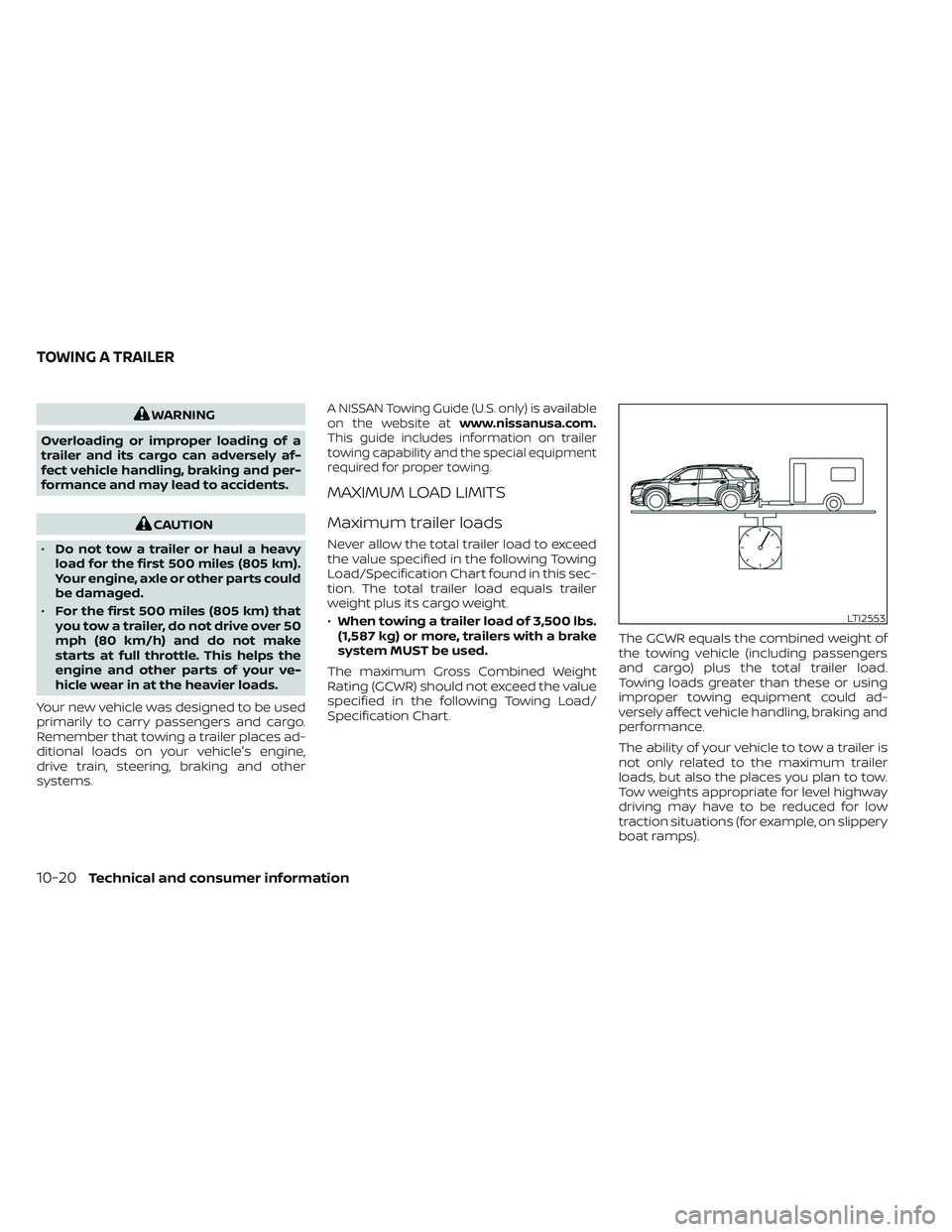
Never allow the total trailer load to exceed
the value specified in the following Towing
Load/Specification Chart found in this sec-
tion. The total trailer load equals trailer
weight plus its cargo weight.
• When towing a trailer load of 3,500 lbs.
(1,587 kg) or more, trailers with a brake
system MUST be used.
The maximum Gross Combined Weight
Rating (GCWR) should not exceed the value
specified in the following Towing Load/
Specification Chart. The GCWR equals the combined weight of
the towing vehicle (including passengers
and cargo) plus the total trailer load.
Towing loads greater than these or using
improper towing equipment could ad-
versely affect vehicle handling, braking and
performance.
The ability of your vehicle to tow a trailer is
not only related to the maximum trailer
loads, but also the places you plan to tow.
Tow weights appropriate for level highway
driving may have to be reduced for low
traction situations (for example, on slippery
boat ramps).
LTI2553
TOWING A TRAILER
10-20Technical and consumer information
Page 626 of 647
• Keep the cargo load as low as possible inthe trailer to keep the trailer center of
gravity low.
• Load the trailer so approximately 60% of the trailer load is in the front half and 40%
is in the back half. Also make sure the load
is balanced side to side.
• Check your hitch, trailer tire pressure, ve- hicle tire pressure, trailer light operation,
and trailer wheel lug nuts every time you
attach a trailer to the vehicle.
• Be certain your rearview mirrors conform to all federal, state or local regulations. If
not, install any mirrors required for towing
before driving the vehicle.
• Determine the overall height of the ve- hicle and trailer so the required clearance
is known.
Trailer towing tips
In order to gain skill and an understanding
of the vehicle's behavior, you should prac-
tice turning, stopping and backing up in an
area which is free from traffic. Steering sta-
bility and braking performance will be
somewhat different than under normal
driving conditions.
• Always secure items in the trailer to pre-vent load shif t while driving. • Lock the trailer hitch coupler with a pin or
lock to prevent the coupler from inadver-
tently becoming unlatched.
• Avoid abrupt starts, acceleration or stops.
• Avoid sharp turns or lane changes.
• Always drive your vehicle at a moderate speed.
• When backing up, hold the bottom of the steering wheel with one hand. Move your
hand in the direction in which you want
the trailer to go. Make small corrections
and back up slowly. If possible, have
someone guide you when you are back-
ing up.
Always block the wheels on both vehicle
and trailer when parking. Parking on a
slope is not recommended; however, if you
must do so:CAUTION
If you push the park button to engage
the P (Park) position before blocking
the wheels and applying the parking
brake, transmission damage could
occur. 1. Apply and hold the brake pedal.
2. Have someone place blocks on the
downhill side of the vehicle and trailer
wheels.
3. Af ter the wheel blocks are in place, slowly release the brake pedal until the
blocks absorb the vehicle load.
4. Apply the parking brake.
5. Push the park button to engage the P (Park) position.
6. Turn off the engine.
To drive away:
1. Start the vehicle.
2. Apply and hold the brake pedal.
3. Shif t the transmission into gear.
4. Release the parking brake.
5. Drive slowly until the vehicle and trailer are clear from the blocks.
6. Apply and hold the brake pedal.
7. Have someone retrieve and store the blocks.
Technical and consumer information10-29
Page 627 of 647
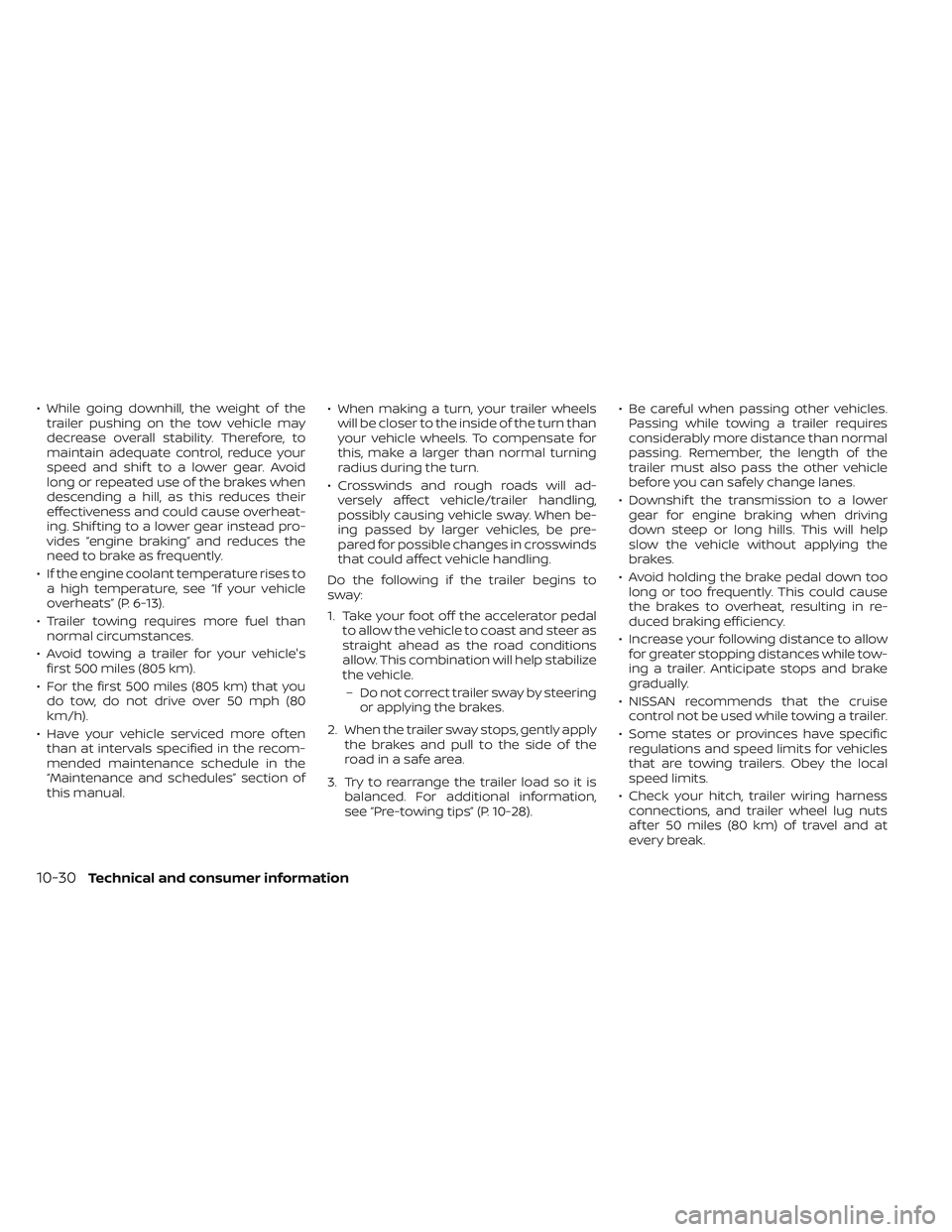
• While going downhill, the weight of thetrailer pushing on the tow vehicle may
decrease overall stability. Therefore, to
maintain adequate control, reduce your
speed and shif t to a lower gear. Avoid
long or repeated use of the brakes when
descending a hill, as this reduces their
effectiveness and could cause overheat-
ing. Shif ting to a lower gear instead pro-
vides “engine braking” and reduces the
need to brake as frequently.
• If the engine coolant temperature rises to a high temperature, see “If your vehicle
overheats” (P. 6-13).
• Trailer towing requires more fuel than normal circumstances.
• Avoid towing a trailer for your vehicle's first 500 miles (805 km).
• For the first 500 miles (805 km) that you do tow, do not drive over 50 mph (80
km/h).
• Have your vehicle serviced more of ten than at intervals specified in the recom-
mended maintenance schedule in the
“Maintenance and schedules” section of
this manual. • When making a turn, your trailer wheels
will be closer to the inside of the turn than
your vehicle wheels. To compensate for
this, make a larger than normal turning
radius during the turn.
• Crosswinds and rough roads will ad- versely affect vehicle/trailer handling,
possibly causing vehicle sway. When be-
ing passed by larger vehicles, be pre-
pared for possible changes in crosswinds
that could affect vehicle handling.
Do the following if the trailer begins to
sway:
1. Take your foot off the accelerator pedal to allow the vehicle to coast and steer as
straight ahead as the road conditions
allow. This combination will help stabilize
the vehicle.
– Do not correct trailer sway by steering or applying the brakes.
2. When the trailer sway stops, gently apply the brakes and pull to the side of the
road in a safe area.
3. Try to rearrange the trailer load so it is balanced. For additional information,
see “Pre-towing tips” (P. 10-28). • Be careful when passing other vehicles.
Passing while towing a trailer requires
considerably more distance than normal
passing. Remember, the length of the
trailer must also pass the other vehicle
before you can safely change lanes.
• Downshif t the transmission to a lower gear for engine braking when driving
down steep or long hills. This will help
slow the vehicle without applying the
brakes.
• Avoid holding the brake pedal down too long or too frequently. This could cause
the brakes to overheat, resulting in re-
duced braking efficiency.
• Increase your following distance to allow for greater stopping distances while tow-
ing a trailer. Anticipate stops and brake
gradually.
• NISSAN recommends that the cruise control not be used while towing a trailer.
• Some states or provinces have specific regulations and speed limits for vehicles
that are towing trailers. Obey the local
speed limits.
• Check your hitch, trailer wiring harness connections, and trailer wheel lug nuts
af ter 50 miles (80 km) of travel and at
every break.
10-30Technical and consumer information
Page 633 of 647

These data can help provide a better un-
derstanding of the circumstances in which
crashes and injuries occur. NOTE: EDR data
are recorded by your vehicle only if a non-
trivial crash situation occurs; no data are
recorded by the EDR under normal driving
conditions and no personal data (e.g.,
name, gender, age, and crash location) are
recorded. However, other parties, such as
law enforcement, could combine the EDR
data with the type of personally identif ying
data routinely acquired during a crash
investigation.
To read data recorded by an EDR, special
equipment is required, and access to the
vehicle or the EDR is needed. In addition to
the vehicle manufacturer and NISSAN
dealer, other parties, such as law enforce-
ment, that have the special equipment, can
read the information if they have access to
the vehicle or the EDR.
EDR data will only be accessed with the
consent of the vehicle owner or lessee or
as otherwise required or permitted by law.ADDITIONAL DATA RECORDING (on
vehicles equipped with optional
ProPILOT Assist)
If your vehicle is equipped with the optional
ProPILOT Assist, it will also be equipped
with a supplemental vehicle data record-
ing function.
The data recording function is designed to
record such data as:
• Driver operational status of accelerator,brakes, steering, etc.
• Detection status of a vehicle ahead and lane markers
• Vehicle information including distance to vehicle ahead and lateral position
• Information on the operation of the Pro- PILOT Assist and other crash avoidance
features
• ProPILOT Assist malfunction diagnosis information
• External images from multi-sensing front camera (Available only when SRS air bag
or AEB with Pedestrian Detection system
is activated)
ProPILOT Assist does not record conversa-
tions, sounds or images of the inside of the
vehicle. To read this vehicle data, special equip-
ment is required and access to the vehicle
or the recording unit is needed. This vehicle
data will only be accessed with the consent
of the vehicle owner or lessee or as other-
wise required or permitted by law.
If downloaded, NISSAN may use the data
recorded for the purpose of improving
NISSAN's vehicle safety performance.
NISSAN will not disclose/provide the re-
corded data to a third party except:
• With the consent of the vehicle owner or
with the consent of the lessee
• In response to an official request from law enforcement, a court order, governmen-
tal agency, or other legally enforceable
requests
• For use as part of NISSAN's defense of litigation
• For research purposes af ter the data is modified such that it is no longer tied to a
specific vehicle or vehicle owner
If you have any questions regarding the
data NISSAN may collect about you,
please visit our Privacy Policy:
https://www.nissanusa.com.
10-36Technical and consumer information
Page 638 of 647
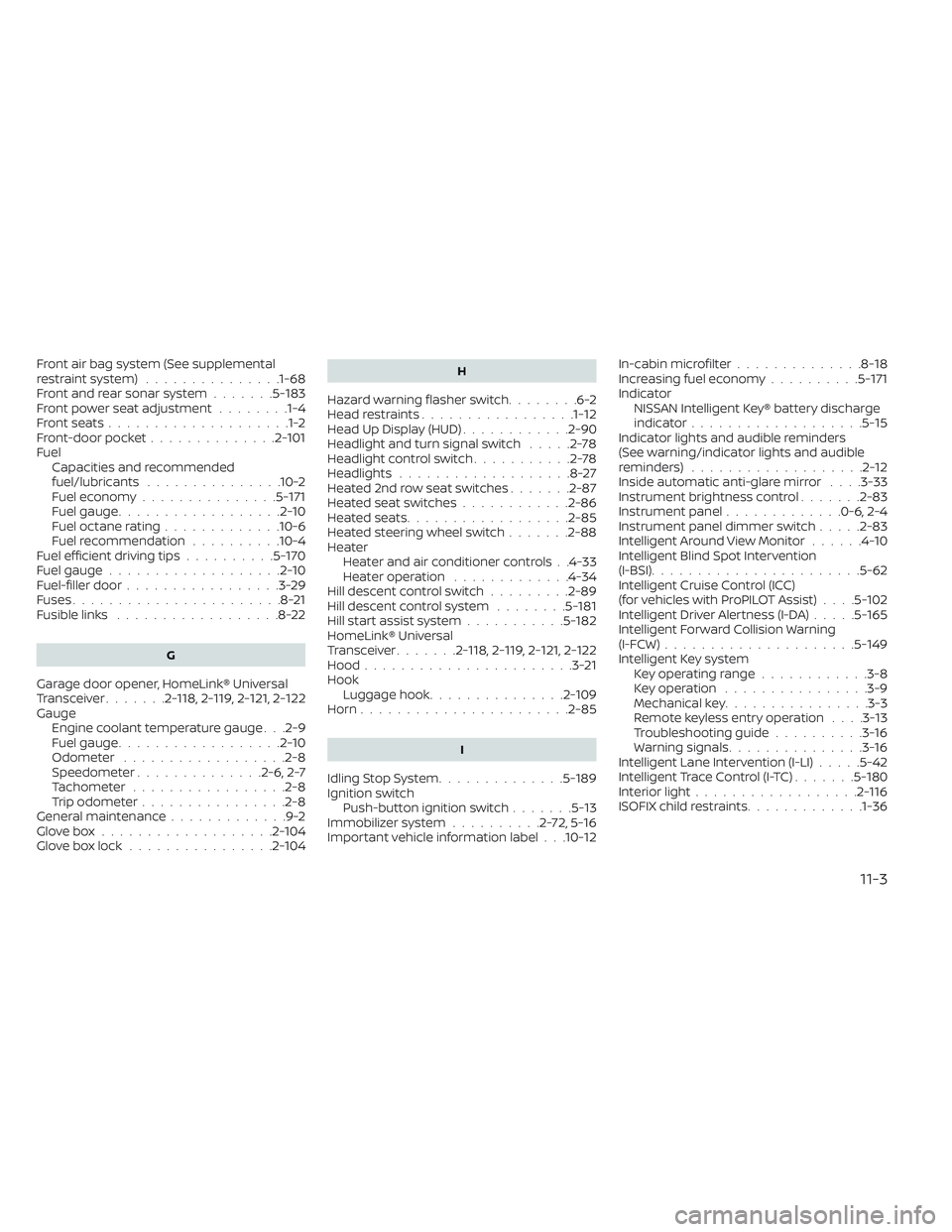
Front air bag system (See supplemental
restraint system)...............1-68Front and rear sonar system.......5-183Front power seat adjustment........1-4Front seats....................1-2Front-door pocket..............2-101FuelCapacities and recommended
fuel/lubricants
...............10-2Fuel economy...............5-171Fuel gauge..................2-10Fuel octane rating.............10-6Fuel recommendation..........10-4Fuel efficient driving tips..........5-170Fuel gauge...................2-10Fuel-filler door.................3-29Fuses.......................8-21Fusible links..................8-22
G
Garage door opener, HomeLink® Universal
Transceiver.......2- 118, 2-119, 2-121, 2-122Gauge
Engine coolant temperature gauge. . .2-9Fuel gauge..................2-10Odometer................. .2-8Speedometer..............2-6, 2-7Tachometer.................2-8Trip odometer................2-8General maintenance.............9-2Glove box...................2-104Glove box lock................2-104
H
Hazard warning flasher switch........6-2Head restraints.................1-12Head Up Display (HUD)............2-90Headlight and turn signal switch.....2-78Headlight control switch...........2-78Headlights...................8-27Heated 2nd row seat switches.......2-87Heated seat switches............2-86Heated seats................. .2-85Heated steering wheel switch.......2-88Heater
Heater and air conditioner controls. .4-33Heater operation.............4-34Hill descent control switch.........2-89Hill descent control system........5-181Hill start assist system...........5-182HomeLink® Universal
Transceiver.......2- 118, 2-119, 2-121, 2-122Hood.......................3-21Hook
Luggage hook...............2-109Horn...................... .2-85
I
Idling Stop System..............5-189Ignition switch
Push-button ignition switch.......5-13Immobilizer system..........2-72,5-16Important vehicle information label. . .10-12
In-cabin microfilter..............8-18Increasing fuel economy..........5-171IndicatorNISSAN Intelligent Key® battery discharge
indicator
...................5-15Indicator lights and audible reminders
(See warning/indicator lights and audible
reminders)
...................2-12Inside automatic anti-glare mirror. . . .3-33Instrument brightness control.......2-83Instrument panel.............0-6, 2-4Instrument panel dimmer switch.....2-83Intelligent Around View Monitor......4-10Intelligent Blind Spot Intervention
(I-BSI)...................... .5-62Intelligent Cruise Control (ICC)
(for vehicles with ProPILOT Assist). . . .5-102Intelligent Driver Alertness (I-DA).....5-165Intelligent Forward Collision Warning
(I-FCW).....................5-149Intelligent Key system
Key operating range............3-8Key operation................3-9Mechanical key................3-3Remote keyless entry operation. . . .3-13Troubleshooting guide..........3-16Warning signals...............3-16Intelligent Lane Intervention (I-LI).....5-42Intelligent Trace Control (I-TC).......5-180Interior light..................2-116ISOFIX child restraints.............1-36
11-3
Page 640 of 647
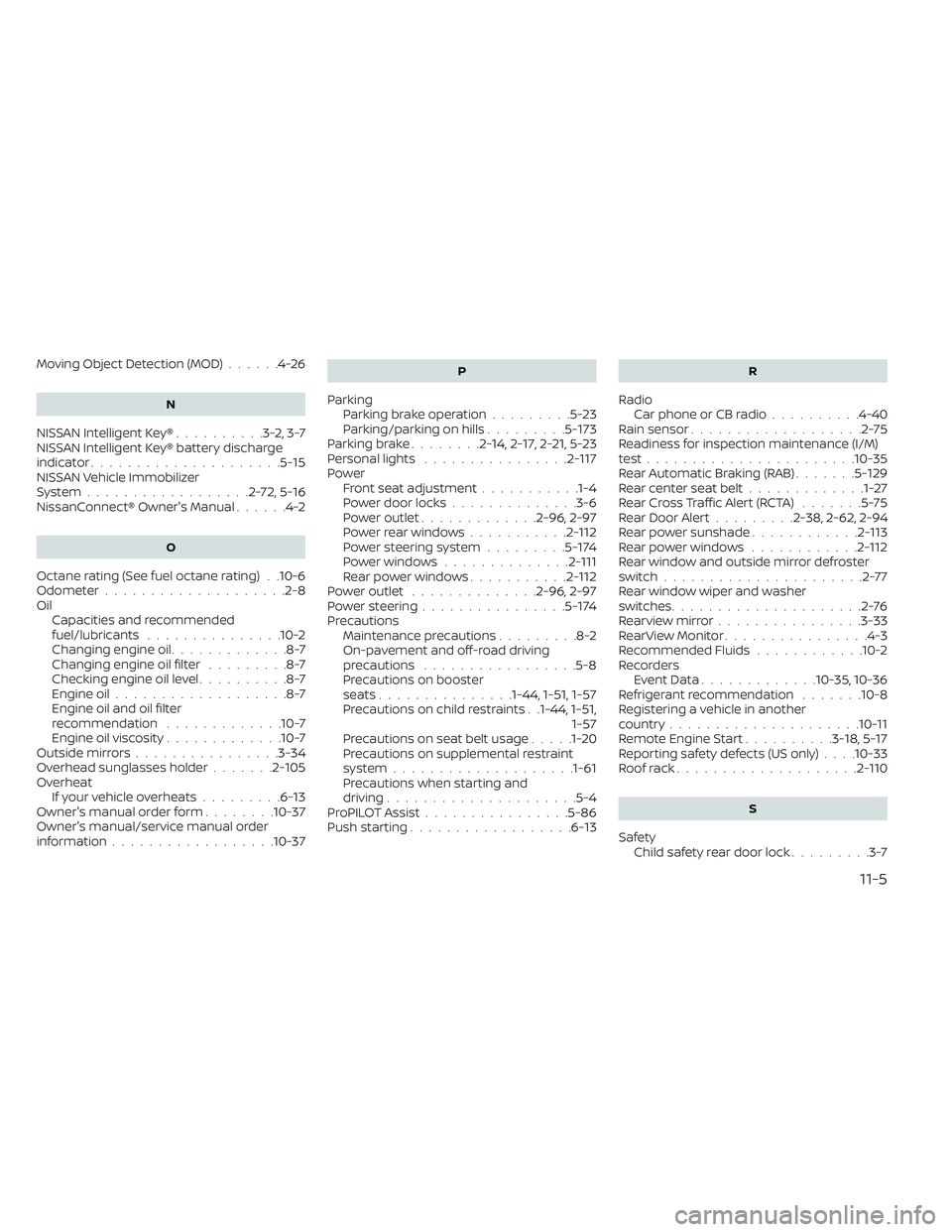
Moving Object Detection (MOD)......4-26
N
NISSAN Intelligent Key®..........3-2,3-7NISSAN Intelligent Key® battery discharge
indicator.....................5-15NISSAN Vehicle Immobilizer
System..................2-72,5-16NissanConnect® Owner's Manual......4-2
O
Octane rating (See fuel octane rating). .10-6Odometer....................2-8Oil
Capacities and recommended
fuel/lubricants
...............10-2Changing engine oil.............8-7Changing engine oil filter.........8-7Checking engine oil level..........8-7Engine oil...................8-7Engine oil and oil filter
recommendation.............10-7Engine oil viscosity.............10-7Outside mirrors................3-34Overhead sunglasses holder.......2-105OverheatIf your vehicle overheats.........6-13Owner's manual order form........10-37Owner's manual/service manual order
information................. .10-37
P
Parking
Parking brake operation.........5-23Parking/parking on hills.........5-173Parking brake........2-14,2-17,2-21,5-23Personal lights................2-117PowerFront seat adjustment...........1-4Power door locks..............3-6Power outlet.............2-96, 2-97Powerrearwindows...........2-112Power steering system.........5-174Power windows..............2-111Rear power windows...........2-112Power outlet..............2-96, 2-97Power steering................5-174PrecautionsMaintenance precautions.........8-2On-pavement and off-road driving
precautions................ .5-8Precautions on booster
seats...............1-44, 1-51, 1-57Precautions on child restraints. .1-44, 1-51,
1-57
Precautions on seat belt usage.....1-20Precautions on supplemental restraint
system................... .1-61Precautions when starting and
driving.................... .5-4ProPILOT Assist................5-86Push starting..................6-13
R
Radio
Car phone or CB radio..........4-40Rain sensor...................2-75Readiness for inspection maintenance (I/M)
test...................... .10-35Rear Automatic Braking (RAB).......5-129Rear center seat belt.............1-27Rear Cross Traffic Alert (RCTA).......5-75Rear Door Alert.........2-38, 2-62, 2-94Rear power sunshade............2-113Rear power windows............2-112Rear window and outside mirror defroster
switch......................2-77Rear window wiper and washer
switches.....................2-76Rearview mirror................3-33RearView Monitor................4-3Recommended Fluids............10-2Recorders
Event Data.............10-35, 10-36Refrigerant recommendation.......10-8Registering a vehicle in another
country.................... .10-11Remote Engine Start..........3-18,5-17Reporting safety defects (US only). . . .10-33Roof rack....................2-110
S
Safety
Child safety rear door lock.........3-7
11-5
Page 641 of 647
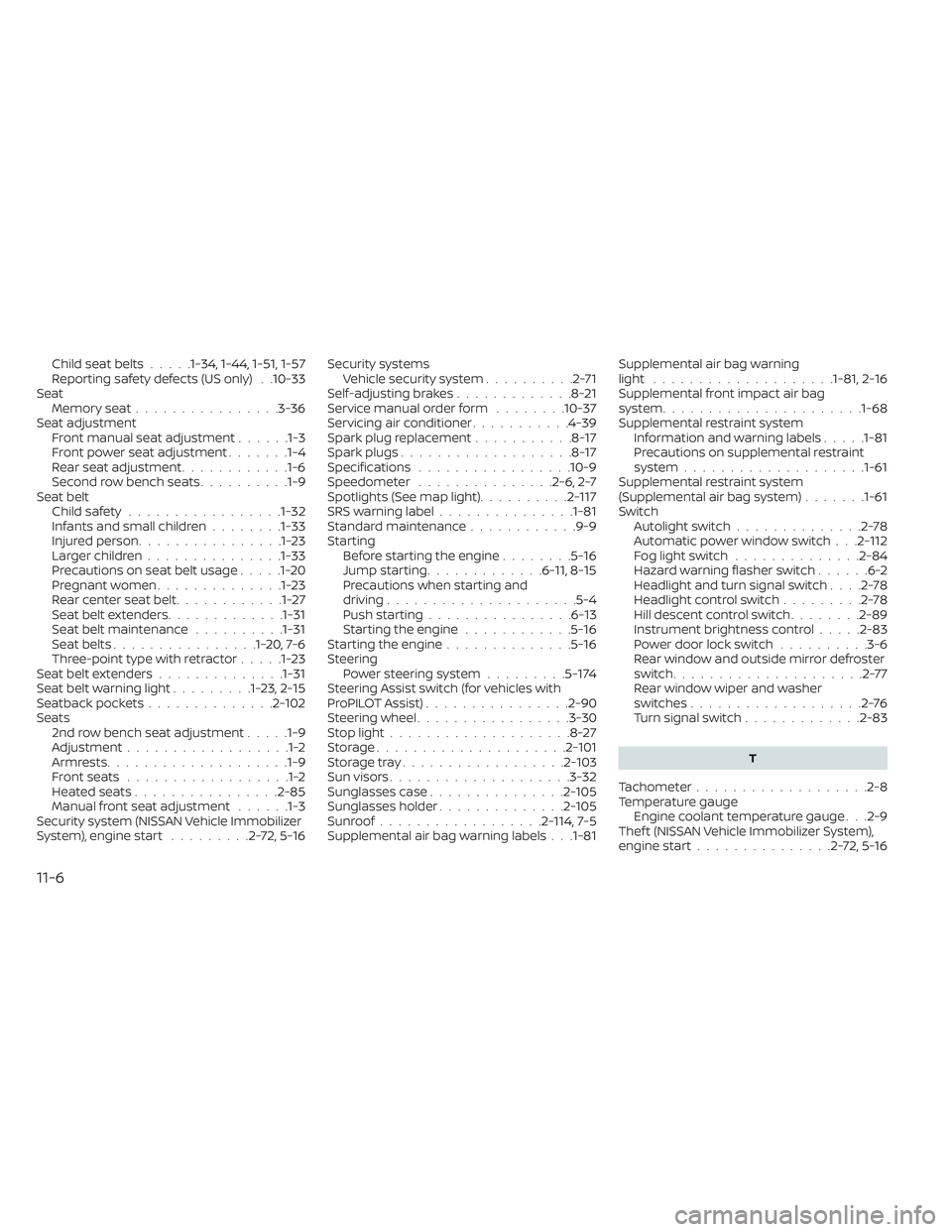
Child seat belts.....1-34, 1-44, 1-51, 1-57Reporting safety defects (US only). .10-33SeatMemory seat................3-36Seat adjustmentFront manual seat adjustment......1-3Front power seat adjustment.......1-4Rear seat adjustment............1-6Second row bench seats..........1-9Seat beltChild safety................ .1-32Infants and small children........1-33Injured person................1-23Larger children...............1-33Precautions on seat belt usage.....1-20Pregnant women..............1-23Rear center seat belt............1-27Seat belt extenders.............1-31Seat belt maintenance..........1-31Seat belts................1-20,7-6Three-point type with retractor.....1-23Seat belt extenders..............1-31Seat belt warning light.........1-23,2-15Seatback pockets..............2-102Seats
2nd row bench seat adjustment.....1-9Adjustment..................1-2Armrests................... .1-9Front seats..................1-2Heated seats................2-85Manual front seat adjustment......1-3Security system (NISSAN Vehicle Immobilizer
System), engine start.........2-72,5-16
Security systems
Vehicle security system..........2-71Self-adjusting brakes.............8-21Service manual order form........10-37Servicing air conditioner...........4-39Spark plug replacement...........8-17Spark plugs...................8-17Specifications................ .10-9Speedometer...............2-6, 2-7Spotlights (See map light)..........2-117SRS warning label...............1-81Standard maintenance............9-9Starting
Before starting the engine........5-16Jump starting.............6-11,8-15Precautions when starting and
driving.................... .5-4Push starting................6-13Starting the engine............5-16Starting the engine..............5-16Steering
Power steering system.........5-174Steering Assist switch (for vehicles with
ProPILOT Assist)................2-90Steering wheel................ .3-30Stop light....................8-27Storage.....................2-101Storage tray..................2-103Sun visors................... .3-32Sunglasses case...............2-105Sunglasses holder..............2-105Sunroof..................2-114, 7-5Supplemental air bag warning labels. . .1-81
Supplemental air bag warning
light................... .1-81, 2-16Supplemental front impact air bag
system..................... .1-68Supplemental restraint system
Information and warning labels.....1-81Precautions on supplemental restraint
system................... .1-61Supplemental restraint system
(Supplemental air bag system).......1-61Switch
Autolight switch..............2-78Automatic power window switch. . .2-112Fog light switch..............2-84Hazard warning flasher switch......6-2Headlight and turn signal switch. . . .2-78Headlight control switch.........2-78Hill descent control switch........2-89Instrument brightness control.....2-83Power door lock switch..........3-6Rear window and outside mirror defroster
switch.....................2-77Rear window wiper and washer
switches...................2-76Turn signal switch.............2-83
T
Tachometer.................. .2-8Temperature gauge
Engine coolant temperature gauge. . .2-9Thef t (NISSAN Vehicle Immobilizer System),
engine start...............2-72,5-16
11-6