fog lights NISSAN PATHFINDER 2022 Owner´s Manual
[x] Cancel search | Manufacturer: NISSAN, Model Year: 2022, Model line: PATHFINDER, Model: NISSAN PATHFINDER 2022Pages: 647, PDF Size: 8.48 MB
Page 379 of 647
–When the vehicle’s traveling direc-
tion does not align with the lane
markers.
– When traveling close to the ve-
hicle in front of you, which ob-
structs the lane camera unit de-
tection range.
– When rain, snow or dirt adheres to
the windshield in front of a lane
camera unit.
– When the headlights are not
bright due to dirt on the lens or if
aiming is not adjusted properly.
– When strong light enters a lane
camera unit. (For example: light
directly shines on the front of the
vehicle at sunrise or sunset.)
– When a sudden change in bright-
ness occurs. (For example: when
the vehicle enters or exits a tunnel
or under a bridge.)
• Do not use the I-BSI system under the
following conditions because the
system may not function properly.
– During bad weather (for example:
rain, fog, snow, etc.).
– When driving on slippery roads,
such as on ice or snow, etc. –
When driving on winding or un-
even roads.
– When there is a lane closure due to
road repairs.
– When driving in a makeshif t or
temporary lane.
– When driving on roads where the
lane width is too narrow.
– When driving with a tire that is not
within normal tire conditions (e.g.,
tire wear, low tire pressure, instal-
lation of spare tire, tire chains,
nonstandard wheels).
– When the vehicle is equipped with
non-original brake parts or sus-
pension parts.
– When towing a trailer or other
vehicle.
• Excessive noise (e.g., audio system
volume, open vehicle window) will in-
terfere with the chime sound, and it
may not be heard.I-BSI DRIVING SITUATIONS
Indicator on
Indicator off
Indicator flashing
5-68Starting and driving
Page 434 of 647
–When driving on roads where
there are multiple lanes or unclear
lane markers due to road
construction
– When driving on roads where
there are sharply contrasting ob-
jects, such as shadows, snow, wa-
ter, wheel ruts, seams, or lines re-
maining af ter road repairs (the
Steering Assist could detect these
items as lane markers)
– When driving on roads where the
traveling lane merges or
separates
• Do not use the Steering Assist under
the following conditions because the
system may not properly detect lane
markers. Doing so could cause a loss
of vehicle control and result in an ac-
cident.
– During bad weather (rain, fog,
snow, dust, etc.)
– When rain, snow, sand, etc., is
thrown up by the wheels of other
vehicles
– When dirt, oil, ice, snow, water, or
another object adheres to the
camera unit –
When the lens of the camera unit
is foggy
– When strong light (for example,
sunlight or high beams from on-
coming vehicles) shines on the
camera
– When the headlights are not
bright due to dirt on the lens or
the headlights are off in tunnels or
darkness
– When a sudden change in bright-
ness occurs (for example, when
the vehicle enters or exits a tunnel
or is under a bridge)
– When driving on roads where the
traveling lane merges or sepa-
rates or where there are tempo-
rary lane markers because of road
construction
– When there is a lane closure due to
road repairs
– When driving on a bumpy road
surface, such as an uneven dirt
road
– When driving on sharp curves or
winding roads
– When driving on repeated uphill
and downhill roads •
Do not use the Steering Assist under
the following conditions because the
system will not operate properly:
– When driving with a tire that is not
within normal tire conditions (for
example, tire wear, abnormal tire
pressure, installation of a spare
tire, tire chains, nonstandard
wheels)
– When the vehicle is equipped with
non-original brake or suspension
parts
– When an object such as a sticker
or cargo obstructs the camera
– When excessively heavy baggage
is loaded in the rear seat or lug-
gage area of your vehicle
– When the vehicle load capacity is
exceeded
– When towing a trailer or other
vehicle
• Excessive noise will interfere with the
warning chime sound, and the beep
may not be heard.
Starting and driving5-123
Page 453 of 647
•The AEB with Pedestrian Detection
system does not detect the following
objects:
– Pedestrians that are small (for ex- ample, children), in a sitting posi-
tion, operating toys/skateboards,
on scooters or in wheelchairs, or
not in an upright standing or
walking position.
– Animals of any size.
– Obstacles (for example, cargo or debris) on the roadway or
roadside.
– Oncoming or crossing vehicles.
– Vehicles where the tires are diffi- cult to see or the shape of the rear
of the vehicle is unclear or
obstructed.
– Parked vehicles.
• The AEB with Pedestrian Detection
system has some performance limi-
tations.
– If a stationary vehicle is in the ve-
hicle’s path, the system will not
function when the vehicle ap-
proaches the stationary vehicle at
speeds over approximately 50
mph (80 km/h). –
Pedestrian detection will not
function when the vehicle is
driven at speeds over approxi-
mately 37 mph (60 km/h) or below
approximately 6 mph (10km/h).
• For pedestrians, the AEB with Pedes-
trian Detection system will not issue
the first warning.
• The AEB with Pedestrian Detection
system may not function properly or
detect a vehicle or pedestrians
ahead in the following conditions:
– In poor visibility conditions (such
as rain, snow, fog, dust storms,
sand storms, smoke, and road
spray from other vehicles).
– If dirt, ice, snow, fog or other ma-
terial is covering the radar sensor
area or camera area of
windshield.
– If a strong light (for example, sun-
light or high beams) enters the
front camera or a sudden change
in brightness occurs (for example,
entering a tunnel or driving in
lightning). –
In dark or dimly lit conditions,
such as at night or in tunnels, in-
cluding cases where your vehi-
cle’s headlights are off or dim, or
the tail lights of the vehicle ahead
are off.
– When the direction of the camera
is misaligned.
– When driving on a steep downhill
slope, on roads with sharp curves,
and/or bumpy or dirt roads.
– If there is interference by other ra-
dar sources.
– When your vehicle’s position or
movement is changed quickly or
significantly (for example, lane
change, turning vehicle, abrupt
steering, sudden acceleration or
deceleration).
– When your vehicle or the vehicle
or pedestrian ahead moves
quickly or significantly such that
the system cannot detect and re-
act in time (for example, pedes-
trian moving quickly toward the
vehicle at close range, vehicle cut-
ting in, changing lanes, making a
turn, steering abruptly, sudden
acceleration or deceleration).
5-142Starting and driving
Page 501 of 647
•When the fan speed control is in any
position other than “OFF,” (0) while the
air flow control is in the front defogger
position.
• When the front defroster switch is on.
• When the rear window defroster switch
is on.
• When the temperature inside the ve-
hicle is lower than approximately 20°C
(68°F), unless the Air Conditioning ECO
customize option is selected, and the
ECO driving mode is on.
• When the temperature inside the ve-
hicle is higher than approximately 30°C
(86°F), unless the Air Conditioning ECO
customize option is selected, and the
ECO driving mode is on. (When the air
conditioner is off, the Idling Stop Sys-
tem will operate.)
• When the fan speed of the air condi-
tioner is set to the maximum speed,
unless the Air Conditioning ECO cus-
tomize option is selected, and the ECO
driving mode is on.
• When the Idling Stop OFF switch is
turned on.
• When the power consumption is large.
• When the vehicle is traveling at alti-
tudes higher than 6,562 f t (2,000 m). •
When the accelerator pedal is
depressed.
• When the shif t lever is in the R (Reverse)
position.
• When the brake pedal is not firmly
depressed.
• When stopping the vehicle on steep
sloping roads.
NOTE:
The engine will not restart even if the
brake pedal is released while the Idling
Stop System is activated under the fol-
lowing conditions: (The engine may re-
start by the other engine restart condi-
tions.)
• When the shif t position is in the P (Park)
position.
NOTE:
It may take some time until the Idling
Stop System activates under the follow-
ing conditions:
• When the battery is discharged.
• When the outside temperature is low or
high.
•
When the battery is replaced or the bat-
tery terminal is disconnected for ex-
tended periods and then reconnected.
NOTE:
When the Idling Stop System indicator
light illuminates, the engine starts run-
ning automatically under at least one of
the following conditions:
• The brake pedal is released with the
shif t lever in the D (Drive) or N (Neutral)
position.
• The shif t position is placed in the D
(Drive) or R (Reverse) position from the
N (Neutral) or P (Park) position.
• The driver’s seat belt is unfastened, or
the driver’s door is open.
• The battery voltage becomes low (due
to electrical load from other vehicle
systems like headlights, heaters, etc.,
or auxiliary devices connected to the
12 volt socket inside the vehicle).
• The vehicle speed is above about 1 mph
(2 km/h).
• When the rear window defroster is
operated.
• When the temperature inside the ve-
hicle is lower than approximately 68°F
(20°C), unless the Air Conditioning ECO
customize option is selected, and the
ECO driving mode is on.
5-190Starting and driving
Page 534 of 647
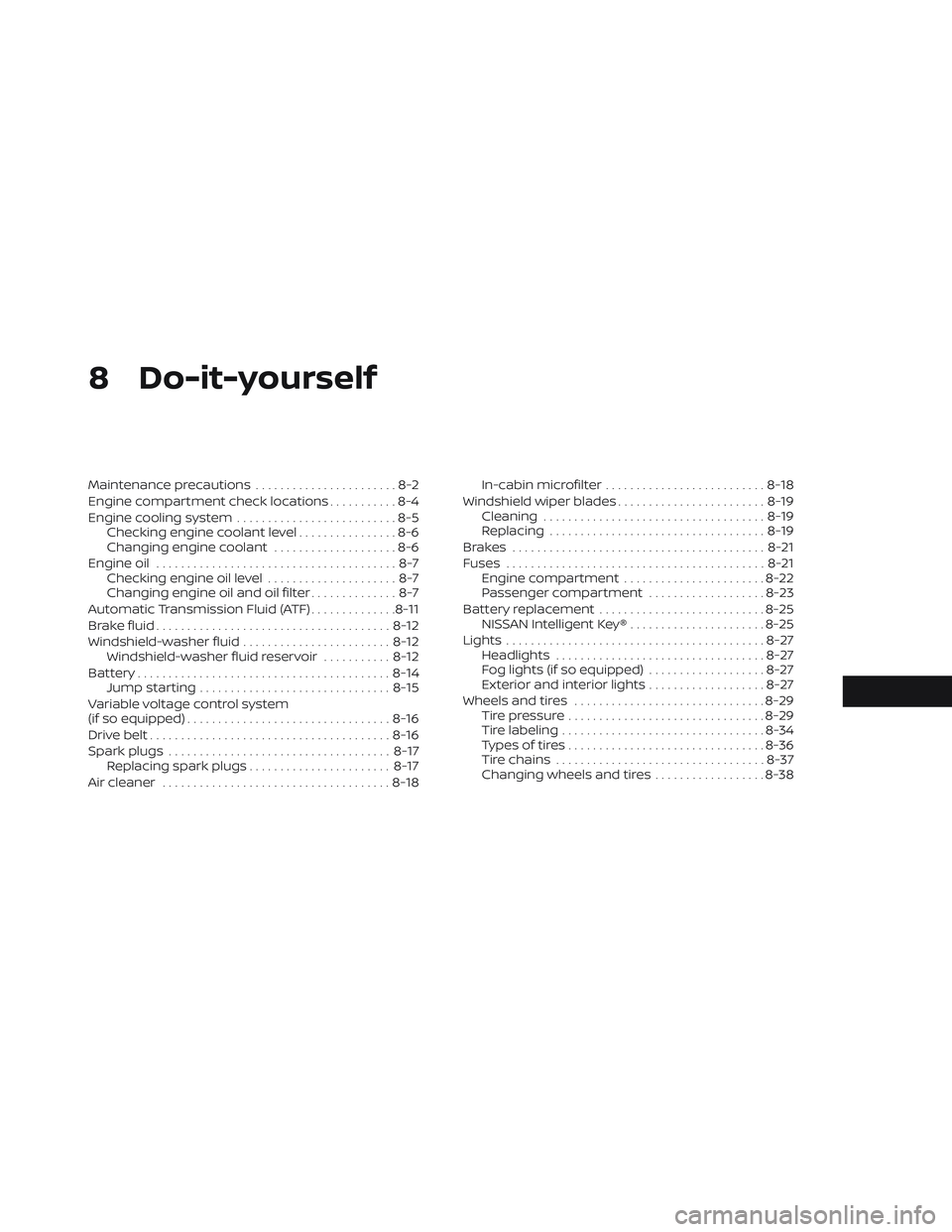
8 Do-it-yourself
Maintenance precautions.......................8-2
Engine compartment check locations ...........8-4
Engine cooling system ..........................8-5
Checking engine coolant level ................8-6
Changing engine coolant ....................8-6
Engine oil .......................................8-7
Checking engine oil level .....................8-7
Changing engine oil and oil filter ..............8-7
Automatic Transmission Fluid (ATF) ..............8-11
Brake fluid ...................................... 8-12
Windshield-washer fluid ........................8-12
Windshield-washer fluid reservoir ...........8-12
Battery......................................... 8-14
Jump starting ............................... 8-15
Variable voltage control system
(if so equipped) ................................. 8-16
Drive belt ....................................... 8-16
Spark plugs .................................... 8-17
Replacing spark plugs ....................... 8-17
Air cleaner ..................................... 8-18In-cabin microfilter
.......................... 8-18
Windshield wiper blades ........................8-19
Cleaning .................................... 8-19
Replacing ................................... 8-19
Brakes ......................................... 8-21
Fuses .......................................... 8-21
Engine compartment .......................8-22
Passenger compartment ...................8-23
Battery replacement ........................... 8-25
NISSAN Intelligent Key® ......................8-25
Lights .......................................... 8-27
Headlights .................................. 8-27
Fog lights (if so equipped) ...................8-27
Exterior and interior lights ...................8-27
Wheels and tires ............................... 8-29
Tire pressure ................................ 8-29
Tire labeling ................................. 8-34
Types of tires ................................
8-36
Tir
e chains .................................. 8-37
Changing wheels and tires ..................8-38
Page 560 of 647
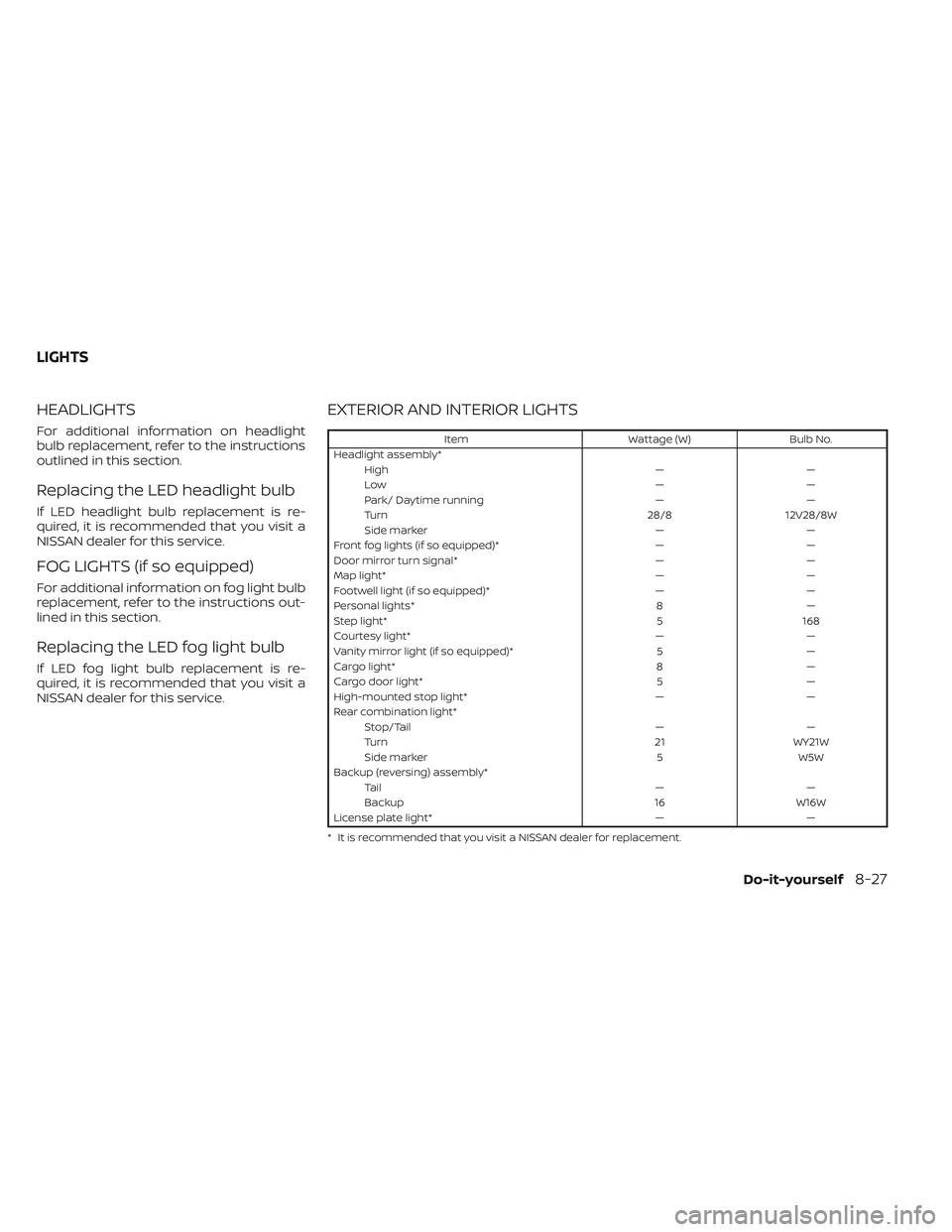
HEADLIGHTS
For additional information on headlight
bulb replacement, refer to the instructions
outlined in this section.
Replacing the LED headlight bulb
If LED headlight bulb replacement is re-
quired, it is recommended that you visit a
NISSAN dealer for this service.
FOG LIGHTS (if so equipped)
For additional information on fog light bulb
replacement, refer to the instructions out-
lined in this section.
Replacing the LED fog light bulb
If LED fog light bulb replacement is re-
quired, it is recommended that you visit a
NISSAN dealer for this service.
EXTERIOR AND INTERIOR LIGHTS
ItemWattage (W)Bulb No.
Headlight assembly* High ——
Low ——
Park/ Daytime running ——
Turn 28/812V28/8W
Side marker ——
Front fog lights (if so equipped)* ——
Door mirror turn signal* ——
Map light* ——
Footwell light (if so equipped)* ——
Personal lights* 8—
Step light* 5168
Courtesy light* ——
Vanity mirror light (if so equipped)* 5—
Cargo light* 8—
Cargo door light* 5—
High-mounted stop light* ——
Rear combination light* Stop/Tail ——
Turn 21WY21W
Side marker 5W5W
Backup (reversing) assembly* Ta i l ——
Backup 16W16W
License plate light* ——
* It is recommended that you visit a NISSAN dealer for replacement.
LIGHTS
Do-it-yourself8-27
Page 561 of 647
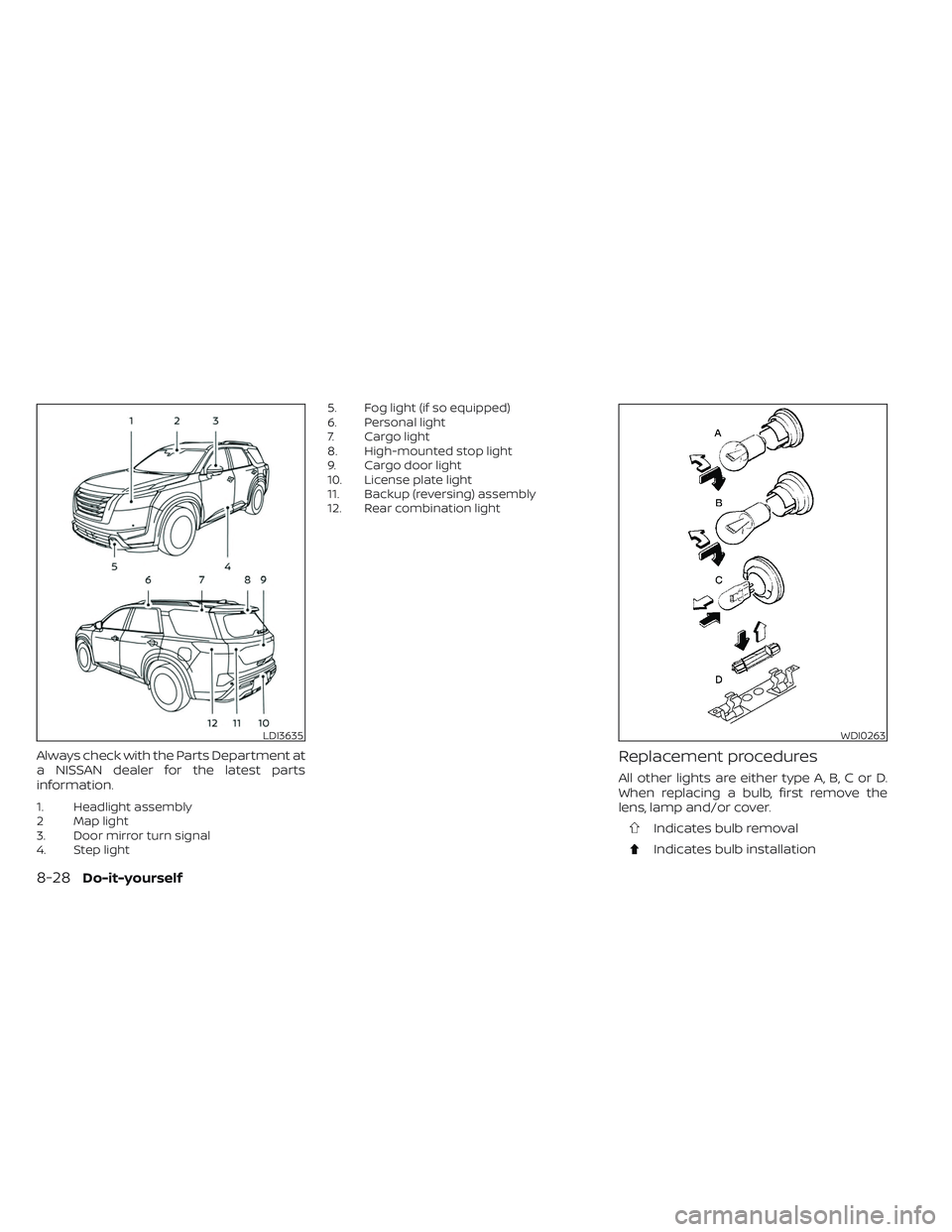
Always check with the Parts Department at
a NISSAN dealer for the latest parts
information.
1. Headlight assembly
2 Map light
3. Door mirror turn signal
4. Step light5. Fog light (if so equipped)
6. Personal light
7. Cargo light
8. High-mounted stop light
9. Cargo door light
10. License plate light
11. Backup (reversing) assembly
12. Rear combination light
Replacement procedures
All other lights are either type A, B, C or D.
When replacing a bulb, first remove the
lens, lamp and/or cover.
Indicates bulb removal
Indicates bulb installation
LDI3635WDI0263
8-28Do-it-yourself
Page 639 of 647
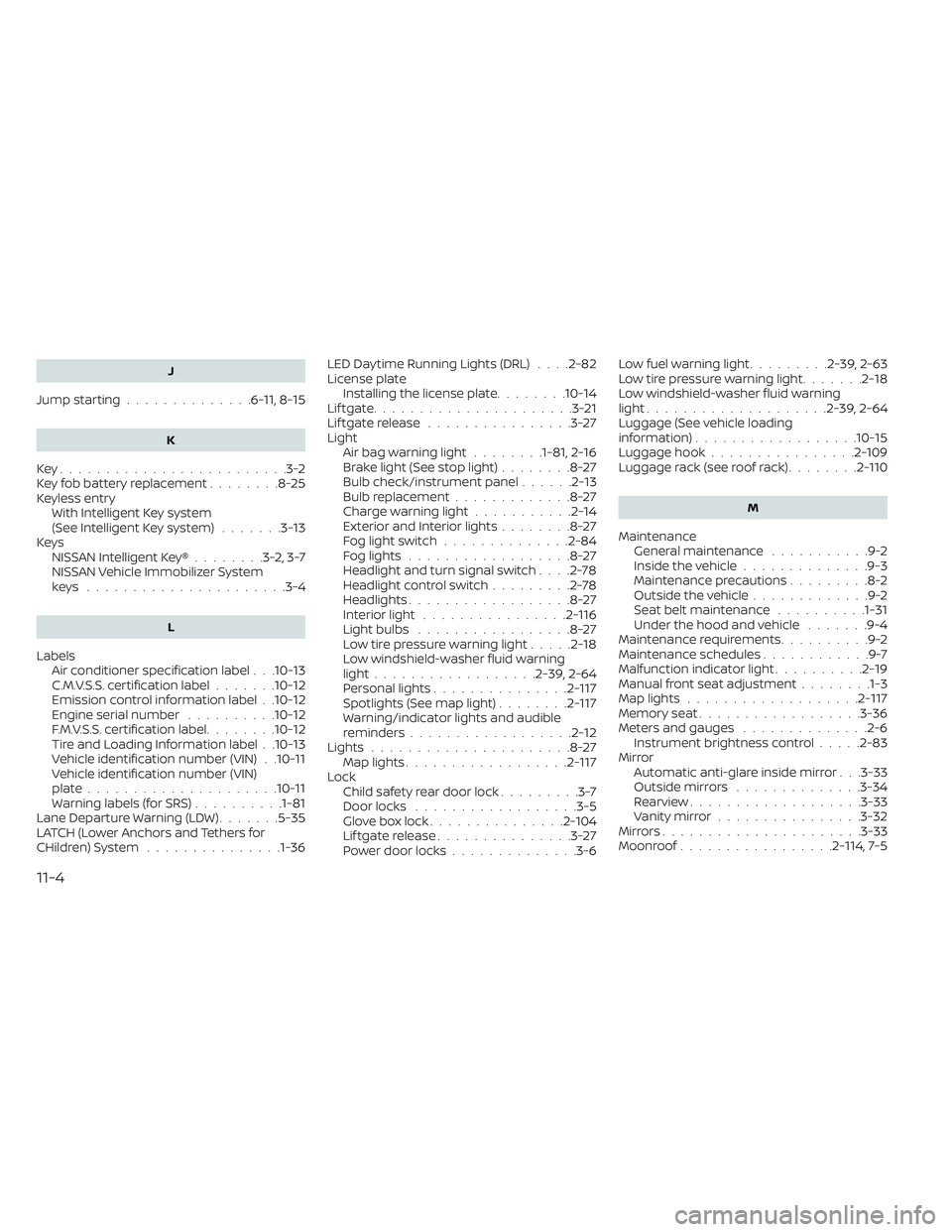
J
Jump starting..............6-11,8-15
K
Key.........................3-2Key fob battery replacement........8-25Keyless entryWith Intelligent Key system
(See Intelligent Key system)
.......3-13KeysNISSAN Intelligent Key®........3-2,3-7NISSAN Vehicle Immobilizer System
keys..................... .3-4
L
Labels
Air conditioner specification label. . .10-13C.M.V.S.S. certification label.......10-12Emission control information label. .10-12Engine serial number..........10-12F.M.V.S.S. certification label........10-12Tire and Loading Information label. .10-13Vehicle identification number (VIN). .10-11Vehicle identification number (VIN)
plate.................... .10-11Warning labels (for SRS)..........1-81Lane Departure Warning (LDW).......5-35LATCH (Lower Anchors and Tethers for
CHildren) System...............1-36
LED Daytime Running Lights (DRL). . . .2-82License plate
Installing the license plate........10-14Lif tgate......................3-21Lif tgate release................3-27LightAir bag warning light........1-81, 2-16Brake light (See stop light)........8-27Bulb check/instrument panel......2-13Bulb replacement.............8-27Charge warning light...........2-14Exterior and Interior lights........8-27Fog light switch..............2-84Fog lights..................8-27Headlight and turn signal switch. . . .2-78Headlight control switch.........2-78Headlights..................8-27Interior light................2-116Light bulbs.................8-27Low tire pressure warning light.....2-18Low windshield-washer fluid warning
light................. .2-39, 2-64Personal lights...............2-117Spotlights (See map light)........2-117Warning/indicator lights and audible
reminders..................2-12Lights......................8-27Map lights..................2-117Lock
Child safety rear door lock.........3-7Door locks................. .3-5Glove box lock...............2-104Lif tgate release...............3-27Power door locks..............3-6
Low fuel warning light.........2-39, 2-63Low tire pressure warning light.......2-18Low windshield-washer fluid warning
light................... .2-39, 2-64Luggage (See vehicle loading
information)..................10-15Luggage hook................2-109Luggage rack (see roof rack)........2-110
M
Maintenance
General maintenance...........9-2Inside the vehicle..............9-3Maintenance precautions.........8-2Outside the vehicle.............9-2Seat belt maintenance..........1-31Under the hood and vehicle.......9-4Maintenance requirements..........9-2Maintenance schedules............9-7Malfunction indicator light..........2-19Manual front seat adjustment........1-3Map lights...................2-117Memory seat................. .3-36Meters and gauges..............2-6Instrument brightness control.....2-83Mirror
Automatic anti-glare inside mirror. . .3-33Outside mirrors..............3-34Rearview.................. .3-33Vanity mirror................3-32Mirrors..................... .3-33Moonroof.................2-114, 7-5
11-4
Page 641 of 647
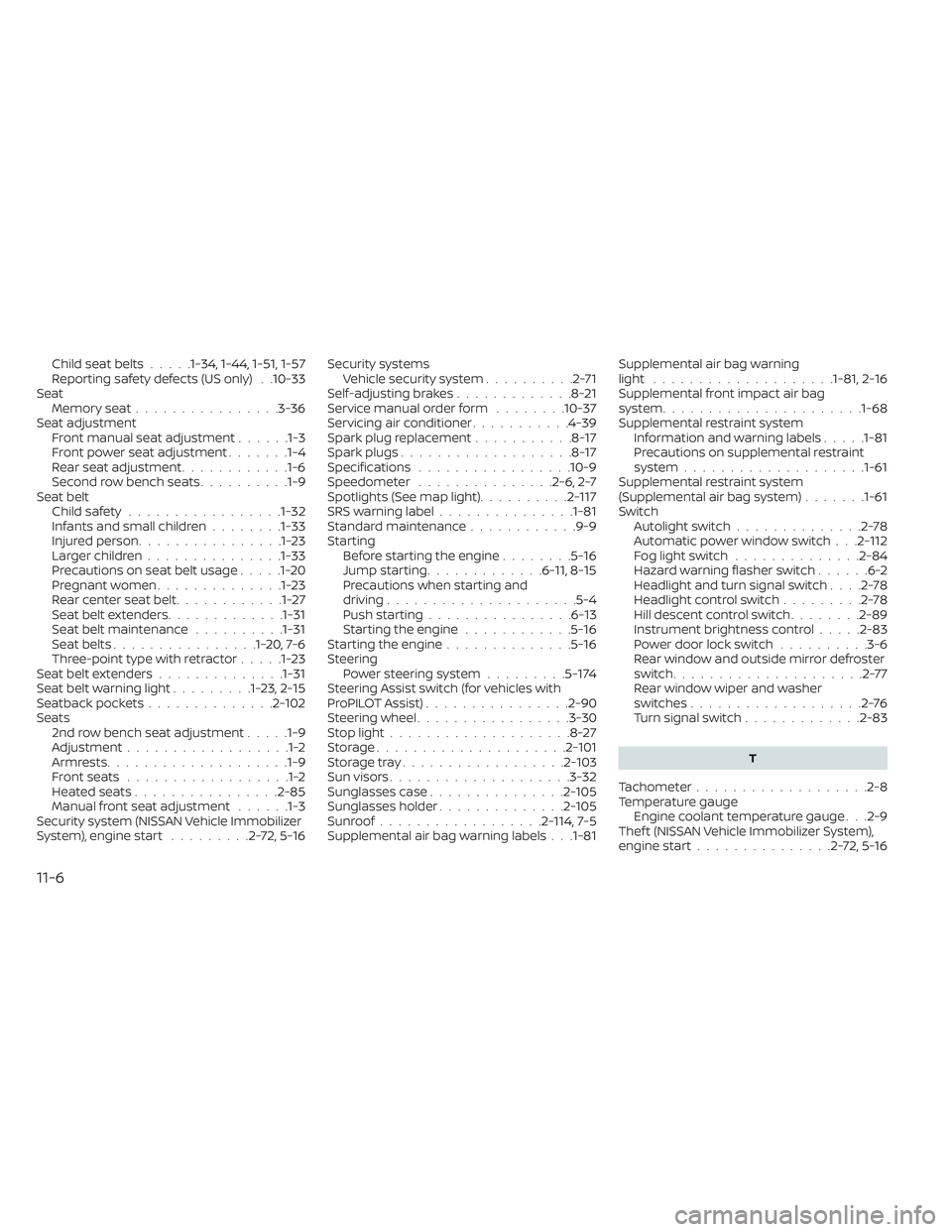
Child seat belts.....1-34, 1-44, 1-51, 1-57Reporting safety defects (US only). .10-33SeatMemory seat................3-36Seat adjustmentFront manual seat adjustment......1-3Front power seat adjustment.......1-4Rear seat adjustment............1-6Second row bench seats..........1-9Seat beltChild safety................ .1-32Infants and small children........1-33Injured person................1-23Larger children...............1-33Precautions on seat belt usage.....1-20Pregnant women..............1-23Rear center seat belt............1-27Seat belt extenders.............1-31Seat belt maintenance..........1-31Seat belts................1-20,7-6Three-point type with retractor.....1-23Seat belt extenders..............1-31Seat belt warning light.........1-23,2-15Seatback pockets..............2-102Seats
2nd row bench seat adjustment.....1-9Adjustment..................1-2Armrests................... .1-9Front seats..................1-2Heated seats................2-85Manual front seat adjustment......1-3Security system (NISSAN Vehicle Immobilizer
System), engine start.........2-72,5-16
Security systems
Vehicle security system..........2-71Self-adjusting brakes.............8-21Service manual order form........10-37Servicing air conditioner...........4-39Spark plug replacement...........8-17Spark plugs...................8-17Specifications................ .10-9Speedometer...............2-6, 2-7Spotlights (See map light)..........2-117SRS warning label...............1-81Standard maintenance............9-9Starting
Before starting the engine........5-16Jump starting.............6-11,8-15Precautions when starting and
driving.................... .5-4Push starting................6-13Starting the engine............5-16Starting the engine..............5-16Steering
Power steering system.........5-174Steering Assist switch (for vehicles with
ProPILOT Assist)................2-90Steering wheel................ .3-30Stop light....................8-27Storage.....................2-101Storage tray..................2-103Sun visors................... .3-32Sunglasses case...............2-105Sunglasses holder..............2-105Sunroof..................2-114, 7-5Supplemental air bag warning labels. . .1-81
Supplemental air bag warning
light................... .1-81, 2-16Supplemental front impact air bag
system..................... .1-68Supplemental restraint system
Information and warning labels.....1-81Precautions on supplemental restraint
system................... .1-61Supplemental restraint system
(Supplemental air bag system).......1-61Switch
Autolight switch..............2-78Automatic power window switch. . .2-112Fog light switch..............2-84Hazard warning flasher switch......6-2Headlight and turn signal switch. . . .2-78Headlight control switch.........2-78Hill descent control switch........2-89Instrument brightness control.....2-83Power door lock switch..........3-6Rear window and outside mirror defroster
switch.....................2-77Rear window wiper and washer
switches...................2-76Turn signal switch.............2-83
T
Tachometer.................. .2-8Temperature gauge
Engine coolant temperature gauge. . .2-9Thef t (NISSAN Vehicle Immobilizer System),
engine start...............2-72,5-16
11-6