Forward NISSAN PATHFINDER 2022 Owner´s Manual
[x] Cancel search | Manufacturer: NISSAN, Model Year: 2022, Model line: PATHFINDER, Model: NISSAN PATHFINDER 2022Pages: 647, PDF Size: 8.48 MB
Page 23 of 647
1 Safety-Seats, seat belts and
supplemental restraint system
Seats............................................ 1-2Front manual seat adjustment
(if so equipped) ................................1-3
Front power seat adjustment
(if so equipped) ............................... 1-4
2nd row seat adjustment .................... 1-6
3rd row bench seat adjustment .............. 1-9
Armrests ..................................... 1-9
Flexible seating ............................... 1-10
Head restraints/headrests ......................1-12
Adjustable head restraint/headrest
components ................................. 1-14
Non-adjustable head restraint/
headrest components .......................1-14
Remove...................................... 1-15
Install ........................................ 1-16
Adjust ........................................ 1-16
Folding head restraint/headrest ..............1-19
Seatbelts ...................................... 1-20
Precautions on seat belt usage ..............1-20
Seat belt warning light and chime ...........1-23
Pregnant women ........................... 1-23
Injured persons ............................. 1-23
Three-point type seat belt with
retractor .................................... 1-23
Seat belt extenders .......................... 1-31Seat belt maintenance
.......................1-31
Child safety .................................... 1-32
Infants ...................................... 1-33
Small children ............................... 1-33
Larger children .............................. 1-33
Child restraints ................................. 1-34
Precautions on child restraints ..............1-34
LATCH (Lower Anchors and Tethers for
CHildren) system ............................ 1-36
Rear-facing child restraint installation
using LATCH ................................ 1-42
Rear-facing child restraint installation
using the seat belts ......................... 1-44
Forward-facing child restraint
installation using LATCH ..................... 1-47
Forward-facing child restraint
installation using the seat belts ..............1-51
Booster seats ............................... 1-57
Supplemental Restraint System (SRS) ...........1-61
Precautions on SRS .......................... 1-61
Front, 2nd row outboard, and front
central (if so equipped) seat-mounted
side-impact supplemental air bag and
roof-mounted curtain side-impact and
rollover supplemental air bag systems ......1-76
Page 26 of 647
CAUTION
When adjusting the seat positions, be
sure not to contact any moving parts to
avoid possible injuries and/or damage.
FRONT MANUAL SEAT
ADJUSTMENT (if so equipped)
Your vehicle seats can be adjusted manu-
ally. For additional information about ad-
justing the seats, refer to the steps outlined
in this section.
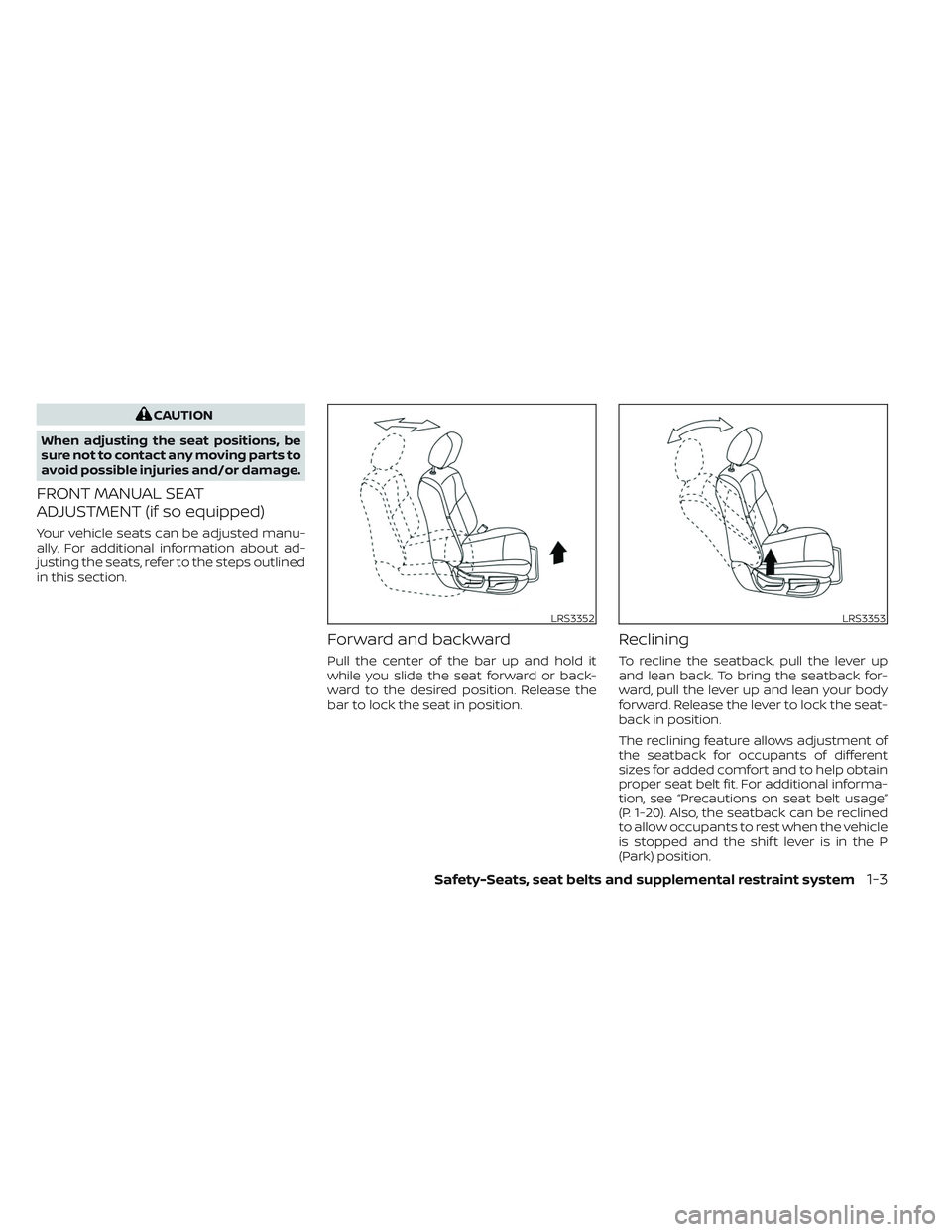
Forward and backward
Pull the center of the bar up and hold it
while you slide the seat forward or back-
ward to the desired position. Release the
bar to lock the seat in position.
Reclining
To recline the seatback, pull the lever up
and lean back. To bring the seatback for-
ward, pull the lever up and lean your body
forward. Release the lever to lock the seat-
back in position.
The reclining feature allows adjustment of
the seatback for occupants of different
sizes for added comfort and to help obtain
proper seat belt fit. For additional informa-
tion, see “Precautions on seat belt usage”
(P. 1-20). Also, the seatback can be reclined
to allow occupants to rest when the vehicle
is stopped and the shif t lever is in the P
(Park) position.
LRS3352LRS3353
Safety-Seats, seat belts and supplemental restraint system1-3
Page 27 of 647
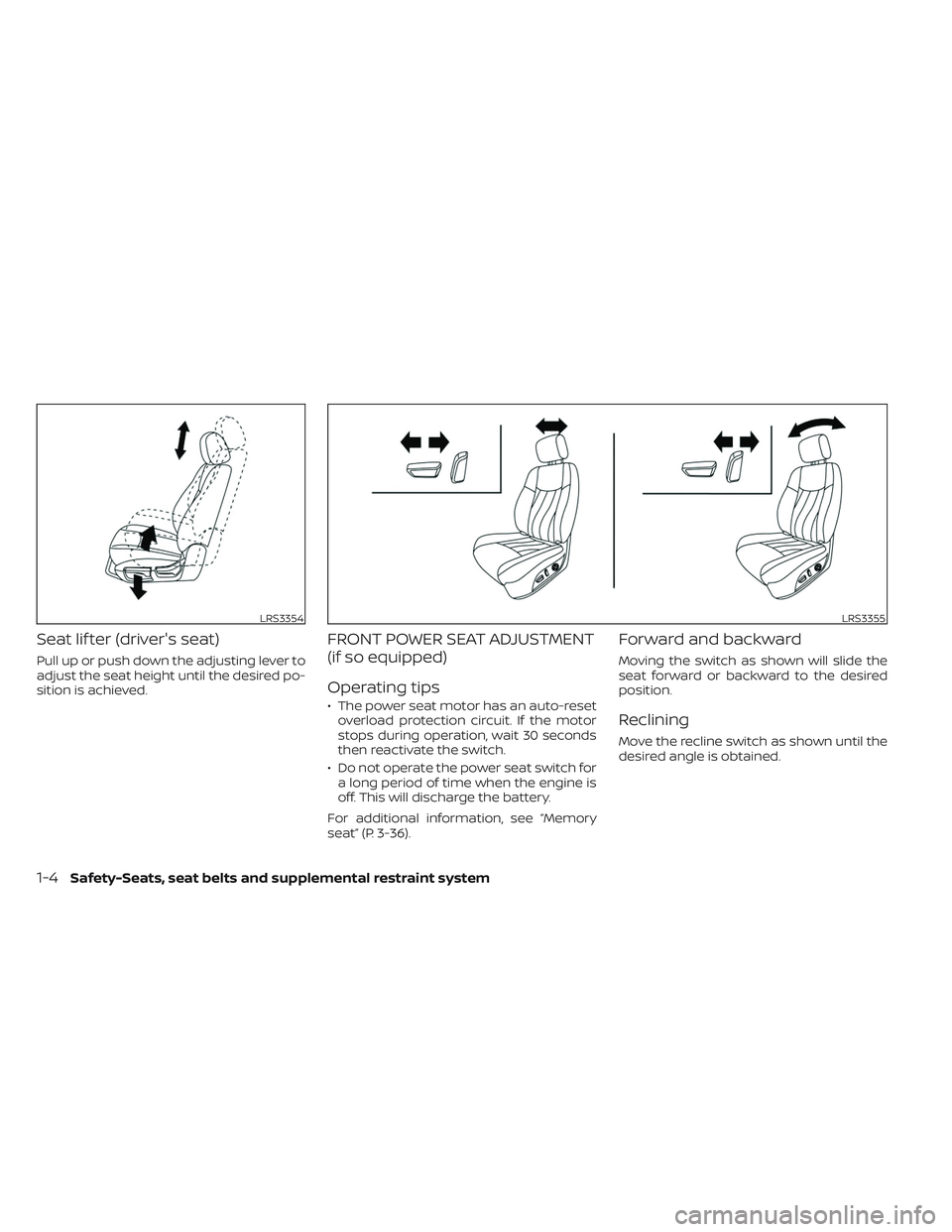
Seat lif ter (driver's seat)
Pull up or push down the adjusting lever to
adjust the seat height until the desired po-
sition is achieved.
FRONT POWER SEAT ADJUSTMENT
(if so equipped)
Operating tips
• The power seat motor has an auto-resetoverload protection circuit. If the motor
stops during operation, wait 30 seconds
then reactivate the switch.
• Do not operate the power seat switch for a long period of time when the engine is
off. This will discharge the battery.
For additional information, see “Memory
seat” (P. 3-36).
Forward and backward
Moving the switch as shown will slide the
seat forward or backward to the desired
position.
Reclining
Move the recline switch as shown until the
desired angle is obtained.
LRS3354LRS3355
1-4Safety-Seats, seat belts and supplemental restraint system
Page 29 of 647
2ND ROW SEAT ADJUSTMENT
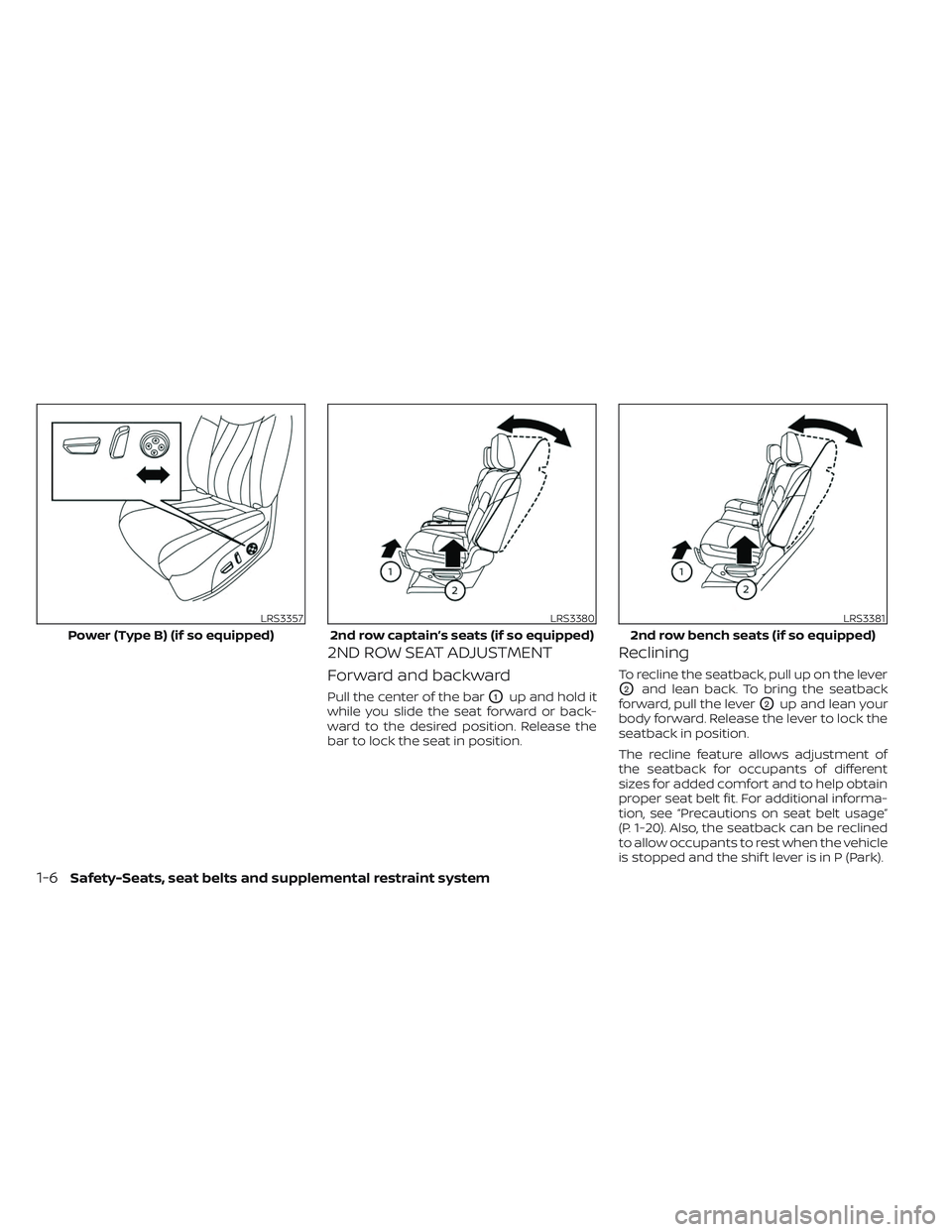
Forward and backward
Pull the center of the barO1up and hold it
while you slide the seat forward or back-
ward to the desired position. Release the
bar to lock the seat in position.
Reclining
To recline the seatback, pull up on the lever
O2and lean back. To bring the seatback
forward, pull the lever
O2up and lean your
body forward. Release the lever to lock the
seatback in position.
The recline feature allows adjustment of
the seatback for occupants of different
sizes for added comfort and to help obtain
proper seat belt fit. For additional informa-
tion, see “Precautions on seat belt usage”
(P. 1-20). Also, the seatback can be reclined
to allow occupants to rest when the vehicle
is stopped and the shif t lever is in P (Park).
LRS3357
Power (Type B) (if so equipped)
LRS3380
2nd row captain’s seats (if so equipped)
LRS3381
2nd row bench seats (if so equipped)
1-6Safety-Seats, seat belts and supplemental restraint system
Page 31 of 647
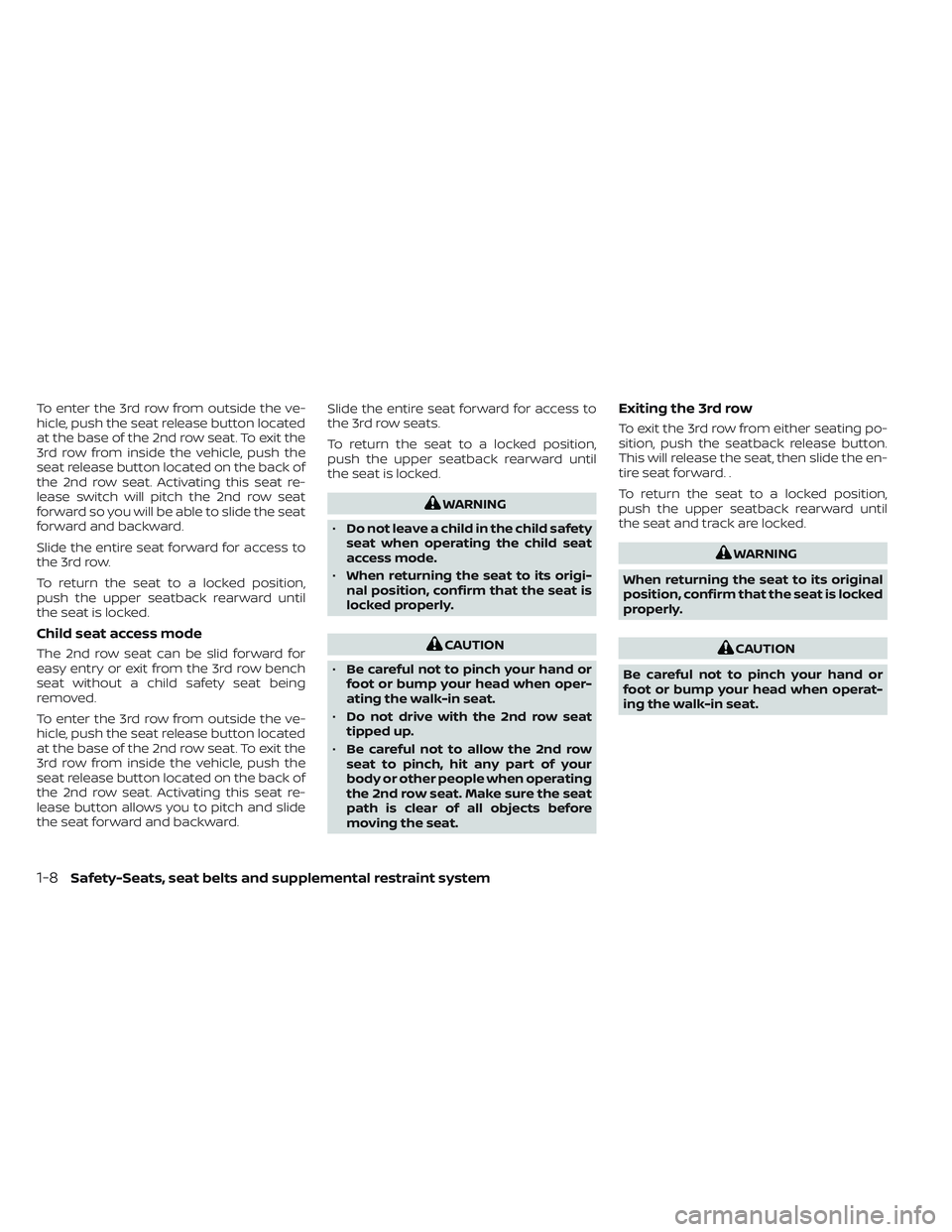
To enter the 3rd row from outside the ve-
hicle, push the seat release button located
at the base of the 2nd row seat. To exit the
3rd row from inside the vehicle, push the
seat release button located on the back of
the 2nd row seat. Activating this seat re-
lease switch will pitch the 2nd row seat
forward so you will be able to slide the seat
forward and backward.
Slide the entire seat forward for access to
the 3rd row.
To return the seat to a locked position,
push the upper seatback rearward until
the seat is locked.
Child seat access mode
The 2nd row seat can be slid forward for
easy entry or exit from the 3rd row bench
seat without a child safety seat being
removed.
To enter the 3rd row from outside the ve-
hicle, push the seat release button located
at the base of the 2nd row seat. To exit the
3rd row from inside the vehicle, push the
seat release button located on the back of
the 2nd row seat. Activating this seat re-
lease button allows you to pitch and slide
the seat forward and backward.Slide the entire seat forward for access to
the 3rd row seats.
To return the seat to a locked position,
push the upper seatback rearward until
the seat is locked.
WARNING
• Do not leave a child in the child safety
seat when operating the child seat
access mode.
• When returning the seat to its origi-
nal position, confirm that the seat is
locked properly.
CAUTION
• Be careful not to pinch your hand or
foot or bump your head when oper-
ating the walk-in seat.
• Do not drive with the 2nd row seat
tipped up.
• Be careful not to allow the 2nd row
seat to pinch, hit any part of your
body or other people when operating
the 2nd row seat. Make sure the seat
path is clear of all objects before
moving the seat.
Exiting the 3rd row
To exit the 3rd row from either seating po-
sition, push the seatback release button.
This will release the seat, then slide the en-
tire seat forward. .
To return the seat to a locked position,
push the upper seatback rearward until
the seat and track are locked.
WARNING
When returning the seat to its original
position, confirm that the seat is locked
properly.
CAUTION
Be careful not to pinch your hand or
foot or bump your head when operat-
ing the walk-in seat.
1-8Safety-Seats, seat belts and supplemental restraint system
Page 32 of 647
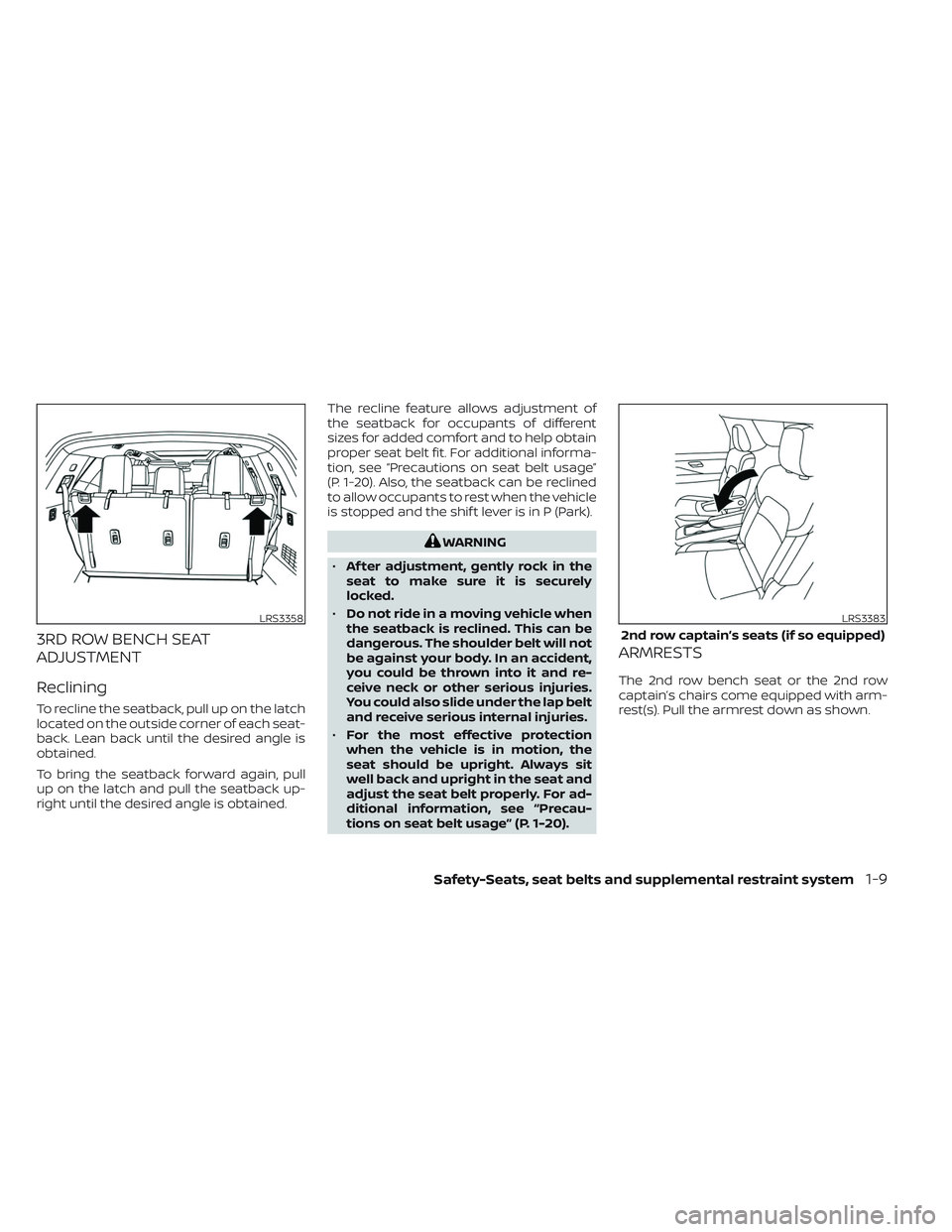
3RD ROW BENCH SEAT
ADJUSTMENT
Reclining
To recline the seatback, pull up on the latch
located on the outside corner of each seat-
back. Lean back until the desired angle is
obtained.
To bring the seatback forward again, pull
up on the latch and pull the seatback up-
right until the desired angle is obtained.The recline feature allows adjustment of
the seatback for occupants of different
sizes for added comfort and to help obtain
proper seat belt fit. For additional informa-
tion, see “Precautions on seat belt usage”
(P. 1-20). Also, the seatback can be reclined
to allow occupants to rest when the vehicle
is stopped and the shif t lever is in P (Park).
WARNING
• Af ter adjustment, gently rock in the
seat to make sure it is securely
locked.
• Do not ride in a moving vehicle when
the seatback is reclined. This can be
dangerous. The shoulder belt will not
be against your body. In an accident,
you could be thrown into it and re-
ceive neck or other serious injuries.
You could also slide under the lap belt
and receive serious internal injuries.
• For the most effective protection
when the vehicle is in motion, the
seat should be upright. Always sit
well back and upright in the seat and
adjust the seat belt properly. For ad-
ditional information, see “Precau-
tions on seat belt usage” (P. 1-20).
ARMRESTS
The 2nd row bench seat or the 2nd row
captain’s chairs come equipped with arm-
rest(s). Pull the armrest down as shown.
LRS3358LRS3383
2nd row captain’s seats (if so equipped)
Safety-Seats, seat belts and supplemental restraint system1-9
Page 35 of 647
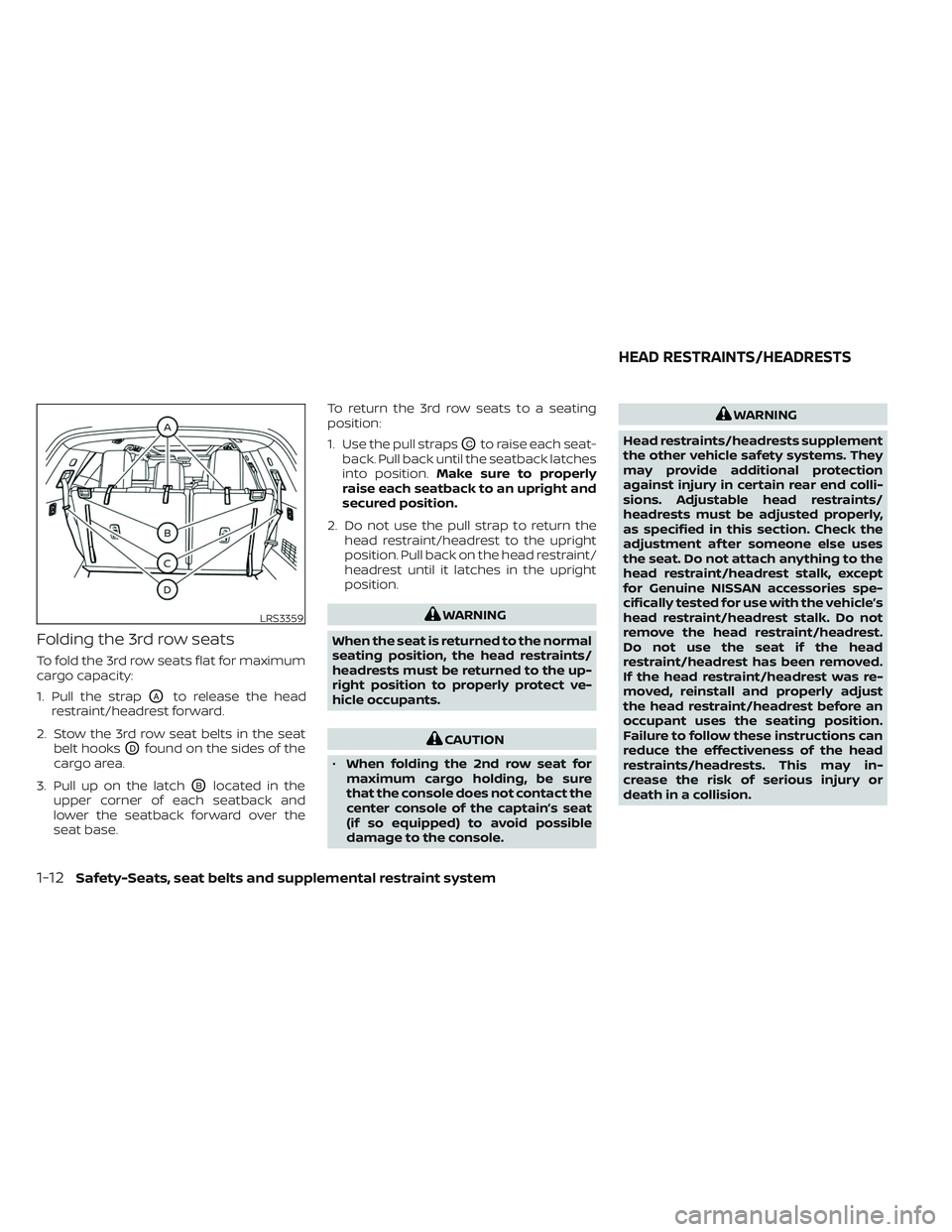
Folding the 3rd row seats
To fold the 3rd row seats flat for maximum
cargo capacity:
1. Pull the strap
OAto release the head
restraint/headrest forward.
2. Stow the 3rd row seat belts in the seat belt hooks
ODfound on the sides of the
cargo area.
3. Pull up on the latch
OBlocated in the
upper corner of each seatback and
lower the seatback forward over the
seat base. To return the 3rd row seats to a seating
position:
1. Use the pull straps
OCto raise each seat-
back. Pull back until the seatback latches
into position. Make sure to properly
raise each seatback to an upright and
secured position.
2. Do not use the pull strap to return the head restraint/headrest to the upright
position. Pull back on the head restraint/
headrest until it latches in the upright
position.
WARNING
When the seat is returned to the normal
seating position, the head restraints/
headrests must be returned to the up-
right position to properly protect ve-
hicle occupants.
CAUTION
• When folding the 2nd row seat for
maximum cargo holding, be sure
that the console does not contact the
center console of the captain’s seat
(if so equipped) to avoid possible
damage to the console.
WARNING
Head restraints/headrests supplement
the other vehicle safety systems. They
may provide additional protection
against injury in certain rear end colli-
sions. Adjustable head restraints/
headrests must be adjusted properly,
as specified in this section. Check the
adjustment af ter someone else uses
the seat. Do not attach anything to the
head restraint/headrest stalk, except
for Genuine NISSAN accessories spe-
cifically tested for use with the vehicle’s
head restraint/headrest stalk. Do not
remove the head restraint/headrest.
Do not use the seat if the head
restraint/headrest has been removed.
If the head restraint/headrest was re-
moved, reinstall and properly adjust
the head restraint/headrest before an
occupant uses the seating position.
Failure to follow these instructions can
reduce the effectiveness of the head
restraints/headrests. This may in-
crease the risk of serious injury or
death in a collision.
LRS3359
HEAD RESTRAINTS/HEADRESTS
1-12Safety-Seats, seat belts and supplemental restraint system
Page 50 of 647
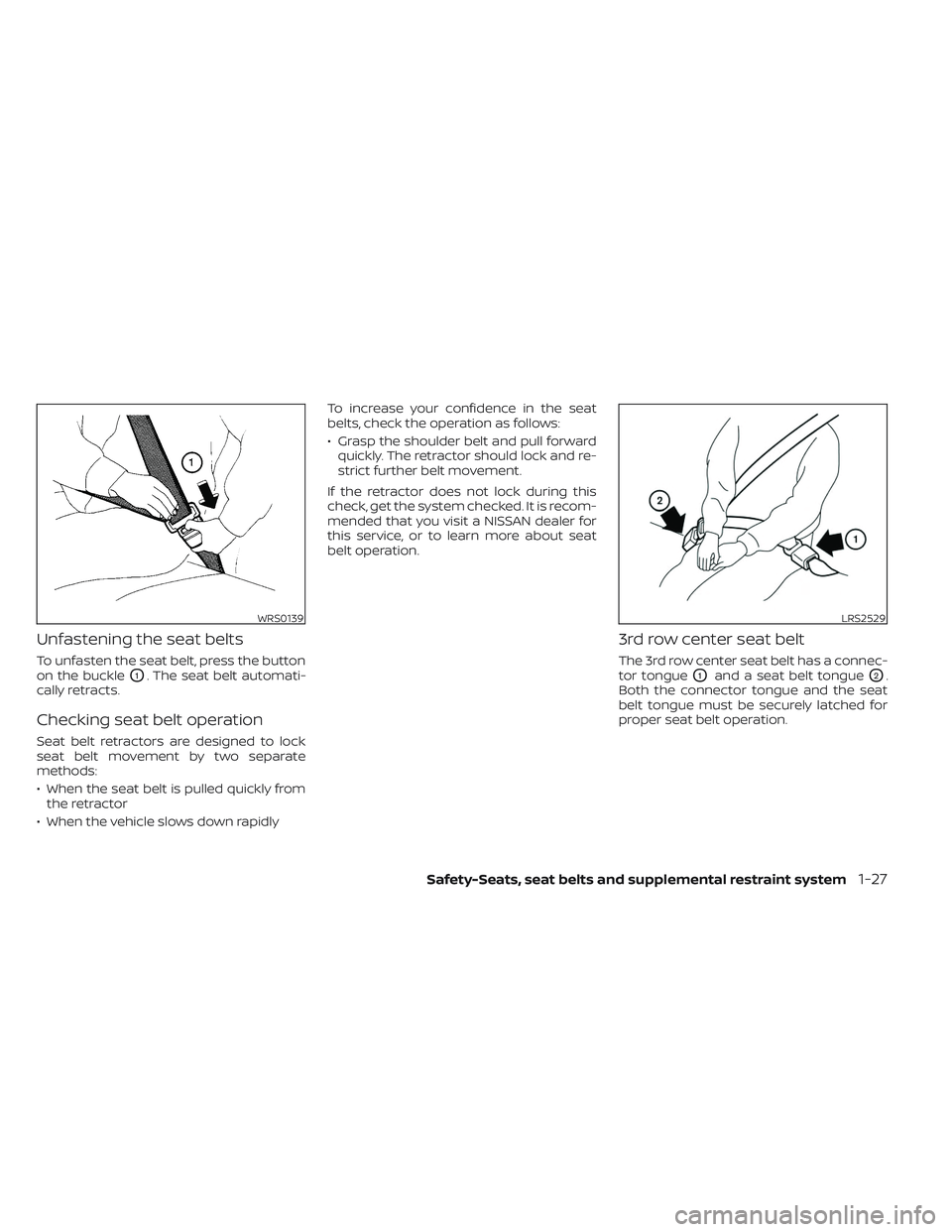
Unfastening the seat belts
To unfasten the seat belt, press the button
on the buckle
O1. The seat belt automati-
cally retracts.
Checking seat belt operation
Seat belt retractors are designed to lock
seat belt movement by two separate
methods:
• When the seat belt is pulled quickly from the retractor
• When the vehicle slows down rapidly To increase your confidence in the seat
belts, check the operation as follows:
• Grasp the shoulder belt and pull forward
quickly. The retractor should lock and re-
strict further belt movement.
If the retractor does not lock during this
check, get the system checked. It is recom-
mended that you visit a NISSAN dealer for
this service, or to learn more about seat
belt operation.
3rd row center seat belt
The 3rd row center seat belt has a connec-
tor tongue
O1and a seat belt tongueO2.
Both the connector tongue and the seat
belt tongue must be securely latched for
proper seat belt operation.
WRS0139LRS2529
Safety-Seats, seat belts and supplemental restraint system1-27
Page 55 of 647
WARNING
Do not allow children to play with the
seat belts. Most seating positions are
equipped with Automatic Locking Re-
tractor (ALR) mode seat belts. If the seat
belt becomes wrapped around a child’s
neck with the ALR mode activated, the
child can be seriously injured or killed if
the seat belt retracts and becomes
tight. This can occur even if the vehicle
is parked. Unbuckle the seat belt to re-
lease the child. If the seat belt cannot
be unbuckled or is already unbuckled,
release the child by cutting the seat
belt with a suitable tool (such as a knife
or scissors) to release the seat belt.
Children need adults to help protect them.
They need to be properly restrained.
In addition to the general information in
this manual, child safety information is
available from many other sources, includ-
ing doctors, teachers, government traffic
safety offices, and community organiza-
tions. Every child is different, so be sure to
learn the best way to transport your child. There are three basic types of child re-
straint systems:
• Rear-facing child restraints
• Forward-facing child restraints
• Booster seats
The proper restraint depends on the child's
size. Generally, infants up to about 1 year
and less than 20 lbs. (9 kg) should be placed
in rear-facing child restraints. Forward-
facing child restraints are available for chil-
dren who outgrow rear-facing child re-
straints and are at least 1 year old. Booster
seats are used to help position a vehicle
lap/shoulder belt on a child who can no
longer use a forward-facing child restraint.
WARNING
Infants and children need special pro-
tection. The vehicle's seat belts may
not fit them properly. The shoulder belt
may come too close to the face or neck.
The lap belt may not fit over their small
hip bones. In an accident, an improp-
erly fitting seat belt could cause serious
or fatal injury. Always use appropriate
child restraints. All U.S. states and Canadian provinces or
territories require the use of approved child
restraints for infants and small children.
For additional information, see “Child re-
straints” (P. 1-34).
A child restraint may be secured in the ve-
hicle by using either the LATCH (Lower An-
chors and Tethers for CHildren) system or
with the vehicle seat belt. For additional
information, see “Child restraints” (P. 1-34).
NISSAN recommends that all pre-teens
and children be restrained in the rear
seat. Studies show that children are
safer when properly restrained in the
rear seat than in the front seat.
This is especially important because
your vehicle has a supplemental re-
straint system (air bag system) for the
front passenger. For additional informa-
tion, see “Child restraints” (P. 1-34) and
“Supplemental Restraint System (SRS)”
(P. 1-61).
CHILD SAFETY
1-32Safety-Seats, seat belts and supplemental restraint system
Page 56 of 647
INFANTS
Infants up to at least 1 year old should be
placed in a rear-facing child restraint.
NISSAN recommends that infants be
placed in child restraints that comply with
Federal Motor Vehicle Safety Standards or
Canadian Motor Vehicle Safety Standards.
You should choose a child restraint that fits
your vehicle and always follow the manu-
facturer's instructions for installation and
use.
SMALL CHILDREN
Children that are over 1 year old and weigh
at least 20 lbs. (9 kg) should remain in a
rear-facing child restraint as long as pos-
sible up to the height or weight limit of the
child restraint. Children who outgrow the
height or weight limit of the rear-facing
child restraint and are at least 1 year old
should be secured in a forward-facing child
restraint with a harness. Refer to the manu-
facturer’s instructions for minimum and
maximum weight and height recommen-
dations. NISSAN recommends that small
children be placed in child restraints that
comply with Federal Motor Vehicle Safety
Standards or Canadian Motor Vehicle
Safety Standards. You should choose a
child restraint that fits your vehicle and al-ways follow the manufacturer’s instruc-
tions for installation and use.
LARGER CHILDREN
Children should remain in a forward-facing
child restraint with a harness until they reach
the maximum height or weight limit allowed
by the child restraint manufacturer.
Once a child outgrows the height or weight
limit of the harness-equipped forward-
facing child restraint, NISSAN recommends
that the child be placed in a commercially
available booster seat to obtain proper
seat belt fit. For a seat belt to fit properly, the
booster seat should raise the child so that
the shoulder belt is properly positioned
across the chest and the top, middle por-
tion of the shoulder. The shoulder belt
should not cross the neck or face and
should not fall off the shoulder. The lap belt
should lie snugly across the lower hips or
upper thighs, not the abdomen.
A booster seat can only be used in seating
positions that have a three-point type seat
belt. The booster seat should fit the vehicle
seat and have a label certif ying that it com-
plies with Federal Motor Vehicle Safety
Standards or Canadian Motor Vehicle
Safety Standards. Once the child has
grown so the shoulder belt is no longer onor near the face and neck and the lap belt
can be positioned properly across the
lower hips or upper thighs, use the seat belt
without the booster seat.
A booster seat should be used until the
child can pass the seat belt fit test below:
• Are the child’s back and hips against the
vehicle seatback?
• Is the child able to sit without slouching?
• Do the child’s knees bend easily over the front edge of the seat with feet flat on the
floor?
• Can the child safely wear the seat belt (lap belt low and snug across the hips and
shoulder belt across mid-chest and
shoulder)?
• Is the child able to use the properly ad- justed head restraint/headrest?
• Will the child be able to stay in position for the entire ride?
Safety-Seats, seat belts and supplemental restraint system1-33