engine coolant NISSAN PATHFINDER 2023 Owner's Manual
[x] Cancel search | Manufacturer: NISSAN, Model Year: 2023, Model line: PATHFINDER, Model: NISSAN PATHFINDER 2023Pages: 665, PDF Size: 4.64 MB
Page 593 of 665
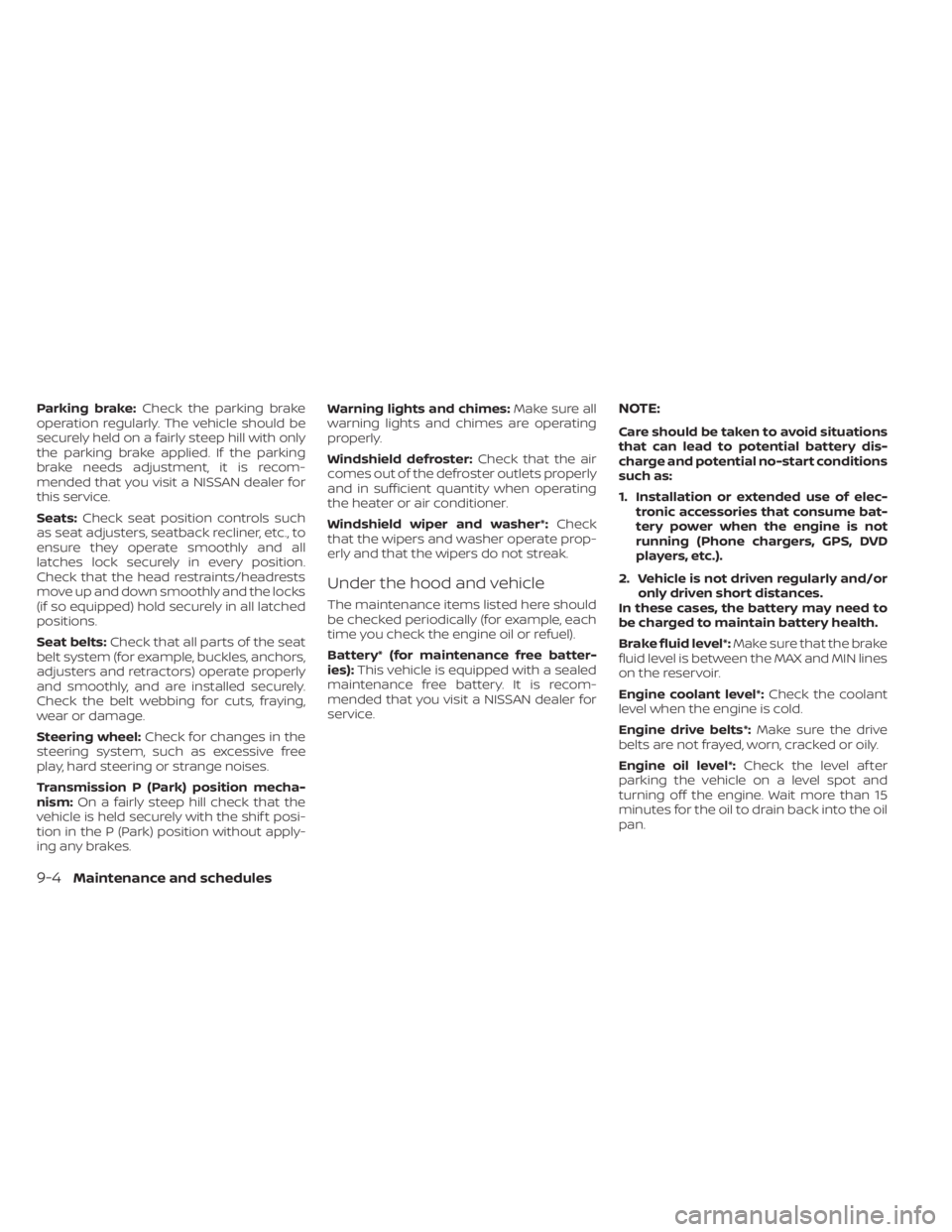
Parking brake:Check the parking brake
operation regularly. The vehicle should be
securely held on a fairly steep hill with only
the parking brake applied. If the parking
brake needs adjustment, it is recom-
mended that you visit a NISSAN dealer for
this service.
Seats: Check seat position controls such
as seat adjusters, seatback recliner, etc., to
ensure they operate smoothly and all
latches lock securely in every position.
Check that the head restraints/headrests
move up and down smoothly and the locks
(if so equipped) hold securely in all latched
positions.
Seat belts: Check that all parts of the seat
belt system (for example, buckles, anchors,
adjusters and retractors) operate properly
and smoothly, and are installed securely.
Check the belt webbing for cuts, fraying,
wear or damage.
Steering wheel: Check for changes in the
steering system, such as excessive free
play, hard steering or strange noises.
Transmission P (Park) position mecha-
nism: On a fairly steep hill check that the
vehicle is held securely with the shif t posi-
tion in the P (Park) position without apply-
ing any brakes. Warning lights and chimes:
Make sure all
warning lights and chimes are operating
properly.
Windshield defroster: Check that the air
comes out of the defroster outlets properly
and in sufficient quantity when operating
the heater or air conditioner.
Windshield wiper and washer*: Check
that the wipers and washer operate prop-
erly and that the wipers do not streak.
Under the hood and vehicle
The maintenance items listed here should
be checked periodically (for example, each
time you check the engine oil or refuel).
Battery* (for maintenance free batter-
ies): This vehicle is equipped with a sealed
maintenance free battery. It is recom-
mended that you visit a NISSAN dealer for
service.
NOTE:
Care should be taken to avoid situations
that can lead to potential battery dis-
charge and potential no-start conditions
such as:
1. Installation or extended use of elec- tronic accessories that consume bat-
tery power when the engine is not
running (Phone chargers, GPS, DVD
players, etc.).
2. Vehicle is not driven regularly and/or only driven short distances.
In these cases, the battery may need to
be charged to maintain battery health.
Brake fluid level*: Make sure that the brake
fluid level is between the MAX and MIN lines
on the reservoir.
Engine coolant level*: Check the coolant
level when the engine is cold.
Engine drive belts*: Make sure the drive
belts are not frayed, worn, cracked or oily.
Engine oil level*: Check the level af ter
parking the vehicle on a level spot and
turning off the engine. Wait more than 15
minutes for the oil to drain back into the oil
pan.
9-4Maintenance and schedules
Page 595 of 665
NOTE:
NISSAN does not advocate the use of
non-OEM approved af termarket flush-
ing systems and strongly advises
against performing these services on a
NISSAN product. Many of the af termar-
ket flushing systems use non-OEM ap-
proved chemicals or solvents, the use of
which has not been validated by NISSAN.
For recommended fuel, lubricants, fluids,
grease, and refrigerant, see “Recom-
mended fluids/lubricants and capaci-
ties” (P. 10-2).
EMISSION CONTROL SYSTEM
MAINTENANCE:
Drive belts*:Check engine drive belts for
wear, fraying or cracking and for proper
tension. Replace any damaged drive belts.
Engine air filter: Replace at specified inter-
vals. When driving for prolonged periods in
dusty conditions, check/replace the filter
more frequently.
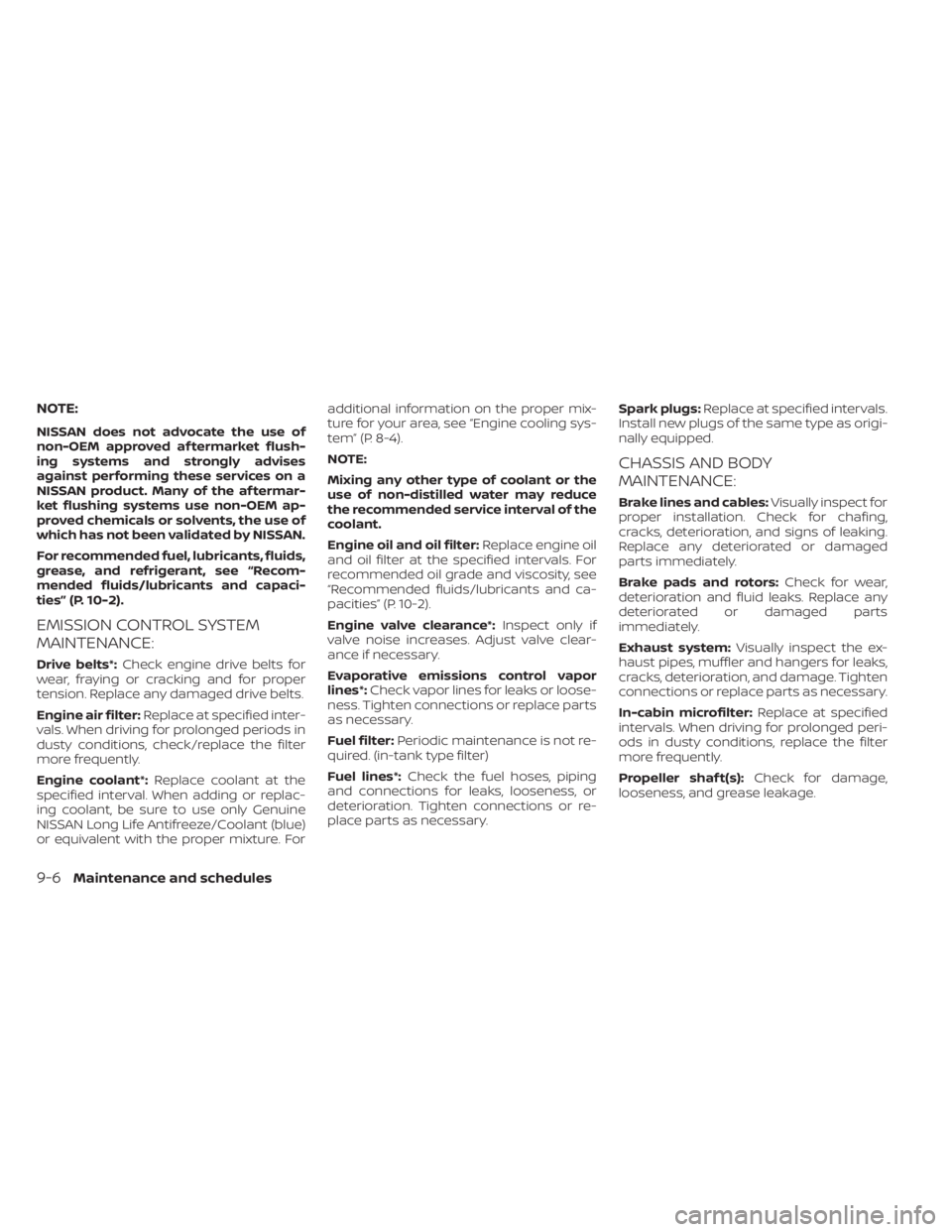
Engine coolant*: Replace coolant at the
specified interval. When adding or replac-
ing coolant, be sure to use only Genuine
NISSAN Long Life Antifreeze/Coolant (blue)
or equivalent with the proper mixture. For additional information on the proper mix-
ture for your area, see “Engine cooling sys-
tem” (P. 8-4).
NOTE:
Mixing any other type of coolant or the
use of non-distilled water may reduce
the recommended service interval of the
coolant.
Engine oil and oil filter:
Replace engine oil
and oil filter at the specified intervals. For
recommended oil grade and viscosity, see
“Recommended fluids/lubricants and ca-
pacities” (P. 10-2).
Engine valve clearance*: Inspect only if
valve noise increases. Adjust valve clear-
ance if necessary.
Evaporative emissions control vapor
lines*: Check vapor lines for leaks or loose-
ness. Tighten connections or replace parts
as necessary.
Fuel filter: Periodic maintenance is not re-
quired. (in-tank type filter)
Fuel lines*: Check the fuel hoses, piping
and connections for leaks, looseness, or
deterioration. Tighten connections or re-
place parts as necessary. Spark plugs:
Replace at specified intervals.
Install new plugs of the same type as origi-
nally equipped.
CHASSIS AND BODY
MAINTENANCE:
Brake lines and cables: Visually inspect for
proper installation. Check for chafing,
cracks, deterioration, and signs of leaking.
Replace any deteriorated or damaged
parts immediately.
Brake pads and rotors: Check for wear,
deterioration and fluid leaks. Replace any
deteriorated or damaged parts
immediately.
Exhaust system: Visually inspect the ex-
haust pipes, muffler and hangers for leaks,
cracks, deterioration, and damage. Tighten
connections or replace parts as necessary.
In-cabin microfilter: Replace at specified
intervals. When driving for prolonged peri-
ods in dusty conditions, replace the filter
more frequently.
Propeller shaf t(s): Check for damage,
looseness, and grease leakage.
9-6Maintenance and schedules
Page 608 of 665
Severe use maintenance:
Inspections:
• Brake pads and rotors
• Exhaust system
• Drive shaf t boots
• Propeller shaf t (4WD models)
• Steering gear and linkage, axle and sus-pension parts
Essential:
• Replace brake fluid
• Replace differential gear oil
• Replace transfer fluid
* Maintenance items and intervals with “*”
are recommended by NISSAN for reliable
vehicle operation. The owner need not per-
form such maintenance in order to main-
tain the emission warranty or manufac-
turer recall liability. Other maintenance
items and intervals are required.
(5) If the oil replacement indicator is dis-
played, change the engine oil and filter
within two weeks or less than 500 miles
(800 km).105,000 miles/(168,000 km)/
126 months
Perform at number of miles, kilometers or
months, whichever comes first.
Standard maintenance:
Essential:
• Replace in-cabin microfilter
• Replace Intelligent Key battery
• Replace spark plugs (6)(7)
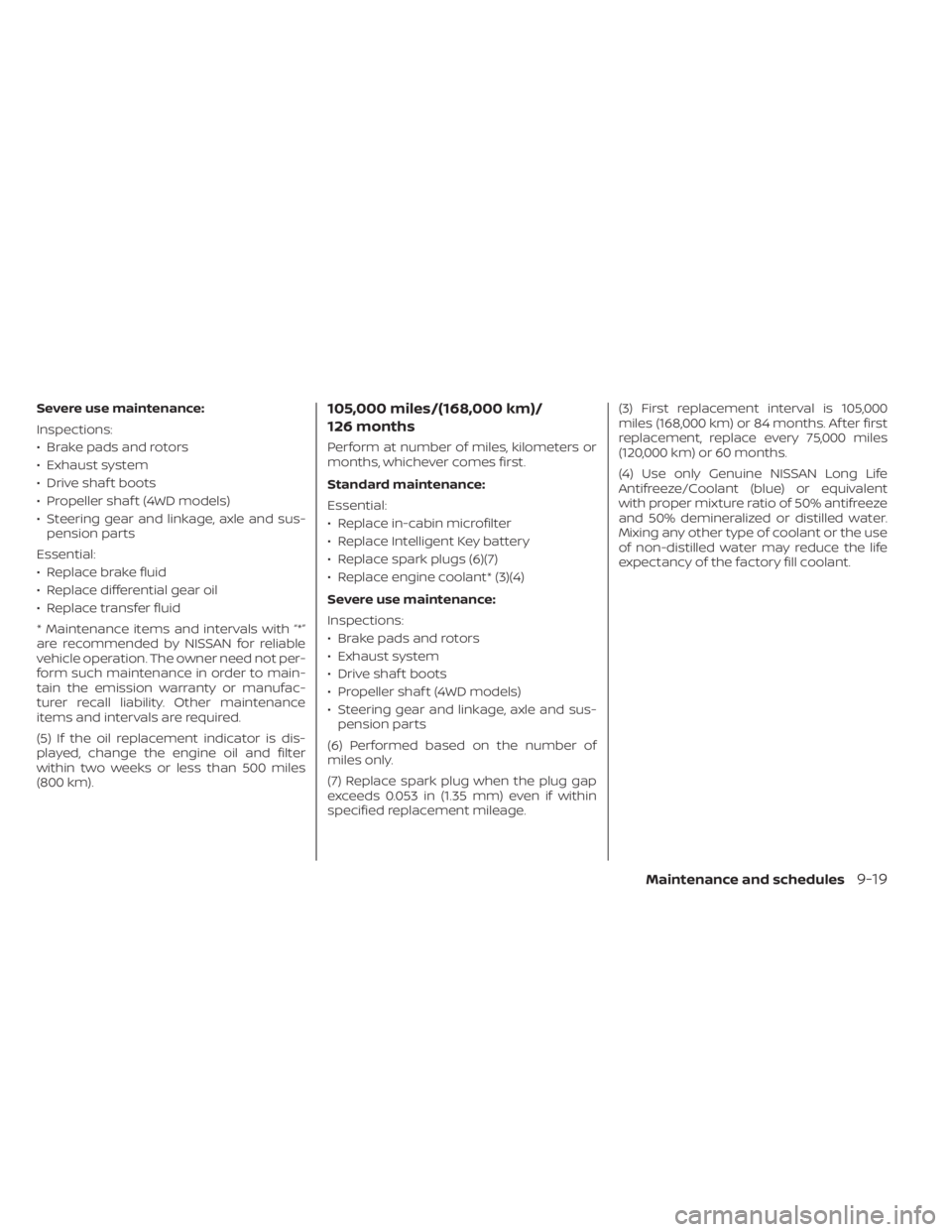
• Replace engine coolant* (3)(4)
Severe use maintenance:
Inspections:
• Brake pads and rotors
• Exhaust system
• Drive shaf t boots
• Propeller shaf t (4WD models)
• Steering gear and linkage, axle and sus- pension parts
(6) Performed based on the number of
miles only.
(7) Replace spark plug when the plug gap
exceeds 0.053 in (1.35 mm) even if within
specified replacement mileage. (3) First replacement interval is 105,000
miles (168,000 km) or 84 months. Af ter first
replacement, replace every 75,000 miles
(120,000 km) or 60 months.
(4) Use only Genuine NISSAN Long Life
Antifreeze/Coolant (blue) or equivalent
with proper mixture ratio of 50% antifreeze
and 50% demineralized or distilled water.
Mixing any other type of coolant or the use
of non-distilled water may reduce the life
expectancy of the factory fill coolant.
Maintenance and schedules9-19
Page 613 of 665
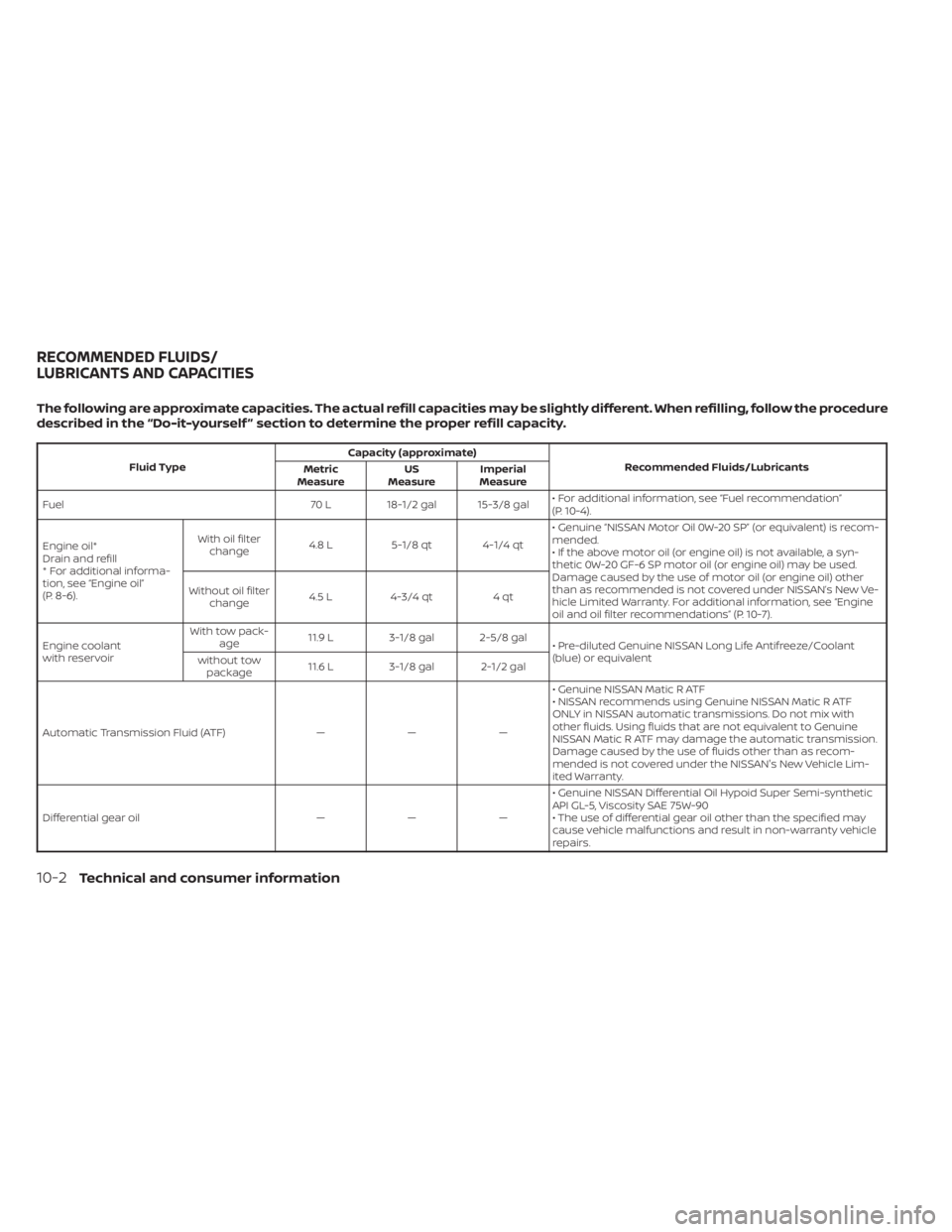
The following are approximate capacities. The actual refill capacities may be slightly different. When refilling, follow the procedure
described in the “Do-it-yourself ” section to determine the proper refill capacity.
Fluid TypeCapacity (approximate)
Recommended Fluids/Lubricants
Metric
Measure US
Measure Imperial
Measure
Fuel 70 L 18-1/2 gal 15-3/8 gal • For additional information, see “Fuel recommendation”
(P. 10-4).
Engine oil*
Drain and refill
* For additional informa-
tion, see “Engine oil”
(P. 8-6). With oil filter
change 4.8 L 5-1/8 qt 4-1/4 qt • Genuine “NISSAN Motor Oil 0W-20 SP” (or equivalent) is recom-
mended.
• If the above motor oil (or engine oil) is not available, a syn-
thetic 0W-20 GF-6 SP motor oil (or engine oil) may be used.
Damage caused by the use of motor oil (or engine oil) other
than as recommended is not covered under NISSAN’s New Ve-
hicle Limited Warranty. For additional information, see “Engine
oil and oil filter recommendations” (P. 10-7).
Without oil filter
change 4.5 L 4-3/4 qt 4 qt
Engine coolant
with reservoir With tow pack-
age 11.9 L
3-1/8 gal 2-5/8 gal
• Pre-diluted Genuine NISSAN Long Life Antifreeze/Coolant
(blue) or equivalent
without tow
package 11.6 L
3-1/8 gal 2-1/2 gal
Automatic Transmission Fluid (ATF) —— —• Genuine NISSAN Matic R ATF
• NISSAN recommends using Genuine NISSAN Matic R ATF
ONLY in NISSAN automatic transmissions. Do not mix with
other fluids. Using fluids that are not equivalent to Genuine
NISSAN Matic R ATF may damage the automatic transmission.
Damage caused by the use of fluids other than as recom-
mended is not covered under the NISSAN's New Vehicle Lim-
ited Warranty.
Differential gear oil —— —• Genuine NISSAN Differential Oil Hypoid Super Semi-synthetic
API GL-5, Viscosity SAE 75W-90
• The use of differential gear oil other than the specified may
cause vehicle malfunctions and result in non-warranty vehicle
repairs.
RECOMMENDED FLUIDS/
LUBRICANTS AND CAPACITIES
10-2Technical and consumer information
Page 642 of 665
• While going downhill, the weight of thetrailer pushing on the tow vehicle may
decrease overall stability. Therefore, to
maintain adequate control, reduce your
speed and shif t to a lower gear. Avoid
long or repeated use of the brakes when
descending a hill, as this reduces their
effectiveness and could cause overheat-
ing. Shif ting to a lower gear instead pro-
vides “engine braking” and reduces the
need to brake as frequently.
• If the engine coolant temperature rises to a high temperature, see “If your vehicle
overheats” (P. 6-13).
• Trailer towing requires more fuel than normal circumstances.
• Avoid towing a trailer for your vehicle's first 500 miles (805 km).
• For the first 500 miles (805 km) that you do tow, do not drive over 50 mph (80
km/h).
• Have your vehicle serviced more of ten than at intervals specified in the recom-
mended maintenance schedule in the
“Maintenance and schedules” section of
this manual. • When making a turn, your trailer wheels
will be closer to the inside of the turn than
your vehicle wheels. To compensate for
this, make a larger than normal turning
radius during the turn.
• Crosswinds and rough roads will ad- versely affect vehicle/trailer handling,
possibly causing vehicle sway. When be-
ing passed by larger vehicles, be pre-
pared for possible changes in crosswinds
that could affect vehicle handling.
Do the following if the trailer begins to
sway:
1. Take your foot off the accelerator pedal to allow the vehicle to coast and steer as
straight ahead as the road conditions
allow. This combination will help stabilize
the vehicle.
– Do not correct trailer sway by steering or applying the brakes.
2. When the trailer sway stops, gently apply the brakes and pull to the side of the
road in a safe area.
3. Try to rearrange the trailer load so it is balanced. For additional information,
see “Pre-towing tips” (P. 10-29). • Be careful when passing other vehicles.
Passing while towing a trailer requires
considerably more distance than normal
passing. Remember, the length of the
trailer must also pass the other vehicle
before you can safely change lanes.
• Downshif t the transmission to a lower gear for engine braking when driving
down steep or long hills. This will help
slow the vehicle without applying the
brakes.
• Avoid holding the brake pedal down too long or too frequently. This could cause
the brakes to overheat, resulting in re-
duced braking efficiency.
• Increase your following distance to allow for greater stopping distances while tow-
ing a trailer. Anticipate stops and brake
gradually.
• NISSAN recommends that the cruise control not be used while towing a trailer.
• Some states or provinces have specific regulations and speed limits for vehicles
that are towing trailers. Obey the local
speed limits.
• Check your hitch, trailer wiring harness connections, and trailer wheel lug nuts
af ter 50 miles (80 km) of travel and at
every break.
Technical and consumer information10-31
Page 651 of 665
LATCH (Lower Anchors and Tethers for
CHildren) System..............1-35Precautions on child
restraints............1-43, 1-50, 1-56Top tether strap anchor point
locations...................1-40Child safety rear door lock..........3-7Cleaning exterior and interior......7-2,7-4Climate-controlled seat switches.....2-90Cold weather driving............5-196Console box..................2-110Controls
Heater and air conditioner controls. .4-33CoolantCapacities and recommended
fuel/lubricants
...............10-2Changing engine coolant.........8-5Checking engine coolant level......8-5Engine coolant temperature gauge. . .2-9Corrosion protection..............7-7Cruise control................ .5-87Cup holders..................2-112
D
Daytime Running Light System......2-87Defroster switch
Rear window and outside mirror defroster
switch
................... .2-81Dimensions and weights..........10-10Dimmer switch for instrument panel. . .2-88Door locks....................3-5Drive belt....................8-15
Driving
Cold weather driving...........5-196Driving with automatic transmission.5-18Precautions when starting and
driving.................... .5-4Driving the vehicle...............5-18Dual panel moonroof............2-120
E
Eco Drive Report...............5-34Economy - fuel................5-171Emergency call (SOS) button........2-98Emergency engine shutoff.......5-15,6-2Emission control information label. . . .10-13Emission control system warranty. . . .10-34Engine
Before starting the engine........5-16Capacities and recommended
fuel/lubricants...............10-2Changing engine coolant.........8-5Changing engine oil............8-6Changing engine oil filter.........8-6Checking engine coolant level......8-5Checking engine oil level.........8-6Engine coolant temperature gauge. . .2-9Engine cooling system...........8-4Engine oil.................. .8-6Engine oil and oil filter
recommendation.............10-7Engine oil pressure warning light. . . .2-15Engine oil viscosity.............10-7Engine serial number..........10-12
Engine specifications...........10-9Starting the engine............5-16Engine Block Heater.............5-197Engine coolant temperature gauge. . . .2-9Event Data recorders........10-36, 10-37Exhaust gas (Carbon monoxide)......5-4Explanation of maintenance items.....9-2Explanation of scheduled maintenance
items...................... .9-5Extended storage switch..........2-106Eyeglass case.................2-111
F
F.M.V.S.S. certification label.........10-12Flashers (See hazard warning flasher
switch)......................6-2Flat tire...................6-3, 6-4Floor mat positioning aid...........7-6Fluid
Brake fluid..................8-11Capacities and recommended
fuel/lubricants...............10-2Engine coolant................8-4Engine oil.................. .8-6Windshield-washer fluid..........8-11Fog light switch................2-89Front air bag system (See supplemental re-
straint system).................1-67Front and rear sonar system.......5-183Front power seat adjustment........1-4Front seats....................1-2Front-door pocket..............2-107
11-2
Page 652 of 665
FuelCapacities and recommended
fuel/lubricants
...............10-2Fuel economy...............5-171Fuel gauge..................2-10Fuel octane rating.............10-6Fuel recommendation..........10-4Fuel efficient driving tips..........5-170Fuel gauge...................2-10Fuel-filler door................ .3-31Fuses......................8-20Fusible links...................8-21
G
Garage door opener, HomeLink® Universal
Transceiver..........2-125, 2-128, 2-129Gauge
Engine coolant temperature gauge. . .2-9Fuel gauge..................2-10Odometer...................2-7Speedometer..............2-6, 2-7Tachometer................ .2-8Trip odometer................2-7General maintenance.............9-2Glove box....................2-110Glove box lock.................2-110
H
Hazard warning flasher switch........6-2Head restraints.................1-13Head Up Display (HUD)............2-95
Headlight and turn signal switch.....2-82Headlight control switch..........2-82Headlights...................8-26Heated 2nd row seat switches.......2-92Heated mirrors................3-39Heated seat switches............2-91Heated seats................. .2-90Heated steering wheel switch.......2-93Heater
Heater and air conditioner controls. .4-33Heater operation.............4-34Hill descent control switch.........2-94Hill descent control system........5-182Hill start assist system...........5-183HomeLink® Universal
Transceiver..........2- 125, 2-128, 2-129Hood.......................3-23Hook
Luggage hook...............2-115Horn...................... .2-89
I
Idling Stop System..............5-189Ignition switch
Push-button ignition switch.......5-13Immobilizer system..........2-77,5-16Important vehicle information label. . .10-12In-cabin microfilter..............8-17Increasing fuel economy..........5-171IndicatorNISSAN Intelligent Key® battery discharge
indicator
...................5-15
Indicator lights and audible reminders
(See warning/indicator lights and audible
reminders)
...................2-12Inside automatic anti-glare mirror.....3-37Instrument brightness control.......2-88Instrument panel.............0-6, 2-4Instrument panel dimmer switch.....2-88Intelligent Around View® Monitor......4-10Intelligent Blind Spot Intervention (I-BSI).5-65Intelligent Cruise Control (ICC) (for vehicles
with ProPILOT Assist)............5-103Intelligent Driver Alertness (I-DA).....5-165Intelligent Forward Collision Warning
(I-FCW).....................5-149Intelligent Key systemKey operating range............3-8Key operation................3-9Mechanical key................3-3Remote keyless entry operation. . . .3-13Troubleshooting guide..........3-18Warning signals...............3-18Intelligent Lane Intervention........5-45Intelligent Trace Control (I-TC).......5-181Interior light..................2-123ISOFIX child restraints.............1-35
J
Jump starting..............6-11,8-14
K
Key.........................3-2
11-3
Page 655 of 665
Front power seat adjustment.......1-4Rear seat adjustment............1-6Seat beltChild safety................ .1-30Infants and small children........1-31Injured person................1-23Larger children...............1-31Precautions on seat belt usage.....1-20Pregnant women..............1-23Rear center seat belt...........1-26Seat belt extenders............1-29Seat belt maintenance..........1-30Seat belts................1-20,7-6Three-point type with retractor.....1-24Seat belt extenders..............1-29Seat belt warning light.........1-23,2-16Seatback pockets..............2-108Seats
Adjustment..................1-2Armrests...................1-10Front seats..................1-2Heated seats................2-90Manual front seat adjustment......1-3Security system (NISSAN Vehicle Immobilizer
System), engine start..........2-77,5-16Security systemsVehicle security system..........2-76Self-adjusting brakes.............8-20Service manual order form........10-38Servicing air conditioner...........4-39Spark plug replacement...........8-16Spark plugs...................8-16Specifications................ .10-9Speedometer...............2-6, 2-7
Spotlights (See map light).........2-123SRS warning label...............1-80Standard maintenance............9-9Starting
Before starting the engine........5-16Jump starting.............6-11,8-14Precautions when starting and driving.5-4Push starting................6-13Starting the engine............5-16Starting the engine..............5-16SteeringPower steering system.........5-174Steering Assist switch (for vehicles
with ProPILOT Assist).............2-95Steering wheel................ .3-34Stop light....................8-26Storage.....................2-107Storage tray..................2-109Sun visors................... .3-36Sunglasses case...............2-111Sunglasses holder..............2-111Sunroof..................2-121, 7-5Supplemental air bag warning labels. . .1-80Supplemental air bag warning
light................... .1-80, 2-16Supplemental front impact air bag
system..................... .1-67Supplemental restraint system
Information and warning labels. . . .1-80Precautions on supplemental restraint
system................... .1-59Supplemental restraint system (Supplemen-
tal air bag system)..............1-59Switch Autolight switch
..............2-83Automatic power window switch. . .2-119Fog light switch..............2-89Hazard warning flasher switch......6-2Headlight and turn signal switch. . . .2-82Headlight control switch.........2-82Hill descent control switch........2-94Instrument brightness control.....2-88Power door lock switch..........3-6Rear window and outside mirror defroster
switch...................
.2-81Rear window wiper and washer
switches...................2-80Turn signal switch.............2-88
T
Tachometer...................2-8Temperature gauge
Engine coolant temperature gauge. . .2-9Thef t (NISSAN Vehicle Immobilizer System),
engine start...............2-77,5-16Three-way catalyst...............5-4TireFlat tire................. .6-3, 6-4Spare tire...............6-5, 8-42Tire and Loading Information label. .10-13Tire chains.................8-38Tire pressure................8-28Tire rotation.................8-39Tires of 4-wheel drive...........8-41Types of tires................8-37Uniform tire quality grading......10-33
11-6