brake light NISSAN PATHFINDER PLATINUM 2018 Owners Manual
[x] Cancel search | Manufacturer: NISSAN, Model Year: 2018, Model line: PATHFINDER PLATINUM, Model: NISSAN PATHFINDER PLATINUM 2018Pages: 474, PDF Size: 5.17 MB
Page 108 of 474
∙ If the brake fluid level is below theMINIMUM or MIN mark on the brake
fluid reservoir, do not drive until the
brake system has been checked. It is
recommended that you visit a NISSAN
dealer for this service.
Anti-lock Braking System (ABS) warning
indicator
When the parking brake is released and the
brake fluid level is sufficient, if both the
brake warning light and the ABS warning
light illuminate, it may indicate the ABS is
not functioning properly. Have the brake
system checked and, if necessary, repaired.
It is recommended that you visit a NISSAN
dealer for this service. Avoid high-speed
driving and abrupt braking. For additional
information, refer to “Anti-lock Braking Sys-
tem (ABS) warning light” in this section.
Page 110 of 474
Master warning light
When the ignition is in the ON position, the
master warning light illuminates if any of
the following are displayed on the vehicle
information display.∙ No key warning
∙ Low fuel warning
∙ Low windshield-washer fluid warning
∙ Parking brake release
∙ Door open warning
∙ Check tire pressure warning
For additional information, refer to “Vehicle
information display” in this section.
Page 279 of 474
∙ Many hills are too steep for any ve-hicle. If you drive up them, you may
stall. If you drive down them, you may
not be able to control your speed. If
you drive across them, you may roll
over.
∙ Do not shif t gears while driving on downhill grades as this could cause
loss of control of the vehicle.
∙ Stay alert when driving to the top of a hill. At the top there could be a drop-
off or other hazard that could cause
an accident.
∙ If your engine stalls or you cannot make it to the top of a steep hill, never
attempt to turn around. Your vehicle
could tip or roll over. Always back
straight down in R (Reverse) gear and
apply brakes to control your speed.
∙ Heavy braking going down a hill could cause your brakes to overheat and
fade, resulting in loss of control and
an accident. Apply brakes lightly and
use a low gear to control your speed. ∙ Unsecured cargo can be thrown
around when driving over rough ter-
rain. Properly secure all cargo so it will
not be thrown forward and cause in-
jury to you or your passengers.
∙ Secure heavy loads in the cargo area as far forward and as low as possible.
Do not equip the vehicle with tires
larger than specified in this manual.
This could cause your vehicle to roll
over.
∙ Do not grip the inside or spokes of the steering wheel when driving off-road.
The steering wheel could move sud-
denly and injure your hands. Instead
drive with your fingers and thumbs on
the outside of the rim.
∙ Before operating the vehicle, ensure that the driver and all passengers
have their seat belts fastened.
∙ Always drive with the floor mats in place as the floor may become hot.
∙ Lower your speed when encountering strong crosswinds. With a higher cen-
ter of gravity, your NISSAN is more af-
fected by strong side winds. Slower
speeds ensure better vehicle control. ∙ Do not drive beyond the performance
capability of the tires, even with 4WD
engaged.
∙ For 4WD equipped vehicles, do not at- tempt to raise two wheels off the
ground and shif t the transmission to
any drive or reverse position with the
engine running. Doing so may result
in drivetrain damage or unexpected
vehicle movement which could result
in serious vehicle damage or personal
injury.
∙ Do not attempt to test a 4WD equipped vehicle on a 2-wheel dyna-
mometer (such as the dynamometers
used by some states for emissions
testing), or similar equipment even if
the other two wheels are raised off the
ground. Make sure you inform test fa-
cility personnel that your vehicle is
equipped with 4WD before it is placed
on a dynamometer. Using the wrong
test equipment may result in drive-
train damage or unexpected vehicle
movement which could result in seri-
ous vehicle damage or personal
injury.
5-10Starting and driving
Page 291 of 474
WARNING
∙ Be sure the parking brake is fully re-leased before driving. Failure to do so
can cause brake failure and lead to an
accident.
∙ Do not release the parking brake from outside the vehicle.
∙ Do not use the shif t lever in place of the parking brake. When parking, be
sure the parking brake is fully
engaged.
∙ To help avoid risk of injury or death through unintended operation of the
vehicle and/or its systems, do not
leave children, people who require the
assistance of others or pets unat-
tended in your vehicle. Additionally,
the temperature inside a closed ve-
hicle on a warm day can quickly be-
come high enough to cause a signifi-
cant risk of injury or death to people
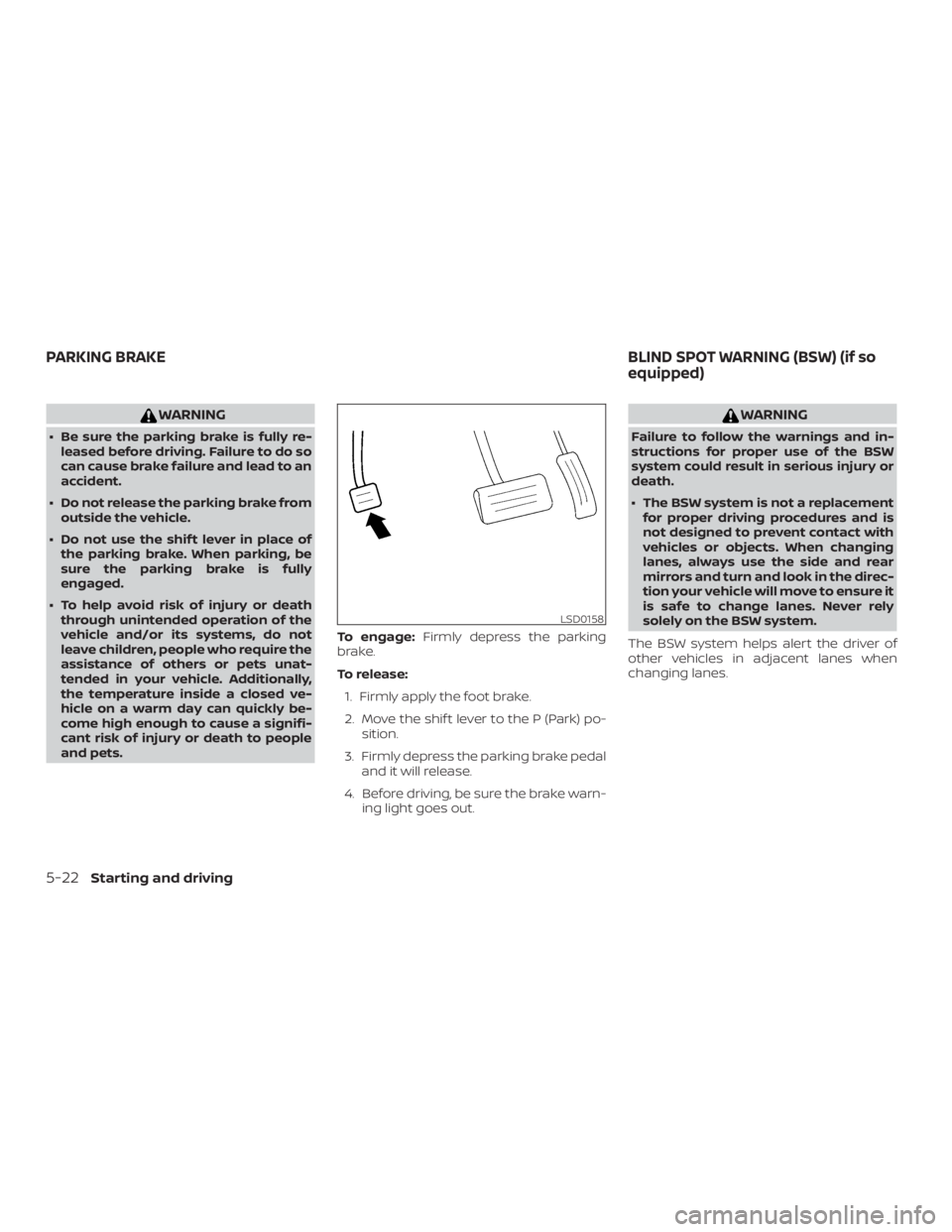
and pets. To engage:
Firmly depress the parking
brake.
To release:
1. Firmly apply the foot brake.
2. Move the shif t lever to the P (Park) po- sition.
3. Firmly depress the parking brake pedal and it will release.
4. Before driving, be sure the brake warn- ing light goes out.
Page 312 of 474
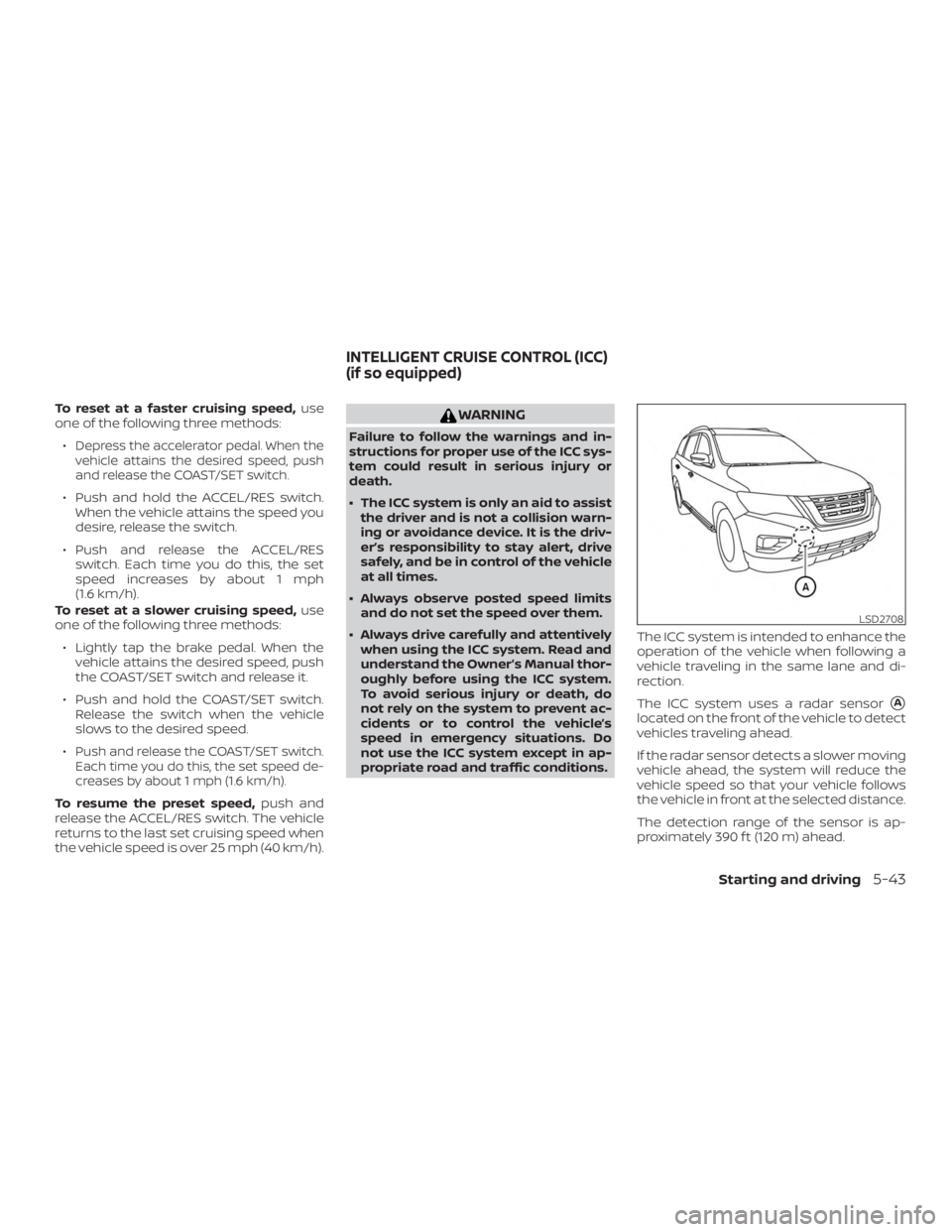
To reset at a faster cruising speed,use
one of the following three methods:
∙
Depress the accelerator pedal. When the
vehicle attains the desired speed, push
and release the COAST/SET switch.
∙ Push and hold the ACCEL/RES switch. When the vehicle attains the speed you
desire, release the switch.
∙ Push and release the ACCEL/RES switch. Each time you do this, the set
speed increases by about 1 mph
(1.6 km/h).
To reset at a slower cruising speed, use
one of the following three methods:
∙ Lightly tap the brake pedal. When the vehicle attains the desired speed, push
the COAST/SET switch and release it.
∙ Push and hold the COAST/SET switch. Release the switch when the vehicle
slows to the desired speed.
∙
Push and release the COAST/SET switch.
Each time you do this, the set speed de-
creases by about 1 mph (1.6 km/h).
To resume the preset speed, push and
release the ACCEL/RES switch. The vehicle
returns to the last set cruising speed when
the vehicle speed is over 25 mph (40 km/h).
Page 334 of 474
CAUTION
During the first 1,200 miles (2,000 km),
follow these recommendations to ob-
tain maximum engine performance
and ensure the future reliability and
economy of your new vehicle. Failure to
follow these recommendations may re-
sult in shortened engine life and re-
duced engine performance.∙ Avoid driving for long periods at con- stant speed, either fast or slow, and do
not run the engine over 4,000 RPM.
∙ Do not accelerate at full throttle in any gear.
∙ Avoid quick starts.
∙ Avoid hard braking as much as pos- sible.
∙ Do not tow a trailer for the first 500 miles (805 kilometers). Your engine, axle or
other parts could be damaged. Follow these easy-to-use Fuel Efficient
Driving Tips to help you achieve the most
fuel economy from your vehicle.
1. Use Smooth Accelerator and Brake
Pedal Application
∙ Avoid rapid starts and stops.
∙ Use smooth, gentle accelerator and brake application whenever possible.
∙ Maintain constant speed while com- muting and coast whenever pos-
sible.
2. Maintain Constant Speed
∙ Look ahead to try and anticipate and minimize stops.
∙ Synchronizing your speed with traffic lights allows you to reduce your num-
ber of stops.
∙ Maintaining a steady speed can mini- mize red light stops and improve fuel
efficiency.
3. Use Air Conditioning (A/C) at Higher
Vehicle Speeds
∙ Below 40 mph (64 km/h), it is more efficient to open windows to cool the
vehicle due to reduced engine load. ∙ Above 40 mph (64 km/h), it is more
efficient to use A/C to cool the vehicle
due to increased aerodynamic drag.
∙ Recirculating the cool air in the cabin when the A/C is on reduces cooling
load.
4. Drive at Economical Speeds and Dis-
tances
∙ Observing the speed limit and not exceeding 60 mph (97 km/h) (where
legally allowed) can improve fuel effi-
ciency due to reduced aerodynamic
drag.
∙ Maintaining a safe following distance behind other vehicles reduces un-
necessary braking.
∙ Safely monitoring traffic to anticipate changes in speed permits reduced
braking and smooth acceleration
changes.
∙ Select a gear range suitable to road conditions.
BREAK-IN SCHEDULE FUEL EFFICIENT DRIVING TIPS
Starting and driving5-65
Page 347 of 474
WARNING
∙ Never rely solely on the hill descentcontrol system to control vehicle
speed when driving on steep downhill
grades. Always drive carefully and at-
tentively when using the hill descent
control system and decelerate the ve-
hicle speed by depressing the brake
pedal if necessary. Be especially care-
ful when driving on frozen, muddy or
extremely steep downhill roads. Fail-
ure to control vehicle speed may re-
sult in a loss of control of the vehicle
and possible serious injury or death.
∙ The hill descent control may not con- trol the vehicle speed on a hill under
all load or road conditions. Always be
prepared to depress the brake pedal
to control vehicle speed. Failure to do
so may result in a collision or serious
personal injury.
The hill descent control system can only be
activated when the 4WD LOCK switch is
engaged.
The hill descent control system helps
maintain vehicle speed when driving under
15 mph (25 km/h) on steeper downhill
grades. Hill descent control is useful when
engine braking alone cannot control ve- hicle speed. Hill descent control applies the
vehicle brakes to control vehicle speed al-
lowing the driver to concentrate on steer-
ing while reducing the burden of brake and
accelerator operation.
If the hill descent control light is blinking,
the hill descent control is engaged; how-
ever, the hill descent control will not control
the vehicle speed.
∙ Once the system is activated, the indi- cator light will remain on in the instru-
ment panel. For additional information,
refer to “Hill descent control system ON
indicator light” in the “Instruments and
controls” section of this manual.
If the accelerator or brake pedal is de-
pressed while the hill descent control sys-
tem is on, the system will stop operating
temporarily. As soon as the accelerator or
brake pedal is released, the hill descent
control system begins to function again if
the hill descent control operating condi-
tions are fulfilled.
For the best results, when descending
steep downhill grades, the hill descent con-
trol switch should be on and the shif t lever
in L (Low gear) for engine braking.
Page 394 of 474
Under some driving or climate conditions,
occasional brake squeak, squeal or other
noise may be heard. Occasional brake
noise during light to moderate stops is nor-
mal and does not affect the function or
performance of the brake system.
Proper brake inspection intervals should
be followed.For additional information re-
garding brake inspections, refer to the ap-
propriate maintenance schedule informa-
tion in the "Maintenance and schedules"
section of this manual.
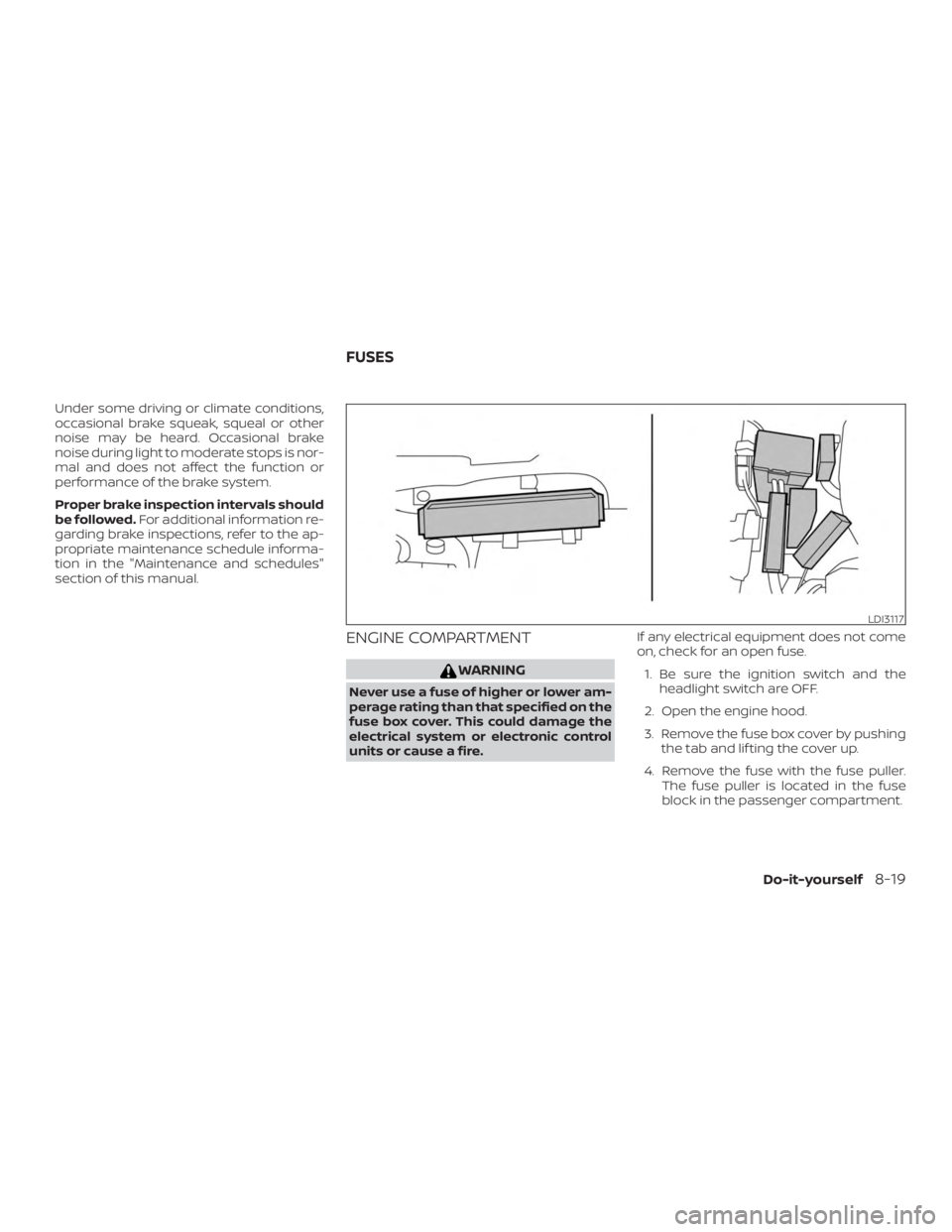
ENGINE COMPARTMENT
Page 467 of 474
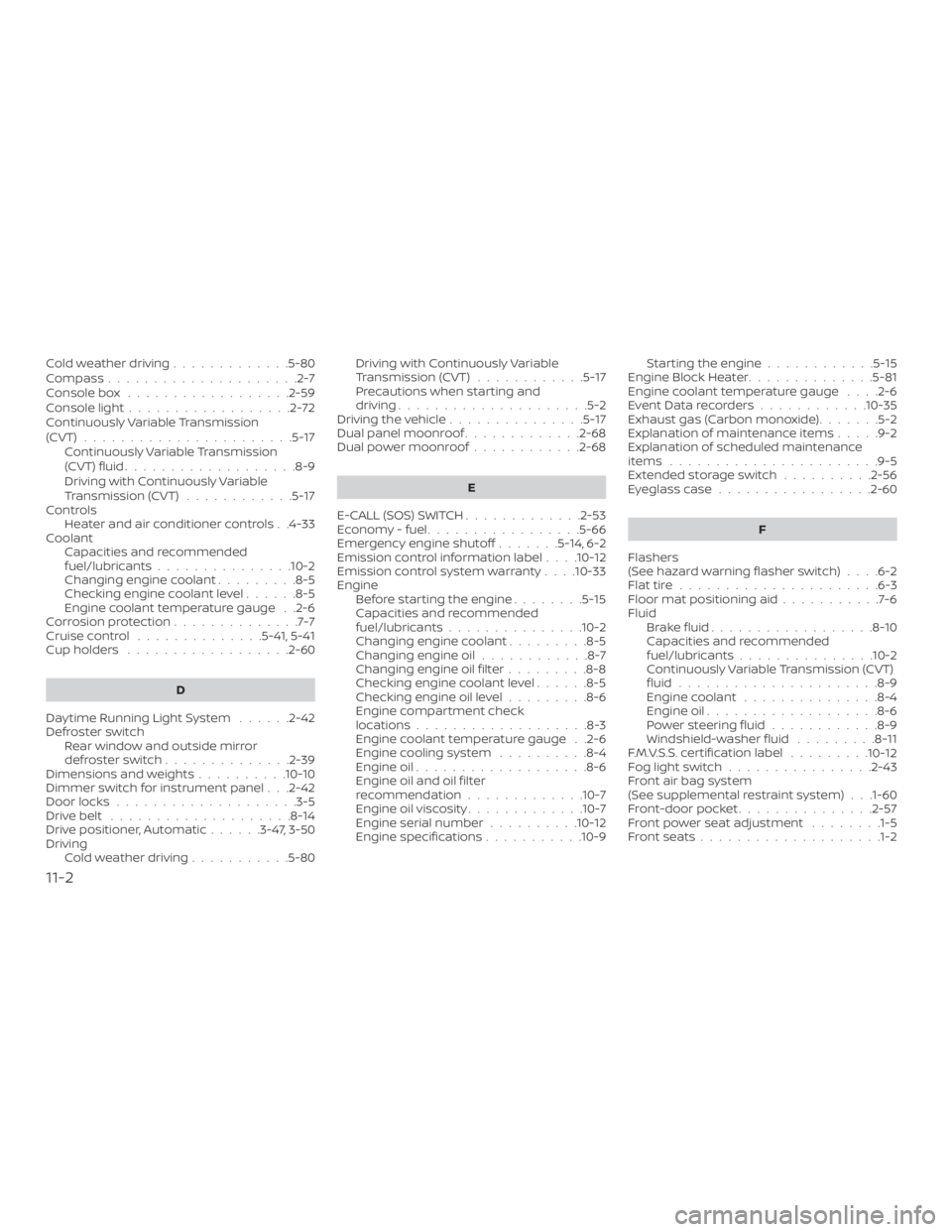
Coldweatherdriving.............5-80
Compass.....................2-7
Console box ..................2-59
Console light ..................2-72
Continuously Variable Transmission
(CVT) .......................5-17
Continuously Variable Transmission
(CVT) fluid ...................8-9
Driving with Continuously Variable
Transmission (CVT) ............5-17
Controls Heater and air conditioner controls . .4-33
Coolant Capacities and recommended
fuel/lubricants...............10-2
Changing engine coolant .........8-5
Checking engine coolant level ......8-5
Engine coolant temperature gauge . .2-6
Corrosionprotection..............7-7
Cruisecontrol ..............5-41,5-41
Cupholders ..................2-60
D
Daytime Running Light System ......2-42
Defroster switch Rear window and outside mirror
defrosterswitch..............2-39
Dimensions and weights ..........10-10
Dimmer switch for instrument panel . . .2-42
Door locks ....................3-5
Drivebelt ....................8-14
Drive positioner, Automatic ......3-47,3-50
Driving Coldweatherdriving...........5-80 Driving with Continuously Variable
Transmission (CVT)
............5-17
Precautions when starting and
driving.....................5-2
Drivingthevehicle...............5-17
Dual panel moonroof .............2-68
Dual power moonroof ............2-68
E
E-CALL (SOS) SWITCH .............2-53
Economy - fuel .................5-66
Emergency engine shutoff .......5-14,6-2
Emission control information label . . . .10-12
Emission control system warranty . . . .10-33
Engine Before starting the engine ........5-15
Capacities and recommended
fuel/lubricants...............10-2
Changing engine coolant .........8-5
Changing engine oil ............8-7
Changing engine oil filter .........8-8
Checking engine coolant level ......8-5
Checking engine oil level .........8-6
Engine compartment check
locations...................8-3
Engine coolant temperature gauge . .2-6
Engine cooling system ..........8-4
Engine oil ...................8-6
Engine oil and oil filter
recommendation .............10-7
Engine oil viscosity .............10-7
Engine serial number ..........10-12
Engine specifications ...........10-9 Starting the engine
............5-15
Engine Block Heater ..............5-81
Engine coolant temperature gauge ....2-6
EventDatarecorders............10-35
Exhaust gas (Carbon monoxide) .......5-2
Explanation of maintenance items .....9-2
Explanation of scheduled maintenance
items .......................9-5
Extended storage switch ..........2-56
Eyeglasscase.................2-60
F
Flashers
(Seehazardwarningflasherswitch)....6-2
Flattire......................6-3
Floormatpositioningaid...........7-6
Fluid Brakefluid..................8-10
Capacities and recommended
fuel/lubricants...............10-2
Continuously Variable Transmission (CVT)
fluid......................8-9
Engine coolant ...............8-4
Engine oil ...................8-6
Powersteeringfluid............8-9
Windshield-washer fluid .........8-11
F.M.V.S.S. certification label .........
10-12
Foglightswitch................2-43
Front air bag system
(See supplemental restraint system) . . .1-60
Front-door pocket ...............2-57
Front power seat adjustment ........1-5
Frontseats....................1-2
11-2
Page 469 of 474

L
Labels Air conditioner specification label . . .10-13
C.M.V.S.S. certification label .......10-12
Emission control information label . .10-12
Engine serial number ..........10-12
F.M.V.S.S. certification label .......10-12
Tire and Loading Information label . .10-13
Vehicle identification number (VIN) . .10-11
Vehicle identification number (VIN)
plate.....................10-11
Warning labels (for SRS) ..........1-71
LATCH (Lower Anchors and Tethers for
CHildren)System............... .1-32
LED Daytime Running Lights (DRL) .....2-42
License plate Installing the license plate .......10-13
Liftgate......................3-31
Liftgaterelease.................3-37
Light Airbagwarninglight........1-72, 2-16
Brakelight(Seestoplight)........8-24
Bulb check/instrument panel ......2-11
Bulb replacement .............8-24
Charge warning light ...........2-13
Console light ................2-72
ExteriorandInteriorlights........8-24
Foglights..................8-23
Foglightswitch..............2-43
Headlight and turn signal switch ....2-40
Headlightcontrolswitch.........2-40
Headlights .................8-23
Interiorlight.................2-71
Lightbulbs.................8-23 Low tire pressure warning light
.....2-13
Low windshield-washer fluid warning
light......................2-31
Passenger air bag and status light . . .1-63
Personal lights ...............2-72
Security indicator light ..........2-18
Spotlights(Seemaplight)........2-72
Warning/indicator lights and audible
reminders ...............2 -11, 2-16
Lights ......................8-23 Maplights..................2-72
Lock Child safety rear door lock ........3-7
Door locks ..................3-5
Gloveboxlock...............2-59
Liftgaterelease...............3-37
Power door locks ..............3-6
Loose fuel cap warning ............2-31
Lowfuelwarninglight.........2-15,2-30
Low tire pressure warning light .......2-13
Low windshield-washer fluid warning
light........................2-31
Luggage hook .................2-63
Luggage rack (see roof rack) ........2-64
Luggage
(See vehicle loading information) .....10-14
M
Maintenance General maintenance ...........9-2
Insidethevehicle..............9-3
Maintenance precautions .........8-2
Outsidethevehicle.............9-2
Seat belt maintenance ..........1-27 Under the hood and vehicle
.......9-4
Maintenance log ................9-13
Maintenance requirements ..........9-2
Maintenance schedules ............9-7
Maintenance under severe operation
conditions....................9-12
Malfunctionindicatorlight..........2-17
Manual front seat adjustment ........1-3
Maplights................... .2-72
Map pocket ...................2-57
Memory Seat ...............3-47,3-50
Meters and gauges ...............2-4
Instrument brightness control .....2-42
Mirror Automatic anti-glare inside mirror. . .3-45
Outsidemirrors..............3-46
Rearview ..................3-44
Vanitymirror................3-44
Mirrors......................3-44
Moonroof ....................2-68
Moving Object Detection (MOD) ......4-27
N
NissanConnect® Owner's Manual ......
4-2
NISSAN Intelligent Key® .........3-2,3-21
NISSAN Vehicle Immobilizer
System ..................2-35,5-15
O
Octane rating (See fuel octane rating) . .10-6
Odometer ....................2-5
11-4