Condition NISSAN PATROL 2004 Electronic Owner's Guide
[x] Cancel search | Manufacturer: NISSAN, Model Year: 2004, Model line: PATROL, Model: NISSAN PATROL 2004Pages: 579, PDF Size: 26.61 MB
Page 283 of 579
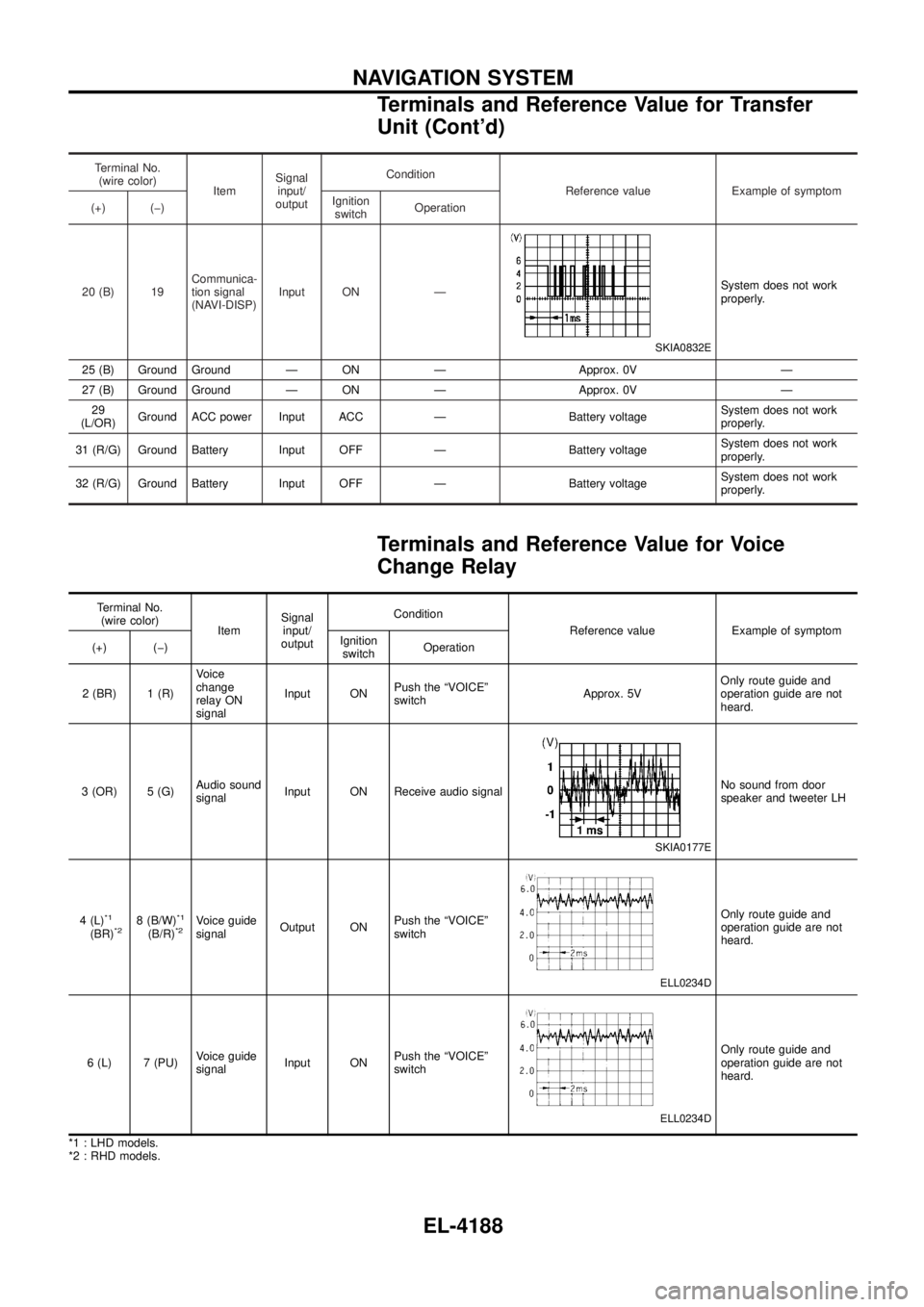
Terminal No.(wire color) ItemSignal
input/
output Condition
Reference value Example of symptom
(+) (þ) Ignition
switch Operation
20 (B) 19 Communica-
tion signal
(NAVI-DISP)Input ON Ð
SKIA0832E
System does not work
properly.
25 (B) Ground Ground Ð ON Ð Approx. 0V Ð
27 (B) Ground Ground Ð ON Ð Approx. 0V Ð 29
(L/OR) Ground ACC power Input ACC Ð Battery voltage System does not work
properly.
31 (R/G) Ground Battery Input OFF Ð Battery voltage System does not work
properly.
32 (R/G) Ground Battery Input OFF Ð Battery voltage System does not work
properly.
Terminals and Reference Value for Voice
Change Relay
Terminal No.
(wire color) ItemSignal
input/
output Condition
Reference value Example of symptom
(+) (þ) Ignition
switch Operation
2 (BR) 1 (R) Voice
change
relay ON
signalInput ON
Push the ªVOICEº
switch Approx. 5VOnly route guide and
operation guide are not
heard.
3 (OR) 5 (G) Audio sound
signalInput ON Receive audio signal
SKIA0177E
No sound from door
speaker and tweeter LH
4 (L)
*1
(BR)*28 (B/W)*1
(B/R)*2Voice guide
signal Output ON Push the ªVOICEº
switch
ELL0234D
Only route guide and
operation guide are not
heard.
6 (L) 7 (PU) Voice guide
signalInput ON Push the ªVOICEº
switch
ELL0234D
Only route guide and
operation guide are not
heard.
*1 : LHD models.
*2 : RHD models.
NAVIGATION SYSTEM
Terminals and Reference Value for Transfer
Unit (Cont'd)
EL-4188
Page 284 of 579
Self-Diagnosis Function
DESCRIPTION
+Diagnosis function consists of the self-diagnosis mode performed automatically and the CONFIRMATION/
ADJUSTMENT mode operated manually.
+ Self-diagnosis mode checks for connections between the units constituting this system, analyzes each
individual unit at the same time, and displays the results on the LCD screen.
+ CONFIRMATION/ADJUSTMENT mode is used to perform trouble diagnosis that require operation and
judgment by an operator (malfunction that cannot be automatically judged by the system), to check/change
the set value, and to display the History of Errors of the navigation system.
DIAGNOSIS ITEM
Mode Description
Self-diagnosis +
NAVI Control unit diagnosis (DVD-ROM drive will not be diagnosed when no
map DVD-ROM is in it.).
+ Performs diagnosis of each unit and connections between control unit and
GPS antenna, as well as between control unit and each unit.
Con®rmation/
Adjustment Display
Color tone and shading of the screen can be checked by the display of a color
bar and a gray scale.
Vehicle signals Analyzes the following vehicle signals: Vehicle speed signal, light signal, ignition
switch signal, and reverse signal.
Navigation Display Longi-
tude & Lati-
tude
Display the map. Use the joystick to adjust position. Longitude and latitude will be
displayed.
Speed Calibra-
tion Under ordinary conditions, the navigation system distance measuring function will
automatically compensate for minute decreases in wheel and tire diameter
caused by tire wear or low-pressure. Speed calibration immediately restores sys-
tem accuracy in cases such as when distance calibration is needed because of
the use of tire chains in inclement weather.
Angle Adjust-
ment Corrects difference between actual turning angle of a vehicle and turning angle of
the car mark on the display.
Initialize Loca-
tion This mode is for initializing the current location. Use when the vehicle is trans-
ported a long distance on a trailer, etc.
History of Errors Diagnosis results previously stored in the memory (before turning ignition switch
ON) are displayed in this mode. Time and location when/where the errors
occurred are also displayed.
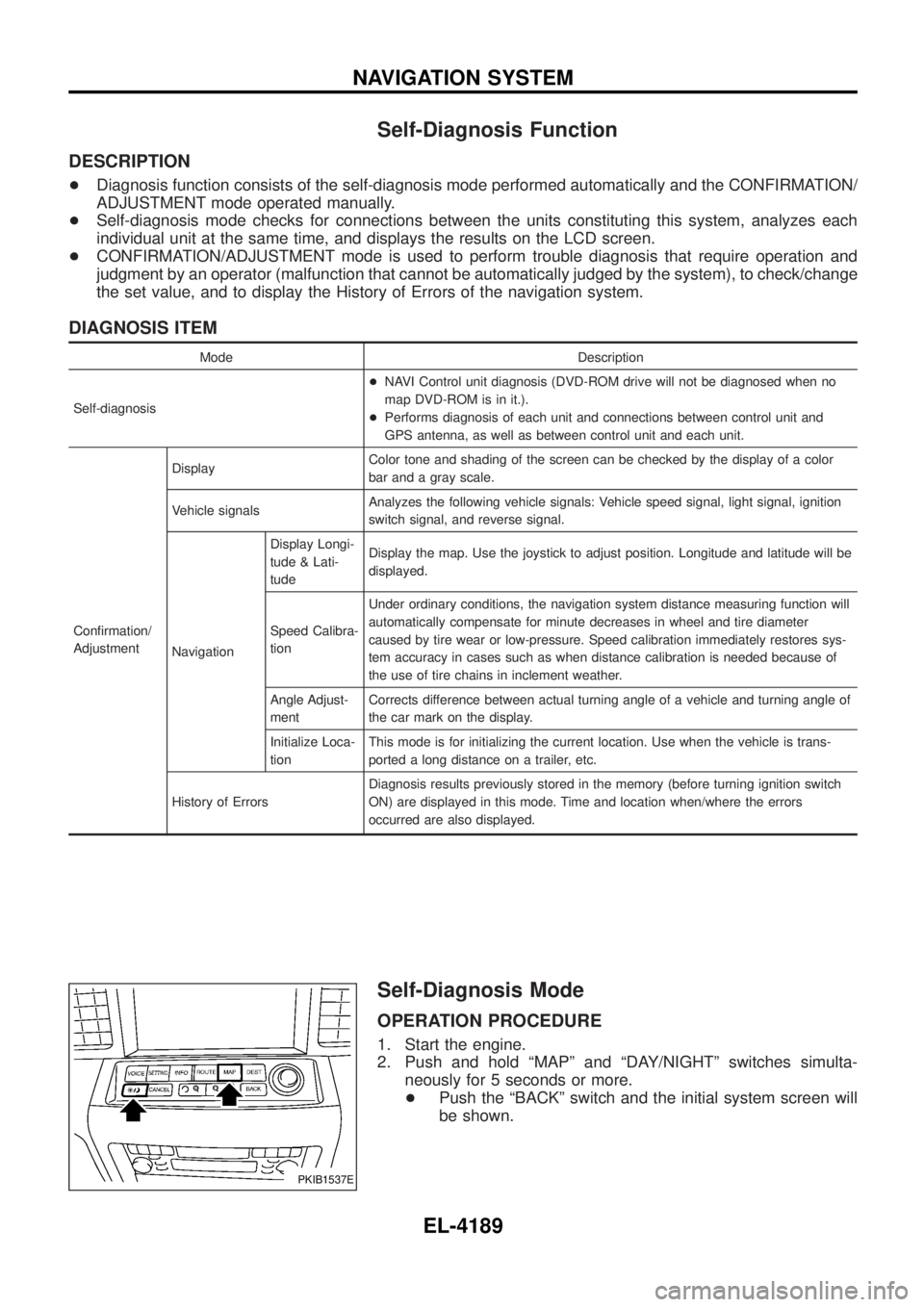
Self-Diagnosis Mode
OPERATION PROCEDURE
1. Start the engine.
2. Push and hold ªMAPº and ªDAY/NIGHTº switches simulta-
neously for 5 seconds or more.
+ Push the ªBACKº switch and the initial system screen will
be shown.
PKIB1537E
NAVIGATION SYSTEM
EL-4189
Page 289 of 579
Diagnosis item Display Condition Remarks
Vehicle speed ON Vehicle spee
d > 0 km/h (0 MPH)
Changes in indication may be delayed by
approx. 1.5 seconds. This is normal.
OFF Vehicle spee
d = 0 km/h (0 MPH)
Ð Ignition switch in ACC position
Light ON Lighting switch ON
Ð
OFF Lighting switch OFF
IGN ON Ignition switch ON
Ð
OFF Ignition switch ACC
Reverse ON Selector lever in R position
Changes in indication may be delayed by
approx. 1.5 seconds. This is normal.
OFF Selector lever in other than R position
Ð Ignition switch in ACC position
+ If vehicle speed is NG, refer to EL-4206.
+ If light is NG, refer to EL-4207.
+ If IGN is NG, refer to EL-4208.
+ If reverse is NG, refer to EL-4208.
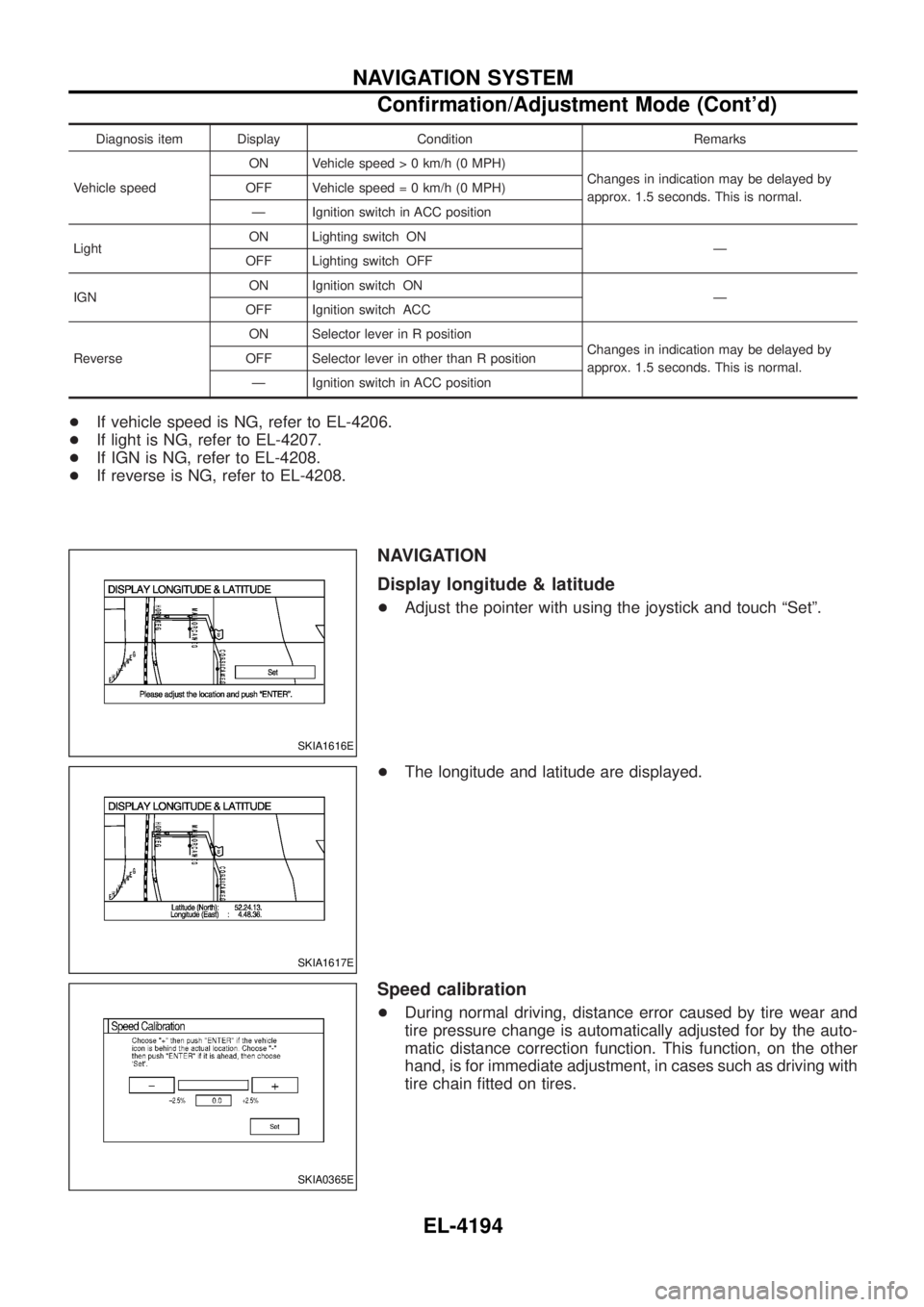
NAVIGATION
Display longitude & latitude
+Adjust the pointer with using the joystick and touch ªSetº.
+ The longitude and latitude are displayed.
Speed calibration
+During normal driving, distance error caused by tire wear and
tire pressure change is automatically adjusted for by the auto-
matic distance correction function. This function, on the other
hand, is for immediate adjustment, in cases such as driving with
tire chain ®tted on tires.
SKIA1616E
SKIA1617E
SKIA0365E
NAVIGATION SYSTEM
Con®rmation/Adjustment Mode (Cont'd)
EL-4194
Page 290 of 579
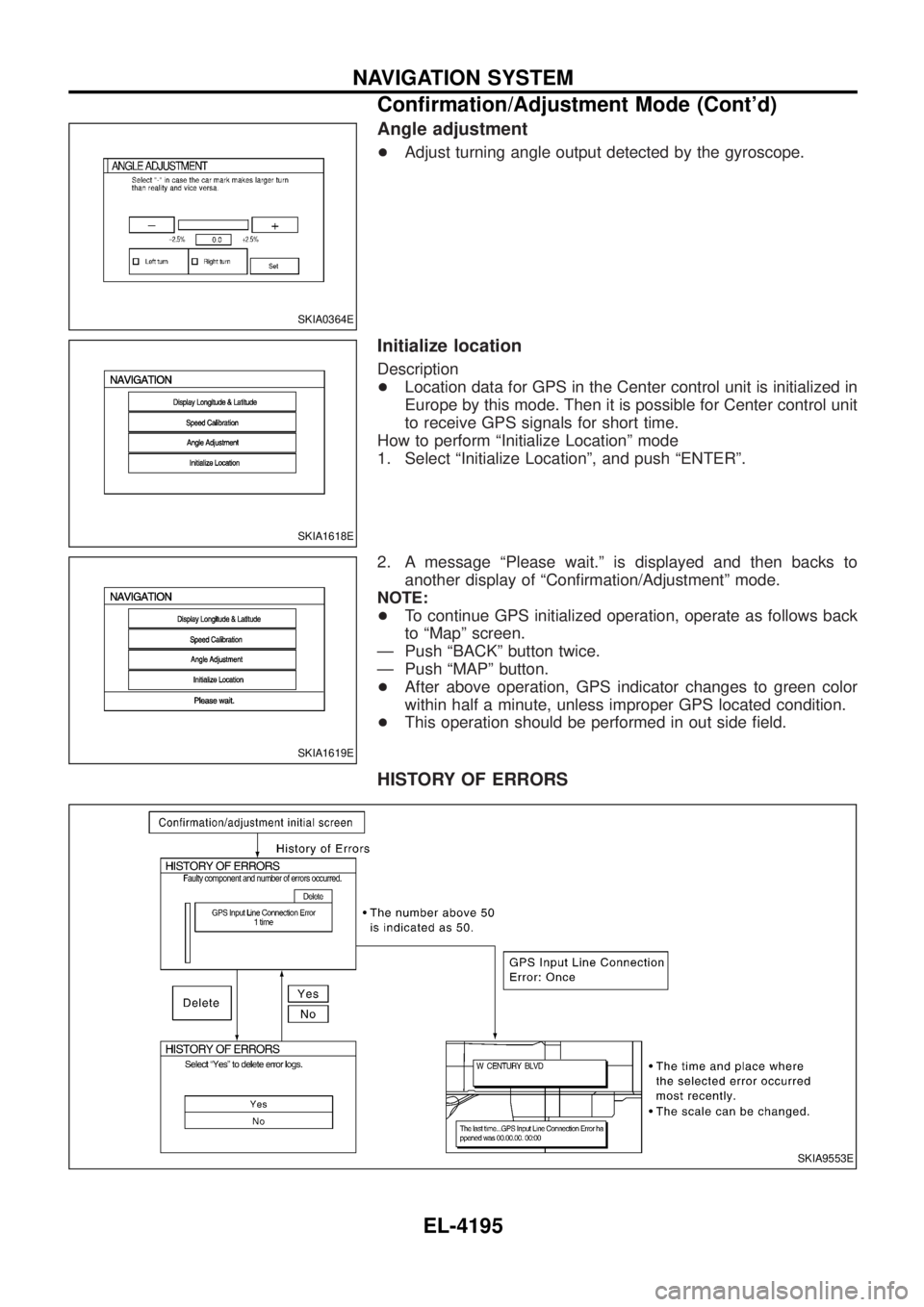
Angle adjustment
+Adjust turning angle output detected by the gyroscope.
Initialize location
Description
+Location data for GPS in the Center control unit is initialized in
Europe by this mode. Then it is possible for Center control unit
to receive GPS signals for short time.
How to perform ªInitialize Locationº mode
1. Select ªInitialize Locationº, and push ªENTERº.
2. A message ªPlease wait.º is displayed and then backs to another display of ªCon®rmation/Adjustmentº mode.
NOTE:
+ To continue GPS initialized operation, operate as follows back
to ªMapº screen.
Ð Push ªBACKº button twice.
Ð Push ªMAPº button.
+ After above operation, GPS indicator changes to green color
within half a minute, unless improper GPS located condition.
+ This operation should be performed in out side ®eld.
HISTORY OF ERRORS
SKIA0364E
SKIA1618E
SKIA1619E
SKIA9553E
NAVIGATION SYSTEM
Con®rmation/Adjustment Mode (Cont'd)
EL-4195
Page 308 of 579

2. CHECK RGB SYNCHRONIZING SIGNAL
1. Connect NAVI control unit connector and display connector.
2. Turn ignition switch ON.
3. Push the ªMAPº switch.
4. Check the signal between NAVI control unit harness connector M167 terminals 16 (W) and 17 with CONSULT-ll oroscilloscope.
PKIB0557E
16 (W) - 19: Refer to EL-4183. OK or NG
OK ©Replace display.
NG ©Replace NAVI control unit.
GUIDE SOUND IS NOT HEARD
1. CHECK VOICE GUIDE SETTING
+While driving in the dark pink route, voice guide does not operate.
NOTE:
Voice guide is only available at intersections that satisfy certain conditions (indicated by +on the map).
Therefore, guidance may not be given even when the route on the map changes direction.
+ Is volume setting not switched ON?
YesorNo
Ye s ©GO TO 2.
No ©Switch the setting ON and turn the volume up.
NAVIGATION SYSTEM
Trouble Diagnoses (Cont'd)
EL-4213
Page 313 of 579
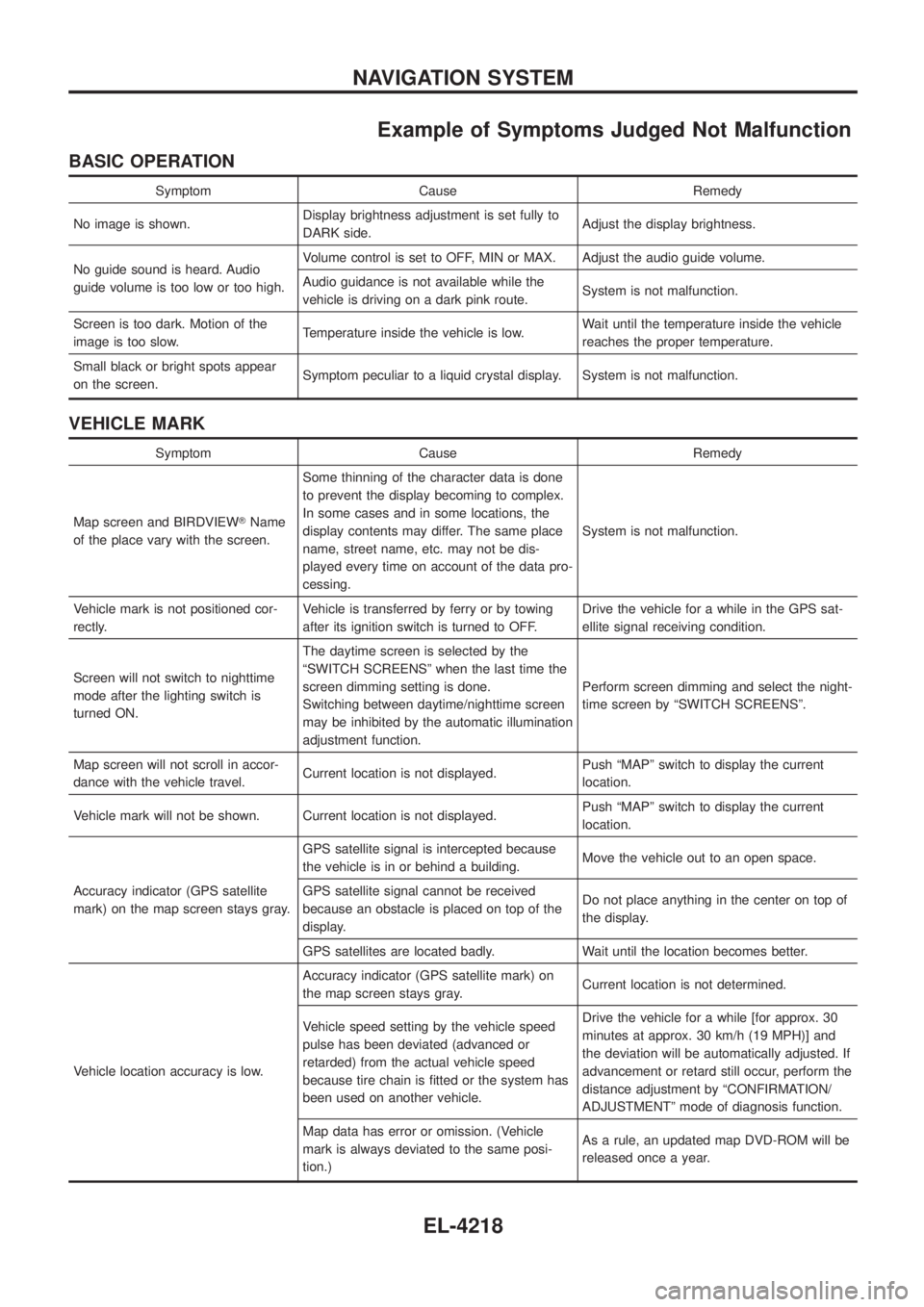
Example of Symptoms Judged Not Malfunction
BASIC OPERATION
Symptom Cause Remedy
No image is shown. Display brightness adjustment is set fully to
DARK side. Adjust the display brightness.
No guide sound is heard. Audio
guide volume is too low or too high. Volume control is set to OFF, MIN or MAX. Adjust the audio guide volume.
Audio guidance is not available while the
vehicle is driving on a dark pink route.
System is not malfunction.
Screen is too dark. Motion of the
image is too slow. Temperature inside the vehicle is low. Wait until the temperature inside the vehicle
reaches the proper temperature.
Small black or bright spots appear
on the screen. Symptom peculiar to a liquid crystal display. System is not malfunction.
VEHICLE MARK
Symptom Cause Remedy
Map screen and BIRDVIEW TName
of the place vary with the screen. Some thinning of the character data is done
to prevent the display becoming to complex.
In some cases and in some locations, the
display contents may differ. The same place
name, street name, etc. may not be dis-
played every time on account of the data pro-
cessing.
System is not malfunction.
Vehicle mark is not positioned cor-
rectly. Vehicle is transferred by ferry or by towing
after its ignition switch is turned to OFF. Drive the vehicle for a while in the GPS sat-
ellite signal receiving condition.
Screen will not switch to nighttime
mode after the lighting switch is
turned ON. The daytime screen is selected by the
ªSWITCH SCREENSº when the last time the
screen dimming setting is done.
Switching between daytime/nighttime screen
may be inhibited by the automatic illumination
adjustment function.
Perform screen dimming and select the night-
time screen by ªSWITCH SCREENSº.
Map screen will not scroll in accor-
dance with the vehicle travel. Current location is not displayed. Push ªMAPº switch to display the current
location.
Vehicle mark will not be shown. Current location is not displayed. Push ªMAPº switch to display the current
location.
Accuracy indicator (GPS satellite
mark) on the map screen stays gray. GPS satellite signal is intercepted because
the vehicle is in or behind a building.
Move the vehicle out to an open space.
GPS satellite signal cannot be received
because an obstacle is placed on top of the
display. Do not place anything in the center on top of
the display.
GPS satellites are located badly. Wait until the location becomes better.
Vehicle location accuracy is low. Accuracy indicator (GPS satellite mark) on
the map screen stays gray.
Current location is not determined.
Vehicle speed setting by the vehicle speed
pulse has been deviated (advanced or
retarded) from the actual vehicle speed
because tire chain is ®tted or the system has
been used on another vehicle. Drive the vehicle for a while [for approx. 30
minutes at approx. 30 km/h (19 MPH)] and
the deviation will be automatically adjusted. If
advancement or retard still occur, perform the
distance adjustment by ªCONFIRMATION/
ADJUSTMENTº mode of diagnosis function.
Map data has error or omission. (Vehicle
mark is always deviated to the same posi-
tion.) As a rule, an updated map DVD-ROM will be
released once a year.
NAVIGATION SYSTEM
EL-4218
Page 314 of 579
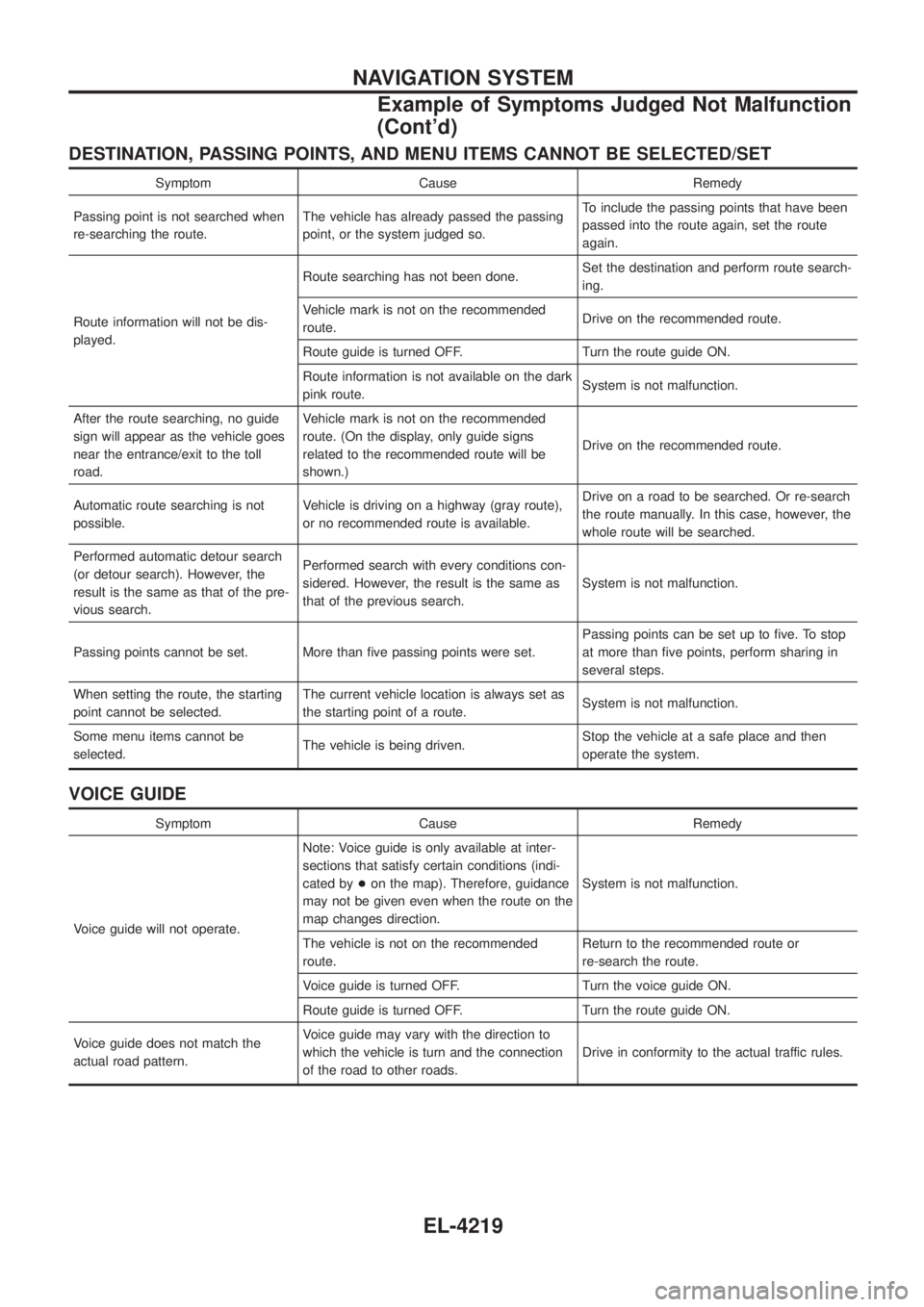
DESTINATION, PASSING POINTS, AND MENU ITEMS CANNOT BE SELECTED/SET
Symptom Cause Remedy
Passing point is not searched when
re-searching the route. The vehicle has already passed the passing
point, or the system judged so. To include the passing points that have been
passed into the route again, set the route
again.
Route information will not be dis-
played. Route searching has not been done.
Set the destination and perform route search-
ing.
Vehicle mark is not on the recommended
route. Drive on the recommended route.
Route guide is turned OFF. Turn the route guide ON.
Route information is not available on the dark
pink route. System is not malfunction.
After the route searching, no guide
sign will appear as the vehicle goes
near the entrance/exit to the toll
road. Vehicle mark is not on the recommended
route. (On the display, only guide signs
related to the recommended route will be
shown.)
Drive on the recommended route.
Automatic route searching is not
possible. Vehicle is driving on a highway (gray route),
or no recommended route is available. Drive on a road to be searched. Or re-search
the route manually. In this case, however, the
whole route will be searched.
Performed automatic detour search
(or detour search). However, the
result is the same as that of the pre-
vious search. Performed search with every conditions con-
sidered. However, the result is the same as
that of the previous search.
System is not malfunction.
Passing points cannot be set. More than ®ve passing points were set. Passing points can be set up to ®ve. To stop
at more than ®ve points, perform sharing in
several steps.
When setting the route, the starting
point cannot be selected. The current vehicle location is always set as
the starting point of a route.
System is not malfunction.
Some menu items cannot be
selected. The vehicle is being driven. Stop the vehicle at a safe place and then
operate the system.
VOICE GUIDE
Symptom Cause Remedy
Voice guide will not operate. Note: Voice guide is only available at inter-
sections that satisfy certain conditions (indi-
cated by
+on the map). Therefore, guidance
may not be given even when the route on the
map changes direction. System is not malfunction.
The vehicle is not on the recommended
route. Return to the recommended route or
re-search the route.
Voice guide is turned OFF. Turn the voice guide ON.
Route guide is turned OFF. Turn the route guide ON.
Voice guide does not match the
actual road pattern. Voice guide may vary with the direction to
which the vehicle is turn and the connection
of the road to other roads.
Drive in conformity to the actual traffic rules.
NAVIGATION SYSTEM
Example of Symptoms Judged Not Malfunction
(Cont'd)
EL-4219
Page 315 of 579
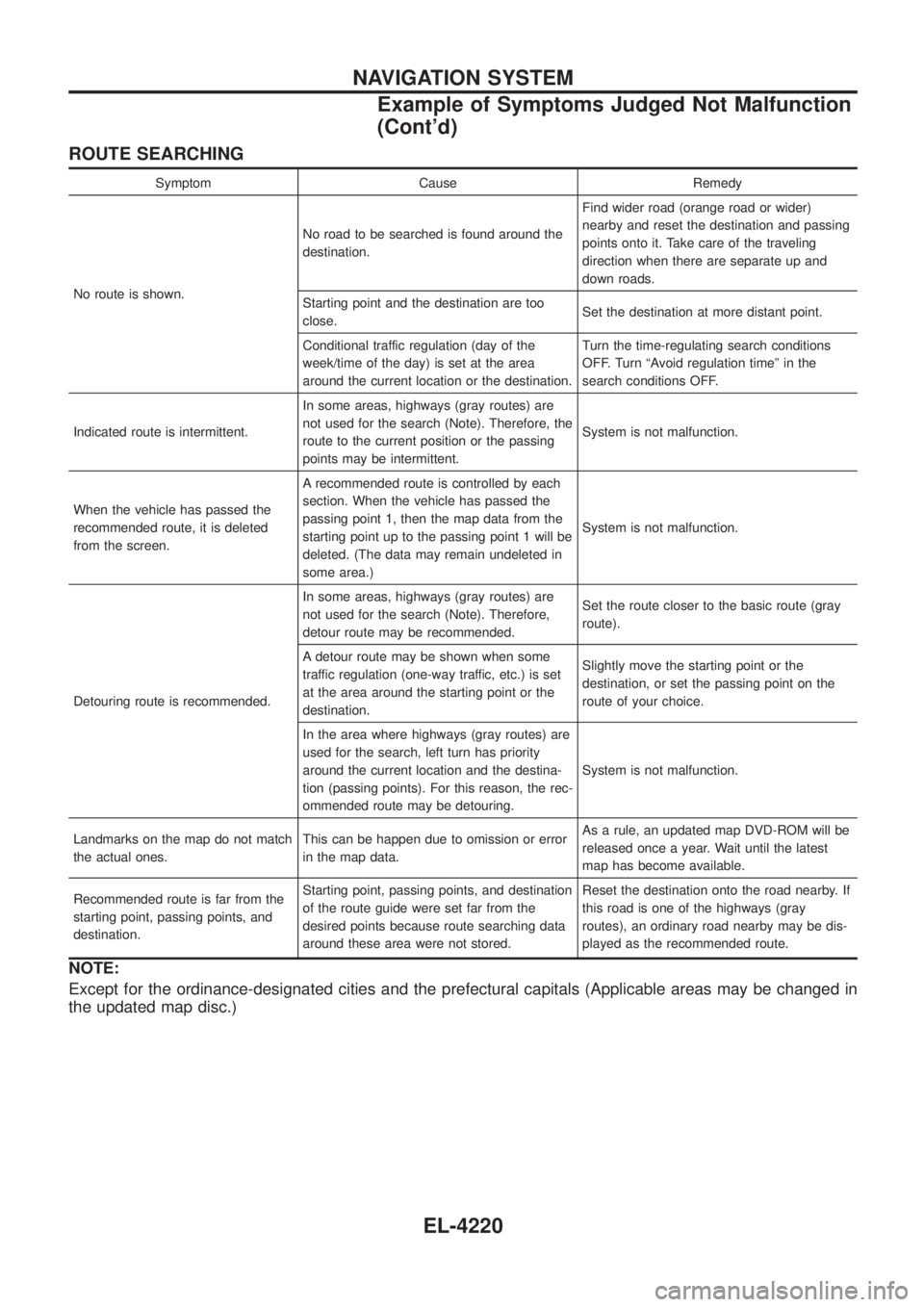
ROUTE SEARCHING
Symptom Cause Remedy
No route is shown. No road to be searched is found around the
destination.
Find wider road (orange road or wider)
nearby and reset the destination and passing
points onto it. Take care of the traveling
direction when there are separate up and
down roads.
Starting point and the destination are too
close. Set the destination at more distant point.
Conditional traffic regulation (day of the
week/time of the day) is set at the area
around the current location or the destination. Turn the time-regulating search conditions
OFF. Turn ªAvoid regulation timeº in the
search conditions OFF.
Indicated route is intermittent. In some areas, highways (gray routes) are
not used for the search (Note). Therefore, the
route to the current position or the passing
points may be intermittent. System is not malfunction.
When the vehicle has passed the
recommended route, it is deleted
from the screen. A recommended route is controlled by each
section. When the vehicle has passed the
passing point 1, then the map data from the
starting point up to the passing point 1 will be
deleted. (The data may remain undeleted in
some area.)
System is not malfunction.
Detouring route is recommended. In some areas, highways (gray routes) are
not used for the search (Note). Therefore,
detour route may be recommended.
Set the route closer to the basic route (gray
route).
A detour route may be shown when some
traffic regulation (one-way traffic, etc.) is set
at the area around the starting point or the
destination. Slightly move the starting point or the
destination, or set the passing point on the
route of your choice.
In the area where highways (gray routes) are
used for the search, left turn has priority
around the current location and the destina-
tion (passing points). For this reason, the rec-
ommended route may be detouring. System is not malfunction.
Landmarks on the map do not match
the actual ones. This can be happen due to omission or error
in the map data. As a rule, an updated map DVD-ROM will be
released once a year. Wait until the latest
map has become available.
Recommended route is far from the
starting point, passing points, and
destination. Starting point, passing points, and destination
of the route guide were set far from the
desired points because route searching data
around these area were not stored. Reset the destination onto the road nearby. If
this road is one of the highways (gray
routes), an ordinary road nearby may be dis-
played as the recommended route.
NOTE:
Except for the ordinance-designated cities and the prefectural capitals (Applicable areas may be changed in
the updated map disc.)
NAVIGATION SYSTEM
Example of Symptoms Judged Not Malfunction
(Cont'd)
EL-4220
Page 317 of 579

Cause (condition) Driving condition Remarks (correction, etc.)
Road con®gu-
ration Y-intersections
ELK0192D
At a Y intersection or similar gradual
division of roads, error the direction
of travel deduced by the sensor may
result in the current location mark
appearing on the wrong road.
If after travelling about 10 km (6
miles) the correct location has not
been restored, perform location cor-
rection and, if necessary, direction
correction.
Spiral roads
ELK0193D
When driving on a large, continuous
spiral road (such as loop bridge),
turning angle error is accumulated
and the vehicle mark may deviate
from the correct location.
Straight roads
ELK0194D
When driving on a long, straight road
and slow curve without stopping,
map-matching does not work effec-
tively enough and distance errors
may accumulate. As a result, the
vehicle mark may deviate from the
correct location when the vehicle
turned at a corner.
Zigzag roads
ELK0195D
When driving on a zigzag road, the
map may be matched to other roads
in the similar direction nearby at
every turn, and the vehicle mark may
deviate from the correct location.
Roads laid out in a grid pattern
ELK0196D
When driving at where roads are laid
out in a grid pattern, where many
roads are running in the similar
direction nearby, the map may be
matched to them by mistake and the
vehicle mark may deviate from the
correct location.
Parallel roads
ELK0197D
When two roads are running in paral-
lel (such as highway and sideway),
the map may be matched to the
other road by mistake and the
vehicle mark may deviate from the
correct location.
NAVIGATION SYSTEM
Example of Symptoms Judged Not Malfunction
(Cont'd)
EL-4222
Page 318 of 579
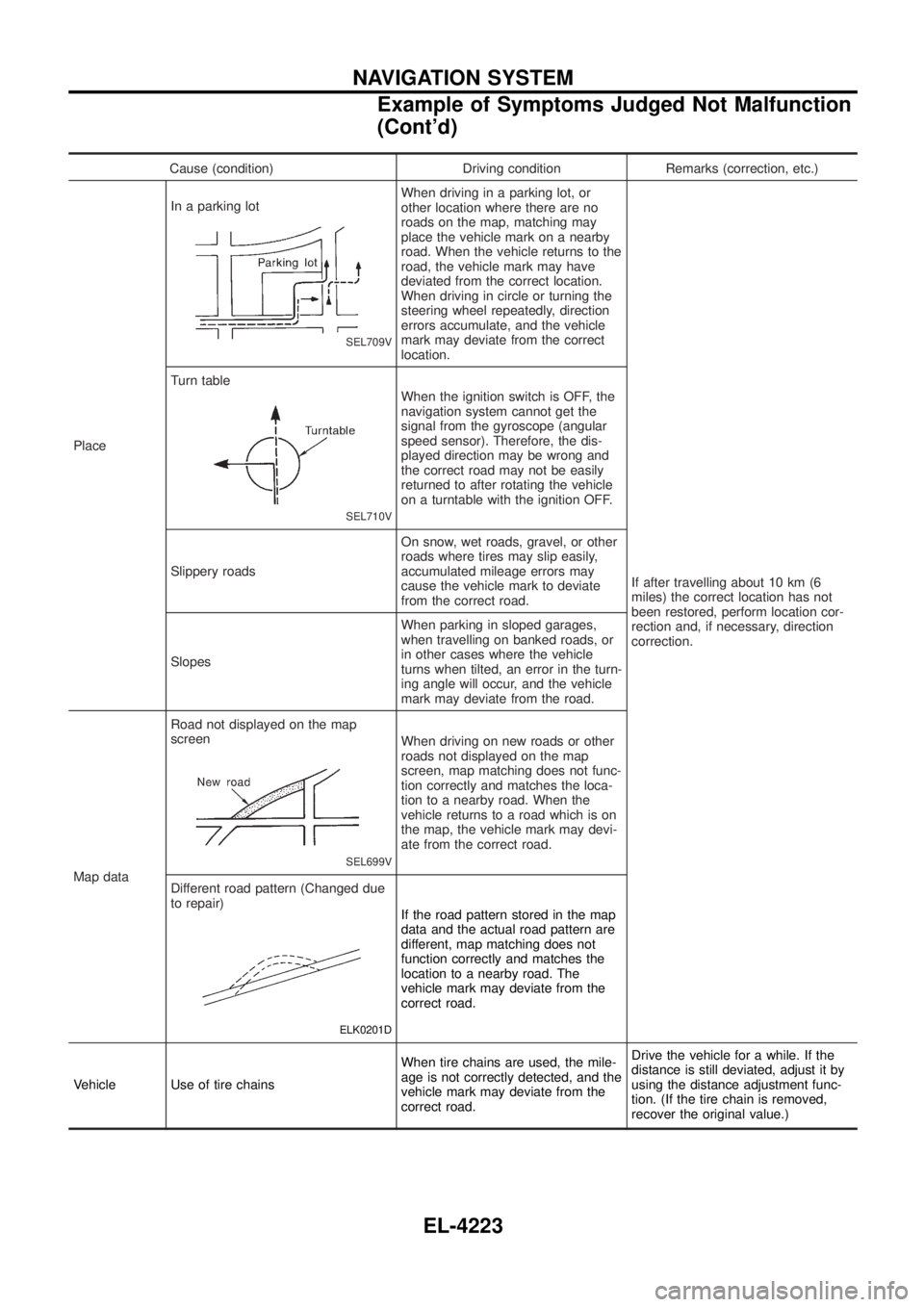
Cause (condition) Driving condition Remarks (correction, etc.)
Place In a parking lot
SEL709V
When driving in a parking lot, or
other location where there are no
roads on the map, matching may
place the vehicle mark on a nearby
road. When the vehicle returns to the
road, the vehicle mark may have
deviated from the correct location.
When driving in circle or turning the
steering wheel repeatedly, direction
errors accumulate, and the vehicle
mark may deviate from the correct
location.
If after travelling about 10 km (6
miles) the correct location has not
been restored, perform location cor-
rection and, if necessary, direction
correction.
Turn table
SEL710V
When the ignition switch is OFF, the
navigation system cannot get the
signal from the gyroscope (angular
speed sensor). Therefore, the dis-
played direction may be wrong and
the correct road may not be easily
returned to after rotating the vehicle
on a turntable with the ignition OFF.
Slippery roads On snow, wet roads, gravel, or other
roads where tires may slip easily,
accumulated mileage errors may
cause the vehicle mark to deviate
from the correct road.
Slopes When parking in sloped garages,
when travelling on banked roads, or
in other cases where the vehicle
turns when tilted, an error in the turn-
ing angle will occur, and the vehicle
mark may deviate from the road.
Map data Road not displayed on the map
screen
SEL699V
When driving on new roads or other
roads not displayed on the map
screen, map matching does not func-
tion correctly and matches the loca-
tion to a nearby road. When the
vehicle returns to a road which is on
the map, the vehicle mark may devi-
ate from the correct road.
Different road pattern (Changed due
to repair)
ELK0201D
If the road pattern stored in the map
data and the actual road pattern are
different, map matching does not
function correctly and matches the
location to a nearby road. The
vehicle mark may deviate from the
correct road.
Vehicle Use of tire chains When tire chains are used, the mile-
age is not correctly detected, and the
vehicle mark may deviate from the
correct road.Drive the vehicle for a while. If the
distance is still deviated, adjust it by
using the distance adjustment func-
tion. (If the tire chain is removed,
recover the original value.)
NAVIGATION SYSTEM
Example of Symptoms Judged Not Malfunction
(Cont'd)
EL-4223