engine NISSAN PATROL 2006 Service Manual
[x] Cancel search | Manufacturer: NISSAN, Model Year: 2006, Model line: PATROL, Model: NISSAN PATROL 2006Pages: 1226, PDF Size: 37.18 MB
Page 959 of 1226
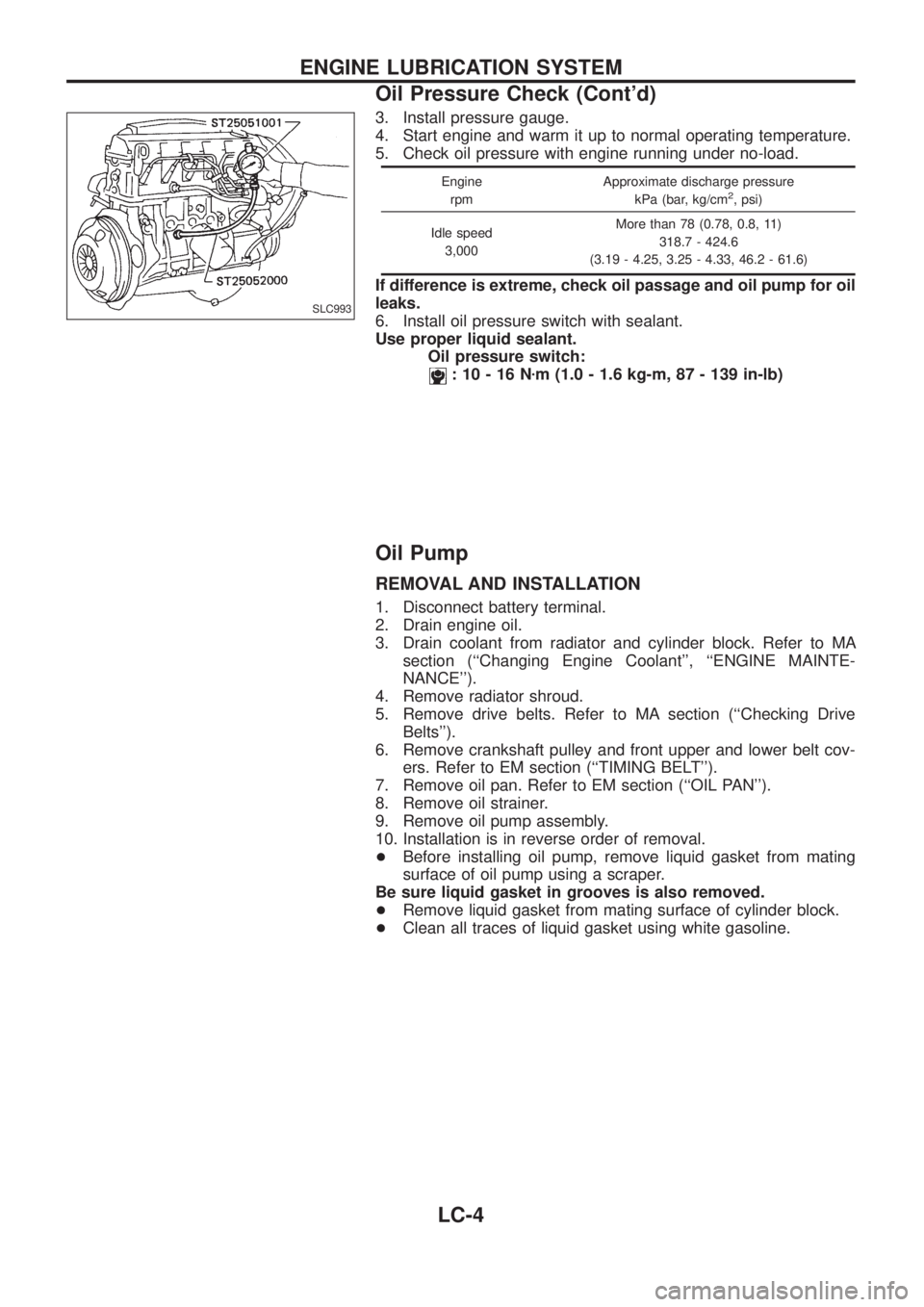
3. Install pressure gauge.
4. Start engine and warm it up to normal operating temperature.
5. Check oil pressure with engine running under no-load.
Engine
rpmApproximate discharge pressure
kPa (bar, kg/cm2, psi)
Idle speed
3,000More than 78 (0.78, 0.8, 11)
318.7 - 424.6
(3.19 - 4.25, 3.25 - 4.33, 46.2 - 61.6)
If difference is extreme, check oil passage and oil pump for oil
leaks.
6. Install oil pressure switch with sealant.
Use proper liquid sealant.
Oil pressure switch:
:10-16Nzm (1.0 - 1.6 kg-m, 87 - 139 in-lb)
Oil Pump
REMOVAL AND INSTALLATION
1. Disconnect battery terminal.
2. Drain engine oil.
3. Drain coolant from radiator and cylinder block. Refer to MA
section (``Changing Engine Coolant'', ``ENGINE MAINTE-
NANCE'').
4. Remove radiator shroud.
5. Remove drive belts. Refer to MA section (``Checking Drive
Belts'').
6. Remove crankshaft pulley and front upper and lower belt cov-
ers. Refer to EM section (``TIMING BELT'').
7. Remove oil pan. Refer to EM section (``OIL PAN'').
8. Remove oil strainer.
9. Remove oil pump assembly.
10. Installation is in reverse order of removal.
+Before installing oil pump, remove liquid gasket from mating
surface of oil pump using a scraper.
Be sure liquid gasket in grooves is also removed.
+Remove liquid gasket from mating surface of cylinder block.
+Clean all traces of liquid gasket using white gasoline.
SLC993
ENGINE LUBRICATION SYSTEM
Oil Pressure Check (Cont'd)
LC-4
Page 960 of 1226
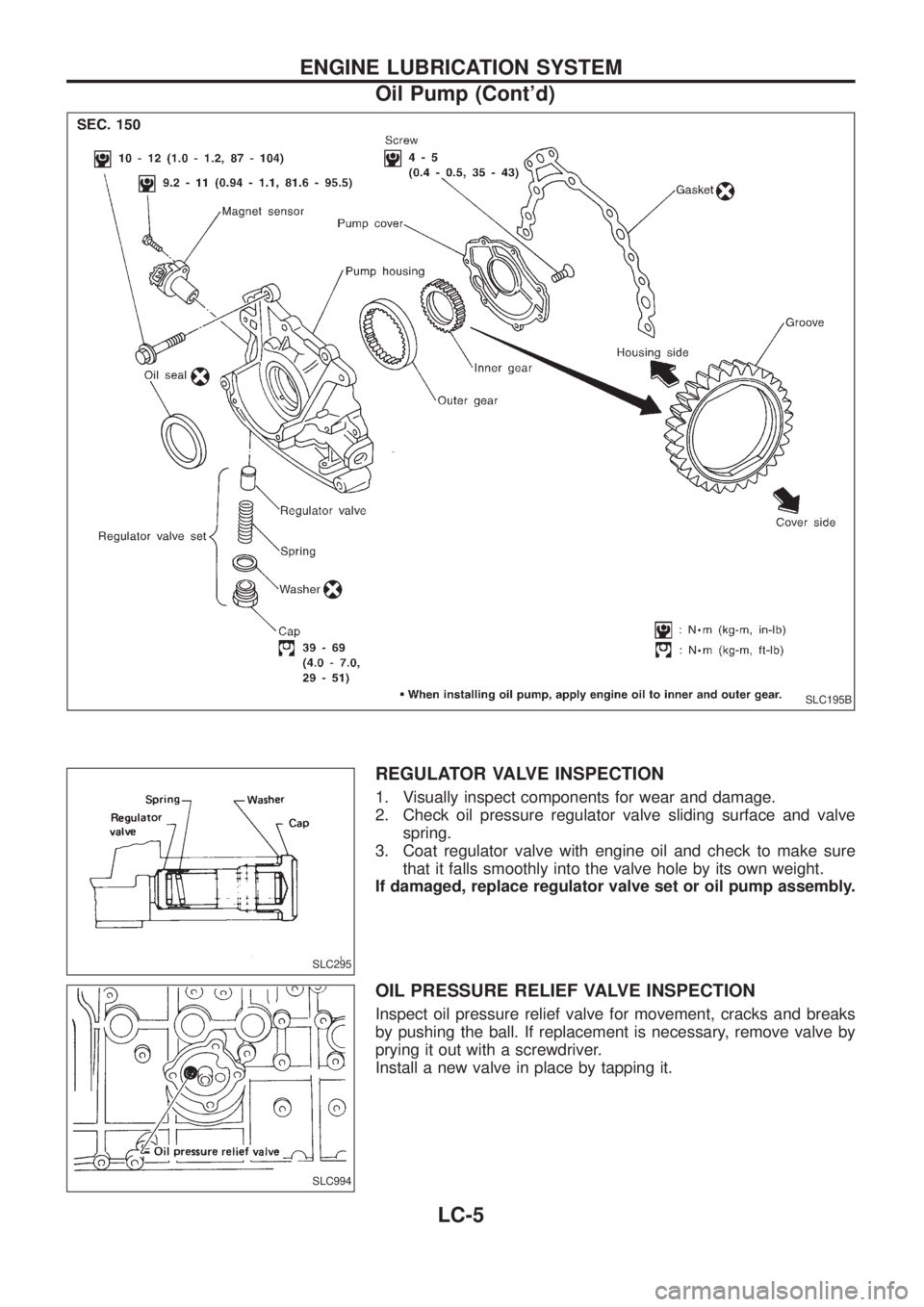
REGULATOR VALVE INSPECTION
1. Visually inspect components for wear and damage.
2. Check oil pressure regulator valve sliding surface and valve
spring.
3. Coat regulator valve with engine oil and check to make sure
that it falls smoothly into the valve hole by its own weight.
If damaged, replace regulator valve set or oil pump assembly.
OIL PRESSURE RELIEF VALVE INSPECTION
Inspect oil pressure relief valve for movement, cracks and breaks
by pushing the ball. If replacement is necessary, remove valve by
prying it out with a screwdriver.
Install a new valve in place by tapping it.
SLC195B
SLC295
SLC994
ENGINE LUBRICATION SYSTEM
Oil Pump (Cont'd)
LC-5
Page 961 of 1226
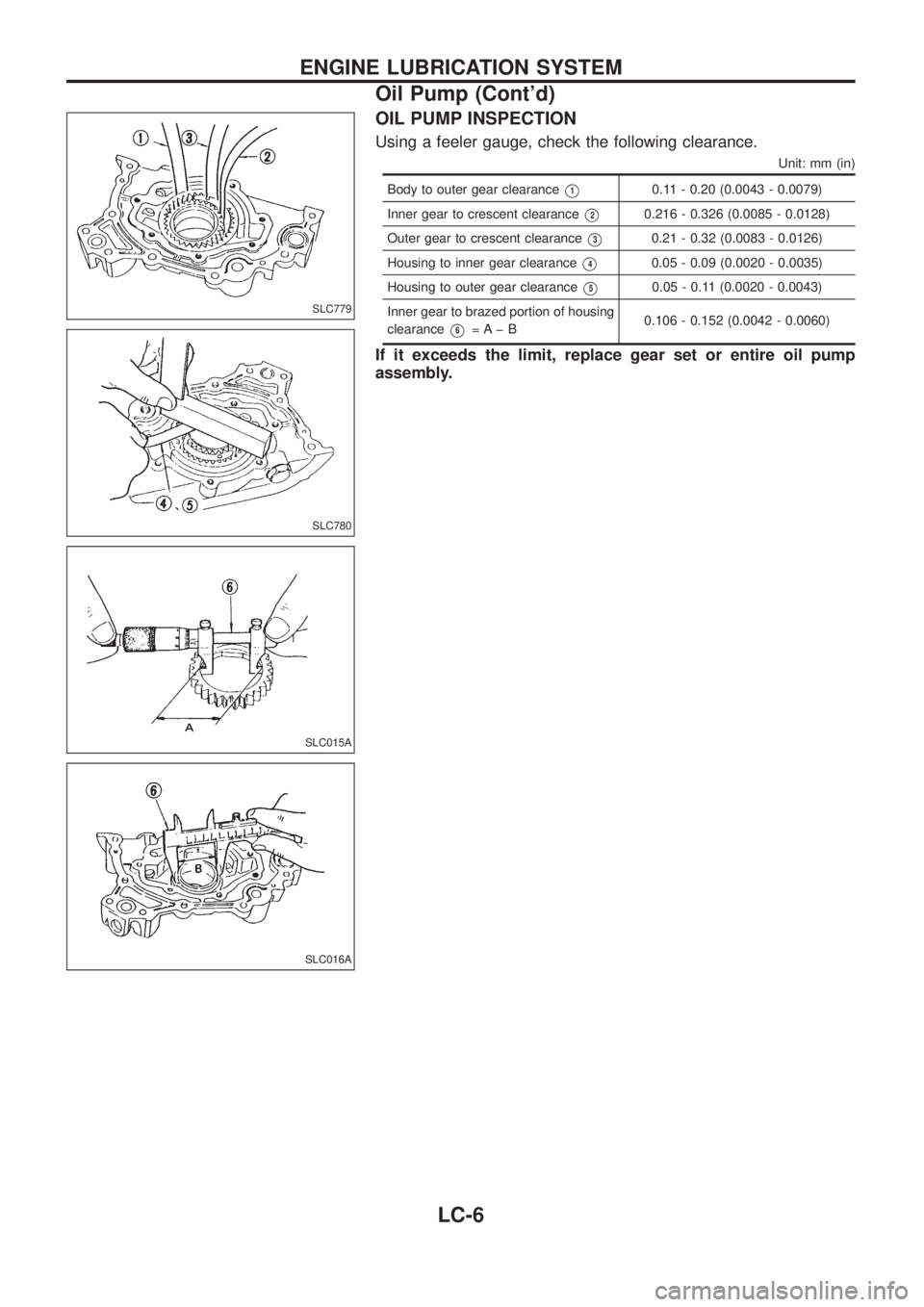
OIL PUMP INSPECTION
Using a feeler gauge, check the following clearance.
Unit: mm (in)
Body to outer gear clearanceV10.11 - 0.20 (0.0043 - 0.0079)
Inner gear to crescent clearance
V20.216 - 0.326 (0.0085 - 0.0128)
Outer gear to crescent clearance
V30.21 - 0.32 (0.0083 - 0.0126)
Housing to inner gear clearance
V40.05 - 0.09 (0.0020 - 0.0035)
Housing to outer gear clearance
V50.05 - 0.11 (0.0020 - 0.0043)
Inner gear to brazed portion of housing
clearance
V6=Aþ B0.106 - 0.152 (0.0042 - 0.0060)
If it exceeds the limit, replace gear set or entire oil pump
assembly.
SLC779
SLC780
SLC015A
SLC016A
ENGINE LUBRICATION SYSTEM
Oil Pump (Cont'd)
LC-6
Page 962 of 1226
Oil Cooler
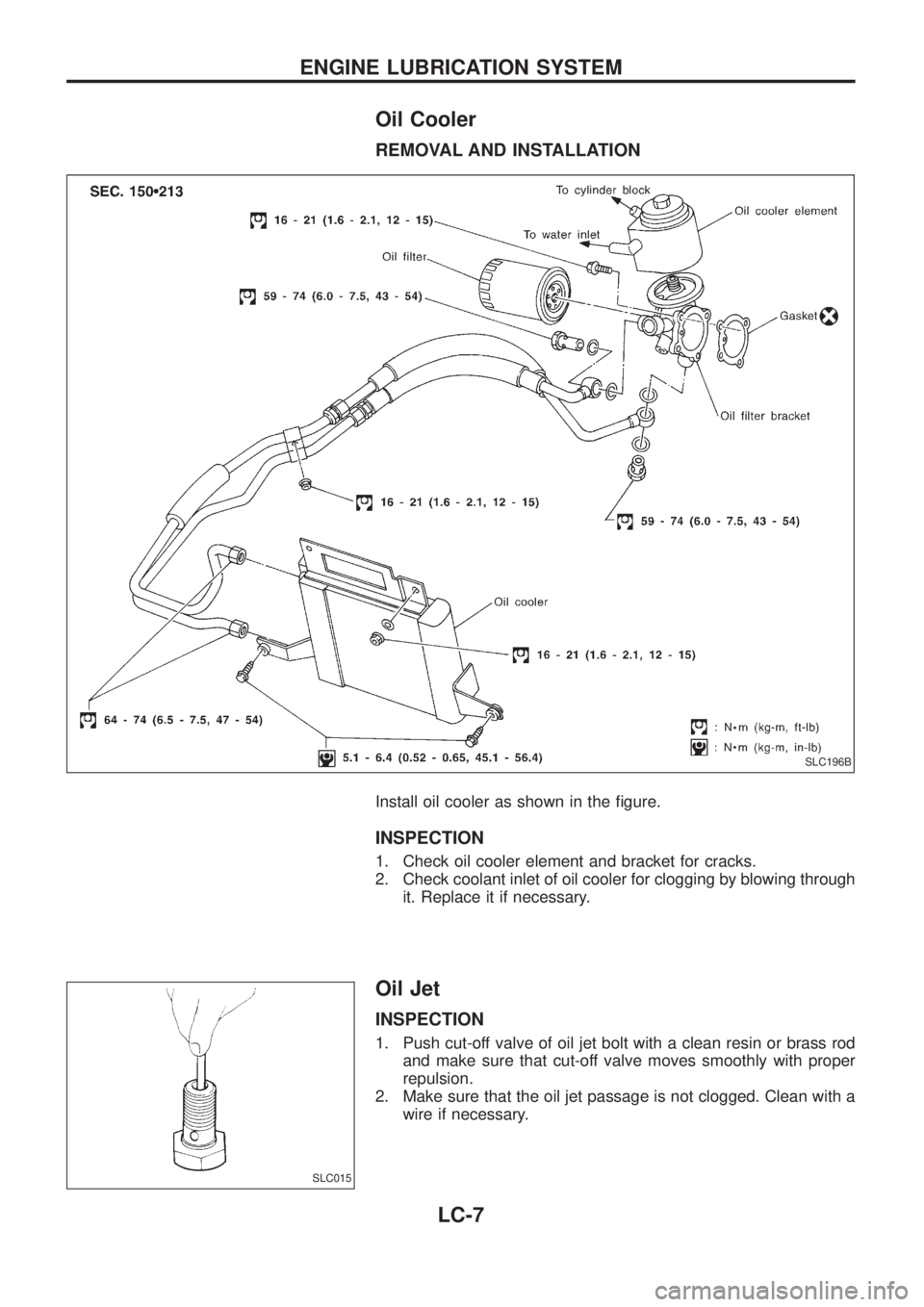
REMOVAL AND INSTALLATION
Install oil cooler as shown in the ®gure.
INSPECTION
1. Check oil cooler element and bracket for cracks.
2. Check coolant inlet of oil cooler for clogging by blowing through
it. Replace it if necessary.
Oil Jet
INSPECTION
1. Push cut-off valve of oil jet bolt with a clean resin or brass rod
and make sure that cut-off valve moves smoothly with proper
repulsion.
2. Make sure that the oil jet passage is not clogged. Clean with a
wire if necessary.
SLC196B
SLC015
ENGINE LUBRICATION SYSTEM
LC-7
Page 963 of 1226
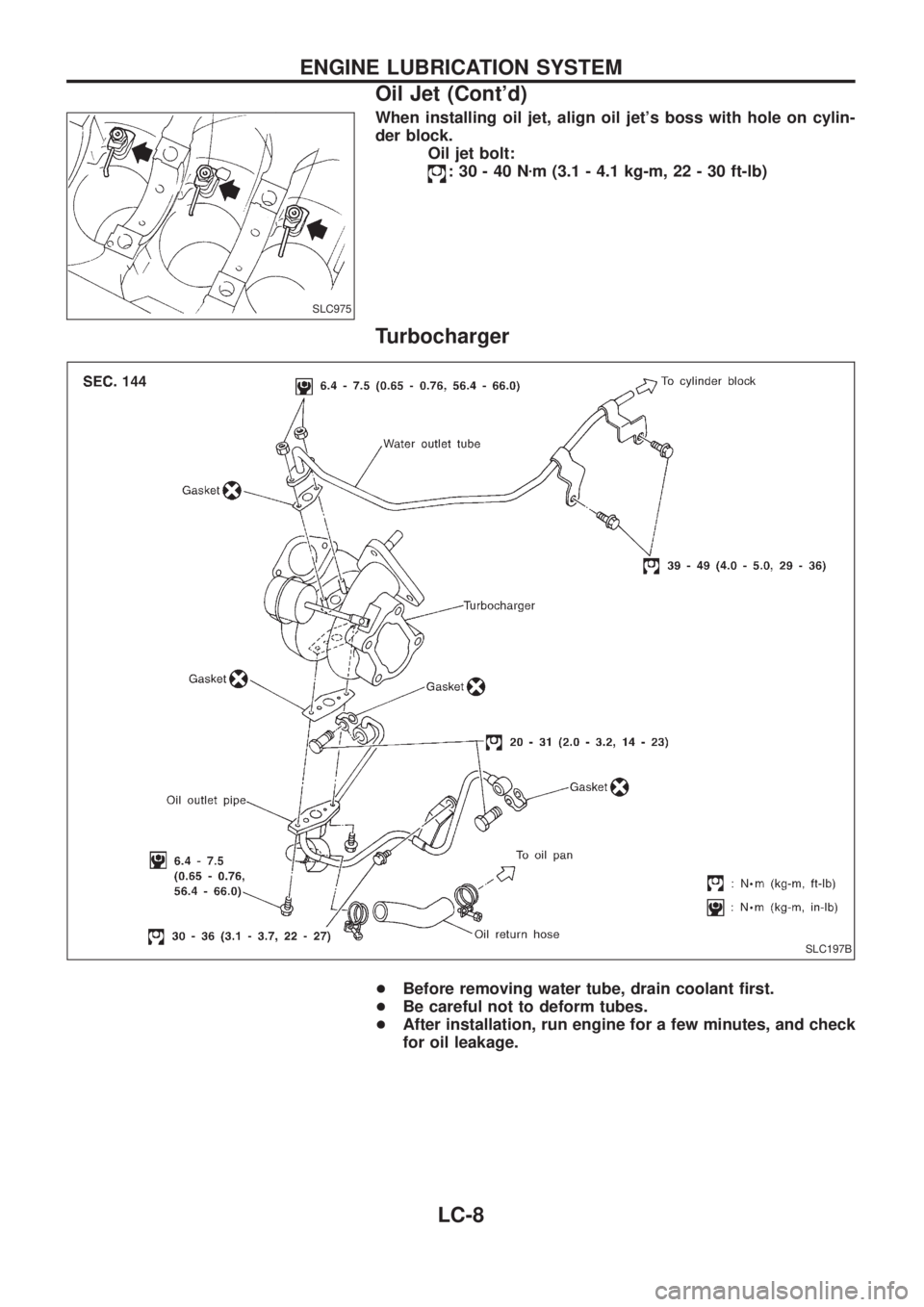
When installing oil jet, align oil jet's boss with hole on cylin-
der block.
Oil jet bolt:
:30-40Nzm (3.1 - 4.1 kg-m, 22 - 30 ft-lb)
Turbocharger
+Before removing water tube, drain coolant ®rst.
+Be careful not to deform tubes.
+After installation, run engine for a few minutes, and check
for oil leakage.
SLC975
SLC197B
ENGINE LUBRICATION SYSTEM
Oil Jet (Cont'd)
LC-8
Page 964 of 1226
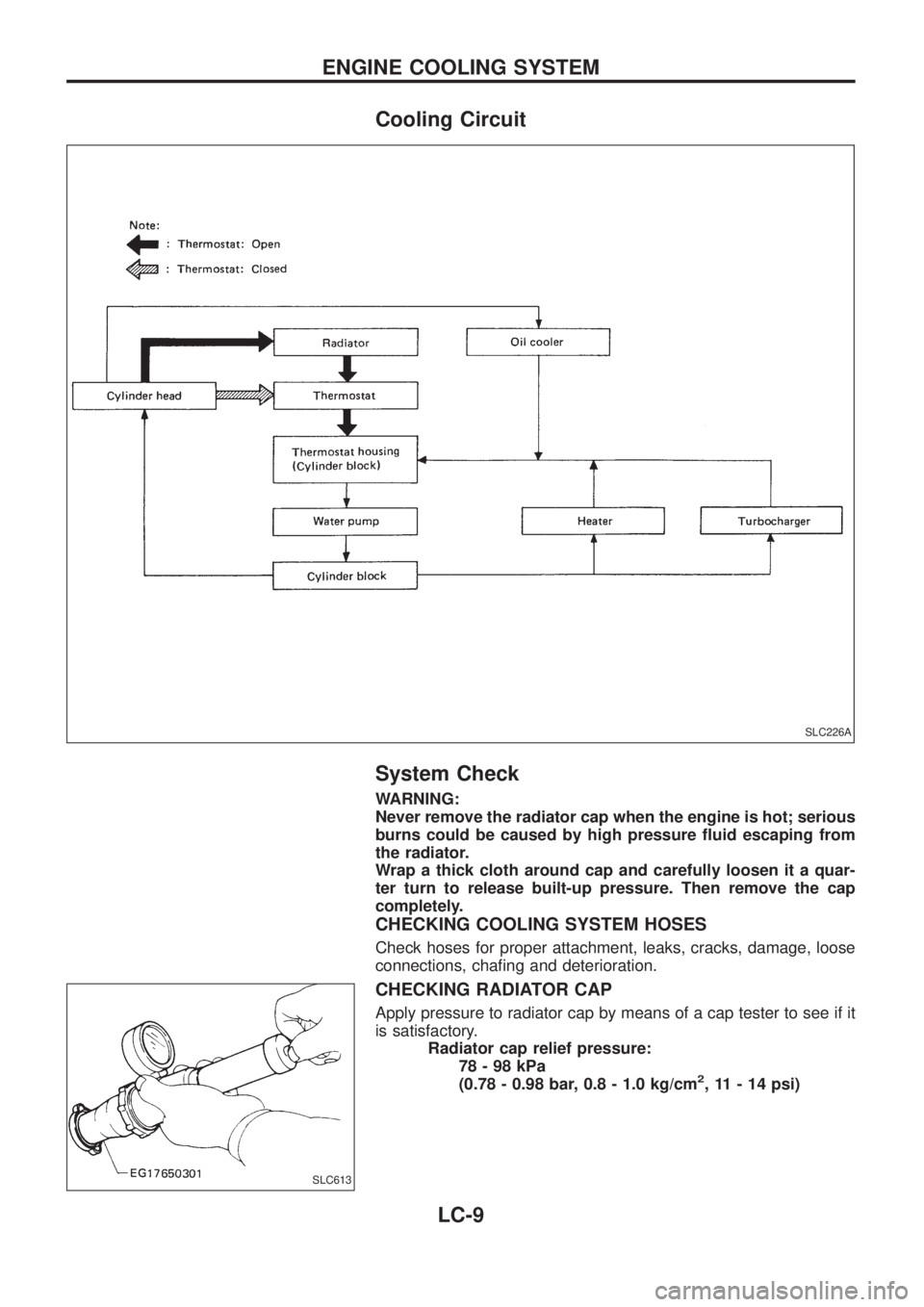
Cooling Circuit
System Check
WARNING:
Never remove the radiator cap when the engine is hot; serious
burns could be caused by high pressure ¯uid escaping from
the radiator.
Wrap a thick cloth around cap and carefully loosen it a quar-
ter turn to release built-up pressure. Then remove the cap
completely.
CHECKING COOLING SYSTEM HOSES
Check hoses for proper attachment, leaks, cracks, damage, loose
connections, cha®ng and deterioration.
CHECKING RADIATOR CAP
Apply pressure to radiator cap by means of a cap tester to see if it
is satisfactory.
Radiator cap relief pressure:
78-98kPa
(0.78 - 0.98 bar, 0.8 - 1.0 kg/cm
2, 11 - 14 psi)
SLC226A
SLC613
ENGINE COOLING SYSTEM
LC-9
Page 965 of 1226
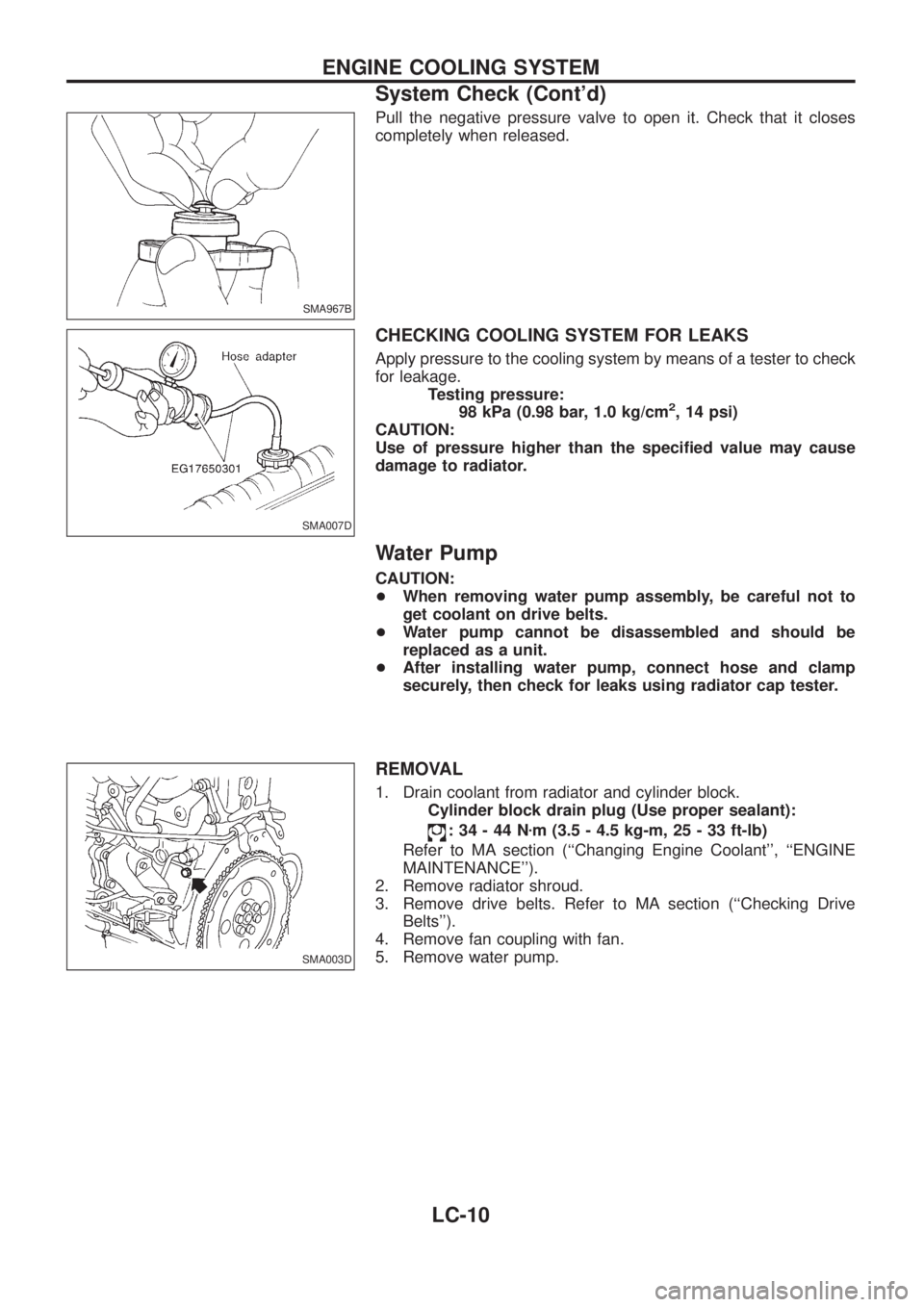
Pull the negative pressure valve to open it. Check that it closes
completely when released.
CHECKING COOLING SYSTEM FOR LEAKS
Apply pressure to the cooling system by means of a tester to check
for leakage.
Testing pressure:
98 kPa (0.98 bar, 1.0 kg/cm
2, 14 psi)
CAUTION:
Use of pressure higher than the speci®ed value may cause
damage to radiator.
Water Pump
CAUTION:
+When removing water pump assembly, be careful not to
get coolant on drive belts.
+Water pump cannot be disassembled and should be
replaced as a unit.
+After installing water pump, connect hose and clamp
securely, then check for leaks using radiator cap tester.
REMOVAL
1. Drain coolant from radiator and cylinder block.
Cylinder block drain plug (Use proper sealant):
:34-44Nzm (3.5 - 4.5 kg-m, 25 - 33 ft-lb)
Refer to MA section (``Changing Engine Coolant'', ``ENGINE
MAINTENANCE'').
2. Remove radiator shroud.
3. Remove drive belts. Refer to MA section (``Checking Drive
Belts'').
4. Remove fan coupling with fan.
5. Remove water pump.
SMA967B
SMA007D
SMA003D
ENGINE COOLING SYSTEM
System Check (Cont'd)
LC-10
Page 966 of 1226
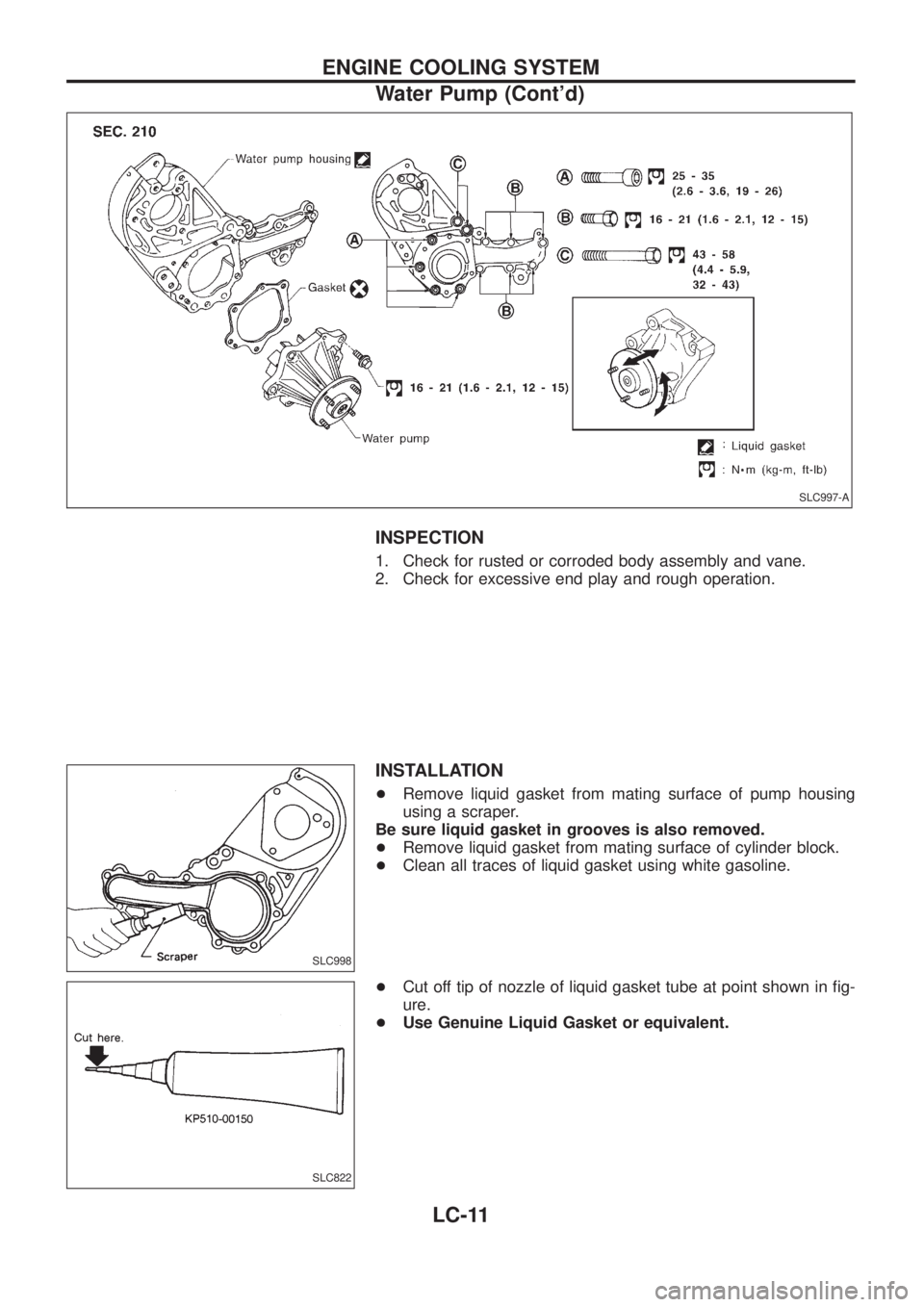
INSPECTION
1. Check for rusted or corroded body assembly and vane.
2. Check for excessive end play and rough operation.
INSTALLATION
+Remove liquid gasket from mating surface of pump housing
using a scraper.
Be sure liquid gasket in grooves is also removed.
+Remove liquid gasket from mating surface of cylinder block.
+Clean all traces of liquid gasket using white gasoline.
+Cut off tip of nozzle of liquid gasket tube at point shown in ®g-
ure.
+Use Genuine Liquid Gasket or equivalent.
SLC997-A
SLC998
SLC822
ENGINE COOLING SYSTEM
Water Pump (Cont'd)
LC-11
Page 967 of 1226
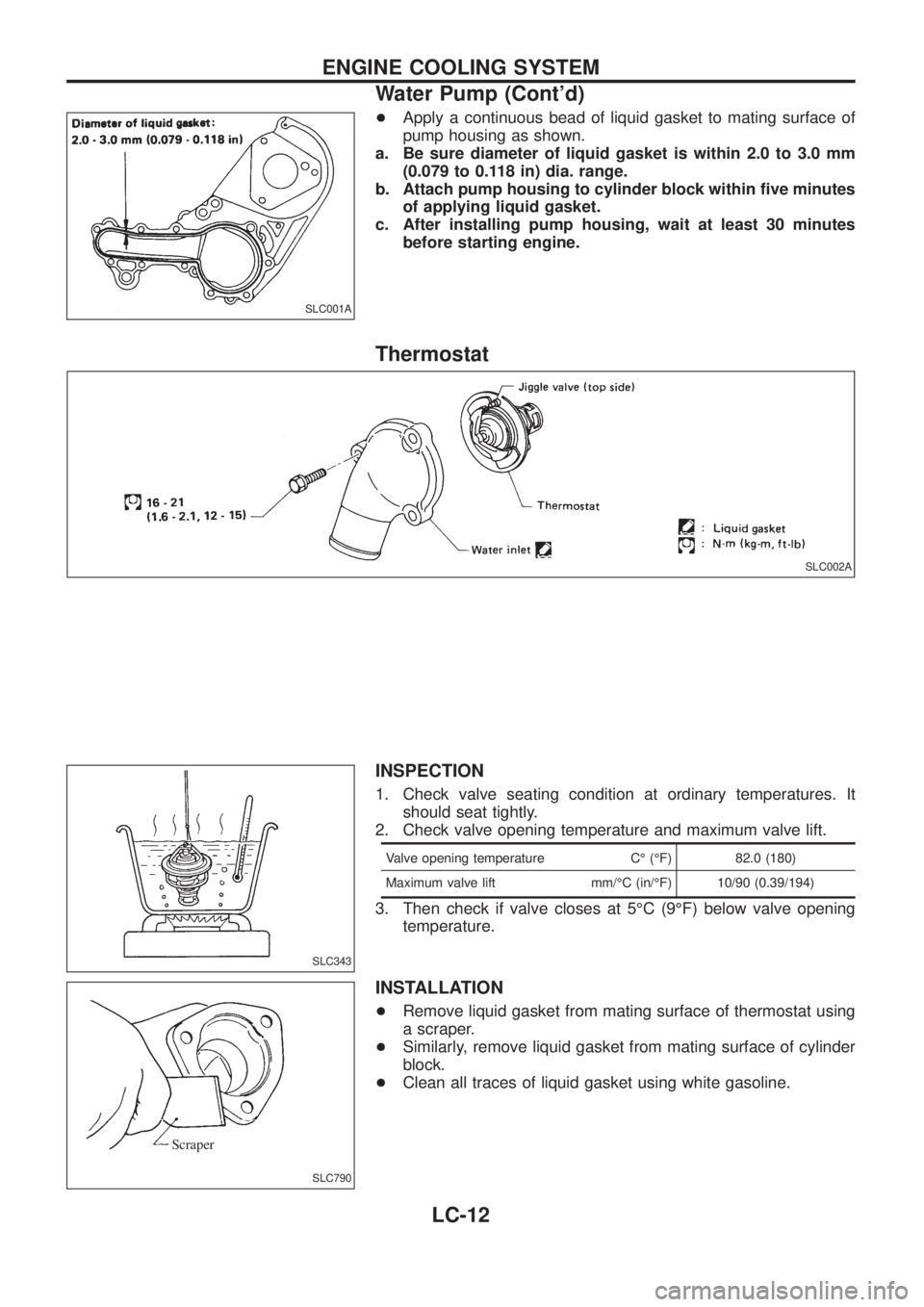
+Apply a continuous bead of liquid gasket to mating surface of
pump housing as shown.
a. Be sure diameter of liquid gasket is within 2.0 to 3.0 mm
(0.079 to 0.118 in) dia. range.
b. Attach pump housing to cylinder block within ®ve minutes
of applying liquid gasket.
c. After installing pump housing, wait at least 30 minutes
before starting engine.
Thermostat
INSPECTION
1. Check valve seating condition at ordinary temperatures. It
should seat tightly.
2. Check valve opening temperature and maximum valve lift.
Valve opening temperature CÉ (ÉF) 82.0 (180)
Maximum valve lift mm/ÉC (in/ÉF) 10/90 (0.39/194)
3. Then check if valve closes at 5ÉC (9ÉF) below valve opening
temperature.
INSTALLATION
+Remove liquid gasket from mating surface of thermostat using
a scraper.
+Similarly, remove liquid gasket from mating surface of cylinder
block.
+Clean all traces of liquid gasket using white gasoline.
SLC001A
SLC002A
SLC343
SLC790
Scraper
ENGINE COOLING SYSTEM
Water Pump (Cont'd)
LC-12
Page 968 of 1226
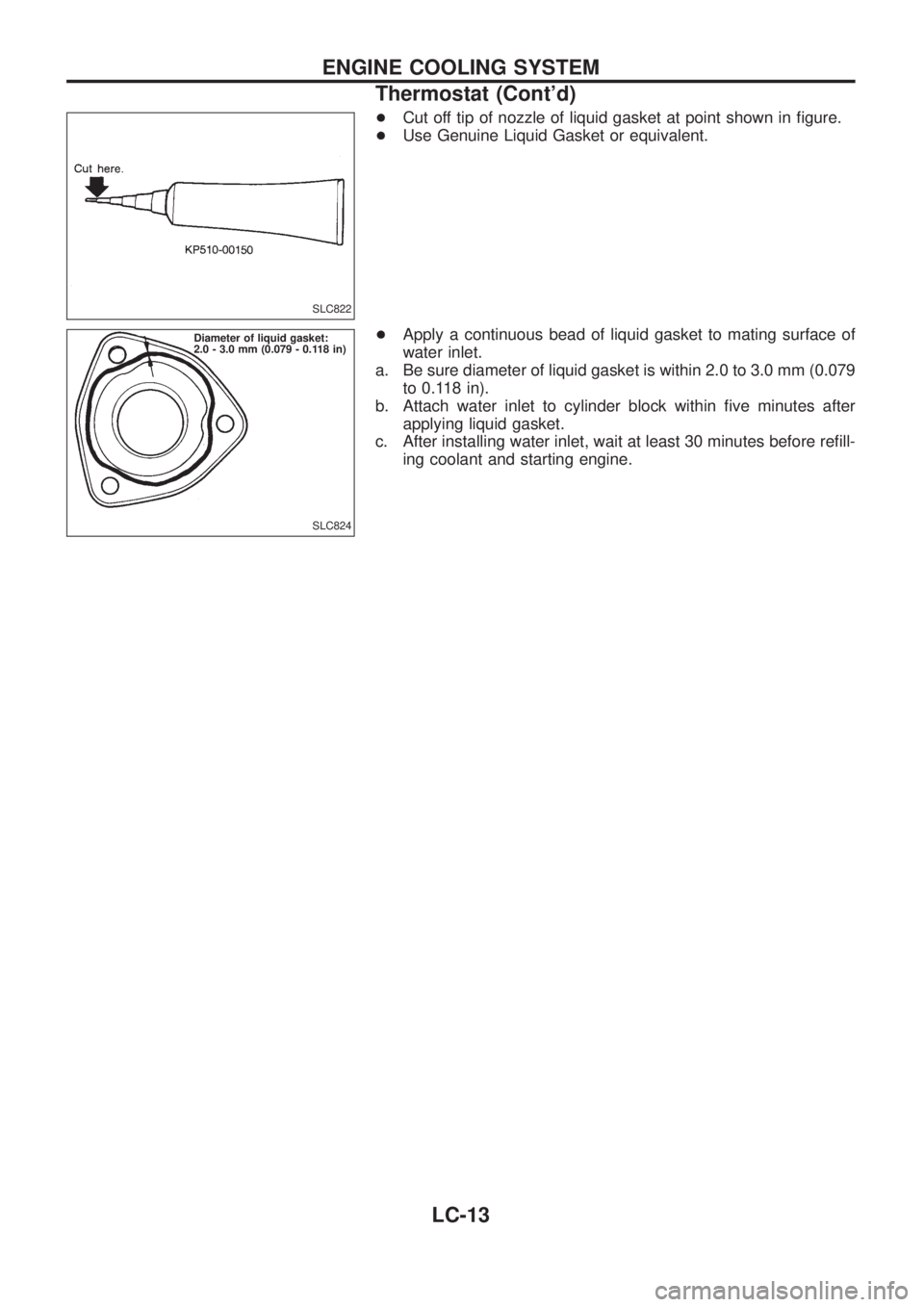
+Cut off tip of nozzle of liquid gasket at point shown in ®gure.
+Use Genuine Liquid Gasket or equivalent.
+Apply a continuous bead of liquid gasket to mating surface of
water inlet.
a. Be sure diameter of liquid gasket is within 2.0 to 3.0 mm (0.079
to 0.118 in).
b. Attach water inlet to cylinder block within ®ve minutes after
applying liquid gasket.
c. After installing water inlet, wait at least 30 minutes before re®ll-
ing coolant and starting engine.
SLC822
SLC824 Diameter of liquid gasket:
2.0 - 3.0 mm (0.079 - 0.118 in)
ENGINE COOLING SYSTEM
Thermostat (Cont'd)
LC-13