engine NISSAN PICK-UP 1998 Repair Manual
[x] Cancel search | Manufacturer: NISSAN, Model Year: 1998, Model line: PICK-UP, Model: NISSAN PICK-UP 1998Pages: 1659, PDF Size: 53.39 MB
Page 370 of 1659
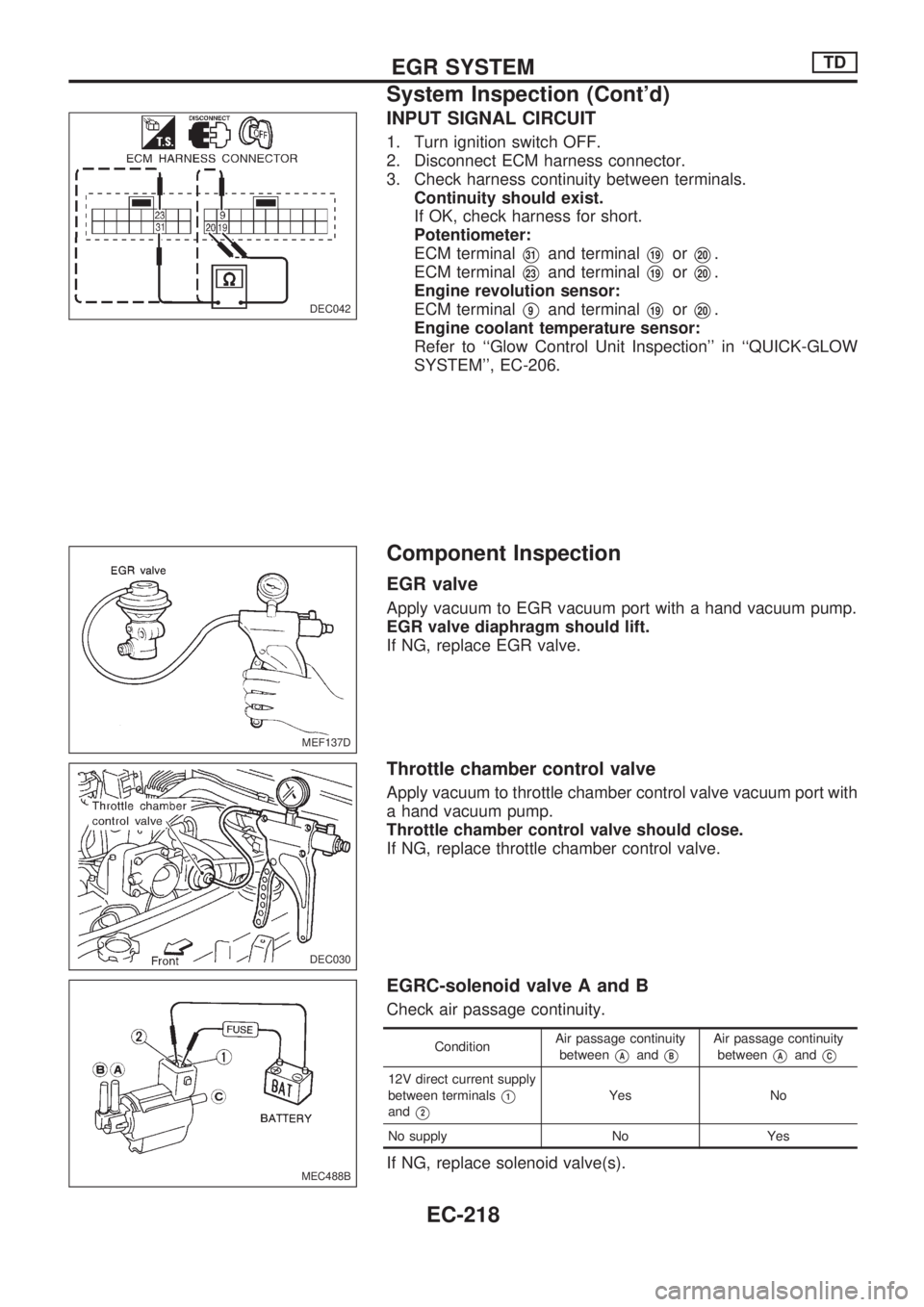
INPUT SIGNAL CIRCUIT
1. Turn ignition switch OFF.
2. Disconnect ECM harness connector.
3. Check harness continuity between terminals.
Continuity should exist.
If OK, check harness for short.
Potentiometer:
ECM terminal
V31and terminalV19orV20.
ECM terminal
V23and terminalV19orV20.
Engine revolution sensor:
ECM terminal
V9and terminalV19orV20.
Engine coolant temperature sensor:
Refer to ``Glow Control Unit Inspection'' in ``QUICK-GLOW
SYSTEM'', EC-206.
Component Inspection
EGR valve
Apply vacuum to EGR vacuum port with a hand vacuum pump.
EGR valve diaphragm should lift.
If NG, replace EGR valve.
Throttle chamber control valve
Apply vacuum to throttle chamber control valve vacuum port with
a hand vacuum pump.
Throttle chamber control valve should close.
If NG, replace throttle chamber control valve.
EGRC-solenoid valve A and B
Check air passage continuity.
ConditionAir passage continuity
betweenVAandVB
Air passage continuity
between
VAandVC
12V direct current supply
between terminals
V1
andV2
Yes No
No supply No Yes
If NG, replace solenoid valve(s).
DEC042
MEF137D
DEC030
MEC488B
EGR SYSTEMTD
System Inspection (Cont'd)
EC-218
Page 371 of 1659
![NISSAN PICK-UP 1998 Repair Manual Engine revolution sensor
1. Disconnect engine revolution sensor harness connector.
2. Check resistance between terminals
V1andV2.
Resistance: Approximately 1.6 kW[at 25ÉC (77ÉF)]
If NG, replace sens](/img/5/57374/w960_57374-370.png "NISSAN PICK-UP 1998 Repair Manual Engine revolution sensor
1. Disconnect engine revolution sensor harness connector.
2. Check resistance between terminals
V1andV2.
Resistance: Approximately 1.6 kW[at 25ÉC (77ÉF)]
If NG, replace sens")
Engine revolution sensor
1. Disconnect engine revolution sensor harness connector.
2. Check resistance between terminals
V1andV2.
Resistance: Approximately 1.6 kW[at 25ÉC (77ÉF)]
If NG, replace sensor.
Potentiometer
1. Disconnect potentiometer harness connector.
2. Make sure that resistance between terminals
V2andV3
changes when accelerator operated.
Accelerator pedal condition Resistance kW[at 20ÉC (68ÉF)]
Completely released Approximately 0.7
Partially depressed 0.7 - 5
Completely depressed Approximately 5
If NG, replace potentiometer.
Atmospheric pressure sensor
This sensor is inside ECM and not replaceable.
EGR system should not operate under atmospheric pressure
below 90.0 kPa (900 mbar, 675 mmHg, 26.57 inHg).
Engine coolant temperature sensor
Refer to ``Component Inspection'' in ``QUICK-GLOW SYSTEM'',
EC-209.
DEC031
DEC032
EGR SYSTEMTD
Component Inspection (Cont'd)
EC-219
Page 372 of 1659
Description
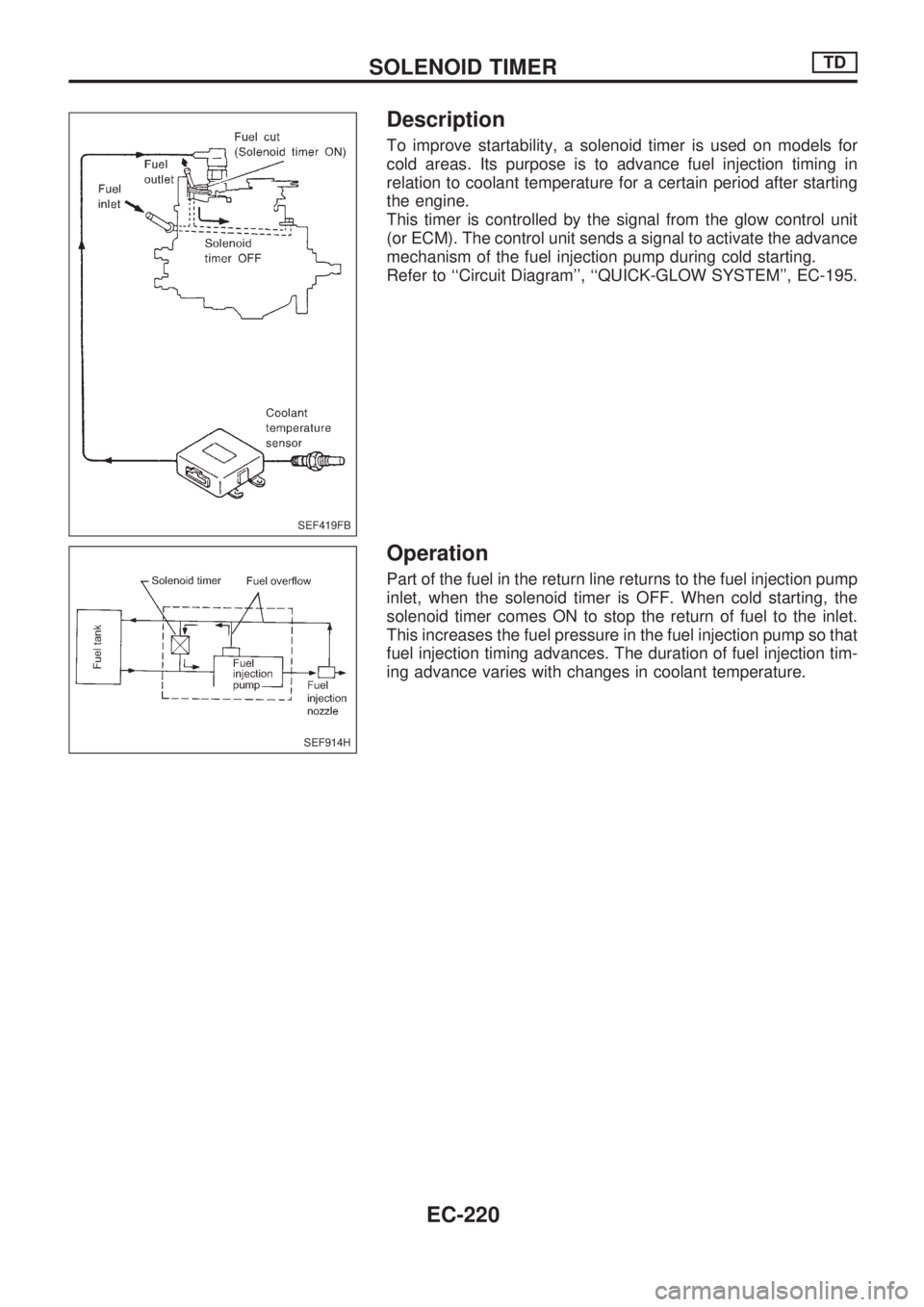
To improve startability, a solenoid timer is used on models for
cold areas. Its purpose is to advance fuel injection timing in
relation to coolant temperature for a certain period after starting
the engine.
This timer is controlled by the signal from the glow control unit
(or ECM). The control unit sends a signal to activate the advance
mechanism of the fuel injection pump during cold starting.
Refer to ``Circuit Diagram'', ``QUICK-GLOW SYSTEM'', EC-195.
Operation
Part of the fuel in the return line returns to the fuel injection pump
inlet, when the solenoid timer is OFF. When cold starting, the
solenoid timer comes ON to stop the return of fuel to the inlet.
This increases the fuel pressure in the fuel injection pump so that
fuel injection timing advances. The duration of fuel injection tim-
ing advance varies with changes in coolant temperature.
SEF419FB
SEF914H
SOLENOID TIMERTD
EC-220
Page 373 of 1659
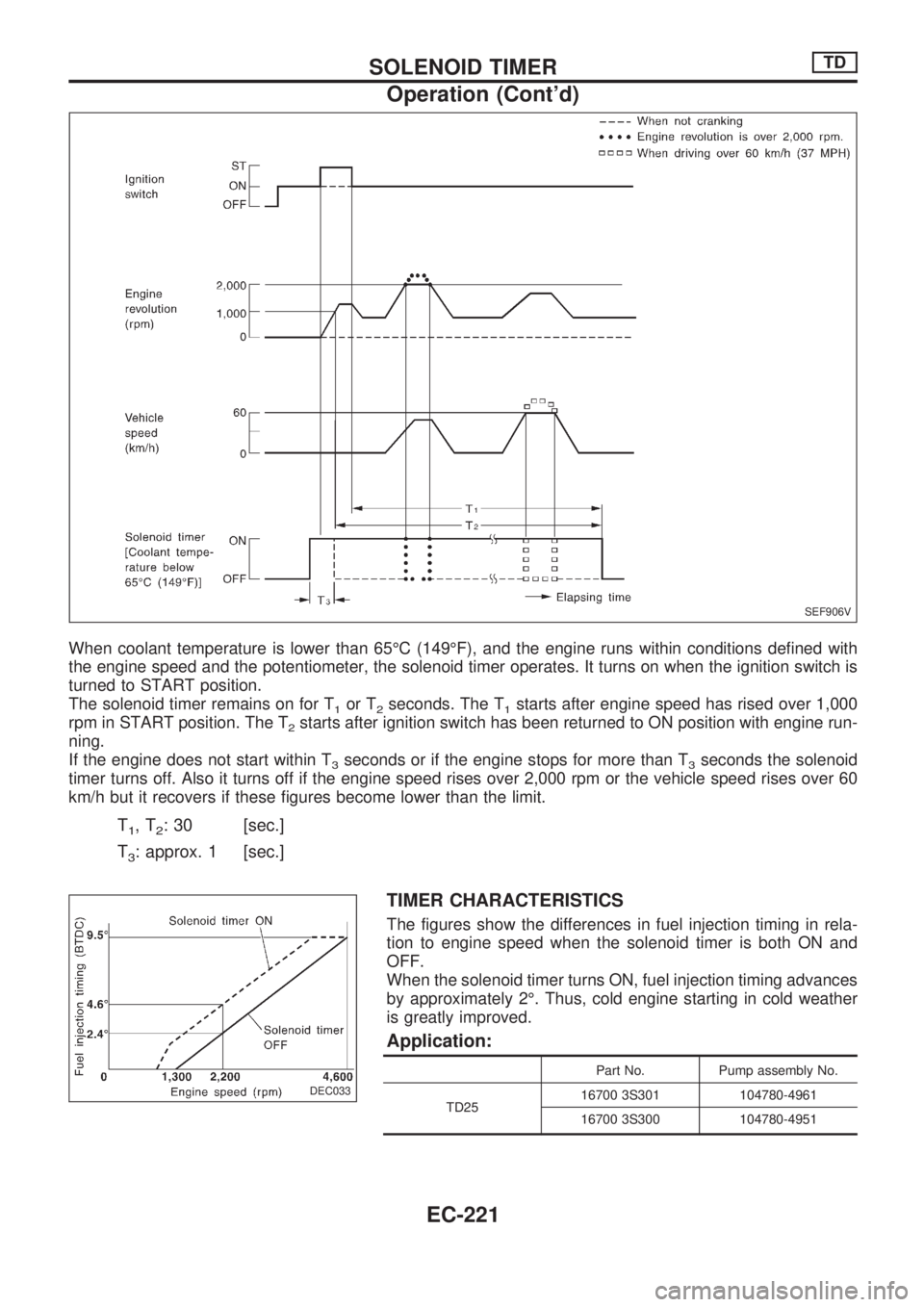
When coolant temperature is lower than 65ÉC (149ÉF), and the engine runs within conditions defined with
the engine speed and the potentiometer, the solenoid timer operates. It turns on when the ignition switch is
turned to START position.
The solenoid timer remains on for T
1or T2seconds. The T1starts after engine speed has rised over 1,000
rpm in START position. The T
2starts after ignition switch has been returned to ON position with engine run-
ning.
If the engine does not start within T
3seconds or if the engine stops for more than T3seconds the solenoid
timer turns off. Also it turns off if the engine speed rises over 2,000 rpm or the vehicle speed rises over 60
km/h but it recovers if these figures become lower than the limit.
T1,T2: 30 [sec.]
T
3: approx. 1 [sec.]
TIMER CHARACTERISTICS
The figures show the differences in fuel injection timing in rela-
tion to engine speed when the solenoid timer is both ON and
OFF.
When the solenoid timer turns ON, fuel injection timing advances
by approximately 2É. Thus, cold engine starting in cold weather
is greatly improved.
Application:
Part No. Pump assembly No.
TD2516700 3S301 104780-4961
16700 3S300 104780-4951
SEF906V
DEC033
.
SOLENOID TIMERTD
Operation (Cont'd)
EC-221
Page 374 of 1659
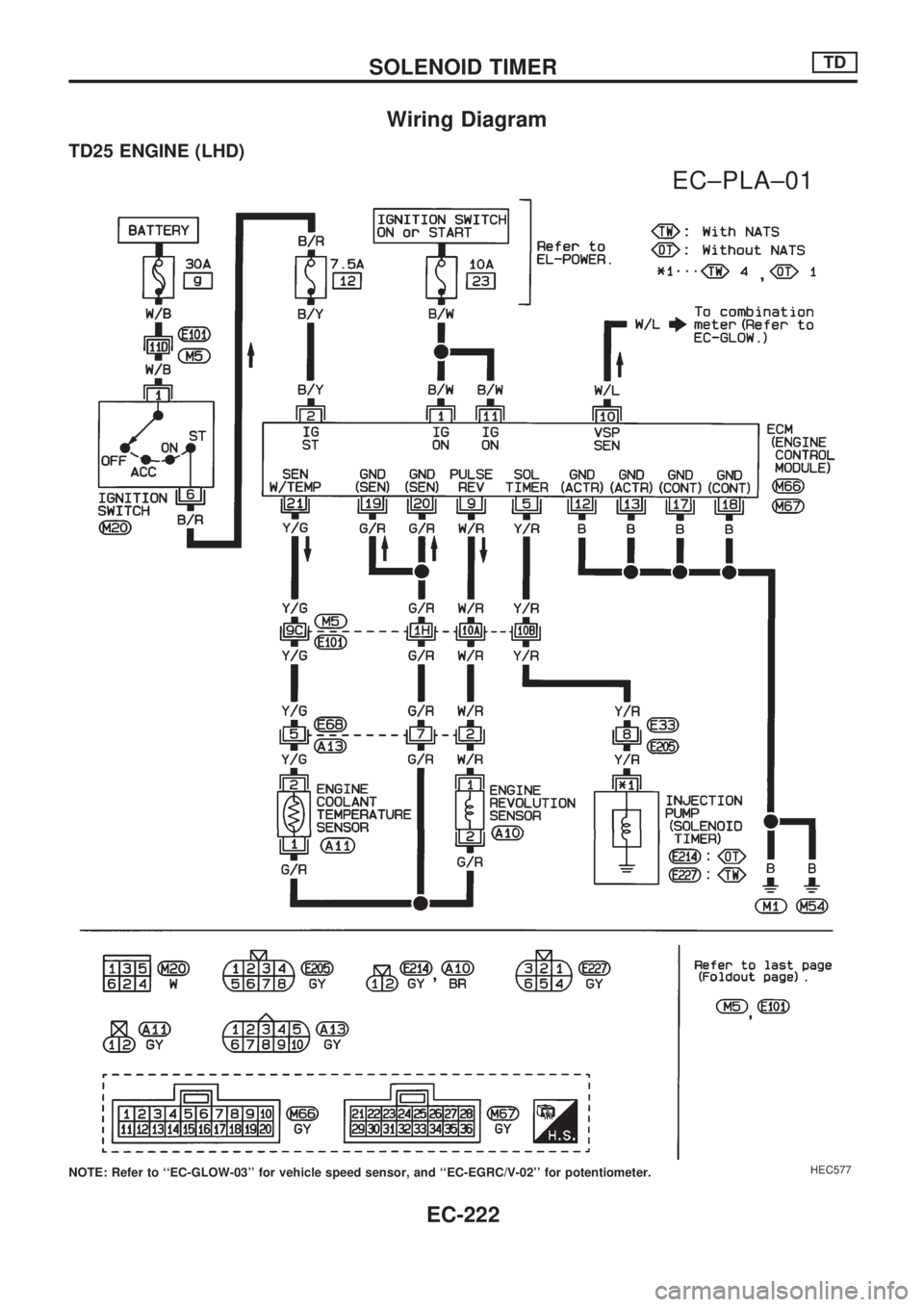
Wiring Diagram
TD25 ENGINE (LHD)
NOTE: Refer to ``EC-GLOW-03'' for vehicle speed sensor, and ``EC-EGRC/V-02'' for potentiometer.HEC577
.
EC±PLA±01
SOLENOID TIMERTD
EC-222
Page 375 of 1659
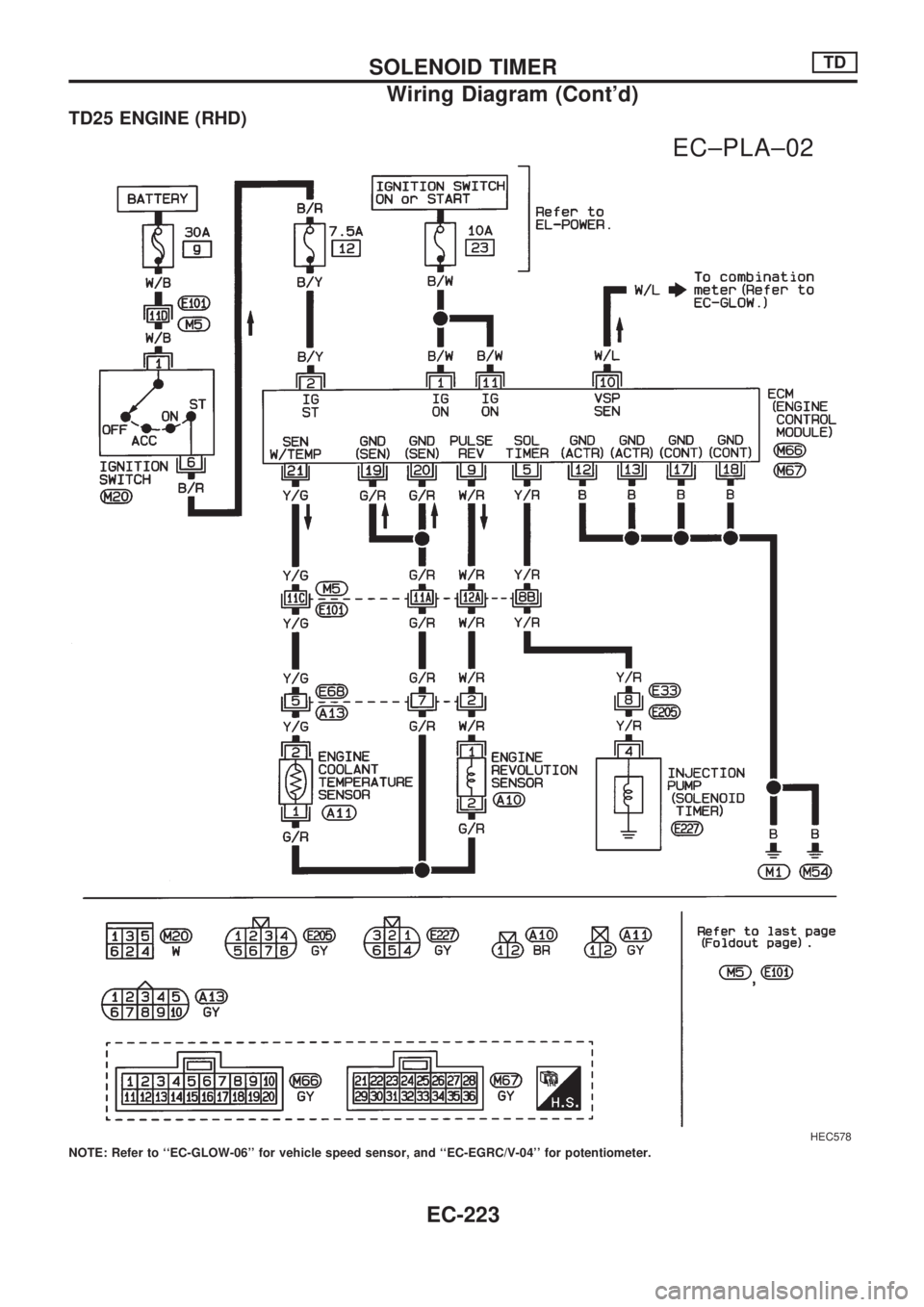
TD25 ENGINE (RHD)
NOTE: Refer to ``EC-GLOW-06'' for vehicle speed sensor, and ``EC-EGRC/V-04'' for potentiometer.
HEC578
.
EC±PLA±02
SOLENOID TIMERTD
Wiring Diagram (Cont'd)
EC-223
Page 380 of 1659
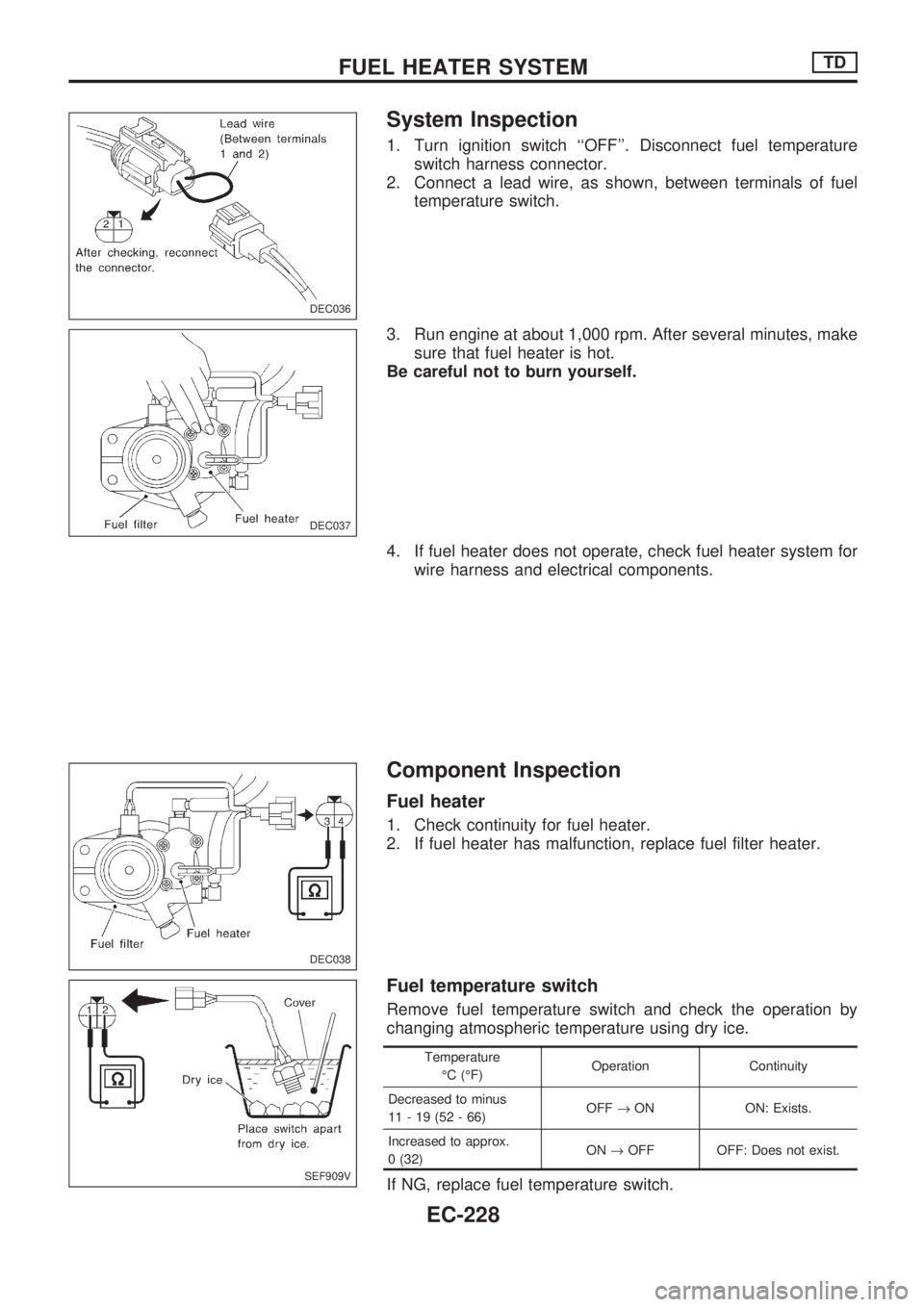
System Inspection
1. Turn ignition switch ``OFF''. Disconnect fuel temperature
switch harness connector.
2. Connect a lead wire, as shown, between terminals of fuel
temperature switch.
3. Run engine at about 1,000 rpm. After several minutes, make
sure that fuel heater is hot.
Be careful not to burn yourself.
4. If fuel heater does not operate, check fuel heater system for
wire harness and electrical components.
Component Inspection
Fuel heater
1. Check continuity for fuel heater.
2. If fuel heater has malfunction, replace fuel filter heater.
Fuel temperature switch
Remove fuel temperature switch and check the operation by
changing atmospheric temperature using dry ice.
Temperature
ÉC (ÉF)Operation Continuity
Decreased to minus
11-19(52-66)OFF®ON ON: Exists.
Increased to approx.
0 (32)ON®OFF OFF: Does not exist.
If NG, replace fuel temperature switch.
DEC036
DEC037
DEC038
SEF909V
FUEL HEATER SYSTEMTD
EC-228
Page 381 of 1659
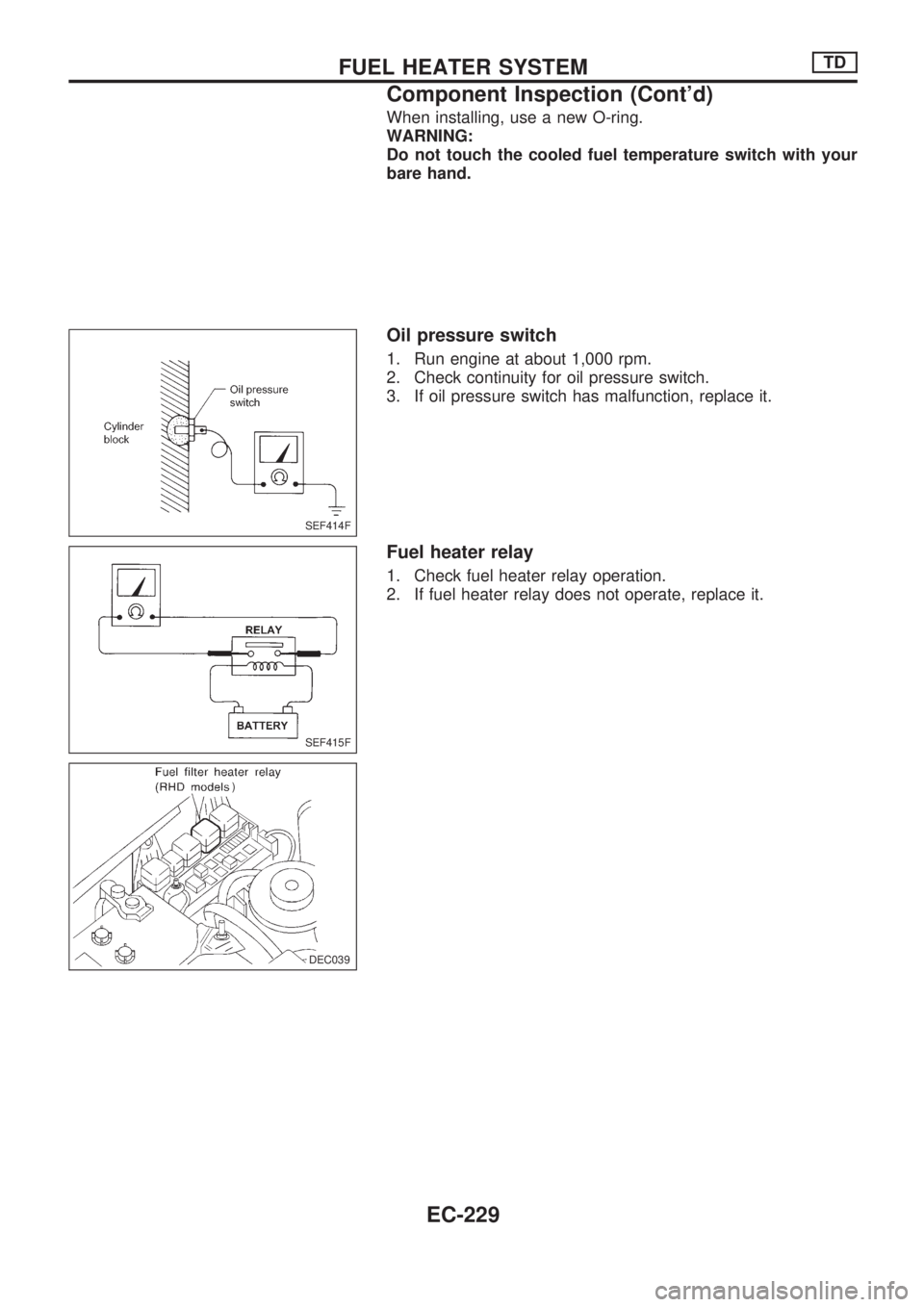
When installing, use a new O-ring.
WARNING:
Do not touch the cooled fuel temperature switch with your
bare hand.
Oil pressure switch
1. Run engine at about 1,000 rpm.
2. Check continuity for oil pressure switch.
3. If oil pressure switch has malfunction, replace it.
Fuel heater relay
1. Check fuel heater relay operation.
2. If fuel heater relay does not operate, replace it.
SEF414F
SEF415F
DEC039
.)
.DEC039
FUEL HEATER SYSTEMTD
Component Inspection (Cont'd)
EC-229
Page 384 of 1659
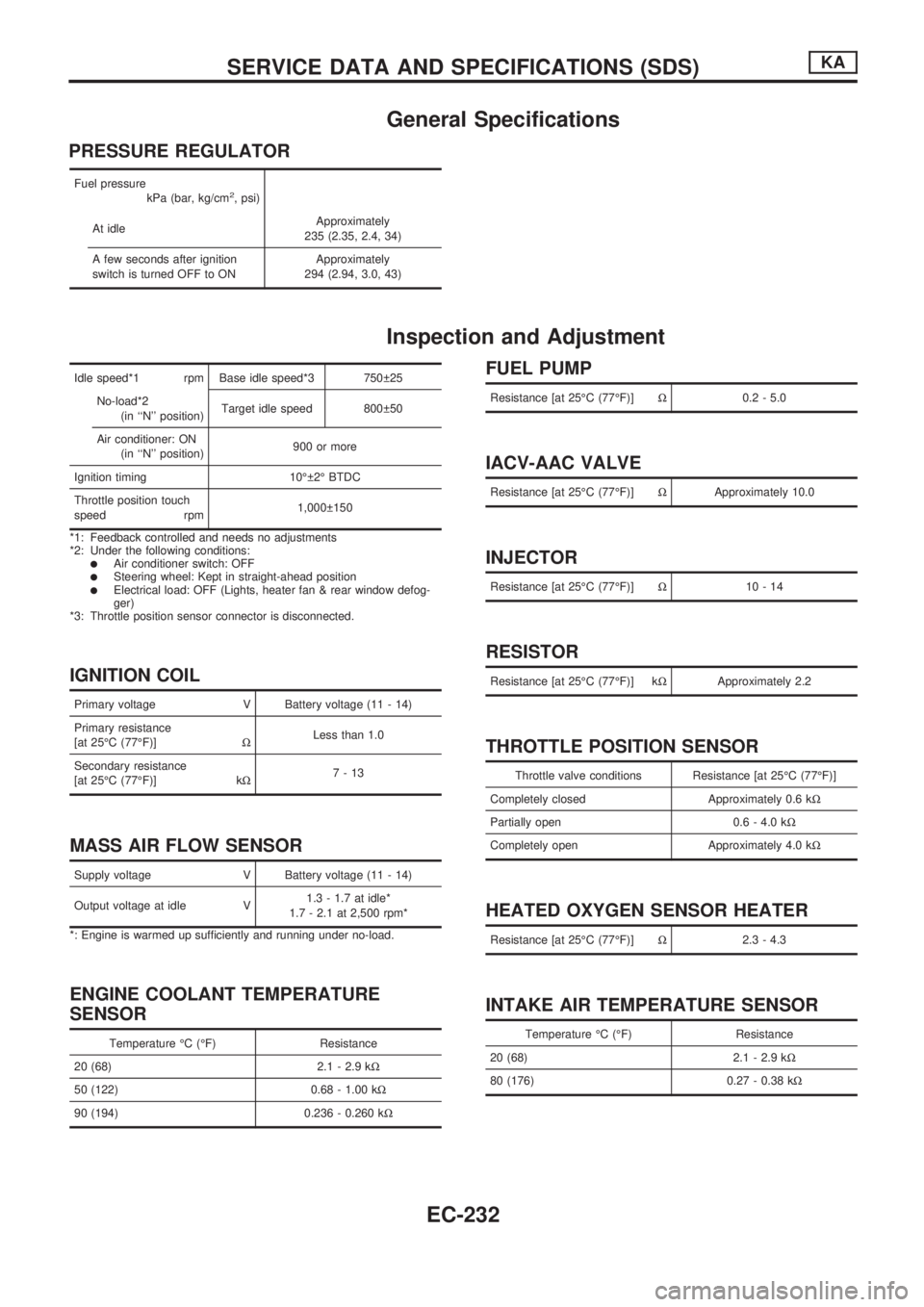
General Specifications
PRESSURE REGULATOR
Fuel pressure
kPa (bar, kg/cm2, psi)
At idleApproximately
235 (2.35, 2.4, 34)
A few seconds after ignition
switch is turned OFF to ONApproximately
294 (2.94, 3.0, 43)
Inspection and Adjustment
Idle speed*1 rpm Base idle speed*3 750 25
No-load*2
(in ``N'' position)Target idle speed 800 50
Air conditioner: ON
(in ``N'' position)900 or more
Ignition timing 10É 2É BTDC
Throttle position touch
speed rpm1,000 150
*1: Feedback controlled and needs no adjustments
*2: Under the following conditions:
lAir conditioner switch: OFFlSteering wheel: Kept in straight-ahead positionlElectrical load: OFF (Lights, heater fan & rear window defog-
ger)
*3: Throttle position sensor connector is disconnected.
IGNITION COIL
Primary voltage V Battery voltage (11 - 14)
Primary resistance
[at 25ÉC (77ÉF)]WLess than 1.0
Secondary resistance
[at 25ÉC (77ÉF)] kW7-13
MASS AIR FLOW SENSOR
Supply voltage V Battery voltage (11 - 14)
Output voltage at idle V1.3 - 1.7 at idle*
1.7 - 2.1 at 2,500 rpm*
*: Engine is warmed up sufficiently and running under no-load.
ENGINE COOLANT TEMPERATURE
SENSOR
Temperature ÉC (ÉF) Resistance
20 (68) 2.1 - 2.9 kW
50 (122) 0.68 - 1.00 kW
90 (194) 0.236 - 0.260 kW
FUEL PUMP
Resistance [at 25ÉC (77ÉF)]W0.2 - 5.0
IACV-AAC VALVE
Resistance [at 25ÉC (77ÉF)]WApproximately 10.0
INJECTOR
Resistance [at 25ÉC (77ÉF)]W10-14
RESISTOR
Resistance [at 25ÉC (77ÉF)] kWApproximately 2.2
THROTTLE POSITION SENSOR
Throttle valve conditions Resistance [at 25ÉC (77ÉF)]
Completely closed Approximately 0.6 kW
Partially open 0.6 - 4.0 kW
Completely open Approximately 4.0 kW
HEATED OXYGEN SENSOR HEATER
Resistance [at 25ÉC (77ÉF)]W2.3 - 4.3
INTAKE AIR TEMPERATURE SENSOR
Temperature ÉC (ÉF) Resistance
20 (68) 2.1 - 2.9 kW
80 (176) 0.27 - 0.38 kW
SERVICE DATA AND SPECIFICATIONS (SDS)KA
EC-232
Page 385 of 1659
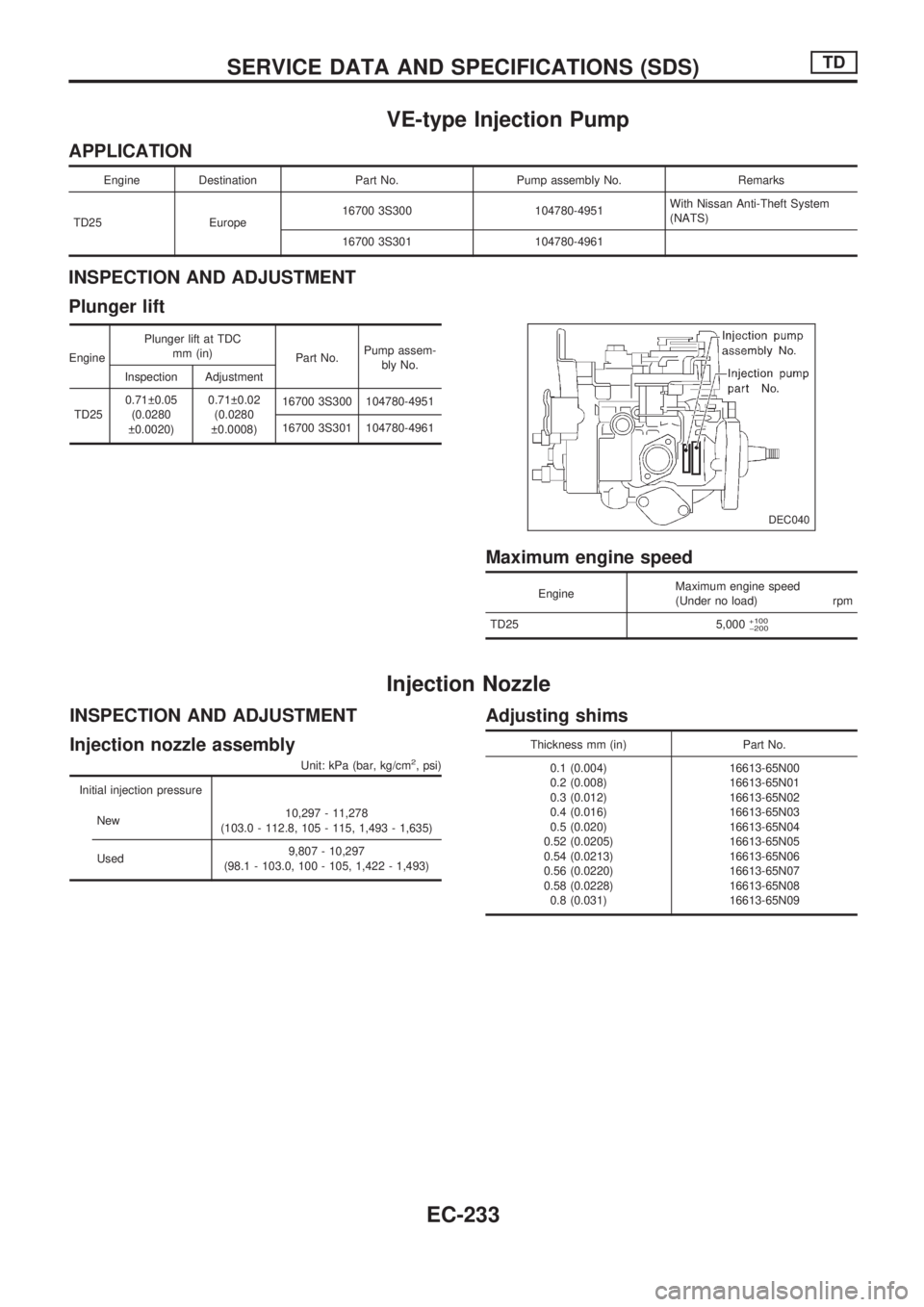
VE-type Injection Pump
APPLICATION
Engine Destination Part No. Pump assembly No. Remarks
TD25 Europe16700 3S300 104780-4951With Nissan Anti-Theft System
(NATS)
16700 3S301 104780-4961
INSPECTION AND ADJUSTMENT
Plunger lift
EnginePlunger lift at TDC
mm (in)
Part No.Pump assem-
bly No.
Inspection Adjustment
TD250.71 0.05
(0.0280
0.0020)0.71 0.02
(0.0280
0.0008)16700 3S300 104780-4951
16700 3S301 104780-4961
Maximum engine speed
EngineMaximum engine speed
(Under no load) rpm
TD25 5,000
+100
þ200
Injection Nozzle
INSPECTION AND ADJUSTMENT
Injection nozzle assembly
Unit: kPa (bar, kg/cm2, psi)
Initial injection pressure
New10,297 - 11,278
(103.0 - 112.8, 105 - 115, 1,493 - 1,635)
Used9,807 - 10,297
(98.1 - 103.0, 100 - 105, 1,422 - 1,493)
Adjusting shims
Thickness mm (in) Part No.
0.1 (0.004)
0.2 (0.008)
0.3 (0.012)
0.4 (0.016)
0.5 (0.020)
0.52 (0.0205)
0.54 (0.0213)
0.56 (0.0220)
0.58 (0.0228)
0.8 (0.031)16613-65N00
16613-65N01
16613-65N02
16613-65N03
16613-65N04
16613-65N05
16613-65N06
16613-65N07
16613-65N08
16613-65N09
DEC040
SERVICE DATA AND SPECIFICATIONS (SDS)TD
EC-233