sensor NISSAN PICK-UP 2001 Repair Manual
[x] Cancel search | Manufacturer: NISSAN, Model Year: 2001, Model line: PICK-UP, Model: NISSAN PICK-UP 2001Pages: 1306, PDF Size: 31.7 MB
Page 424 of 1306
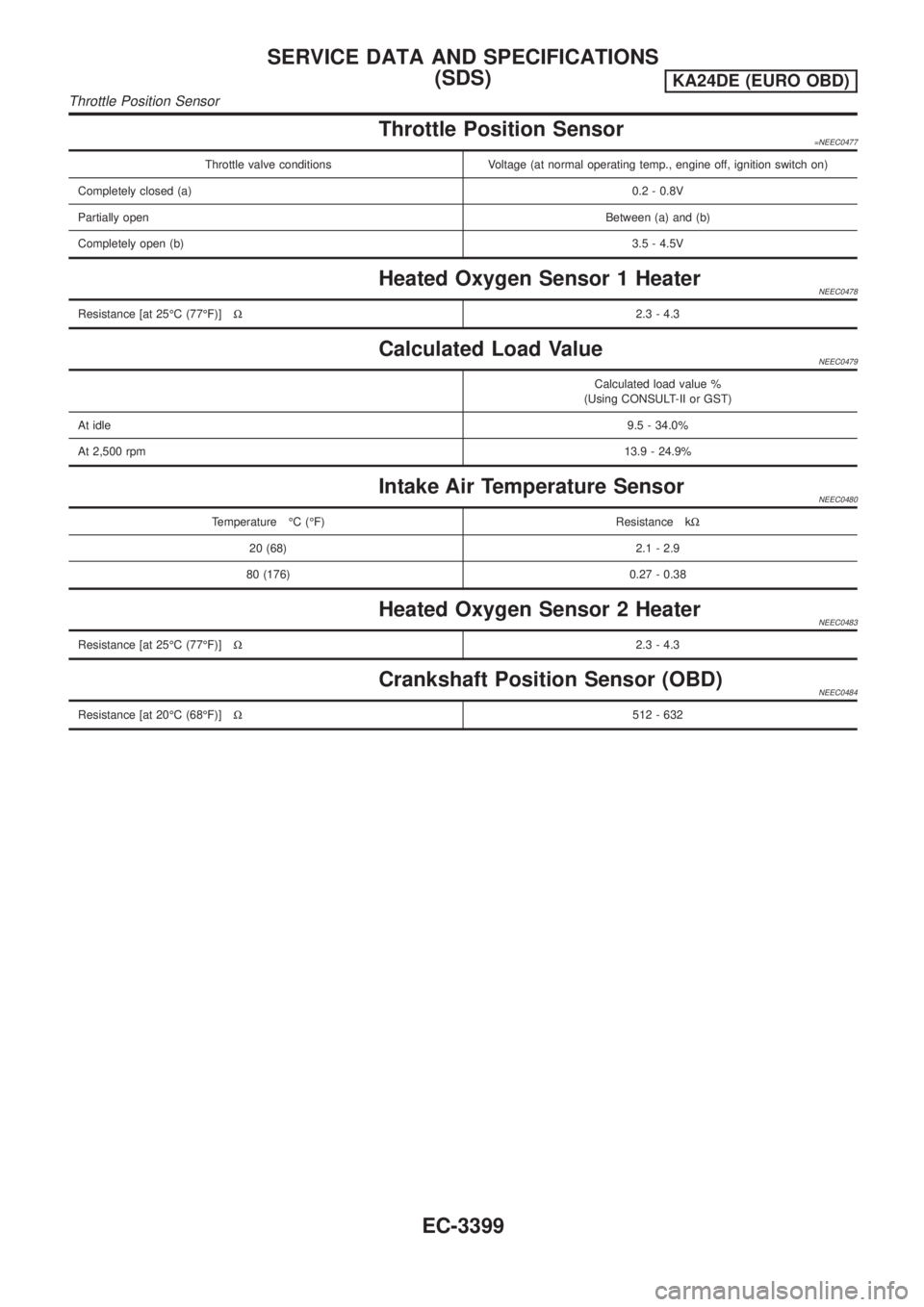
Throttle Position Sensor=NEEC0477
Throttle valve conditions Voltage (at normal operating temp., engine off, ignition switch on)
Completely closed (a)0.2 - 0.8V
Partially openBetween (a) and (b)
Completely open (b)3.5 - 4.5V
Heated Oxygen Sensor 1 HeaterNEEC0478
Resistance [at 25ÉC (77ÉF)]W2.3 - 4.3
Calculated Load ValueNEEC0479
Calculated load value %
(Using CONSULT-II or GST)
At idle9.5 - 34.0%
At 2,500 rpm13.9 - 24.9%
Intake Air Temperature SensorNEEC0480
Temperature ÉC (ÉF) Resistance kW
20 (68) 2.1 - 2.9
80 (176) 0.27 - 0.38
Heated Oxygen Sensor 2 HeaterNEEC0483
Resistance [at 25ÉC (77ÉF)]W2.3 - 4.3
Crankshaft Position Sensor (OBD)NEEC0484
Resistance [at 20ÉC (68ÉF)]W512 - 632
SERVICE DATA AND SPECIFICATIONS
(SDS)
KA24DE (EURO OBD)
Throttle Position Sensor
EC-3399
Page 425 of 1306
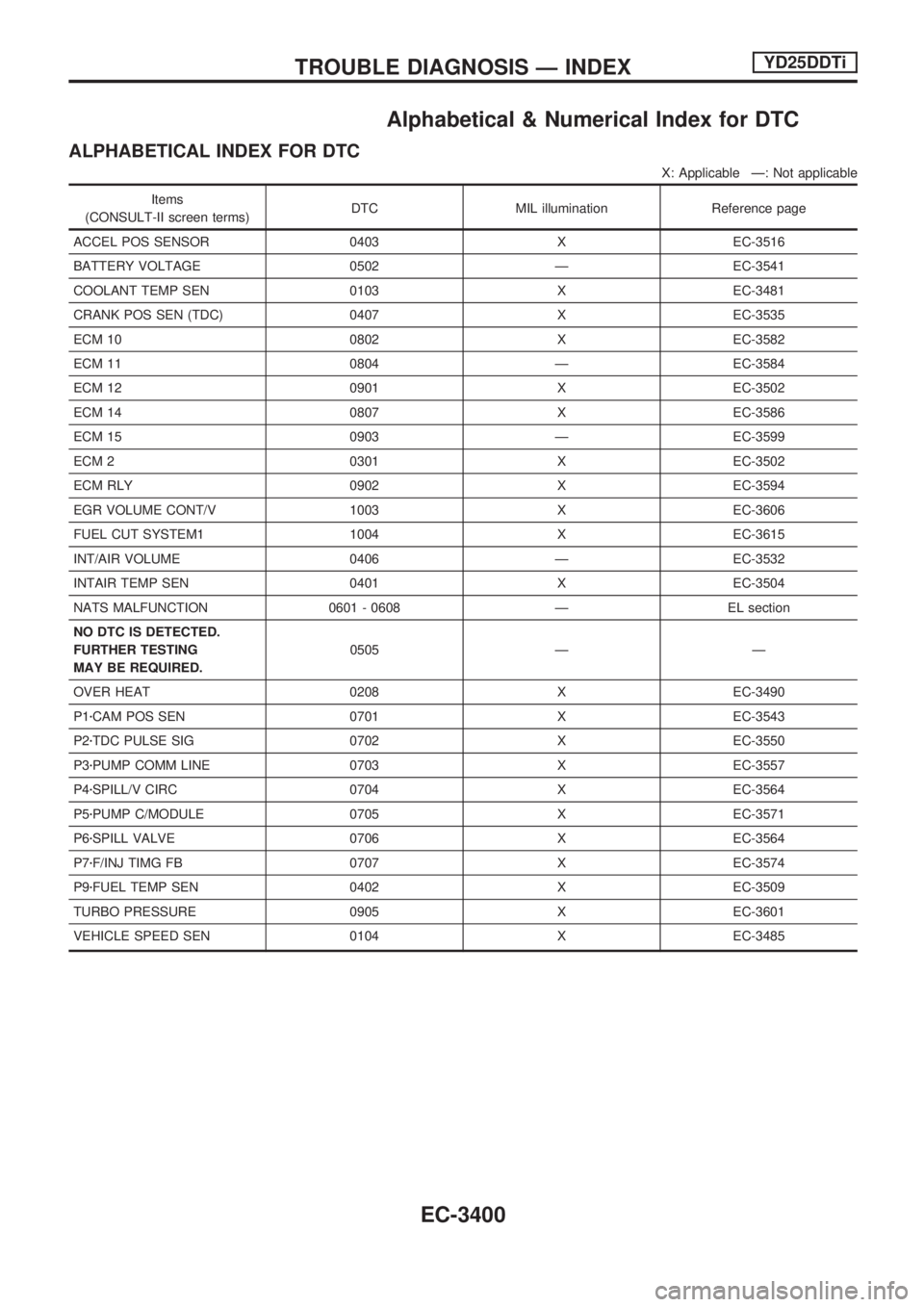
Alphabetical & Numerical Index for DTC
ALPHABETICAL INDEX FOR DTC
X: Applicable Ð: Not applicable
Items
(CONSULT-II screen terms)DTC MIL illumination Reference page
ACCEL POS SENSOR 0403 X EC-3516
BATTERY VOLTAGE 0502 Ð EC-3541
COOLANT TEMP SEN 0103 X EC-3481
CRANK POS SEN (TDC) 0407 X EC-3535
ECM 10 0802 X EC-3582
ECM 11 0804 Ð EC-3584
ECM 12 0901 X EC-3502
ECM 14 0807 X EC-3586
ECM 15 0903 Ð EC-3599
ECM 2 0301 X EC-3502
ECM RLY 0902 X EC-3594
EGR VOLUME CONT/V 1003 X EC-3606
FUEL CUT SYSTEM1 1004 X EC-3615
INT/AIR VOLUME 0406 Ð EC-3532
INTAIR TEMP SEN 0401 X EC-3504
NATS MALFUNCTION 0601 - 0608 Ð EL section
NO DTC IS DETECTED.
FURTHER TESTING
MAY BE REQUIRED.0505 Ð Ð
OVER HEAT 0208 X EC-3490
P1zCAM POS SEN 0701 X EC-3543
P2zTDC PULSE SIG 0702 X EC-3550
P3zPUMP COMM LINE 0703 X EC-3557
P4zSPILL/V CIRC 0704 X EC-3564
P5zPUMP C/MODULE 0705 X EC-3571
P6zSPILL VALVE 0706 X EC-3564
P7zF/INJ TIMG FB 0707 X EC-3574
P9zFUEL TEMP SEN 0402 X EC-3509
TURBO PRESSURE 0905 X EC-3601
VEHICLE SPEED SEN 0104 X EC-3485
TROUBLE DIAGNOSIS Ð INDEXYD25DDTi
EC-3400
Page 426 of 1306
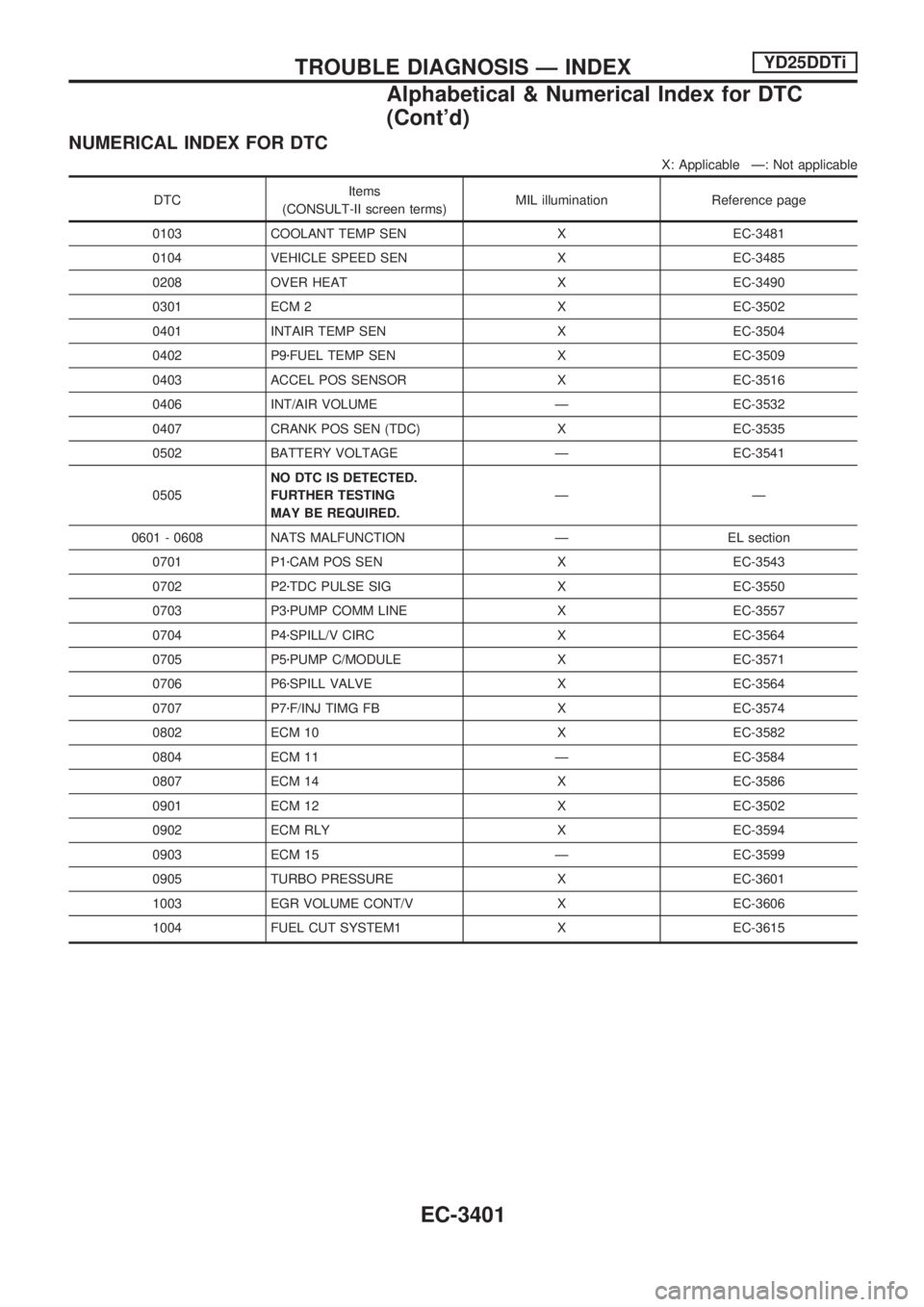
NUMERICAL INDEX FOR DTC
X: Applicable Ð: Not applicable
DTCItems
(CONSULT-II screen terms)MIL illumination Reference page
0103 COOLANT TEMP SEN X EC-3481
0104 VEHICLE SPEED SEN X EC-3485
0208 OVER HEAT X EC-3490
0301 ECM 2 X EC-3502
0401 INTAIR TEMP SEN X EC-3504
0402 P9zFUEL TEMP SEN X EC-3509
0403 ACCEL POS SENSOR X EC-3516
0406 INT/AIR VOLUME Ð EC-3532
0407 CRANK POS SEN (TDC) X EC-3535
0502 BATTERY VOLTAGE Ð EC-3541
0505NO DTC IS DETECTED.
FURTHER TESTING
MAY BE REQUIRED.ÐÐ
0601 - 0608 NATS MALFUNCTION Ð EL section
0701 P1zCAM POS SEN X EC-3543
0702 P2zTDC PULSE SIG X EC-3550
0703 P3zPUMP COMM LINE X EC-3557
0704 P4zSPILL/V CIRC X EC-3564
0705 P5zPUMP C/MODULE X EC-3571
0706 P6zSPILL VALVE X EC-3564
0707 P7zF/INJ TIMG FB X EC-3574
0802 ECM 10 X EC-3582
0804 ECM 11 Ð EC-3584
0807 ECM 14 X EC-3586
0901 ECM 12 X EC-3502
0902 ECM RLY X EC-3594
0903 ECM 15 Ð EC-3599
0905 TURBO PRESSURE X EC-3601
1003 EGR VOLUME CONT/V X EC-3606
1004 FUEL CUT SYSTEM1 X EC-3615
TROUBLE DIAGNOSIS Ð INDEXYD25DDTi
Alphabetical & Numerical Index for DTC
(Cont'd)
EC-3401
Page 429 of 1306
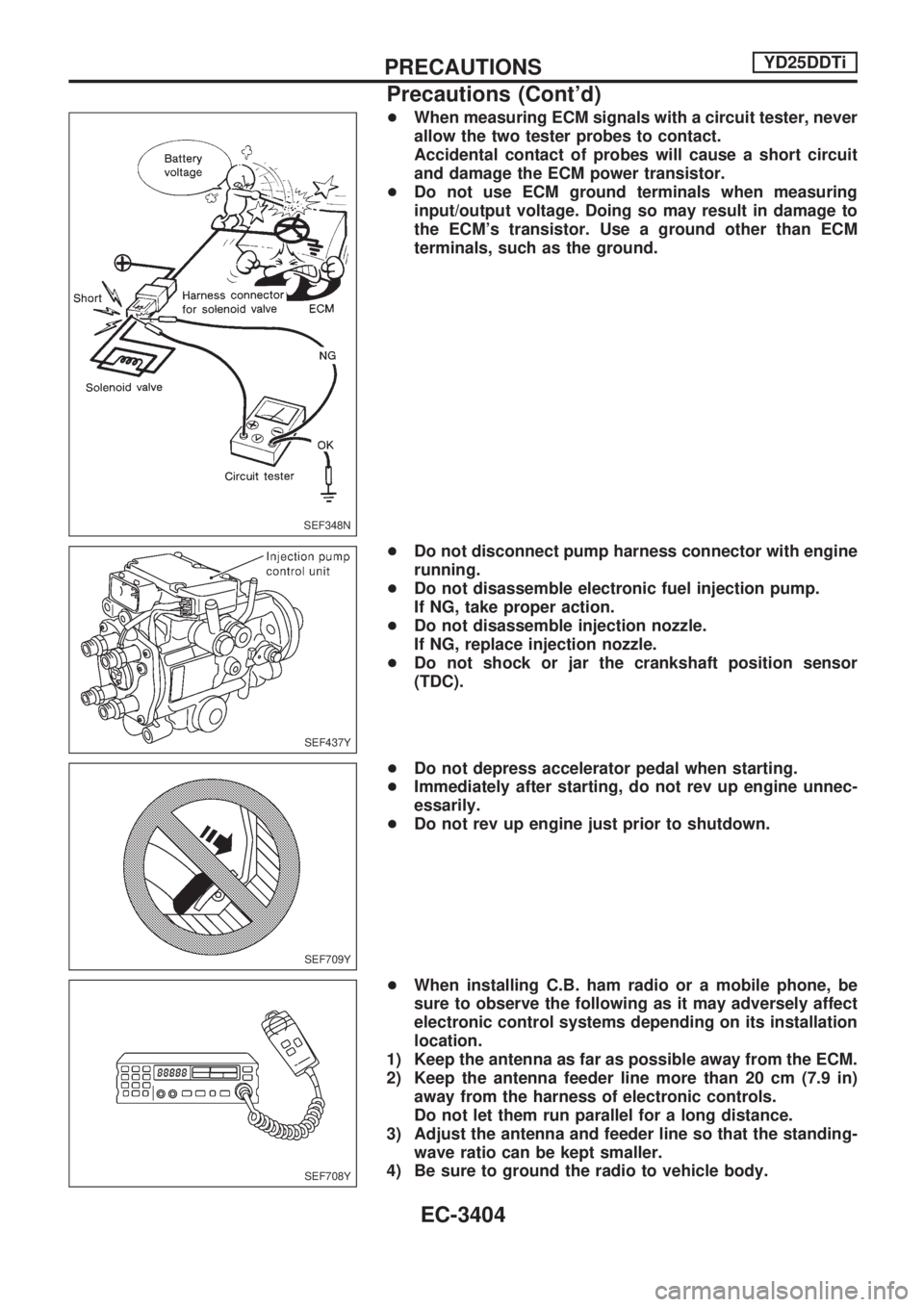
+When measuring ECM signals with a circuit tester, never
allow the two tester probes to contact.
Accidental contact of probes will cause a short circuit
and damage the ECM power transistor.
+Do not use ECM ground terminals when measuring
input/output voltage. Doing so may result in damage to
the ECM's transistor. Use a ground other than ECM
terminals, such as the ground.
+Do not disconnect pump harness connector with engine
running.
+Do not disassemble electronic fuel injection pump.
If NG, take proper action.
+Do not disassemble injection nozzle.
If NG, replace injection nozzle.
+Do not shock or jar the crankshaft position sensor
(TDC).
+Do not depress accelerator pedal when starting.
+Immediately after starting, do not rev up engine unnec-
essarily.
+Do not rev up engine just prior to shutdown.
+When installing C.B. ham radio or a mobile phone, be
sure to observe the following as it may adversely affect
electronic control systems depending on its installation
location.
1) Keep the antenna as far as possible away from the ECM.
2) Keep the antenna feeder line more than 20 cm (7.9 in)
away from the harness of electronic controls.
Do not let them run parallel for a long distance.
3) Adjust the antenna and feeder line so that the standing-
wave ratio can be kept smaller.
4) Be sure to ground the radio to vehicle body.
SEF348N
SEF437Y
SEF709Y
SEF708Y
PRECAUTIONSYD25DDTi
Precautions (Cont'd)
EC-3404
Page 435 of 1306
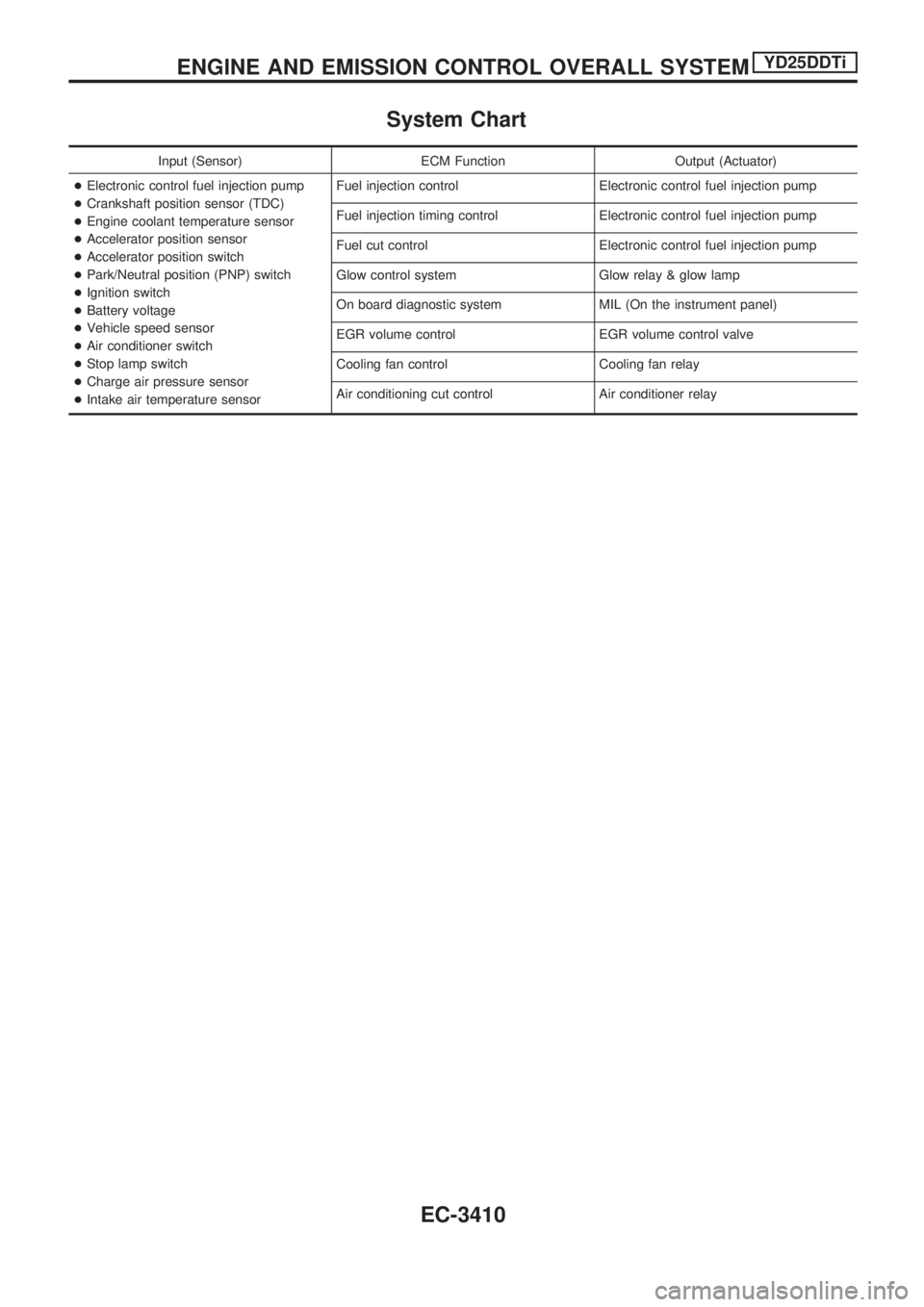
System Chart
Input (Sensor) ECM Function Output (Actuator)
+Electronic control fuel injection pump
+Crankshaft position sensor (TDC)
+Engine coolant temperature sensor
+Accelerator position sensor
+Accelerator position switch
+Park/Neutral position (PNP) switch
+Ignition switch
+Battery voltage
+Vehicle speed sensor
+Air conditioner switch
+Stop lamp switch
+Charge air pressure sensor
+Intake air temperature sensorFuel injection control Electronic control fuel injection pump
Fuel injection timing control Electronic control fuel injection pump
Fuel cut control Electronic control fuel injection pump
Glow control system Glow relay & glow lamp
On board diagnostic system MIL (On the instrument panel)
EGR volume control EGR volume control valve
Cooling fan control Cooling fan relay
Air conditioning cut control Air conditioner relay
ENGINE AND EMISSION CONTROL OVERALL SYSTEMYD25DDTi
EC-3410
Page 436 of 1306
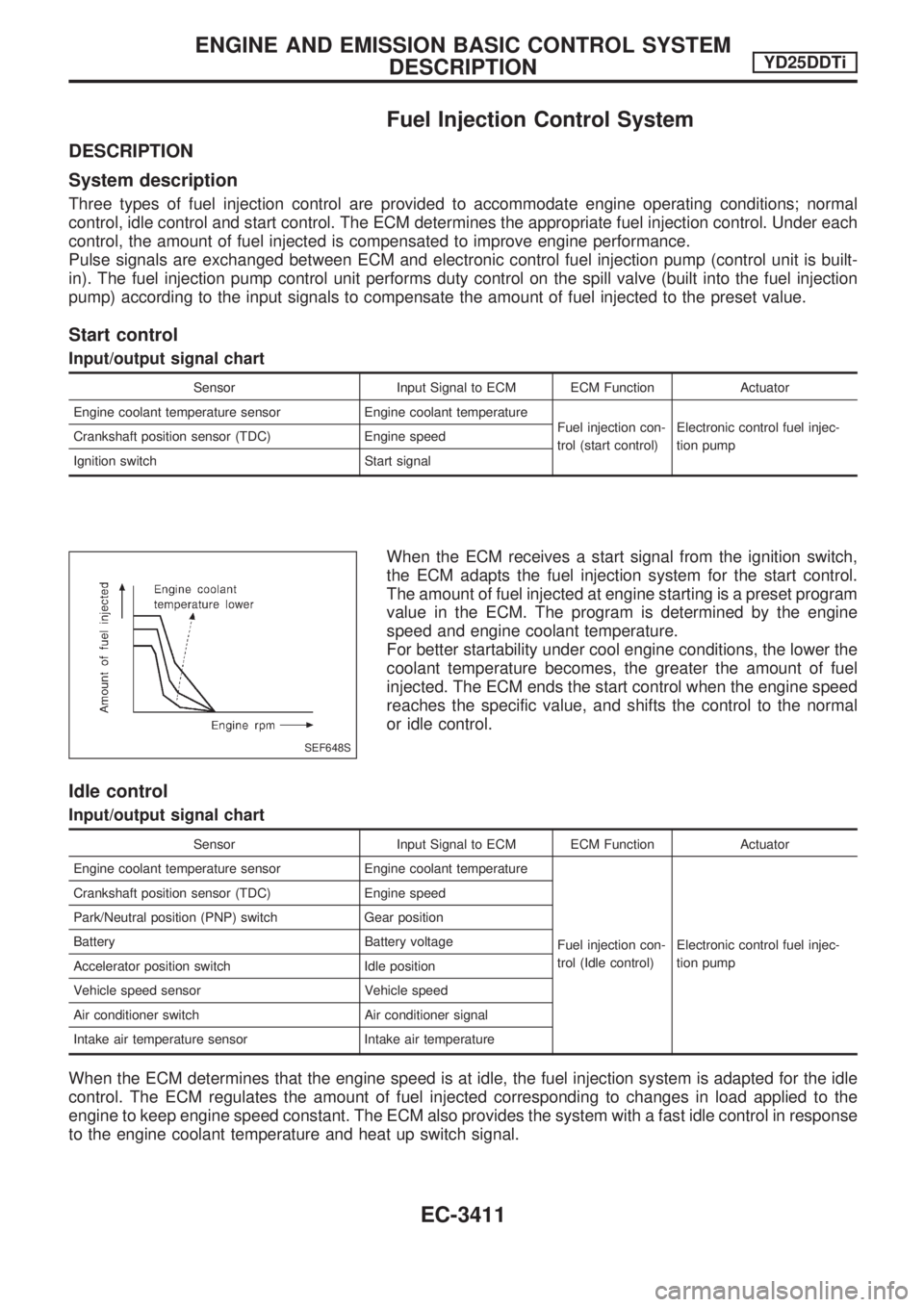
Fuel Injection Control System
DESCRIPTION
System description
Three types of fuel injection control are provided to accommodate engine operating conditions; normal
control, idle control and start control. The ECM determines the appropriate fuel injection control. Under each
control, the amount of fuel injected is compensated to improve engine performance.
Pulse signals are exchanged between ECM and electronic control fuel injection pump (control unit is built-
in). The fuel injection pump control unit performs duty control on the spill valve (built into the fuel injection
pump) according to the input signals to compensate the amount of fuel injected to the preset value.
Start control
Input/output signal chart
Sensor Input Signal to ECM ECM Function Actuator
Engine coolant temperature sensor Engine coolant temperature
Fuel injection con-
trol (start control)Electronic control fuel injec-
tion pump Crankshaft position sensor (TDC) Engine speed
Ignition switch Start signal
When the ECM receives a start signal from the ignition switch,
the ECM adapts the fuel injection system for the start control.
The amount of fuel injected at engine starting is a preset program
value in the ECM. The program is determined by the engine
speed and engine coolant temperature.
For better startability under cool engine conditions, the lower the
coolant temperature becomes, the greater the amount of fuel
injected. The ECM ends the start control when the engine speed
reaches the specific value, and shifts the control to the normal
or idle control.
Idle control
Input/output signal chart
Sensor Input Signal to ECM ECM Function Actuator
Engine coolant temperature sensor Engine coolant temperature
Fuel injection con-
trol (Idle control)Electronic control fuel injec-
tion pump Crankshaft position sensor (TDC) Engine speed
Park/Neutral position (PNP) switch Gear position
Battery Battery voltage
Accelerator position switch Idle position
Vehicle speed sensor Vehicle speed
Air conditioner switch Air conditioner signal
Intake air temperature sensor Intake air temperature
When the ECM determines that the engine speed is at idle, the fuel injection system is adapted for the idle
control. The ECM regulates the amount of fuel injected corresponding to changes in load applied to the
engine to keep engine speed constant. The ECM also provides the system with a fast idle control in response
to the engine coolant temperature and heat up switch signal.
SEF648S
ENGINE AND EMISSION BASIC CONTROL SYSTEM
DESCRIPTIONYD25DDTi
EC-3411
Page 437 of 1306
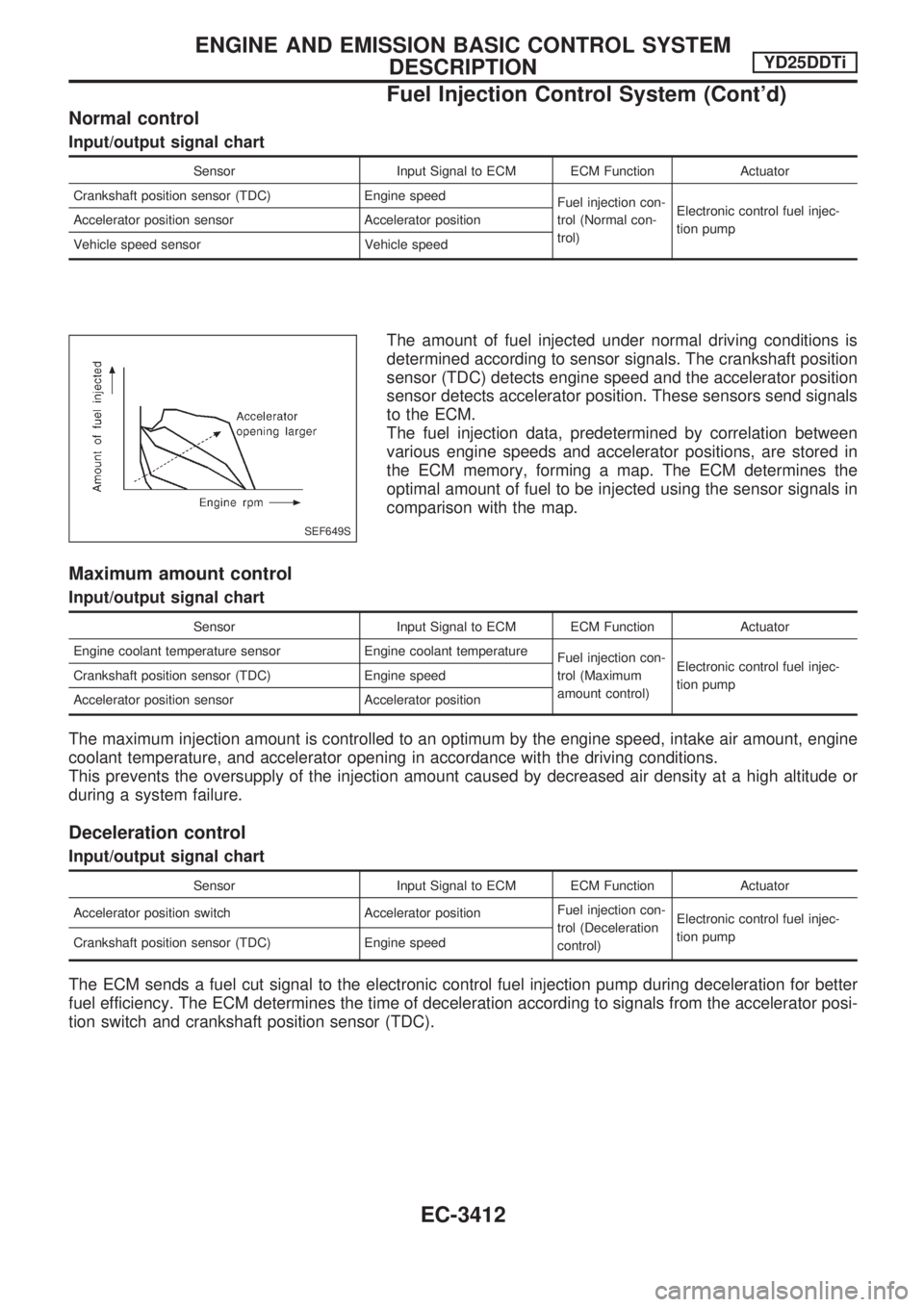
Normal control
Input/output signal chart
Sensor Input Signal to ECM ECM Function Actuator
Crankshaft position sensor (TDC) Engine speed
Fuel injection con-
trol (Normal con-
trol)Electronic control fuel injec-
tion pump Accelerator position sensor Accelerator position
Vehicle speed sensor Vehicle speed
The amount of fuel injected under normal driving conditions is
determined according to sensor signals. The crankshaft position
sensor (TDC) detects engine speed and the accelerator position
sensor detects accelerator position. These sensors send signals
to the ECM.
The fuel injection data, predetermined by correlation between
various engine speeds and accelerator positions, are stored in
the ECM memory, forming a map. The ECM determines the
optimal amount of fuel to be injected using the sensor signals in
comparison with the map.
Maximum amount control
Input/output signal chart
Sensor Input Signal to ECM ECM Function Actuator
Engine coolant temperature sensor Engine coolant temperature
Fuel injection con-
trol (Maximum
amount control)Electronic control fuel injec-
tion pump Crankshaft position sensor (TDC) Engine speed
Accelerator position sensor Accelerator position
The maximum injection amount is controlled to an optimum by the engine speed, intake air amount, engine
coolant temperature, and accelerator opening in accordance with the driving conditions.
This prevents the oversupply of the injection amount caused by decreased air density at a high altitude or
during a system failure.
Deceleration control
Input/output signal chart
Sensor Input Signal to ECM ECM Function Actuator
Accelerator position switch Accelerator positionFuel injection con-
trol (Deceleration
control)Electronic control fuel injec-
tion pump
Crankshaft position sensor (TDC) Engine speed
The ECM sends a fuel cut signal to the electronic control fuel injection pump during deceleration for better
fuel efficiency. The ECM determines the time of deceleration according to signals from the accelerator posi-
tion switch and crankshaft position sensor (TDC).
SEF649S
ENGINE AND EMISSION BASIC CONTROL SYSTEM
DESCRIPTIONYD25DDTi
Fuel Injection Control System (Cont'd)
EC-3412
Page 438 of 1306
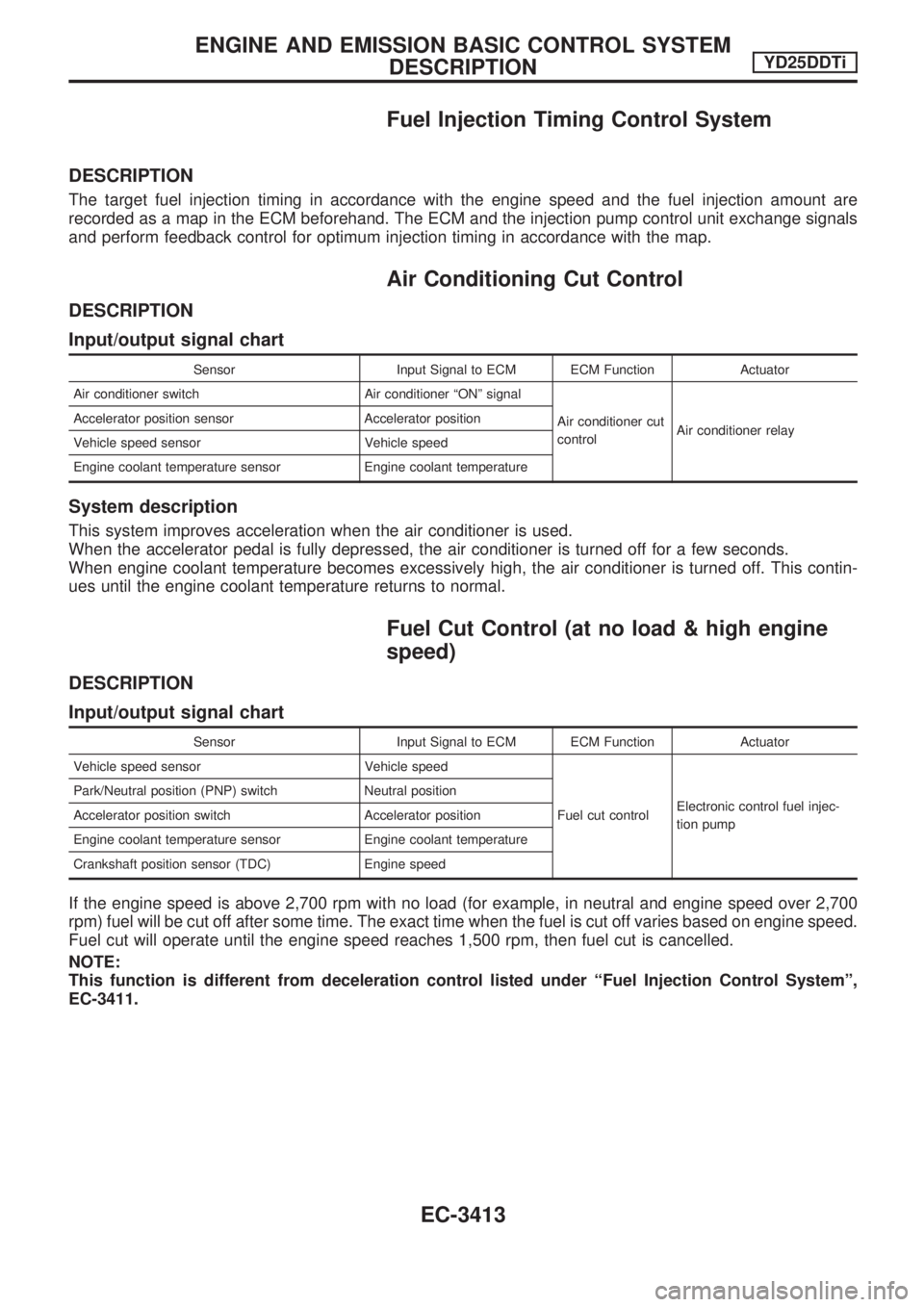
Fuel Injection Timing Control System
DESCRIPTION
The target fuel injection timing in accordance with the engine speed and the fuel injection amount are
recorded as a map in the ECM beforehand. The ECM and the injection pump control unit exchange signals
and perform feedback control for optimum injection timing in accordance with the map.
Air Conditioning Cut Control
DESCRIPTION
Input/output signal chart
Sensor Input Signal to ECM ECM Function Actuator
Air conditioner switch Air conditioner ªONº signal
Air conditioner cut
controlAir conditioner relay Accelerator position sensor Accelerator position
Vehicle speed sensor Vehicle speed
Engine coolant temperature sensor Engine coolant temperature
System description
This system improves acceleration when the air conditioner is used.
When the accelerator pedal is fully depressed, the air conditioner is turned off for a few seconds.
When engine coolant temperature becomes excessively high, the air conditioner is turned off. This contin-
ues until the engine coolant temperature returns to normal.
Fuel Cut Control (at no load & high engine
speed)
DESCRIPTION
Input/output signal chart
Sensor Input Signal to ECM ECM Function Actuator
Vehicle speed sensor Vehicle speed
Fuel cut controlElectronic control fuel injec-
tion pump Park/Neutral position (PNP) switch Neutral position
Accelerator position switch Accelerator position
Engine coolant temperature sensor Engine coolant temperature
Crankshaft position sensor (TDC) Engine speed
If the engine speed is above 2,700 rpm with no load (for example, in neutral and engine speed over 2,700
rpm) fuel will be cut off after some time. The exact time when the fuel is cut off varies based on engine speed.
Fuel cut will operate until the engine speed reaches 1,500 rpm, then fuel cut is cancelled.
NOTE:
This function is different from deceleration control listed under ªFuel Injection Control Systemº,
EC-3411.
ENGINE AND EMISSION BASIC CONTROL SYSTEM
DESCRIPTIONYD25DDTi
EC-3413
Page 452 of 1306
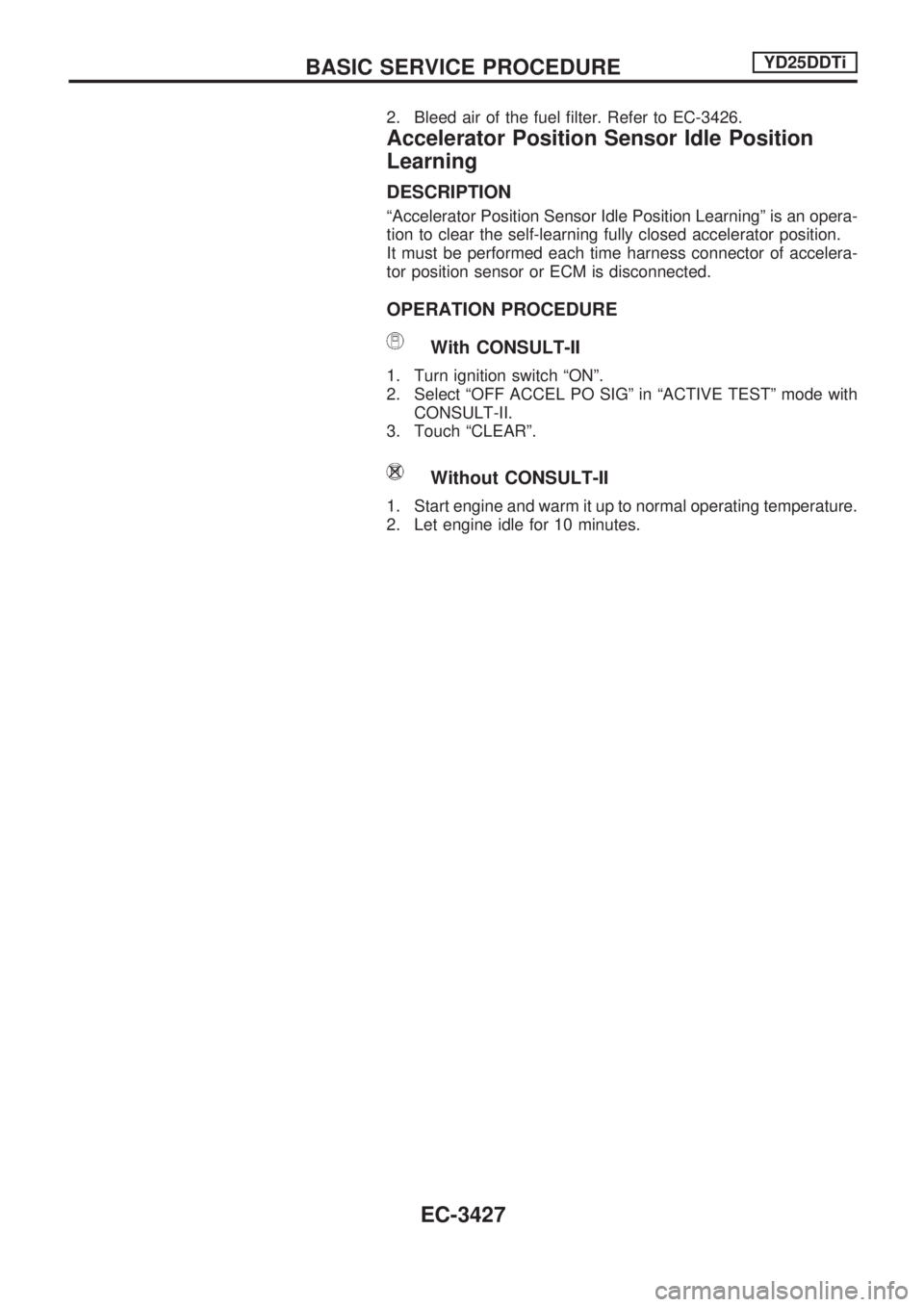
2. Bleed air of the fuel filter. Refer to EC-3426.
Accelerator Position Sensor Idle Position
Learning
DESCRIPTION
ªAccelerator Position Sensor Idle Position Learningº is an opera-
tion to clear the self-learning fully closed accelerator position.
It must be performed each time harness connector of accelera-
tor position sensor or ECM is disconnected.
OPERATION PROCEDURE
With CONSULT-II
1. Turn ignition switch ªONº.
2. Select ªOFF ACCEL PO SIGº in ªACTIVE TESTº mode with
CONSULT-II.
3. Touch ªCLEARº.
Without CONSULT-II
1. Start engine and warm it up to normal operating temperature.
2. Let engine idle for 10 minutes.
BASIC SERVICE PROCEDUREYD25DDTi
EC-3427
Page 460 of 1306
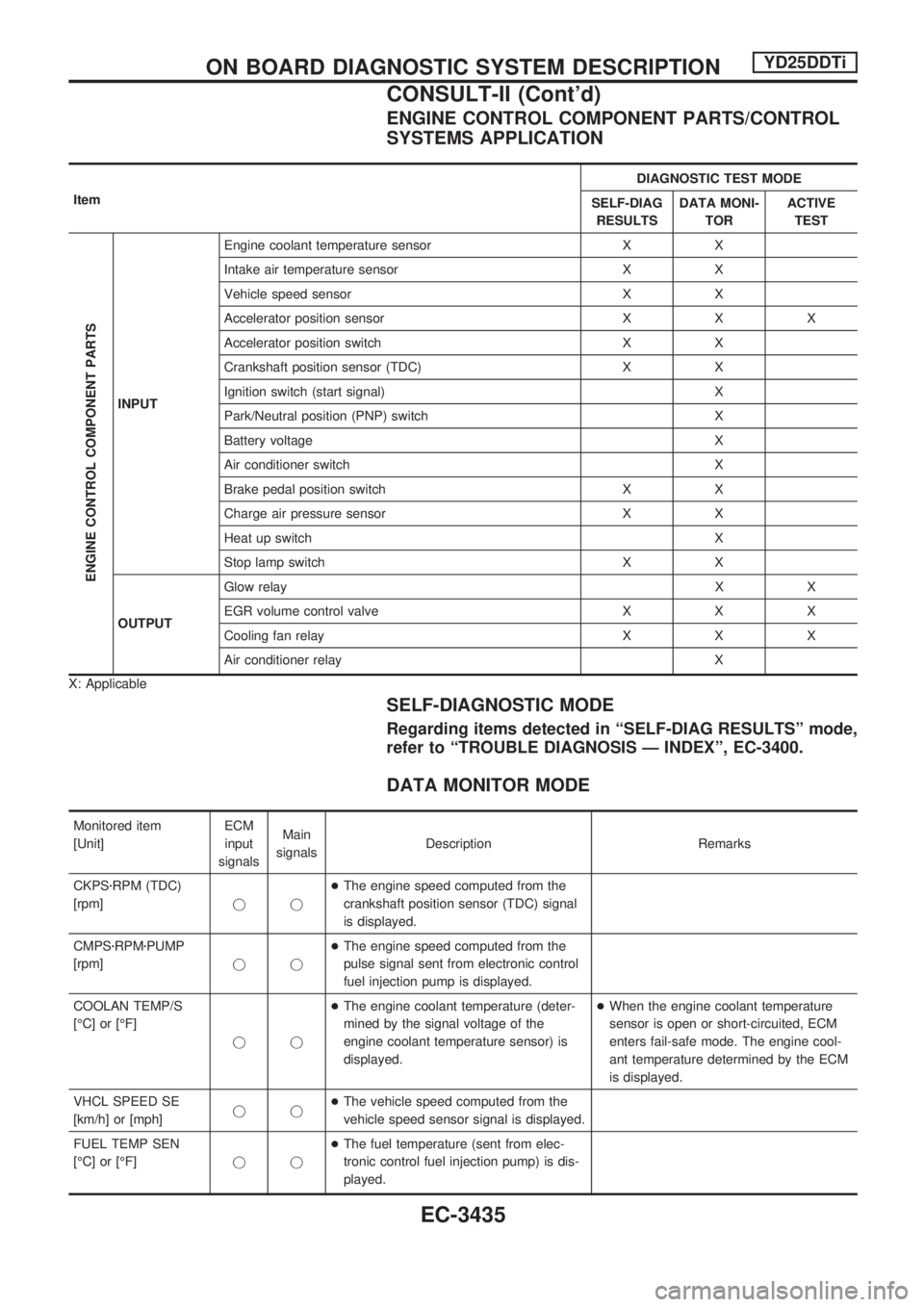
ENGINE CONTROL COMPONENT PARTS/CONTROL
SYSTEMS APPLICATION
ItemDIAGNOSTIC TEST MODE
SELF-DIAG
RESULTSDATA MONI-
TORACTIVE
TEST
ENGINE CONTROL COMPONENT PARTS
INPUTEngine coolant temperature sensor X X
Intake air temperature sensor X X
Vehicle speed sensor X X
Accelerator position sensor X X X
Accelerator position switch X X
Crankshaft position sensor (TDC) X X
Ignition switch (start signal) X
Park/Neutral position (PNP) switch X
Battery voltage X
Air conditioner switch X
Brake pedal position switch X X
Charge air pressure sensor X X
Heat up switch X
Stop lamp switch X X
OUTPUTGlow relayXX
EGR volume control valve X X X
Cooling fan relay X X X
Air conditioner relay X
X: Applicable
SELF-DIAGNOSTIC MODE
Regarding items detected in ªSELF-DIAG RESULTSº mode,
refer to ªTROUBLE DIAGNOSIS Ð INDEXº, EC-3400.
DATA MONITOR MODE
Monitored item
[Unit]ECM
input
signalsMain
signalsDescription Remarks
CKPSzRPM (TDC)
[rpm]jj+The engine speed computed from the
crankshaft position sensor (TDC) signal
is displayed.
CMPSzRPMzPUMP
[rpm]jj+The engine speed computed from the
pulse signal sent from electronic control
fuel injection pump is displayed.
COOLAN TEMP/S
[ÉC] or [ÉF]
jj+The engine coolant temperature (deter-
mined by the signal voltage of the
engine coolant temperature sensor) is
displayed.+When the engine coolant temperature
sensor is open or short-circuited, ECM
enters fail-safe mode. The engine cool-
ant temperature determined by the ECM
is displayed.
VHCL SPEED SE
[km/h] or [mph]jj+The vehicle speed computed from the
vehicle speed sensor signal is displayed.
FUEL TEMP SEN
[ÉC] or [ÉF]jj+The fuel temperature (sent from elec-
tronic control fuel injection pump) is dis-
played.
ON BOARD DIAGNOSTIC SYSTEM DESCRIPTIONYD25DDTi
CONSULT-II (Cont'd)
EC-3435